KEIEI TO KEIZAI, Vol.81 No.l, June 2001 Bank-firm Relationship in Bangladesh:
Present State and Some Lessons
Sarwar Uddin Ahmed Atsuyuki Fukaura
Abstract
The objective of this study is to critically analyze the banking system of Bangladesh with special aim of tracing out the major banking problems of the economy underneath and suggest remedies to solve the problems.
In doing so the study revealed that huge loan-default, inadequacy of capital, higher transaction costs, lack of long-term financing and lack of close bank-firm relationship are the key problems of the banking sector of Bangladesh. Among these problems bank-firm relationship has been singled out as the key problem for discussion. Accordingly, it has been observed that bank-firm relationship in Bangladesh is mainly limited to financing aspects. The study concludes that, making bank-firm relationship closer can be beneficial for both the bank and the firm. It
can work as remedy towards solving problems such as loan default; in- formation asymmetry and finally interest-spread problem for the banks.
Also for the client firms, closer bank-firm relationship can reduce transaction costs, delay in loan decisions, and interest expense of bor- rowings. Finally, the study suggests that, by following Japanese ex- perience of loan syndication in the pattern of 'reciprocal delegated monitoring', supply of management resources and stockholding of firms by banks, can also become effective for the banking system of Ban- gladesh to promote close bank-firm relationship.
Keywords: Bank-firm relationship, Corporate governance, Loan syndica- tion, Reciprocal delegated monitoring
27
28 KEIEI TO KEIZAI
1. Introduction
Among the South Asian countries, Bangladesh is one of the leading countries to commence economic reform programs under the guidance of international development agencies. In between the reform agendas, privatization of a large number of nationalized enterprises including banks and insurance companies, making the price of credit closer to that of deter- mining by the interaction of market forces, a drastic reduction of the level of protection and wide reform of the trade regime and so on have been under- way (Ahmed, 1999). But unfortunately, all these reforms could not produce any major impact in the economic development of the country. The annual GDP growth rate is around four percent (4.4 percent in 1999), as it was also before economic reforms. Since its independence till now, the economy of Bangladesh is characterized by low level of saving (21. 1 percent in 1999) and investment (22.5 percent in 1999), underdeveloped financial market, and agri-based economy (figure 1). Social indicators ·of development of
Figure 1: Regional Comparision of Indicators on Financial Sector, Saving and Investment
40 50
Percent of GOP
60
.Broad Money II National Savings ~ Investment
Source: Derived from IMF Staff Country Report No. 98/130, December 1998.
Bank-firm Relationship in Bangladesh:
Present State and Some Lessons 29
Bangladesh have progressed at a far slower rate than that of developing Asia including South Asia (Khan, 1995).
The banking sub-sector is also surrounded by the problems of non-per- forming loans (43 percent of tota110ans on June 1999), capital inadequacy, provisioning shortfall etc. And as the banking sector dominates the financial sector in Bangladesh, accounting for about 97 percent of the market in terms of assets (IMF, 2000) ; this sector is making the entire financial sector vulnerable to economic crisis. As a result, it is worthwhile to look into the sector more critically, to find more fundamental problems, if any, which are making this sector performing so bad, and also making the reform activities ineffective.
It is believed by many scholars and policy makers that the Japanese ex- perience in the post-Meiji Restoration period is relevant and useful in the context of Bangladesh (Farouk, 1974). Both Japanese and Bangladeshi firms are highly levered and the banking sector is the main source of finance.
Historically, both Bangladesh and Japan have furnished only a fraction of total financing through issue of corporate securities (Ahmed, 1997). In the milieu of the scenario portrayed above, this study is a modest attempt to identify the actual problems attributable to the deterring conditions in the banking sector of Bangladesh and to see whether any relevance can be drawn from the experience of Japanese banking system. Although the ex- perience of one country may be irrelevant for another country because of differences in socio-economic background, the study of comparative finan- cial system is useful as it might point out the merits and demerits of different system.
30 KElEl TO KElZAl
2. Objectives of the Study
The main objective of the study is to find out the major problems in the banking sector of Bangladesh and to suggest remedies by analyzing and comparing with the banking system of other countries. In doing so, the focus will be given mainly on Japanese banking system. And the more specific objectives of the study are as follows:
1. To critically review the problems of the banking sector of Bangladesh and to single out one of them.
2. To examine the nature and importance of the selected problem in the banking sector of Bangladesh.
3. To suggest remedies for solving the problem by drawing relevance form the Japanese banking system.
4. Finally, to suggest overall lessons from the experience of the Japanese banking system, if and when applicable.
3. Literature Review
As in most of the developing countries, the banking sector is so dominant in the financial sector of the country that, their performance in a way deter- mines the economic development of the country. But unfortunately in the case of Bangladesh this sector has failed to play its due role. The mammoth percentage of non-performing loans, capital inadequacy and large interest spread are some of the few problems. As a first step to trace out the main problems of the banking sector let us review some of the recent literatures.
Bank-firm Relationship in Bangladesh:
Present State and Some Lessons 31
3. 1 Causes and Remedies for Loan Default:
Alam and lahan (1999) argues that, loan default in public sector banks occurred mainly because of government directed loss financing of the public sector enterprises and for use of bank credit mechanism on political con- siderations. On the other hand, loan default occurred in private sector banks due to enhancement of bank lending to satisfy sponsor directors interests and also the burden of inherited bad loan since the period of de-nationali- zation. Lack of proper professional exercises in respect of disbursement, monitoring and supervision of credit also increased the problem in manifold.
They suggested that, the directors or their concerned banks might be de- barred from obtaining loans from the same institutions. An effective on-site and off-site supervision system should be in place in the scheduled banks and the central bank to provide early signal to the banks, before a particular loan becomes classified.
3. 2 Actions Needed for Capital Adequacy:
Another paper by Choudhury and Moral (1999) examined the FSRP (Financial Sector Reform Program) restructuring measures during 1990- 1996 and their impact; followed by BRCI CBRP measures and their probable impact on the banking system. It has been observed that the FSRP res- tructuring measures like interest rate deregulation, discontinuation of directed credit etc., were not properly matched with prudential regulation and supervision til11996. As a result banking restructuring measures under FSRP could not bring back financial discipline, and improve operational ef- ficiency of the banking system rather it experienced deterioration of banking problems. They recommended that, through the restructuring process capi- tal solvency of the banking institutions should be achieved. If injection of
32 KEIEI TO' KEIZAI
new capital is not possible, then· the banks should· be allowed to raise new capital from the security market.
3.3 Solutions for Capital Inadequacy:
According to Majid (1998), capital inadequacy should be identified as one of the major problems of the banking sector. The bank restructuring process should be aimed at achieving capital adequacy in the banking sector which is yet to be achieved. Finally this paper concluded that, bank should be allowed to raise capital form the security market, if needed.
3.4 Distribution of Credit and Loan Default:
In another paper regarding bank restructuring, Chaudhury (1999) observed that, the vast majority of private domestic banks have loan portfolios cen- tered in loans to insiders, stockholders, influential businessman and politi- cians who have defaulted on their obligations and are either unable or un- willing to repay their debts. Also the new method of capital requirement calculation has revealed that, almost all the banks suffer from the capital inadequacy and provisioning shortfall. He recommended that, for developing the asset utilization ratio, portfolio of asset structure should be rearranged by removing the non-earning assets or transforming the non-earning assets into the earning one.
3.5 Lack of Political Commitment:
Choudhuri, Choudhuri, Moral and Banerjee (1995) pointed out that, the results so far (during 1990-95) achieved out of bank reform measures are not very encouraging. The bankers and bank management are yet to be guided adequately by market forces. They suggested that, political com-
Bank-firm Relationship in Bangladesh:
Present State and Some Lessons 33
mitment on the part of the government in implementing reform measures consistently and uniformly as well as non-interference in decision making of the banks are essential.
3. 6 Asian Financial Crisis and Bangladeshi Banking Sector:
Hassan, M. Kabir (1999) in his paper regarding the influence of Asian financial crisis on the economy of Bangladesh observed that the financial sector of the country is shaky as compared to the other East Asian countries.
But if crisis appears, it will be due to its own domestic reasons and not in response to the Asian situation. For the financial sector his recommendation was to purse vigorous reforms in banking sector and capital market.
3.7 Absence of Close Bank-firm Relationship:
Ahmed (1997), who is one of the few researchers comparing the Japanese and Bangladeshi financial systems commented that, under the present practice in Bangladesh, the banks give advice to customers as outsiders rather than insiders and have tended to keep away from firms facing finan- cial constraints. Even banks may compel a firm for premature liquidation to protect its own interest. The commercial banks are reluctant to go for long-term investments, such as loan. And an examination of the statements of the individual banks reveals very small-holding of shares. According to the author, the Japanese banking system provides a different nature of the bank-firm relationship.
Although Bangladeshi firms are highly levered, the bank-firm relationship is not so close as that of Japan. If the bank-firm relationship is promoted to be closer, it may have its likely positive impact on the prevailing 'default cul- ture' of the borrowing firms. Some examples are also presented, but this
34 KEIEI TO KEIZAI
Table 1: Current Banking Problems of Bangladesh and Observations of Related Research Papers Summarized
Banking Problems Identified A. Loan Default
B.Capital Inadequacy
C. Reluctance to provide long-term finace D. Bank-firm relationship
Comments of the Related Research Papers 1. According to Alam and J ahan (1999), currently the magnitude of loan default is quite enormous in the context of Bangladesh (The classified loan as a percentage of total outstanding loan was 33% and 35% on the part of the NCBs and PCBs respectively during 1990-1996), which is a threat for the existence of the banking sector.
Recommendations Offered for Solving Problems
I. I The directors or their concerned banks may be debarred from obtaining loans from the same institutions.
I. 2 An effective on-site and off-site su- pervision system should be in place in the scheduled banks and the central bank to provide early signal to the banks, before a particular loan becomes classified.
1. 3 Waiver of interest or loan forgiveness culture often practiced by the government should be stopped.
2. Also Choudhury (1999) pointed that, the 2. I For developing the asset utilization most disturbing features of the loan classifi- ratio, portfolio of asset structure should be cation scenario relates to preponderance of rearranged by removing the non-earning bad loans for all types of banks- about 72% assets or transforming the non-earning of total classified loans were categorized as assets into the earning one.
bad loans' as on June 30, 1997.
1. According to Choudhury and Moral (1999), solvency of the banking system was the prime objective of the restructuring process undertaken so far. But unfortunately, still a number of NCBs and PCBs are observed to be undercapitalized. According to new re- quirement, capital shortfall of the NCBs and PCBs increased to 30% and 20% respectively as on December 1996.
I. I Through the restructuring process capital solvency of the banking institutions should be achieved. If injection of new capital is not possible, then the banks should be allowed to raise new capital from the security market.
2. Majid (1998) observes that achieving 2.1 If needed banks should be allowed to capital solvency should be stressed through raise capital from the security market out the restructuring process, which is still
not been achieved.
Also Ahmed (1997) observed that the com- Like in Japan commercial banks should mercial banks are reluctant to go for long also provide long-term financing.
term investments, such as loan. And an ex- amination of the statements of the individual banks reveals very small holding of shares.
Ahmed (1997), who is one of the few Banks should operate as a quasi-residual researchers comparing the Japanese and risk bearer and should establish close Bangladeshi financial systems commented bank-firm relationship to have a positive that, under the present practice in Ban- impact on the prevailing 'default culture' gladesh, the banks give advice to customers of the borrowing firms.
as outsiders rather than insiders and have tended to keep away from firms facing financial constraints. Even banks may com- pel a firm for premature liquidation to pro- tect its own interest. According to the author, the Japanese banking system pro- vides a different nature of the bank-firm relationship. Some examples are also presented, but this area have not been deeply covered, as the main focus of the paper was on the capital market of Bangladesh.
Bank-firm Relationship in Bangladesh:
Present State and Some Lessons 35
area has not been deeply covered by the author, as his key focus of the paper was on the capital market of Bangladesh.
By taking this literature survey as a background, for convenience of dis- cussion we can summarize the important banking problems so far identified in Table 1, including remedies suggested by different authors.
From the aforesaid literature review, we can find that the problems of loan default, capital inadequacy and financing concentration have been well dis- cussed and identified by different researchers. But on the other hand, regarding the problem of bank-firm relationship, there have not been so much discussions and studies. There might be two reasons for this: firstly, bank-firm relationship is not that much important for the banking system of Bangladesh as there are alternative sources of fund e.g, capital market. Se- condly, enough data sources are not available to estimate bank-firm relationship in the banking sector of Bangladesh.
The first case cannot be true, because in a bank dominated financial system, bank-firm relationship plays and played important role in the development of a sound banking system. Specially, for a country like Bangladesh where capital market is underdeveloped, industries rely heavily on the indirect finance of the banking sector for meeting their fund requirements. This de- pendence on the banking sector rules out the first argument. The second argument may be true, as research papers discussing bank-firm relationship are very few.
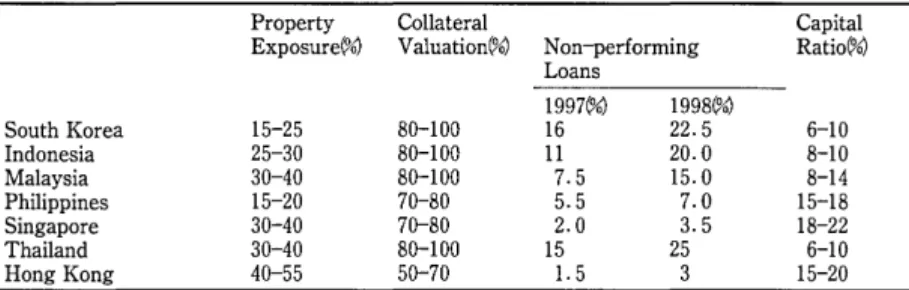
Also if we look at the other East Asian countries (table 2), they are also having non-performing loans, financing concentration and capital inade-
36 KElEl TO KElZAl
Table 2 : Banking System Exposure to Risk (% of assets at the end of 1997)
South Korea Indonesia Malaysia Philippines Singapore Thailand Hong Kong
Property Collateral
Exposure(%) Valuation(%) N on-performing Loans 15-25
25-30 30-40 15-20 30-40 30-40 40-55
80-100 80-100 80-100 70-80 70-80 80-100 50-70
1997(%) 16 11 7.5 5.5 2.0 15
1.5
1998(%) 22.5 20.0 15.0 7.0 3.5 25
3
Capital Ratio(%)
6-10 8-10 8-14 15-18 18-22 6-10 15-20 Sources: ]. P Morgan 'Asian Financial Markets', January 1998 and Corsetti, Pesenti and Roubini
(J 999, table 22).
quacy problems. For example, non-performing loans were as high as 22.5 percent and 20 percent in South Korea and Indonesia respectively in 1998.
But in spite of these, their economic condition is much better than Ban- gladesh. Thus at this part of our analysis, we would like to point out that, perhaps not bad loans or capital inadequacy, rather sound bank-firm relationship might be the prime factor that should be stressed for developing healthy banking system of Bangladesh. Accordingly from this part of our discussion we would like to concentrate on bank-firm relationship and con- tinue our discussion on this particular aspect.
4. Concepts of Bank-tirm relationship
4. 1 Definition
A. Conventional Definition:
The relationship between banks and firms varies significantly in degree of breadth and intensity depending on the status of both the firm and the bank.
Further, it is dynamic and flexible, as both banks and firms seek more benefits (Horiuchi, 1994). In Japan, where the size of the banking sector to GNP is the largest, we can find the most typical and conventional nature of
Bank-firm Relationship in Bangladesh:
Present State and Some Lessons 37
bank-firm relationship. This typical kind of relationship is also interchan- geably referred to as main-bank relationship. The traditional academic definition of such relationship is that, it is a long-term relationship between firm and a particular bank from which the firm obtains its largest share of borrowings (Aoki et al.. 1994). But for the present day concept of the bank-firm relationship, this definition is too much restrictive. Nowadays the provision of bank credit is regarded as one of several aspects of the relationship between a bank and the firm, although traditionally it has been a key one.
B. Current Definition:
Gradually, the aspects of bank-firm relationship have been broadened in many dimensions and are not confined to loans only. Let us examine some of the latest developments. According to Das and Nanda (1999), bank-firm relationship can be categorized on the basis of bank functions, which are: (0
relationship banking and (i0 deal/transaction banking.
In relationship banking, tasks are performed via a long-term relationship (relationship specific transaction). Here the degree of relationship specific information between client and bank required to render the service. Thus in relationship banking the degree of relationship specificity of information is high, and the value of throughput of the relationship is easily verifiable by a third party. Whereas in deal! transaction banking tasks are performed through one-off transaction type relationship (deal specific transaction). In this kind of banking, the degree of relationship specificity of information is lower, and the value of the deal to the client is less readily measurable.
Das and Nanda (1999), modelled relationship banking as a two period game with no discounting.
38 KEIEI TO KEIZAI
Stage 1 Stage 2
Bank develop resources Tasks are performed
In period 1, bank invests in developing resources, and in period 2, they use these resources to perform tasks for the client. For example, if the client approaches the bank for long-term funding of its working capital needs, the bank invests in client-specific activities such as credit analysis, due diligence and loan structuring (first period), followed by the bank providing the client with the revolving facility (second. period) .
In this paper we will take relationship banking as the definition of bank-firm relationship. Because, commercial banking activities which are more com- mon in Bangladesh, leads to longer-term bank-firm relationship with ex- -post payoffs. While deal! transaction banking activities lead to short-term relationships with ex-ante payments and are known as investment banking
(Das and Nanda,1999).
4.2 The Importance of Bank-firm Relationship:
The importance of this kind of bank-firm relationship has been emphasized in several relevant literatures. The importance of long-term commitment in the bank-firm relationship is stressed by Mayer (1988), Hellwing (1989) and Boot and Thakor (1994), just to name a selection of the extant relationship lending literature.
Bank-firm Relationship in Bangladesh:
Present State and Some Lessons 39
Asymmetric information hinders efficient functioning of the financial system and results in significant financial contracting problems between borrowers and lenders CJ.Cai et al. 1999). As complete and state-contingent contracts are not feasible in a world of asymmetric information, intermediaries may restore efficiency through the use of relationship lending (Elsas and Krah- nen,1998). In particular, a bank is able to offer a technology for low cost renegotiations of debt contracts: " ... by close and continued interac- tion, a firm may provide a lender with sufficient information about, and a voice in, the firm's affairs so as to lower the cost of and increase the avail- ability of credit (Peterson and Rajan, 1995, P-5). Here, private information helps to establish commitment by the lender vis-a-vis the borrower. The resulting optional contract allows for inter-temporal arrangements, lowering aggregate financing costs and reducing credit rationing (see Greenbaum et al., 1989; Sharpe, 1990; Fischer, 1990; Boot and Thakor, 1994; Petersen and Rajan, 1995).
In Bank-firm relationship not only the length but also the volume of trans- actions are important. As Cole (1998 P-962) found that firms with multiple sources of financial services are less likely to receive credit, in support of the theory that the private information about a firm generated by a financial institution is less valuable when the firm deals with multiple sources of financial services. Also bank-firm relationship has significant positive ex- ternalities. For example, Fama (1985) argues that public debtholders can free ride on banks' monitoring services. In other words, the information production and control that results from bank lending relations improves the financial contracting environment for the firm's other public debtholders.
Thus, the structure of debt contracts between a firm and outside debt
40 KEIEI TO KEIZAI
providers is affected by the structure of the bank-firm relationships.
4.3 Monitoring and Bank-firm Relationship:
Bank-firm relationship and corporate governance are closely interrelated.
One can define corporate governance as the set of rules and institutions that assure those who finance a firm of an adequate return on their investment
(Shleifer and Vishny, 1995).
The literature generally treats the bank's function as analogous to the shareholders' (Ciocca, 1997). The banks also have an interest in their cus- tomers' management, in that they have provided substantial resources and thus need to prevent imprudent behavior by the borrower firms. The banks have the tools for forceful intervention behavior on their debtor firms: the threat not to renew credit and to sue for bankruptcy in case of default. To carry the analogy further, the intensity of the banking system's monitoring of a firm may be determined by the structure of its credit relationships.
Monitoring is costly, requiring the acquisition and assessment of information on borrower's behavior. When lenders are numerous, this information takes on the nature of public good: no one has an incentive for monitoring, because while the costs would be borne by just one lender, the benefits would be enjoyed by the other, inactive lenders as well.
4.4 The case of USA, Japan and Germany:
A considerable number of evidence on the role of banks as monitors comes from the US, Japan and Germany (e.g. Kaplan and Minton, 1994; Roe, 1994; and Elsas and Erahnen, 1998; among others). These countries provide good examples of extreme cases of corporate governance and bank-firm relation-
Bank-firm Relationship in Bangladesh:
Present State and Some Lessons 41
ship. Us firms tend to rely on anonymous investors more heavily than firms in other countries.1 Due to constraints imposed by regulatory barriers (Glass-Steagall Banking Act) imply that the banks cannot exercise close monitoring; in fact the objective of such legislation is that the banks should not have a significant influence over a client firm's decisions (Ocana, 1999). But the situation is different for Japanese firms. In the case of Japanese firms the main control over mangers often comes not from large shareholders, but from the so-called "main bank", which is simultaneously a large shareholder and the principal lender. Besides, Japanese firms depend more on debt than on issuing stocks. Thus, it is often observed that the bank has controlling power over the firm even though it is not a large stockholder (Ahmed, 1999). Also in Germany close connection between industry and their major banks, or housebanks, is partly credited with some industriali- zation success in the late 19th century.2 Tilly (1989) reports results on the contribution of German universal banks to industrial investment in large corporations. His findings support the view that house banks play an im- portant, and largely positive, role in the process of corporate control, and of industry-wide merger activities.3 Also in Germany bank-firm relationship
1) Among financial institutions it is only US insurance firms and pension and mutual funds which are comparatively important shareholders; in particular, banks' holdings are es- pecially small (0.3% in 1995). By contrast, in Japan the ownership of exchange-listed firms by banks is very important (26.7% in 1995) [Ocana, 1999, P-1580].
2) In Germany housebank is regarded as the premier lender of a firm, being equipped with more relevant, and more timely information than any "normal", non-housebank institu- tion. Furthermore, a housebank is more committed to its client, enlarging their role as financier if the firm faces sudden and temporary difficulties (Elsas and Krahnen, 1998, P- 1284).
3) In other OECD member countries such as Germany (OECD, 1995; Cable, 1985), banks also seem to have traditionally played a greater monitoring role.
42 KEIEI TO KEIZAI
takes a closer form than are in market-oriented systems. This includes:
ownership of equity in a borrowing firm; bank personnel serving on a client's board; voting custodial shares; and serving as exclusive provider of funds and other financial services to a firm, e.g., house bank (Baums, 1994). In general, in the countries where the corporate governance is based on internal mechanisms, the role of the bank is more relevant than those based on ex- ternal control (Gracia-Marco and Ocana, 1999).
5. Nature of Bank-tirm Relationship in Bangladesh
5. 1 Comparative Characteristics of the Banking System of Bangladesh:
If we compare, US, Japan and Germany are developed countries with large, liquid and developed capital markets. The case of Bangladesh is entirely different. For the purpose of comparison, it stands more close to Japan and Germany than US:
Holding of Stakes. Bangladeshi banks hold large stakes in some sectors but their role in disciplining management and monitoring performance does not seem to be as important as it is in Japan or Germany,
Capital Market. The Bangladeshi capital market is very much underdeve- loped than the Japanese, German or American markets. And it is very difficult for firms to raise fund from through the issue of bond and share. As a result, bank loans are their major source of external finance.
Ownership Structure: The ownership structure of the Bangladeshi firms is somewhat similar to the structure found in many European and Japanese firms, in the sense that the separation of ownership and management is not as radical as in the US.
Agency Problem: The ownership of Bangladeshi firms is very concentrated
Bank-firm Relationship in Bangladesh:
Present State and Some Lessons 43
and the control group can exercise a close vigilance over the management behavior and mitigate the agency problem. Thus in case of Bangladesh, we should not be concerned about the implication of a separation between ownership and control resulting from limited shareholding concentration, but on the implications for efficiency of the nature of the control group, in our case, the banks.
Accordingly we can conclude that, the role of monitoring and control by banks is also important for Bangladesh as it is in Japan and Germany for similarities in the areas of - dominance of the banking sector as a source of fund, greater stake of the banking sector, concentrated ownership structure etc. On the other hand, for US, monitoring by banks is less important be- cause of separation of ownership and control, easy access to capital market and above all for restrictions imposed by regulatory barriers (Glass-Steagall Banking Act) .
5.2 Aspects of Bank-firm Relationship in Bangladesh:
According to Aoki, Patrick and Sheard (1995), there are five main aspects of bank-firm relationship, such as, bank loans; bond issue related services;
shareholding; payment settlement account; and supply of management and information resources. Also Baums, 1994, in explaining the nature of bank-firm relationship in Germany mentioned about several aspects of relationship between the bank and the firm, which include: ownership of equity in a borrowing firm; bank personnel serving on a client's board; voting custodial shares; and serving as exclusive provider of funds and other financial services to a firm (house bank) . We can reclassify these aspects of relationship into two broad categories (flow chart l).
44 KEIEI TO KEIZAI
Flow Chart 1: Aspects of Bank-firm Relationship
Aspects of Bank·firm Relationship
•
I•
Financing Aspect Corporate Monitoring and Governance Aspect
1 1
• Bank Loans • Stockholding
• Bond-issue Related • Settlement of Accounts
Services
•
Supply of ManagementInformation and Resources.
As shown in the flow chart 1, financing aspect refer to bank loans and bond issue related services, of which bank loan has been traditionally the key one.
While settlement accounts, stockholding and supply of management resources are the monitoring and governance aspect of the relationship. In the eyes of capital market participants and regulators, bank is expected to monitor the firm and intervene when things go wrong.
In contrast bank-firm relationship in Bangladesh takes in a conventional form, where bank loan is the main link between the bank and the firm. The monitoring and governance aspect of the relationship, such as stockholding and dispatch of management personnel are not seen. Banks give advice to firms as outsiders and remained away form firms facing financial difficulties.
Thus, financing aspect of the bank-firm relationship is the most commonly
Bank-firm Relationship in Bangladesh:
Present State and Some Lessons 45
present in the banking system of Bangladesh. In order to examine the nature of bank-firm relationship, we would put our main focus on the bank lending.
Keeping this in mind, let us now see the nature of bank lending based bank-firm relationship in Bangladesh.
I. Retail Nature of Transactions:
If we review the nature of accounts in which banks are providing loans, then we can see that they are concentrating more on retail than wholesale trans- actions (see figure 2).
Figure 2 shows that as on 31st Dec. 1998, 89.07 percent of the accounts of advances of NeBs, which holds the major share of lending, are for loan
Figure 2: Number of Advance Account Holders in Different Amount of Advance (1998)
ONCB's .PCB's II1II FCB's
Up to Tk. 25000 Tk. 25,000- Tk. Tk. 200.000- Tk. Tk.2.5Million- Tk.10 Million and 200,000 2.5Million Tk. 10 Million above
Category of Banks
Source: Calculated from Bangladesh Bank Bulletin, Bangladesh Bank, October-December, 1996.
46 KEIEl TO KElZAl
amount up to TK.25,000 (about US$ 420)4, 8.27 percent of the advance accounts are for loan amounts from Tk. 25,001 to Tk. 200,000. And only 2.66 percent of the total number of advance accounts are for loan amounts more than Tk.200, 001 (about US$ 3,704) and above.s This indicates heavy concentration of banks on small amount of retail transactions. These retail transactions are small in amount and are normally short-term in nature.
Hence from this data we can also conclude that about 90 percent of all the lending of the banks are of retail in nature and wholesale lending accounts for only a very small fraction of the total loan portfolio.
II. Credit Rationing:
Credit rationing takes place when lenders limit the amount individuals can borrow, even though the borrowers are willing to pay the going interest rate on their loans (Dornbusch and Fischer, 1998). If credit is rationed borrowers might be unable to obtain the credit necessary to carry out an investment project even when the project passes the test of profitability. Credit rationing arises principally in two cases: first, when governments put ceilings on in- terest rates that keep them below market equilibrium, and second, when lenders cannot accurately assess the risks of lending to particular borrowers
(Sachs and Larrain, 1993)6.
4) Taking 1 US$=Tk. 50.85 rate quoted on June 23,2000.
5) NCB's stands for Nationalized Commercial Banks PCB's stands for Private Commercial Banks FCB's stands for Foreign Commercial Banks
6) Interest rate ceilings are sometimes imposed as a measure of purported "macroeco- nomic management" and sometimes for political purposes or to channel cheap credits to favored sectors of the economy. But often, interest-rate ceilings are an expression of the old Christian and Islamic injunctions against usury, which hold that lending at "high"
interest rates is contrary to religious precepts (Sachs and Larrain, 1993).
Bank-firm Relationship in Bangladesh:
Present State and Some Lessons 47
Thus the extent of credit rationing depends on the judgment ability of the bank to assess the risks involved in a particular investment project. On the other hand the credit risk assessment ability of the bank depends on the following aspects-
• Nature and duration of relationship with the borrower;
• Accessibility of the bank to reliable information source of the borrower;
• Efficiency and expertise of the bank officials to evaluate potential in- vestment project.
Keeping aside the third aspect, which is related to bank personnel efficiency, the first and second aspect is closely interrelated. Access to borrowers in- ternal information becomes really crucial particularly in developing coun- tries, where true and accurate information about borrower's are hard to get.
In that case banks having close and long-term relationship with a particular borrower feel easier to provide credit, depending on the smoothness of the previous relationship. In such a case it becomes easier to assess the risk of particular borrower and the extent of credit rationing become relaxed.
Now if we look back to the position of Bangladesh then we can see that, credit rationing is present in Bangladesh not because of the government imposed interest-rate ceilings but because of inability of banks to accurately assess the risks of lending to particular borrowers7• In Bangladesh deposits
7) Effective from April 1, 1992, Bangladesh Bank removed all ceilings on deposit rates and all floors and ceilings on all lending rates with the exception of the rates applicable to the export, agriculture and small cottage industries sectors. But later ceilings on interest rates to agriculture and small and cottage industries were also lifted in July 1999, loan rate ceilings are only in effect for export loans (IMF, 1998).
48
100 80 60 40 20
o
KEIEI TO KEIZAI
Figure 3: Distribution of Bank Deposits
Year
III Demand Deposits • Time Deposits I
Source: Calculated from Bangladesh Bank Bulletin, Bangladesh Bank, October-December, 1996. and Economic Trends (Monthly), September, 1999.
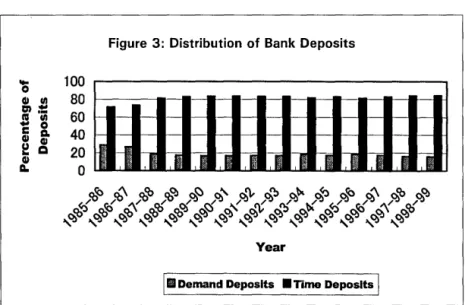
as a source of fund have increased from 42. 7 percent in 1975-76 to 54 percent in 1993-94. While advances by banks, as a use of fund increased only to 37.1 percent from 33.9 percent in the same period. Also as shown in figure 3, among the total deposit of banks time deposits are about 82 percent. As we come to the recent period, time deposits have increased more rapidly than have demand deposits. But on the other hand banks failed to channel this fund into credit. Then the question arises where this growth in time deposits went? The answer is- to other retail financing sectors. Hence it can be concluded that, credit rationing is occurring because of inability on the part of the banks to assess credit risk accurately resulting into unwillingness to provide credit.
Bank-firm Relationship in Bangladesh:
Present State and Some Lessons 49
III. Interest Margin:
In the banking sector Bangladesh, spread between the deposit and lending interest rate is very high. In a competitive market, relationship between the lending interest rate and deposit interest rate can be derived by the following formulas. Choudhury and Raihan(1999) also used the following formula to calculate the interest spread9•
. 1 'd
tl= l-k t
Where, k=required reserve ratio (20 percent of deposits), = deposit interest rate and = lending interest rate.
Accordingly the nominal interest rate spread is calculated as follows:
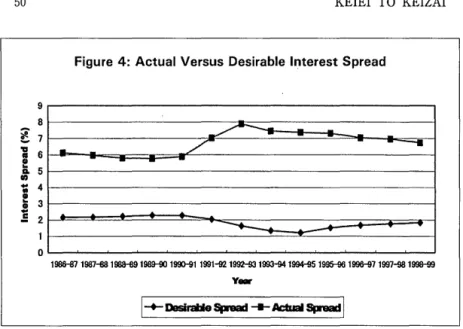
We calculated desirable spread between lending interest rate and deposit interest and plotted in figure 4. The figure shows that the actual spread is as high as 7 percent, where the desirable spread is around 2 percent. Both savings and lending volumes have been depressed due to the high spread between bank lending and deposit interest rates (over 7 percentage points) as a result of the very high incidence of NPL (non-performing loans) and real lending rates have remained high 9 to 12 percent since 1990 (IMF, 1998). This implies serious operational and managerial inefficiency in reducing the ,spread. But one of the main inherent reason behind this big gap
8) Wahba and Mohieldin(1998)
9) Choudhury, T. A. and Raihan, A, Implications of WTO on the Banking and Financial Sector in Bangladesh, Paper presented at the seminar organized by BIBM on August 24, 1999.
50
9 8
~ 7
1 6
a 5
en 1Ii 4
j :
o
KEIEI TO KEIZAI
Figure 4: Actual Versus Desirable Interest Spread
.~
-
.../ - - -.
..
-- -
..ole ..ole
---+---...
--
198&-87 1987-i381988-89198HO 1990-91199HI2 1992-00 1993-941994~ 1995-961996-971997-981991H19 Va.
I-+-Desirable Spruad -+-Actual Spruad I
might be the high risk premium that banks are charging inside lending in- terest rates. Banks charge higher risk premium because they don't have adequate information about the borrower and also there is lack of consistent long-term relationship between them to ensure credit worthiness of the prospective borrower.
IV. High Transaction Cost and Delay in Loan Decisions:
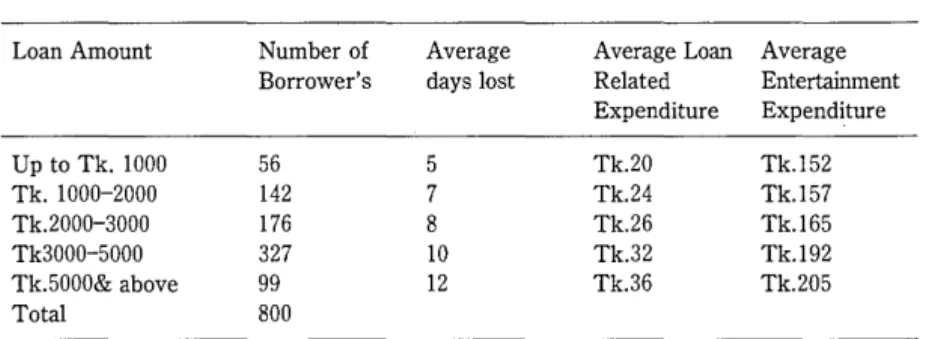
Also in Bangladesh, the transaction cost of getting loan is very high, which is again accentuated by the delay in decision making. Regarding this a study had been conducted by Bangladesh Institute of Bank Management (BIBM).
The findings of which are Summarized in table 3.
As presented in the table, the average loan related expenses of the 800 borrowers taken as sample are from Tk. 20 to Tk. 36 for each borrower depending upon the amount of loan received. Although, expenses in this
Bank-firm Relationship in Bangladesh:
. Present State and Some Lessons 51
Table 3 : Average Costs of Loan To The Borrower's
Loan Amount Number of Average Average Loan Average Borrower's days lost Related Entertainment
Expenditure Expenditure
Up to Tk. 1000 56 5 Tk.20 Tk.152
Tk. 1000-2000 142 7 Tk.24 Tk.157
Tk.2000-3000 176 8 Tk.26 Tk.165
Tk3000-5000 327 10 Tk.32 Tk.192
Tk.5000& above 99 12 Tk.36 Tk.205
Total 800
category should have been the same for all borrowers, but since the figure in the table shows variation, it leads to the conclusion that these fees are ar- bitrarily taken from the borrowers by a section of people who helped the borrowers in getting the loan. Also it is obvious from the table that the number of days lost in getting the loan varies among the borrowers from 5 to 12 days. These loan related expenses and days lost in getting the loans, which are more literally known as transaction cost may arise for the fol- lowing reasons:
1. Lack of Information About the Borrower: The banks are having in- adequate information base about borrowers. Also inter-bank exchange of information is not so popular. Hence, when a new loan application is made it takes a considerable amount of time for a bank to process the application to judge the loan competency of the borrower.
2. Extra Loan Related Expenses: The cost structure of the loan indicates that in addition to normal loan related expenses, the borrowers are paying some undesirable expenses for getting bank loan. Some un- scrupulous persons both within and outside the bank are making money out of bank lending programs in the name of making the loan money available to the borrower or expediting the loan process for them.
52 KEIEI TO KEIZAI
V. Bad loans:
In Bangladesh bad loan accumulates for several reasons e.g., government interference in loan decision process, borrowings and consequently non-payment of loan by directors of the PCBs, inherited burden of bad loans received by PCBs during de-regulation of nationalized banks, misappraisa1 of projects etc. Again, misappraisa1 and the errors in the underlying as- sumptions of the project were closely associated with the extraction of premiums by the relevant bank employees (Nabi, 1992). But in connection with the facts described, another important reasons for loan default is the high transaction costs and delay in loan decision process. This whole process occurs as shown in flow chart 2.
Flow Chart 2:Higher Transaction Cost Leads to Bad Loans
Includes:
• Formal expenditure for loan application.
• Entertainment expenditures (paid to person mediating in
• Days lost for lack of information about the borrower
Raise in the real effective interest rate of the borrower
Induce borrowers towards non-repayment of
loans because of higher aggregate loan
burden Unterest cost + Transaction cost>_
As explained in flow chart 2, lack of information about the borrower in- creases the transaction cost to borrowers unexpectedly, which in turn leads to huge amount of non-performing loans in the banking sector of Ban- gladesh.
Bank-firm Relationship in Bangladesh:
Present State and Some Lessons 53
By following the course of the discussion it can be concluded that, financing aspect is the key area of bank- firm relationship in Bangladesh. But again this particular aspect of the relationship is not working to its optimal level as evidenced by the existence of different negative symptoms such as: over- -existence of retail transactions, credit rationing by not channeling the growth of deposits to credit, higher interest margin between deposit and lending interest rates, high transaction costs, delay in loan decisions and bad loans. Thus the area of bank-firm relationship leaves the scope for a great deal of development and improvements.
6. Lessons and Suggestions for the Banking System of Bangladesh From the undergoing discussion we can put forward suggestions for the banking system of Bangladesh by dividing into two parts. The first part contains suggestions or lessons to improve the existing system and the se- cond part point out towards introduction of new things, which is believed to be appropriate for the banking system of Bangladesh.
6. 1 Suggestions to Develop the Existing Structure:
Firstly, on the backdrop of the study conducted in the previous sections we have seen that the main aspect of bank-firm relationship in Bangladesh takes place in the form of financing aspect, i.e., bank loans. Accordingly the suggestions that can be made for this existing financing aspect of bank-firm relationship are as follows:
1. Banks should not be involved in retail transactions only. They should increase the volume of wholesale transactions, i.e., long-term financing.
As in Bangladesh banking sector accounts for more than 96 percent of the
54 KEIEI TO KEIZAI
financial systems assets, it's role in meeting the long-term financing need of the country is of immense importance. This is also beneficial in terms of lower transaction costs. Going for long-term financing will enable to es- tablish long~term relationship between banks and the firm, by which the latter will receive benefits in terms of lower interest rates, prompt credit decisions an eventually lower transaction costs.
2. Although banks are free to decide about their interest rates, rationing of credit takes place in the banking system of Bangladesh for fear of loan default. This is again related to asymmetry in information caused by poor communication between bank and firm. Banks should look for establishing close long-term relationship· with firms and accordingly broaden their database about a particular firm to reduce information gap. This will en- able more informative judgment of potential loan applicant and reduce loan default and credit rationing eventually.
3. High interest spread between lending and borrowing interest rates (over 7 percent) is also the result of poor bank-firm relationship. Instead of one-off transaction, which is more common in Bangladesh, banks should go for longer version of relationship with firms. This will enable the banks to properly evaluate the credit worthiness of the borrowing firms without much hassle and reduce risk premium that they are charging wi- thin the interest rates.
4. Finally, loan default is related to the misappraisal of projects, errors in assumption about market behavior, higher transaction costs in terms of long time taken for project approval. Again misappraisal and higher transaction cost of the loan project are closely associated with information insufficiency about the borrowing firms. In order to reduce such infor- mation insufficiency close bank-firm relationship should be promoted.
Bank-firm Relationship in Bangladesh:
Present State and Some Lessons 55
Because by having a close bank-firm relationship a bank can have valuable inside information about the client firm. This in turn will have positive impact on loan default culture by enabling the bank to have more judge- ment about the client firm.
6.2 Lessons from Japanese Banking System:
Secondly, we would like put forward some lessons form the Japanese banking system during the high-growth era to further strength the bank-firm relationship in Bangladesh1o •
A. Stockholding of Firms:
In Japan bank maintains a substantial stockholding in the firms to which it acts as main bank. According to the The Japanese Anti-Monopoly Law, banks can hold up to 5 percent of a firm's stock (prior to 1987 up to 10 percent) on their own account. The main bank usually is in the top five shareholders of the client firm and is normally the top shareholder among banks. This enables the main bank to protect a customer firm from hostile take-over (Sheared, 1991a, 1994b.)
Purchasing shares of the customer's firm if adapted might also be effective for the banking system of Bangladesh. This will enable a bank to obtain in- formation and review firms operations and reduce mangers' ability to avoid debt payments. Ahmed (1997) observes that even with smaller equity contribution, the bank-based system associated with cross stockholding is likely to have favorable impact on the initial stages of industrialization
10) The terms bank and main bank are used interchangeably, as bank-firm relationship in Japan takes place under the typical heading of main bank.
56 KEIEl TO KElZAl
process and apprehension for fostering the policy measures toward that end is desirable. Bangladesh in the primitive leg of industrialization can utilize stockholding by banks as a means to ease the loan default problem by fol- lowing the Japanese banking experience.
B. Supply of Management Resources:
In Japan bank often sends its mangers as directors or auditors on the board of client firms. In 1992, about one quarter (24.4 percent) of the 40,045 directors of listed Japanese firms were from outside the firm (Aoki et al., 1994 p .15). Of those about one-fifth (21. 7 percent, or just over 5 percent of all directors) were from banks (Kigyo Keiretsu Soran, 1992, p.86). The shifts of mangers from the main bank to its customer firms promote close management relationship and enable the transfer of management know-how. On the other hand banks can also prevent the board of directors of the firm from making an illegal or seriously unjust decision.
This nature of transfer of management resources can be extremely beneficial for the banking system of Bangladesh where the client firms are seriously lacking the sufficiency of management competence and also board of direc- tors are taking seriously unjust decisions regarding the use of bank loans.
Dispatched bank officials can keep a close look on the firm's activities and can prevent the mangers' of the firm from avoiding debt payments.
c. Loan Syndication:
Another unique nature of bank-firm relationship in Japan is the reciprocal delegated monitoring in the form of loan syndication. Monitoring is largely delegated to the main bank, as other banks do not monitor the borrowing firms with the same intensity. Usually a loan syndication procedure is fol-