A Study on the Korean Senior Employment
Promotion Project that In?uence on the Quality
of Participants --Focused on gender
difference--journal or
publication title
Journal of social policy and social work
volume
13
page range
15-38
year
2009-03
A Study on the Korean Senior Employment Promotion
Project that Influence on the Quality of Participants
─ Focused on gender difference ─
Kim, Ok Hee
Jeong, Jong Hwa
【Abstract】
This study analyzes the Korean senior employment promotion projects influence on the qual-ity of elderly peoples lives. This study is focused on the gender differences, and based on their identification it provides policy implications to use for senior job creation initiatives as a way to promote improved quality of their lives.
For this study, university students who were trained about interview techniques from October, 2007 to January, 2008 visited 33 organizations in each of Seoul’s administrative districts includ-ing social welfare centers, senior centers, senior employment support centers and community senior clubs. Ten to thirty older people of each organization had face-to-face interviews with the interviewers, resulting in 595 questionnaires collected. After data cleaning, a total of 574 ques-tionnaires were used for this study.
SPSS 14.0 was used to conduct data analysis, and many analysis techniques were employed for the analysis: frequency analysis, independent samples t-test, one-way ANOVA, correlation analysis, hierarchical multiple regression analysis.
The study uses regression analysis to find out the influence of variables on quality of life, and found that older men felt happier when they were early on in their retirement years, healthier and they participated in the project for an extended time. On the other hand, older women said they were happier when they were healthier and their job gave them more satisfaction when their job was not for public service or human resource dispatch.
【Key words】
Quality of life, Korean senior employment promotion project, job types, project participation pe-riod, gender comparison of the quality of life
Ⅰ. Introduction
and 24.3% by 2030 according to the increase in expected life span (Korea National Statistical Office, 2006: KNSC, 2006).
With Korea’s low birth rate and aging society, the problems of population decrease and an aging work force has occurred as in other advanced countries. The insecurity over an elderly person’s jobs is deepening and the unemployment rate of the aged is becoming more serious as our society faces a labor market in which the rate of elderly is relatively high according to the structural change in the ag-ing society, while the size of the labor market is decreasag-ing1.
The retirement causes elderly people to get stress as they lose their labor power and the loss of economic and social resources. Furthermore it may be a major factor to a decrease in life satisfaction. The loss of job causes the loss of a role as well as a decrease in income; lowering of self-respect and increasing loneliness and alienation as they face a change in their social ties. As a result, the quality of life is likely to deteriorate more at this time than at any other stage of human life.
The quality or satisfaction of life may be defined as a subjective sense of well-being, happiness or life satisfaction; however, in general it may be referred to as the overall evaluation of a life an indi-vidual person feels subjectively. When an elderly person spends a happy and comfortable life in which a regular income is secured it may be called a successfully aging or a successfully retired life, which can be viewed as a high quality of life (satisfaction of life).
There are many factors having effects on quality of life, among them are the level of economy, whether to have a job or not and employment for the aged. Though it is recognized that the economic conditions of the aged, including whether to have a job or not, have effects on life satisfaction, job activity has positive effects on life satisfaction (Yu-ja No, 1988; Sin-suk Lee, 1955), there are study results that argue elderly employment does not have meaningful effects on their life satisfaction as well. It was reported that participating in elderly employment had effects on life satisfaction (Yang-yeol Seo, 2004; Gu-yeong Gweon · Jeong-min Choi, 2007).
The rapid increase of elderly population and the extension of the average life span, due to the de-velopment of medical science, improvements in diet and level of living, have resulted in a longer old age life and the greater population of healthy elderly people. Accordingly, elderly people’s desire to have economic self-reliance is increasing so that a stable retired life may be secured. According to the results of the ‘National survey of elderly life conditions and welfare demands (Gyeong-hee Jeong and others, 2005) carried out by Korea Institute for Health and Social Affairs, the aged people who were willing to prepare the living expenses for themselves occupied 49.4% of total survey participants, taking the highest place, and according to the research data of Korea National Statistical Office, it ap-peared that more than half (57.9%) of elderly people wanted to be employed later on, in life and the fact that the main reason they wanted to get a job was to make up the deficit of ‘living expense’.
In terms of social aspects in advanced countries, which are already experiencing an aging society,
the reduction of productive age population and the extension of the average life span of aged people, due to the low birth rate and aging, have caused an increase in social security expenditures such as pensions and medical insurance as the elderly population has sharply increased, which society sup-ports economically. Making the best use of an elderly labor force, which is one of the available labor forces, has become an important matter of policy, so that the financial pressure due to the increase of social security expenditure may be relieved, as well as the national productivity may be sustained al-lowing continued economic growth.
As long as the aged laborers with high desire for a job have an ability to work, there is a growing need to reorganize the labor environment 2 in order to allow the aged to continue to work using their
knowledge and experience regardless of their age, as a countermeasure against the aging labor force, caused by lowering birth rate and becoming an aging society, may be taken and the aging labor force may be used (Ok-hee Kim, 2007: 202).
Despite the extension of life span and the increase of healthy elderly people, our society is not mak-ing use of the elderly manpower in an orderly fashion, so most of them depend on their children for living expenses. Accordingly, the necessity of productive elderly welfare policies through employment promotion policies are needed in order to reduce the family and social support expense and to allow the aged to lead a successful old age as they prepare a living expense for themselves.
In the advanced western European countries, which have already experienced the aging population, economic welfare became the one of major targets of national policies, and the countries developed in-come security systems and diverse elderly employment programs for economic stability of the aged popu-lation, so that they might promote the self-sustenance and improve the quality of life of elderly people. Since 2004 our government has carried out job creation programs for the elderly to enhance the quality of life for them by providing healthy elderly people with suitable jobs, and the opportunity for social activity and income preservation. However, despite the quantitative expansion, providing 110,000 jobs in 2007, the project contains various problems to be resolved in terms of quality, such as the con-tinuation of project, the sharp difference between the ratio of jobs provided by government and private sector, and the weakness in the strategic job series of which the possibility of continuance is verified. The preceding studies as to life satisfaction of elderly, who participate in economic activities, show so much diversity that it may be a little difficult to generalize them. It seems that the life satisfaction of elderly who participate in elderly employment programs, in which the jobs are different from other oc-cupations in terms of activity content and working conditions, has not been discussed enough yet and needs to be studied.
Though the existing studies on the elderly focused on the difference between elderly male and el-derly female, incomplete results were received, in which the peculiar problems of each gender were misunderstood as they were defined on the basis of the average characteristics of elderly males and females (Gi-nam Park, 2004:16).
As the gender was limited to the subordinate variable of socio-demographic variables like age and education, the cause identification or comparative studies about the origination process and related fac-tors, such as employment project participation of elderly males and females, poverty, joblessness and reentry, were passed over, so that it may be concluded the social implication about the study results were not sufficiently considered.
Because it was impossible to find consistent study results between the variables of gender and the quality of life, it was decided to research the relationship, considering the importance of the variable of gender and making it become an independent variable. So, it was designed to carry out the com-parative analysis on the factors having effects on quality of life on the basis of distinction of gender when the analysis of characteristics of the employment project, which has effects on the quality of life of elderly people who participate in the programs, was carried out.
The concrete problems to study were as follows;
First, how was the quality of life according to the type of elderly jobs, participation period and project satisfaction? Is there any difference in quality of life between elderly males and females according to the type of elderly jobs, participation period and project satisfaction?
Second, do the type of jobs, participation period and project satisfactions have effects on quality of life? Is there any difference between the effects on quality of life of elderly males and that of females caused by the type of jobs, participation period and project satisfaction?
Ⅱ . Theoretical backgrounds and preceding studies
1. Korean Elderly employment project for improvement of quality of life
The Korean Elderly Employment Project is a project aiming at the effects of elderly health, expan-sion of social participation, supplementary support income for the elderly over age 65, in order to pre-pare for the rapid aging society (Chun-sik Lim and others, 2007:92). As of the year 2007, there were 5 types of project, such as Public benefit type, Educational type, Welfare type, Market type and Man-power dispatch type3 .
The legal ground of Elderly Employment Project are Article 23, Clause 2 of Article 23 and Article 11 of Low Birth Rate and Aging Society Act4. Elderly Employment Project are carried out by the
Min-istry for Health, Welfare and Family Affairs, Korea Labor Force Development Institute for the Aged, local governments and project execution agencies.
3 The type of Korean Elderly Employment Project and the concept definition is changing continuously. As of the year 2007, there were 5 types of projects, such as Public benefit type, Educational type, Welfare type, Market type and Manpower dispatch type. There are 5 types of employment supported by the government, and the employment activity in the private sector includes introduction through Elderly Employment Fair, Employment Support Center in Korea Elderly Association and Senior clubs.
The necessity of Elderly Employment Project can be looked into as it is divided into the necessity of elderly employment, elderly poverty problems, deficiency of personal · social preparation for old age, and low employment rate compared to the high desire of elderly employment.
Quality of life can be examined as it is divided into an objective one and subjective one; however, there is a tendency to understand the quality of life focusing on the subjective aspects of individuals (Tae-hyeon Kim and others, 1997:4 Tae-hyeon Kim, 1999: 62).
Quality of life also can be divided into health and objective parts of material and emotional and subjective parts of satisfaction or happiness, but the subjective aspect of quality of life is regarded as more important, and it is explained as the concept similar to the life satisfaction, well-being and hap-piness, and measured as the life satisfaction degree (Byeong-eun Gwak, 2006: 55).
Padilla (1985) argues that the quality of life is the process of evaluating the response to mental health, physical health, interests in physical body, interests in society, diagnosis and treatment, so the quality of life is the subjective well-being perceived by individuals in the physical, mental and social·economic fields. Like this, the concept of quality of life or subjective sense of happiness is com-posed of multi-dimensional fields, so it is defined differently according to different scholars. Quality of life is dealt with in many academic fields and the term is used universally in our society, but the characteristics may be easily defined, and it is very difficult to derive the agreed principles for the for-mation of scales (Jae-gi Lee. Eun-woo Lee. Jae-hong Kim, 1998).
Quality of life is the emotional content as to the attitude of a personal life, and it can be also a sub-jective feeling about the present and future, so it refers to life satisfaction and happiness.
In this study, the quality of life was defined as “the personal subjective evaluation and sense of hap-piness as to the objective conditions, such as physical, mental and social-economic conditions, pos-sessed by individual elderly person, based on the diverse concept definitions of quality of life.
2. Preceding studies about elderly employment project and quality of life
Maeda Daisaku, Nokuchi Yuji, Tamano Kajuyoshi, Nakaya Yoaki, Sakata Shyuichi.Jersey Liang (1989) have drawn the conclusion that the satisfaction of economic condition, whether to have a dis-ease or not, physical function, satisfaction from social supports, present depression or self-respect have significant effects on the subjective sense of happiness, through the research survey using the modified PGCMS.
Kaminari Hideo (2004) found out that social participation activities have certain effects on the subjective sense of happiness of elderly in research survey using the modified PGCMS, and the subjec-tive sense of happiness appeared to have posisubjec-tive effects on social participation activities conversely. The economic condition, including whether elderly have a job or not, seems to have a positive mu-tual relations with quality of life (Larsom, 1977; Klemmack & Roff, 1984; Yu-ja No, 1988; Sin-suk Lee, 1995).
poverty, had a high life satisfaction.
Job activities of elderly have effects on the quality of life or psychological sense of welfare (Aquino, Russel, & Altmaier, 1996; Riddick, 1985; Thompson, 1973; Wha-hee Son.Ok-bun Jeong, 1999; Jung-don Gwon. Ju-yeon Jo, 2000; Ik-gi Kim and others, 1999; Ji-hyeon Lee and others, 2008; Nan-suk Go, 2005; Hye-ja Lee. Myeong-ok Seong. Yun-a Shin, 2003; Havighurst, 1972; Mutchler, Burr, Masagli & Pienta, 1999; Mutran, Retzes, Bratton, & Fernandez, 1997). On the other hand, the positive effects of wage labor of elderly were not found in the study of McIntosh and Danigelis (1995).
One studies results argues that economic activities would deteriorate the quality of life in the case of the elderly, and it does not have any effect on the psychological sense of welfare (Sun-deok Yun, 2004).
Accordingly, it may be considered that the effect of the state of employment on elderly quality of life has no consistency. It was reported that participating in the elderly employment project had posi-tive effects on quality of life of elderly (Yang-yeol Seo, 2004; Su-o Seo, 2007; Gu-yeong Gwon. Jeong-min Choi, 2007; Gyeong-whoi Kim, 2007).
Some preceding studies argued that the type of employment project had meaningful effects on the life satisfaction of the elderly participants, and the others argued that there was no relation between them. Yang-yeol Seo argued that the elderly participating in the Public benefit type showed the higher satisfaction. In the case of the study result of Hee-jin Park (2005), the elderly participating in the Wel-fare type showed the highest satisfaction of the project, but the elderly participating in the Educational type showed the lowest satisfaction with the elderly employment project than the other elderly. Accord-ing to the study result of Hyeon-suk Kim (2005) the satisfaction degree of project participation was highest in the Market type, and the Manpower dispatch type and Welfare type were higher than the Public benefit type, but the Educational type showed the overall lower level of participation satisfac-tion compared to other type of employments. In the studies of Gu-yeong Gwon. Jeong-min Choi (2007), Gu-yeong Gwon. Gong-sik Park (2007), the will of participation in the Educational type and Welfare type were higher than the Public benefit type, and the sense of well-being of participants appeared to be higher than the other types.
On the other hand, according to the study of Gyeong-whoi Kim, the type of employment did not appear to have meaningful relations with life satisfaction. Looking into the study results related to the participation period and quality of life, it was identified that the group which had participated more than a year showed lower satisfaction than the group which had participate less than a year (Su-o Seo, 2007), or in the other study, the elderly participating within 5 months showed higher satisfac-tion with the employment project than the elderly who had participated for different periods (Hee-jin Park, 2005). In another study by Gu-yeong Gwon and Gong-sik Park (2007), the group participating between 4 months and 6 months showed the higher satisfaction than the group participating less than 3 months and between 10 months and 12 months, and the group participating less than 3 month and between 7 months and 9 months showed higher satisfaction than the group participating between 10 months and 12 months.
the factors included the age, sex, educational level, income, occupation, marital status, religion, social activity, health status and social support (Fitch and Slivinske, 1988; Su-won Chai · Gyeong-ok Oh, 1992; Seung-deok Go · Suk-haeng Jo, 1997).
Woo-bok Lee (1993) reported that the variables, which had effects on elderly life satisfaction, in-cluded the sex distinction, age, educational background, occupation, economic status, health, religion, marital status, social relations, support from family and environment. In-jeong Lee (1999), Diener & Suh (1998) reported that the age of elderly did not have effects on life satisfaction.
Quality of life showed the directly-opposed results according to the sex distinction. According to one study, elderly females had lower life satisfaction than elderly males (Liang, 1982; Chung-seon Park, 1998; Gi-wol Seong, 1999; Hyeon-suk Oh, 2003). However, there was a study that argued elder-ly males had lower life satisfaction than elderelder-ly females instead, due to undergoing lots of changes in social roles (Sang-hee Jang, 1983; Jun-su Heo, 2004; Jin-hee Bae, 2004; Seon-me Lee and Gyeong-sin Kim, 2002), on the other hand, there was a study that argued the sex distinction had no effects on life satisfaction of elderly (Yeong-gil Lee, 1994, Palmore & Kivett. 1977; Lason, 1978; Warr et al., 2004; Berg, Hassing, Mcclearn and Johansson, 2006; Gwang-hee Park. Hye-gyeong Han, 2002; Su-o Seo, 2007; Hyeon-gu Shin, 2007).
In the study of Gi-nam Park (2004), life satisfaction of elderly males appeared to be meaningfully higher than that of elderly females in the simple mutual relations between sex variables and life satis-faction, but in the case of consideration of all other variables, the directly-opposed result came out in which the life satisfaction of elderly male was rather lower than that of elderly females.
In the study of Jeong-seok Kim (2003), it was found that elderly females were more dependent on the spouse or children than elderly males as the relationship between the elderly males or females and the economic resources appeared to be different according to whether they had a spouse or not, and whether they were living with their children or not.
Even in the case of the western European countries which had experienced an aging society for some time, the study on the difference between sex distinctions of elderly were actively performed re-cently.
According to the study about what effects employment after retirement has on the life satisfaction of elderly females (Choi, 2001), it argued that though the employment itself did not contribute to the life satisfaction of elderly females, the financial resources became the potential factor of life satisfac-tion, so the study proposed that the economic condition and the satisfaction should be considered as the important factors in the study of quality of life at old age (Gi-nam Park, 2004).
Ⅲ . Study Method
1. Study object and method of data analysis
The research survey of this study was carried out over 4 months, from October 2007 to January 2008, with the elderly who were participating in the elderly employment projects in the Seoul area. The summary of sampling process for this study is as follows; first, copies of official notice for coop-eration were sent out to the officers in charge of elderly employment project at social welfare centers, senior welfare centers, elderly employment support centers and senior clubs of communities in each administrative district in Seoul area, then the surveyor visited the institutions, which agreed to the plan, to carry out the survey of 10 to 30 people in each institution.
University students who received the survey training visited 17 multipurpose welfare centers, 6 se-nior welfare centers, 7 elderly employment support centers, and 3 community sese-nior clubs in person, and carried out face to face survey in consideration of the educational level of the participating el-derly. Among the collected 595 questionnaires, 21 cases that were prepared faithlessly were excluded through data cleaning, then total 574 cases were used as the final study objects.
The data analysis method was as follows.
The Hangeul SPSS 14.0 was used to analyze the data, and as for the analysis techniques, the fre-quency analysis, independent sample t-test, one-way ANOVA, correlation analysis and hierarchical multi-regression analysis were carried out.
2. Study tools
1) Socio demographical variables
According to the multiple preceding studies, the socio-demographical variables having ef-fects on the quality of life of the participating elderly were composed of age, educational back-ground, existence or nonexistence of spouse, economic status and health status. The scale of variable were as follows; age, educational background (1~6: dummy variables), existence or non-existence of spouse (non-existence: 1, nonnon-existence: 0), economic status (1~5: dummy variables) and health status (5 dummy variables).
2) Sex distinction
Elderly males and females.
3) Characteristic variables of elderly employment project
The employment project characteristics having effects on the quality of life of participating elderly were measured by the participation period (1~5: continuous variable) and the satisfaction with projects (1: satisfied, 0: unsatisfied)
4) Types of employment project
5) Quality of Life
The revised Philadelphia Geriatric Center Morale Scale (PGCMS) of Lawton, which is a scale of subjective quality of life was used, in order to survey and analyze the quality of life of the elderly participating in the elderly employment projects. PGCMS5 (Lawton,1972) was
ini-tially developed as a scale of 22 items and 6 dimensions, but later it was modified to be the scale of 17 items and 3 dimensions (Lawton,1975).
The reliability of quality of life in this study appeared to be proper with the value, α=.832. If neces-sary, the reverse encoding of question points were carried out to adjust the higher point to indicate the higher life satisfaction.
Ⅳ. Results of analysis
1. The socio-demographical characteristics of survey participants and the difference in quality of life based on the socio-demographical characteristics
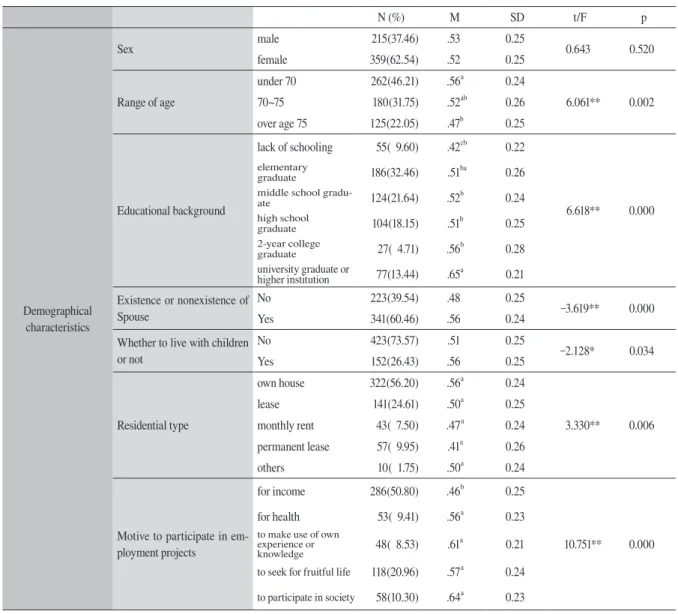
Frequency analysis was carried out to examine the demographical characteristics, and the results of independent sample t-test and one-way ANOVA, which were carried out to verify the difference of quality of life according to the demographical characteristics, are presented in <Table 1>.
According to the analysis, the variables related to the difference of quality of life were age, edu-cational background, existence or nonexistence of spouse, whether to live with children or not, resi-dential type, motive to participate in employment project, average monthly income, monthly living expense of family and health status.
It appeared that the elderly under 70 (M=.42) had the higher quality of life than that of the elderly over age 75 (M=.47). (F=6.061, p=.002)
As for educational background, the quality of life of elderly who graduated from a university or ed-ucational institutions beyond universities (M=.65) was higher than that of elderly who graduated from a 2-year college (M=.56), a high school (M=.51), a middle school (M=.52), an elementary school (M=.51) or the elderly without schooling (M=.42). (F=6.618, p=.000)
As for existence or nonexistence of spouse, the quality of life of elderly with spouse (M=.56) was higher than that of elderly without spouse (M=.48). (t=-3.619, p=.000)
As for whether to live with children or not, the quality of life of elderly who said “Yes” (M=.56) was higher than that of elderly who said “No” (M=.51). (t=-2.128, p=.034)
The residential type showed no difference (F=3.330, p=.006).
Table 1 Verification of difference in quality of life according to the demographical
characteristics of survey participants (totality)
(N=574 people, % ) N (%) M SD t/F p Demographical characteristics Sex male 215(37.46) .53 0.25 0.643 0.520 female 359(62.54) .52 0.25 Range of age under 70 262(46.21) .56a 0.24 6.061** 0.002 70~75 180(31.75) .52ab 0.26 over age 75 125(22.05) .47b 0.25 Educational background lack of schooling 55( 9.60) .42cb 0.22 6.618** 0.000 elementary graduate 186(32.46) .51ba 0.26 middle school
gradu-ate 124(21.64) .52b 0.24 high school graduate 104(18.15) .51b 0.25 2-year college graduate 27( 4.71) .56b 0.28 university graduate or higher institution 77(13.44) .65a 0.21 Existence or nonexistence of Spouse No 223(39.54) .48 0.25 -3.619** 0.000 Yes 341(60.46) .56 0.24
Whether to live with children or not No 423(73.57) .51 0.25 -2.128* 0.034 Yes 152(26.43) .56 0.25 Residential type own house 322(56.20) .56a 0.24 3.330** 0.006 lease 141(24.61) .50a 0.25 monthly rent 43( 7.50) .47a 0.24 permanent lease 57( 9.95) .41a 0.26 others 10( 1.75) .50a 0.24
Motive to participate in em-ployment projects
for income 286(50.80) .46b 0.25
10.751** 0.000 for health 53( 9.41) .56a 0.23
to make use of own experience or
knowledge 48( 8.53) .61
a 0.21
to seek for fruitful life 118(20.96) .57a 0.24
to participate in society 58(10.30) .64a 0.23
As for the motive for participation in the employment project, ‘for health’ (M=.56), ‘to make use of one’s own experience and knowledge’ (M=.61), ‘to seek a fruitful life’ (M=.57) and ‘to participate in society’ (M=.64) were more closely related to quality of life than ‘for income’ (M=.46). (F=10.751, p=.000)
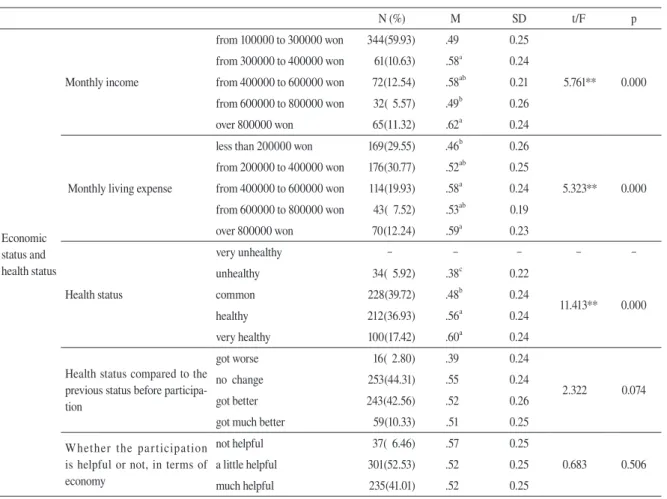
Table 2 Verification of difference in quality of life according to the economic status
and health status (totality)
(N=574 people, % ) N (%) M SD t/F p Economic status and health status Monthly income from 100000 to 300000 won 344(59.93) .49 0.25 5.761** 0.000 from 300000 to 400000 won 61(10.63) .58a 0.24 from 400000 to 600000 won 72(12.54) .58ab 0.21 from 600000 to 800000 won 32( 5.57) .49b 0.26 over 800000 won 65(11.32) .62a 0.24
Monthly living expense
less than 200000 won 169(29.55) .46b 0.26
5.323** 0.000 from 200000 to 400000 won 176(30.77) .52ab 0.25 from 400000 to 600000 won 114(19.93) .58a 0.24 from 600000 to 800000 won 43( 7.52) .53ab 0.19 over 800000 won 70(12.24) .59a 0.23 Health status very unhealthy - - - - -unhealthy 34( 5.92) .38c 0.22 11.413** 0.000 common 228(39.72) .48b 0.24 healthy 212(36.93) .56a 0.24 very healthy 100(17.42) .60a 0.24
Health status compared to the previous status before participa-tion
got worse 16( 2.80) .39 0.24
2.322 0.074 no change 253(44.31) .55 0.24
got better 243(42.56) .52 0.26 got much better 59(10.33) .51 0.25 Whether the participation
is helpful or not, in terms of economy
not helpful 37( 6.46) .57 0.25
0.683 0.506 a little helpful 301(52.53) .52 0.25
much helpful 235(41.01) .52 0.25
The quality of life with monthly income’ over 800000won (M=.59) and ‘from 400000 to 600000won (M=.58) was higher than that with’ less than 200000won (M=.46). (F=5.323, p=.000) As for the health status, ‘very healthy’ (M=.60) and ‘healthy’ (M=.56) showed the higher points than ‘common’ (M=.48) and ‘unhealthy’ (M=.38), and the quality of life with ‘common’ appeared to be higher than the quality of life with ‘unhealthy’. (F=11.413, p=.000)
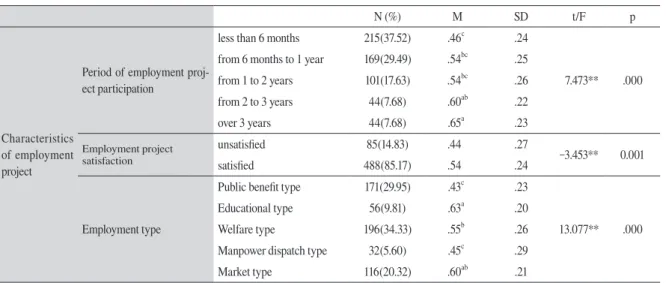
According to the verification of difference in quality of life based on the characteristics and types of employment project, the quality of life varied in accordance with the period of participation, satis-faction with employment project and the type of employment.
Table 3 Verification of difference in quality of life according to the characteristics of
employment project and the type of employment
(N=574 people, %)
N (%) M SD t/F p
Characteristics of employment project
Period of employment proj-ect participation
less than 6 months 215(37.52) .46c .24
7.473** .000 from 6 months to 1 year 169(29.49) .54bc .25
from 1 to 2 years 101(17.63) .54bc .26 from 2 to 3 years 44(7.68) .60ab .22 over 3 years 44(7.68) .65a .23 Employment project satisfaction unsatisfied 85(14.83) .44 .27 -3.453** 0.001 satisfied 488(85.17) .54 .24 Employment type
Public benefit type 171(29.95) .43c .23
13.077** .000 Educational type 56(9.81) .63a .20
Welfare type 196(34.33) .55b .26
Manpower dispatch type 32(5.60) .45c .29
Market type 116(20.32) .60ab .21
2. Quality of life difference between elderly females and males according to the socio-demographical characteristics
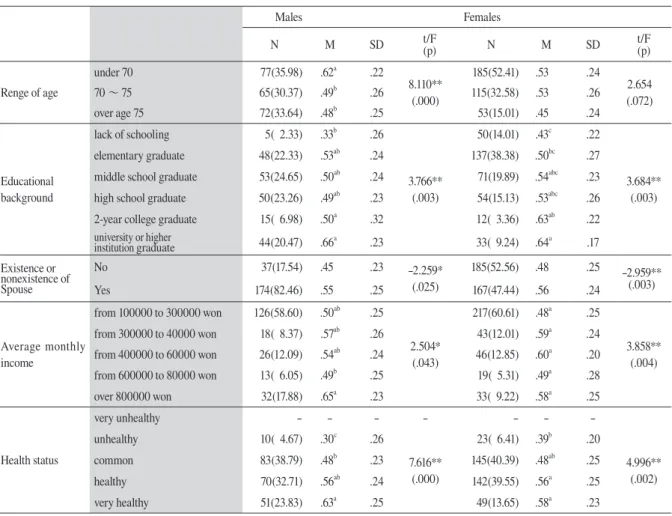
The verification results of quality of life difference between elderly females and males according to the socio-demographical characteristics are presented in <Table 4>.
As for the verification of quality of life difference according to age, in the case of elderly males, the quality of life of elderly under males 70 (M=.62) appeared to be higher than that of elderly males be-tween 70 and 75 (M=.49) and over age 75 (M=.48). (F=8.110, p=.000)
As for the verification of quality of life difference according to educational background, in the case of elderly males, the quality of life of ‘2-year college graduate’ (M=.50) and ‘university or higher institution graduate’ (M=.66) appeared to be higher than that of elderly males without schooling (M=.33) (F=3.766, p=.003), and in the case of elderly females, the quality of life of ‘university or higher institution’ graduate’ (M=.63) appeared to be higher than that of the ‘elementary graduate’ and the elderly females without schooling (M=.43). (F=3.684, p=.003)
As for the verification of quality of life difference according to existence or nonexistence of spouse, the quality of life of both elderly males and females with spouse (‘Yes’) appeared to be higher than who marked ‘No’. (t=-2.959, p=.003)
Table 4 Verification of quality of life difference according to the socio-demographical characteristics (N=574 people, %) Males Females N M SD t/F (p) N M SD t/F (p) Renge of age under 70 77(35.98) .62a .22 8.110** (.000) 185(52.41) .53 .24 2.654 (.072) 70~ 75 65(30.37) .49b .26 115(32.58) .53 .26 over age 75 72(33.64) .48b .25 53(15.01) .45 .24 Educational background lack of schooling 5( 2.33) .33b .26 3.766** (.003) 50(14.01) .43c .22 3.684** (.003) elementary graduate 48(22.33) .53ab .24 137(38.38) .50bc .27
middle school graduate 53(24.65) .50ab .24 71(19.89) .54abc .23
high school graduate 50(23.26) .49ab
.23 54(15.13) .53abc
.26 2-year college graduate 15( 6.98) .50a .32 12( 3.36) .63ab .22
university or higher institution graduate 44(20.47) .66a .23 33( 9.24) .64a .17 Existence or nonexistence of Spouse No 37(17.54) .45 .23 -2.259* (.025) 185(52.56) .48 .25 -2.959** (.003) Yes 174(82.46) .55 .25 167(47.44) .56 .24 Average monthly income from 100000 to 300000 won 126(58.60) .50ab .25 2.504* (.043) 217(60.61) .48a .25 3.858** (.004) from 300000 to 40000 won 18( 8.37) .57ab .26 43(12.01) .59a .24 from 400000 to 60000 won 26(12.09) .54ab .24 46(12.85) .60a .20 from 600000 to 80000 won 13( 6.05) .49b .25 19( 5.31) .49a .28 over 800000 won 32(17.88) .65a .23 33( 9.22) .58a .25 Health status very unhealthy - - - -unhealthy 10( 4.67) .30c .26 7.616** (.000) 23( 6.41) .39b .20 4.996** (.002) common 83(38.79) .48b .23 145(40.39) .48ab .25 healthy 70(32.71) .56ab .24 142(39.55) .56a .25 very healthy 51(23.83) .63a .25 49(13.65) .58a .23
As for the verification of quality of life difference according to health status, in the case of elderly males, the elderly quality of life of ‘very healthy’ (M=.63) appeared to be higher than that of ‘common’ (M=.48) and ‘unhealthy’ (M=.30), and the elderly quality of life of ‘healthy’ (M=.56) and ‘common’ appeared to be higher than that of ‘unhealthy’. (F=7.616, p=.000) In the case of elderly females, the elderly quality of life of ‘very healthy’ (M=.58) and ‘healthy’ (M=.56) appeared to be higher than that of ‘unhealthy’ (M=.39). (F=4.996, p=.002)
3. Quality of life difference between elderly females and males according to characteris-tics and types of employment project
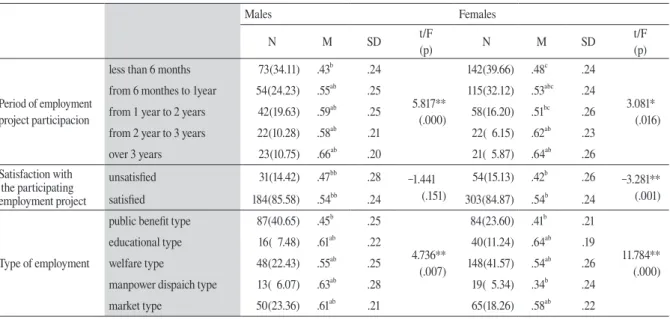
life of ‘from 2 to 3 years’ (M=.62) was higher than that of ‘less than 6 months’ (M=.48). (F=3.081, p=.016)
In the verification of difference according to satisfaction with employment project, in the case of elderly females, the elderly quality of life of ‘satisfied’ (M=.54) appeared to be higher than that of ‘unsatisfied’ (M=.42). (t=-3.218, p=.001).
In the verification result of difference according to employment type, in the case of elderly males, the elderly quality of life of educational type (M=.61), manpower dispatch type (M=.63), market type (M=.61) were higher than that of public benefit type (M=.45) (F=4.736, p=.007), and in the case of elderly females, the elderly quality of life of educational type (M=.64), welfare type (M=.54), market type (M=.58) appeared to be higher than that of public benefit type (M=.41), manpower dis-patch type (M=.34). (F=11.784, p=.000)
Table 5 Verification of quality of life difference according to period of employment project participation, employment type and project satisfaction
Males Females N M SD t/F (p) N M SD t/F (p) Period of employment project participacion
less than 6 months 73(34.11) .43b .24
5.817** (.000)
142(39.66) .48c .24
3.081* (.016) from 6 monthes to 1year 54(24.23) .55ab .25 115(32.12) .53abc .24
from 1 year to 2 years 42(19.63) .59ab .25 58(16.20) .51bc .26
from 2 year to 3 years 22(10.28) .58ab .21 22( 6.15) .62ab .23
over 3 years 23(10.75) .66ab .20 21( 5.87) .64ab .26 Satisfaction with the participating employment project unsatisfied 31(14.42) .47bb .28 -1.441 (.151) 54(15.13) .42b .26 -3.281** (.001) satisfied 184(85.58) .54bb .24 303(84.87) .54b .24 Type of employment
public benefit type 87(40.65) .45b .25
4.736** (.007) 84(23.60) .41b .21 11.784** (.000) educational type 16( 7.48) .61ab .22 40(11.24) .64ab .19 welfare type 48(22.43) .55ab .25 148(41.57) .54ab .26 manpower dispaich type 13( 6.07) .63ab .28 19( 5.34) .34b .24
market type 50(23.36) .61ab .21 65(18.26) .58ab .22
4. Effect analysis of variables that have influences on quality of life
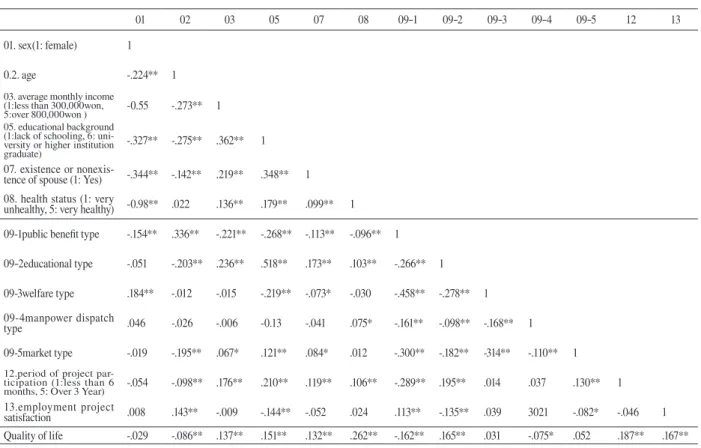
As shown in <Table 6>, before carrying out the regression analysis, the Biserial Correlation Coef-ficient and the Pearson’s Correlation CoefCoef-ficient were derived in order to analyze the variables that had influence on quality of life, through correlation analysis.
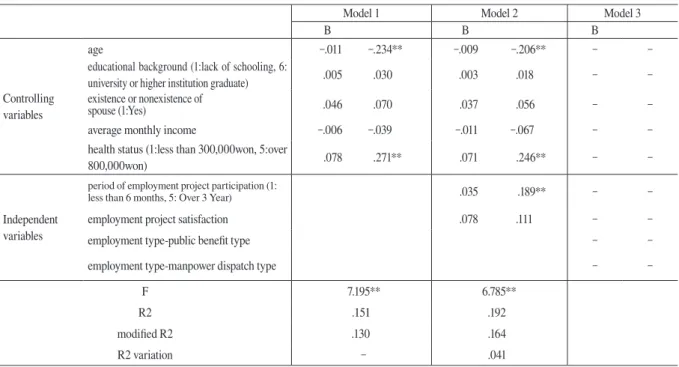
The Hierarchical Multi Regression Analysis was carried out in order to analyze the variables that had influence on quality of life, and the results are presented in <Table 7> and <Table 8>.
Table 6 Correlation analysis among the socio-demographical variables, characteristics and types of employment project and quality of life variables
01 02 03 05 07 08 09−1 09−2 09−3 09−4 09−5 12 13 01. sex(1: female) 1
0.2. age -.224** 1
03. average monthly income (1:less than 300,000won,
5:over 800,000won ) -0.55 -.273** 1 05. educational background
(1:lack of schooling, 6: uni-versity or higher institution graduate)
-.327** -.275** .362** 1 07. existence or
nonexis-tence of spouse (1: Yes) -.344** -.142** .219** .348** 1 08. health status (1: very
unhealthy, 5: very healthy) -0.98** .022 .136** .179** .099** 1 09-1public benefit type -.154** .336** -.221** -.268** -.113** -.096** 1 09−2educational type -.051 -.203** .236** .518** .173** .103** -.266** 1 09-3welfare type .184** -.012 -.015 -.219** -.073* -.030 -.458** -.278** 1 09-4manpower dispatch
type .046 -.026 -.006 -0.13 -.041 .075* -.161** -.098** -.168** 1 09-5market type -.019 -.195** .067* .121** .084* .012 -.300** -.182** -314** -.110** 1
12.period of project par-ticipation (1:less than 6
months, 5: Over 3 Year) -.054 -.098** .176** .210** .119** .106** -.289** .195** .014 .037 .130** 1
13.employment project
satisfaction .008 .143** -.009 -.144** -.052 .024 .113** -.135** .039 3021 -.082* -.046 1 Quality of life -.029 -.086** .137** .151** .132** .262** -.162** .165** .031 -.075* .052 .187** .167** *p<.05 **p<.01 ***p<.001
According to the result of multiple regression analysis, in the case of elderly males, it was identified that the age (α=-.234) and health status (α=.271)had effects on quality of life, and the power of expla-nation by Model 1 was 15.1%. In Model 2, it appeared that the period of employment project partici-pation (α=.189) had effects on quality of life, and the increased power of explanation by the period of employment project participation and employment project satisfaction, which were the characteristics of employment project, was 4.1%. The overall power of explanation of Model 2 was 19.2%. However, in the case of elderly males, it was identified that there was no employment type that had effects on quality of life. So to speak, in the case of elderly males, it was identified that the younger and healthier, the longer period of employment project participation, the better quality of life the elderly had.
Table 7 Analysis of variables that has influence on quality of life (elderly males)
Model 1 Model 2 Model 3
B B B
Controlling variables
age -.011 -.234** -.009 -.206** -
-educational background (1:lack of schooling, 6:
university or higher institution graduate) .005 .030 .003 .018 - -existence or non-existence of
spouse (1:Yes) .046 .070 .037 .056 -
-average monthly income -.006 -.039 -.011 -.067 - -health status (1:less than 300,000won, 5:over
800,000won) .078 .271** .071 .246** -
-Independent variables
period of employment project participation (1:
less than 6 months, 5: Over 3 Year) .035 .189** -
-employment project satisfaction .078 .111 -
-employment type-public benefit type -
-employment type-manpower dispatch type -
-F 7.195** 6.785**
R2 .151 .192
modified R2 .130 .164
R2 variation - .041
*p<.05 **p<.01 ***p<.001
Table 8 Analysis of variables that has influence on quality of life (elderly females)
Model 1 Model 2 Model 3
B B B
Controlling variables
age .002 .040 .000 .000 .004 .079
educational background (1:lack of schooling, 6:
university or higher institution graduate) .027 .156* .026 .149 .018 .105 existence or nonexistence of spouse (1:Yes) .048 .097 .040 .080 .025 .050 average monthly income .018 .097 .015 .079 .009 .046 health status (1:less than 300,000won, 5:over
800,000won) .049 .159** .050 .164** .050 .161**
Independent variables
period of employment project participation (1:
less than 6 months, 5: Over 3 Year) .019 .087 .008 .036 employment project satisfaction .142 .200** .135 .190** employment type-public benefit type -.146 -.250** employment type-manpower dispatch type -.238 -.214**
F 6.383** 7.124** 9.201**
R2 .086 .129 .199
modified R2 .073 .111 .177
R2 variation - .043 .070
*p<.05 **p<.01 ***p<.001
Ⅴ. Conclusion and policy proposals
1. Analysis result
In this study, at first, the characteristics and types of elderly employment project and the quality of life were examined, and then the influence of the characteristics and types of elderly employment project on quality of life was reviewed. The significance of this study is that the differences among the characteristics and types of elderly employment project and quality of life were analyzed in terms of sex distinction.
First, among the employment project types, the welfare type had the highest percentage of employ-ment, followed by public benefit type, market type, educational type and manpower dispatch in that order. In the case of sex distinction, the highest percentage of employment in public benefit type was seen in elderly males, but in the case of elderly females, the largest part of employment was welfare type.
In the case of under age 65, the percentage of market type was high, but over age 75 took the high percentage in public benefit type. The public benefit type took the high ratio of elderly with an average monthly income between 100,000 and 300,000 won, but the educational and market type employment took the high ratio of elderly with average monthly income over 800,000 won, so it was found out that the average monthly income of the educational and market type employment was relatively higher than other types. As for the educational background, it appeared that the elderly without schooling were most in public benefit type, high school graduate in market type, 2-year college graduate in market and university or higher educational institution were most in educational type.
Second, in the verification results of quality of life difference according to the socio-demographical characteristics, the variables showing differences were age, educational background, existence or non-existence of spouse, whether to live with children or not, residential type, motive to participate in em-ployment project, average monthly income, monthly living expense and health status.
Third, the verification results of quality of life difference between elderly females and males ac-cording to the socio-demographical characteristics are as follows. As for the age, in the case of elderly males, the quality of life of elderly under 70 appeared to be higher than that of elderly between 70 and 75, and over age 75, and in the case of educational background, the elderly male quality of life of ‘2-year college graduate’ and ‘university or higher institution graduate’ appeared to be higher than that of el-derly without schooling, in the case of elel-derly females, the quality of life of ‘university or higher insti-tution’ graduate’ (M=.63) appeared to be higher than that of the ‘elementary graduate’ and the elderly females without schooling.
As for the health status, in the case of elderly males, the elderly quality of life of ‘very healthy’ ap-peared to be higher than that of ‘common’ and ‘unhealthy’, and the elderly quality of life of ‘healthy’ (M=.56) and ‘common’ appeared to be higher than that of ‘unhealthy’. In the case of elderly females, the elderly quality of life of ‘very healthy’ and ‘healthy’ appeared to be higher than that of ‘unhealthy’. Fourth, the verification results of quality of life difference between elderly females and males ac-cording to characteristics and types of employment project are as follows.
In the verification of difference according to the period of employment project participation, in the case of elderly males, the elderly quality of life of ‘over 3 years, ‘from 2 to 3 years’, ‘from 1 to 2 years’ appeared to be higher than that of ‘less than 6 months. In the case of elderly females, the el-derly quality of life of ‘over 3 years’ appeared to be higher than that of ‘from 1 to 2 years’ and ‘less than 6 months’, and the elderly quality of life of ‘from 2 to 3 years’ was higher than that of ‘less than 6 months’.
In the verification of difference according to satisfaction with employment project, in the case of elderly females, the quality of life of satisfied elderly females appeared to be higher than that of the unsatisfied.
In the verification result of difference according to employment type, in the case of elderly males, the quality of life of educational type, manpower dispatch type, and market type were higher than that of public benefit type. While in the case of elderly females, the quality of life of educational type, welfare type, and market type appeared to be higher than that of public benefit type, and manpower dispatch type.
Fifth, according to the results of regression analysis to analyze the variables that had influence on quality of life, in the case of elderly males, it was identified that the younger and healthier the person was along with the longer period of employment project participation, the better quality of life the el-derly had. In the case of elel-derly females, it was identified that the healthier, higher employment project participation, less public benefit type, and manpower dispatch type, the better quality of life the elderly females had.
In the studies of Gu-yeong Gwon. Jeong-min Choi (2007), Gu-yeong Gwon. Gong-sik Park (2007), the willingness to participate in the educational and welfare type was higher than the public benefit type, and the sense of well-being of participants appeared to be higher than that of participants in other employment types. On the other hand, according to the study of Gyeong-whoi Kim (2007), the relations between the type of employment and life satisfaction did not seem to be meaningful.
However, unlike the preceding studies, it was identified in this study that though the elderly males were not affected, the quality of life of elderly females was affected meaningfully by the type of em-ployment. Namely, it was disclosed that the public benefit and manpower dispatch type of employment had negatively meaningful effects on the quality of life of elderly females.
The results of this study show that as the period of project participation grows longer, the quality of life of elderly males will be affected more positively, but that elderly females are not affected is differ-ent from the results of preceding studies.
employment project satisfaction of a group that participated in the project for more than a year was lower than that of another group which participated in the project less than a year, and that of Hee-jin Park’s study (2005), which argued the employment project satisfaction of the elderly who participated in the project within 5 months was higher than that of other elderly who participated in the project for different periods, and that of Gu-yeong Gwon and Gong-sik Park’s (2007), which showed the employ-ment project satisfaction of the group which participated in the project between 4 and 6 months ap-peared to be more satisfied than the group which participated in the project less than 3 months and the group which participated in the project between 10 and 12 months, and the employment project satis-faction of those who participated in the project less than 3 months and the group which participated in the project between 7 and 9 months appeared to be more satisfied than the group which participated in the project between 10 and 12 months .
2. Policy proposal
In order to achieve the original purpose of the employment project and raise its effectiveness, and in order to prepare for the development of a productive aging society, it is required to make efforts to raise the satisfaction with employment projects, and furthermore to activate the public benefit type, manpower dispatch type and educational type employment, so that the quality of life of participating elderly may be enhanced.
The concrete policy proposals for this are as follows.
1) Revision of the laws related to elderly employment or establishment of related ordinances. In order to secure elderly employment, revision of the laws related to elderly employment or es-tablishment of relevant ordinances may be required, so that the 11 elderly-oriented jobs in public sectors, such as public building custodian, office building janitor, welfare facility security, park caretaker, parking and stop regulator, school violation regulator, forest ranger, plant cultivator, hometown caretaker, elderly experiential hall operation and item systematizer, may be provided in local communities.
2) Local governments shall break from the limited role of merely operating employment projects, to create or expand the projects based on the community to provide more elderly employment. In the case of Japan, local governments support for establishment of elderly talent centers with-out state intervention. The local governments help the centers create and expand diverse employ-ment projects based on the local community, so that they may be profitable.
The elderly employment execution agencies, private non-profit institution, private businesses and local residents shall make efforts to create and expand elderly employment all together. Plans for the development of local employment shall be established and implemented at the local gov-ernmental level, and institutional devices that can derive positive private sector participation shall be prepared (Ok-hee Kim, 2007: 225-226).
3) Conversion from the current operating method depending on governmental intervention to au-tonomous and independent organization operation and social employment project that make a profit. The elderly employment projects in our country are organized and operated with a focus centering on the central government. On the contrary, in Japan, the elderly employment projects based on the elderly talent center are generalized, so the projects are organized and operated by the center and elderly members autonomously and independently. As the centers have the roots of business activities in individuals, families, local community, private enterprises and local govern-ment, they take small jobs and deal with the jobs with care and sincerity, gaining public favor. On the basis of positive evaluation from communities, the elderly members of elderly talent centers reinvigorate the locally close-related organization (local team) and develop employment projects independently, getting more orders from the private sector (Ok-hee Kim, 2007: 220-230).
It is necessary for the elderly of this country to break from the stiff operating method centered on the central government, and organize and operate the elderly employment projects autono-mously, having the roots of projects in individuals, families, local community, private enterprises and local governments, so that demand of elderly employment projects (especially the market type and manpower dispatch type) may be created in many ways.
4) It is assumed that the access to the public benefit type from a gender-sensitive view point is needed, which has a negative effect on the quality of life of elderly females. As the participation rate of over 75, solitary, low-income, low-education elderly and, late elderly6, the public benefit
type, which provides for the elderly living in poverty with income supplement is low, they shall have preferential access to employment programs.
A public benefit type employment with low intensity shall be considered for the elderly who have vulnerable points in their educational background, age, health and others, and also are weak in labor force. The employment of the public benefit type shall be expanded as a limited labor chance and as a means of income supplement.
5) It is necessary to explore a fundamental improvement scheme for the employment project of manpower dispatch type, which has negative effects on quality of life of elderly females. It seems that various improvement schemes are needed, which include guarantee of average monthly com-pensation similar to other types, guarantee of continuous employment, extension of work-hours and total period, job site monitoring and post management.
It is needed to develop the human resources with identity and creativity by developing custom
vocational training course or in-depth training courses which meets the demands of elderly labor in the local private businesses and reflects the employment desire of the elderly as well as the di-verse connections between the project and businesses in the community. Recently, as businesses are forced to take on social responsibilities, they can offer motives for the systematization of el-derly employment projects.
6) The operation scheme of employment project needs to be differentiated according to sex distinc-tion because the factors having effects on quality of life vary according to the sex distincdistinc-tion of the participating elderly person. The employment policy needs to be established and implemented from a gender-sensitive view point, developing the types of employment appropriate for elderly females (educational>welfare>market type) analyzing work and assigning roles in consideration of preference of each gender, physical strength and ability. It seems that elderly males need the guarantee that they will participate in continuous employment projects.
7) As the health status of both gender appeared to be meaning for variables for quality of life, it seems that it is important to develop and operate employment for which the gender, age, health and physical strength of elderly are considered scientifically.
References
Seung-deok Go · Suk-haeng Jo (1997), “Abstract of factors for improvement of elderly quality of life”, 『Korea
Geron-tology』 17(2), 17−35.
Byeong-eun Gwak (2006), “A study on socialization of social welfare facilities and life satisfaction of humans”, Graduate school of Catholic Univ. Doctoral dissertation.
Gu-yeong Gwon · Gong-sik Park (2007), “A study on effectiveness of elderly employment project”, 『Korea
Gerontol-ogy』27(3), 527−547.
Gu-yeong Gwon · Jeong-min Choi (2007), “Relationship between participation experience in elderly employment
project and life quality”, 『Elderly welfare study』 38, 51−78.
Jung-don Gwon · Ju-yeon Jo (2000), “Factors having effects on quality of life at old age”, 『Korea Gerontological
academy journal』 20(3), 61−78.
Chi-youn Gwon · Seon-woong Kim · Jung-cheol Lim · Hong-jik Lee (2007), “A study on effects of employment
par-ticipation on elderly self-respect”, 『Korea Gerontology』 27(2), 427−433.
In-whoi GuByeong-don Son (2005), “Blind spot of income security of old age”, 『Korea Gerontology』, 25, 35−52.
Gyeong-whoi Kim (2007), “A study on life satisfaction of elderly employment participants”, Welfare administration department, Graduate school of administration of Dongkuk Univ. Master’s degree dissertation.
Mi-gon Kim (2006), “Socio-economic effect analysis of elderly employment project: Income supplement effect”, Korea labor force development for the aged.
Mi-ryeong Kim (2006), “a comparative study on quality of life of early, late elderly females and influential factors”, 『Korea social welfare』 58(2), 197−222.
Ok-hee Kim · Gi-wook Eom · Gyeong-nam Lee · Cahng-jin Bae (2006), 『Korea elderly welfare』, Hakjisa.
______ (2008), “Relationship between types of elderly employment project and mental health of participating elderly:
Intermediation effect of project satisfaction”, 『2008 spring academic conference of Korea Gerontological
acad-emy; data collection』, 114−135.
230.
Ik-gi Kim (1999), 『Life of Korean elderly: Diagnosis and prospect』, Seoul: Future human resource research center.
Jeong-seok Kim (2003), “Difference in genders at old age”, 『Korea demography』26(1), 59−77.
Tae-hyeon Kim · Mi-hye Kim · Yeong-jin Lee · Ae-sun Kim (1997), 『Quality of life: old age』, Human behavior
re-search center, Yunsei Univ.
Tae-hyeon Kim (1999), “A study on improvement of quality of life at old age (II)”,『Korea Gerontology』 19(1), 61−81.
Gyeong-jin Min· Jin-su Whang (2007), “A study on effects of elderly routine life activities on quality of life”, 『Elderly
welfare study』, 221−246.
Gwang-hee Park · Hye-gyeong Han (2002), “Factors having effects on life satisfaction of rural elderly”, 『Korea
Ger-ontology study』, 11, 43−61.
Gi-nam Park (2004), “Difference in genders as to life satisfaction at old age”, 『Korea Gerontology』24(3), 13−29.
Chung-seon Park (1990), “Analytical study on quality of life of elderly females”, 『Female study』, 8(3), 115−153.
Hee-jin Park (2005), “Survey research on satisfaction with elderly employment project participation”, Graduate school of Socio culture, Hannam Univ. Master’s degree dissertation.
Jin-hee Bae (2004), “Social support and life satisfaction of elderly in rural area: centered on functional aspects of
support from children and neighbors”, 『Social welfare policy』, 20, pp. 197−216.
Elderly labor operation center, Ministry for Health, Welfare and Family Affairs (2005), 『Analysis result of
question-naire of elderly employment project participants in 2004』, Elderly labor operation center, Ministry for Health,
Welfare and Family Affairs.
So-yeon Seo (2006), “A study on work satisfaction of elderly who participated in elderly employment project”, Grad-uate school of Gyeongseong Univ. Master’s dissertation.
Su-o Seo (2007), “A study on work satisfaction of elderly who participated in elderly employment project”, Graduate school of Daegu Catholic Uni. Master’s dissertation.
Yang-yeol Seo (2004), “A study on work satisfaction of elderly employment project participation: centered on elderly
in Jeolla Province”, 『Elderly welfare study』 24, 31−51.
Gi-wol Seong (1999), “Comparison of routine life activity and life satisfaction between elderly in welfare facility and
elderly at home”, 『Korea Gerontology』, 19(1), 105−117.
Wha-hee Son. Ok-bun Jeong (1999), “Ecological approach to subjective sense of well-being of elderly beneficiary of
home-based service”, 『Korea Gerontology』 19(1), 83−103.
Hyeon-gu Sin (2007), “Retirement satisfaction of the retired from labor market and life satisfaction”, 『Labor
re-view2007』, Korea labor institute.
Seun-whan Oh. Dong-seong Yun (2006), “A study on characteristics of elderly quality of life: centered on urban city,
farm village and fishing village”, 『Elderly welfare study』 32, 119−147.
Hyeon-suk Oh (2003), “A study on effects of elderly characteristic factors on life satisfaction”, Graduate school of Daegu Univ. Doctoral dissertation.
Sun-deok Yun (2004), “Productive activity and psychological welfare of farm village elderly”, Seoul Univ. Doctoral dissertation.
Sun-deok Yun. Gyeong-hye Han (2004), “Productive activity and psychological welfare of farm village elderly”, 『Korea Gerontology』 24(2), 57−77.
Mun-kuk Lee. Jun-haeng Jo (2008), “Economic status and health promotion effect analysis of elderly who
partici-pate in employment project”, 『2008 spring academic conference of Korea senior welfare academy; data
collec-tion』, 67−94.
variables”, 『Korea Gerontology』, 22(1), 139−157.
Sin-suk Lee (1995), “A study on life satisfaction elderly females with or without spouse according to economic
sta-tus, health status and family support”, 『Mokpo Univ. Female study』3, 159−179.
Seung-jun Lee (2002), “A study on elderly income security policy in aging society”, 『Jeollabuk-do administration
annual report』 16(2), 173−204.
Ik-seob Lee. Yeong-su Hong (2005), “Social support for medical care beneficiary with chronic disease and quality of
life: Comparison between genders, diseases and residential area”, 『Korea social welfare』 57(2), 71−92.
In-jeong Lee (1999), “A study on difference between early and late old age”, 『Korea Gerontology』19(3), 35−50.
Jeong-wha Lee. Gyeong-hye Han (2007), Influence of job and leisure activity of farm village elderly on
psychologi-cal sense of welfare, 『Rural society』13(1), 209−238.
Ji-hyeon Lee. Hyeong-gon Gang. Woo-sik Jeong. Yu-mi Chai. Young-geon Ji, (2008), “Influence of employment on
quality of life of elderly -centered on elderly males in Seoul area-”, 『Korea Gerontology』28(1), 143−156.
Cheol-su Lee (2003), “Hiring elderly and legal task of age-limit system”, 『Regulations of Labor Act』second half of
2003, No. 15, Labor act study group, Seoul Univ. 95−108.
Hye-ja Lee. Myeong-ok Seong. Yun-a Shin (2003), “Mental health of elderly females in big cities and relevant
socio-demographical variables: centered on psychological sense of welfare and depression”, 『Elderly welfare study』
22, 127−150.
Chun-sik Lim. Geun-hong Kim. Hyeong-su Kim. Hye-gyeong Kim. Seo Yun. Seong-ho Yu. Geun-hong Lee. Yun-ro
Lee. In-si Lee. Hyeon-Ji Lee and others (2007), 『Introduction to senior welfare』, Hakhyeonsa.
Sang-hee Jang (1983), “A study on life satisfaction of elderly living in big cities”, Busan Univ. 『Social survey and
re-search』2(1), pp. 49−64.
Su-won Chai. Gyeong-ok Oh (1992), “A study on social support for elderly and quality of life-centered on elderly at
ordinary home and elderly in nursing home”, 『Nursing society journal』22(4), 552−568.
Seong-jae Choi (1986), “A study on development of scale for elderly life satisfaction”, Korean culture institute, Ewha woman’s Univ.
Hyeon-su Choi (2002), “Old age poverty caused by blind spot of national pension and assumption of income
in-equality, 『Korea Gerontology』22(3), 223−243.
Hyeon-su Choi. Yeon-gyu Ryu (2003), “A study on trend of elderly poverty and poverty formation in our country”, 『Korea Gerontology』, 23(3), pp. 143−160.
National statistical office (2005), 『2005 Old age statistics.』
______ (2006),『Future population estimation.
______ (2007), 『2007 Old age statistics』, Social welfare statistics section.
Korea labor force development for the aged (2007), 『2007 Integrated guidance for elderly employment project.
Jun-su Heo (2004), “A study on life satisfaction of community residing elderly”, 『Elderly welfare study』24, 127−151.
Kaminari Hideo (2004), “高齡者の主觀的幸福感の對する社會參加活動の役割 ”, Journal of East Asian Studies
No 3, 125−141.
Maeda Daisaku, Nokuchi Yuji, Tamano Kajuyoshi, Nakaya Yoaki, Sakata Shyuichi. Jersey Liang (1989), “高齡者の
主觀的幸福感の構造と要因 ”, 『社會老年學』30, 3−16.
Maeda Daisaku (1989), “高齡者の生活の質 ”, 『社會老年學』28, 3−18.
Aquino,J.A.,Russel,D.M., Cutrona C.E. & Altmaier, E. M., (1996), “Employment status, social support and life
satis-faction among the elderly”, Journal of Counseling Psychology 43(4), 480−489.
Berg, A. I., Hassing, L. B., McClearn, G. E. & Johansson,B, (2006), “What Matter for Life Satisfaction in the
Choi, Namkee G. (2001), “Relation between life satisfaction and postretirement Employment among older women”,
International Journal of Aging and Human development 52(1), 45−70.
Diener, E., & Suh, E. (1998), “Age and subjective wellbeing: An International analysis”, Annual Review of
Geronto-logical and Geriatirics, 17, 304−324.
Diener, E., Suh, E., Lucas, R., & Smith, H. (1999), “Subjective wellbeing: Three decades of progress”, Psychological
and Bulletin, 125, 276−302.
Fitch, V.L., and Slivinske, L.R., (1988), “Maximizing effects of wellness programs for the elderly”, National
asso-ciation of social workers winter, 61−67.
Havighurst,R.J. (1972), Development Task and Education (3rd ed.), N.Y.: David Mckay.
Hileras, P., Jorm, A., Herliltz, A., & Winbald, B. (2001), “Life satisfaction among the very old”, International
Jour-nal of Aging and Human Development, 51(1), 71−90.
Horley, J., & Lavery, J. (1995), “Subjective wellbeing and age”, Social Indicators Research, 34, 275−282.
Klemmack, D. L., & Roff, L. L. (1984),“Fear or Personal Aging and Subjective Well-being in later life”, Journal of
Gerontology 39, 756−758.
Larson, R. (1978), “Thirty years of research on the subjective well-being of older Americans”, Journal of
Gerontol-ogy 33(1), 109−155.
Lawton, M.P. (1972), “The dimension of Morale”, In D. Kent (ed.). Research Planning and Action for the Elderly,
N.Y.:Behavioral Pupulications, 144−165.
______ (1975), “Philadelphia Geriatric Center Morale Scale:A revision”, Journal of Gerontology 30, 85−89.
Liang, J. (1982), “Sex differencess in life satisfaction among the elderly”, Journal of Gerontology, 37.
McIntosh, B. R. & Danigelis, N. L. (1995), “Race, gender, and the relevance of productive activity for elders affect”,
Journal of Gerontology 50, S229−S239.
Michalos, A. C. (1985), “Multiple discrepancies theroy”, Social Indicators Research, 16, 347−413.
Mutchler, J.E., Burr, J.A., Massagli, M.P. & Pienta, A.M. (1999), “Work transitions and health in later life”, Journal
of Gerontology: Social Sciences 54B(5), S252−S261.
Mutran,E.J., Reitzes, D.J., Bratton, K.A., Fernandez, M. E. (1997), “Self-esteem and subjective responses to work among mature workers: similarities and differences by gender”, Journal of Gerontology: Series B:
Psychologi-cal Sciences and Social Sciences 52, S 89−S96.
Palmore, E., & Kivett .V. (1977), “Change in Life Satisfaction; A Longitudinal Study of Persons Aged 46−70”,
Jour-nal of Gerontology 32, 311−316.
Riddick, C. C. (1985), “Life satisfaction for older female homemakers, retirees, and workers”, Research on Aging 7, 393.
Thompson,G.B. (1973), “Work versus leisure soles: an investigation of morale among employed and retired men”,
Journal of Gerontology 28, 339−344.
Warr, P., Butcher, V. & Robertson, I. (2004), “Activity and psychological well-being in older people”, Aging &