attitudes toward extensive reading
著者名(英) Daniel Jeks, A.Daniel Brinham journal or
publication title
神田外語大学紀要
volume 24
page range 181‑202
year 2012‑03
URL http://id.nii.ac.jp/1092/00000609/
toward extensive reading
Daniel Jenks A. Daniel Brinham
1) INTRODUCTION
This study was prompted by a desire on the part of the authors to learn more about the process that learners employ to select their extensive reading texts and how this process affects their attitude towards extensive reading.
At Kanda University of International Studies, the compulsory sophomore Advanced Reading course is subdivided into two parts, intensive reading and extensive reading (ER). While intensive reading focuses on developing reading skills for in-depth comprehension of academic texts, extensive reading aims to promote and develop positive reading habits. It is therefore appropriate for students to make their own choices of reading material for ER, because as Palmer et al (1994) observed, “freedom of choice with respect to what is read increases engagement with the text”. Emphasis within the course curriculum is placed upon the promotion of learner engagement and fostering a reading habit based on the enjoyment of reading.
Grabe (2009:327) gives a list of 13 points necessary for engaging students in extensive reading, but emphasizes that “the most important point is having students reading material they want to engage with and continue reading on their own.”
'HVSLWHJHQHUDODJUHHPHQWZLWKWKLVYLHZDPRQJVWUHVHDUFKHUVLWUHPDLQVXQGH¿QHG how students are expected to find material that they will find engaging, and what informs their choice of reading matter. Are the criteria that they use to make these
choices an accurate means of measuring the engagement value of the text? Or do students subsequently attempt to use alternative criteria when choosing a text if a text selected on one basis fails to live up to expectations and proves to be less than engaging?
Text choice is restricted in that students are usually expected to read graded readers. Despite the availability of a wide range of authentic reading material in the KUIS library and Self-Access Learning Centre (SALC), graded readers have the benefit of being “stories written in language learners can understand” (Hill, 6WXGHQWVDUHIDUOHVVOLNHO\WRHQJDJHZLWKDWH[WLILWLVIDUWRRGLI¿FXOW which is often the case with authentic texts. Hu and Nation (2000) claim that,
“extensive reading can only occur if 95 to 98 percent of the running words in a text are already familiar to the learner or are no burden to the learner.” Nation (2009:51) further suggests that the “optimum density” of previously known vocabulary is 98 or even 99 percent. Therefore, while curtailing students’ freedom of choice of text by restricting them to graded readers could be criticized by those who object to using non authentic materials, Hill (1997:57) counters that:
[Graded readers are] generally disparaged by applied linguists and native speaker teachers of English as a foreign language on the grounds that they are not authentic. If these critics are merely pointing out that graded readers are not written for native speakers and use a modified language, they are stating the obvious. If they go further, and say that only materials written for native speakers should be used for language learning, they seem to me to be harming the interests of learners.
2) LITERATURE REVIEW
2.1 What is extensive reading?
Everyone involved with teaching or researching extensive reading would probably JLYHDVOLJKWO\GLIIHUHQWGH¿QLWLRQRIZKDWWKHSUDFWLFHPHDQVWRWKHPEXWWKHUHLV general agreement that (in the words of Richards and Schmidt (2002)) “extensive reading means reading in quantity and in order to gain a general understanding of what is read. It is intended to develop good reading habits, to build up a knowledge of vocabulary and structure, and to encourage a liking for reading.” Marc Helgesen (2005) defines ER more succinctly as “students reading a lot of easy, enjoyable books.”
$QRWKHUGH¿QLWLRQZRXOGEHWRFRQWUDVW(5ZLWKLQWHQVLYHUHDGLQJZKLFKLVXVXDOO\
considered to involve the careful reading of short texts with an emphasis on achieving a complete and detailed understanding of both content and language forms. Extensive reading, on the other hand, refers to the reading of large amounts of text with the focus on achieving a general overall understanding. Learners are not expected to focus on the text at the micro level and are encouraged to skip over words or sections of text that they do not fully comprehend in order to achieve the greater goal of a macro understanding of a large amount of text whilst reading relatively quickly. Notably, the pleasurable aspects of this type of reading (compared to intensive reading) and the idea of a liking for reading leading to the formation of lifetime reading habits are also usually emphasized by those such as Mikulecky (1990).
7KHRUHWLFDOEDFNJURXQG EHQH¿WVRIH[WHQVLYHUHDGLQJ
The benefits of extensive reading in a language learning context were extolled by the likes of Michael West as far back as the 1920’s and later by Harold Palmer EXWWKH¿HOGXQGRXEWHGO\DFTXLUHGIXUWKHUWKHRUHWLFDOFUHGLELOLW\ZLWK
the publication of Krashen’s Input Hypothesis (1982). This holds that the key to second language acquisition is exposure to large amounts of comprehensible input.
Extensive reading of easily understood books is clearly one means to gain exposure to comprehensible input.
While Krashen did not make the connection between extensive reading and the input hypothesis at the time, his later reading hypothesis (1993) argues that
“free voluntary reading” has a beneficial effect on general L2 ability. Subsequent studies seem to support this view and indeed if all the literature is to be believed, extensive reading can help with just about every aspect of L2 learning. Several researchers such as Elley and Mangubhai (1983), Mason & Krashen (1997), and
<DPDVKLWDKDYHUHSRUWHGWKHEHQH¿FLDOHIIHFWVRIH[WHQVLYHUHDGLQJRQHLWKHU DQXPEHURIVNLOOVRURQJHQHUDOODQJXDJHSUR¿FLHQF\$FFRUGLQJWR+D¿] 7XGRU (1989) and Tsang (1996), extensive reading actually improves writing ability. Yang (2001) believes it improves grammar and Grabe & Stoller (1997), Horst (2005), and Pigada & Schmidt (2006) all claim it improves vocabulary. Bell (2001) says it improves reading comprehension and reading speed. However, it should be noted WKDWUHVHDUFKHUVVXFKDV*UDEHDQG6WROOHUDUJXHWKDWWKHEHQH¿WVRIH[WHQVLYH reading are only apparent over the long term which makes research into extensive reading problematic.
There has been scarce attention paid in the literature to the topic of how books should be chosen by L2 readers. As Bamford and Day (1998) note, “there is little research concerning the role of affective factors on the development of L2 reading abilities.” This is surprising, since according to Grabe & Stoller (2002), “one major factor that determines success with extensive reading is motivation.” There are, however, several studies relating to the way L1 readers choose books. Pressley and Allington (1999), for example, describe research carried out by Palmer, Codling
and Gambrell (1994) in which they interviewed L1 elementary students and found that previous conscious experiences with a book (such as the teacher reading it or seeing their friends reading) it would motivate them to read it themselves. Catherine Sheldrick Ross (1999) looked at how L1 adults make their reading choices and highlights the importance of mood in choosing reading material:
“The bedrock of choice is the reader’s mood: what do I feel like reading now? What will I want to read in the future...?”
“Readers overwhelmingly reported that they choose books according to their mood and what else is going on in their lives.”(1999:790)
According to Ross, mood is one of “many interrelated considerations” that inform readers’ choices of texts. Readers can draw on their “behind the eyes knowledge”
(attributed to Smith, 1982) when deciding which books to read. Such knowledge is a combination of prior experience and “meta-knowledge of authors, publishers, cover art, conventions of promoting books and sometimes depended on a social network of family or friends who recommended or lent books.”
3) METHODOLOGY
3.1 Aims
The present study is an attempt to investigate the decisions that students make when selecting their extensive reading books. It will describe the reasons that students give for choosing particular books, and examine the correlations between these choices and the same students’ subsequent attitudes towards the books that they read and towards extensive reading as a general practice. It is hoped that based on these observations teachers will be able to encourage students to consider a range
of factors when choosing new books, and enable them to make choices that result in effective and enjoyable reading.
3.2 Research questions
This study will attempt to address the following questions:
:KDWIDFWRUVGRVWXGHQWVFRQVLGHUZKHQFKRRVLQJH[WHQVLYHUHDGLQJERRNV"
:KDWFRUUHODWLRQVH[LVWEHWZHHQIDFWRUVFRQVLGHUHGZKHQFKRRVLQJDERRNDQG subsequent attitudes towards that book?
:KDWFRUUHODWLRQVH[LVWEHWZHHQIDFWRUVFRQVLGHUHGZKHQFKRRVLQJDERRNDQG subsequent attitudes towards the practice of extensive reading?
3.3 Context and participants
The project was carried out at Kanda University of International Studies (KUIS), a private foreign language university in Japan. Participants were second year students from three different classes, and all were majoring in English language. Classes at .8,6DUHVWUHDPHGE\(QJOLVKSUR¿FLHQF\OHYHOVROHO\E\ZD\RIDSODFHPHQWWHVW administered to all students at the end of each school year, which includes speaking, listening, reading and writing components. The three classes chosen to participate each represented one of the three existing tiers of language ability – lower, medium, and upper. Each class studied a compulsory Advanced Reading course for two class periods per week, one of which was devoted to extensive reading. Although each class contained 29 registered students, only data from students who attended class for every stage of data collection is considered here, for a total of 77 respondents (25, 27, and 25 students from the respective classes).
3.4 Data collection
Data for this study was collected through an online survey administered during extensive reading classes. As the survey formed a class activity, it was presented to VWXGHQWVDVDQRSSRUWXQLW\WRUHÀHFWRQWKHLUUHDGLQJDQGWKH\ZHUHJLYHQWLPHWR discuss their answers in groups after completion. The survey was administered to HDFKFODVV¿YHWLPHVWKURXJKRXWRQHDFDGHPLF\HDUWKUHHWLPHVLQWKH¿UVWVHPHVWHU and twice in the second semester. Students were asked to complete the survey individually, and allowed as much time to complete it as necessary (which was XVXDOO\EHWZHHQWHQDQG¿IWHHQPLQXWHV
The survey consisted of questions about what students were currently reading, where and how they had chosen their books, and what opinions they held regarding ERWKWKHERRNVWKDWWKH\ZHUHFXUUHQWO\UHDGLQJDQGWKHEHQH¿WVWKDWWKH\SHUFHLYHG to extensive reading. To provide potential answers for the multiple choice questions on book choice, a separate group of students in a previous semester were asked to brainstorm the factors that they might consider when choosing a book. The researchers then compiled these into a list, and added other answers that they felt might be appropriate. The full 10-question survey can be seen in Appendix A.
4) SURVEY RESULTS
4.1 Questions on book choice
Over the five separate survey administrations, there was no noticeable trend of change in the locations from which students obtained their books. The SALC remained the most common location throughout, with a smaller but still substantial number of students also using the KUIS library. Other locations were minimally reported.
7KHDYHUDJHQXPEHURISDJHVLQVWXGHQWV¶ERRNVGLGQRWDSSHDUWRVLJQL¿FDQWO\ULVH or fall over the year. Students most commonly reported reading books in the 51-100 and 101-200 page ranges, with very few reading substantially longer books at any point.
Clearer patterns emerged in the factors that were reported as contributing to students’ book choices over the year. As shown in Figure 1 (in which each group of five vertical bars shows the number of students reporting each factor over the five administrations of the survey), factors such as the book’s front cover, its title, whether its level matched the student’s pre-determined vocabulary level, how easy it looked WRUHDGDQGWKHVWXGHQWKDYLQJDOUHDG\VHHQD¿OPRU79VHULHVEDVHGRQWKHERRN were most commonly reported as the most important contributing factors in students’
choices. At the end of the year, the most important factors had become interest in the book’s topic, recommendations from classmates and friends, information from the ERRN¶VEDFNFRYHUMXGJPHQWRIWKHERRN¶VGLI¿FXOW\DVDSSURSULDWHEDVHGRQVDPSOLQJ pages from it, and the desire for a more challenging book.
4.2 Questions on attitudes towards students’ current books
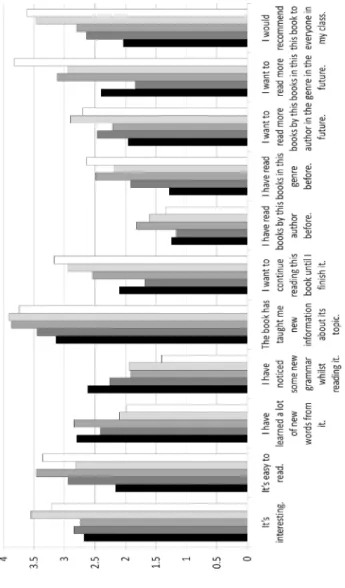
Several patterns can be observed in responses to these questions over the five survey administrations. Earlier in the year, students perceived themselves to have
learned more new vocabulary and grammar than from the books that they were reading later in the year. Despite this, they claimed to have learned more about their later books’ topics and
Figure 2. Factors reported as contributing to students’ choice of reading books
appear to have enjoyed the later books more, finding them more interesting and easier to read. They showed greater interest in the genres and authors of their later books, and stated that they would recommend them to classmates more strongly.
Overall, it seems fair to state that students’ attitudes towards their books generally improved over the year.
Mean scores from 1 (strongly disagree) to 4 (strongly agree) for each statement over the 5 rounds of surveys can be seen on the graph in Figure 2.
4.3 Questions on attitudes towards extensive reading
Students appeared to begin the year with generally positive attitudes towards extensive reading, with eight of the eleven statements about the benefits of ER UHFHLYLQJDERYHWKHK\SRWKHWLFDOO\QHXWUDOPHDQVFRUHRILQWKH¿UVWVWDJHRIWKH survey. They were less inclined to agree with spending class time just reading books, and that it is better for students to choose their own books to read.
This level of positive opinion towards ER was generally maintained throughout the year, with seven of the eleven statements receiving above-neutral scores in the
¿QDOURXQGRIVXUYH\V$WWKLVVWDJHVWXGHQWVZHUHQRZPRUHSRVLWLYHDERXWUHDGLQJ during class time and choosing their own books, and less enthusiastic about the idea of a teacher choosing books for them. They also no longer seemed to agree as strongly that ER helped them to improve their vocabulary or grammar.
Mean scores for each statement can be seen on the graph in Figure 3.
4.4 Correlating book choice factors and attitudes
Some of the factors that students reported as playing an important role in their book FKRLFHVDUHSHUKDSVPRUHVXSHU¿FLDOWKDQRWKHUV)DFWRUVVXFKDVDERRN¶VWLWOHRUFRYHU image do not necessarily require the student to consider how appropriate the book
PLJKWEHIRUWKHPDVWKHFRYHUDQGWLWOHPD\QRWDFFXUDWHO\UHÀHFWDERRN¶VFRQWHQWRU GLI¿FXOW\OHYHO:KHQWKHDWWLWXGHVRIVWXGHQWVZKRUHOLHGRQVXFKVXSHU¿FLDOIDFWRUV were compared with the attitudes of students who made more informed choices, it was noticed that the former group tended to express less enjoyment of the books and less satisfaction with their choices. Conversely, those who took care to choose books that ZHUHQRWWRRGLI¿FXOWRUZKRFKRVHERRNVIURPDJHQUHLQZKLFKWKH\KDGSUHYLRXVO\
enjoyed books, found their reading easier and more pleasurable.
Figure 3. Mean scores showing students’ level of agreement with statements about extensive reading
6LPLODUO\VWXGHQWVZKRVHFKRLFHVPLJKWEHFRQVLGHUHGPRUHVXSHU¿FLDOH[SUHVVHG OHVVSRVLWLYHDWWLWXGHVWRZDUGVH[WHQVLYHUHDGLQJDQGOHVVEHOLHILQLWVEHQH¿WV0RUH FDUHIXOERRNFKRLFHVDSSHDUHGWRFRUUHODWHZLWKRSLQLRQVWKDW(5LVEHQH¿FLDODQGD productive use of class time.
Figure 4. Mean scores showing level of agreement with statements about reading books for students choosing books according to particular factors
Figure 5. Mean scores showing level of agreement with statements about extensive reading for students choosing books according to particular factors
5) DISCUSSION
5.1 Factors contributing to choice of book
Although students in the participating three classes were not in principle restricted to graded readers, the vast majority of them chose these books for every book that they read. The most likely reasons for this are the ease with which they would be able to read such books, and the availability of them in the library and SALC at KUIS. The extensive reading classes all took place in classrooms adjoined to the SALC, which made this the most convenient location from which to obtain reading books. The SALC contains a large number of graded readers from most of the major publishers, with titles intended to appeal to a wide range of students. It is therefore unnecessary for most students to travel further than the SALC in order to find something to read that appeals to them in both its content and level. Students may DOVREHXQOLNHO\WRPDNHDQHIIRUWWRUHDGPRUHGLI¿FXOWPDWHULDOVLQFHSDUWRIWKHLU grade for the advanced reading course depends on the number of books that they are able to get through in a semester.
7KHIDFWRUVWKDWVWXGHQWVUHSRUWHGDVEHLQJPRVWVLJQL¿FDQWWRWKHPZKHQFKRRVLQJ books tended to be more superficial in the earlier surveys. Basing choices on the attractiveness of the front cover, the catchiness of the title, or the desire to simply get through a book as quickly and with as little effort as possible, is perhaps unlikely to result in students reading books that they actually enjoy. In the later surveys, contributing factors became arguably less superficial, with students relying more on interest in the topic, recommendations from peers, information about the content gleaned from the back cover blurb, and sampling the level of the book by reading WKH¿UVWIHZSDJHV7KHVHPHWKRGVRIFKRRVLQJERRNVUHÀHFWWKHNLQGVRIDFWLYLWLHV that were carried out during extensive reading classes, in which students discussed the books that they read with peers and took part in activities such as predicting
book plots from their blurbs and comparing readers containing the same stories but at different vocabulary levels. It might therefore be suggested that teachers FDQLQÀXHQFHWKHLUVWXGHQWV¶FKRLFHVRIERRNVDWWKHVDPHWLPHDVDOORZLQJWKHP freedom of choice) by encouraging them to think more carefully when at the bookshelf and choose books that correspond to the their personal preferences.
While this study did not explore the effect that “mood” plays in determining students’ book choices, the other factors mentioned by Ross (1999), notably the
“behind the eyes knowledge” and the influence of social networks, do feature in the findings. Book recommendations from friends and classmates became a more commonly important factor over the course of the year, and more so than recommendations from teachers and other staff members. This perhaps supports Ross’s conclusion that, “recommendations are important, but only from a trusted source”, with non-peers being apparently less trusted.
5.2 Correlations between book choice and attitudes
The results described in section 4 quite clearly indicate that students enjoy their books and think more highly of extensive reading when they make an effort to choose books that are appropriate for them in content and level. While it is often suggested that teachers should act as model readers in the reading classroom, and while students may be inspired to read a book after seeing a teacher enjoy it, it does not seem to be advisable for teachers to recommend books to students to the extent that students subsequently disregard their own preferences. It may also be necessary for students to be trained in selecting books that they will appreciate, and not to simply choose the nearest or shortest text in order to obtain credit with the OHDVWSRVVLEOHHIIRUW7KHEHQH¿WVRIJUDGHGUHDGHUVERWKSHGDJRJLFDODQGSUDFWLFDO should not mean that students are limited to books that they do not want to read, as if
the goal of ER is to encourage students to gain a reading habit they are only likely to do so with material that they choose to read without being told to do so.
6) CONCLUSION
6XPPDU\RI¿QGLQJVDQGLPSOLFDWLRQV
,WKDVEHHQVXJJHVWHGWKDWH[WHQVLYHUHDGLQJVWXGHQWVZLOOEHQH¿WPRUHIURPVHOI directed reading if they choose books to suit their own personal ability, interests, and preferences. They will not only enjoy such books more than books assigned by a WHDFKHURUVHOHFWHGZLWKRXWFDUHEXWDOVR¿QGWKHPHDVLHUWRUHDGPRUHVXFFHVVIXOO\
facilitating the extensive reading that they are supposed to be doing. Teachers should encourage their students to think carefully about the books that they intend to read, DQGDOVRWRUHÀHFWRQWKHPDIWHUUHDGLQJWRGHFLGHLIWKH\ZLOOHQMR\VLPLODUERRNVLQ the future. It is likely that friends and classmates with similar interests will be better suited than teachers to recommend reading material.
6.2 Limitations and suggestions for further study
Further data is to be collected and analysed following this study, in the hope of obtaining a broader and more reliable view of the ways that students choose their books and the links between these and their enjoyment of extensive reading.
Statistical correlations will be calculated when a larger set of data is available.
The participants in the present study were students in three classes, taught by two different teachers. It is entirely likely that different classroom teaching methods and activities employed by different teachers would result in different book choices being made and different attitudes towards books. It would therefore be desirable to collect data from a wider range of classes, and also to report on the things that take SODFHLQHDFKFODVVWKDWPLJKWLQÀXHQFHWKHVHUHVXOWV
REFERENCES
Bell, T. (2001) Extensive Reading: Speed and Comprehension. The Reading Matrix 9RO1R
Day, R., & Bam ford, J. (1998) Extensive reading in the second language. New York: CUP
Ellery, W., Mangubhai, F.(1983) The impact of reading on second language learning.
Reading Research Quarterly 19,53-67.
Grabe, W. (2009) Reading in a second language: moving from theory to practice.
New York: CUP
Grabe W., & Stoller F. (1997) A six Ts approach to content-based instruction. In M. Snow & D. Brinton (Eds), The content based classroom: Perspectives in integrating and content (pp. 78-103). New York: Longman.
Grabe, W., & Stoller,F. (2002) Teaching and researching reading. New York:
Longman.
Hafiz, F., & Tudor, I. (1989) extensive reading and the development of language skills.English Language Teaching Journal 43,1, 4-13.
Horst, M. (2005) Learning L2 vocabulary through extensive reading: A measurement study. Canadian Modern Languages Review 61, 355-82.
Helgesen, M. (2005) Extensive reading reports-different intelligences, different levels of processing. The Asian EFL Journal9RO1R
Hill, D. (1997) Survey review: graded readers. ELT Journal 51,57-81.
Hill, D. (2001) Survey : Graded readers. ELT Journal, 55 (3), 300-324
+X0 1DWLRQ,639RFDEXODU\GHQVLW\DQGUHDGLQJFRPSUHKHQVLRQ Reading in a Foreign Language, 13(1), 403-430.
Krashen, S. (1982), Principles and Practice in Second Language Acquisition, Pergamon Krashen, S. (1985), The Input Hypothesis: Issues and Implications, Longman
Krashen, S. (1993), The Power of Reading, Libraries Unlimited Inc, Englewood Colorado
Mason, B. and Krashen, S. (1997). Extensive reading in English as a foreign language. System, 25, 91-102.
Mikulecky, B. (1990). A short course in teaching reading skills. Reading, MA:
Addison -Wesley.
Nation, I.S.P. (2009) Teaching ESL/EFL Reading and Writing. New York: Routledge.
Palmer, H.E (1964) Principles of language study. London:Oxford University Press Palmer, B.M., Codling, R.M., & Gambrell, L.B. (1994). In their own words: What
elementary students have to say about motivation to read. The Reading Teacher 48,176-178.
3LJDGD0 6FKPLGW19RFDEXODU\DFTXLVLWLRQIURPH[WHQVLYHUHDGLQJD case study. Reading in a Foreign Language 18 (1), 1-28.
Pressley, M., & Allington, R. L. (1999).What should educational research be the research of ? Issues in Education: Contributions from Educational Psychology, 5, 1–35.
Richards, J.C. & Schmidt, R. (Eds.). (2002). Longman dictionary of language teaching and applied linguistics London: Longman.
Tsang, W. (1996). Comparing the effects of reading and writing on writing performance.Applied Linguistics, 17 (2), 210-233.
Sheldrick Ross, C. (1999) Finding without seeking: the information encounter in the context of reading for pleasure. In formation Processing and management 35(6): 783-799
Yamashita, J. (2008) Extensive reading and development of different aspects of L2 SUR¿FLHQF\System 36, 661-672.
Yang, A. 2001. Reading and the non-academic learner: A mystery solved. System 29(4):451-466.
APPENDIX A
– Extensive reading book selection survey1. Please enter your student number ...
2. What is the title of your current book? ...
3. Who is the author of your current book? ...
:KHUHGLG\RX¿QG\RXUFXUUHQWERRN"
___ The SALC ___ The KUIS library ___ Borrowed it from a friend ___ Book shop ___ Another library ___ Other ...
5. How many pages does your book have?
___ 0-50 ___ 101-200 ___ 301-400 ___ Over 500 ___ 51-100 ___ 201-300 ___ 401-500
6. How many pages of your book have you read so far?
___ 0-10 ___ 51-75 ___ 151-200 ___ 11-25 ___ 76-100 ___ 201-300 ___ 26-50 ___ 101-150 ___ Over 300
7. Why did you choose your book? (Select as many reasons as you want) ___ I am interested in the topic ___ I liked the title
___ I am interested in the genre ___ I have read it before in Japanese ___ I like the author ___ It is part of a series that I like ___ A classmate or friend ___ It is the right level for me, recommended it to me judging my the vocabulary test ___ A teacher or staff member ___ It is the right level for me, recommended it to me judging by reading a part of it ___ It is very popular/famous/ ___ It looked easy to read well-known
___ I liked the front cover ___ I wanted a challenging book
BBB,OLNHGWKHEDFNFRYHU BBB,KDYHVHHQWKH¿OPRU79VHULHV 8. Which is your MOST IMPORTANT reason (select only one)
___ I am interested in the topic ___ I liked the title
___ I am interested in the genre ___ I have read it before in Japanese ___ I like the author ___ It is part of a series that I like ___ A classmate or friend ___ It is the right level for me, recommended it to me judging my the vocabulary test ___ A teacher or staff member ___ It is the right level for me, recommended it to me judging by reading a part of it ___ It is very popular/famous/ ___ It looked easy to read well-known
___ I liked the front cover ___ I wanted a challenging book BBB,OLNHGWKHEDFNFRYHU BBB,KDYHVHHQWKH¿OPRU79VHULHV 9. Thinking about your current book, do you agree or disagree with the
following statements?
Disagree a lot
Disagree a little
Agree a little
Agree a lot
(a) It’s interesting ___ ___ ___ ___
(b) It’s easy to read ___ ___ ___ ___
(c) I have learned a lot of new words from it. ___ ___ ___ ___
(d) I have noticed new grammar whilst reading it. ___ ___ ___ ___
(e) The book taught me information about its topic. ___ ___ ___ ___
(f) ,ZLOOFRQWLQXHUHDGLQJWKLVERRNXQWLO,¿QLVKLW ___ ___ ___ ___
(g) I have read books by this author before. ___ ___ ___ ___
(h) I have read books in this genre before. ___ ___ ___ ___
(i) I want to read more by this author in the future. ___ ___ ___ ___
(j) I want to read more in this genre in the future. ___ ___ ___ ___
(k) I would recommend this book to everyone in my class. ___ ___ ___ ___
10. Thinking about extensive reading in general, do you agree or disagree with the following statements?
Disagree a lot
Disagree a little
Agree a little
Agree a lot (a) Extensive reading helps to improve my
English. ___ ___ ___ ___
(b) Extensive reading helps to improve my
vocabulary. ___ ___ ___ ___
(c) Extensive reading helps to improve my
grammar. ___ ___ ___ ___
(d) Extensive reading helps to improve my
reading speed. ___ ___ ___ ___
(e) Extensive reading helps to improve my
understanding of written English. ___ ___ ___ ___
(f) I often read my English reading book
when I have free time. ___ ___ ___ ___
(g) I want to spend more time in class just
reading my book. ___ ___ ___ ___
(h) I like talking in class about the books
that I have read. ___ ___ ___ ___
(i) ,WLVHDV\IRUPHWR¿QGERRNVWRUHDG ___ ___ ___ ___
(j) It is better for the teacher to tell students
which books they should read. ___ ___ ___ ___
(k) It is better for students to choose their
own books to read. ___ ___ ___ ___