Survey Results: Attitude toward Sustained Silent Reading and Extensive Reading outside the Classroom
Nobuko SAKURAI
Abstract
This paper discusses the findings of the questionnaire surveys on Sustained Silent Reading (SSR) and extensive reading (ER) outside the classroom together with the implication of the amount of reading that participants achieved for one academic year. Thirty-seven first-year university students experienced SSR for ten minutes every lesson, filling out record sheets.
As homework, they were expected to read and take quizzes on Moodle Reader. The records of the number of words read showed that the students eagerly read books extensively both in and outside the classroom. It was also indicated that the participants increased reading speed by SSR and that the difficulty to find time to read outside the classroom caused the decrease in the amount of reading. The outcomes of matched t-tests suggested that the students had a more positive attitude toward reading during class time. This was due to the fact that they felt more pressure although they were able to gain a greater sense of accomplishment when they read books as homework. However, further analyses demonstrated that the subjects who accomplished the homework assignment were not pressured as much. It is suggested that the amount of reading could influence the attitude toward ER.
Keywords: SSR, ER, the number of words read, matched t-test, an analysis of variance
Introduction
Reading is an essential part of English education in Japan at junior and senior high schools as well as in universities. Especially at Japanese junior and senior high schools, English lessons are usually centered around reading instructions. Although Day & Bamford (1998) stated that reading in language education consists of scanning, skimming, close reading and extensive reading, reading in Japanese schools has generally been what Nuttall (1982) described as careful reading to pursue deep and accurate understanding of materials under the guidance of the instructor. However, extensive reading (ER) has been gaining popularity in recent years. In fact, Furukawa, Takase & Nishizawa (2009) noted that the number of people and schools that were engaging in ER increased from 2003 to 2008 (Takase, 2010).
Day & Bamford (1998) who have been conducting ER in language classrooms for long defined ER as follows (pp. 7-8):
1. Students read as much as possible.
2. A variety of materials on a wide range of topics are available.
3. Students select what they want to read.
4. The purposes of reading are usually related to pleasure.
5. Reading is its own reward.
6. Reading materials are well within the linguistic competence of the students.
7. Reading is individual and silent.
8. Reading speed is usually faster rather than slower.
9. Teachers orient students to the goals of the program.
10. The teacher is a role model of a reader for students.
In a nutshell, learners choose what they want to read from among a variety of easy books and enjoy reading a large number of them at a good rate of speed in ER programs.
There has been a lot of research published to prove the beneficial outcomes of ER.
Krashen (2004) summarized a number of studies that ER had a significant effect not only on reading ability and vocabulary but also on spelling, writing and listening skills. When people read, they automatically and instantly understand the accurate meaning and sound of vocabulary used, keep them in the working memory as a chunk and understand the meaning of the passage using their background knowledge (Day & Bamford, 1998). This process seems to suggest that what is necessary for reading is vocabulary, phonology, grammar and knowledge about the world. Hence, it may be natural to conclude that reading influences the development in these. Interestingly, however, Mason & Krashen (1997) reported the further efficacy of ER. University students who had failed an English class and were repeating the course learned English through ER in their study. This resulted in the turnaround in the students’ attitude toward English in addition to the better scores in an English test than those of the students in the controlled group who were learning English in the traditional manner. In a study conducted by Furukawa (2008), 49 second-year junior high school students in his juku, a private school after school, read extensively for 80 minutes a week listening to the CDs that accompanied ER books. Their test scores of the Assessment of Communicative English Exam, a nationwide English test for high school students in Japan, outperformed the average score of second-year senior high school students nationwide in the vocabulary/grammar and reading sections as well as the national average score of third- year high school students in the listening section. After carefully examining the previous experience of English learning of his students and the amount of their learning outside
his juku, Furukawa (2008) attributed the outstanding performance of his students to ER.
Moreover, the average TOEIC score of engineering majors in a technical college who read extensively for 45 minutes per week for five years reached the national average of third-year university students who majored in English (Nishizawa, Yoshioka & Ito, 2010). Furthermore, nine studies reported by Elley (1991) demonstrated that elementary school students who were learning English as a second language improved listening, speaking and writing skills together with vocabulary and reading skills in an ER program. In summary, ER can lead to the progress with language skills and general language proficiency, the growth of positive attitude toward English and the advancement in test scores.
Although Day & Bamford (1998) along with Nuttall (1982) affirmed that ER should be conducted outside the classroom, reading in class has a history when it comes to reading in the mother tongue. According to Grubaugh (1986), Sustained Silent Reading (SSR) was established by Hunt (1971). It is an effective method to cultivate a positive attitude toward reading (Sadoski, 1980). Some researchers are promoting SSR in the second language learning context. Takase (2010) assured that one of the three essential principles of the instruction of ER is SSR as it fosters the reading habit, enhances concentration and secures time for reading. The role of instructors in ER programs is crucial (Sakai & Kanda, 2005; Furukawa, 2010; Day & Bamford, 1998). It is doubtful that Japanese students who often do not read regularly even in their native language can choose appropriate ER books by themselves.
Also, those who are used to reading complicated materials word by word to prepare for entrance exams may not understand how they should read books for ER. Therefore, SSR that enables the instructor to counsel and give advice to individual students is indispensable in successful ER programs.
The primary question under investigation in the current study is how SSR affects learners in an ER program. The results of the questionnaire surveys that were carried out with students who experienced both SSR and ER outside the classroom are going to be examined.
The influence of the way ER is conducted in the attitude toward ER will also be assessed.
Method
Participants of this research were 37 first-year students who were majoring in science at a private Japanese university in 2010. All freshmen were divided into 5 levels based on the results of the placement test developed by the university. The subjects of the study
were either level 3 or 4 and considered to be intermediate in English proficiency level.
These students were required to take the two major English courses, Oral Communication and Reading Skills, which met twice a week for one year. Students were expected to read extensively outside the classroom for both of the courses as part of course work.
Students were given a handout that informed them of the purpose and effectiveness of the ER program at the beginning of the spring semester. The instructor explained with it about what students should do and how the number of words they read was reflected on their final grades. After this short orientation, students were obliged to go to the library, borrow books of their levels, and take quizzes for books they read on Moodle Reader, a module developed by the university to assist the implementation of ER. They were allowed to use the dictionary and look at books during tests. The number of words in a book accumulated when they correctly answered approximately 60% of the questions that were randomly generated from the database.
The final grade comprised the result of the final exam that was developed by the university (30%) and participation / assignment points calculated by each instructor (70%).
Depending on the number of words they accumulated by reading extensively, students had up to 5 points added to or deducted from their final grades. The minimum number of words they were demanded to read was also announced. No points were added or deducted for those who just reached the minimum number of words to be read. Table 1 shows how the number of words read was converted to points. A level 3 student who read 35,000 words gained 2 points which were added to the final grade, while a student of the same level who accumulated only 10,000 lost 3 points, for example. Since the participants of the present study, level 3 or 4 students, were taking the two English courses, it was necessary for them to read 100,000 and 120,000 respectively in order to get the maximum points to be added to the final grades of both of the courses.
Table 1
The number of words per point, the minimum number of words to be read and the number of words to be read to obtain 5 points (words)
1 point ± 0 + 5
Level 3 5,000 25,000 50,000
Level 4 6,000 30,000 60,000
The subjects of the study spent 10 minutes of each lesson of Reading Skills course on choosing and reading an easy English book brought into the classroom. They were instructed to keep a reading record sheet where they wrote down the date, the title of the book, the series name, the number of words the book contained, and a short comment or a summary of the story. They were oriented to write comments that would prove they read and understood the stories. They usually needed a few minutes to complete an entry on the record sheet.
Reading record sheets were collected upon the completion of every tenth book, and the number of words in the books the students read accumulated when the record keeping was evaluated as satisfactory. The number of words read in SSR accounted for 20% of the final grade of Reading Skills course.
The students were guided through an appropriate way of reading ER books in the first few weeks of April. They were trained to read smoothly from left to right with CDs and to avoid regressing and translating. They were also encouraged to guess the meaning of unknown words from the context and illustrations. They sometimes suggested books to each other. Some asked the instructor to recommend a good book to read.
As Table 2 summarizes, the participants chose Oxford Bookworms, Cambridge English Readers, and Penguin Readers when they read outside the classroom. The majority of the books in the library were graded readers (GR), books carefully written for English learners.
The students mostly read books that were 5000 to 7000 words long. To avoid overlap, leveled Table 2
Books used in and outside the classroom
Outside the classroom In class
Oxford Bookworms Starter Cambridge English Readers Starter Penguin Readers Level 2
Oxford Bookworms Level 1 Cambridge English Readers Level 1
Penguin Young Readers Levels 2, 3 & 4 Oxford Reading Tree Levels 5 & 6 Oxford Classis Tales B1, B2, E1, E2 & E3 Cambridge Storybooks Level 4
Primary Classic Readers Levels 2 & 3 Let’s Read and Find Out Science Levels 1 & 2 Rookie Read About Health
Ready-To-Read (Henry & Mudge) All Aboard Reading Levels 1 & 2 Scholastic Reader Levels 2 & 3 I Can Read Books Levels 1 & 2 Fast Forward Level 10
readers (LR), easy books for young native speakers of English, were utilized for SSR. LRs that were not on the database of Moodle Reader were selected by the instructor. Also, most of the LRs contained less than 1,200 words so that the students were able to finish reading within 10 minutes. All or a part of books were changed every month depending on the likes and dislikes of the students and their reading speed.
A 6-point Likert scale questionnaire which was a variation of the one created by Takase (2007) was administered in class in January, 2011. It consisted of three sections. The first section included 11 questions that inquired about reading overall, the second section 22 concerning SSR and the third section 22 about outside-the-classroom ER. The translated version of the questionnaire can been found in Appendix 1. The statements in Section 2 and 3 were identical except for one item regarding the way to prove that books were read and understood. That is, keeping reading record sheets was recognized as equivalent to taking quizzes on the computer (Q22 and Q44).
The results of the questionnaire and the number of words read in class were first input into Excel, then transferred to SPSS (version 18.0) together with the data of the outside- the-classroom ER. Matched t-tests were performed to identify if there were statistically significant differences between the attitude toward SSR and ER as homework. This was followed by Pearson correlation coefficient to examine if there was a relationship between the total number of words read and the attitude toward ER. Then, one-way analyses of variance (ANOVA) were run to further investigate the influence of the number of words read on the attitude toward SSR and outside-the-classroom ER.
Results and Discussion
As exhibited in Table 3, the participants read an average of 83,325 words in the spring semester and 60,138 in the fall respectively for the two English courses outside the classroom. The minimum number of words that level 3 and 4 students were required to read for each course was 25,000 and 30,000 respectively (see Table 1). Therefore, it can be said that the students fully accomplished the assignment for both courses. Unfortunately, however, the average number dropped in the fall, as did the number of words the most
enthusiastic student read from 230,263 to 140,081. In fact, 29 students out of 37 accumulated fewer words in the fall. It is believed that the more people read, the faster they will read.
The subjects should have read more in the fall for it is assumed that their reading speed was faster in the second semester. The main cause of the decrease was apparently the increased assignments in their science courses. A lot of students were often observed studying science materials between classes in the fall. They actually said they were busier with quizzes, tests and reports in their major in the fall than in the spring. This is suggestive that they had less time to spend on reading extensively as homework. Another possible reason is that some students who achieved a high grade in the spring decided that they did not need extra points to be added to their final grades. The sharp fall of the minimum number of words read from 21,924 to 1,928 also implies the less engagement in ER outside the classroom in the fall.
Table 3
The descriptive statistics of the number of words read outside the classroom for the two English courses (words)
Mean SD Max Min
Spring 82,325 34,129.03 230,263 21,924
Fall 60,138 32,022.66 140,081 1,928
Whole year 142,463 62,342.09 370,334 39,527
Contrary to ER as homework, the average number of words read in class increased in the fall as well as the maximum number of words read (Table 4). There were 14 or 15 weeks in one semester in the academic year of 2010. ER was conducted from the second lesson in both semesters. This means that the participants experienced SSR in 58 lessons. A simple calculation indicates that the students read a 500-word long book in each lesson in the spring and a 600-word long book in the fall. Comments heard from some students in the fall included
“I now can read English in English if the books are easy enough!” and “I can read smoothly now in the English word order.” These remarks can be interpreted as the evidence of a gain in reading speed. The minimum number of words read in class decreased by about 1,000 in the fall. This is attributed to the poorer attendance. Approximately half of the students were Table 4
The descriptive statistics of the number of words read in 58 lessons (words)
Mean SD Max Min
Spring 13,923 3,203.28 20,925 7,539
Fall 17,315 4,070.15 27,275 6,552
Whole year 31,238 6,374.24 46,583 14,589
absent from class once to four times in the fall, lowering the overall attendance rate to 92%
from 95%. Excuses provided were club activities and study for science classes.
The first section of the questionnaire was to investigate the participants’ overall attitude toward reading. Table 5 demonstrates the positive responses (Likert scales of 4 to 6) to 11 questions of the section. A number of the students seemed to feel they had not been good at reading in English during the six years of their previous education (Q10). In spite of that, they said they were interested in exchanging e-mails and reading websites, newspapers, magazines and novels in English (Q1 & Q2). In addition, the responses to Q4 revealed that they wanted to read English books in order to make use of the knowledge they would obtain from the books when traveling overseas. Likewise, they stated they wanted to broaden their views and absorb knowledge to be educated (Q5 & Q7). Interestingly, however, the branches of knowledge, history, culture and lifestyles did not seem to appeal to them as much (Q3).
Their replies to Q6, Q8 and Q9 implied that they were aiming not at a short-term goal such as getting a good grade but at a long-term goal which was to improve their English in general. About half of the subjects appeared to have a positive attitude toward reading from the answers to Q11.
Table 5
The positive replies to Section 1 of the questionnaire (%)
Table 6 summarizes the outcomes of two-tailed matched t-tests performed utilizing the data of Section 2 and 3 of the questionnaire. There was a statistically significant difference in five sets of attitude between SSR and ER as homework.
Firstly, it seemed to be suggested that the participants were less likely to feel bored or sleepy while reading extensively in class (#1). They might have also been feeling that ER books selected by the instructor tended to be somewhat more interesting (#5) and enjoyable (#3). Impressively, the classroom during SSR was so quiet and serene that it was as if the concentration of the students had been visible even during the first period and in the third
period after lunch. How they were reading outside the classroom was not monitored, so it is not possible to compare the level of their attention to books when they were outside the classroom. However, the results of the t-test are understandable and believable to the researcher who witnessed the students’ immersion in books during SSR. In contrast, it appeared to be indicated that the students were inclined to feel somewhat more bored and sleepy when they were reading as homework. The assigned books in the library generally contained 1,000 to 7,000 words, whereas books read in class were 200 to 1,500 words long.
The urge to reach the target to finish the assignment quickly seemed to have made the participants choose books with more than 5,000 words. The time required for a short book and a long one differs significantly. Therefore, it can be said that a 10-minute reading time was too short to fall asleep. The setting where the students needed to stand up to select and exchange books might also have prevented them from feeling tired.
Secondly, result #4 revealed that the subjects of the present research felt a greater sense of accomplishment when they finished books from the library. These were GRs that were longer with fewer illustrations compared to LRs utilized in the classroom. The students must have thought that GRs were more difficult than LRs. Dornyei (1994) concluded from the result of the research carried out by Skehan (1991) that “what motivates learners to study a second language depends on what language they study and where they study it” (p. 275).
This suggests that a distinctive, culturally imbedded motivation could exist in the Japanese environment where people learn English as a foreign language. In Japan where students generally learn reading in the traditional grammar translation method, people tend to believe the acquisition of a foreign language is the product of effort and hard work (Day & Bamford, 1998). The books that the participants read as homework must have involved more effort and stronger determination to fight against sleepiness and boredom. This could have fostered a greater sense of accomplishment. In addition, Oxford & Shearin (1994) reported that some language learners are motivated to learn more by experiencing superior, proud feelings of acquiring a difficult language. It is probable that Japanese students who read more difficult materials than their actual English levels at junior and senior high schools acknowledge that reading easy materials is not equal to study.
The difference in attitude toward SSR and ER outside the classroom appears to have been revealed by result #2. A lot of students asked how many books they had to read as homework to reach the target goal when they were given a handout about outside-the- classroom ER in April. This was due to the fact that the number of words listed as a goal was not understandable to the students who were to try ER for the first time. In fact, they
all looked overwhelmed by the big numbers like 50,000 and 60,000. It was easily speculated that the students felt a lot of pressure to complete the assignment as well as frightened of failing the required English courses since the educational system of university was still unclear to them at the beginning of the spring semester. Questions such as “Are you taking quizzes?” and “How many words have you read?” were often heard among students with worried look on their faces. Their purpose of reading extensively outside the classroom could have been to read 100,000 words (level 3) or 120,000 words (level 4) in order to obtain the maximum points for the two courses rather than to enjoy stories.
While ER as homework seemed to have entailed some stress rather than enjoyment, SSR did not appear to have caused much negative emotions to the readers. As mentioned above, reading record sheets were carefully examined and they accounted for 20% of the final grade. The points allotted to SSR were more affective than the points received by ER outside the classroom. Regardless of this fact, the students gave the impression to the instructor that they were reading spontaneously. This can be attributed to some factors. First, ER in class was conducted in every lesson, so it is assumed to have become a regular classroom activity rather than an assignment. Additionally, all their classmates were engaged in it next to each other. According to Day & Bamford (1998), favorable feelings toward the instructor, classmates, assignments and reading materials contribute to the development of a positive reading habit. The fact that the participants were getting along with each other well and that they found books utilized for SSR inspiring can be thought to have made a desirable atmosphere for reading. The majority of the students named SSR when they were asked what they wanted the instructor to continue doing in the same course in the following year.
This remark can be a proof that they did not suffer from SSR but enjoyed it and considered Table 6
The descriptive statistics and t-values of the items that showed a statistically significant difference
Question In class Outside the classroom
Q# M SD Q# M SD t
#1 I feel bored and sleepy when I
read an ER book. #19 3.27 1.239 #41 4.05 1.153 -4.400*
#2 I read an ER book only because it
is a requirement. #21 3.22 1.134 #43 4.22 1.134 -4.967*
#3 I enjoy reading an ER book. #29 3.97 .957 #51 3.35 1.033 4.235*
#4 I feel a sense of achievement when
I finish an ER book. #32 3.92 1.090 #54 4.22 1.158 -3.353*
#5 A lot of ER books are interesting. #33 3.95 .815 #55 3.32 1.132 3.251*
* = p < .05
it as effective.
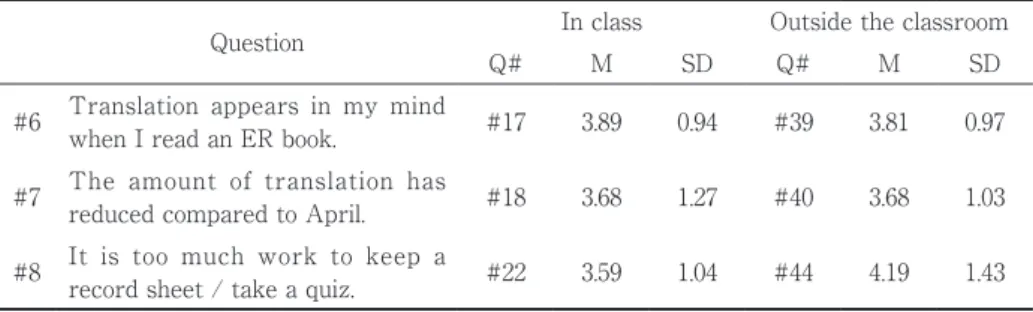
Table 7 exhibits the descriptive statistics of the questions concerning the amount of translation and the means of reporting that the books were read and understood.
Unexpectedly, the replies to the questions Q17, Q18, Q39 and Q40 did not produce statistically significant results (#6 and #7). It can be inferred that the length and difficulty of books may not influence the individual students’ habit of translating English into Japanese word by word. It is also noteworthy that keeping a record sheet and taking quizzes on the computer did not affect the students’ attitude toward ER (#8). The issue can be associated with the widespread use of smart phones and iPads. Students who have been surrounded by these advanced gadgets from an early age on may be less inclined to reject computers than students in the past. Also, this could have been because the participants were science majors.
Another reason can be offered by a finding that taking tests powerfully motivates learners as its results confirm their progress and it can be an immediate goal to aim at (Bandura &
Schunk, 1981). Some students could have found passing a quiz enjoyable.
Table 7
The descriptive statistics of the questions related to translation and the means of reporting
Question In class Outside the classroom
Q# M SD Q# M SD
#6 Translation appears in my mind
when I read an ER book. #17 3.89 0.94 #39 3.81 0.97
#7 The amount of translation has
reduced compared to April. #18 3.68 1.27 #40 3.68 1.03
#8 It is too much work to keep a
record sheet / take a quiz. #22 3.59 1.04 #44 4.19 1.43
As shown in Table 8, the participants read 173,701 words on average in and outside the classroom altogether during the academic year. Pearson correlation coefficient was computed to find out if the relationship between the total number of words read and the attitude toward ER existed. The results confirmed that the amount of reading was statistically significantly correlated to question #14 “ER books used in class are more interesting than English textbooks because stories are longer” (r = -.428, p < .01) and question #43 “I read an ER book outside the classroom only because it is a requirement” (r = -.333, p < .05). It is suggested that the more the participants read, the less interesting they felt the ER books utilized in SSR were. Since question #14 prompted the respondents to compare the length of LRs with that of stories in English textbooks, it can also be interpreted that the students
started feeling that LRs were as short and boring as reading passages in textbooks as they kept reading extensively. The correlation between the amount of reading and question #43 offers a possibility that the students were less obliged to do ER outside the classroom as the number of words they accumulated increased. Interestingly, the previously conducted t-test demonstrated a statistically significant difference between the attitude toward SSR and ER as homework (See #2 in Table 6). It is speculated that the pressure the participants were facing to reach the target goal could have been lessened as they read more.
Table 8
The descriptive statistics of the total number of words read in and outside the classroom throughout the year (words)
Mean SD Max Min
In and outside the classroom (year) 173,701 64,759 412,546 76,903
ANOVA was performed to explore the amount of reading that was needed to alter the attitude toward the outside-the-classroom ER. First, the subjects were divided into two groups: those who read more than the average and those who read less than the average.
More specifically, the students in one group read more than 173,701 words and the others less than that number. The descriptive statistics of the groups are shown in Table 9. The result did not yield a statistically significant difference between the means of these two groups.
To investigate further, a different way of grouping was pursued as exhibited in Table 10.
ANOVA was computed between the students who accomplished reaching the minimum number of words they were assigned to read as homework and those who did not. That is, the first group consisted of 17 level 3 and 9 level 4 students who accumulated at least 100,000 and 120,000 words respectively for both of Oral Communication and Reading Skills courses in the spring and fall semesters. There was a significant difference between the groups (F (1, 35)
= 6.787, p < .05). One interpretation of this outcome is that the participants in the first group were feeling more relieved toward the end of the academic year when the questionnaire was administered. They had successfully completed the assignment in the spring semester, Table 9
The descriptive statistics of the reply to Q#43 by those who read more than average and less than average in and outside the classroom altogether throughout the year
Question Q# Group N M SD
I read an ER book outside the classroom
only because it is a requirement. #43 More than average 19 3.95 1.079 Less than average 18 4.50 1.150
and they had grasped the number of words required to read was manageable. They were probably feeling assured that no points were going to be deducted from their final grades of the fall semester. Also, it seems reasonable to consider that the subjects started enjoying books from the library once they gained momentum. They could have got so engrossed in long stories of GRs that they forgot that it was an assignment. As Day & Bamford (1998) state, reading a lot is critical in ER programs. The amount of reading could be powerful enough to change the attitude toward reading for the better.
Table 10
The descriptive statistics of the reply to Q#43 by those who read more than the minimum and less than the minimum as homework for both of the courses throughout the year
Question Q# Group N M SD
I read an ER book outside the classroom only
because it is a requirement. #43 Accomplished 26 3.92 .997
Not accomplished 11 4.91 1.221
Conclusion
This study attempted to research on some differences between the attitude toward ER in class and the attitude toward ER as homework. The participants read less outside the classroom in the fall semester than in the spring. It is plausible to conclude that less time was available for ER outside the classroom. On the other hand, they read more in class in the fall semester. This implicates that their reading rate improved as they read more in class.
The results of matched t-tests applied were suggestive that the students tended to enjoy ER books brought to class more and that SSR made them feel less tired or bored. It was also speculated that completing a GR caused them to feel a greater sense of achievement although they were feeling impelled to read. In addition, the increase in the amount of reading correlated with the improved attitude toward ER outside the classroom according to the result of Pearson correlation coefficient. The further investigation utilizing ANOVA revealed that there was a statistically significant difference in the attitude toward ER as homework between the participants who achieved accumulating the minimum number of words to be read for the two required English courses in both of the semesters and those who did not. A possible conclusion can be drawn that the students who accomplished the target goal were reading extensively outside the classroom not only for their grades but also for pleasure.
It should be admitted that there are crucial limitations to this study. The outcomes could
not be the same if the way SSR and the ER program of the university were implemented had been altered. Firstly, the change in the number of words students were expected to read and the way it was reflected on the final grade could have been influential. The fact that the participants had nothing else to do but to read during SSR should be underscored as well.
They needed to struggle to secure time for ER as homework in their tight schedule. Thirdly, utilizing two different kinds of ER books might have been an affective factor. GRs and LRs are different in nature. Generally speaking, LRs used in class were full of colorful, cute illustrations. A lot of students might have been paying attention to illustrations since they were oriented to get clues from pictures when they guessed the meaning of words they did not know. They often made comments about pictures even though they had been instructed to talk about storylines on reading record sheets. In fact, some were selecting books because of illustrations they favored. Moreover, the length of the books brought into the classroom was much shorter than that of GRs. This made a lot of difference in the amount of time the students were forced to keep concentrating. Therefore, the discrepancies between the setting of SSR and ER outside the classroom should be recognized. The same results cannot be likely to be obtained if one element of the setting is modified. It needs to be emphasized that generalizing the outcomes of this research is not appropriate.
Nuttall (1982) stated that “if you enjoy reading, you will read faster. If you read faster, you will read more. If you read more, you will understand more. If you understand more, you will enjoy reading more” (pp. 167-168). She continued that it is most desirable to start with enjoying reading to form a good reading habit. What the results of this study suggest is that SSR provides sufficient conditions for it. If students read extensively in class with their classmates regularly, they will genuinely enjoy reading as a fun activity. If they enjoy reading, they will read faster. Developing a reading habit in this way will lead students to feel less pressured to do ER as homework. They will read more outside the classroom, and may continue reading for pleasure. Even if the results of the current study should not be applied to general situations, it is believed that a number of ER advocates along with the author will agree to benefits of SSR.
References
Bandura, A., & Schunk, D. (1981). Cultivating competence, self-efficacy, and intrinsic interest through proximal self-motivation. Journal of Personality and Social Psychology, 41, 586-598.
Day, R. R., & Bamford, J. (1998). Extensive reading in the second language classroom. New York:
Cambridge University Press.
Dornyei, Z. (1994). Motivation and Motivating in the Foreign Language Classroom. The Modern
Language Journal, 78(3), 273-284.
Elley, W. B. (1991). Acquiring literacy in a second language: The effect of book-based programs.
Language Learning, 41(3), 375-411.
Furukawa, A. (2008). Extensive reading from the first day of English learning. Extensive Reading in Japan, 1(2), 11-14.
Furukawa, A. (2010). Eigo tadoku ho [How to read English extensively]. Tokyo: Shogakukan Inc.
Grubaugh, S. (1986). Initiating sustained silent reading in your school. The Clearing House, 60, 169-174.
Krashen, S.D. (2004). The power of reading: Insights from the research (2nd. Ed.). CT: Libraries Limited.
Mason, B., & Krashen, S. (1997). Extensive reading in English as a foreign language. System, 25(1), 91 -102.
Nishizawa, H., Yoshioka, T., & Ito, K. (2010). The effectiveness of a 5-year extensive reading program.
JERA Bulletin, 4, 2-14.
Nuttall, C. (1982). Teaching reading skills in a foreign language. Oxford: Heinemann.
Oxford, R., & Shearin, J. (1994). Language learning motivation: Expanding the theoretical framework.
The Modern Language Journal, 78, 12-28.
Sadoski, M. C. (1980). An attitude survey for sustained silent reading programs. Journal of Reading, 23, 721-726.
Sakai, K., & Kanda, M. (2005). Kyoshitsu de yomu eigo 100 man go [One million words to be read in the classroom]. Tokyo: Taishukan Publishing, Co., Ltd.
Skehan, P. (1991). Individual differences in second language learning. Studies in Second Language Acquisition, 13, 275-298.
Takase, A. (2007). Japanese high school students’ motivation for extensive L2 reading. Reading in a Foreign Language, 19(1), 1-18.
Takase, A. (2010). Eigo tadoku tacho shido manyuaru [Manual for teaching extensive reading and listening]. Tokyo: Taishukan Publishing, Co., Ltd.
Appendix 1
Questionnaire
This questionnaire is only for research purposes to improve the ER program, and is not at all related to your grades. Please answer honestly using the numbers 1 to 6.
6. I strongly think so. 5. I think so. 4. I think so to some extent.
3. I don’t think so so much. 2. I don’t think so. 1. I never think so.
About reading in English overall
1. I want to be able to read information on websites written in English and exchange e-mails in English.
2. I want to be able to read newspapers, magazines and novels in English.
3. I want to learn histories, cultures and lifestyles of English speaking countries by reading English books.
4. I want to make use of knowledge I get by reading English books when I travel abroad.
5. I want to broaden my view by reading English books.
6. I want to be able to read in English in order to get a good job in the future.
7. I want to get knowledge to be educated by reading English books.
8. I want to improve my general English proficiency by reading English books.
9. I want to get a good grade by reading English books.
10. I was good at reading in English at junior and senior high schools.
11. I like reading in Japanese.
About ER in class
12. I feel relieved when I finish reading an ER book in class.
13. I feel like reading another ER book when I finish reading one in class.
14. ER books used in class are more interesting than English textbooks because stories are longer.
15. I read an ER book used in class till the end of the story even if it is not interesting.
16. I get absorbed in the story when an ER book I read in class is interesting.
17. Japanese translation appears in my mind when I read an ER book in class.
18. The number of times when Japanese translation appears in my mind has reduced
compared to April while I read an ER book in class.
19. I feel bored and sleepy when I read an ER book in class.
20. I want to keep reading and finish it once I start reading an ER book in class.
21. I read an ER book in class only because it is a requirement.
22. It is too much work to keep a reading record sheet.
23. I sometimes talk with my friends about the contents of ER books that I read in class.
24. I want to read more books in class than my friends.
25. I feel like checking my dictionary when I see unknown words while I read an ER book in class.
26. I enjoy seeing the number of books and words I read in class increase.
27. I enjoy feeling that my reading speed is getting faster while I read an ER book in class.
28. I have to stop reading and learn the meaning of them when I see unknown words while I read an ER book in class.
29. I enjoy reading an ER book in class.
30. I enjoy the challenge that reading an ER book in class poses.
31. I feel more confident every time I finish an ER book in class.
32. I feel a sense of achievement when I finish an ER book in class.
33. A lot of ER books used in class are interesting.
About ER outside the classroom
34. I feel relieved when I finish reading an ER book outside the classroom.
35. I feel like reading another ER book when I finish reading one outside the classroom.
36. ER books used outside the classroom are more interesting than English textbooks because stories are longer.
37. I read an ER book used outside the classroom till the end of the story even if it is not interesting.
38. I get absorbed in the story when an ER book I read outside the classroom is interesting.
39. Japanese translation appears in my mind when I read an ER book outside the classroom.
40. The number of times when Japanese translation appears in my mind has reduced compared to April while I read an ER book outside the classroom.
41. I feel bored and sleepy when I read an ER book outside the classroom.
42. I want to keep reading and finish it once I start reading an ER book outside the classroom.
43. I read an ER book outside the classroom only because it is a requirement.
44. It is too much work to take quizzes on the computer.
45. I sometimes talk with my friends about the contents of ER books that I read outside the classroom.
46. I want to read more books outside the classroom than my friends.
47. I feel like checking my dictionary when I see unknown words while I read an ER book outside the classroom.
48. I enjoy seeing the number of books and words I read outside the classroom increase.
49. I enjoy feeling that my reading speed is getting faster while I read an ER book outside the classroom.
50. I have to stop reading and learn the meaning of them when I see unknown words while I read an ER book outside the classroom.
51. I enjoy reading an ER book outside the classroom.
52. I enjoy the challenge that reading an ER book outside the classroom poses.
53. I feel more confident every time I finish an ER book outside the classroom.
54. I feel a sense of achievement when I finish an ER book outside the classroom.
55. A lot of ER books used outside the classroom are interesting.
授業内多読と授業外多読への取り組み姿勢に関する調査結果
桜 井 延 子
要 旨
本稿は,教室内での多読と授業外の課題として多読を経験した大学一回生 37 名に実施した アンケートの回答を読書量と共に考察するものである。学生は,授業内では記録用紙に記録を とりながら多読図書を 10 分間程度読み,授業外の課題としては多読後にコンピューター上の ムードルリーダーにアクセスして読んだ本に関する小テストを受験することになっていた。一 年間の読書量の記録から,対象者は授業内でも授業外でも熱心に多読に取り組んでいたことが 分かるが,教室内で読むことでスピードを上げ,授業外では時間の確保が問題であることが示 唆された。また,対応のある T 検定の結果,課題としての多読は,達成感は味わえるが課題 であるという意識が強く,教室内での多読に対してより肯定的な姿勢で取り組んでいたことが 分かった。しかし,更なる分析の結果,課題をこなした被験者はこなさなかった被験者に比べ 課題であるという意識が弱かったことが分かった。読書量が多読に取り組む姿勢にも影響を与 えることが示唆された。
キーワード: 授業内多読,授業外多読,読書量,対応のある T 検定,一元配置の分散分析