The persisting legacies of imperial elites among contemporary top‑ranked Vietnamese politicians
著者(英) Tien Manh Vu, Hiroyuki Yamada journal or
publication title
AGI Working Paper Series
volume 2020‑13
page range 1‑7
year 2020‑06
URL http://id.nii.ac.jp/1270/00000177/
Creative Commons : 表示 ‑ 非営利 ‑ 改変禁止 http://creativecommons.org/licenses/by‑nc‑nd/3.0/deed.ja
The persisting legacies of imperial elites among contemporary top-ranked Vietnamese politicians
Tien Manh Vu
Asian Growth Research Institute, Osaka University, and Kyushu University
And
Hiroyuki Yamada
Faculty of Economics, Keio University
Working Paper Series Vol. 2020-13
June 2020
The views expressed in this publication are those of the author(s) and do not necessarily reflect those of the Institute.
No part of this article may be used reproduced in any manner whatsoever
without written permission except in the case of brief quotations
embodied in articles and reviews. For information, please write to the
Institute.
1 The persisting legacies of imperial elites among contemporary top-ranked
Vietnamese politicians
Tien Manh Vu
†and Hiroyuki Yamada
††Abstract
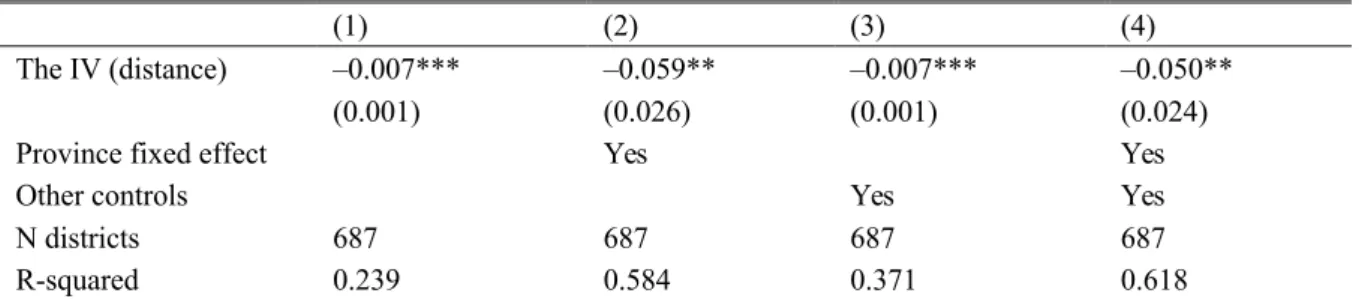
This study investigated how the legacies of Vietnamese elites continue to affect top-ranked politicians in Vietnam. We therefore compared a list of elites who passed the imperial examination (1075–1919) at the national level with a list of currently active Vietnamese top- ranked politicians (1930–2020) by matching their home districts. We used the average distance from each district to imperial test venues as instrumental variables for estimating possible connections at the district level. Results showed strong and persistent imperial legacies based on these home districts. This suggests the existence of persistent transmissions via informal institutions and channels of home favoritism.
Key words: legacy, elite, imperial elite, politician, Vietnam JEL classification: N35, N45, P26, J62
Acknowledgements
This work was supported by JSPS (Japan Society for the Promotion of Science) KAKENHI Grant Number 18K12784, 18K01580, 19H00619, and 20H01506, project grants from the Asian Growth Research Institute, Kyushu University, and Keio Gijuku Academic Development Funds.
†
Corresponding author. Asian Growth Research Institute, Osaka University, and Kyushu University. 11–4 Otemachi, Kokura-kita, Kitakyushu, Fukuoka 803–0814, Japan.
Tel.: +81 93 583 6202, Fax: +81 93 583 6576.
E-mail: [email protected].
††
Faculty of Economics, Keio University.
2–15–45 Mita, Minato–ku, Tokyo 108–8345, Japan.
1. Introduction
People of the mid-20
thcentury witnessed the rise of communism throughout the world while many former colonies gained independence. In this regard, the Communist Party of Vietnam (CPV) was a pioneer. Its initial aims were to free the country from oppressive French colonialism, terminate the monarchical regime, and transition to communism. Members of the CPV distinguished themselves from those working in previous institutions while holding power in 1945 and continued to do so even after reunification in 1975. As communists, they defined themselves as the leaders of a revolutionary faction.
Meanwhile, a rich body of literature shows that historical legacies have continued to persist, even through formal institutional changes (for specific reviews, see Nunn, 2020).
Recent investigations into the impacts of imperial elites on contemporary educational outcomes and revolutions have also revealed strong connections. Chen et al. (2020) found that more imperial elites were associated with higher average years of schooling in contemporary China.
Vu and Yamada (2020) showed a similar connection in Vietnam, thus indicating the influence of a strong legacy (via learning culture) on educational quality despite the termination of Chinese script in the Vietnamese written language. Notably, Bai and Jia (2016) investigated higher quotas on entry level imperial examinations, thus finding a higher corresponding probability of revolution after the examinations were removed. They also argued that this resulted in a cessation of access to higher social classes. As such, those who expected to become elites actually became revolutionaries. Meanwhile, Bai (2019) found that the quota was also associated with higher numbers of “new” Chinese elites who acquired their educations abroad.
Unlike China, Vietnam spent additional decades passing between French colonialism
and monarchy following the last imperial examination in 1919. This arrangement continued
based on a North–South division until the emergence of today’s regime in the whole country
after reunification in 1975. This poses the question of whether a similar mechanism can explain
a similar legacy in Vietnam. As such, this study investigated whether the imperial legacy still
influenced contemporary top-ranked communists and what channels may have affected this
transmission. More specifically, we searched for connections between the historical numbers
of imperial elites and numbers of top-ranked communists in terms of their respective home
3 ranked communists were considered members of the Central Committee of the CPV throughout its history. These politicians are probably the most powerful people in the authoritarian regime (for details, see Vu and Yamada, 2017). We based our analyses on an instrumental approach in which the instrumental variables (a proxy for the educational costs posed to those who took the imperial examination) were set as the average distances from each district to the imperial test venues. Our findings addressed a gap in the literature while also enabling us to propose alternative mechanisms for transmission.
2. Data and empirical strategy
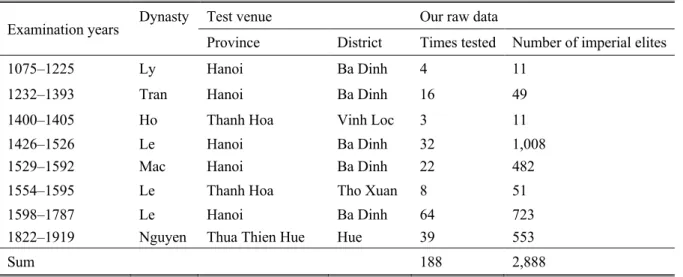
This study used an instrumental approach in which we regressed the number of contemporary top-ranked communists ( 𝑇𝑜𝑝 𝑝𝑜𝑙𝑖𝑡𝑖𝑐𝑖𝑎𝑛 ) on the number of imperial elites (𝐼𝑚𝑝𝑒𝑟𝑖𝑎𝑙 𝑒𝑙𝑖𝑡𝑒) for each Vietnamese district. In this regard, we used two data sources. The first was a list containing the names of 2,888 imperial elites from Ngo (2006), while the second was a list of all (825) Central Committee members of the CPV (hereafter, top politicians) between 1930 and 2020 (taken from Vu and Yamada, 2017). These lists were compared to determine which individuals were operating in the same home districts. We were able to identify and match 2,839 imperial elites with 738 contemporary top politicians based on their respective home districts
1. Ngo (2006) compiled the most comprehensive list of imperial elites who passed the imperial examination at the national level from 1075 to 1919 (i.e., throughout Vietnamese history), while Vu and Yamada (2017) compiled a list of contemporary top politicians based on their corresponding profiles from the official CPV website. The data consisted of 687 Vietnamese districts
2.
We then created three panels to analyze outcomes. Panel A’s outcome consisted of all top politicians (1930–2020), while Panel B’s consisted of affiliates of the first Central Committee of the CPV (1930–1951), and Panel C’s consisted of those in power subsequent to reunification (1976–2020) (excluding those who were also listed as Central Committee members in any previous period
3) (see Appendix 1). District-level geographical data were used as controls (𝑋). We then calculated three other factors, including population density, the Kinh
1
Some observations were omitted due to missing information concerning the home district.
2
The district is the second administrative level in Vietnam. There were 689 in 2009. Two districts were omitted because they were missing necessary information for controls.
3