Abstract
Consultation Support Specialists (CSS) are required to create Service Utilization Plans for all individuals using welfare services for persons with disabilities. However, the number of Service Utilization Plans created to date falls far short of national targets. This reveals that no efforts are being made to increase CSS knowledge and skill requirement levels. Guidelines to help increase knowledge and skill levels can be obtained from the perspective of disaster social work conducted in the wake of the Great East Japan Earthquake.
Although many social workers involved in disaster victim support were unable to provide support in response to the Great East Japan Earthquake, there were a few reports of such support during social welfare symposia. Following these reports, the authors structurally analyzed support in response to the Great East Japan Earthquake from the perspective of “tacit knowledge” with the objective of improving CSS skill levels. An interview survey was conducted between March and August 2015 on nine CSS engaged in disaster victim support. Based on the perspectives elucidated from the survey, previous literature, and the support experiences of the researchers
themselves, 20 key words were extracted from interview narratives and divided into five categories using hierarchical cluster analysis. Free association was then applied to clarify the core concept of “clarify the principles of CSS and systemize comprehensive community support including crisis management without placing special focus on support recipients”.
Introduction 1. Background
Since April 2012 it has been compulsory for Consultation Support Specialists (CSS) 1 to create Service Utilization Plans aimed at problem solving and service use for all individuals using welfare services for persons with disabilities. According to data published by the Ministry of Health, Labour, and Welfare, there were 735,958 users of welfare services for persons with disabilities[1] as of March 2015. Of these, Service Utilization Plans were prepared for only 146,817 individuals.
Numbers of plans were particularly low for Kochi (n=814), Yamanashi (n=919), Tokushima (n=1,057), and Kagawa (n=1,077) Prefectures and high for Tokyo Metropolis (n=8,403) and Osaka (n=8,375), Aichi (n=7,910) and Hokkaido
Developing a consultation support specialists training and education program:
A social work viewpoint based on disaster victim support
Satoru Yamaguchi Department of Social Welfare, Niigata University of Health and Welfare, Niigata, Japan
Key words: disaster social work, the Great East Japan Earthquake disaster, tacit knowledge, hierarchical cluster analysis, predictability
Received: 7 June 2016/Accepted: 8 September 2016
Corresponding author: Satoru Yamaguchi
Department of Social Welfare, Niigata University of Health and Welfare, 1398 Shimami-cho, Kita-ku, Niigata city, Niigata 950-3198, Japan
TEL/FAX: +81-25-257-4407, E-mail: [email protected]
recipients becomes unclear. In other words,
“recipients” and “mission” are (temporarily) lost and normal support methods are not viable.”[2]
Despite this background, CSS support activities in response to the Great East Japan Earthquake were occasionally reported during social welfare symposia and training workshops. The study objective was structurally analyzed from the perspective of the “tacit knowledge” (knowledge which cannot be easily expressed) contained within the small number of support activities performed in response to the disaster. The guidelines obtained from the structural analysis were then presented as basic materials for effective consultation support, including but not limited to disaster victim support.
3. Clarifying the disaster situation
The combination of human, natural, and nuclear power factors in the Great East Japan Earthquake disaster produced a compound disaster unprecedented in Japan’s history. According to Nishio et al., “Disaster social work accurately assesses need and then systemizes effective support for rescue, living situations, and rebuilding lives of disaster victims, particularly vulnerable members of society. These public and private support activities protect the lives, living situations, and dignity of individuals facing hardships due to disaster.”[3] This definition was used to think about disaster social work during the Great East Japan Earthquake disaster and demonstrates the importance of supporting the living situations of vulnerable individuals in terms of social work during disasters. Situation-based social welfare systems and problem solving ability are likely to be challenged by the needs and unexpected problems arising due to the manifestation of social vulnerabilities that exist during normal times.
The Great East Japan Earthquake occurred on March 11, 2011. Tsunami-related drownings accounted for 90% of deaths. A magnitude class 6 (n=7,224) Prefectures. However, all of these
numbers fall far short of Ministry of Health, Labour and Welfare targets, revealing issues with the qualification process and skill requirements.
One possible reason may be insufficiency in the current training standards for CSSs. Participation in prefectural training on consultation support for persons with disabilities is required in order to work as a CSS. However, if an individual has at least 5 years of practical experience in the social welfare field, only 3 to 5 days of this training are required to claim a CSS qualification, which is necessary to obtain a related job. This simplification of the qualification process means that no efforts are being made to increase CSS knowledge and skill requirement levels.
2. Objective
The present study aimed to verify CSS knowledge and skill requirement levels based on disaster victim support practice in order to try to improve these levels. Focus was placed on disaster victim support for the following reasons. During social welfare symposia and training workshops held after the Great East Japan Earthquake disaster, it was stated that, “the content of CSS activities in disaster-affected regions is hard to see.” Reponses to this opinion included, “when the Great East Japan Earthquake struck, the priority was on saving lives”, “social work to support living situations comes into play after physical and mental security has been established”, and “unlike standard social welfare practice, social work in disaster-affected regions targets a wide range of support recipients.” According to Endo, the social work perspective immediately post-disaster is that, “during normal times, social workers perform support activities within a conscious framework of domains (micro, meso, and macro) and fields (recipients: the elderly, children, persons with disabilities, and others). However, when a disaster occurs, social systems become at least temporarily dysfunctional, and the identity of support
living situations of disaster victims.
Materials and Methods 1. Clarifying terminology
With regard to ‘disaster social work’, Uenoya et al. characterized the structure of disaster social work in five stages[6]. In Stage 1, the “pre- emergency stage”, preventive measures are implemented before a disaster occurs. These involve building cooperation and support to avoid overlooking vulnerable individuals at the time of a disaster. In Stage 2, the “rescue and evacuation stage”, rescue and evacuation support and safety confirmation are performed immediately after a disaster occurs with the primary objective of keeping people alive. In Stage 3, the “evacuation shelter living stage”, support is provided to alert with the frustration and inconveniences that arise during the restricted lifestyle in an evacuation shelter. In Stage 4, the “temporary housing living stage”, new community organizations are formed to counteract the loss of pre-disaster communities.
In Stage 5, the “new/rebuilt housing living stage”, ongoing support is provided for rebuilding lives and looking to the future. Thus, even in tough disaster conditions, disaster social work must take into account potential problems that need to be dealt with for post-disaster living. This requires going beyond social work theory as a unique field of study to consultation support practice that will also be effective during disasters.
Nonaka et al.[7] introduced the term “tacit knowledge” from an economics perspective, defining it as subjective wisdom and knowledge that is difficult to express verbally or in writing.
Wisdom indicates judgment and processing, while knowledge represents recognition and understanding. In other words, tacit knowledge is
“judgment, processing, recognition, and understanding that are difficult to express.” Classic tacit knowledge comprises know-how and techniques requiring a high level of skill that are difficult to transfer to another person, for example aftershock also hit inland areas, exacerbating the
damage. In March 2015, a Japanese National Police Agency[4] report confirmed 15,892 deaths and 2,547 people missing, while according to the Nihon Keizai Shimbun[5], the number of people nationwide living away from their home reached approximately 229,000. In addition to the tsunami damage, in Fukushima Prefecture, the Tokyo Electric Power Company Fukushima Dai Ichi Nuclear Power Plant accident resulted in approximately 119,000 evacuations with approximately 47,000 people forced to leave the prefecture (as of February 2015). Four years after the Great East Japan Earthquake disaster, there were at least 80,000 evacuees living in prefabricated temporary housing across Iwate, Miyagi, and Fukushima Prefectures. Thus, the Great East Japan Earthquake disaster markedly affected the living situations of people in the area, resulting in a wide range of support needs spanning medical, sanitation, and social welfare services.
Persons with disabilities no longer had access to places for social interactions and were unable to receive support, which made their daily life difficult. Many people were forced to leave the prefecture or enter group living situations. This lifestyle stress caused an increase in psychological symptoms including insomnia, loss of appetite, and persistent anxiety. Although 5 years have now passed since the Great East Japan Earthquake, the future is still unclear. Although people are slowly rebuilding their lives, many individuals are still living in temporary housing. These factors together with current conditions after the Great East Japan Earthquake disaster and the definition of disaster social work indicate the need for renewed recognition by CSS of 1) the potential for unexpected problems and needs arising due to manifestation of social vulnerabilities that exist during normal times; 2) the likelihood that situation-based social welfare systems and problem solving abilities will be challenged; and 3) the paramount importance of support for the
was set that “one should have a common knowledge about factors that can enhance abilities of CSSs from the accumulated know-hows among the survey respondents.” In addition to that prerequisite, by being able to obtain a wide variety of opinions due to the wide-ranging years of experience in the field of social welfare, it was possible to extract concepts of high quality. In order to extract concepts of high quality, it is necessary not only to aggregate data from an unspecified number of respondents but also to focus on the individual survey respondents’ and aim for detailed concepts from what they have to say. However, the greater the number of people to be surveyed, the more difficult it becomes to verify on an individual basis, hence the overall picture of the concepts derived from the research subjects becomes less clear. The scientific nature of this study lies in the process of qualitative research that follows “the collection of data, identifications of investigators and research subjects, methods of analysis, generation of concepts and hypotheses, and the conclusions derived.” When this process is considered, the number of research subjects can be regarded as appropriate.
3. Study process and survey method
The study process involved clarifying the role, function, and other related aspects of disaster social work role based on subjects’ experiences;
verifying support for vulnerable disaster victims from the perspective of tacit knowledge; and clarifying guidelines for transforming the identified tacit knowledge into explicit knowledge.
Semi-structured interviews based on an interview guide were conducted at subjects’ workplaces between March and August 2015. The disaster victim support interview guide covered 1) the subject’s personal and support history; 2) the subject’s interpretation of CSS expertise; 3) the subject’s interpretation of care management; 4) proposals for CSS training; and 5) aspects of disaster victim support experience reflected in drifting in motorsports. Tacit knowledge is
experiential and can only be obtained through repeating experiences involving individual behavior, values, and emotions to form a comprehensive concept. This comprehensive concept gives rise to new explicit knowledge and advanced tacit knowledge. “Explicit knowledge”
is objective wisdom and knowledge that can be expressed verbally and in writing. It includes all wisdom and knowledge not included in tacit knowledge and can be explained as “judgment, processing, recognition, and understanding that can be expressed.” Generally, know-how and skills that have been visibly cultivated can be transferred and shared.
2. Subjects
Subjects 2 comprised nine CSS (seven men, two women) who met the following three inclusion criteria: 1) working in Consultation Support Offices for persons with disabilities in A Prefecture;
2) completion of CSS leadership training held by the Ministry of Health, Labour, and Welfare; and 3) involvement in disaster victim support 3 in A Prefecture after the Great East Japan Earthquake.
Subjects were in their 30s (n=3, 33.3%), 40s (n=4, 44.4%), and 50s (n=2, 22.2%). Mean±standard deviation (SD) age and length of experience in the social welfare field were 42.8±6.81 (range, 36-58) and 19.7±6.34 (range, 14-36) years, respectively.
The nine CSS who were surveyed had participated in the management of the CSS training that was held in Prefecture A from fiscal 2006 through fiscal 2015. The system was structured in such a way that three supervisors in charge were selected and they learned and gathered training know-how in their three-year term. Specifically, they were appointed as section leaders of the training program for one year, and the system was organized and implemented so that they would participate in all the sections in three years.
Considering the process of the training system, one of the prerequisites for survey respondents
excluded from rating). Similarity matrix data were then analyzed using a multivariate technique, specifically hierarchical cluster analysis (Ward’s method). Analyses were performed using HALBAU7 (ver. 7.5.1) statistical software.
5. Ethical considerations
Prior to the start of the study, subjects were provided with a written explanation of the survey response methods and the voluntary nature of participation, and informed that no negative bias would result from non-participation and data obtained would only be used within the scope of the present study. The same information was verbally delivered at the time of the interviews in presenting the consent form for participation was obtained. The study was approved by the Niigata University of Health and Welfare Ethics Committee (approval no. 17504-140703).
Results
1. Similarity matrix
The following 20 key words were extracted: 1) acquire rules of thumb; 2) expand range of living situations; 3) carefully listen to living situation background; 4) confirm fundamentals of living situation; 5) read mood of the other person; 6) consider regional characteristics; 7) provide timely support; 8) visualize the future based on the past;
9) be aware of the surroundings; 10) expand personal network; 11) clarify role; 12) share social resources; 13) do not depend on unreliable information; 14) generate ideas about what can be done; 15) think on feet; 16) transferring thoughts is difficult; 17) reality does not follow theory; 18) require the strength to be troubled; 19) shake off feelings of limitation; and 20) feel like nothing can be done. Table 1 shows the similarity matrix created for these 20 key words. The numerical value in Table 1 represents the distance between key words, and there is no specific unit to the value.
regular practice.
4. Analysis
Results regarding subject’s tacit knowledge were clarified from item 5 of the interview guide (aspects of disaster victim support experience reflected in regular practice), which was influenced by the responses for items 1) (the subject’s personal and support history) to 4) (proposals for CSS training). Taking into consideration previous literature and the perspectives of the researchers themselves based on their practical experience in disaster victim support, distinct key words were extracted after consolidating similar concepts. A Personal Attitude Construct analysis support tool[8] was used to quantify the similarity between the extracted key words in terms of distance. The reason for the using of “the PAC analysis support tool” was that the analytical process to generate the Similarity matrix was the same as “the PAC analysis” and thus the analysis was efficient. In the hierarchical cluster analysis, the distance is measured from the rating scale of each key word obtained from the survey participants. However, manual operation can mean a significant increase in workload, and that can lead to the possibility that responses become of lower validity as the analysts get tired. Furthermore, it is difficult to randomize the order of presentation, and there is a risk of entering the key words incorrectly because the record is made against the extracted key words.
One of the advantages of using the “PAC analysis support tool” is that the slider operation is available for the “simplification of answers and inputs, fragmentation of rating scales, easy analysis of calculation of the graded average between the key words.” Similarity was measured on a scale from 0-7 (0: almost completely dissimilar, 1: very dissimilar, 2: somewhat dissimilar, 3: neither similar nor dissimilar, 4: somewhat similar, 5:
very similar, 6: extremely similar, and 7: almost identical) and rated to create a similarity matrix (same-item pairs on the diagonal line were
Because it does not assume any groups to be classified, it can be considered a form of classification taxonomy that has no external criteria or evaluation for classification.
By using hierarchical cluster analysis, this study aims to discover and classify, from the similarities obtained, potential concepts that derive from the consciousness and behaviors of the research subjects that cannot be gained solely by questions and answers of interviews. The relationship between the similarity and the distance in hierarchical cluster analysis is that if they are
“alike = degree of similarity is high = distance is near”, whereas if they are “not alike = degree of similarity is low = distance is far”. Therefore, this study interprets “difference in nature of each piece of data” as distance and expresses similarities 2. Hierarchical cluster analysis
Based on the distances shown in the similarity matrix, hierarchical cluster analysis (Ward’s method) was then performed as a multivariate technique to generate category concepts from clusters of key words.
Multivariate analysis can be broadly divided into two methods. The first is the method that reveals the causal relationship between the objective variable (i.e. external criterion) and the explanatory variable (i.e. internal standard). Next is the method that classifies questions and answers of research subjects and clarifies the degrees of similarity. Hierarchical cluster analysis has no objective variable (i.e. external criterion).
Therefore, it does not separate existing groups into individuals as does the discriminant analysis.
Table 1. Similarity matrix for 20 key words
acquire 1.
rules of thumb
expand 2.
range of living situations
carefully 3.
listen to living situation background
confirm 4.
fundamentals of living situation
read 5.
mood of the other person
consider 6.
regional characteristics
provide 7.
timely support
visualize 8.
future the based on
the pas be aware 9.
of the surroundings
expand 10.
personal network
clarify 11.
role share 12.
social resources
13.do not depend on unreliable information
generate 14.
ideas about what can
be done think 15.
on feet transferring 16.
thoughts is difficult
reality 17.
does not follow theory
require 18.
strength the to be troubled
shake off 19.
feelings limitationof
20.feel like nothing
can be done 1 0 17.9 28.3 61 30.5 71.1 22.7 20.5 17.9 13.4 25 33.1 20.5 61.4 19 48 84.1 75.1 14.2 77 2 17.9 0 18.6 14.9 20.1 16.4 44.3 13.1 19.4 11.6 44.3 15.3 82.2 24.2 33.9 84.4 70.3 30.2 29.4 84.8 3 28.3 18.6 0 19.4 18.6 10.1 33.5 6.7 29 42.8 57.7 60.6 25.7 31.6 43.2 81.8 92.6 67.7 74.8 73.3 4 61 14.9 19.4 0 29.4 16.4 14.5 33.9 39.1 66.6 25.3 11.6 74.8 64.7 63.6 76.6 74 78.5 58.8 87 5 30.5 20.1 18.6 29.4 0 22.4 28.3 14.5 17.2 34.6 35.7 36.1 20.5 36.9 21.2 76.3 83.7 62.9 70.3 87.8 6 71.1 16.4 10.1 16.4 22.4 0 28.3 41.7 22 72.2 74.8 48.4 19.8 61.4 71.4 87 65.5 90 77.7 79.6 7 22.7 44.3 33.5 14.5 28.3 28.3 0 19.8 15.7 17.2 25 51.7 78.1 20.1 29 77.4 81.5 84.4 75.5 80.7 8 20.5 13.1 6.7 33.9 14.5 41.7 19.8 0 16.8 38.3 32.4 45.8 25 31.3 64.4 67 81.5 74.4 87.4 71.8 9 17.9 19.4 29 39.1 17.2 22 15.7 16.8 0 17.2 33.5 19.4 74 17.2 16 69.6 71.1 66.6 17.2 75.1 10 13.4 11.6 42.8 66.6 34.6 72.2 17.2 38.3 17.2 0 83.7 30.9 74 21.6 70.3 79.6 86.7 81.1 17.9 37.2 11 25 44.3 57.7 25.3 35.7 74.8 25 32.4 33.5 83.7 0 33.1 78.1 33.1 49.9 62.9 82.6 69.6 67.7 75.5 12 33.1 15.3 60.6 11.6 36.1 48.4 51.7 45.8 19.4 30.9 33.1 0 83.3 49.5 75.1 78.1 86.3 87.4 80 78.9 13 20.5 82.2 25.7 74.8 20.5 19.8 78.1 25 74 74 78.1 83.3 0 69.9 75.9 71.8 17.5 18.3 49.1 62.1 14 61.4 24.2 31.6 64.7 36.9 61.4 20.1 31.3 17.2 21.6 33.1 49.5 69.9 0 10.1 69.2 17.2 79.6 15.7 34.3 15 19 33.9 43.2 63.6 21.2 71.4 29 64.4 16 70.3 49.9 75.1 75.9 10.1 0 64 86.7 73.7 23.8 32.8 16 48 84.4 81.8 76.6 76.3 87 77.4 67 69.6 79.6 62.9 78.1 71.8 69.2 64 0 17.2 68.8 91.5 18.6 17 84.1 70.3 92.6 74 83.7 65.5 81.5 81.5 71.1 86.7 82.6 86.3 17.5 17.2 86.7 17.2 0 17.2 68.8 16.4 18 75.1 30.2 67.7 78.5 62.9 90 84.4 74.4 66.6 81.1 69.6 87.4 18.3 79.6 73.7 68.8 17.2 0 25.7 22.4 19 14.2 29.4 74.8 58.8 70.3 77.7 75.5 87.4 17.2 17.9 67.7 80 49.1 15.7 23.8 91.5 68.8 25.7 0 38.7 20 77 84.8 73.3 87 87.8 79.6 80.7 71.8 75.1 37.2 75.5 78.9 62.1 34.3 32.8 18.6 16.4 22.4 38.7 0
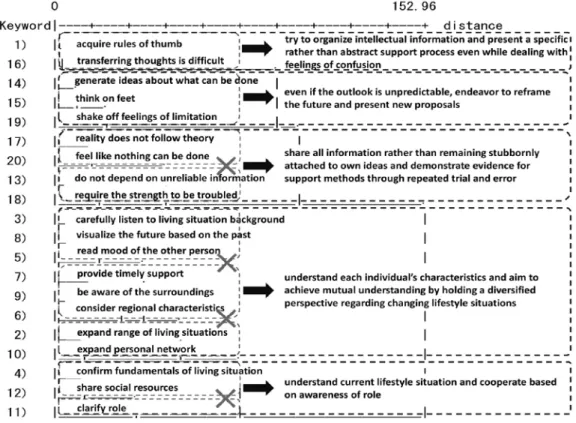
generated category 3: “share all information rather than remaining stubbornly attached to own ideas and demonstrate evidence for support methods through repeated trial and error”. Cluster 5 (key words 3 [carefully listen to living situation background], 5 [read mood of the other person], and 8 [visualize the future based on the past], cluster 6 (key words 6 [consider regional characteristics], 7 [provide timely support], and 9 [be aware of the surroundings]) and cluster 7 (key words 2 [expand range of living situations] and 10 [expand personal network]) together generated category 4: “understand each individual’s characteristics and aim to achieve mutual understanding by holding a diversified perspective regarding changing lifestyle situations”. Cluster 8 (key words 4 [confirm fundamentals of living situation] and 12 [share social resources]) and cluster 9 (key word 11 [clarify role]) generated category 5: “understand current lifestyle situation and cooperate based on awareness of role”
by the magnitude of distance between key words.
The definition of the degree of similarity in regard to the Ward method is: “the amount of increase of the sum of the squares when two clusters are merged” = “(sum of the squares after A and B are merged) ? (sum of squares within A) ? (sum of squares within B)”
Cluster 1 (key words 1 [acquire rules of thumb]
and 16 [transferring thoughts is difficult]) generated category 1: “try to organize intellectual information and present a specific rather than abstract support process even while dealing with feelings of confusion”. Cluster 2 (key words 14 [generate ideas about what can be done], 15 [think on feet], and 19 [shake off feelings of limitation]) generated category 2: “even if the outlook is unpredictable, endeavor to reframe the future and present new proposals”. Cluster 3 (key words 17 [reality does not follow theory] and 20 [feel like nothing can be done]) and cluster 4 (key words 13 [do not depend on unreliable information] and 18 [require the strength to be troubled]) together
Table 2. Annexation process of cluster
Step Keyword number New number Annexation distance
1 1+16 ⇒ 16 4.00
2 3+8 ⇒ 8 6.70
3 14+15 ⇒ 15 10.10
4 2+10 ⇒ 10 11.60
5 4+12 ⇒ 12 11.60
6 7+9 ⇒ 9 15.70
7 17+20 ⇒ 20 16.40
8 13+18 ⇒ 18 18.30
9 8+5 ⇒ 5 18.86
10 15+19 ⇒ 19 22.54
11 9+6 ⇒ 6 27.83
12 12+11 ⇒ 11 33.35
13 5+6 ⇒ 6 36.26
14 20+18 ⇒ 18 46.67
15 6+10 ⇒ 10 51.70
16 10+11 ⇒ 11 75.52
17 16+19 ⇒ 19 91.55
18 19+18 ⇒ 18 101.55
19 18+11 ⇒ 11 152.96
fundamental questions and record responses”;
“ask fundamental questions in terms of what subjects ‘see’, ‘hear’, ‘judge’, and ‘do’”; and “ask additional questions regarding ‘how much’, ‘what are the keys to helping’, and ‘until when’”. The third level and measure is “conduct interviews based on hypothetical testing”, specifically, “form a hypothesis focusing on the rationality of work operations, ask questions and record responses”
and “if the responses fit the hypothesis, write them down; if they do not match, ask questions regarding
‘where’ and ‘why’ they differ, and clarify”. The fourth level and measure is “once the interviewer has understood, verbalize”; specifically, “the interviewer themselves performs the work operations to fully understand the key aspects of the situation” and “the interviewer thinks for themselves and clarifies the fundamental meaning of the work operations”.
Discussion
Analysis of the subjects’ 4 years of experience after the Great East Japan Earthquake reinforced the importance of tacit knowledge when investigating means of passing on knowledge and lessons obtained through disaster victim support.
Specifically, the process of transforming tacit knowledge (judgment, processing, recognition and understanding that are difficult to express), into explicit knowledge is key. This process is demonstrated in the following “four levels and measures of clarifying tacit knowledge”[9]. The first level and measure is “observe and verbalize”, specifically, “observe and record subjects’ work operations and activities”; “list the work operation procedures in chronological order”; and “write down ‘what’ and ‘how’”. The second level and measure is “conduct interviews based on fundamental questions, specifically, “ask subjects
Figure 1. Dendrogram derived from 20 key words
Treatment and outreach support services for persons with disabilities were occasionally disrupted by the earthquake. The present study clarified that CSS providing disaster victim support in the wake of the Great East Japan Earthquake were openly confused regarding what constituted appropriate support. For example, from the perspective of evacuations, subjects reported that “in order to escape from radiation contamination, we left the prefecture with the persons with disabilities in only the clothes they were in” and from the perspective of a human resources, “mid-level staff with young children working for welfare services for persons with disabilities left the prefecture. So, the staff who remained behind were overloaded.” With regard to support for the CSS, subjects reported that, “CSS from other prefectures came to A Prefecture to help. However, they were overzealous and did not recognize the need to fit in with the activities of the CSS already working there, which increased Based on these four levels and measures of
clarifying tacit knowledge, categories 1-3 identified during cluster analysis were combined into overall category 1’ “social worker skill” while categories 4-5 were combined into overall category 2’ “approach toward support recipients.” Free association was used to generate a core concept based on these categories and the five underlying category concepts. From the process of forming explicit knowledge, this core concept was clarified as “clarify the principles of CSS and systemize comprehensive community support including crisis management without placing special focus on support recipients”.
Establishing and maintaining a comprehensive disaster support system for persons with disabilities has been of interest since disasters such as the Great Hanshin Earthquake and the Niigata Chuetsu Earthquake. However, during the Great East Japan Earthquake disaster, pre-disaster support frameworks such as Assertive Community
Figure 2. Process of formation of core concept to foster explicit knowledge
cannot be provided to the subjects, their lives do not improve. The support processes and living conditions vary from subject to subject, and change on a daily basis. Thus, it is important to consider the changing conditions of support subjects and assess and monitor them continuously, rather than attempting to fit them into one’s routine works. In order to ensure effective cooperation and participation in a rapidly changing social climate, the fundamental meaning of consultation support must be standardized. A further perspective of “predictability” must also be incorporated into a standardized approach to disaster victim support while complying with the four levels and measures of clarifying tacit knowledge. This entails envisaging the crisis situation resulting from a disaster. Unlike routine social work, there is no
“right” form of disaster victim support. The optimal solution in a given situation arises from the individual CSS at that particular time or cooperation from diverse sources. Thus, it is important to create a wealth of knowledge and possess practical resources and attributes. The most important factor is that systemization of ongoing consultation support is based on forming teams rather than one-way communication from individual CSS. An understanding of this concept will enable CSS to protect the living situations of support recipients through supplementary systems involving other social workers, even if the CSS finds themselves powerless to help.
Further investigations are planned for ongoing verification of the present findings. The aim is to create a “management system for tacit knowledge”
4 in order to identify as a matter of urgency potential community requirements in situations such as disasters. The present findings provide basic materials for effective consultation support including disaster victim support in order to support CSS in their vital role within the community.
the mental burden” and, in terms of daily life, that
“the tap water was cut off and we were unable to flush the toilets. However, luckily, because we could use the electricity, we were able to run the humidifiers and utilize water absorbed into the water tanks.” Subject narratives of their many experiences with disaster victim support also conveyed the impression that the CSS felt mentally and physically overwhelmed. However, subjects acquired knowledge through their confusion in this tense situation, as reflected in the extracted 20 key words.
Finally, it is necessary to look at disaster victim support from the perspective of the core concept
“clarify the principles of CSS and systemize comprehensive community support including crisis management without placing special focus on support recipients.” When the Great East Japan Earthquake occurred, systems, welfare services for persons with disabilities, and other support provisions malfunctioned. Immediate support is required at the time of a disaster and the consultation support required by disaster victims reflects the fundamental meaning of consultation support. The present subjects stated that “CSS who had been performing routine consultation support were able to provide effective consultation support even during disasters”, demonstrating that there is considerable overlap between the functions of consultation support during normal times and during disasters. The expression “Without placing special focus on support recipients” clearly shows the function of consultation support. Supporters become influenced by preconceptions and tend to assume “This person is a such and such type” or
“This is the support that is appropriate,” and fail to recognize the wishes of the subjects. If attempts to understand the wishes of the subjects are not made, appropriate collection of information is impossible. Social work fails to function properly if you don’t ascertain appropriate information about the subjects and, therefore, high quality support cannot be provided. If high quality support
2. Endo Y. A study of social work practices which accompanies the livelihood rehabilitation of disaster victims: Disaster Social Work to be considered together with students. Human Welfare Studies: 2013; 6 (1); 27.
3. Nishio Y, Otsuka Y, Furukawa T. What is Disaster Welfare: towards the establishment of a livelihood support structure. Minerva Publishing; 2010; 8.
4. Damage Situation and Police Measures. The Metropolitan Police Department; 2015. Available from: https://www.npa.go.jp/archive/keibi/biki/
higaijokyo.pdf. (accessed March 12, 2016) (in Japanese)
5. Number of Evacuees still at 229000: 4 years after the Great East Japan earthquake. The Nikkei; 2015. Available from: http://www.
nikkei.com/article/DGXLASDG10H80_
Q5A310C1MM8000/. (accessed March 12, 2016) (in Japanese)
6. Uenoya K, Endo T, Endo Y, Oshima T, Kawai T, Kawakami T, et al. Introduction to Disaster Social Work: Learning from practical knowledge gained in disaster areas. Chuohoki Publishing Co. Ltd; 2013; 30-32.
7. Nonaka I, Takeuchi H. The Knowledge Creating Company. Toyo Keizai Inc; 1996: 8.
8. Personal Attitude Construct Analysis Support Tool. Tsuchida Y; 2016. Available from: http://
wwwr.kanazawa-it.ac.jp/~tsuchida/lecture/
pac-assist.htm (accessed April 13, 2016) (in Japanese)
9. Mori K. How to proceed with the inheritance of tacit knowledge. Tokugikon. 2013; 268: 46.
Note1 Consultation Support Specialists aim to support the integration of “persons with disabilities” into the community. As social work professionals, they provide impartial, fair consultation support activities founded in care management, and support persons with disabilities in achieving independent living.
Note2 “Subjects” are operationally defined as
“Consultation Support Specialist engaged in disaster victim support” and “Social workers potentially able to bring new knowledge to light.”
Note3 “Disaster victim support” is operationally defined as “support for disaster victims who have evacuated their homes in exclusion zones (no-return zones, restricted residence zones, and pre-restriction lifting zones) to other areas regardless of whether this support is within or outside the social workers normal scope of work” (including support provided during temporary dispatch from support organizations and by individual volunteers.
Note4 A “management system for tacit knowledge”
is operationally defined as “a collection of information for transforming tacit knowledge into explicit knowledge.”
Acknowledgements
The author would like to thank professor Toyoharu Yokoyama, and all of the subjects who participated in this study.
References
1. About the utilization situation of welfare services for people with disabilities and benefits for children with disabilities. Ministry of Health, Labour and Welfare; 2015.
Available from: http://www.mhlw.go.jp/bunya/
shougaihoken/toukei/dl/01-24.pdf (accessed March 4, 2016) (in Japanese)