Comparison of the Interactive Classroom
Cultures in Japan and Bangladesh : Muhammmad Nur‑E‑Alam SIDDIQUEE
著者 Kubota Kenichi
journal or
publication title
情報研究 : 関西大学総合情報学部紀要
volume 49
page range 15‑20
year 2019‑01‑30
URL http://hdl.handle.net/10112/16847
*Senior Science Education Specialist, National Curriculum and Textbook Board (NCTB), Bangladesh
**Professor, Faculty of Informatics, Kansai university
Comparison of the Interactive Classroom Cultures in Japan and Bangladesh
Muhammmad Nur-E-Alam SIDDIQUEE*
Kenichi KUBOTA**
Abstract
The objective of this study is to compare the interactive classroom cultures in Japan and Bangladesh. A qualitative research design and especially an ethnographic video study were employed as a part of this unique study. Twenty science lessons from elementary education of both countries’ were recorded. Video lessons were transcribed verbatim and analyzed with coded categories. The results of our study revealed that there were notable gaps between the classroom culture in Japan and Bangladesh. More specifically, it was observed that the current teaching practices in the elementary science classroom in Bangladesh are unable to effectively promote active learning
Keywords: interactive classroom, dialogue, comparative study, Bangladesh
Research Background
The poor-quality science education is one of the most crucial concerns in Bangladesh. The quality teaching, on the other hand, is one of the most important levers to improve students’ learning (Stigler and Hiebert, 1999). To address the issues, the National Education Policy 2010 in Bangladesh emphasized the country’s educational system to be reformed. One of the major issues was the quality of teachers, which is closely related to professional development. To overcome the deficiencies and weaknesses of teachers’ teaching, the Ministry of Primary and Mass Education (MoPME) has been conducting various in-service programs and courses aiming to improve teachers’ teaching knowledge, skills and competencies. In line with this, the National Curriculum and Textbook Board (NCTB) with the technical support of the Japan International Cooperation Agency (JICA), developed competency- based curriculum and revised science and mathematics textbooks from grades 1 to 5 accordingly. The center of the revision was mainly focused on enhancing learners’ thinking skills through inquiry/
problem solving approach. In addition to that, teacher’s edition and teacher’s guides were developed
and distributed to the school in the year 2015. However, internal survey conducted by researcher
pointed out that the status of teaching practices was not change up to the required standards towards
promoting thinking skills. The lack of the most rudimentary information regarding existing science classroom was argued to not have produced an effective change in teaching (Stigler and Hiebert, 1999). Therefore, it is important to analyze the existing teaching process to identify the gap between intended and implemented curriculum in the context of Bangladesh.
Towards interactive teaching
Interaction through dialogue in classroom has been the subject of increasing discussion in the last few years and a number of writers have suggested that it held the greatest cognitive potential for pupils. Today, much success lies in being able to communicate, share, and use information to solve complex problems, in being able to adapt and innovate in response to demands and changing circumstances, in being able to command and expand the power of technology to create new knowledge. Educators around the globe, therefore, stress on the classroom interaction because of its tremendous impact on students’ learning, especially on problem solving skills. There is a call for incorporating 21
stcentury skills as well as its pedagogy in the next generation curriculum. The term dialogic teaching is increasingly appearing in documents from the education community, especially in England, French, The USA, and India to accommodate the dialogic pedagogy. This suggests that dialogic teaching/ interactive teaching is a concept of growing importance in discussion of learning and teaching. Bakhtin’s concepts of ‘dialogical meaning-making’ base on Vygotsky and Bruner’s notion – that all learning takes place in an historical, social and cultural context by claiming that ‘most learning in most setting is a communal activity, a sharing of culture’- allows the learner to play active role in developing a personally constructed understanding of the curriculum through the process of dialogic exchange. Next section will discuss regarding dialogue teaching, its features in a brief account.
What is Dialogue?
The is a general consensus that dialogue is beneficial for conceptual development and meaning- making learning of the pupils. Educators across the globe, however, define ‘dialogue’ in different ways.
In this study, researcher adopted the definition of dialogue given by Adam Lefstein and Julia Snell in their Book “Better Than Best Practice”. According to them, “Dialogue is the process of talking or reasoning through an issue” (this definition is a literal translation of the Greek: dia means ‘across’ or
‘through’ and logs ‘speech’, ‘word’, or ‘reason’). More precisely, dialogue is particular form of talking through an issue that serves particular purposes. Speech or talk must possess some characteristics to be the dialogue. Adam Lefstein and Julia Snell (2014) summaries the six approaches of dialogue;
interactional form, interplay of voices, critique, thinking together, relationship, and empowerment.
Each emphasizes different dimensions of communication and aimed towards the realization of different purposes. On the other hand, Alexander (2008) characterized and exemplified productive forms of dialogue in the classroom along with five core principles; collective, reciprocal, supportive, cumulative, and purposeful. Dialogism assumes that knowledge is something people do together rather than an
関西大学総合情報学部紀要「情報研究」第49号
2019年 1 月
16
individual possession. This approach to classroom practice is in contrast with monologic approaches, which dominate in the classroom in many parts of the world. It is the evident that, in most cases, classroom teachers at elementary level do not have clear understanding about the quality dialogue.
Therefore, purpose of the present study is to identify the features of science lessons in Japan and Bangladesh towards dialogue through ethnographic video study.
Main research question:
What are the instructional methods towards interaction that teachers currently use in Japan and Bangladesh? Specifically, the study explores:
i) What type of questions do teachers ask in teaching?
ii) What types of students’ responses are triggered?
iii) How teacher’s feedback to students’ various responses?
iv) How much thinking-time (wait-time) they offer for students to response?
Research Methodology:
We have started our research based on above-mentioned questions since October 2016. The research is highly qualitative in nature. The data of the research gathered through field research with video recording of science lessons in Japan and Bangladesh. Twenty Japanese science lessons in both private and public elementary schools have been observed and recoded from October 2016 to December 2106.
Twenty science lessons from the public elementary schools of Bangladesh have been observed and recorded form January 2107 to February 2017. The observed lessons were in mixed in nature, which included discussions on particular concepts, science experiments, class tests, demonstrations, outside observations and so on. Video data and filed notes were preserved accordingly for further analysis.
Data analysis:
Common classroom features in both countries were drawn by visiting the classroom videos and field notes repeatedly. In the common features of the classroom, total duration of the lesson, number of students, lesson organization (introduction, development, and summarization) were taken into account.
In order to capture the common instruction/ teaching methods of the lesson, this study did fine grain analysis. For the fine grain analysis, the main focus was teacher’s questions, students’ responses and teacher’s feedback as well as the thinking time (Wait-time). Only the sample lesson on discussion from both countries were transcribed verbatim from Japanese to English; and Bengali to English, and analyzed by coded categories. Video data were transcribed verbatim and analyzed through wait-time in classroom interaction analysis and the Questioning-based Discourse Analysis method, suggested by Ingram & Elliott (2016) and Chin (2006) respectively.
Research Results
The results of this collaborative study were organized into two categories: (a) common features of
the classroom and (b) the common instructional methods in Japan and Bangladesh.
(a) Common features of the classroom
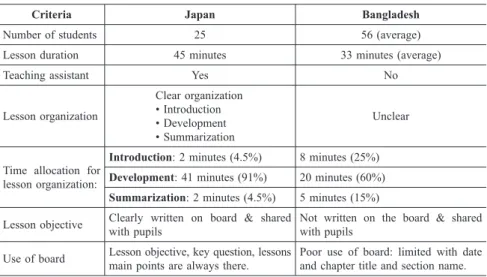
In Japan, average number of students is 25 while in Bangladesh it is 56. The average lesson duration is 45 minutes in Japan whereas in Bangladesh its only 33 minutes. Usually in Japan, there is a provision for teaching assistant; however, such provision is absolutely absent in Bangladesh. There are distinct three parts in Japanese lesson, including introduction that usually comes up with lesson objective and key question, development, and summarization alternatively, in Bangladesh such kind of clear division in lesson is lacking. However, an effort was made to identify the time distribution in each part of the lesson through this study. It reveals that Japanese teachers employ maximum time for the development part, which is accounted for 91% while it is 60%. in Bangladesh. Bangladesh teachers spend 25% of its lesson time for introduction whereas it is accounted for 4.5% in Japan. Maximum use of board is evident in Japan that contains lesson objectives, key question, and lesson’s main points and so on while in Bangladesh, use of board is limited with the chapter title, date and section name. The results of the common feature of the classroom are shown in the table 1.
Table 1: Common feature of the classroom
Criteria Japan Bangladesh
Number of students 25 56 (average)
Lesson duration 45 minutes 33 minutes (average)
Teaching assistant Yes No
Lesson organization
Clear organization
• Introduction
• Development
• Summarization
Unclear
Time allocation for lesson organization:
Introduction: 2 minutes (4.5%) 8 minutes (25%) Development: 41 minutes (91%) 20 minutes (60%) Summarization: 2 minutes (4.5%) 5 minutes (15%) Lesson objective Clearly written on board & shared
with pupils Not written on the board & shared with pupils
Use of board Lesson objective, key question, lessons
main points are always there. Poor use of board: limited with date and chapter title and section name.
(b) Common classroom instruction
Common classroom instruction methods, namely teacher’s questions, student’s responses, teacher’s feedback and wait-time, both in Japan and Bangladesh, was drown through fine grain analysis of a sample lesson and the results were describe according to following heads:
About question: In a single lesson period, the Japanese science teacher asked a variety of questions, which included all six categories of the Bloom’s revised taxonomy. Whereas in Bangladesh, teacher’s questions had less variation, asked mainly remembering questions, there was no question found in evaluating and creating question categories (Table 2).
関西大学総合情報学部紀要「情報研究」第49号
2019年 1 月
18
Table 2: Features of the classroom instruction
Instruction criteria Japan Bangladesh Teachers’ question (%)
Teacher’s Question
(I)
Remembering 8 (17.4) 24 (85.7)
Understanding 16 (34.8) 2 (7.1)
Applying 5 (10.9) 1 (3.6)
Analyzing 8 (17.4) 1 (3.6)
Evaluating 6 (13.0) 0
Creating 3 (6.5) 0
Total 46 28
Student’s response (%)
Student’s response
(R)
Long response with
reasoning/thinking 20 (43.5) 0
Long response with
knowledge 18 (39.1) 2 (7.1)
Word/Phrase type response 8 (17.4) 20 (71.4)
Incorrect response 0 1 (3.6)
I don’t/no response 0 5 (17.9)
Total 46 28
Teacher’s feedback (%)
Teacher’s feedback
(E)
C-S* 0 12 (43.0)
C-Q1 6 (13.0) 3 (10.7)
Q1 10 (21.7)
Q2 9 (19.6)
S-q 2 (4.3) 5 (17.6)
Q3 5 (11.0)
Q4 8 (17.4)
S 0 8 (28.7)
C-Q2 6 (13.0)
Total 46 28
*C-S: Restate student response-add more information via exposition; C-Q1: Neutral comment-asking question; Q1:
Precise question for elaboration; Q2: Ask students to judge; S-q: Explicit correction–direction instruction; Q3:
Constructive challenge; Q4: Reponses give back to the student via question; S: No comment-Direct instruction;
C-Q2: Restate the question along with comment.
Wait-time (elapsed time measured)
Post-teacher questions WT1a** WT1b 12(5.0) =60 7(0.8)=5.6 3.5 4(0.5) =2.0 9(.)=2.7 0.4 Post-student responses WT2a WT2b 5(0.7)=3.5 15(8.0)=120 6.2 7(.) 0 0.3 Total
**WT1a: Pauses following a teacher finishing speaking and a student starting to speak; WT1b: Pauses following a teacher finishing speaking and then taking next turn; WT2a: Pauses following a student finishing speaking and then the teacher taking the next turn; WT2b: Pauses following a student finishing speaking and then continuing their turn.
Note: (0.0) Number in brackets represents elapsed time measured in tenths of seconds, (.) Brief pause of less than 0.3 seconds [Formula for calculating WT: Frequencies of WT observed X elapsed time measured / Total observed frequencies of a category]
About student’s responses: A clear reflection of teacher’s question is evident on student’s response. Most
of the Japanese students’ responses similar to sentence containing knowledge and reasoning. The word
and phrase type responses are few, and there is no incorrect or no responses. In contrast, Bangladesh
students’ responses are mostly resemble to word or phrase types, few long responses having no
reasoning, there are incorrect and no responses (shown in Table 2).
About teacher’s feedback: Japanese teacher mostly employ facilitative feedback. The feedback contains neutral comment with question and question alone. While Bangladeshi teacher mostly use evaluative feedback, which contain direct exposition, statement and managerial question (Table 2).
About Wait-time: In the post-teacher question wait-time category, period of silence in the case of Japanese teacher is 3.5 seconds. Silence lasted 6.2 seconds in the case of post-student response, while in the case of Bangladeshi teacher, the post-teacher question wait-time category the period of silence is 0.4 seconds and post-student response category silence lasted a brief pause of less than 0.3 seconds (Table 2).
Conclusion
The comparative study reveals that there is clear distinction of teaching as well as common classroom features between Japan and Bangladesh. The results regarding teaching practices unveiled that the science teachers of the researched primary schools in Japan and Bangladesh employ different strategies in asking question, providing feedback and thinking time.
Asking various higher order questions along with providing enough thinking time, the Japanese teachers promote active learning which is clearly evident in students’ responses. In contrast, the Bangladesh teachers ask less variety of questions limited with remembering level and provides less thinking time indicated that there is no opportunity for students to think deeply and engage in active learning.
Therefore, the teacher educators should take the findings into consideration for further teachers’
professional development courses in Bangladesh, especially questioning techniques along with thinking time evident in Japanese case.
Acknowledgement: This research was supported by JSPS KAKENHI Grant Number 17H04572.
References
Alexander, R.J. (2008) Essays on Pedagogy, Routledge, especially pp 72-172 and 184-191
Chin, C. (2006). Classroom Interaction in Science: Teacher questioning and feedback to students’ responses, International Journal of Science Education, 28(11), 1315-1346
Ingram, J. & Elliott, V. (2016). A critical analysis of the role of wait time in classroom interactions and the effects on student and teachers interactional behaviours. Cambridge Journal of Education, 46:1, 37-53.
Lefstein, A., & Snell, J. (2014). Better Than Best Practice: Developing teaching and learning through dialogue, London: Routledge
Stigler, James W. & Hiebert, J. (1999). The Teaching Gap: Best Ideas from the world’s Teachers for Improving Education in the Classroom. New York, London, Toronto, Sydney: Free Press
関西大学総合情報学部紀要「情報研究」第49号
2019年 1 月