KONAN UNIVERSITY
Using Facebook as a Recording Tool in a Business Communication Course
著者(英) Richard Silver
journal or
publication title
Hirao School of Management review
volume 1
page range 112‑125
year 2011‑03‑01
URL http://doi.org/10.14990/00001637
Hirao
School of Management Review
本文情報
出版物タイトル: Hirao School of Management Review 巻: 第1巻
論文固有番号: HSR-2010-1-009 開始ページ: 112
終了ページ: 125 原稿種別: 論文
論文タイトル: Using Facebook as a Recording Tool in a Business Communication Course
著者: Richard Silver
著者所属: Ritsumeikan University 投稿推薦者: Roger Palmer
Hirao School of Management Review 第1巻
Using Facebook as a Recording Tool in a Business Communication Course
Richard Silver
Abstract
The purpose of this study was to investigate the use of Facebook to record the weekly “minutes” of student meetings in a business communication class. This paper will explain the context of the task, the advantages of using publicly available Web 2.0 tools in class, why Facebook was chosen and how it was implemented and, finally, discuss students’ reactions. For this research 37 participants answered an anonymous questionnaire. The results suggest that for the teacher using Facebook allowed for an easily accessible repository for students’ work and a convenient way of monitoring students’ progress. However, for the students the benefits were less clear.
Keywords
Facebook, connectivism, business communication, Web 2.0, Moodle
1. Introduction
The institution in which this research took place had recently been established, offering a unique opportunity for the creation of an English language program from scratch. Business Communication was a required course for second year students and it was the first time it had been taught. Though the overall aims and assessment of the course were set by the heads of the English language program, and a textbook was also chosen by them, individual instructors (one full-time contract teacher and three part-time teachers) teaching the course were encouraged to develop their own methods of assessment as well.
In initial meetings involving the four instructors teaching the course it was noted that the chosen textbook offered some challenges. Namely, that being designed for English learners who were already in business environments much of the communication tasks called for knowledge of business situations that undergraduates would not have. As a solution to this problem, a suggestion was made to group students into teams of four or five and have them research a company so that they could mine information to use in the conversations. The students were also instructed to choose a role that appeared in the book, for example accounts manager, sales representative etc. By keeping the same groups each week it was hoped that the students would develop a strong idea of what the role entailed and grow into their characters.
During a meeting of the four instructors later in the semester, and partly inspired by the textbook chapter based around meetings, a suggestion was made to have students take minutes. This was extended into a weekly activity, so that all students had the chance to practice the skills involved in keeping accurate records of conversations, discussions and decisions. This led to the issue of how students would keep a record of the minutes and how they would be presented to the teacher. In keeping with the exploratory nature of the program, the four teachers chose three different methods of requiring students to take minutes: two teachers used a paper-based portfolio kept by the groups, another teacher chose to record them digitally using a Moodle website, and the final teacher used the social networking site Facebook, the implementation and use of which this paper discusses.
2. The research in context
Orientation to previous research. The advance of the internet into people’s everyday lives and the growth of social networking sites have gone hand in hand. Though its enduring popularity cannot be taken for granted, Facebook is currently the most popular social network with 620 million users around the world and 33 million users in the UK alone (Halliday, 2010).
Those in the field of education have been quick to see the potential benefits of using Web 2.0 tools in classes of digital native students (Talandis, 2008). Amongst this group, many have opted to use Facebook as a class tool and in spite of the relative newness of Facebook there is a growing body of research into its use, in particular the way in which it can create self-supporting virtual communities of learning (See Hoffman, 2009). By using social networking sites in this way, educators have found themselves able to create group cohesion in their classrooms, something deemed essential to effective learning in EFL classrooms (See Senior, 2006; Dörnyei & Murphey, 2003). In White’s 2009 study at a Japanese university, he used Facebook for students to voluntarily submit extra pieces of writing. He found that the amount of feedback and the personalisation of the
feedback that he gave was aided by using Facebook, and that an unintended but positive consequence was greater communication between students in English through the website.
Orientation to current educational thinking. The internet continues to change educational practice at great speed. How the internet has influenced education and teaching has been explained by Siemens (2008) in his educational theory described as connectivism. In it he states that the internet has changed teachers from bearers of knowledge to facilitators of learning as a result of information being freely and readily available. He also posits the belief that “learning has an end goal, namely the increased ability to do something” and that learning requires students not simply to have knowledge but to know how and where to get that knowledge (Siemens, 2004).
The use of social networking sites as a class tool extends the classroom boundaries opening up new possibilities for students. These possibilities are not confined to the classroom space or the participants within it but actually offer a means for connecting language education to culturally embedded phenomenon. Thus it can be argued that opting to use publicly available “open” systems that students can continue to use after the end of a course fits in with Siemens’ theory, because students gain the ability to make their own learning connections; in other words their ability to “do something” is increased. They are also actively engaged in collaborative work in shared community spaces, often generating their own content and are thus motivated to learn (Mason & Rennie, 2008).
In the case of this study, at the same time as students were doing something fairly routine – the collection and dissemination of minutes – students were also able to learn about using a genuine organ of Western culture. Moreover, publicly available Web 2.0 tools are more in step with the current potential of the internet compared with institutionally administered “closed” tools (Allen &
Long, 2009). As Siemens (2008) states, there is “a growing disconnect in the tools and methods of classroom activity and those of youth culture and larger society [and] the growing prominence of networked technologies for formal and informal learning suggests substantial pressures for education institutions to adapt their models to better suit the interests and digital literacy skills of a growing percentage of the learner population.” This is a view of classroom education that is echoing through the teaching world with Stevens (2010) suggesting that learning new technologies is a
“responsibility” of teachers. He cites Fisch and McCleod’s point that teachers are training groups of students to do jobs that have yet to be invented, thus supporting the idea that teachers, wherever possible, should introduce their students to new means of knowledge gathering. Thus the choice of Facebook as a classroom tool instead of other options was underpinned by connectivism and a growing belief in a teacher role described by Siemens as “network administrator”.
3. Methods and analysis
Participants. The participants in this research consisted of 45 second year undergraduate students studying in the school of management who were divided into two classes. The class met once a week on a Wednesday afternoon for fifteen weeks. At the same time they were also doing required courses in European Studies, TOEFL and Active Listening. For the business communication course students were streamed and the students in this study were ranked third out of four groups.
Description of the course. As previously explained, this was the first time the instructors had taught the Business Communication course. The drawback of the chosen textbook, Pearson Longman’s Intelligent Business Skills Book: Elementary was that it is not designed for university students who have no experience of working in a company. So many of the activities, such as role-plays, would be difficult for students because they would not have the relevant knowledge. As a result, all four of the teachers teaching the course decided that groups of students would choose a real company to be. Groups consisted of four or five students. After choosing a company each group had to find out information about it such as the number of employees, products etc. and also take on actual roles such as sales representative and finance manager within their company. The instructors hoped that by adopting these roles early on the students would feel comfortable doing more challenging activities later in the book, such as advertising one of their company’s products or negotiating a business deal. The instructors also felt that it would create a greater feeling of authenticity doing communication activities.
After the groups had been set up in the classes, it was agreed that each student group would be required to take weekly minutes of the group’s activities. It was felt that not only would this add greater authenticity to the simulated business situation, but also that it would teach students valuable organisational skills. In addition, requiring students to keep a record of proceedings would help them retain a focus and it was hoped would encourage in students a greater sense of pride in their work.
Finally, taking minutes was another form of assessment which the instructor could use both to observe the success of the groups and to award a final grade.
4. The decision to use Facebook
Different teachers opted for different methods of having students keep the minutes. One opted for electronic storage on a Moodle site, and two others for paper files of work. The final instructor opted to use Facebook with his two classes because it seemed to offer the most appropriate solution to the specific requirement of recording the weekly minutes of each class in the Business Communication course. There were several reasons why he felt this to be the case. The first reason
was that by recording proceedings digitally it was simple to collect all the minutes in one place, no one student was responsible for keeping it, and thus there was less chance of it being lost. Students could also access the record wherever and whenever they wished. The second reason was that the teacher could observe the progress of the groups whenever he wished without having to physically receive the group’s collection of minutes. A final reason for using Facebook was that other students in the group could easily access the minutes whenever they wanted to. This added to the authenticity of a real company, which also circulates its minutes among the participants for their scrutiny and approval. While there was no formal approval of the minutes in the following class, each student had the opportunity to check his or her group’s minutes for the previous week and indeed also those of other groups.
Two alternatives class tools were being used in the institution: a type of blackboard learning system being used by the university administration as a way of recording students’ attendance and informing them of class changes etc. and Moodle, which had been introduced to all students in the English program in another course. Both were rejected as being inappropriate for the specific task, though for different reasons.
The blackboard learning system was rejected because it was used primarily by the university administration and all in Japanese and the teacher had no way of knowing whether it was possible to do what he wanted.
However, there can be a duality in terms of the experience the internet offers to learners using formal educational tools as oppose to publicly available ones. Formal online educational tools do not offer the same opportunities for learning through net-working that publicly available Web 2.0 tools do (Allen & Long, 2009). One clear example of this is the way in which tools designed for formal education settings still centre around the teacher who retains the controlling hand and ultimate sanction. In this task the teacher was an outsider, and therefore it was felt that Facebook whose interface places the user at the centre of events would be more appropriate. In addition, the exact requirements of the tool were of a very specific nature: the ability for students to keep a written record securely online and for all students to have access to them. As it was not envisioned that there would be any expansion to the task, Moodle, while offering myriad potential ways of being used, was simply too large and complicated a system, and was therefore also rejected.
The decision to use Facebook can be summarized as follows:
Appropriateness. The extent of the task was quite limited. It simply required students to keep a written record of the class decisions, events etc. and that the record would be available to everyone in the class to see.
An open and decentralized system. Facebook is an open system that potentially offers students learning opportunities from outside the class. The interface also centres students, not the course or instructor, as in Moodle, or the institution, as in the blackboard learning system, at the heart of the experience, giving them more of an incentive to involve themselves.
A genuine networking tool. The growing popularity of Facebook is plain to see and though the uptake in Japan is much slower than around the rest of the world it is slowly gaining a foothold.
By introducing this tool to students, the majority of whom had no experience of using it, it was felt that students were being taught how to use a genuine communication tool that crosses both personal and work boundaries. It was also hoped that there would be something intrinsically motivating for students by learning about a Web 2.0 tool that they could use after the end of the class to communicate with their friends and also to make new friends.
No overarching administrator responsibilities. As mentioned, unlike Moodle and the blackboard learning system, which requires the teacher to take on the role as a kind of gatekeeper either by creating security settings or by administering passwords etc., by using publicly available Web 2.0 tools students must take responsibility. Thus, though there were instances of forgotten passwords while using Facebook, the student had to make contact with the administrators of Facebook. Though, as the creator of the group the teacher had to do some setting up of the discussion boards that were used for recording the minutes, this only had to be done once at the very beginning.
Previous successful experiences with Facebook. The teacher had previously used all three types of tool on offer in this course and had the most rewarding experience from Facebook as students became regular users of the tool outside of the course and after it had finished. The level of personalization that Facebook allows its users was also deemed to be an advantage.
Easy access for the teacher. Because of his familiarity with it, Facebook was the most obvious choice for the instructor in his circumstances. As a part-time instructor with limited amounts of time to devote to the course the teacher needed a simple way of monitoring students' progress.
Facebook being an open system was slightly easier to access than the closed systems that required redirection through the university’s website. Moreover, as a Facebook user, the teacher was already in the habit of logging into his account and thus could, at the same time, check on his students’
progress.
5. Implementation of Facebook in the class
One of the primary concerns instructors and institutions have with using publicly available
Web 2.0 tools is that of privacy and security. In a university setting the former, which refers to the proliferation of personal data, seems more pertinent than the latter which is attached to issues of personal safety more relevant to younger students at a more vulnerable age. However, there is of course considerable overlap between the two as the sharing of personal data could lead to identity theft which is a form of security breach. For the instructor the task is further complicated by the speed with which Web 2.0 progresses. With each new development there is a new potential danger and not only is it difficult to keep up with the changes, it’s also difficult to imagine the potential dangers. As some industry commentators have pointed out, for consumers “Facebook is a massive learning curve” (Kiss, 2010).
At the same time as recognising the need to warn students thoroughly of the potential dangers to themselves and the harmful consequences of inappropriate usage such as posting personal comments about others, the instructor also sought to balance the warnings with a common sense approach. When used sensibly, Facebook is unlikely to pose great risks and the vast majority of Facebook users encounter no problems.
Facebook was introduced to the class by the teacher around the 3rd week of the course. A show of hands indicated that most people were neither using Facebook nor familiar with it. The two or three students who were already Facebook users were invited to describe the experience of using it and any problems they had encountered. At the same time, the teacher instructed students on how to join the website and set their security settings so as to protect themselves as fully as they could.
The instructor gave a handout and demonstrated at the same time how to change security settings, advising all students to set their accounts to the highest levels of security (namely the buttons that allow information to be seen by “Only friends”) so that information would only be shared amongst those people who had been approved by the student.
The simplest way of joining the group was to first make friends with the instructor. It was stressed that there was no requirement to be friends with the instructor – something that could have given him access to students’ personal pages – but only to be a member of the group. It was also stressed that students did not have to be friends with other people in the class, though many chose to become so. Before introducing Facebook to the class, the instructor had created a group dedicated to the class. It was a closed group. In other words, only members would have access to the group’s information. Within the group he had set up discussion forums – one for each company group and so ten in all – where students could post their business minutes.
At the beginning of each class, each company group chose a secretary who would make notes about the class to later be written up on their Facebook page. Though the initial idea had been for
students to record only the company “meeting” part of the class, an unintended consequence was that students began reporting on the whole class from start to finish. This seemed to be as a result of students looking at the postings of other groups and copying them, an example of peer modelling that is possible when using networking tools. Another unintended consequence was that a certain amount of self-policing took place within each group. Because everybody could see what everybody else was doing, it soon became clear if a member of the group had failed to do their part.
Though the teacher monitored the groups periodically, he did not give feedback due to time constraints. It would have been simple to add comments to each group’s pages and indeed more structured peer review could have been encouraged between students, but given the main aim was simply for Facebook to be a repository of minutes these possibilities were not explored.
6. Data Collection and Analysis
Students’ opinions towards the use of Facebook as a class tool were collected in the final class of the semester. Unfortunately, due to class absences, only 37 students completed the final survey.
The questionnaires were anonymous, written in both Japanese and English, and students were told that their answers would have no impact on their final grade. The survey consisted of closed answers, Likert scale questions and open comment boxes. The information from the questionnaire was inputted into a spreadsheet using OpenOffice software and analysed.
Overall, student feedback on the use of Facebook in class was slightly negative. The majority of students felt that Facebook was neither particularly easy to use nor was it a useful class tool.
However, when asked whether they felt comfortable being friends with their classmates via Facebook the feeling was slightly positive, again suggesting the potential it has for creating the types of class cohesion identified in previous research as being beneficial to a good learning environment.
Table of Results
Table 1. Students’ answers to questions about the use of Facebook as a class tool
Question Median Mode
1. Facebook was not a useful tool 4 4
2. I felt comfortable being Facebook friends with my
classmate 4 4
3. It is easy to use Facebook 3 3
Scale: 1= Strongly Disagree 6 =Strongly Agree n=37
Figure 2. Were you using Facebook before this class?
6
29
Yes No
n=35
Figure 2 confirms the limited extent to which Facebook has broken into Japan’s cyber communities with only six members of the group being users of Facebook before the class.
Figure 3. Do you think you will use Facebook after this class?
13
23
Yes
No
n=36Of the students who were new to Facebook several stated that they would continue to use the website after the end of the course (See Figure 3). The students gave varying reasons, but one commented that she would because she has friends in other countries, while another student said because it connects him to many people. A few students at least then felt that the introduction of Facebook in class had introduced them to a tool that they could and would use beyond the end of the course. Moreover, it seemed clear from the responses that students felt that they had been introduced to a means by which they could communicate with people internationally. However, this was a clear minority with most students indicating they would not use Facebook beyond the end of the course.
The most common reasons students gave were that it was difficult to use or that they didn’t know
how to use it. One or two students said that they were using the alternative Japanese networking site, Mixi.
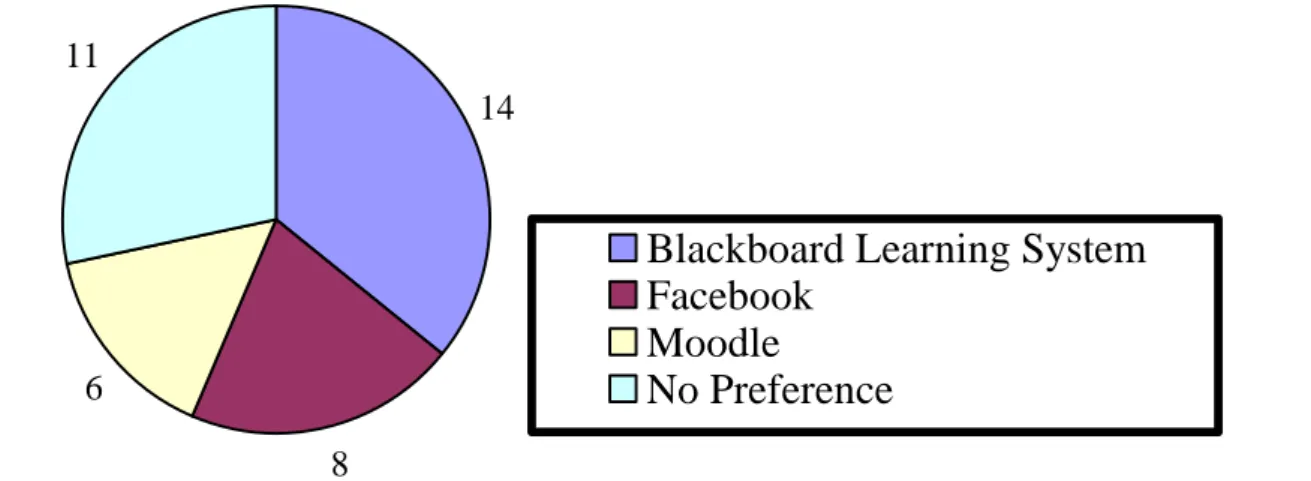
Figure 4. Which is better as a class tool: Blackboard learning system, Moodle, or Facebook?
14
8 6
11
Blackboard Learning System Facebook
Moodle
No Preference
n=37 (multiple answers allowed)
The final question in the survey asked students to choose their preferred classroom tool. As can be seen from figure 4, most students chose the institution’s own blackboard learning system as their preferred class computer tool. Many students explained that they checked it everyday and thus it was the most convenient tool for them. In addition, several students commented that the administration used it for making announcements etc. Students similarly explained their preference for Moodle as being because they were using it in other classes. Of those students surveyed only eight preferred Facebook, with one commenting that it was useful like Mixi.
Even when students preferred different class tools, most students who explained their preference wrote that it was because they felt that their chosen class tool was easy to use. Two students chose two class tools while 11 students stated no preference, with one commenting, “I think everything is bad for me.”
7. Discussion and conclusions
Overview of the study. This research looked into the utility of publicly available social networking software as a method for keeping a weekly record of students’ homework in a required business communication class at the same time as introducing students to a Western cultural website.
The design was experimental thus allowing for unexpected outcomes.
Overview of the findings. Though previous research reporting on the use of Facebook in class has been largely positive, in this case the website was not embraced by the majority of students, possibly for reasons that are discussed below. While instructors often have the best possible motives for introducing new technologies to their students who they perceive as digital natives, this research seems to suggest that students have also developed into discerning consumers of technology who favour ease of use and practicality over innovation.
The manner in which Facebook was used – for a discrete purpose in the classroom without any explicit instruction on how to use the site as a networking tool beyond advice on privacy and security – could be a reason why many students stated that they would not continue to use the website. Exploiting the tools of Facebook in a functional way could have drawn attention away from its use as a networking tool. So there was an overall feeling that Facebook as a class tool was not useful even though the website was successfully used in the way the teacher envisaged.
With regard to creating authenticity in a business communication class by having students record minutes, Facebook complemented the task. Students were diligent and effective in recording the process of each class meeting and posting it on Facebook. For the teacher as well, the choice seemed good in that it was simple to set up and each piece of work being tagged by the student with a record of the date and time of submission meant it was very easy for the teacher to monitor the progress of students, and also make an assessment of each student’s contribution at the end of the course.
When considering the reaction of students, it is clear that many did not feel that the use of Facebook as a class tool benefitted them. Certainly, teachers must consider when introducing technological innovations the added burden they may be imposing on students. The students in this research were using three different internet-based tools that required a login and password. Given the range of alternatives open to educational practitioners – a choice that is welcome – it would not be surprising to find that this was common in tertiary education, certainly in Japan. In this research students, when stating a preference, usually gave reasons of practicality and ease rather than a preference for the benefits of the system. Students then, though so-called digital natives, are conscious of time pressures. Though the students’ first choice tool was the institution’s blackboard learning system, whether or not it could actually be used for the purpose of collecting minutes remains unanswered. If there is indeed a way, then there appears to be a need for greater communication between teachers and administration staff and possibly a need for explicit instruction on how to do so.
The final aim of the research was to introduce students to an authentic communication tool
that they could then use beyond the end of the course. Many students who were introduced to Facebook through the class said they would continue to use it, often citing it as a means of communication with foreigners. Thus in terms of cultural knowledge, the introduction of Facebook did benefit some of the users.
8. Other notable benefits of using Facebook
There were several other benefits of using Facebook suggested by this study.
No administrator responsibilities. Unlike other more specialised educational software, after initially setting up and organising the group the teacher was not required to act as an administrator.
Students self-monitoring. Students could self-monitor and self-police their groups as well as look at other groups. Unfortunately, in the end of course questionnaires students were not asked whether or not they had looked at their partner’s work or even that of other groups. However, the open community environment had the potential to allow for peer teaching and commentary.
Benefits of personalisation. The personalisation that Facebook allows could help to create a learner-centered learning environment and help create class cohesion among participants.
9. A Future for Facebook in the Classroom?
The use of Facebook in an educational setting has up till now largely been in an experimental vein and this research adds to that body of knowledge. Though social networking sites will always be prey to changing fashions, to date Facebook remains in the ascendancy. Because of this, it seems useful to introduce business and management students to these vectors of communication that in real life often blur the boundaries between professional and personal spheres.
As with previous research, the setting up of groups via Facebook created a certain strength in the classroom, though limiting the scope of the classroom use to a record, as oppose to a more interactive method of reading and commenting as you might do a blog, meant that the potential of Facebook for creating group cohesion was not fully realised. In a similar vein, because of the way in which it was used it didn’t stand out in students’ minds from other web-based tools they were using.
For the teacher, the potential benefits of Facebook over, for example, Moodle, are many.
However, for multiple tasks or even simple things such as posting files – something Facebook does not allow for – it means that in more complex situations it will not satisfy the requirements of teachers. Similarly, the amount of control Moodle offers its practitioners means it will gain favour with a significant other group of teachers.
Each teacher in his or her own teaching context needs to evaluate the possible benefits and
pitfalls of introducing publicly available Web 2.0 tools, like Facebook, into the classroom. For the teacher, after initially setting up groups it can be a time-saving experience depending on the scope of tasks that it is intended to be used for. For students as well, electronic means of record will clearly benefit some of them. On the other hand, there are many who might not have access to computers, may not feel comfortable making contributions in public spaces and who might feel overwhelmed by the technology. Clearly, in these cases, the teacher in charge must make an informed judgement.
10. Limitations of the study
Because of the limited and experimental nature of this study the findings cannot be generalised. However, this study suggests further research needs to be done into how technology is applied in the classroom.
11. Future areas for research
A key concern for teachers, as suggested by students’ reactions to this research, must be the burden which the use of internet-based software places on students, especially when they are already using other tools in different classes. Though only reporting on a specific use of Facebook this paper suggests some areas that need to be followed up. The main one seems to be the need to investigate how students feel about the use of technology as class tools and whether or not they are feeling a technological overload. The second suggestion for practicing teachers is to remember that innovation needs to be carefully evaluated, both in terms of its social effect as well as its educational value, before being implemented.
References
Allen, M. & Long, J. (2009). Learning as knowledge networking: conceptual foundations for revised uses of the Internet in higher education. In S. I. Ao, Craig Douglas, W. S. Grundfest and Jon Burgstone (Eds.), Proceedings of the World Congress on Engineering and Computer Science 2009. (pp. 652-657). Hong Kong: Newswood.
Dörnyei, Z. & Murphey, T. (2003). Group dynamics in the language classroom. Cambridge:
Cambridge University Press.
Halliday, J. (2010, November 18). MySpace announces “mashup with Facebook” collaboration. The Guardian. Retrieved from: www.guardian.co.uk
Hoffman, E. S. (2009). Evaluating social networking tools for distance learning. TCC 2009
Proceedings. Retrieved February 12, 2010 from: http://etec. hawaii.edu/proceedings/2009/
hoffman.pdf
Kiss, J. (2010, August 19). Facebook places location tool unveiled, sparking fresh privacy concerns.
The Guardian. Retrieved from: www.guardian.co.uk
Mason R., & Rennie, F. (2008). E-learning and social networking handbook: Resources for higher education. New York: Routledge.
Senior, R. M. (2006). The experience of language teaching. Cambridge: CUP.
Siemens, G. (2004). Connectivism: A learning theory for the digital age. elearnspace. Retrieved February 1, 2010 from: http://www.elearnspace.org/Articles/connectivism.htm
Siemens, G. (2008). Learning and knowing in networks: Changing roles for educators and designers.
Retrieved February 1, 2010 from: http://www.tskills.it/userfiles/Siemens.pdf
Stevens, V. (2010). How can teachers deal with technology overload? TESOL Arabia Perspectives, 17(1).
Talandis Jr., J. (2008). Web 2.0 in the ELT classroom: An introduction. In K. Bradford Watts, T.
Muller, & M. Swanson (Eds.), JALT2007 Conference Proceedings. Tokyo: JALT.
White, J. (2009). The use of Facebook to improve motivation and academic writing. Proceedings of the Third International Wireless Ready Symposium. Retrieved January 8, 2010 from:
http://wirelessready.nucba.ac.jp/white2009.pdf