A Clinical Application of Brazelton's Neonatal Behavior Assessment Scale.
Shohei OG11 , Tomitaro AKIYAMA2, Masafumi FUKUDA3, Yoshiko GoT04 and Mineko KUSAN02
Abstract We have applied the Brazelton's Neonatal Behaviour Assessment Scale (NBAS) for the evaluation of early development stages in both premature infants, and mature risk infants, as well as for the clinical application of early intervention method. This paper reports the neonatal behaviour peculiarities of premature infants forecast by NBAS to have mental‑motor delays. This paper also report on our practical application of the early intervention program.
Finally, we conclude with the progress made in these infant's developments.
Bull. Sch. Allied Med. Sci., Nagasaki Univ. 7 : 11‑20, 1993
Key words : Neonatal Behavior Assessment Scale (NBAS), Premature Infants, Early Intervention Program
Introduction
We have applied the Brazelton's Neonatal Behavior Assessment Scale (NBAS) both to the clinical evaluation of neonatal development and as a method of intervention in both premature and mature risk infants. This is because the fundamental principle of the NBAS, to assess the individual char‑
acteristics and best performance of each neonatal infants, are useful for the early assessment and intervention of risk infants. This study reports on the differences in the neonatal behavior of premature infants with development difficulties, and a discussion of practical early intervention programs using the NBAS. We conclude this with a report the ongoing progress of these infants' development.
3 4
Dept. of Rehabilitation, Nagasaki University Hospital The School of Allied Medical Sciences, Nagasaki University Dept. of Pediatrics, Nagasaki University
Faculity of Education, Nagasaki University
‑ 11 ‑
Fig. 1 Subject
Gestational Age 40v 44v 48v 52v
Habituation
Orientation
lotor
State
State Range
Regulation
Autonomic
Su pplement
Ref lexes
Stability
Items
7. 69 0. 61
5. 33io. 89
5. 45 0. 60
3. 74io. 56
5. 13 0. 64
6. 27iO. 92
6. 64 0. 99
O. 63to. 90
7. 80 0. 54 6. 80 0. 64
5. 97iO. 98 4. 79il. 07
5. 75 0. 67 4. 59iO. 67
3. 93iO. 56 3. 12tO. 86
5. 17il. 15 3. 65iO. 95
6. 97iO. 76 6. 39il. 12
7. 30il. 06 5. 83iO. 89
O. 73iO. 81 3. 6lil. 40
8. 12iO. 63 7. OliO. 71
6. 79tO. 72 5. 06iO. 97
6. O1 0. 57 4. 80iO. 84
4. 29iO. 73 3. 5ltO. 93
5. 59iO. 92 4. 06 0. 93
7. 84iO. 71 7. O0 0. 77
7. 71 0. 80 5. 84 0. 80
O. 64 0. 72 3. 23 1. 37
6. 82io. 75
5. 3lil. 18
4. 81 0 60
3. 34io 92
3. 89tO. 80
7. 16iO. 90
5. 89io. 86
3. 17iO. 89
Fig. 2 Result of NBAS Examinations. The upper line showed controlled subjects.
The second line showed the risk infants.
Brazelton's Behavior Assessment Scale
Sub jects
We used the NBAS to evaluate 111 premature infants. We examined our‑
findings on predictions made of developmemt difficulties in 16 cases of these premature infants and implemented the early intervention program as on the basis of these findings. Delays in mental‑motor progress were predicated for 14 of the infants, and disorders in the central nervous system were pre‑
dicated for 2 infants.
While the former were extremely premature and had respiratory disease, the latter did not indicate any significant pediatric problems (Fig. 1). (Another 2 infants were found to have disorders in the CNS, however as these displayed sufficient progress after being transferred to anothersite, they have been omitted from this report.)
Result of the NBAS examinations
The score of each NBAS cluster (by Lester, 1982) is seen in Fig. 2. In comparison with controlled subjects who developed normally, at risk infants showed a low score for a long period. It was shown that in such cases,neo‑
natal behavior was very fragile, and progressive adaptation to the environ‑
ment did not come about successfully.
Results of the NBAS examinations showed that at risk infants displayed neonatal behavioural differences according to the following classifications (Fig. 3);
) Physiological System :
Eleven cases of the subjects with predicted delays displayed RDS, outof witch six cases showed chronic respiratory disorders,BPD,Wilson Mikity Syndrome. In these at risk infants stress behavior was observed in the physiological system. During rest, paradoxical or irregular breathing was observed. Crying capacity was weak,breathing was gasped and exerted and cyanosis was detected. The ability to maintain a constant physiological standard was poor, impairing the organization of other neonatal behavioral systems.
@ State Control System :
Sleep and waking rhythms were prone to change, and problems such as the presence of only brief woken states during the day were also noticed.
Sleeping ability was slight and easily disturbed by numerous distractions.
Waking episodes were a very brief with brief periods of alert response and displays of drowsiness frequent,
‑ 13 ‑
These infants were easily irritated by extemal stimulation and wereprone to sudden crying. Their self.quieting ability was poor so they lapsed into
panic easily.
③MotorSystem
In these at risk infants abnormal posture occured frequently due to pro−
blems in the central nervous system an(l from the long period of intubation.
Asymmetrical posture,shoulder retraction and opisthotonic posture were
1.Physiological Syste臨:
。 paradoxica1, irregular, forced ● gasPing, 9runting, stridof
・skincolorchangestocyanosis
・ 可eak cryi ng capas i ty
・ tre皿oring, startling
・ya胃ning
・etc
respiration
2.State Cootrol Syste■=
● unstable sleep−a冒ake r血yth■
● 1ight sleep, excess responce to stiロulation in s leeping ・ short a冒ake state, short period of alertness
● panicked, 冒orried, dro冒sy alertness ● rapid state change to crying
・irritability,prolongedcfying(fussystate)
● unconsolabi l ity, poor self−quiet ing act ivi ty ・etc
3.聾otorsysteg:
● abnor粗al muscle tonus (hypotonus, hypertonus)
● abnor魅al posture (flaccid, opistLtonic, high−gird posture)
・ abnor皿al response to priロitive reflexes (hypo一, hyper一, asy皿皿etrica1)
● overshooting, jerky 皿ove皿ent ・poorpostualrightingreaction ● POOr unti−graVitiC aCtiVity
・etc
4.Interactioo syste■:
● OVer−SenSitiVe reSpOnSe . inattention
. rovin9, avertin9, staring eye 皿ove田ent ● panicke(1。 blankly glassy exPression 。 stiffen, passively cuddling
・ weak sucking capasity
・etc
Fig.3 Characteristics of Neonatal Behavior at Risk infants using NBAS
Brazelton's Behavior Assessment Scale
observed, as well as underdeveloped anti‑gravitational activity in head, body and limbs. Furthermore, Iimbs movements were uncoordinated, it showed overshooting and/or jerky movement. The infants withsymptomsofampaired CNS showed abnormal response in primitive reflex items, predominantly so in the total movement patterns of lower limbs.
Interaction System :
The stress shown in the physiological control and state regulatory system made the obstruction of the social interaction process likely. An excessively agitated facial expression and staring eyes, change of state to crying or drawsyness, the excessive uncoordinated movement of limbs and total exten‑
sion of body, all demonstrated signs of stress.
Early Intervention Programs
Next,we express on our practical early intervention programs for at risk infants who shows the above pecularities of newborn behavior.
The premature infants with developmental difficulties had not matured sufficiently in utero. These infants easily contracted infectious or respira‑
tory distress and had central nervous system disorders. Therefore, the organization of their neonatal behavioral processes obstructed. Further, 10ng‑term medical supervision and separation from the mother were all
reflected in their developmetal processes. Due to these peculiaruties of behav‑
ior, progress in adaptation to the environment did not progress well, and the course of learning was delayed as well.
A fundamental principle of the early intervention program is to assist development of neonatal behavior system by encouraging mother‑infant interaction. Therefore, we attach importance to the daily transactions bet‑
ween mother and infants (Fig. 4).
Program I : Assisting development of mother‑infant interaction
The infant's early separation from the mother, the fragility of the infant's behavior and the difficults in socialisation of premature riskinfants make it difficult for the mother to deal with the infant. We recommend that early stepsare taken to assist development of a normal and healthy mother‑infant relationship. In the intervention method,it is important that the mother appreciates the infants behavior abilities and the infant's signs of stress.
Program 2: Assisting the development of sleep‑wake rhythm
Sleep and wake rhythms should be in accord with the natural cycle of the daysothat a pattern of sleep at night and waking during daytime
‑ 15 ‑
isensured。
Sleep shou1(1be in a dark room to prevent disturbance by su(1d.en or strong light or noises. Stable sleep is an essential behavior pattern which
helps regulate neonatal behavior.
Thirty minutes to an hour after mid.day feeding can be employed as a time for gentle play activities that stimulate senses of touch,sight and
hearing and so to help controle regulate the waking state. Extend.ing a stable waking cond.ition d.uring the day helps increase the infants interaction
abilities.
Program31Assisting(1evelopment of state control
Appropriate forms of stimulation from the extemal environment are recommended in order to improve neonatal behavior system,In usingappro.
priate treatment it is vital to deal carefully with the infants,without eliciting any stress behaviour, In infants that easily(iisplay stress behavior,signs of
①Assistingthede▼elop6eotofinf聞t皿d瞳otherinteracti㎝
・apPreciationofinfant sbehavioralability ・ apPreciation of stress behavior
②Assistin窓thede▼elop■entofa肥』e−s1㏄prhyth■
● rhyth皿 adaptatable a day cycle(1ight and darkness)
● stable sleep ; 1ife environ巴ent care ・ s table awake : treat皿ent in a罵ake state
③Assistingthede▼elop・eotofstatecontro1
・staring(visua1)
. talking (audi tory)
・touch,皿assage(tactile)
・s冒inging,rocking(vestiblar)
● kand to 皿outh, ha1}d to eyes coordinat ion ■ pLysical exercise
● oPPortuni ty to sel f−quiet fro皿 crying
④Pro■oti㎎口otor de▼elop■ent(Physical Exercise)
. positioning in lying, holding
。 facility of head, body righting reaction ・ breathing assisst techniques
⑤Pro量otingfeedingabilities
● 皿outh, tangue, passive sti皿ulation
. pos i t ioning in feeding
Fig.4 Early i皿terventional Program
Brazelton's Behavior Assessment Scale
stress may be prevented by gentle rocking and holding so that the state of alertness is also promoted.
To encourage the sense of touch,begin by using hands gently. To foster the audio‑visual sense, eye contact and familiarity with the mother's voice as well as other sounds, will enable gradual progressive steps in recognition.
In play between mother and infant, playing with the hands,hand to eye‑
contact and encouraging hand to mouth behavior is recommended to improve coordination inthese regions. In the crying state, it is important to allow the infant to self‑quiet and then to use consoling techniques.
Program 4: Promoting motor development (Physical Therapy)
Abnormal posture in the neonatal period obstructs the process of acquir‑
ing normal motor development. An early correction of posture is necessary in order to acquire normal motoric development.
In the lying and holding posture,it is important to inhibit abnormal‑
posture, as well as a development of anti‑gravitic activities is attended.
Physical Therapy will promote behavioral development, if the stress that accompanies physiology can gradually be alleviated. The approach put into practice is the facilitation of the head and body's righting reaction, and anti‑
gravitic activities.
When an infant has asevere respiratory disease, enforce chest physical therapy. The postural drainage and thoracic mobilization which assists the infant's breathing movement will improve respirational efficiency, and regu‑
late neonatal behavior.
Program 5: Promoting feeding abilities
Disorders of feeding in a premature infant originate frorn respiratory distress.
However, one group of infants may have a neurogical disorder and over‑
sensitivity in their oral regions.
In this type of infants, fingers should be used to practice stimulation of the internal‑external oral region.
Attention should also be paid to the posture during feeding.
Development Progress
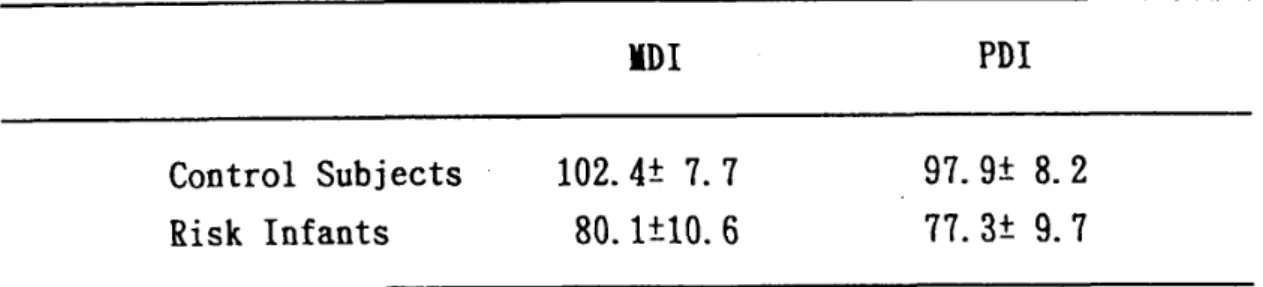
In one year's treatment up to the present, 11 cases out of the 16 at risk infants viewed in the Fig. 5 indicated a developmental level of 12 months on the Bayley Scales. In 9 infants with predicted difficulties in mental‑motor development, both MDI and PDI scores showed comparatively smooth prog‑
ress. However it did not develop to a standard value yet. In 2 cerebral palsy
‑ 17 ‑
infants, with 80.5 average points MDI scores indicated comparatively smooth progress. However in 61.0 average points PDI scores reflected delayed acqui‑
sition of walking.
This Fig. 6 shows progress of the former cases' motor development. In comparison with the standard values, smooth progress in development lagged by two or three months later. In cerebral palsy infants the progress from sitting and sanding, to acquiring walking, tended to be markedly slow.
Conclusion
The above has been a report of the effects of intervention based on the NBAS on the early development of at risk infants, and our application of the early intervention program. The NBAS was extremely useful for the assess‑
ment and intervention planning of development difficulties, as well as assist‑
ing at theirdevelopment. We strongly recommend a clinical application of NBAS for at risk infants.
ID I PDI
Control Subjects Risk Infants
102. 4 7. 7 80. ItlO. 6
97. 9i 8. 2 77. 3 9. 7
Fig. 5 Development level of 12 months (Corrected Age) on the Bayley Scales.
ua I k i ng
hold
IJa t k i n8
oreep i n8
s i tt i ng
rol , I ng
head control
e
h‑‑ c>‑‑
e H ( l) ‑‑H
e r‑ ‑‑1C
e : control ( ): RISK InT.
,
HDH
H‑‑O‑H
e(Corr . Age) 2 4 o lO
12 14 16 lO
Fig. 6 Motor Development Progress
Brazelton's Behavior Assessment Scale
Ref erence
1. Akiyama T, et al:Neonatal behavior of healthy matured infants and devel‑
opment through 5 year old.Bull Sch Allied Med Sci Nagasaki Univ, 4: 19‑
27. 1990.
2. Akiyama T, et al: Neonatal behavioral assessment of SFD infants and 10ngitudinal study of their development‑During the first postnatal year‑.
Bull Sch Allied Med Sciences Nagasaki Univ, 5: 41 ‑50. 1991.
3. Brazelton T. B.: Neonatal behavioral assessment scale. Clinics in Devel‑
opmental Medicine No. 88, Blackwell Scientific Publication Ltd. , London, I ‑ 104, 1984.
4. Joy Donigor Osofsky (Edited): Handbook of Infants Development. Second Edition. A Wiley‑Interscience Publication, New York, 1987, 788‑817.
5. Ogi S, et al: Early Assessment and Intervention for Premature Infants with respiratory distress.Bull Sch A1lied Med Sci Nagasaki Univ, 6: 25‑30.
1992.
6. Ezure K, et al: Physiotherapy for the premature and mature newborn infants. Rigakuryohogaku, 14: 357‑364, 1987.
‑ 19 ‑
ブラゼルトン新生児行動評価の臨床活用
ヨ
大城 昌平 穐山富太郎 福田 雅文
4
後藤ヨシ子 2草野美根子
1 2 3 4
長崎大学医学部付属病院理学療法部 長崎大学医療技術短期大学部 長崎大学小児科
長崎大学教育学部
要旨我々はこれまでブラゼルトン新生児行動評価法(NBAS)を未熟児やリスク を有する成熟児の早期発達評価と介入手段として応用してきた。今回は未熟児を対象 にNBASの評価結果から発達障害を予測された児の新生児行動上の特性を4っの行 動系に分けて整理し,我々の実施している早期療育プログラムにっいて報告した。ま た,これまでフォローした児にっいて発達経過を加えた。
長崎大医療技短大紀7:11−20,1993