Japanese listeners influenced by the
distribution of accent in their L1? : in the case of truncated word stimuli
著者(英) Mariko Sugahara
journal or
publication title
Doshisha studies in English
number 97
page range 59‑118
year 2016‑11
権利(英) The Literary Association, Doshisha University URL http://doi.org/10.14988/pa.2017.0000015349
Is the Perception of English Stress by Japanese Listeners Influenced by the Distribution of Accent in their L1?
In the Case of Truncated Word Stimuli
Mariko Sugahara
Abstract
The main goal of this study is to investigate whether Japanese listeners’
knowledge of pitch accent distribution in their native language affects their auditory perception of English stress by comparing the response patterns of Japanese listeners with those of native English listeners and Seoul Korean listeners in a forced choice identification experiment using English truncated word stimuli. The location of accent in Japanese is skewed to the syllable that contains the antepenultimate mora, and the hypothesis tested in this study is that Japanese listeners are biased towards antepenultimate- mora stress even when perceiving English stress. The experiment consisted of two tasks. One of them used truncated stimuli consisting of only initial syllables extracted from noun-verb pairs with different stress patterns such as TRANS- from TRANSplant and trans- from transPLANT (Group 1). The results of the task did not support the hypothesis because all the three language groups showed the same response patterns. The other task used truncated stimuli extracted from four-syllable suffixed words, e.g., DOminating and domiNAtion (Group 2). The results obtained from the task with three-syllable truncated stimuli, e.g., DOmina- and domiNA-, in a condition where the two stress patterns were not distinguished by pitch complied with the prediction made by the hypothesis: the Japanese listeners showed more preference for the -ion forms, e.g., domiNAtion, that have stress on the antepenultimate mora than the other two language groups. In the final conclusion, the possibility that what matters in Japanese listeners’
perception of English stress is in fact not the antepenultimate accent rule but the Latin accent rule is also considered.
1. Introduction
The main goal of this study is to investigate whether Japanese listeners’
knowledge of lexical accent distribution in their native language affects their perception of English stress by carrying out a forced choice identification experiment using English truncated word stimuli. The location of accent in Japanese, e.g., Tokyo Japanese and Osaka-Kyoto Japanese, is skewed to the syllable that contains the antepenultimate mora (McCawley, 1968; Kubozono, 2006; among others), and this research aims to examine if Japanese listeners are affected by the antepenultimate accent even when perceiving English stress.
There are a substantial number of research results on suprasegmental properties in native languages or first languages (L1) affecting the perception of suprasegmental features in foreign languages or second languages (L2).
Listeners are known to be sensitive to suprasegmental features such as pitch in foreign languages or L2 that are also used in their L1 as a lexical tone, lexical accent or lexical stress. For example, Beckman (1986) reports that Japanese listeners heavily rely on pitch to detect English stress while native English listeners evenly use not only pitch but also duration, amplitude and spectral quality for stress jusdgment. It is because the Japanese language utilizes only pitch to mark lexical accent and therefore Japanese listeners are sensitive to pitch information when detecting lexical stress in English.
Ou (2010) considered Taiwan Mandarin listeners’ perception of English stress. She found that they were able to correctly identify English stress when it was signaled by high pitch followed by a falling contour while they were not good at doing so when stressed syllables had a low rising contour. Her interpretation of the result is that Taiwan Mandarin listeners
Perception of English Stress by Japanese Listeners Mariko Sugahara
interpret stress in terms of tonal features. It is because they are influenced by the tonal system of their L1: Mandarin is a lexical tone language in which words are distinguished by tonal shapes. Ou & Guo (2015) reports that not only Taiwan Mandarin listeners but also Japanese listeners took high- falling pitch but not low-rising pitch as a cue for English lexical stress in a lexical decision task. This may be because Japanese accented syllables are always signaled by a high pitch immediately followed by a falling contour.
Schaefer and Darcy (2014) compared the perception of Thai tones among the listeners of Mandarin (lexical tone language), Japanese (lexical pitch accent language), English (lexical stress language), Kyungsang Korean (lexical pitch accent language), and Seoul Korean (with neither lexical stress nor lexical accent). They report that the order of accuracy rate among the listeners of those language groups were as follows: Mandarin > Japanese
= Kyungsang Korean > English > Seoul Korean. Their interpretation of the result is that the ‘pitch functionality’ of L1, i.e., ‘the degree to which pitch differentiates lexical items in the L1,’ affects the perception of foreign tones (Schaefer and Darcy, 2014: p.512). According to them, the pitch functionality of lexical tone languages is maximal because the specification of different shapes of pitch is made at the syllable level, that of pitch accent languages is intermediate because pitch specification is made at a wider domain, i.e., a word, and that of lexical stress languages is also intermediate but lower than that of pitch accent languages because pitch is not the only correlate of stress, and that of languages with neither lexical pitch accent nor stress is the lowest.
There are also studies on the influence of native lexical accent/stress distribution on the perception of foreign lexical accent/stress. In their production and perception study, Guion, Harada & Clark (2004) compared
stress assignment to English disyllabic pseudo words among native English speakers, early Spanish-English bilinguals who had started to be massively exposed to English in the United States by the age of 6 and late Spanish- English bilinguals who had started to be massively exposed to English in the United States after the age of 15. They found that late Spanish-English bilinguals were more strongly biased towards initial-syllable stress than the other two groups of speakers. One of the possible interpretations of the result is that late bilinguals transferred the stress pattern in their L1. In Spanish, there are two regular stress patterns for disyllabic words: initial or final.
Initial stress appears when the final syllable ends with a vowel, and final stress appears when the final syllable ends with a consonant. Among them, the initial stress pattern is more frequent because most of the disyllabic words in Spanish ends with a vowel. This distributional knowledge about their L1 stress was used even when the late bilinguals assigned stress to English disyllabic pseudo words. It is also reported by Guion (2005) in her production and perception study using the same English disyllabic pseudo words as those used in Guion et al. (2004) that late Seoul Korean-English bilinguals did not distinguish the stress pattern of nouns and that of verbs as much as native English speakers and early Seoul Korean-English bilinguals did. Guion states that it is because their L1 lacks lexical stress and they pay less attention to stress pattern differences between the two categories when learning English vocabulary.
Sugahara (2016a) posed the question whether the most frequent Japanese accent pattern, i.e., the antepenultimate accent, has any influence on their judgement of English stress locations in an auditory identification task. In that study, the response patterns of three groups of listeners were compared:
native English listeners, Japanese learners of English mostly from the
Perception of English Stress by Japanese Listeners Mariko Sugahara
Kansai area (Japanese listeners, henceforth) and Seoul Korean learners of English (Seoul Korean listeners, henceforth). In that perception task, the participants were asked to detect the syllable with primary stress in English disyllabic nouns and verbs forming minimal pairs in terms of the location of primary stress, such as TRANSplant (noun, trochaic) and transPLANT (verb, iambic). The final syllable of those pairs of words consisted of three morae:
CVCC or CVVC. In one of Sugahara’s (2016a) experimental conditions, the pitch of stimuli was synthesized so that those two types of words were not disambiguated by pitch. The main results obtained from that experimental condition are (a) the native English listeners showed no bias towards either initial or final stress, (b) both the Japanese and the Seoul Korean listeners preferred final stress, and (c) the Japanese listeners’ final stress bias was significantly stronger than the Seoul Korean listeners’. Sugahara (2016a) interpreted the results as follows. First, the native English listeners were able to use acoustic information other than pitch to disambiguate the two stress patterns. Secondly, there was something in the stimuli which led both the Japanese and the Seoul Korean listeners to prefer more final stress than initial stress, e.g., the durational difference between the initial and the final syllables (see Section 3.2 of this article for more discussion).
Nonetheless, the Japanese listeners showed stronger final-stress bias than the Seoul Korean listeners because the final syllable vowel in those stimuli was an antepenultimate mora and the Japanese listeners considered it as the most ideal location for stress being influenced by the predominance of antepenultimate-mora accent in their L1 lexicon.
The current study aims to support the conclusion made by Sugahara (2016a) by carrying out auditory perception tasks using truncated word stimuli. The tasks reported in this article and the task reported in Sugahara
(2016a) are from a single large experiment consisting of multiple tasks, and therefore participants and experimental environments are shared by the current study and Sugahara (2016a).
The organization of this article is the following. In Section 2, an overview of the lexical prosodic systems of English, Japanese and Seoul Korean is provided. It will be also explained here how their prosodic systems make different predictions for the perception patterns of English stress. Section 3 presents the result of the task with truncated stimuli consisting of only initial syllables extracted from noun-verb pairs such as TRANS- from TRANSplant and trans- from transPLANT. This stimuli set is called Group 1. The results obtained in the task did not support the hypothesis. Section 4 presents the result of another set of tasks with truncated stimuli, Group 2. The Group 2 stimuli set consisted of two-syllable and three-syllable stimuli extracted from four-syllable suffixed words with different stress patterns, e.g., DOmi- and DOmina- from DOminating and domi- and domiNA- from domiNAtion.
The results obtained from the task with three-syllable stimuli complied with the prediction made by the hypothesis. Finally, concluding remarks will be provided in Section 5. In that section, the possibility that what matters in Japanese listeners’ perception of English stress is in fact not the antepenultimate accent rule but the Latin accent rule is also considered.
2. Lexical stress and accent systems in the three languages
A brief overview of the lexical stress or accent systems in the three languages and some consideration to how those different systems may result in different sensitivity to lexical prominence are given in this section.
Although some content of this section may overlap with the summary of the three languages’ prosodic systems presented in Sugahara (2016a), it is
Perception of English Stress by Japanese Listeners Mariko Sugahara
necessary to have such overlap here to reexamine and reinterpret some of the ideas presented in the 2016a study.
Japanese and English are different in that the former is a pitch accent language while the latter is a stress language. They are, however, similar in a way that prosodic prominence (accent or stress) is distinctively used in the phonemic representation of words. Furthermore, the stress/accent distribution of those languages is skewed to certain positions in a word:
initial-syllable (antepenultimate or penultimate-‘syllable’) stress is the most common in English and antepenultimate-‘mora’ accent in Japanese. Seoul Korean, on the other hand, has neither lexical stress nor lexical accent, and all seeming stress-related phenomena are at a phrase-level. The hypothesis tested in this study is that those typological differences regarding the distribution of stress/accent among the languages result in different patterns of English stress perception.
2.1. English
2.1.1. The distribution of English stress
English is a stress language in which the lexical prominence of a word is acoustically expressed with not only pitch1 but also duration, vowel quality and amplitude (Beckman 1986, among others). At the same time, it is a ‘free stress’ language where stress locations are determined word by word, and every content word has a syllable with primary stress. Therefore, there exist minimal pairs whose meanings are distinguished by only stress locations, e.g., díffer vs. defér, fórearm (noun) vs. foreárm (verb), etc.2 The distribution of stress is not completely random, however.
First, English primary stress positions are usually confined to one of the last three syllables of a word. Because monosyllabic, disyllabic and
trisyllabic words are the majority in the English vocabulary, this tendency leads to the predominance of the initial stress in the English lexicon (Cutler
& Carter, 1987: Clopper, 2002). Grammatical categories also matter when determining which of the last three syllables bears stress: verbs gravitate to final stress more than nouns. Based on the numerical figure given by Hammond (1999: 194), the following becomes clear. Among disyllabic words, 83% of nouns have primary stress on the penultimate (initial) syllable while 52% of verbs have primary stress there. When it comes to trisyllabic words, 50% of nouns have antepenultimate (initial) main stress whereas the proportion of antepenultimate main stress in verbs is only 20%.3 Although the proportion of nouns and that of verbs having penultimate (middle) primary stress are the same (about 40%)4, final stress is more dominant in verbs (40%) than in nouns (9%).5 Since the number of verbs is only about half the number of nouns in English (Hammond, 1999:194), final-syllable stress is rarer than antepenultimate and penultimate stress, which also leads to the predominance of initial stress. Cutler & Carter (1987) reports that about 60 % of English vocabulary and about 90 % of all lexical tokens in spontaneous speech are those with word-initial primary stress.
Secondly, derivational suffixes also affect stress patterns. Although all inflectional suffixes do not change the original stress pattern of the stem to which they attach, derivational suffixes are divided into two groups depending on whether their attachment to a stem keeps or alters the original stress pattern of the stem. Examples of stress-neutral suffixes are -ness and -less, and those of suffixes that call for deviation from the original stress pattern of the stem are -al, -ion, -ese, -eer, -ate, -oid. The former are called ‘Class II’ suffixes and the latter ‘Class I’ suffixes.6 For example, -ion requires the final syllable that contains the suffix to be extrametrical
Perception of English Stress by Japanese Listeners Mariko Sugahara
and a weight sensitive main stress foot to be created immediately before it:
va.(cá)<tion>. When it comes to the suffix -ate, it receives secondary stress and a weight-insensitive main stress foot is created immediately before it:
(dé.sig)(nàte). One of the experimental tasks of this study uses words that contain both -ate and -ion, e.g., domination. The base form of domination is the verb dominate, which also contains a bound morpheme -ate. When the verb base is bare without any derivational suffix, it has initial stress: (dó.
mi)(nàte). Once the suffix -ion is attached, the main stress moves from the initial to the penultimate syllable: (dò.mi)(ná)<tion>. The task also uses verbs with an inflectional suffix -ing, e.g. dóminàting, which maintains initial stress.
Another thing to note is that prefixes such as in-, re-, mis-, trans-, are more likely to lack main stress according to the author’s count of words stored in the CELEX database (Baayen, Piepenbrock & Gulikers, 1995).
For example, the number of word lemmas which start with TRANS- (main stress) is only three and their total frequency is 1,460. On the other hand, the number of those which start with trans- (without main stress) is thirty-four and their total frequency is 2,676.
Those characteristics of English stress will be considered later again when making predictions for native English listeners’ responses in the experiment carried out for this study.
2.1.2. Stress perception by native English listeners and initial stress bias When native English listeners are not fully sure about the identity of English words they have heard, they are likely to respond that what they have heard is of initial stress. That is, they tend to rely on the knowledge of stress distribution when segmental and supersegmental content of English
word stimuli is not clear enough.
Van Leyden and van Heuven (1996) made native English listeners hear both disyllabic or trisyllabic English words and the initial fragments of those words (e.g., only the initial syllable), and asked them to write down what they thought to be the ones they had heard. Interestingly, the majority of their error responses had initial stress regardless of the stress patterns of the original stimuli. Van Leyden and van Heuven argue that it is because the native English listeners gravitated to the most common stress pattern in English. Errors occur when participants are not sure about the identity of the stimuli, and in that kind of environment they might rely on their knowledge about English stress distribution.
Cooper, Cutler and Wales (2002) made native English listeners hear truncated stimuli consisting of only initial syllables extracted from words such as MU- from MUsic (initial stress) and mu- from muSEum (non-initial stress) in one of their experiments. They asked the listeners to identify which word they had heard, MUsic or muSEum. Their correct response rate was higher for the initial-stress words (more than 70%) than for the non- initial-stress words (less than 50%). That is, they were more biased towards initial stress. Cooper et al. also claim that the response patterns of their native English listeners were influenced by the predominance of initial stress in English. Since the stimuli consisted of only initial syllables in their task, both the segmental and the suprasegmental content of the stimuli were scarce. Therefore the listeners had to rely on their distributional knowledge of English stress when giving their responses.
The results obtained in Sugahara (2011) and those obtained in Sugahara (2016a) also imply that native English listeners’ bias towards initial stress emerges when stimuli provided to them lack suprasegmental information
Perception of English Stress by Japanese Listeners Mariko Sugahara
to distinguish stress patterns. Sugahara’s (2011) forced choice auditory experiment conducted previous to her 2016a study used trochaic noun- iambic verb minimal pair stimuli produced by a female native speaker of American English, such as TRANSplant and transPLANT. In the experiment, native English listeners gave more correct responses to initial-stress stimuli than to final-stress stimuli when the pitch track of the stimuli was made flat so that it did not disambiguate the two stress patterns. Sugahara (2016a) tried to replicate the result in the 2011 study, with similar minimal pair stimuli produced by a male native speaker of American English. The 2016a study, however, did not obtain initial-stress bias in native English listeners’ responses in spite of the fact that pitch was synthesized in the same way as in Sugahara (2011). The difference may depend on the nature of stimuli. In fact, more durational contrast between the initial-stress stimuli (TRANSplant) and the final-stress stimuli (transPLANT) was available in the 2016a study than in the 2011 study. It is because when the stimuli were produced in the 2011 study, the words were deeply embedded in long sentences without any diacritic on the syllable with main stress when they were recorded. Since the sentential contexts were abundant to discriminate between the initial-stress nouns and the final-stress verbs, the speaker did not have to spend much effort to acoustically distinguish the two forms.
Therefore, the two types of stimuli had similar durational properties. Once those stimuli were synthesized so that their noun forms and the verb forms are not disambiguated by pitch, they sounded so similar that the native English listeners had to guess the stress pattern of a given stimulus relying on their knowledge about the stress distribution in English. In the 2016a study, however, the words were visually presented to the native speaker embedded in a short sentence frame that did not provide any clue about their
grammatical category and their stress pattern. Furthermore, in order to let the speaker know the stress pattern of the words, the location of primary stress was indicated by an accent mark in the visual presentation. This probably made the speaker consciously pay attention to the stress pattern differences between the noun forms (TRANSplant) and the verb forms (transPLANT), and made him acoustically distinguish those two forms with some exaggeration. As a result, durational contrast between the two stress patterns in Sugahara (2016a) was clearer than that in Sugahara (2011). That is, the listeners were able to discriminate the two stress patterns based on durational cues in Sugahara (2016a) even when pitch was not a reliable cue to discriminate them. This means that there was no room for their knowledge about stress distribution to play a role there.
2.1.3. Predictions for native English listeners
In this section, predictions are made for the native English listeners responses to stimuli used in the current study.7
<Group 1: TRANS- and trans- from TRANSplant and transPLANT>
The Group 1 stimuli consisted of only the initial syllables of disyllabic words such as TRANS- and trans- extracted from TRANSplant and transPLANT. When the truncated stimuli contain substantial acoustic information (pitch, duration, etc.) to distinguish the two stress patterns, native English listeners will rely on it and will be able to correctly identify the original words from which the stimuli are extracted. However, when they lack such acoustic information, they become uncertain about their identity and they will rely on frequency-related knowledge.
The following is the list of frequency-related knowledge that may possibly affect native listeners’ perception.
Perception of English Stress by Japanese Listeners Mariko Sugahara
Table 1. The list of frequency-related knowledge
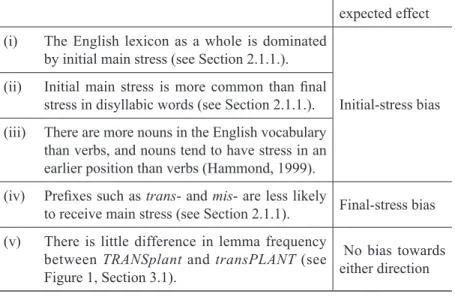
expected effect (i) The English lexicon as a whole is dominated
by initial main stress (see Section 2.1.1.).
Initial-stress bias (ii) Initial main stress is more common than final
stress in disyllabic words (see Section 2.1.1.).
(iii) There are more nouns in the English vocabulary than verbs, and nouns tend to have stress in an earlier position than verbs (Hammond, 1999).
(iv) Prefixes such as trans- and mis- are less likely
to receive main stress (see Section 2.1.1). Final-stress bias (v) There is little difference in lemma frequency
between TRANSplant and transPLANT (see Figure 1, Section 3.1).
No bias towards either direction
The knowledge pertaining to (ii) and (iii) may be part of the knowledge about the lexicon as a whole shown in (i), and therefore (i) to (iii) may be counted as a single set, all of which will lead participants towards an initial stress bias. The knowledge in (iv), however, will lead participants towards the opposite direction. As for (v), the lemma frequency of initial-stress words and that of final-stress words used in this study are almost equal as shown in Figure1, Section 3.1.1. Therefore, the knowledge in (v) will not lead the participants towards either direction.
If those three knowledge factors affect the participants additively and their effect size is equal, native listeners will not be biased towards either of the stress patterns because the factors leading them to the opposite directions cancel each other’s effect. If the knowledge factors in (i) to (iii) affect their perception more strongly than the others, their responses will be
biased towards initial stress. If the other way round is true, then the outcome will be the opposite. In this way, it is impossible to make a prediction for native English listeners’ response patterns based on the frequency-related knowledge shown in Table 1.
The fact that Sugahara (2011) obtained an initial-stress bias using the full forms of the noun-verb pairs implies a possibility that the factors in (i) to (iii) are more influential than the factor in (iv).
<Group 2: DOmi- and DOmina- from DOminating, domi- and domiNA- from domiNAtion>
Secondly, consider the Group 2 stimuli, i.e., the truncated stimuli extracted from four-syllable suffixed words. One group of those four- syllable words have initial stress ending with an inflectional suffix -ing, e.g., DOminating, and the other have penultimate stress (stem-final stress) ending with a derivational suffix -ion, e.g., domiNAtion. The base forms of those suffixed words are trisyllabic verbs having initial stress and ending with a morpheme -ate, e.g., DO.mi.nate. There are two types of truncated stimuli:
two-syllable stimuli (DOmi- and domi-) and three-syllable stimuli (DOmina- and domiNA-). Since the truncated stimuli extracted from those forms do not provide native English listeners the full segmental and suprasegmental information of their original words, frequency-related knowledge is likely to play a role in their responses. The frequency-related knowledge that need be taken into consideration here is summarized below.
Perception of English Stress by Japanese Listeners Mariko Sugahara
Table 2. The list of frequency-related knowledge
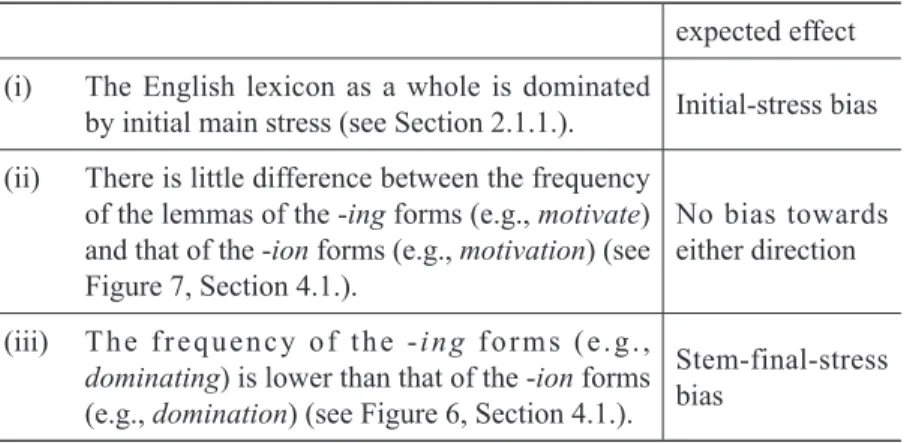
expected effect (i) The English lexicon as a whole is dominated
by initial main stress (see Section 2.1.1.). Initial-stress bias (ii) There is little difference between the frequency
of the lemmas of the -ing forms (e.g., motivate) and that of the -ion forms (e.g., motivation) (see Figure 7, Section 4.1.).
No bias towards either direction (iii) The frequency of the -ing forms (e.g.,
dominating) is lower than that of the -ion forms (e.g., domination) (see Figure 6, Section 4.1.).
Stem-final-stress bias
Here, it is almost impossible to make a prediction for native English listeners’ response patterns. If the knowledge in (i) affects them the most strongly, they will be biased towards initial stress. If the knowledge in (iii) affects them the most strongly, however, they will be biased towards stem- final stress.
2.2. Japanese
2.2.1. Accent distribution in Japanese
Japanese is a pitch accent language in which lexical prominence is acoustically signaled mostly by a high-low falling pitch (Beckman, 1986;
among others). It is also a language in which both the presence or absence and the location of accent are distinctive. Therefore, there is a minimal triplet such as hasi (‘edge’, accentless), ha˺si (‘chopsticks’, accent on the first syllable) and hasi˺ (‘bridge’, accent on the final syllable) in Tokyo Japanese, and a minimal pair such as hasi (‘chopsticks’ accentless) vs. ha˺si (‘bridge’, accent on the first syllable) in Kyoto-Osaka Japanese.
A closer look into the Japanese lexicon gives an interesting picture: the location of accent in accented words is strongly skewed to the syllable that contains the antepenultimate mora. Take three-mora accented words for example: Kubozono (2006) has shown that more than a half of the native (Yamato) words and approximately 95% of the Sino-Japanese words and the loanwords have an accent on the antepenultimate mora. Similar figures are true of Osaka Japanese according to Sugahara’s (2016a) count of accented words stored in Sugito’s (1995) Osaka/Tokyo akusento onsei ziten (Pronunciation dictionary of Osaka/Tokyo accent). Tanaka (2009) has also looked into accented loanwords with five morae in both Tokyo and Osaka Japanese, and reports that antepenultimate-mora accent is the most common, i.e., about 40 to 50% of the accented loanwords have accent on their antepenultimate mora.
2.2.2. A bias towards antepenultimate-mora stress?
Having in mind the fact that the Japanese lexicon is dominated by antepenultimate-mora accent, consider the English noun-verb pairs such as TRANSplant (noun) and transPLANT (verb) used in Sugahara’s (2011, 2016a) auditory tasks. The final syllable is a superheavy ending with a consonant cluster, and is therefore divided into three different moras: /a/, /n/, /t/. The nucleus vowel /a/ of the final syllable is the antepenultimate mora, which is expected to be the most favorable prominence position for native Japanese speakers regardless of whether the words are originally of initial stress or of final stress in English. This becomes apparent in loanword adaptation. If TRANSplant (noun) and transPLANT (verb) are adapted into Japanese as a loanword, both of them come to have accent on the antepenultimate mora vowel as in t‹o›.ra.n.s‹u›.p‹u›.ra˺.n.t‹o›, where the
Perception of English Stress by Japanese Listeners Mariko Sugahara
vowels in ‘‹ ›’ are epenthetic and ‘.’ separates moras.8
Here, one should not confound the antepenultimate mora in Japanese with the word-final syllable in English: not all vowels in word-final syllables in English are antepenultimate moras. Only when word-final syllables are superheavy, their nucleus vowels are antepenultimate. When words end with a heavy or a light syllable such as hotel and banana, native Japanese speakers are not attracted to their final syllable vowels as the most desirable accent position. Once those words are introduced into Japanese as loanwords, Japanese speakers place accent on the nucleus vowel of their initial syllables as ho˺.te.r<u> and ba˺.na.na, because the initial syllable vowels correspond to their favorite antepenultimate mora.
Let us now consider native Japanese listeners’ results obtained in Sugahara’s 2011 and 2016a studies. In both cases, Japanese listeners showed strong final bias when they heard trochaic and iambic English words such as TRANSplant and transPLANT. Sugahara (2016a) interpreted the result as supporting evidence for Japanese listeners relying on the knowledge of antepenultimate-mora accent in Japanese (L1) even in tasks where they judge English (L2) stress locations. The current study, then, asks whether a similar final-stress bias is obtained in tasks with truncated English words.
2.2.3. Predictions for Japanese listeners in this study
<Group 1>
Let us consider what predictions are made for Japanese listeners in this study. As for the Group 1 stimuli (TRANS- from TRANSplant and trans- from transPLANT), they are predicted to prefer more final stress than the other two groups of listeners because the final syllable vowel corresponds to the antepenultimate mora.
This, however, does not necessarily mean that Japanese listeners have not acquired at all the frequency-related knowledge of English in Table 1, Section 2.1.3. For example, Ishikawa and Nomura (2008) report that not only native English speakers but also Japanese speakers use probabilistic knowledge about the stress patterns of verbs and nouns when predicting the stress patterns of pseudo English words in a production task. My assumption here is that even if Japanese listeners have acquired frequency- related knowledge about the English vocabulary, their preference for antepenultimate stress is more influential than the frequency-related knowledge of English when perceiving English stress. As a result, they are predicted to be more biased towards final-syllable stress than English native listeners.
<Group 2>
As for the truncated stimuli extracted from Group 2 (DOmi- and DOmina- from DOminating and domi- and domiNA- from domiNAtion), it is predicted that Japanese listeners are more likely to respond that the truncated stimuli are from the -ion forms. It is because the -ion forms match the stress pattern ideal to them.
In the forced identification task of this study with those stimuli, every time they hear one of the stimuli, they are visually given two options from which they are required to choose as what they believe to be its original word from. Those options are always an -ing form with an accent diacritic on the initial syllable vowel, e.g., dóminating, and an -ion form with an accent diacritic on the penultimate syllable vowel, e.g., dominátion (see Figure 12, Section 4.2). The representation dóminating has stress on its initial syllable, which is too far from the ideal stress position, i.e., the
Perception of English Stress by Japanese Listeners Mariko Sugahara
antepenultimate mora. On the other hand, the representation dominátion has stress on the ideal position, i.e, on the antepenultimate mora as shown in (1a).
When the word is adapted into Japanese as a loanword, it also carries an accent on the same antepenultimate vowel as in (1b).
(1)
a. do. mi. n[éɪ]. [ʃn̩] (English)
b. do. mi. ne˺e. ʃon (Japanese loanword)
Given this, it is highly likely that Japanese listeners accommodate the stimuli auditorily presented to them to the -ion forms, e.g., dominátion.
2.3. Seoul Korean
Seoul Korean is a language with neither a lexical stress nor a lexical accent, and pitch does not play a distinctive role. Although it has tonal melodies, they are the properties of accentual phrases and intonational phrases (Jun, 1996, 1998, 2005, 2006). According to Jun, long accentual phrases, i.e., those with four or more than four syllables, are associated with a sequence of LHLH or HHLH tones unless they are intonational phrase-final9, and whether or not they start with LH or HH depends on the segmental content of their initial segment. If the initial segment is a ‘lenis’
obstruent or a sonorant, the accentual phrase begins with a LH tone. If it is an ‘aspirated’ or ‘fortis (tense)’ obstruent, however, an HH tone appears instead (Jun, 1998). When it comes to shorter accentual phrases, medial tones undergo ‘undershoot’ and they come to have tonal melodies such as L(HL)H, L(H)LH, LH(L)H, H(HL)H, H(H)LH, HH(L)H, where the tones in the parenthesis are the ones that are undershot (Jun, 2005, 2006). The
final H tone, however, is always at the final syllable of an accentual phrase unless the accentual phrase is intonational phrase-final. Jun (1996) further states that the accentual-phrase final H tone is ‘salient’ and is realized with higher pitch than the H tones that may appear earlier in an accentual phrase.
It is not clear in what sense Jun (1996) used the word ‘salient’, whether it is simply higher than the other H tone in F0 or if it even has perceptual salience. The salience, whether phonetic or perceptual, does not have a root in the phonemic representation of the lexicon. Because the final H tone is the property of an accentual phrase, the final syllable of the same word does not always bear the H tone: whether the H tone appears or not depends solely on which position it occupies in an accentual phrase. Accentual phrase formation in Seoul Korean varies depending on speech rate, phonological weight, information structure, semantic weight and morpho-syntactic structure (Jun, 1996). For example, a four-word sentence in (2) may consist of four separate accentual phrases if it is produced with a slow speech rate while it may have only two accentual phrases if it is produced with a fast rate (Jun, 1996).
(2) / igən adʒu tʃoɨn kɨɾimija / this very good a picture-be
a. {L H} {L H} {L H} {LH IntPh-final tone} slow rate b. {L H} {LH IntPh-final tone} fast rate
(from Jun, 1996: 158)
The third lexical word tʃoɨn ‘good’ in (2a) forms an independent accentual phrase and its final syllable bears an H tone. The same syllable in (2b), however, does not carry an H tone because it is phrase-medial. Furthermore,
Perception of English Stress by Japanese Listeners Mariko Sugahara
when accentual phrase-final syllables are at an intonational phrase-final position in a declarative utterance, it is no longer associated with an H tone but is associated with an L boundary tone. In this way, the presence or absence of an H tone in word-final syllables is purely post-lexical and does not play a distinctive role in the phonemic representation.
Given this, it is imaginable that native Seoul Korean speakers set their
‘stress parameter’, the term originally proposed by Peperkamp & Dupoux (2002), such that lexical stress/accent information is not encoded in their phonological representation because it is not useful in their native language, and the parameter even affects their L2 perception. That is, it is possible that Seoul Korean learners of English are less fastidious about the location of lexical stress than Japanese learners of English when asked to judge which syllable is stressed in English words.
As already introduced in Section 1, Guion (2005) has found that in her production and perception study using pseudo English words that late Seoul Korean-English bilinguals did not distinguish the stress pattern of nouns and that of verbs as much as native English speakers and early Seoul Korean- English bilinguals did. Guion states that it is because their L1 lacks lexical stress and they pay less attention to stress pattern differences between nouns and verbs when learning English vocabulary.
If so, it is expected that the Seoul Korean listeners in this study are less influenced by the statistical distribution of English stress than native English listeners. In addition, they do not have any preferred lexical stress/accent position in L1. Given this, it is at least predicted that Seoul Korean listeners’
responses are less biased towards final stress (Group 1) and are less biased towards -ion forms (Group 2) than Japanese listeners’. However, no clear prediction is made as to whether they would give responses different from native English listeners, because the only prediction made for native English
listeners is that they will be less biased towards final stress than Japanese listeners (Section 2.1.3 and Section 2.2.3).
2.4. Summary of predictions
For both Group 1 and Group 2, the only prediction made in this section is that Japanese listeners are more biased towards final-syllable stress in the task with the Group 1 stimuli and they are more biased towards the -ion forms in the task with the Group 2 stimuli than native English listeners and Seoul Korean listeners. No prediction is made for the relation between native English listeners and Seoul Korean listeners. This is summarized below.
(3) Predictions
biased towards biased towards
tránsplant transplánt
dóminating dominátion
E, SK J
3. The identification task with the truncated stimuli ‘Group 1’
3.1. Method
3.1.1. Stimuli
The truncated stimuli considered here consist of initial syllables extracted from two-syllable noun-verb minimal pairs such as TRANSplant (noun) and transPLANT (verb), which are shown in (4). Their full-word counterparts were used as stimuli in the task reported in Sugahara (2016a).
Perception of English Stress by Japanese Listeners Mariko Sugahara
(4) Truncated stimuli ‘Group 1’
a. IM- from IMport, im- from imPORT b. IN- from INsult, in- from inSULT c. MIS- from MISprint, mis- from misPRINT d. RE- from REtake, re- from reTAKE e. TRANS- from TRANSplant, trans- from transPLANT
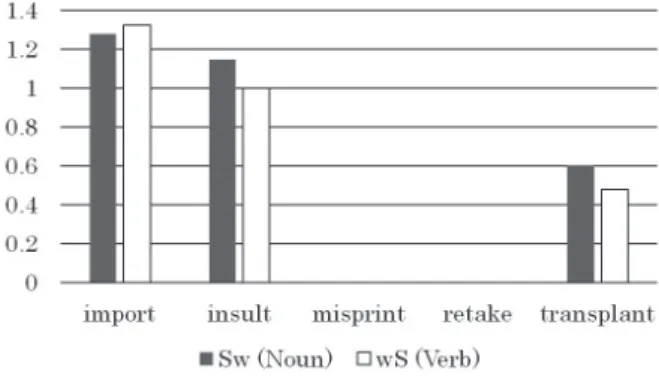
The log lemma frequencies10 of those words were obtained from the CELEX database (Baayen, Pipenbrock & Gulikens, 1995) and are summarized in Figure 1.11 The frequency information is considered here because there is a possibility that listeners gravitate to more frequent forms when asked to identify what they have heard.
Figure 1. The log lemma frequency of the stimuli words obtained from CELEX.
The dark gray bars are of trochaic nouns (e.g., TRANSplant) and the white bars are of iambic verbs (e.g., transPLANT).
The mean log frequency of the trochaic noun forms (TRANSplant) turned out to be 0.61 and that of the iambic verb forms (transPLANT) was 0.56,
which are very close. Given this, it is safe to say that the lemma frequency of the words used in this task does not affect participants’ responses.
The stimuli were created through the following procedure. Their full form counterparts, which were used in Sugahara (2016a), were first produced by a male American English speaker in his mid-twenties. The full words were embedded in a sentential frame “I wanted to say ___” when they started with a consonant and in “I said ___” when they started with a vowel or a liquid /r/. The location of primary stress was indicated by an accent mark ‘´’ on the vowel bearing main stress. Those sentences were recorded onto a Marantz Solid State Recorder PMD671 (44.1 KHz, 16 bits), using a Countryman ISOMAX Headset Microphone in a sound-attenuated room. The target words (full words) were segmented from the sentence frames, and the initial syllables were further segmented from the full words using Praat (Boersma
& Weenink, 2013).
Two kinds of F0 conditions were, then, prepared: <Natural> and <90Hz>.
The former consisted of stimuli without any pitch manipulation. The latter underwent pitch manipulation and the F0 of the vowel interval was made into 90Hz.
Acoustic properties of the <Natural> stimuli are summarized in Table 3.
From the table, it is clear that the initial syllables of the trochaic noun forms, e.g., TRANS-, had greater values than those of the iambic verb forms, e.g., trans-, in three acoustic dimensions, i.e., F0, duration, and overall intensity.
The high-vowel syllables (im-, in-, mis-, re-) in the noun (trochaic) forms had lower F1 and higher F2 than those in the verb (iambic) forms, which means that the former were produced with more jaw closure and more tongue advancement. For the low-vowel syllable (trans-), its noun form had a slightly higher F1 value (more jaw opening) and a lower F2 (less tongue
Perception of English Stress by Japanese Listeners Mariko Sugahara
advancement) than the verb form. Those acoustic measures show that although the truncated stimuli contained less information to disambiguate the two stress patterns than the full-word stimuli used in Sugahara (2016a), they still had some acoustic contrast between the two stress patterns.
Table 3. Acoustic properties of the truncated <Natural> stimuli
Initial syllable Category Stress F0 averaged across the vowel period (Hz)
Duration (ms) Overall
intensity (dB)
Midpoint
F1 (Hz) Midpoint F2 (Hz)
im(port) N primary 121 145 72 500 2517
V secondary 87 131 63 597 2071
in(sult) N primary 106 187 67 457 2439
V secondary 86 156 64 543 2209
mis(print) N primary 98 220 69 470 1843
V secondary 85 182 62 500 1036
re(take) N primary 111 151 63 354 1702
V secondary 88 130 59 369 1629
trans(plant) N primary 100 329 67 659 1464
V secondary 87 264 63 644 1644
3.1.2. Participants
Twenty-one native English listeners (eight males and thirteen females), thirty native Japanese listeners (twelve males and eighteen females), and twenty-seven Seoul Korean listeners (four males and twenty-three females) participated in the identification task. The native English speakers were exchange students studying at Doshisha for a year or a semester, or international students studying at Doshisha University Center for Japanese Language and Culture for a year12, and all of them had the experience of learning Japanese for one to three years. Fourteen were from the US, three were from England, two were from Canada, and the other two were from Australia.13 The native Japanese speakers were full-time students at Doshisha University or Kyoto University and most of them were from the
Kansai area speaking Kansai Japanese as their native dialect. They had been learning English as a second language for more than six years prior to the experiment. They were asked to report their TOEFL ITP, TOEFL iBT or TOEIC scores if they had taken any of those English proficiency tests in advance. Twenty-eight of them revealed their scores. Their scores were converted into CEFR (Common European Framework of Reference for Languages), and their CEFR proficiency were the following: three of them were at A2 (waystage), fourteen of them were at B1 (threshold) and eleven of them were at B2 (vantage). All of the Seoul Korean listeners were university students, too. Nineteen of the Seoul Korean listeners were full- time students at Ewha Womans University in Seoul and they were visiting Doshisha to take part in a two-week spring program when they participated in the experiment. The rest of the Seoul Korean listeners were international students at Doshisha University Center for Japanese Language and Culture.
All of the Korean listeners had studied English and Japanese as second languages (English for more than six years and Japanese for one to nine years) prior to the experiment. Although they were asked to report their English proficiency test scores, only eight of them did so. Among them, one was at B1 and seven were at B2. The rest of the Koreans were also able to communicate in English without any difficulty and all the instructions and written information were given to them using English. None of the participants had reported hearing disorders, and all of them were paid for their participation. As already stated in Sugahara (2016a), they were given a chance to be reminded of the stress pattern differences between the noun forms and the verb forms listed in (4) before the perception task. For more details about this, see Sugahara (2016a: 93).
Perception of English Stress by Japanese Listeners Mariko Sugahara
3.1.3. The forced choice identification task
The identification task was carried out via SuperLab Version 4.5 installed on MacBook Air with OS X Version 10.7.4 (also see Sugahara (2016a) for more details). The <Natural> and the <90 Hz> truncated stimuli were presented to participants in separate blocks in the order shown in (5). The order of stimuli presentation within each block was randomized for each participant, and each stimulus was presented only once to each participant.
(5) Presentation order of blocks
(F) → (O) → (O) → <Natural> → (F) → (O) → (O) → <90Hz> → (F)
F = blocks with full word stimuli (noun-verb minimal pairs) used in Sugahara (2016a)
O = blocks with other truncated words
The participants listened to the stimuli through SONY dynamic stereo headphones connected to MacBook Air (also see Sugahara (2016a) for more details). The letter strings of the noun-verb pair to which the stimulus belonged were presented on a computer monitor whenever each truncated stimulus was played to a participant. The letter sequence that corresponded to the initial syllable of a noun (trochaic) stimulus was colored in yellow and those which corresponded to the initial syllable of a verb (iambic) stimulus was colored in blue. Truncated parts of the stimuli were colored in light gray. The letter sequence of a trochaic form was shown at the top and that of an iambic form was shown below it. The location of primary stress was indicated by a diacritical mark ‘ʹ’, which was placed above the letter corresponding to the nucleus of a syllable with primary stress as shown
in Figure 2. The participants pressed the yellow button on the computer keyboard if they thought the stimulus they had heard was trochaic and pressed the blue button if they thought it was iambic. They only used their index finger of their dominant hand when carrying out the task. (Also see Sugahara (2016a) for relevant and more detailed information).
yellow light gray
tránsplant transplánt
blue
Figure 2. A sample of the visual presentation of response options on the computer monitor
3.2. Results and discussion
The number of responses obtained from each participant was 10 (5 pairs
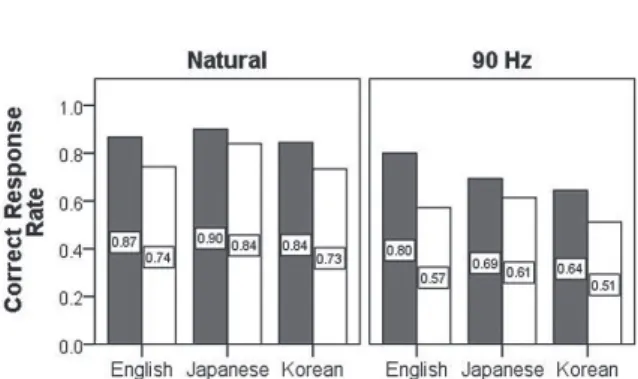
× 2 stress patterns), and 1,560 responses (10 responses × 2 blocks × 78 participants ) were obtained in total. Then, the correct response rate of each language group was calculated for each stress and pitch condition, which is summarized in Figure 3.
Perception of English Stress by Japanese Listeners Mariko Sugahara
Figure 3. The rate of correct responses in the Natural and the 90 Hz condition.
Overall, the rates of correct responses were greater in the Natural condition than in the 90 Hz condition regardless of the stress patterns of the stimuli and the participants’ native languages. It is not surprising given that the Natural condition provided listeners with F0 cues to disambiguate the two stress patterns. Another thing is that the correct response rates of the stimuli originally produced as trochaic were greater than those of the stimuli originally produced as iambic regardless of the difference in native languages. That is, all language groups showed a trochaic bias rather than an iambic bias. Nonetheless, the Japanese listeners’ trochaic bias was the weakest of all.
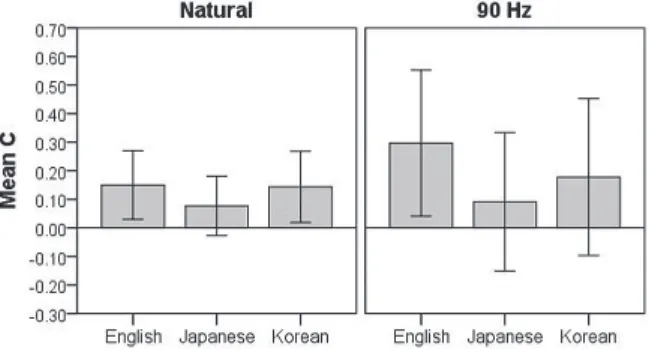
To see if the difference between the Japanese group and the other two language groups is real, a bias measure ‘c’ (Macmillan & Creelman, 1990, 2005) was obtained for each listener in each stress and each F0 condition.
Since the main goal of this study is to examine if the Japanese listeners are biased towards final-stress (antepenultimate-mora-stress) even when presented with truncated stimuli, c values considered here were calculated
to show the magnitude of a final-stress bias, though all the three language groups did not actually show such a bias here.14 Figure 4 summarizes the mean c values of each language group averaged across listeners in each F0 condition.
Figure 4. The mean c values of each language group averaged across listeners in each F0 condition. Error bars show 95% confidence intervals.
The distance between c and zero indicates the magnitude of a bias: the farther apart from zero in the negative range, the more biased towards final stress, and the farther apart from zero in the positive range, the more biased towards initial stress. If c is zero, then there is no bias towards either direction. Since all language groups were biased towards trochaic stress in this case, their mean c values were all in the positive range as shown in Figure 4. Nonetheless, the mean c values of the Japanese listeners were the closest to zero, and their 95 % confidence intervals in both the Natural and the 90 Hz condition included zero. That is, although their mean c values were indeed in the positive range, i.e., in the direction of an initial- stress bias, it was too weak to conclude that there was any bias. The mean c value of the English listeners and that of the Seoul Korean listeners in
Perception of English Stress by Japanese Listeners Mariko Sugahara
the Natural condition were greater in the positive range than that of the Japanese listeners, and their 95 % confidence intervals did not include zero, which means that the English and the Seoul Korean listeners were biased towards trochaic stress. When it comes to the 90 Hz condition, it is only the English listeners who showed a clear trochaic bias because it is only their 95
% confidence interval that did not include zero. In summary, the Japanese listeners were the least biased and the English listeners were the most biased towards initial stress.
The difference among the language groups, however, was not statistically significant according to ANOVA (univariate general linear model) in which c was a dependent variable and ‘language groups’ and ‘F0 conditions’ were the fixed factors: There was no significant difference between the two F0 conditions, and there was no significant interaction between the language factor and the F0 factor, either. That is, although the native English listeners showed the strongest and the Japanese listeners showed the weakest trochaic bias, it was not backed up by the results of statistical analysis.
The results here are in contrast with Sugahara’s (2016a) observation that the Japanese and the Seoul Korean listeners showed a final stress bias when they were provided with full-word stimuli such as TRANSplant and trasnPLANT in an environment where pitch was not a reliable cue.15 One possible account is the following. First of all, the final syllables of the full- word stimuli in Sugahara (2016a) were longer than their initial syllables as summarized in Table 2. For example, the durational ratio between the initial and the final syllable in the trochaic noun form IMport is 1:3.5. The only pair whose final syllables were less than two times longer than their initial syllables was the pair of transplant.
Table 4. The durational properties of syllables in the full-word stimuli used in the task reported in Sugahara (2016a)
Initial syllable Category Stress Pattern Syllable 1
Duration(ms) Syllable 2
Duration(ms) ratio between Syllable 1 and Syllable 2
import N trochaic 145 508 1:3.5
V iambic 131 575 1:4.4
insult N trochaic 187 501 1:2.7
V iambic 156 585 1:3.8
misprint N trochaic 220 454 1:2.1
V iambic 182 524 1:2.8
retake N trochaic 151 431 1:2.9
V iambic 130 456 1:3.5
transplant N trochaic 329 481 1:1.5
V iambic 264 506 1:1.9
Given this, it is possible that both the Japanese and the Seoul Korean listeners paid more attention to the relative durational difference between the initial and the final syllables than the native English listeners, and they might have judged that the longer final syllables had been more prominent than the shorter initial syllables. A closer investigation into the data considered in Sugahara (2016a) seems to support this speculation. Although Sugahara (2016a) only showed correct response rates for the full-word stimuli having all of the word-pairs lumped together, Figure 5 shows those of each word pair separately.
Perception of English Stress by Japanese Listeners Mariko Sugahara
Figure 5. The correct response rates obtained for the full-word stimuli in Sugahara (2016a). ‘90 Hz Flat’ means that the pitch contours of the stimuli were made into flat at 90 Hz, and ’90-87 Hz Slightly Slanting’ means that the pitch contours of the stimuli were made into a slightly slanting slope declining from 90 Hz to 87 Hz.
Figure 5 shows that listeners were paying attention to durational difference between the initial and the final syllables. The evidence comes from the pair of transplant which behaves differently from the other pairs.
For the Japanese listeners, it is only the pair of the transplant that obtained no bias towards either direction. A similar picture was also basically true of the Seoul Korean listeners. When it comes to the English listeners, only the pair of transplant obtained a strong initial-stress bias. This peculiar behavior of the transplant pair is explained if the durational difference between the initial and the final syllable is taken into consideration: transplant was the only pair whose initial and final syllables had relatively similar duration.
The two syllables having similar duration might have made the participants
hear less prominence on the final syllables, which might have resulted in no final stress bias or a bias towards initial stress. In this way, the relative length factor of the initial and the final syllables might have affected the results of the task reported in Sugahara (2016a).
In the current task, the participants were not able to hear the relative durational difference between the initial and the final syllables. Therefore the Japanese and the Seoul Korean listeners were not biased towards final stress as they did in Sugahara (2016a). Since the relative durational difference between the initial and the last syllable in the same word is not available, one may speculate that the current task allowed more genuine effect of the stress/accent systems of listeners’ L1 to emerge. However, in this task, no significant difference was obtained between the response pattern of Japanese listeners and that of the other two language groups.
In summary, no evidence was obtained to support the hypothesis that the Japanese listeners are affected by the antepenultimate stress rule in their L1 when perceiving English stress.
4. The identification task with truncated stimuli ‘Group 2’
4.1. Stimuli and predictions
The second group of truncated stimuli comes from four-syllable suffixed words sharing the same verb stems: the -ing forms such as DOminating and the -ion forms such as domiNAtion. The complete list of those words used in the experiment are shown below.
(6)
a. ACtivating, actiVAtion b. Agitating, agiTAtion c. ALlocating, alloCAtion
Perception of English Stress by Japanese Listeners Mariko Sugahara
d. CALculating, calcuLAtion e. CAPtivating, captiVAtion f. CElebrating, celebRAtion g. COMplicating, compliCAtion h. CONcentrating, concentRAtion i. CONjugating, conjuGAtion j. DEdicating, dediCAtion k. DOminating, domiNAtion l. Educating, eduCAtion m. EStimating estiMAtion n. INdicating, indiCAtion o. MEdicating, mediCAtion p. MItigating, mitiGAtion q. MOtivating, motiVAtion r. NAvigating, naviGAtion s. PROpagating, propaGAtion t. PROsecuting, proseCUtion u. TERminating, termiNAtion
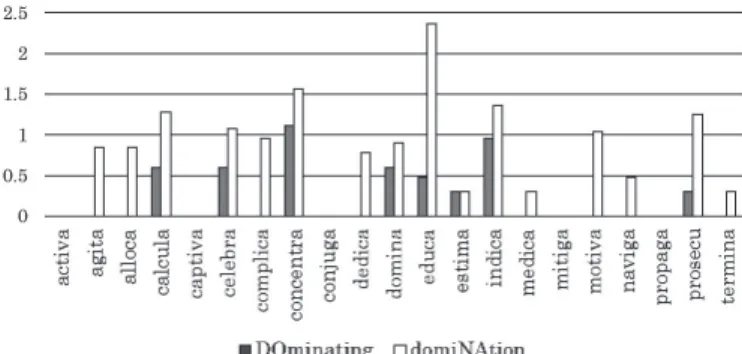
It is also necessary to inspect the frequency of each word to see if word frequency affected listeners responses. Frequency information was obtained from the CELEX database (Baayen, Piepenbrock & Gulikers, 1995) and is summarized in Figure 6.
Figure 6. The log frequency obtained from CELEX. The dark gray bars are of the -ing forms (e.g. DOminating) and the white bars are of the -ion forms (e.g., domiNAtion).
The mean log frequency of the -ing forms is 0.24 while that of the -ion forms is 0.75. The log value of 0.24 means that there are about 1.8 occurrences and that of 0.75 means that there are about 5.6 occurrences, which means that the -ion forms are about three times more likely to occur.
This frequency difference may affect the result of the experiment, and the frequency factor was taken into consideration in the analysis presented in Section 4.3.
The log frequency of verb lemmas, i.e., the frequencies of all inflected forms combined together, is also shown in Figure 7. The mean verb lemma frequency is 0.86 (7.3 occurrences) and the mean frequency of the -ion forms is 0.74 (5.5 occurrences), which means that the total number of occurrences of the former is 1.3 times higher than that of the latter. The difference, however, is not as obvious as the difference between the inflected forms -ing and the derived forms with -ion shown in Figure 6, which I assume not to have affected the responses of the participants.
Perception of English Stress by Japanese Listeners Mariko Sugahara
Figure 7. The log frequency obtained from CELEX. The dark gray bars are of the verb lemmas (e.g. DOminate) and the white bars are of the -ion forms (e.g., domiNAtion).
4.2. Method
The words listed in (6) were produced by the same native English speaker who also produced the Group 1 stimuli. The recording procedure was the same as that of the Group 1 task. The only difference was that although the primary stress locations of the Group 1 words were indicated by an accent mark ‘´’ when they were visually presented to the speaker, no such marking was employed for the words in (6). It is because for the native speaker the stress patterns of the words in (6) were obvious from their suffix endings.
Two kinds of truncated words were created using Praat: those with initial two syllables such as DOmi- from DOminating and domi- from domiNAtion, and those with three syllables such as DOmina- from DOminating and domiNA- from domiNAtion. Acoustic properties of those stimuli are summarized in Tables 5 to 8 and Appendices 1 to 3.
As shown in Table 5 and Appendix 1, the initial vowels and syllables of the -ing forms were longer than those of the -ion forms. It is also true that
the second vowels and syllables of the former were slightly longer than those of the latter. Their third vowels and syllables, however, displayed an opposite relation: the -ion forms were longer than the -ing forms. That is, the durational differences between the -ing and the -ion forms may serve as disambiguating cues if listeners are sensitive to them. Table 6 shows the mean values of F0 averaged across each vowel period and those of overall intensity: the initial and the second vowels of the -ing forms have greater mean values than those of the -ion forms while the other way round is true for their third vowels (also see Appendix 2). Those may also serve as disambiguating cues. Formant values are shown separately for the initial vowels and for the final vowels in Table 7 and Table 8 respectively (also see Appendix 3). The magnitude of differences in F1 mean values between the -ing and the -ion forms was small. The only initial vowels that differed relatively clearly (about 40 Hz or more) between the two forms were /i/ and /æ/. As for the third vowels, there were no such differences. The magnitude of differences in mean F2 values was small, too, and the only case where a relatively clear difference (about 100 Hz) existed was the third vowel /ju/ in prosecuting and prosecution. Given this, formant values are predicted to be less reliable cues for listeners to distinguish the two stress patterns.
Table 5. Duration (ms)
Vowel1 Vowel2 Vowel3 Syllable1 Syllable2 Syllable3
-ing Mean 99 53 126 173 107 205
SD 23.9 12.9 12.5 48.6 24.5 27.7
-ion Mean 81 49 132 146 103 223
SD 18.7 14.3 13.4 47.9 23.5 28.8
Perception of English Stress by Japanese Listeners Mariko Sugahara
Table 6. F0 (averaged across a vowel period) and overall intensity
Vowel1 Vowel2 Vowel3
F0 (Hz) Intensity (dB) F0 (Hz) Intensity (dB) F0 (Hz) Intensity (dB)
-ing Mean 100 64 93 60 79 58
SD 3.9 2.5 4.8 3.2 2.8 2.5
-ion Mean 92 62 88 59 90 61
SD 4.2 2.7 3.5 3.1 3.3 2.4
Table 7. V1 Midpoint F1 and F2 (Hz)
Front Non Front
n = 2ɪ ɛ
n = 5 æ
n = 6 ɝ
n = 1 oʊ
n = 1 ɑ
n = 6
F1 F2 F1 F2 F1 F2 F1 F2 F1 F2 F1 F2
-ing Mean 492 2300 583 1698 771 1591 679 1628 525 1305 686 1155
SD 51.6 639 61.2 171.8 46.8 198 . . . . 21.5 45.8
-ion Mean 532 2368 564 1666 719 1504 691 1498 540 1128 690 1182
SD 62.2 685.2 64.7 183.9 45.7 153 . . . . 18.6 54.1
Table 8. V3 Midpoint F1 and F2 (Hz)
n = 20eɪ ju
n = 1
F1 F2 F1 F2
-ing Mean 474 1986 380 2031
SD 30.6 140 . .
-ion Mean 458 2013 357 1930
SD 34.8 153 . .
The two-syllable stimuli e.g., DOmi- and domi-, had only one F0 condition <Natural>, whereas the three-syllable stimuli, e.g., DOmina- and domiNA-, had two F0 conditions: <Natural> and <Slightly Slanting>. This is summarized in Table 9.
Table 9. Truncated stimuli and F0 conditions
truncated stimuli F0 conditions Two syllables
DOmi-, domi- <Natural>
Three syllables
DOmina-, domiNA- <Natural> & <Slightly Slanting>
The <Slightly Slanting> stimuli had the same F0 slope regardless of whether they were extracted from the initial-stress -ing forms or from the stem-final-stress -ion forms. To create the <Slightly Slanting> stimuli, the left edge of their initial syllable’s voicing period was set at 90 Hz and the right edge of their third syllable’s voicing period was set at 85 Hz, and those two points were connected with a straight F0 slope using the pitch manipulation function of Praat. In Figures 8 to 11, example pitch contours are shown.
Figure 8. A three-syllable stimulus DOmina-: <Natural>
Figure 9. A three-syllable stimulus domiNA-: <Natural>