Japanese University Teachers’ Beliefs and Practices regarding an English-only Policy
Yukie Saito
Abstract: The recent focus on Communicative Language Teaching (CLT) seems to have fueled a belief in an English-only classroom. Surprisingly, however, little attention has been paid to teachers’ beliefs and practices regarding an English-only policy. This article examines what attitudes Japanese university teachers hold toward the monolingual approach and how their attitudes influence classroom practices. A qualitative analysis of video-taped observations and interviews with two Japanese university instructors reveals that despite students’ different levels, in general, the institutional English-only policy was followed effectively in all the six observed classes. However, the two teachers differed in their interpretations of the policy and the way they dealt with students’ L1 use. The findings of this study are consistent with those from previous studies on teacher cognition (Ford; 2009; Kurihara, 2013;
Nishimuro & Borg, 2013): classroom practices were not explicitly theory-based, but rather underpinned by individual teacher beliefs, and their learning and teaching experiences.
Keywords: English-only policy, Teacher beliefs, L1 use
1. Introduction
With the recent focus on “teaching English through English” in high schools, the issue of L1/L2 use in the classroom has been attracting growing attention. A belief in an English- only policy, which is in keeping with the tradition of “direct” teaching methods (e.g.
McKay, 2012), has been fueled by an emphasis on communicative language teaching (CLT).
Although some research has been directed toward understanding teachers’ perceptions about a monolingual policy at Japanese tertiary level (e.g. Ford, 2009; McMillan & Rivers, 2011), participants in such studies are native speakers of English, not Japanese teachers who share their mother tongue with their students. The purpose of this study, therefore, is to investigate Japanese teachers’ beliefs and practices about an English-only policy, using interviews and class observations as main data sources.
2. Literature Review
2.1. Rationale for L1 use: Socio-political, pedagogical, and practical reasons The discussion of L1/L2 use in the classroom is far from being settled. One of the main
theoretical grounds for an English-only policy is attributed to Krashen’s (1982) input theory that L2 is acquired subconsciously through exposure to comprehensible input. It seems to be a common sense assumption that more use of L2 results in higher proficiency in that language (Auerbach, 1993; Swain & Lapkin, 2000) and teachers who establish a staying-in-English rule strictly are found to hold a strong belief in the assumption (Ford, 2009; Mori, 2004). It was critical researchers that gave the impetus for the reevaluation of L2 in the classroom in ESL contexts. Among them was Phillipson, the author of Linguistic Imperialism (1992). He cast doubt upon the then dominant CLT practice that English should be taught in a monolingual way and by native speakers, arguing that this
“monolingual fallacy” is the remnants of the colonial era and implants negative beliefs about bilingualism. The denial of L1 has been also seen as the deprival of “linguistic human rights” (Skutnabb-Kangas, 1999), social injustice, and existing unequal power relations (Auerbach, 1993).
In EFL contexts, L1 has been shown to play an important role in L2 learning (e.g. Anton & DiCamilla, 1999; Cook, 2001; Fotos, 2001; Leeming, 2011; Levine, 2012;
Macaro, 2001; McKay, 2012; Swain & Lapkin, 2000) and this study is based on a belief that there are several reasons to support L1 use in the L2 classroom. Firstly, any foreign language classroom should be considered as a multilingual social place. McKay (2012) argues that as the spread of English has grown dramatically, traditional L2 pedagogy which heavily relied on the native-speaker model should be reconsidered. For English pedagogy to reflect the current area of globalization, it is indispensable to teach English as an international language. She calls for reexamining the idea of an English-only policy, stating that such a policy deprives teachers of an opportunity to promote learners’ awareness of multilingualism.
In addition to this opposition to an English-only policy from a socio-political viewpoint, several empirical studies (Anton & DiCamilla, 1999; Fotos, 2001; Leeming, 2011; Macaro, 2001; Swain & Lapkin, 2000) have argued important functions that L1 use serves for pedagogical reasons. Based on a Vygotskian sociocultural framework, in which language is understood as a cognitive tool, Anton and DiCamilla (1999) examined the use of L1 in the discourse of L2 learners engaged in pair writing tasks. They demonstrated three critical functions of L1 use: for scaffolded help, intersubjectivity, and private speech.
Adopting Anton and DiCamilla’s framework with modifications, Leeming (2011) focused on his Japanese high school students’ use of L1 during pair communicative tasks. It was concluded that his initial fear that Japanese was used extensively and was undermining the effectiveness of tasks, which was a strong motive for his study, was not supported by evidence. Consistent with the findings of Anton and DiCamilla (1999), Leeming argued that L1 played an important role in assisting students to cope with tasks and in creating a collaborative learning environment. Furthermore, other researchers have claimed that limited class time should be used efficiently by taking advantage of many connections between L1 and L2 that learners establish cognitively (Cook, 2001; Ford, 2009), in particular, concerning vocabulary learning (see Nation & Webb, 2011).
Finally, linked to the idea of regarding both L1 and L2 as personal repertoire, complete exclusion of L1 is often “unenforceable”, especially in group work, in which it
is more natural for students to communicate in their shared L1 (McKay, 2012). Hancock (1997) analyzed students’ code switching during group work in monolingual classrooms based on two frames: a literal and a nonliteral frame (originally from Goffman, cited in Hancock, 1997). Discourse within a literal frame is off-record, mainly concerned with negotiation between learners while discourse within a nonliteral frame is on-record, in which learners are role-playing to be heard by a referee. He found that students’ L1 use markedly differed in the two different layers and, therefore, stated that it is important “not to assume that all L1 use is ‘bad’ and all L2 use is ‘good’” (p. 233).
2.2. Teachers’ beliefs regarding L1 and L2 use in the classroom
As Ford (2009) pointed out, most research investigating the L1/L2 issue conducted in Japan or other EFL contexts has been limited to students’ perceptions (e.g. Carson &
Kashihara, 2012) and less attention has been paid to teachers’ beliefs regarding using only English in the classroom except for a few studies (Ford, 2009; Macaro, 2001; McMillan
& Rivers, 2011). Despite growing theoretical and pedagogical grounds against the total ban of L1 use, teachers’ beliefs regarding the L1/L2 issue still remains controversial. In fact, two studies conducted in Japanese university contexts that explored teachers’ beliefs (Ford, 2009; McMillan & Rivers, 2011) have shown that teachers have mixed attitudes toward L1/L2 use. Ford (2009) interviewed ten English native speakers at universities and found that majority of the teachers followed an English-only approach in terms of their own language use while there was more flexibility concerning students’ language use. He argued that given discretion when and how to use Japanese in the classroom, teachers, emphasizing the need to feel comfortable whatever approach they take, tended to be influenced by personal factors such as “beliefs and experiences, practical considerations, and personality and intuition” (p. 77). In McMillan and Rivers (2011), it was reported that a significant number of their participants believed the L1 played a positive role in L2 learning and that this was not contradictory to CLT. They concluded that the issue of L1/L2 should not be considered as all or nothing; teachers could follow an “English-mainly” rule which allows students to make effective language choices according to tasks they are engaged in. Their conclusion resonates with the Levine’s (2012) argument that in order to achieve the baseline aim of having students use L2 as much as possible, L1 should be given “a sanctioned place in language pedagogy” (p. 3).
Although these two studies provide insights into teachers’ perceptions about L1/L2 use, their participants were all native speakers of English. Therefore, it is worth focusing on practices and beliefs of teachers who share the same L1 with students. Interesting use of Japanese highlighted by some non-Japanese teachers was for humor effect, which could contribute to a positive atmosphere (Ford, 2009). This use of L1 by Japanese teachers, however, is unlikely to be equally effective. Additionally, one of the limitations in the two studies is that the data came from one single data source: interviews or open-ended questionnaires. To overcome this limitation, the present study includes both interviews and observations, which allows us to examine how teachers actually practice an English- only policy in the classroom and how their practices are influenced by or related to their beliefs about the language policy. Although my original research addresses three points: (1)
the amount of L1, (2) the purposes of L1 use, and (3) teachers’ beliefs and practices about the English policy, due to space constraints, I am only sharing the results regarding the third issue. Research questions this paper investigates are:
1. What are Japanese university teachers’ beliefs about an English-only policy?
2. How do such beliefs influence the way teachers react to students’ L1 use?
3. Research Methods
3.1. Context
The research was conducted at a private university in Tokyo, where all the first-year students, regardless of their majors, are required to take English discussion classes throughout a year as part of compulsory credits. Students meet once a week for 90 minutes over the course of 14 weeks each semester. To achieve high consistency of teaching within this program, teachers are expected to follow certain classroom procedures and an English-only policy under a unified syllabus. The language policy is written clearly in both student and instructor handbooks.
The goal of this course is for students to actively participate in discussions.
Accordingly, the primary teaching focus is to develop students’ speaking fluency, not accuracy; teachers hardly provide corrective feedback on grammar and vocabulary.
Instead, to implement the English-only policy, teachers introduce various communication strategies including asking for unknown words (“How do you say … in English?”) and clarification (“Sorry, I don’t understand. Can you explain?”). In-house workshops enable teachers to share ideas to manage classes in a way that can successfully implement this institutionalized language policy.
3.2. Participants
When the research was conducted, there were approximately 40 instructors and eight of them were Japanese. Among them, I selected two participants: a female teacher, Kaori and a male teacher, Akira; they are pseudonyms. The selection of the participants was made based not only on their willingness to participate in my study, but also on gender, experience as English learners, previous teaching experience, and years of teaching at this program. Kaori, finishing her M.A. in TESOL from an American graduate school, was teaching in an ESL context before she got her current position as an English discussion instructor in April, 2012. Akira joined the program at the university at the same time as Kaori did. After several years of working for a Japanese company, he made a decision to change his career into teaching, something he had been interested in but never had had a chance to pursue. His M.A. in TESOL from an Australian university paved the way for him to experience teaching in various contexts in Japan: as a part-timer at university and as an ALT at elementary school.
3.3. Data collection and analysis methods
The data were collected from three videos taken over a period of one and a half years
per each participant. In this program, all instructors are required to video-tape one of their 90-minute classes per semester as part of teacher development. In other words, video-taping was for teachers’ evaluation; otherwise, teachers as well as students might have changed their behaviors. Nevertheless, possible effects of the existence of a video on students’ performance should be noted here and were checked later in a follow-up interview with each instructor.
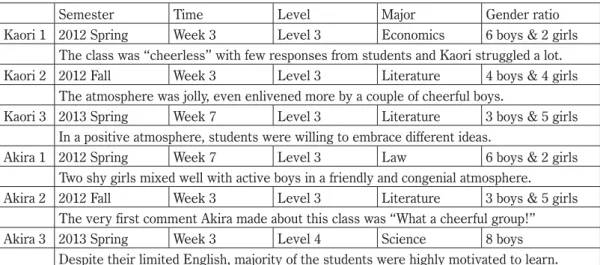
Considering the fact that observations regularly take place, the use of observation videos was thought to be the least obstructive way of collecting data. The purpose of using three different videos for each participant is to understand how the English-only policy, which is supposed to be adopted equally under the unified syllabus, is followed in various classes which differ greatly in terms of student’s individual differences in English proficiency level and motivation, and also each class’ atmosphere and dynamics. Table 1 shows the level, major, and gender ratio along with the teachers’ brief comments about each class, which they shared with the researcher in the interviews. Discussion classes are divided into four levels; level 1, 2, 3, and 4 indicate advanced, intermediate, low- intermediate, and pre-intermediate, respectively. The estimated TOEIC score of level 3 students would be somewhere between 450 and 550. Five out of the six classes analyzed for this study were level 3 while one of Akira’s classes was level 4.
Table 1 The background information about the six observed classes
Semester Time Level Major Gender ratio
Kaori 1 2012 Spring Week 3 Level 3 Economics 6 boys & 2 girls The class was “cheerless” with few responses from students and Kaori struggled a lot.
Kaori 2 2012 Fall Week 3 Level 3 Literature 4 boys & 4 girls The atmosphere was jolly, even enlivened more by a couple of cheerful boys.
Kaori 3 2013 Spring Week 7 Level 3 Literature 3 boys & 5 girls In a positive atmosphere, students were willing to embrace different ideas.
Akira 1 2012 Spring Week 7 Level 3 Law 6 boys & 2 girls
Two shy girls mixed well with active boys in a friendly and congenial atmosphere.
Akira 2 2012 Fall Week 3 Level 3 Literature 3 boys & 5 girls The very first comment Akira made about this class was “What a cheerful group!”
Akira 3 2013 Spring Week 3 Level 4 Science 8 boys
Despite their limited English, majority of the students were highly motivated to learn.
In addition to observations, two semi-structured interviews for each participant were conducted to investigate their beliefs about an English-only policy. In the first interviews, which took place in December 2012, three guiding questions were prepared to ask for (a) English learning experience, (b) English teaching experience, and (c) their beliefs about the policy. Question (a) was included because as Borg (2003) argues in his review article about research on teacher cognition, “teachers’ prior language learning experiences establish cognition about learning and language learning” (p. 88). Teachers’ teaching experience, especially regarding whether or not they adopted an English-only policy previously, was considered to be one of the influential factors on their beliefs and therefore, question (b)
was asked in the interviews. A follow-up interview was carried out in July 2013, in which the participants reflected their observed classes. All the interviews were audio-recorded, transcribed in Japanese, a language used throughout the interviews. And then the data was translated into English by the researcher with fillers and false starts removed for simplicity.
4. Findings and discussion
Numerous studies in the mainstream education have revealed that “language teachers’
classroom practices are shaped by a wide range of interacting and often conflicting factors”
(Borg, 2003, p. 91) and among them, teacher cognition, defined as “what teachers think, know, and believe” (ibid, p. 81) consistently remains powerful. The aim of this section is to examine the close relationship between teachers’ beliefs and classroom practices, and whether and how the relationship was influenced or even modified by contextual factors, such as each class’ dynamics and students’ level of proficiency.
4.1. Kaori’s beliefs and practices
Throughout her various teaching experiences both in America and Japan, it seems that Kaori has been trying to teach by her motto, “Do lessons which I would love to take as a student.” One of her criteria for successful teaching is students’ reactions: whether or not they get lively and have fun through learning. At the end of the first interview, she said her strength as a teacher lay in her consideration of students’ perspectives in planning lessons.
This idea of putting herself in their shoes is a key concept to understand her beliefs and attitudes toward the English-only policy in her classes.
The monolingual policy did not strike Kaori as a matter of special attention because she had been teaching English, using only English. It was something she expected and took for granted in her previous teaching environment, so it is just natural for Kaori to follow the policy whenever she is in the classroom. Although she does not seem to question that English should be used in the class, her approach toward the monolingual policy is more flexible and less strict compared to that of Akira, which will be discussed later. She does not become upset or frustrated with students’ L1 use, but rather acknowledges its certain value as seen in the excerpt below.
I can wait until students get ready [to speak English]. I think of small talk [in Japanese] as a break. If students keep using Japanese, I will intervene, but if not, if their use of Japanese is kind of transitional, it is okay (Interview 1).
What is revealed here could explain why quite a few number of L1 instances were identified, especially in transitions from one activity to another. She said in her first interview that she would hardly say “No!” to remind students of the 100% English rule, even when a student used L1 in an excessive manner. In such a case, she said she would translate what the student was saying into English so that he/she could switch back to English. In all the observed lessons, she never took a negative approach toward students’
L1, but there was one time when she gave feedback on their Japanese during a discussion in Kaori 1. Compared to her other classes, students in this class were frequently using Japanese not between activities, but during a group discussion. After the discussion, Kaori gave feedback on their L1 use as follows:
Sometimes, you have some words you don’t know how to say in English. If you say … oh “jyōdan jyōdan”, somebody might help you, “Oh it’s a joke.” Right? But because this is an English class, I want you to ask properly, “Oh how do I say jyōdan in English?” so that your friends can help you in English. At that time, both of you, the person who asked and the person who helped can get a point for that (Transcript, Kaori 1).
Another way of giving feedback is through the website, where students can check their weekly grades and read instructor’s comments. All discussion instructors are asked to write a class comment after each class, referring to ideas, the use of functions, and communication which includes agreeing/disagreeing, asking follow-up questions, and the use of Japanese. Regarding Kaori 3, she said in the follow-up interview that almost every week, she wrote a comment on the English-only rule because the students were very good at the other communication skills. Again, she did not write anything negative, but listed good examples of using simple English to explain difficult words. She said she just wanted to make this class comment a “reminder” for them. Asked if there had been any changes in adopting the language policy in her second year of teaching discussions, she answered that in addition to introducing the phrase “How do you say … in English?”, she advanced to the next level, having students think how they could have explained the word they asked for help. Her aim was not to reprimand students for their L1 use, but to make the use of it and transform it into a learning opportunity.
Kaori seems to take a more lenient approach in dealing with low-level students and attributes one reason to her interest in collaborative learning, especially among less proficient students.
It cannot be helped if students use “accidental” Japanese, for example, “Eee?” or
“Wakaranai (I don’t know)”. If students help each other, I see them motivated and keen. On the other hand, even when I try to explain in simple English, some students shut down like this [she is covering her ears with both hands] and will not try to understand me. If someone explains in Japanese quickly, they get it and can do tasks quickly (Interview 1).
In this excerpt, she admitted that the simplest English explanation could not be equally helpful, particularly for students who had given up staying tuned to her instruction in English. She does not allow herself to switch into Japanese even in such cases, but accepts other students to use L1 to create a shared understanding so that everyone in the class is on a right track. What she meant by “accidental” Japanese here includes not only reactions but also personal comments on tasks (“I do not know”). It is implied that Kaori is tolerant
of students’ use of L1 for task control, social purposes, and as accidental reactions. She also showed her empathy for students with low vocabulary level and further commented, “It [L1 use] cannot be helped if their vocabulary size, which is fundamental, is small. We don’t focus on there but on whether students can actually use their vocabulary or not (Interview 1).”
4.2. Discussion for Kaori
Kaori’s belief that successful teaching should help students enjoy learning experience appears to underlie her teaching practices and one of them is to reinforce their learning by providing feedback on what students are good at, instead of what they did not do well. This is true of her approach toward the English-only policy; in all of her classes, she never made negative comments on their L1 use. Even in Kaori 1, where the largest amount of L1 use was identified, her feedback was not to scold students for their L1 use, but to encourage them to use strategies so that they could earn points for communication. Likewise, as a weekly class comment on the website, she quite often referred to the English-only rule as a “reminder”.
Kaori’s approach is shared by Leeming (2011), who, from his own fear that students’
excessive L1 use might undermine the effectiveness of tasks, investigated L1 use of his Japanese high school students during communicative tasks. They are similar in that they both “encourage students to use L2 only but not explicitly prohibit the use of L1” (p. 375).
In Kaori’s case, her motto of conducting lessons students enjoy seems to push her to opt for the “carrot” rather than “stick” approach, which made it possible to implement the institutional language policy in all the three observed classes, not perfectly but still fully, while students were engaged in student-student interactions.
Though she did not explicitly refer to any theories for L1 use in the interviews, she seems to consider that students’ L1 is part of communication (Levine, 2012). In fact, she was particularly lenient toward L1 use for social purposes, the examples of which were often found between activities. As mentioned in the previous section, she regarded such students’ L1 use as a break time and went further to say that she could wait until they became ready to switch back to English. In other words, for Kaori, L1 in the classroom, if it could promote, not hinder, the maximized and rich L2 use, should not be discarded ruthlessly. This view is consistent with Levine’s argument that L1 should be acknowledged for its important role if it can afford rich communication and learning in L2.
In addition, during the interviews with Kaori, the phrase “it [L1] cannot be helped” was used twice: when she talked about Japanese reactions and low-level students with limited vocabulary. Her tolerance for accidental reactions in L1 is linked to the argument that teachers cannot force students’ L1 to be completely excluded from the classroom (McKay, 2012). In conclusion, it seems that for Kaori, the 100% English rule, the language policy required by the institution, is certainly one of the objectives of each lesson, yet, in the process of aiming at this goal, she admits certain functions L1 serves in the classroom.
4.3. Akira’s beliefs and practices
After working for a Japanese company for years and feeling the need of Japanese engineers’
English skills, especially in negotiating with foreign counterparts, he entered this field, determined to help Japanese people develop their English communicative competence.
His initial take on the English-only policy at the institution was, therefore, quite favorable.
Considering the high reputation that the university enjoyed, he thought the institutional goal was achievable. Akira, however, showed some reservations about saying an English- only policy should be one-size-fits-all. Actually, his previous job as an ALT at elementary school officially required him to stick to an English-only policy but he often used Japanese in the classroom. He set a goal that he would assist students in having fun with, and communicating in English, and realized that Japanese was necessary in order to achieve the goal. The practice of using Japanese in the classroom was also supported by another ALT at the elementary school, who advised Akira to do what he believed was beneficial for students.
His preconception that the English-only policy would be implemented successfully in his classes is supported by the data collected from the observations. In the three video- taped observation classes, Akira followed this policy strictly on his side with a concern that “once I start speaking in Japanese then students will count on it”. As for students’ use of L1 before or after the lesson, he commented in the interview that he would encourage them to try in English first, but if they struggled, he would say “Okay, in Japanese!” and let them switch into L1. In fact, in all his classes, students were chatting with each other in a relaxed manner in Japanese before the class began and Akira, making a few English comments, briefly joined their conversation, which appeared to be a way of building rapport with his students.
The only dilemma Akira seems to face regarding the L2-only policy is time efficiency; the use of L1, in particular, in explaining an already familiar concept to students, could allow more time to be spent for other classroom activities such as student-student interactions. He commented:
My approach [to teaching discussion classes] is to minimize my instructions and maximize student-student interactions. However, even when I give instructions, using very simple words, there are some students who just can’t understand or deal with them … For example, if I said, “Paraphrasing means youyaku”, it’s done. But I have to explain what paraphrasing means by giving examples. If I said in Japanese,
“Youyaku shite kiite goran (Paraphrase what you heard and check)”, the explanation would be ten seconds. Why I bother to spend one and half minutes to explain it in English, I sometimes wonder (Interview 1).
To achieve 100% English environment, he takes a rather strict approach to students’ use of Japanese during the class; he identifies Japanese use quickly and responds to it, just as suggested in a teacher manual. In all of his three video-taped lessons, he reminded students of the English-only rule as feedback on their L1 use. For instance, at one point in the second lesson when he was collecting quizzes, Akira noticed two students chatting about hairstyle in Japanese, task-unrelated L1 use for social purposes. Making eye contact with them, he warned these students half-jokingly, “Did I hear any Japanese? Minus
point?” and other students were laughing in a way that could support the English-only environment.
Later in the same class, one female student used L1 to explain the meaning of an English proverb, “When in Rome, do as Romans do”. After a few seconds of thinking, she decided to use L1 for clarification. Akira did not intervene the interaction, but hearing her saying “In Japanese …”, he made a gesture indicating “no Japanese” although his sign remained unnoticed by the student. On hearing only the first two Japanese words of the proverb, her partner understood its meaning, and then they continued exchanging their ideas in English. In this interaction, L1 was used to provide help; if her partner had known the meaning of the English proverb, she would not have relied on Japanese. Nevertheless, Akira still wanted the student not to give up explaining in English and therefore, gave feedback on this L1 use, saying the student could have said “If you go somewhere, you should follow local rules.” In other words, Akira was strict about L1 for scaffolded help, hoping that students would help each other only in English.
Similarly, he was not tolerant with L1 to control the task; he discouraged his students from using Japanese even with a good will to help others. In the follow-up interview, he said:
If a student had explained briefly in Japanese, I’d say thank you and ask another student in trouble, “Do you understand? Yes?” And then I’d say “Next time, try to do that in English!” to make sure that students can learn from the lesson (Interview 2).
His beliefs about dealing with students’ use of Japanese were well summarized in his first interview as follows:
I don’t mind if students give reactions in Japanese, but when Japanese is directly related to the context, I take a rigorous approach, saying “Minus one point!” to students who use it. If they repeatedly use Japanese, I will deduct a point from their weekly grade so that they can learn from the lesson. But if students use Japanese for the first time, I will just warn them. I try to avoid students’ use of Japanese becoming habitual (Interview 1).
Concerning L1 use between activities, including when students move around to look at pieces of paper on the wall, Akira seems to take a less strict approach. In the first interview he said that Japanese reactions such as “Aah! (Oh!)” were okay and that “Acchi?
(That one?)” to perform task lay in a “gray zone” but he was tolerant with it. However, he confirmed that it was not acceptable if students used L1 to communicate something topic- related during discussions. For Akira, it is the functions and the timings of L1 use that matter in drawing a line.
4.4. Discussion for Akira
With hope to help future Japanese business people develop communication skills, Akira seems to believe strongly that the institutionally required language policy is an attainable,
essential goal. In contrast to Kaori, Akira follows literally the English-only policy with very few exceptions. His biggest concern is the “knock-on effect” (Ford, 2009, p. 70) that once he allows L1 to be used, students think they can rely on it. Therefore, as suggested in the handbook, he makes the goal clear to students at the beginning and this seems to be one of the keys to implementing the English-only rule almost perfectly in all of his classes. In the very first lesson in any class, he makes sure that students understand the “no Japanese”
rule and tries to engrain it for the first couple of weeks by taking a “stick” approach toward L1 use: he would warn students, saying “You used Japanese so minus one point!” In fact, his feedback on L1 use identified in the observation data was consistent across the classes.
When he recognized Japanese, he was quick to respond to it and addressed the issue to the whole class because he did not want their L1 use to be “habitual”. The data from both the observations and the interviews reveal that Akira is strict about L1 use for asking for or providing unknown words, controlling task, and social purposes while he regards knee-jerk Japanese reactions less problematic.
During the first interview, Akira referred to one dilemma about adopting the English- only policy: time efficiency. No matter how simple his instructions were, it took some time for students, especially those with small vocabulary size, to follow them. Akira wondered, although he did not put it into practice, that the time used for Akira’s explanation could be dramatically reduced if he used Japanese in class. Interestingly, students’ ability to understand teachers’ instructions was brought up as an issue again the second time I interviewed him.
In the follow-up interview, two factors vital for adopting the English-only policy began to emerge: students’ listening skills to understand teacher’s instructions and willingness to use communication strategies without depending on L1. Students’ listening comprehension is subject to their English proficiency, in particular, vocabulary size, and this was a stumbling block to maximizing students’ interaction time under the 100% English policy, as discussed in his first interview. In his second year of teaching discussion classes, however, Akira has made efforts to clarify and simplify his instructions by slowing down his speaking speed and sometimes using visual cues. One example of visual cues he used in the observations is a microphone-shaped object. In Akira 3, during the fluency activity, he had each speaker hold the “microphone”, which helped them quickly grasp the idea of who were speakers and listeners. This example illustrates how the teacher modified his classroom practices, influenced by contextual factors in each different classroom.
Secondly, he came to see the importance of teaching students strategies to deal with the English-only environment: how to guess the meaning of unknown words from the context and check their guess with other classmates, and how to explain ideas in simple English by giving examples before asking “How do you say … in English?” These strategies are meant to be tools and Akira has noticed through his experiences that with the tools at their command, students become willing to share more opinions, try to adapt to an English-only classroom, and function well, regardless of their proficiency level.
Akira’s approach toward the English-only policy, which is stricter than Kaori’s, has not changed a lot since he started teaching discussion classes although he has been simplifying his instructions more. His attitude has been always consistent not only within
himself, but also with any level of students at any time and this might be one of the reasons for adopting the English-only policy thoroughly, effectively, and successfully.
5. Conclusion
This study, driven by my ambivalent feelings toward an English-only policy, focused on teachers’ beliefs and practices regarding the monolingual policy. To answer the research questions, data were collected from six different 90-minute classes conducted by Kaori and Akira, and also from two interviews with each of them. Kaori, acknowledging possibly beneficial functions L1 serves in the classroom, in particular, L1 for social functions, did not provide negative feedback concerning students’ Japanese at all. Her feedback, instead, was more positive, with an aim of reinforcing students’ desirable behaviors such as the use of a strategy to avoid depending on L1. On the other hand, it seems that Akira claims a near zero tolerance of students’ Japanese, except for L1 use as a slip of the tongue, in other words, accidental Japanese. It was not only his strong belief in the English-only policy but his teaching skills that enabled him to adopt the English-only rule successfully.
Some techniques identified in his videos and suggested in the interviews overlap with those covered in the literature (e.g. Polio & Duff, 1990). Among them, Akira highlighted the need to (1) make instructions comprehensible by using non-verbal cues, (2) establish an English-only rule from the very beginning, and (3) teaching communication strategies which help students not fall into Japanese. This is similar to what Mori (2004) found out in her case study with a teacher, Jean, who believed that “the implementation of the staying- in-English rule was a cooperative endeavor involving both the students and the teacher”
(p. 228).
The study has shown that the institutional English-only policy was generally followed and implemented effectively in all the observed classes, although the two teachers differed in their interpretations of the language policy and, consequently, the degree of flexibility in dealing with students’ use of L1. What the study has found is compatible with those from previous studies (Ford, 2009; Kurihara, 2013; Nishimuro & Borg, 2013) in that classroom practices were not theory-driven, but formed by each teacher’s personal beliefs and learning and teaching experiences. My primary purpose in this article, hence, has not been to name one single best approach to follow the English-only rule successfully, but to provide insights into the way each classroom is unique in that it is affected by educational policy, teacher’s beliefs, and students in the class. The findings of this study are valuable for teachers to decide what language rule to adopt in their classroom as well as for the administration to decide whether or not to make a certain language policy an institutional requirement. It is hoped that further research exploring teachers’ and students’ beliefs and practices about an English-only policy, especially in a longitudinal manner, will shed more light on the use of L1 in the L2 classroom, a still under-explored topic in our field.
References
Anton, M., & DiCamilla, F. J. (1999). Socio-cognitive functions of L1 collaborative interaction in the L2 classroom. The Modern Language Journal, 83 (2), 233 247.
Auerbach, E. R. (1993). Reexamining English only in the ESL classroom. TESOL Quarterly, 27, 9 32.
Borg, S. (2003). Teacher cognition in language teaching: A review of research on what language teachers think, know, believe, and do. Language Teaching, 36 (2), 81 109.
Carson, E., & Kashihara, H. (2012). Using the L1 in the L2 classroom. The students speak.
The Language Teacher, 36(4), 41 48.
Cook, V. (2001). Using the first language in the classroom. Canadian Modern Language Review, 57, 402 423.
Ford, K. (2009). Principles and practices of L1/L2 use in the Japanese university EFL classroom. JALT Journal, 31(1), 63 80.
Fotos, S. (2001). Codeswitching by Japan’s university bilinguals: Japanese university students’ use of their native language as a learning strategy. In M. Goebel, & S.
Fotos (Eds.), Studies in Japanese Bilingualism (pp. 329 352). Clevedon: Multilingual Matters.
Hancock, M. (1997). Behind classroom code switching: Layering and language choice in L1 earner interaction. TESOL Quarterly, 31(2), 217 235.
Krashen, S. (1982). Principles and Practice in Second Language Acquisition. Pergamon, Oxford.
Kurihara, Y. (2013). EFL teachers’ learning: Transitional experiences from an overseas teacher education program to Japanese school settings. JALT Journal, 35 (1), 51 72.
Leeming, P. (2011). Japanese high school students’ use of L1 during pair-work. International Journal of Applied Linguistics, 21 (3), 360 381.
Levine, G. S. (2012). Principles for code choice in the foreign language classroom: A focus on grammering. Language Teaching, FirstView article, 1 17.
Macaro, E. (2001). Analyzing student teachers’ codeswitching in foreign language classroom: theories and decision making. The Modern Language Journal, 85 (4), 531 548.
McKay, S. (2012). Principles of Teaching English as an International Language. In L.
Alsagoff, S., McKay, G., Hu, & W., Renandya (Eds.), Principles and Practices for Teaching English as an International Language (pp. 28 46). New York: Routledge.
McMillan, B. A., & Rivers, D. J. (2011). The practice of policy: Teacher attitudes toward
“English only”. System, 39, 251 263.
Mori, R. (2004). Staying-in-English rule revisited. System, 32, 225 236.
Nation, I. S. P., & Webb, S. (2011). Researching and analyzing vocabulary. Boston: Heinle.
Nishimuro, M., & Borg, S. (2013). Teacher cognition and grammar teaching in a Japanese high school. JALT Journal, 35 (1), 29 50.
Phillipson, R. (1992). Linguistic Imperialism. Oxford: Oxford University Press.
Polio, C. G., & Duff, P. A. (1990). How much foreign language is there in the foreign language classroom? The Modern Language Journal, 74 (2), 154 165.
Skutnabb-Kangas, T. (1999). Linguistic human rights – Are you naïve, or what? TESOL Journal, 8 (3) 6 12.
Swain, M., & Lapkin, S. (2000). Task-based second language learning: the use of the first language. Language Teaching Research, 4 (3), 251 274.