1
■ Article ■
Preliminary
Report
on
Field
Re-search
along
the
Ancient
Routes
in
the
Northern
Areas
of Pakistan
and
Related
Historical
and
Art
Historical
Information (September 1991) [II]
●
Haruko Tsuchiya
The purpose of the present field research, as stated in Part I1), is to study the routing of the ancient roads in the Northern Areas of Paki-stan which once directly connected India and China. The 1991 sur-vey was conducted in the Northern Areas of Pakistan with assump-tion that evidence left by the immense traffic passing through the many different valleys of the Karakoram and the Hindukush ranges must exist in the form of Buddhist sites and remains, and religious and secular petroglyphs, as well as in inscriptions and architectural motifs. The present report will deal with two themes :
1) Some groups of petroglyphs from the Northern Areas of Pakistan. 2) The archaeological site of Bubur and a study of the Bubur Bud-
dha image.
土谷遙子 Haruko Tsuchiya, Sophia University, History of Oriental Art. Other
publications include:
「ア フ ガ ニス タ ン ・カ ピサ 地 方 ハ ム ・ザ ル ガー ル 仏 教 寺 院 」 『三上 次 男博 士 喜 寿 記 念 論 文集 歴 史 編 』1985,平 凡 社
"
Preliminary Report on Field Research along the Ancient Routes in the
North-ern Areas of Pakistan and Related Historical Information (September 1991) [I]," Sophia International Review, Vol. 15, 1993.
2 Journal of the Japanese Association for South Asian Studies, No. 5
1. A Study of Some Groups of Petroglyphs from the Northern Areas of Pakistan
As one travels uptstream along the Indus, groups of petroglyphs2)' start to appear where the Indus makes a sudden 45-degree bend to-ward the east in the Hindu Kohistan a place known as " the Hanging Pass ". Among the groups, Chilas I, Chilas II3) and Thalpan, Hod-ar4) and Shatial are known to have very important examples besides the inscriptions found from the area of Hunza5) of petroglyphs of both Buddhist and non-Buddhist themes6). The 1991 exploration made possible a close study of some of the petroglyphs at Thalapan III, No. 1 and of some additional examples at Chilas I and II, while new materials were also collected at Partab7), at Alam Bridge8) along the Indus River and at Danyor near Gilgit and at Upper Gakuch in Punial. (Map 1)
1. 1 Thalpan III
Thalpan III is located in the western part of the Thalpan site. (Fig. 1) The so-called " altar piece "9) stands against the northern edge of a large sandy field on the right bank of the Indus. The rocks naturally formed the shape of an altar which has been measured (Fig. 2). The rectangular front face, facing south, is mostly adorned by non-Buddhist themes, particularly by animals such as horses and ibexes. The most notable petroglyph found on the face of the rock is a figure of a warrior10) (Fig. 3) represented in profile, holding a small animal by its hind leg which he is about to slaughter with an enor-nous sword held in his right hand. The figure is 73 centimeters high and is very minutely represented. Wearing a typical nomadic tunic, which is well-fitted around the waist and decorated with tassels at its hem, the warrior is represented with bulky trousers, the ends of which are bound around the instep like leggings. A wide belt is tightly wrapped around the waist. The figure wears a helmet with a long nape-cover. This warrior-figure was said to have been
iden-Preliminary Report on Field Research along the Ancient Routes•c•c 3 tified as Parthiani11), but similar helmets among Parthian figures have not been located by this author. The profile of the figure is char-acterized by a large nose and a large eye, and what appears to be : thick beard, suggesting a physiological resemblance to the Kushans, as seen when compared to the profile of King Kanishka appearing on
coins12). The tunic reaching to the knees and tied with an elaborate belt also may have a prototype in Kushan portraiture, as represented in Gandharan13 and Kapisi images14). This remarkable figure strongly suggests the presence of nomadic or horse-riding peoples.
Chiseled into the rock surface, the figure presents an exemplary portrayal of the human image at Thalpan and surpasses all others in the Northern Areas. The significance of the present figure is that it indicates the versatile cultural exchanges which must have taken place in the Chilas area15). Since animal slaughter is prohibited in
Bud-dhist practice, this might suggest that at the time of representing this warrior figure, the influence of nomadic people was considerable. Al-though it is still difficult to define the exact affiliation of the figure, a Western Asiatic, nomadic cultural connection is indicated by the
pre-sence of such features as the figure's nomadic dress and by the scene of animal slaughter.
Another facet of a cattle-herding culture is represented on the same surface of the rock altar piece: an image of a horse shown in profile, bending one of its front legs at a 45-degree angle in the pose called
"
knielauf "16) (Fig. 4). This is a special type of stylization often found in Achaemenian art. The horse is beautifully rendered with its mane and tail tied in small knots arranged like bows. Nearby this image of the horse on the same front face of the altar, are two
more examples of animals17) (Fig. 5), though produced using a dif-ferent technique and style. Standing in rigid poses, their right front legs advanced, each animal has a single horn: on the animal to the right the horn is bent in a half circle; the other's horn ends in a spiral, as does its tail. While the three animal forms thus far discussed are for the most part covered with small chisel-like marks, large roughly triangularly shaped areas at their necks and at the front and the back
4 Journal of the Japanese Association for South Asian Studies, No. 5
of their bodies are without such peck-marks. The shapes of these blank areas are very similar to those inlaid with such precious stones as turquoise, carnelian, or garnet, on the gold animal forms of the typical "animal style " of the steppe culture18).
The spiral pattern again appears in the representation of the horns of a stag and that of the two tails of a beast of prey pursuing the stag19) (Fig. 6), represented on the same surface of the altar as the examples above. The wavy, swirl-like movement of lines of these spiral pat-terns is a characteristic found in the art particularly from the Altai
region in South Siberia. The reindeer and figures, excavated from a Scythian kurgan site (burial mound), Pazyryk, reveal the strong pre-dilection for curves and spirals in the art of the people of the Altai region20).
It is evident that these three examples of animal forms are derived from different artistic traditions, including Achaemenid and Altaic. The presence of Persian influence in this area is not very surprising given the fact that Gandhara and Taxila were satrapies during the Achaeamenid period. However, actual proof of contact with the Al-taic culture from South Siberia at the Thalpan site in the Indus Kohistan is especially noteworthy since these two regions are sep-arated by one of the most mountainous regions in the world. These animal forms testify to continuous traffic in the area despite the treacherous mountain travel.
In addition to the animals forms, a large seated Buddha image with a halo and mandorla, and eight smaller seated Buddhas with halos, all in dhayana mudra are represented on the lower part of plane A of the altar (Fig. 7). The robes cover the shoulders and the drapery folds indicated by parallel, horizontal lines derived from the fluid and elegant drapery of the images of the Gupta Period. Strangely, there are images of stags, one each on the left and the right of the halo of the image of the Buddha. Both stags are advancing toward the right, the one on the right is turning back as if to see whether the stag on the left is following. The Buddha image must have been produced after the images of the stags, between which just enough space
ex-Preliminary Report on Field Research along the Ancient Routes•c•c 5
isted to accomodate the width of a halo. This could also be said in regard to the four smaller seated Buddha figures on the right, as they are represented around a square form obviously outlining the animal forms.
Rudimentary workmanship and rather provincial style are also ev-ident in the scene of the First Sermon (Fig. 8), represented on the side of a boulder near the Thalpan Bridge. A large seated Buddha image in dharmacakra mudra with a round, undecorated halo, is com-pletely covered by his robe, the draperies of which are also depicted in parallel lines. It should be noted, however, that the drapery folds of the robes are represented with accentuated and considerably more fluid lineament than to that of the Buddhist images on plane A of the altar. Surrounding the Buddha are five monks, two on the left and three on the right, each much smaller in size than the big Buddha whom they are facing. Below the Buddha, a wheel mounted on a pole which is supported on a square pedestal with two confronting deer suggests that the scene is the Deer Park at Sarnath where the first sermon of the Buddha occurred.
The difference in the level of skill in the execution of petroglyphs is apparent when considering a most remarkable representation of a stupa and a seated Buddha on a lotus throne issuing from a lotus stem with a bodhi tree depicted behind the halo (Fig. 9). The details of the tip of the lotus petals of the throne, each leaf of the bodhi tree, and the flying banners of the stupa are very carefully executed. Partic-ularly notable is a small representation of a devotee in kneeling pose on the right (Fig. 10). The devotee is not in a posture of adoration, but the hands are raised near the shoulders as if the figure is gliding through the air. Despite being drawn by means of outline, the figure reminds us of the elegance and gracefulness of an apsara (heavenly being)21). This example indicates the competence and sophistication of the artisans working in this region.
These discrepancies in artistic and technical skill can be attributed not only to the fact that this area was much frequented by travellers from different worlds and traditions, but also to the fact that this
6 Journal of the Japanese Association for South Asian Studies, No. 5
secluded area was a place of political refuge from Gandhara and Kash-mir22). It is possible to assume that the artists and sculptors who served those ousted courts in Gandhara or in Kashmir sought to ex-press their artistic creativity through the only available material in the region: granite covered by desert varnish, whose brown and bluish shiny and smooth surface has been colored by iron and manganese oxide to brown and bluish hues could easily be worked by use of a pointed tool23). Instead of making carvings or paintings as they had done before, they had to resort to petroglyphs, through which their artistic competence remains to us today. Evidence of this great skill can also be seen in Chilas I, a site on the left bank of the Indus, op-posite that where Thalpan is located.
The various degrees of workmanship as exhibited at Thalpan and other petroglyph sites in this region is attributed to the fact that many travellers from various walks of life passed through this area after or before crossing the formidable mountainous area where the three ranges, the Himalayas, the Karakorams and the Hindukush meet. The images were likely produced in relationship to travellers either praying for or in gratitude for successful passage through the moun-tains.
Aside from the Buddha images there are numerous stupas found in Thalpan, which serve as valuable material to trace the evolution of stupa forms, with multiple layers of pedestals with round domes, har-mika, umbrellas, and banners in Gandhara and in the Central Asia
regions. Particularly interesting aspects of these stupas are the pres-ence of a large niche on the side of the dome and the shape of the inverted harmika. A careful treatment of the ornamentation of the pedestals with geometric or scroll motifs reveals the high degree of
importance accorded to stupa worship.
Our examination of the altar at Thalpan III revealed an interesting coexistence of the northern nomadic culture from the Altai mountains and the Persian tradition, and of the tradition of Buddhist art from the south, from Gupta India or from earlier Gandhara. It is quite evident, as Jettmer pointed out24), that the altar rock seemed to have
Preliminary Report on Field Research along the Ancient Routes•c•c 7
attracted the nomadic people first, as the best examples of animal styles occupy the most prominent position on the front plane of the altar. The whole altar complex must have served as a place of
wor-ship for these nomads, as suggested by the scene of the animal slaugh-ter depicted on plane B. It is quite clear that the Buddhists did not make use of the altar. Only one example of a Buddha image can be found on the front plane, at its very end, squeezed in between two animals figures. This will provide information for the further stu-dies of petroglyphs.
1. 2 Chilas I
The site Chilas I is located on the left bank of the Indus where the road from Kashmir through Babsar Pass reaches the Indus at a point where two roads diverged: one leading to Gilgit, probably through the Gilgit Karakoram (or the Hindu Raj), and the other through the narrow valleys of the Indus into the Darel and Tangir areas. Chilas I is dominated by petroglyphs of superbly represented Buddhist im-ages. The rock complex A (Fig. 11 a-b) (Photo. 1), with an irreg-ularly shaped front plane, represents a seated Bejewelled Buddha (a), one seated Buddha, one flanking Bodhisattva, a stupa and a donor devotee (b). Although it is the only example of a Bejewelled. Buddha found in this area, the image satisfies all the necessary iconog-raphical requirements of the type : a trefoil crown, a three pointed, chasuble like cape, seated on a lotus throne with reverted petals, and
a mandorla and halo.
Similar Bejewelled Buddhas were also found in Kashmir25) (Fig. 12), Fondukistan26), Bamiyan27), and Tape Sardar28). It is consid-ered that the representation of " Maitreya Bodhisatta in Tusita Heav-en " in the form of a kingly image, is closely linked with the divinity of a Cakravartin. Sakyamuni, after the Parinirvana, descends to the world together with Maitreya Buddha, represented as the Bejewelled Buddha29). The presence of this iconography in this region strongly testifies that the Mahayana influence also reached Chilas when the Bejewlled Buddha image was created and popularized at the end of
8 Journal of the Japanese Association for South Asian Studies, No. 5
the Buddhist period in the seventh and eighth centuries A.D. This indicates that Chilas I dates much later than the time when the traf-fic through this area was stopped during the early centuries upto the fifth century A.D.
The flanking Bodhisattva (not shown here) is clad in dhoti, which possesses very unusual motif: horizontal stripes originating from the central vertical double lines, a design unknown in Gandharan art. Standing against a halo and a mandorla, the statue of the Bohisattva is in contraposto with an elegantly curved s-shaped profile, holding a lotus flower in the left hand while the right hand is in adhaya mudra.
In between the Bodhisattva and the Bejeweled Buddha is a kneel- ing figure (Fig. 11 b) probably representing a female devotee, holding an incense burner in her right hand. Her slender figure and graceful pose contrast with the fullness of her thighs, partially covered by her tunic. The detail of the toes folded in back are expressibely
de-picted.
These figures, including the stupa and the other seated Buddha, are all executed with very expresssive, accentuated, and fluid outlines, all chisseled or pecked very minutely. Each line enhances the grace- ful and sophisticated rendering, making these Buddhist images among the most beautiful of all Buddhist petroglyphs.
The same could be said of the two standing Bodhisattva figures (Fig. 13) and a stupa of rock complex B, located slighty east of rock complex A. Both Bodhisattva are wearing elaborate crowns, are in adhaya mudra, hold water jars in their left hands, while standing with their feet pointing outward similar to the postures of nomadic figural images, such as that depicting King Kanishka").
Chilas I is also noted for the presence of Chinese characters. So
far, two characters ' gao '
高
and ' chang ' 張, done in calligraphic style not later than T'ang period have been identified31). These are one each in series containing three characters making it very clear that most probably during the T'ang period. Chinese travellers must have passed through this area32).Kara-Preliminary Report on Field Research along the Ancient Routes•c•c 9
koram Highway and thus apart from the remains at Chilas I. This rock is decorated with a small but beautifully executed seated Bod-hisativa figure wearing a crown. However, the upper torso is left bare, the right hand in adhaya mudra, while the left hand is holding a water jar. The accentuated flow of lines are from the same tradi-tion as seen in Chilas I figures.
1. 3 Chilas II
Located about two kilometers downstream on the Indus from Chilas I and Thalpan, a series of rock cliffs stretch about 98 meters along the sandy beach on the left bank of the river (Fig. 14). Nu-merous animals, hunting scenes, human figures, and stupas with wor-shippers are depicted on the uniquely shaped rocks. One scene de-picting the veneration of a stupa is noteworthy. This stupa (Fig. 15) has a large archaic dome above the round pedestal with a door on the side of the pedestal. Jettmer suggested that the stupa is hollow, and thus chapel-like33). A similar hall is depicted in the wall painting of Bamiyan's 55 meter Buddha niche in the representation of stupas34) behind the Bodhisattva figures flanking the now lost central figure of
"
Maitreva Bodhisattva." The hollow stupas, suggested as a chapel
by Jettmer, was actually discovered at Naupur, Gilgit, in 1931, con-taining the Gilgit manuscript35). The dedication of the sacred sutras inside the stupa seemed to be a practice based on a teaching in the Suddharmapundarika, the 10th chapter of the Lotus Sutra36).
The stupa at Chilas II could be one of those stupas constructed in accordance with this Mahayana teaching. Despite the naivete or childlike affect of the depiction, the stupa betrays the later date of this petroglyph which must have been carved after Mahayana Bud-dhism was prevalant and after Sasanian influence had penetrated quite deeply in this area. Chilas II presents numerous examples of this type of stupa, still sometimes surrounded by railings in a style earlier than that of Sanchi. A man with shaven head is also depicted wear-ing an enourmously thick unbelted coat, a very unique figure, un-known in Gandhara or in Afghanistan. All the lines employed are
10 Journal of the Japanese Association for South Asian Studies, No. 5
very thick and bold without any accents, producing a rather primitive yet solid and bold effect. The stylistic examination of this example at Chilas II supports the later date, when from the 6th to the 8th century, Buddism became predominant37).
There is a unique example of a drawing of what is probably a stupa, which is now necessary to introduce and discuss. Facing the Indus, the cliffs have been well smoothened and polished by the strength of the river water and are shaped in irregular forms. One of these rock formations resembles a small sanctuary with a canopy or a baldachin with a small platform (Fig. 16). In the middle of the canopy, there is a very puzzling represention of a stupa-like structure with limbs and perhaps as many as three faces (Fig. 17). The legs are opened almost horizontally in the form of a rectangular platform, but the presence of feet with toes unmistakably suggests a human form, as if to indicate the transormation of a stupa into a human38). On the left of this strange representation, another interesting drawing can be found, that of a pillar supporting a wheel, resembling an Asokan pillar. In this case, two profiles of a face, facing in opposite directions, are attached to the wheel under which a pair of arms open. This is supported at the bottom on a pedestal, which resem-bles a pair of open legs. To the extreme right, where the canopy-like formation of the rock makes a deep curve, there is a stupa repre-sented in an archaic style with hemicircular dome and a round ped-estal, and surmounted by a crescent (Fig. 18). To the left of this stupa four horses with very long tails and a cow are drawn in very simple but assured lines. Three men are leading these animals but their heads are strange, triangular shapes, almost echoing the shape of the upper part of the stupa in human form. There is a long tail-like form which might be identified as a long sword, carried by each of these figures. Since these iconographical points are unique, fur-ther detailed research on this site as well as comparative study with other sites will be made in the future.
Preliminary Report on Field Research along the Ancient Routes•c•c 11
1.4 Partab
The Partab site is located where the old Partab bridge once con-nected the old Skardu route to that of Gilgit. The Partab bridge has not been used for heavy traffic since the construction of the Alam bridge. Partab is located about 5 kilometers south of the confluence of the Indus and the Gilgit rivers. Situated at the important junc-tion of the routes, Kashmir to the southeast, Baltistan to the east, Gilgit to the northwest, and Chilas/Darel to the southwest, it is not suprising that gourps of petroglyphs were found there. The petro-glyphs are located on the rocky plain on the right bank of the Indus. The site is not visible from the highway, since it is situated slightly lower than the road.
There seem to have been numerous rocks with the representations of stupas and animal forms scattered over an extensive area. How-ever, most of the rocks bearing petroglyphs were badly damaged by the dynamiting carried out during the construciton of the Karakoram Highway. The example (Fig. 19) shows that the upper part of the rock is completely lost, revealing the granite's natural white colour. The lower part of the rock still bears a petroglyph of a stupa, its dome embellished with lotus petals, a round pedestal, and three square ped-estals, the lowest with a staircase leading to the second elevation, where a niche appears to have been placed in the center. The form appearing on the right side of the niche is difficult to identify, but might represent a pillar or a stand. In the center of the third level of the pedestal, a shape suggesting a seated Buddha figure can be seen. A narrow band surrounds the middle of the round pedestal. A small round object, which might be a bell, hangs from the edge of the dome, the diameter of which is much larger than that of the round pedestal just below. Two banners stream from the top of the chatra. This type of stupa is frequently represented at such other sites as Chilas I and Thalpan. A prototype of the votive stupa with mul-tiple platforms and chatras from Loryan Tangai is now housed in the Museum of Indian Art in Calcutta. This Partab stupa is represented in a stylized and decorative form, as seen in rigidly hanging banners
12 Journal of the Japanese Association for South Asian Studies, No. 5
on the side of the stupa.
Besides Buddhist themes, animal forms such as the ibex can be found in great numbers at the Partab site represented in very simple straight line drawings, a common type in the Northern Areas, par-ticularly notable at the Hunza Haldeikish site. Two standing human figures are also depicted with only a few lines, while a large disc-like object, probably a sun symbol, a wheel, or a shield, can be seen. The upper part of the rock is missing.
Many badly damaged rocks still bearing petroglyphs like the above two examples, must have deteriorated rapidly due to the severe weath-er in this region. It was strongly felt that an effort for conservation of these petroglyphs is urgently required.
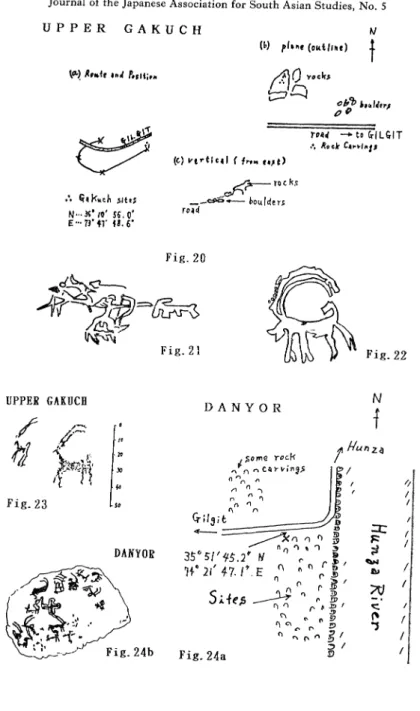
1. 5 Upper Gakuch (Fig. 20)
Gakuch is located in the Punial District, 80 kilometers west of Gilgit and situated on the right bank of the river. While the main part of the village is clustered on the bank of the Gilgit river, there is an upper village on a high plateau at the foot of the Gilgit Kar-akoram (Hindu Raj), where villagers have cultivated land, planted orchard, and used pastures for their cattle. This plateau is also con-nected with the valleys which eventually reach Darel. A villager of Gakuch pointed out that people from Darel often visit this village to purchase wheat and other necessary household supplies. The route from the side of the Gilgit river to Darel, which is close to the Indus, is still used, but it seems that the traffic, in this case mostly on foot, is only from Darel to Gakuch, but not from Gakuch to Darel, be-cause of the prevailing tribal situation in the Darel valleys.
While driving through the Upper Gakuch, a cluster of boulders near the road and large rocks to the northwest of the boulders were spot-ted all bearing petroglyphs. A quick survey revealed that there were several different styles of animal forms and hunting scenes scattered among these rocks and boulders. In a hunting scene men with bows and arrows aimed at animals with long straight horns. Although both animals and men were depicted in a quite primitive manner with
Preliminary Report on Field Research along the Ancient Routes•c•c 13
simple, thick lines, the power and energy of the hunt were quite viv-idly represented. (Fig. 21)
One example of a horned animal reveals a sophisticatied stylization in depiction: the horns are semicircular in shape, covering the total length of the body (Fig. 22), reminiscent of the Scythian animal style which is renowned for the ingenuous treatment of horns. Here the powerful strength of the animal is skillfully conveyed.
Other depictions of horned animals (Fig. 23) were rendered with greater delicacy and sensitivity. The lines are very lightly drawn, the bodies of the animals are lightly chiseled without clear outlines, still subtly suggesting movement. The exaggeration and elongation of horns are also present.
No Buddhist themes were found among the petroglyphs examined during the survey, but it is possible that more petroglyphs will be found in this area as it is situated at the junction of roads coming from Darel, leading to Gilgit to the east, and Mastuj to the north west and Chitral to the west, and to the Ishkoman valley and Pamir to
the north. The sampling of petroglyphs from Gakuch reflects the vastness of the distribution of petroglyphs in this region.
1. 6 Daniyor (Fig. 24 a)
At Gilgit, where the Hunza river flows into the Gilgit, a vast plat-eau is almost completely covered by boulders which bear a rich col-lection of petroglyphs, numbered and classified by German
reser-chers from the University of Heiderberg. Most of the petroglyphs are fairly similar to those from the other sites. One interesting ex-ample with swastika (Fig. 24 b) drew our attention, as none of this type was recognized at other sites. Drawn in thick lines, the heavy squarish sign of the swastika is completely surrrounded by double outlines. What it was meant to indicate is not clearly known. An association with Buddhist themes is a possibility. However, the im-age could be a symbol of the solar system. This site will be sur-veyed more closely in the future.
14 Journal of the Japanese Association for South Asian Studies, No. 5
1. 7 Alam Bridge
Famous for the Kharoshti inscription39), the site is located on the 1 eft bank of the Gilgit river, just before it joins the Indus. The site was briefly visited in order to confirm the location and the inscrip-tion. Situated on the sloping plateau from the road connecting Gilgit and Skardu, the site is right on the bank of the Gilgit river. Again it is very clear that this location is strategically an important point. Many examples of petroglyphs were collected but must await another paper to report the findings.
2. The archaecological site of Bubur and a study of the Bubur
Buddha image
A Buddha image said to have been unearthed at Bubur on the Gilgit river has been cited by Saifur Rahmand Dar49) as well as by Ahmad Hasan Dani41). However, their descriptions of the Buddha image are too brief and do not provide sufficient data on the style or the characteristics of the statue, nor is mention made of the location of its site in Bubur. During our preliminary survey, it was possible to visit the site at Bubur and make a close examination of the statue at Gilgit.
2. 1 Bubur Site (Fig. 25)
Bubur village is located sixty-five kilometers west of Gilgit, on the Gilgit river. From Gilgit, the road leading towards the head of the river runs along its right bank, passing Basin and Henzel villages in the Gilgit district. As one enters the Punial region of the Ghizer district, one passes through Bargu, Guapur and Sher Qila, the centre of Punial, Danlati, Japuck, Gichi and Singal, each well cultivated with good irrigation systems. At Gulmoti, crossing a suspension bridge, we reached Bubur village, located on the left bank of the river. We were fortunate to find, almost immediately, a young boy, Sher Alam, who knew the location of the site. We went along the river for about five hundred meters, then took a road northward for about eight hundred meters and left our vehicle. We then walked about
Preliminary Report on Field Research along the Ancient Routes•c•c 15
two-hundred and fifty meters along a small irrigation canal and came to a flat field about three meters high adjacent to the foothills of a mountain to the north. At the end of the field was a corn field sur-rounded by a very low stone platform. Sher Alam told us that the Buddha image had been excavated from this corn field. We looked in vain for any trace or evidence of excavation, and seemed impos-sible to discover its location. The corn field was owned by a farmer who resided in a small house nearby. He was not home, but his wife was available. We showed her a picture of the Bubur Buddha
image, which she immediately recognized and we obtained the follow-ing information from her.
The image was discovered by her husband, Ziarat Khan, a forty year old Ismaili farmer, in his field located in the Khutom District,
Bubur village (N. 36•‹ 9'21.5", E. 73•‹ 51'31.1"), in 1985. According to her, a part of the head of the Buddha started to appear from the earth when Ziarat Khan was digging his field. Being frightened, he collected the villagers and consulted with them as to what to do with the statue. As he was advised to excavate the statue, he started to dig, but the excavation took about two months. Despite some minor damages incurred in the course of excavation, the image in general has proven to be in good condition. The height was about 160 cen-timeters. The statue was left in situ for about two years, and in 1987, the statue was cut into three pieces42) and was transported by a tractor to Gilgit. The image is carved out of 4-sided granite block that is slightly pointed at the top. Three sides bear carved reliefs representing images. Each of two sides has a standing image of the Buddha. On the third side are two images of children. The fourth side was left uncarved.
During the survey conducted in September 1992, we re-visited the village of Bubur in hopes of directly securing further information from Ziarat Khan. Instead, we happened to come across his neph-ew, Fraz Khan, a high school teacher from whom we were able to obtain firsthand information on the excavation of the Bubur statue. According to him, the excavation was conducted by four people, not
16 Journal of the Japanese Association for South Asian Studies, No. 5
only by Ziarat Khan, as his wife Kukuri informed us last year. Since the account given by Fraz Khan differs on several points from that of Kukuri, the information obtained by Fraz Khan is given as follows: a) Individuals who excavated the Bubur statue :
Fraz Khan, 35 year-old school teacher at the Government High School in Bubur.
Sarfraz Khan, 60 years old, Fraz Khan's father Ziarat Khan, 50 years old, Fraz Khan's uncle Shan Fraz, 40 years old, Fraz Khan's elder brother b) Discovery of the Bubur statue
The statue was accidentally unearthed during the tilling of the land, owned at that time jointly by Ziarat Khan and Sarfraz Khan, which later was divided and is presently owned by Ziarat Khan. The year of the discovery, given by Fraz Khan, was 1980, instead of 1985 as stated by Kukuri. Since it is difficult to obtain a precise date for the discovery, the two years, 1980 and 1985, may be considered the dates between which the discovery was made.
c) Excavation
While the four men were tilling the land, the back side of the head of the Bubur statue gradually started to appear and eventually the whole head was unearthed. Both Ziarat Khan and Sarfraz Khan were quite distraught over excavating such a statue, but Fraz Shah encouraged them to continue. The unearthing of the entire statue took about one month (instead of two months as stated by Kukuri). At the end of the excavation it became quite apparent that the statue was in perfect condition and standing upright where it had likely been originally erected. This assumption was made because charcoal and ashes which could be closely associated with the statue were found as they cleaned the surface where the statue was standing. The work was carried out with utmost care as they were attracted by the possibility of finding a treasuretrove. It seemed as if an inunda-tion by flood water or a landslide must have buried the statue, with-out causing it to fall. Fraz Khan also added that the granite used for the Bubur statue is a local material. This points to a possibility
Preliminary Report on Field Research along the Ancient Routes•c•c 17
that the statue was actually carved in Bubur or in its vicinity . d) After the discovery
For one year the statue was left standing on the ground where it was excavated. Rumours spread and many people started to come to see it. The authorities soon learned about the statue and it was even said that the government would take it into their custody. The statue was broken into two pieces for the sake of easy transportation and was taken to Gilgit one year after it was discovered. It might be too early to decide which of these two stories is true since there may be yet another version when we revisit the village in the future. We may now be content with the fact that first-hand information was made available to us which we have related here without amendment. It might be added, however, that the observations made by Fraz Khan that the granite stone was available locally and that the statue was found standing as it was originally installed are quite remarkable and provide many interesting clues for analyzing the nature of local Buddhist worship and Buddhist art.
An examination of the adjacent field made in September 1991 did not yield any sign of a Buddhist temple or other ancient monument. The corn field from which the Bubur Buddha image was unearthed is undistinguishable from any other corn field and presents no special characteristics. It must have been completely recultivated, leaving no sign of its past history.
This confirmation of the actual site where the Bubur Buddha im-age was excavated suggests that Bubur is located on a route where Buddhist art was prevalent. Bubur village is on the left bank of the Gilgit river. Along this river there are many villages which used to serve as key stations for travellers from all directions, from India, Gandhara, and Swat, from Tibet and Kashmir, from the Hindu Kush ranges of West Asia, and from the Pamirs and East Purkistan. One of the most important stations is Gupis, 40 kilometers west of Bubur, where the route crossing Baroghil Pass in the Wakhan Corridor-one of the most important passes crossing Pamir and dividing China and India-and Darkot Pass, through Darkot and Yasin, reaches the
18 Journal of the Japanese Association for South Asian Studies, No. 5
Gilgit river. Another station is Gakuch, at the mouth of Ishkoman river (a tributary of the Gilgit river); Imit and Ishkoman at the head of the Ishkoman river are also known to be stations on the route from Baroghil Pass to the Gilgit river. Bubur is only less than 10 kilo-meters east of Gakuch on the route connecting Gupis and Gakuch to
Gilgit, the center of the area. This discovery of the Bubur Buddha image implies that the route between Gilgit and Bubur, or Gaguch at 1 east, must have been one section of the very important road con-necting the Chinese and the Indian worlds. The Buggha image from Bubur is still the only example so far discovered from this area which testifies to the history of the traffic which must have flowed
through there in the past.
2. 2 A study of the Bubur Buddha image
It was known that the Bubur Buddha image was in the possesion of Mr Ali Ahmad Jan, A.I.G. Police, Gilgit.43) In Gilgit we were informed that the image is now in the garden of his residence in Gilgit. We tried several times to make a visit to the residence but the keeper was away and we were unable to see the statue. In the meantime, we were also informed that a part of the statue, which was already detached from the main image during the time of its trans-portation from Bubur, was taken to Nagar and placed in a small hall, which Mr Ali Ahmad Jan had specially prepared for this segment of the image. Putting aside an immediate study of Bubur's main image in Gilgit, we set off to see the segment in Nagar. The small hall was located on the left bank of the Hunza River on the opposite side of the Karakoram Highway at Tashot, 10 kilometers west of Karimabad on the way to Gilgit. We had to cross a suspension bridge at Tashot, which we did with great difficulty as we had to negotiate the curving, narrow passage down, along a very steep and long side bank to reach the bridge. As our vehicle started to cross the bridge, the bridge itself made a big swing horizontally. After we crossed the bridge, we were asked by the workmen on the other side of the bank to congrat-ulate them, as this bridge, which they were constructing, turned out
Preliminary Report on Field Research along the Ancient Routes•c•c 19
to be strong enough to hold a heavy vehicle, a Toyota Landcruiser in this case. Our vehicle was the first to cross the bridge not yet having been completed. After all this difficulty, we were told that the statue had not yet been placed in the small hall which was located on the top of a high plateau a few hundred meters above the bridge. Although disappointed, we were buoyed by the information that the segment still seemed to be in Gilgit.
A study of the Bubur statue was finally made after we paid several visits to the residence of Mr. Ali Ahmad Jan in Gilgit. Led into the compound, we finally found the Bubur Buddha statue, placed
against the left side of the main entrance. The segment, said to have been in the hall at Tashot, had been in Ali Ahmad Jan's backyard all along. We were thus able to confirm that the statue had been cut in two pieces, rather than in three, in order to facilitate transportation from Bubur to Gilgit, as the wife of the discoverer of the statue, had
claimed. As she had said, the Bubur statue has four planes, only three of which are carved (A, B, C).
a) Plane A (Fig. 26) (Photo. 2 & 3)
Plane A faces front and is the main sculpture, a standing Buddha in abhaya mudra. This sculpture, in perfect condition, is repre-sented in relatively high relief, the highest being eight centimeters deep around the shoulders. The sculpture exhibits a unique style, not found elsewhere in Gandharan art. The head is
disproportion-ately large, having a length of 44 centimeters, about one third of the total height of the figure (155 centimeters); the heads of Gandharan
sculptures are normally about one fifth to one sixth, the total height of the figure. Particularly notable is the full face, which is almost squarish. The round face of a typical early Mathura Buddha image, such as that of the Katra Buddha, is not present in the Bubur age.44) Closer parallels can be found among Kashmiri Buddhist im-ages, such as in the rock-cut Bodhisattva image from Mulbek in
Ladakh45), or a wooden Bodhisattva figure, also, from Ladakh46). Perhaps the closest can be found at Kargah in Gilgit, where a stand-ing image of the Buddha is carved out of the rock-face at the
junc-20 Journal of the Japanese Association for South Asian Studies, No. 5
tion of two valleys, Kargah and Shukogah47). The Kargah Buddha also has a squarish full face, but the proportion of its head to its height is only one fifth the total height, leaving the Bubur figure unique in its proportions. The details of the face of the Bubur figure (Photo. 3) are carved in low linear relief suggesting eyes and eyebrows, a short, thick nose, and a small mouth with almost childlike smile. Elongated large ears with large holes at the bottom of the ear lobes dominate the sides of the face. The hair is represented in tight curls along the outline of the head and the topknot is quite small, similar to the head of a Buddha from Kakrak in Bamiyan valley. The ab-haya mudra, represented in front of the chest by a twisting of the wrist showing the plam of the left hand, reminds us of the similar gesture of the Kargah Buddha figure (Fig. 27) in Gilgit and also the small stucco Buddha from Dandan Uilik in Khotan discovered by both Hedin48) and by Stein49). The contour of the body is very soft and round, particularly along the arms and thighs where the high relief gives an almost three dimensional effect, a fashion known among the Indian prototypes such as the fifth century standing Buddha fig ures from Cave 6 at Ajanta50) or the colossal Buddha in Cave 3 at Kanheri51). The left hand is slightly outstretched toward the left and holds the edge of the Buddha's robe. On both sides of the Buddha's feet a donor in adoration is shown in very small scale, as if to enhance the towering effect of the Buddha. These donor figures are probably " the figures of children on the third plane " referred to by the wife of Ziarat Khan at Bubur. The donors are represented_ in profile. There is no halo or mandorla, as the edge of the stone on close examination proved to be the original outline of the statue, though the irregular lines around the head of the Buddha may look incomplete.
b) Plane B (Fig. 26) (Photo. 5)
Plane B is to the left52) of the main Buddha represented on Plane A. This standing Buddha figure is in slightly smaller scale than that of Plane A. It is 125 cm high, 29 cm shorter than the Plane A Buddha. This Plane B Buddha seems to have suffered damage after it was
Preliminary Report on Field Research along the Ancient Routes 21
excavated. A photograph53) apparently taken soon after the excava-tion-the statue is seen with a field of corn behind-does not show any of the damage we observed during our examination, such as 1) damage to the right eye, leaving the nose, the mouth and the left eyebrow and the left eye intact, and 2) a vertical deep line from the neck to the foot of the Buddha. This line could be the sign of an attempt to cut the statue into still another (the third) piece, as sug-gested by the wife of Ziarat Khan. Besides the damage noted above, much of the surface of the statue seemed to have been weathered or perhaps abraded, leaving a rough plane. This damage, however, did not decrease the effectiveness of the rounded contours of the standing Buddha of the Plane B. It is apparent that the Buddha of Plane B was conceived almost identically to the main Buddha of Plane A.
The Buddha in Plane B stands with its left hand raised in front of the chest in abhaya mudra. The facial features are rendered in the same manner as those of the main Buddha. The torso here seems slightly more slender than in the main image. Another difference is that the end of the monastic robe worn by this Buddha is represented in a large " u " shape hanging from the waist down and crossing over the lower part of the legs. This detail had almost disappeared by the time of our examination. Donors represented on each side of the foot of the Buddha are now quite indistinct. The left donor stands looking up at the Buddha and the right one is posed with its head down in prayer. The smaller size and somewhat rudimentary representation of the Buddha of Plane B indicate that the image was initiated as a secondary figure to the left to the main Buddha image on the Plane A.
c) Plane C (Fig. 28) (Photo. 4)
Plane C was originally at the right side of the main Buddha. It was separated from the main image and moved in the backyard of the residence of Mr. Ali Ahmad Jan. Here, a seated Bodhisativa is repre-sented. The right side of the figure is now missing. The image is 107 cm. high, and is much smaller than the two standing Buddhas. The right hand seems to be held downward as if in bhumisparsa mudra
22 Journal of the Japanese Association for South Asian Studies, No. 5
(thouching of the earth), but it is not very clear as only a portion of the hand remains at the corner of the pedestal and is not distinctly evident.
The Bodhisattva wears a crown-like headdress, possibly in a trefoil pattern, although again it is not clear. However, if it is a trefoil crown, then it could be like that of a " bejewelled Buddha ", as seen in the seated figure at Chilas I. The image has been identified as a Bodhisattva on the basis of its vestments: it is not clad in a monastic robe but seems to be wearing a dhoti. The slightly raised lines on the surface of the torso may indicate jewellery, usually associated with Bodhisattva images. This figure compares stylistically to the other two figures, with rounded outlines in high relief. The figure is well modeled in the area of the shoulders and the waist, while the lower part of the figure is indicated by incised lines. With the figure's left leg missing, and only the right leg folded the pose cannot be defi-netely identified as lalitasana. A certain identification of the Bodhis-attva preserved cannot be made because of the figure's incomplete state.
The presence of a group of Buddhas and Bodhisattva in such an arrangement as in the three planes A, B, and C is very rare. Noth-ing of this type of representation has been found in Gandhara, Swat, Dir, Hadda, Kabul, Kapisi and in Bamiyan. The group at Bubur may be studied in light of the development of the Hindu art, which encouraged the representation of a multiplicity of the images.
The Bubur group presents a unique aspect of the development of Buddhist art which must have developed in this northern mountain-ous area located to the north of the Indian classical world of the
Gupta Period and Kashmir in the Western Himalayas, to the south of Turkistan, the southeast of West Turkistan, and to the southwest of East Turkistan. Like the Karagah Buddha, the Bubur group is similar to the rock-cut seated Buddha image at Jahanabad in the Swat valley, which is characterized by its round, heavy facial type. Both the Kargah and Jahanabad Buddhas have been attributed to the sev-enth century. The distinctively heavy figural type closely related to
Preliminary Report on Field Research along the Ancient Routes 23
the Kashmir style was created in a new period of prosperity long after the Gandharan region lost its original role as the seat not only of politics but also of artistic development. In view of this, the Bubur group cannot be dated to be seventh century without reservation. Conclusion
The 1991 survey of the Northern Areas of Pakistan was preliminary field work and therefore not intended to provide definitive conclu-sions. The findings made during this survey will be very valuable in providing guidelines for future field research.
In the present report, two themes were addressed, namely the pet-roglyphs from the Northern Areas, and the archaeological sites of Bubur along with a study of the Bubur Buddha images. Two other important subjects were already covered in the 1991 (I) Report: the exploration of the Kandia valley and a survey of the archaeological site at Naupur, Gilgit.
The report on the petroglyphs here could not be comprehensive as the materials collected were too numerous to be categorized in the present report. One characteristic aspect of the individual sites has been briefly pointed out. From Thalpan III, where a survey was made at the altar, nomadic traditions revealing different sources, from Persia and from the Altai region were analyzed in view of the Scythian animal style, particularly from the Pazyryk site in the Altai region. Strikingly similar styles in the animal form were confirmed from the Thalpan site, which is the most eloquent proof of the existance of traffic in the ancient worlds between the north of the Tien Shan mountain range and the south of the Pamirs and the Karakorams.
Buddhist themes at Chilas I were discussed. The iconographically important representation of the so-called Bejewelled Buddha was the center of discussion, as it is considered that the Buddha bejewelled is a special iconographic image appearing toward the end of the Bud-dhist period in Afghanistan at Bamiyan, Fondukistan and Tape Sar-dar, and from Kashmir. Considered to be representations of Mai-treya Bodhisattva in royal attire in Tusita Heaven, heavily ornamented
24 Journal of the Japanese Association for South Asian Studies, No. 5
Buddha images appeared frequently in those sites in Afghanistan. To find this iconography at Chilas I, midway between Kashmir and Bamiyan, signifies the fact that the link of the artistic tradition be-. tween the Kashmir region and Bamiyan and Foundukistan in the
middle of the Hindukush mountains was most probably maintained during the sixth to the eighth centuries.
Two unique Buddhist themes from Chilas II were pointed out. One is the stupa form, which suggested a hollow construction inside the dome. In view of the fact that the Gilgit manuscripts were found in a hollow stupa at Naupur Gilgit, which was also examined during the 1991 preliminary survey, the Chilas II petroglyph may confirm the prevelance of the idea of the type of worship which was strongly purported in the Lotus Sutra to be the only way to worship the Buddha: by putting the sutras, a symbol of the teaching of the Buddha, in place of the relics of the Buddha in the stupa, a type of relic worship fanatically practised by Hinayanists.
The other unique representation found at the Chilas II stite was a stupa with limbs and head, suggesting a human form. It is pre-mature to draw any conclusions concerning this image. It is quite certain that this iconographical puzzle may lead us to a new devel-opment in the understanding of Buddhist iconography in the future.
Other surveyed sites, such as Partab, Alam Bridge, Daniyor, and Upper Gakuch were referred to, but again, analytical studies and conclusive remarks can only be made after the collection of more materials from the individual sites.
The Bubur Buddha image was carefully examined and the site of the excavation of the image was surveyed. The first-hand informa-tion on the excavainforma-tion was collected at Bubur village during the 1991 and the 1992 fieldwork from the people directly involved with the excavation. The Bubur Buddha image revealed many new facts which had been rather difficult to surmise from previous publications or from photographs thus far published. The rounded, heavy style with enormously large head seemed to be more a local style especially when compared to those of Ladakh or Swat. A close affinity was
Preliminary Report on Field Research along the Ancient Routes 25
found with the Kargah Buddha, near Naupur in Gilgit, indicating that the Buddhist art which flourished in this area dui ing the sixth to the seventh centuries was powerful enough to result in a local style which was not overwhelmed by the well-established traditions of, for example, Gandhara, Swat, or Gupta India.
Although the 1991 survey was preliminary, it was nevertheless val-uable enough to allow observation of the richness of the cultural her-itage of the region from firsthand reports and from artifacts includ-ing petroglyphs, Buddha images, and material from Buddhist sites along various roads and valleys. The 1992 survey which was made in September 1992 was planned on the basis of observations made during the 1991 survey. Still there are many tasks awaiting us in the future. The 1991 survey made us aware of the rich and profound culture wealth that the northern areas possesses.
Notes
1) [Tsuchiya 1993]. This field research was made possible by a grant from the Metropolitan Center for Far Eastern Studies for the year 1991. The 1991 survey was conducted by a team of four members; Tamio Hongo, Kazumichi Sugiyama, Amjad Ayub and Haruko Tsuchiya. Our field work was sup-ported by the secretarial assistants, Lie Kimura, Miharu Mano and Kaoru Shimo, in charge of research and documentation.
2) [Dani 1981, 1983c, 1986], [Jettmer 1977, 1982a, 1982b, 1984]. 3) [Jettmer 1986: 13].
4) [Tanabe, 1990].
5) [Jettmer 1989a], [Dani 1985], [Ma 1986], [Yoshida 1989]. 6) [Jettmer 1983a, 1983b, 1989a].
7) [Jettmer 1989c: 183]. 8) [Fussman 1978]. 9) [Jettmer 1982b : 22], [Dani 1983b: 91]. 10) [Jettmer 1982b: fig. 10b]. 11) [Jettmer 1982b: 22]. 12) [Tanabe 1992: 132, pl. 167 rev.]. 13) [Ingholt 1957: Fig. 417]. 14) [Munie 1942: Pl. XIX, XX]. 15) [Jettmer 1986: 194]. 16) [Jettmer 1985: Pl. 4].
26 Journal of the Japanese Association for South Asian Studies, No. 5 17) [Jettmer 1982: 22, fig. 8]. 18) [Sarianidi 1985: pls. 77-79]. 19) [Jettmer 1982: 22 fig. 7]. 20) [Bondina 1969: pis. 13-15]. 21) [敦 煙 文 物 研 究 所 編1980:Pl.138]. 22) [Jettmer 1986: 194]. 23) [Jettmer 1986: 192]. 24) [Jettmer 1983 : 757]. 25) [Pal 1975: pl. 30 a. b], [Koezuka 1992: pl. 11].
26) [Hackin 1959: fig. 179 (Buddha pare, Fondukistan, Niche D)]. 27) [Miyaji 1981: pl. 1], [Higuchi 1983: Vol. I, pl. 108 no. 2]. 28) [Taddei 1978: Fig. 11]. 29) [Miyaji 1992: 577-582]. 30) [Rosenfield 1967: pls. 2, 119, 120]. 31) [Ma 1986: 205]. 32) [Miyaji 1991: 271-284]. 33) [Jettmer 1982b: 14].
34) [Higuchi 1983: Vol. 1, pl. 101 no. 3, pl. 103 no. 4]. 35) [Tsuchiya 1993: 33]. 36) [Tsuchiya 1993: 34]. 37) [Jettmer 1989b: 407]. 38) [Jettmer 1982b : 15]. 39) [Fussman 1978]. 40) [Dar 1985]. 41) [Dani 1989b: 497].
42) Actually in two pieces, as confirmed by our examination. 43) [Dani 1989b: 497].
44) [Rowlamd 1967: pl. 98]. 45) [Pal 1989: pl. fig. 4]. 46) [Pal 1989: pl. fig. 5].
47) [Biddulph 1977: 109], [Stein 1981: Vol. I, 18 fig. 1]. 48) [Montell 1938: no. 9 pl. XVIII and 10].
49) [Stein 1981: Vol. III, pl. LIV, D II. 34, pl. LV, D I. II]. 50) [Huntington 1985: pl. 12. 18].
51) [Huntinsgon 1985: pl. 12. 24].
52) In this paper the terms " left " and " right " denote directions seen from the viewer's perspective, unless otherwise specified.
Preliminary Report on Field Research along the Ancient Routes•c•c 27 Bibliography
Biddulph, John 1977 (reprint; original 1880) Tribes of the Hindoo Koosh. Kara-chi, Indus Publications.
Bondina, Valentina (ed.) 1969 Hermitage Museum, in Museums of the Worlds, Vol. 25, Tokyo, Kodansha.
Dar, Saifur Rahman 1985 " History of Rock-cut standing figure at Kargah near Gilgit ", Journal of Central Asia, vol. VIII no. 2, pp. 191-211, Islamabad. Dani, Ahmad H. 1981 Karakorum Highway unfolds the romance of the past.
Is-lamabad, CSCCA (Centre for the Study of the Civilizations of Central Asia). Dani, Ahmad H. 1983a Chilas the City of Nanga Parvat (Dyamar). Islamabad,
CSCCA.
Dani, Ahmad H. 1983b " Carvings on Thalpan Rock ", in Ethnologie and Ge-schechte Festschrift fiir Karl Jettmer. Wiesbaden, Beitrage Sudasienforschung
86, pp. 89-95, Siidasien-Institut der Universitat Heidelberg.
Dani, Ahmad H. 1983c Human records on Karakorum Highway, Islamabad, CSCCA.
Dani, Ahmad H. 1985 "The sacred rock of Hunza ", Journal of Central Asia, Vol. 8, No. 2, pp. 5-124, Islamabad, CACCA.
Dani, Ahmad H. 1989a "Archaeology of the Northern Areas ", in Recent Archaeo-logical Discoveries in Pakistan, Paris & Tokyo, The UNESCO Centre for East Asian Cultural Studies, pp. 96-98.
Dani, Ahmad. H. 1989b History of Northern Areas of Pakistan. Islamabad, Na-tional Institute of Historical and Cultural Research.
Fischer, E. Robert 1989 " Buddhist Architecture " in Pal, Pratapaditya (ed.) Art and Architecture of Ancient Kashmir, pp. 17-23, Bombay, Marg Publication. Fussman, Gerard 1978 " Inscriptions de Gilgit ", in Bulletin de l'Ecole Franfaise
d'Extreme-Orient, Tome LXV, Fascicule 1, Paris; 1-64.
Hackin, J. Carl, J. Munie, J., 1959, Divers recherches archeologiques (1933-40), Tome VIII. Memoires de la Delegation Archeologique Francaise en Afghanistan,
Paris.
Higuchi, Takayasu 1983 Bamiyan. Kyoto, Doho Shuppan.
Huntington, Susan 1985 The Art of Ancient India. New York, Tokyo, Weather-hill.
Ingholt, H. & Lyon, I, 1957 Gandhran Art in Pakistan. New York, Pantheon Books.
Jettmer, Karl, 1977 " Bolor-A Contribution to the Political and Ethnic Geo-graphy of North Pakistan ", Zentralasiatische Saidien, 11, pp. 411-448, Bonn. Jettmer, Karl, 1982a " Petroglyphs and Early History of the Upper Indus
Val-ley: The 1981 Expedition-A Preliminary Report ", Zentralasiatische Stfidien, pp. 293-308, Bonn.
28 Journal of the Japanese Association for South Asian Studies, No. 5
Jettmer, Karl, 1982b Rockcarvings and Inscriptions in the Northern Areas of Pa-kistan, Islamabad, Institute of Folk Heritage.
Jettmer, Karl, 1983a " Westerners beyond the Great Himalayan Range-Rock Carvings and Rock Inscriptions in the Indus Valley near Chilas ", in Joachim Deppert (ed.) India and West: Proceedings of a seminar deicated to the memory of Herman Goetz. pp. 159-164, New Dehli, Manohar.
Jettmer, Karl, 1983b " Non-Buddhist Traditions in the Petroglyphs of the Indus Valley ", South Asian Archaeology 1983, pp. 751-777, Naples.
Jettmer, Karl, 1984 " Project : Rockcarvings and Inscriptions along the Kara-korum Highway ", Himalayan Research Bulletin, Fall 1984, Vol. IV, No. 3 pp.
31-37.
Jettmer, Karl, 1985. Zwischen Gandhara and den Seidenstrassen—Felsbilder am Karakorum Highway. Mainz am Rhein, Verlag Philipp von Zabern.
Jettmer, Karl, 1986 "Rock Art as Clue to the Cultural History of North Pa-kistan ", PaPa-kistan Archaeology, no. 10-22 (1974-1986), pp. 191-195.
Jettmer, Karl, 1989a " The Main Buddhist Period as Represented in the in the Petroglyphs at Chilas and Thalpan ", South Asian Archaeology 1985, pp. 407-411, Karachi.
Jettmer, Karl, 1989b Antiquities of Northern Pakistan—Reports and Studies, Vol. 1, Rock Inscription in the Indus Valley, Texts & Plates, Mainz Verlad Philipp von Zabern.
Jettmer, Karl, 1989c " Documentaion and Exploration in Northern Areas of Pakistan Preliminary Report, 1988 ", Pakistan Archaeology, No. 24-1989, pp.
194, Karachi.
Koezuka, Takashi 1992 " Crowned Buddha in Dharmachakra-Mudra " in ex-hibition catalogue of Treasures of Asian Art from the Mr. & Mrs. John D. Rocke-feller the Third Collection; The Asia Society New York, pl. 11, Tokyo, Idemitsu
Museum of Arts.
Ma Yong 1986 " The Chinese Inscription of the Da Wei Envoy on the ' Sacred Rock of Hunza ' ", Pakistan Archaeology, no. 10-22 (1974-86), pp. 203-221. Miyaji, Akira 1981 「バ ー ミァ ンの[飾 られ た仏 陀]の 系 譜 とそ の年 表 」,『 仏教芸術』,
137 , pp. 11-34.
Miyaji, Akira 1991 「西域の仏教美術 ― イ ン ド仏教美術 の受容 と変容」,鎌 田茂雄
(編)『 講 座 仏 教 の 受 容 と変 容4』pp.243-284,東 京,佼 成 出 版 社.
Miyaji, Akira 1992 『涅 槃 と弥 勒 ,図 像学』東京,吉 川 弘文館.
Montell, Gosta 1938 " Sven Hedin's Archaeological Collections from Khotan ", The Museum of Far Eastern Antuities, Bulletin, no. 9 & 10.
Munie, J. 1942 Shotorak, Tome X, Memoires de la Delegation Archeologique
Francaise en Afghanistan, Paris, Libraire F. de Nobele.
Ver-Preliminary Report on Field Research along the Ancient Routes•c•c 29 lagsanstalt.
Pal, Pratapaditya 1989 " Kashmir and the Tibetan Connection " in Pal, Prata-paditya (ed.) in Art and Architecture of Ancient Kashmir. pp. 117-135, Bombay,
Marg Publications.
Rosenfield, M. John 1967 The Dynastic Arts of the Kushans. Berkeley & Los Angeles, University of California Press.
Rowland, Benjamin 1967 The Art and Architecture of India, 3rd ed., Baltimore, Penguin Books.
Sarianidi, Victor 1985 The Golden Hoard of Bactria. New York, H. N. Abram. Sims-Williams, Nicholas 1986 " The Sogdian Inscriptions of Upper Indus: A
Preliminary Report ", Pakistan Archaeology, no. 10-22 (1974-1986), pp. 196-202.
Stein M. Aurel 1981 (reprint; original 1907) Ancient Khotan, New Delhi, Cosmo Publications.
Taddei, Maurizio 1978 " Tapa Sardar Second Preliminary Report ", East and West. New Series, Vol. 28, Nos. 1-4.
Tanabe, Katsumi 1990 " Essay on the Two Lion Images from the rockcarvings at Hodar, Upper Indus Valley•\econstruction of K. Jettmer's Interpretations ", Bulletin of the Ancient Orient Museum. Vol. XI. pp. 209-256. Tokyo.
Tanabe, Katsumi 1992 シ ル ク ロ ー ドの コイ ン.東 京,講 談 社.
Tsuchiya, Haruko 1993 " Preliminary Report on Field Research along the Ancient Routes in the Northern Areas of Pakistan and Related Historical and Art His-torical Information (September 1991) [I], Sophia International Review, Vol. 15, pp. 27-39, Tokyo, Faculty of Comparative Culture, Sophia University.
敦 煙 文 物 研 究 所(編)1980 『敦 煙石 窟寺 院』I,東 京,平 凡 社.
Yoshida, Yutaka 1989 " Sogian miscellany (III) ", 『内 陸 ア ジ ア 言 語 の 研 究 』no . V, pp.91-93,神 戸,神 戸 市 立 外 語 大 学.
30 Journal of the Japanese Association for South Asian Studies, No. 5
Preliminary Report on Field Research along the Ancient Routes•c•c 31
Chilas I. (Photo 1)
↑
Bubur Buddha (Plane A) detail (Photo 3)
32 Journal of the Japanese Association for South Asian Studies, No. 5
Bubur Bodhisattva (Plane C) (Photo 4) Bubur Buddha (Plane B) (Photo 5) Photographs by H. Tsuchiya
Preliminary Report on Field Research along the Ancient Routes•c•c 33
THAL PAN III
Fig. 1a Fig 1b Fig. 2a Fig. 2b Fig. 3 Fig. 4 Fig. 5 Fig. 6
34 Journal of the Japanese Association for South Asian Studies, No. 5 Complex A Complex B THALPAN III Fig. 7 Fig. 8 Fig. 9 Fig. 10 CHILAS I Fig. 11a Fig. 11b Fig. 1.2 Kashmir The Rockefeller Collection Fig. 13
Preliminary Report on Field Research along the Ancient Routes•c•c 35 PARTAB CHILAS II Fig. 14 Fig. 15 Fig. 16 CHILAS II Fig. 17 Fig. 18 Fig. 19
36 Journal of the Japanese Association for South Asian Studies , No. 5
(a) Route and Position
(b) plone (outline)
(c) vertical (from eart) UPPER GAKUCH UPPER GAKUCH DANYOR Fig. 20 Fig. 21 Fig. 22 Fig. 23
Preliminary Report on Field Research along the Ancient Routes•c•c 37
BUBUR
Map of the Si.te where Buddha rmage discoverd
38 Journal of the Japanese Association for South Asian Studies, No. 5
BUBUR
Fig. 26
BUBUR Illustrations by Tamio Hongo