• 検索結果がありません。

Which Genus to Study? In Search of Plant Genera Underrepresented or Overrepresented in the Research from the Flora of Japan

N/A
N/A
Protected

Academic year: 2021

シェア "Which Genus to Study? In Search of Plant Genera Underrepresented or Overrepresented in the Research from the Flora of Japan"

Copied!
9
0
0

読み込み中.... (全文を見る)

全文

(1)

Introduction

The Japanese Archipelago harbors remarkably rich and unique flora in its relatively small land area (Iwatsuki, 1995) and thus has been serving as a valuable field for plant biology including community-level studies on pollination (Kato et al., 1990, 1993 and 2003; Kato, 2000), seed dispersal (Noma and Yumoto, 1997), phytogeog- raphy (Fujii et al., 2002; Fujii and Senni, 2006;

Aoki et al., 2004; Ikeda et al., 2006; Ikeda and Setoguchi, 2006, 2007), and developmental anatomy (Takahashi, 1994; Ota et al., 2001;

Tobe, 2008) and molecular systematics (Nakaza- wa et al., 1997; Okuyama et al., 2005, 2008;

Yamaji et al., 2007) using endemic species. De- spite the considerable number of studies conduct- ed, however, much of the natural history of the plants native to Japan remains yet to be studied.

Meanwhile, comprehensive field collection of any data on plants native to Japan is becoming

more and more difficult, with more than a quarter of species now being considered endangered of extinction largely because of human activities (Environment Agency of Japan, 2000) and in- creasing deer browsing (Kato and Okuyama, 2004). Therefore, some guidelines for establish- ment of efficient strategies on researches, which utilize the vast diversity of plants native to Japan, are needed. To this end, the overall picture on how our knowledge of natural history in the flora of Japan is distributed is crucial, although it has not been clearly presented yet.

In this study, I aimed to reveal the general pat- terns on the research effort made for each of the angiosperm genera native to Japan. I expect the genus with more constituent species is likely to have more topics to be studied. If this is true, there should be a tendency that larger genera have more research efforts made. In turn, plant genera that have relatively fewer publications despite their size might have more important

Which Genus to Study? In Search of Plant Genera Underrepresented or Overrepresented in the Research from the Flora of Japan

Yudai Okuyama

Department of Botany, National Museum of Nature and Science, Amakubo 4–1–1, Tsukuba, 305–0005 Japan

E-mail: [email protected] (Received 16 February 2010; accepted 24 March 2010)

Abstract One good criterion for determining certain plant groups as a research target would be to choose those much less or much more studied than the average. Here I conducted a brief survey on research effort already made for each of the 84 angiosperm genera, in which 10 or more species are recorded as native to Japan. For each of the genera, approximate amount of the research effort was measured by counting the number of literature titles and the number of nucleotide sequences available online. I found a clear tendency that the amount of research effort strongly correlates with the generic size (the number of species in the world for a given genus). Judging from the deviation from this tendency, I found that four genera were exceptionally well studied and 14 gen- era were relatively less studied despite their generic size. I propose the statistics presented here would be one of the good criteria for starting new research projects on the flora of Japan, which is facing serious loss of diversity largely because of human activities.

Key words : endemic species, flora of Japan, genus, research effort, species richness.

(2)

publications would serve as model systems for studies on plant diversity in Japan.

Here, I surveyed the publication records regarding the 84 genera of Japan, which have 10 or more native species. Specifically, I addressed the following questions: (1) First, which genus is especially species rich in Japan compared to other regions? (2) Second, among the plant gen- era, is there a correlation between the number of constituent species and research effort made? (3) Third, if the correlation is present, which genera are overly represented and which are underrepre- sented in literature in proportion to their species richness? (4) And finally, which genera should we prioritize to work on?

Materials and Methods Data collection

With the aid of the Wild Flora of Japan (Satake et al., 1981, 1989), I selected 84 flower- ing plant genera in which the number of species native to Japan exceeds 10. Hereafter I refer to these 84 genera as “species-rich angiosperm gen- era of Japan”. Note that this number of genera might be slightly an underestimate, as the Wild Flora of Japan does not include herbaceous plants in Ryukyu Islands. Next, I coded the num- ber of species native to Japan and the number of endemic species in Japan based on the number of species listed in the Wild Flora of Japan (Satake et al., 1981, 1989), and supplemented the infor- mation with Flora of Japan (Iwatsuki et al., 1993;

1995, 1999, 2001 and 2006) where possible. In addition, the worldwide number of species for each of the genera was also coded based on The Plant-Book (Mabberley, 1997).

To measure the amount of research effort made for each genus, two measures were used, i.e, number of literature titles and the number of nucleotide sequences each available online. The approximate number of literature titles regarding each of the 84 genera was retrieved using Google Scholar (http://scholar.google.co.jp/) by entering the two words “genus ‘name’” with quotation

“genus Acer” were used as a key) on December 2, 2009. This should result in the underestimate of the number of literature titles retrieved, as genus names are not always coupled with the word “genus”, but apparently could prevent the erroneous inflation of the number due to occa- sional, multiple meanings of the genus name.

Likewise, the number of nucleotide sequences deposited online were count using the query form of the nucleotide database of National Cen- ter for Biotechnology Information (NCBI) web- site (http://www.ncbi.nlm.nih.gov/). The full tax- onomy path was used as a query to enter into the form to minimize the erroneous hit (e.g., for genus Acer, “Eukaryota; Viridiplantae; Strepto- phyta; Embryophyta; Tracheophyta; Spermato- phyta; Magnoliophyta; eudicotyledons; core eudicotyledons; rosids; eurosids II; Sapindales;

Sapindaceae; Acer” was used as a query.)

Data analysis

The relative species richness and the relative endemicity in Japan were calculated by dividing the number of native/endemic species in Japan by the number of species in the world for each of the 84 genera. These values are expected to be high for genera having Japan as their center of diversity, making them suitable for screening candidate plant lineage for pursuing research in Japan as a valuable research field.

The presence of significant correlation be-

tween the overall number of species and the num-

ber of literature titles available online, and be-

tween the overall number of species and the num-

ber of nucleotide sequences deposited online, for

each of the 84 genera, was tested using Spear-

man’s rank correlation test. Furthermore, linear

regression of the number of literature titles or the

number of nucleotide sequences deposited online

using the overall number of species for the genus

as an explanatory variable was also conducted,

and 50% and 95% expectation interval was also

arbitrary set and calculated based on the regres-

sion in order to find out “outlier” genera in terms

of research effort. All statistical analyses in this

(3)

study were made using the statistical program R ver. 2.9.1(R Development Core Team, 2009).

Results

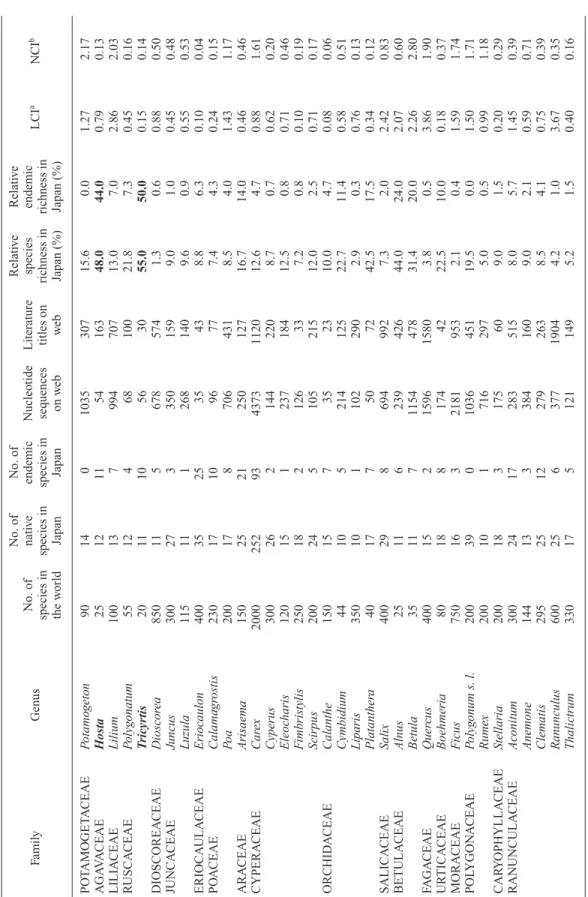
All the measures surveyed in the present study are listed in Table1. Both the relative species richness and the relative endemic richness in Japan were found to be highest in the following five genera, i.e., Hosta (Agavaceae), Tricyrtis (Ruscaceae), Asarum (Aristolochiaceae), Hy- drangea (Hydrangeaceae), and Mitella (Saxifra- gaceae) (Table 1, shown in bold), indicating that these genera have their center of diversity in Japan.

Figure 1 shows the scatter plot between the number of species in the world and the number of literature titles available online for the 84 species-rich angiosperm genera of Japan. As expected, the number of literature titles was posi- tively correlated with the number of species in the world (Spearman’s rank correlation, P 5.0 10

7

, r 0.53), indicating the research effort for each genus is somewhat proportional to its size. The outlier genera in terms of research

effort proportional to the generic size were only found as those with the number of literature titles exceeding the 95% credibility threshold as ex- pected from the regression (y 0.5428x 192.6).

These outlier genera found were Ranunculus (Ranunculaceae), Quercus (Fagaceae), Prunus (Rosaceae), and Rosa (Rosaceae). By placing 50% threshold, more genera were found as the outliers, in which the number of literature titles either exceed or fall below the number expected from the regression. Under this criterion, 14 gen- era, i.e., Calanthe (Orchidaceae), Fimbristylis (Cyperaceae), Eriocaulon (Eriocaulaceae), Stel- laria (Caryophyllaceae), Euonymus (Celas- traceae), Calamagrostis (Poaceae), Saussurea (Asteraceae), Symplocos (Symplocaceae), Cory- dalis (Fumariaceae), Thalictrum (Ranunculaceae), Pedicularis (Orobanchaceae), Saxifraga (Saxifra- gaceae), Senecio (Asteraceae), and Euphorbia (Euphorbiaceae), were found to have especially fewer publications online than expected from the regression.

As shown in Fig. 2, the number of nucleotide sequences deposited online for each genus also positively correlated with its number of species

Fig. 1. The relationship between the number of species and the number of literature titles available online for 84

species-rich angiosperm genera of Japan. The solid line indicates the regression line best goodness-of-fit

according to the Spearman’s rank-correlation test (y 0.5428x 192.6). 50% and 95% confidence interval

from the regression are also shown with broken lines.

(4)

in the world, but the tendency was weaker (Spearman’s rank correlation, P 5.0 10

4

, r 0.40). Again, the outlier genera found were only those exceeding the number expected from the regression (y 1.172x 371.4) if I put 95%

threshold. These were Prunus (Rosaceae), Car- damine (Brassicaceae), and Primula (Primu- laceae). Like in the number of literature titles, more genera were found as the outliers, for which the number of nucleotide sequences are either exceeding or below the number expected from the regression by placing 50% threshold.

Discussion

Before determining certain plant groups to study, it would be good to know which is rela- tively less studied, and which is relatively more so. I presented here a first attempt for quantifying the amount of research effort already made for individual genera. Although one can start a research project on plant natural history in vari- ous points of view, including that focuses on populations, species or higher taxa, or communi- ties, it is good to keep in mind that one of the most remarkable methodological progresses on plant biology in the last decades is the wide-

spread and routine use of molecular phylogenet- ics (Savolainen and Chase, 2003). In light of phylogenetic information, regardless of that of populations or species, one can conduct compar- ative studies on any traits of interest, especially in association with the other factors (Martins and Hansen, 1997). This will result in a deeper un- derstanding of the origins and adaptive functions of diverse characteristics of the focal plants. To this end, it would be a good research strategy to focus on certain lineages of plants such as gen- era, especially those having many, say 10 or more, species native to Japan. Therefore, in this study, I only included the angiosperm genera with 10 or more species native to Japan in the analyses.

As a result, I revealed that there is a general, clear trend that more effort tends to be paid to genera with more species. Although this finding itself might not be so surprising, one can see if a certain genus has a deviation from this general trend. To quantify this deviation, here I propose literature collection index (LCI) and nucleotide collection index (NCI), where each of the mea- sure is calculated from the number of literature titles/nucleotide sequences deposited online for a certain genus divided by that expected from the

Fig. 2. The relationship between the number of species and the number of nucleotide sequences deposited in

GenBank for 84 species-rich angiosperm genera of Japan. The regression lines are also shown as in Fig. 1

(y 1.172x 371.4).

(5)

T ab le 1. A summar y of species richness, endemism, and research ef for t made for 84 species-rich angiosper m genera of Japan No. of No. of Relati v e Relati v e No. of nati v e endemic Nucleotide Literature species endemic F amil y Genus species in species in species in sequences titles on richness in richness in LCI

a

NCI

b

the w orld Japan Japan on w eb w eb Japan (%) Japan (%) PO T AMOGET A CEAE P otamo g eton 90 14 0 1035 307 15.6 0.0 1.27 2.17 A G A V A CEAE Hosta 25 12 11 54 163 48.0 44.0 0.79 0.13 LILIA CEAE Lilium 100 13 7 994 707 13.0 7.0 2.86 2.03 R USCA CEAE P o ly g onatum 55 12 4 6 8 100 21.8 7.3 0.45 0.16 T ricyr tis 20 11 10 56 30 55.0 50.0 0.15 0.14 DIOSCOREA CEAE Dioscor ea 850 11 5 678 574 1.3 0.6 0.88 0.50 JUNCA CEAE Juncus 300 27 3 350 159 9.0 1.0 0.45 0.48 Luzula 115 11 1 268 140 9.6 0.9 0.55 0.53 ERIOCA ULA CEAE Eriocaulon 400 35 25 35 43 8.8 6.3 0.10 0.04 PO A CEAE Calama g rostis 230 17 10 96 77 7.4 4.3 0.24 0.15 Po a 200 17 8 706 431 8.5 4.0 1.43 1.17 ARA CEAE Arisaema 150 25 21 250 127 16.7 14.0 0.46 0.46 CYPERA CEAE Car ex 2000 252 93 4373 1120 12.6 4.7 0.88 1.61 Cyperus 300 26 2 144 220 8.7 0.7 0.62 0.20 Eleoc haris 120 15 1 237 184 12.5 0.8 0.71 0.46 F imbristylis 250 18 2 126 33 7.2 0.8 0.10 0.19 Scirpus 200 24 5 105 215 12.0 2.5 0.71 0.17 ORCHID A CEAE Calanthe 150 15 7 3 5 2 3 10.0 4.7 0.08 0.06 Cymbidium 44 10 5 214 125 22.7 11.4 0.58 0.51 Liparis 350 10 1 102 290 2.9 0.3 0.76 0.13 Platanther a 40 17 7 5 0 7 2 42.5 17.5 0.34 0.12 SALICA CEAE Salix 400 29 8 694 992 7.3 2.0 2.42 0.83 BETULA CEAE Alnus 25 11 6 239 426 44.0 24.0 2.07 0.60 Betula 35 11 7 1154 478 31.4 20.0 2.26 2.80 FA GA CEAE Quer cus 400 15 2 1596 1580 3.8 0.5 3.86 1.90 UR TICA CEAE Boehmeria 80 18 8 174 42 22.5 10.0 0.18 0.37 MORA CEAE F icus 750 16 3 2181 953 2.1 0.4 1.59 1.74 POL YGON A CEAE P o ly g onum s. l. 200 39 0 1036 451 19.5 0.0 1.50 1.71 Rumex 200 10 1 716 297 5.0 0.5 0.99 1.18 CAR Y OPHYLLA CEAE Stellaria 200 18 3 175 60 9.0 1.5 0.20 0.29 RANUNCULA CEAE Aconitum 300 24 17 283 515 8.0 5.7 1.45 0.39 Anemone 144 13 3 384 160 9.0 2.1 0.59 0.71 Clematis 295 25 12 279 263 8.5 4.1 0.75 0.39 Ranunculus 600 25 6 377 1904 4.2 1.0 3.67 0.35 Thalictrum 330 17 5 121 149 5.2 1.5 0.40 0.16

(6)

T ab le 1 . (Continued) No. of No. of Relati v e Relati v e No. of nati v e endemic Nucleotide Literature species endemic F amil y Genus species in species in species in sequences titles on richness in richness in LCI

a

NCI

b

the w orld Japan Japan on w eb w eb Japan (%) Japan (%) ARIST OLOCHIA CEAE Asarum 70 50 47 533 78 71.4 67.1 0.34 1.18 CLUCIA CEAE Hypericum 370 35 29 244 720 9.5 7.8 1.83 0.30 PA PA VERA CEAE Corydalis 400 15 3 9 0 141 3.8 0.8 0.34 0.11 BRASSICA CEAE Car damine 200 15 4 2634 125 7.5 2.0 0.42 4.35 CRASSULA CEAE Sedum 280 17 9 402 242 6.1 3.2 0.70 0.57 HYDRANGEA CEAE Hydr ang ea 23 12 8 202 119 52.2 34.8 0.58 0.51 SAXIFRA GA CEAE Chrysosplenium 60 18 11 62 39 30.0 18.3 0.17 0.14 Mitella 20 11 10 978 33 55.0 50.0 0.16 2.48 Saxifr a g a 440 16 6 415 189 3.6 1.4 0.44 0.47 R OSA CEAE P otentilla 500 23 2 1076 274 4.6 0.4 0.59 1.12 Prunus 200 15 4 5412 1080 7.5 2.0 3.59 8.93 Rosa 150 12 5 1944 996 8.0 3.3 3.63 3.55 Rubus 250 38 11 774 875 15.2 4.4 2.67 1.16 Spir aea 100 13 3 9 7 7 7 13.0 3.0 0.31 0.20 FA B A CEAE V icia 140 13 1 1244 689 9.3 0.7 2.57 2.32 Lespedeza 40 13 4 4 5 135 32.5 10.0 0.63 0.11 GERANIA CEAE Ger anium 300 12 2 557 211 4.0 0.7 0.59 0.77 EUPHORBIA CEAE Euphorbia 2000 13 6 1250 953 0.7 0.3 0.75 0.46 SAPIND A CEAE Acer 111 26 23 1948 638 24.3 20.7 2.52 3.88 A Q UIFOLIA CEAE Ilex 400 23 7 1221 290 5.8 1.8 0.71 1.45 CELASTRA CEAE Euon ymus 177 18 5 8 5 6 3 10.2 2.8 0.22 0.15 ELAEA GN A CEAE Elaea gnus 40 15 11 58 39 37.5 27.5 0.18 0.14 VIOLA CEAE V iola 400 55 13 1136 723 13.8 3.3 1.76 1.35 ON A GRA CEAE Epilobium 165 12 0 348 196 7.3 0.0 0.69 0.62 APIA CEAE Ang elica 110 23 16 281 135 20.9 14.5 0.54 0.56 ERICA CEAE Rhododendr on 850 51 42 2132 866 6.0 4.9 1.32 1.56 V accinium 450 19 7 614 572 4.2 1.6 1.31 0.68 SYMPLOCA CEAE Symplocos 250 23 11 693 110 9.2 4.4 0.34 1.04 PRIMULA CEAE L ysimac hia 150 15 4 239 97 10.0 2.7 0.35 0.44 Primula 425 14 10 2511 409 3.3 2.4 0.97 2.89 GENTIAN A CEAE Gentiana 361 15 6 1005 397 4.2 1.7 1.02 1.26 APOCYN A CEAE Cynanc hum 100 22 12 462 97 22.0 12.0 0.39 0.95 R UBIA CEAE Galium 300 18 4 8 7 169 6.0 1.3 0.48 0.12 VERBEN A CEAE Callicarpa 140 10 5 124 65 7.1 3.6 0.24 0.23 CAPRIFOLIA CEAE Lonicer a 180 21 11 656 145 11.7 6.1 0.50 1.13 V iburnum 150 16 5 463 194 10.7 3.3 0.71 0.85

(7)

species number of the genus. For example, for genus Calanthe, which has 150 spp. worldwide, the numbers of literature titles and nucleotide se- quences deposited online are 23 and 35, so LCI and NCI can be calculated as 0.08 23/(0.5428 150 192.6) and 0.06 35/(1.172 150 371.4), respectively. LCI and NCI for each of the species-rich angiosperm genera of Japan are list- ed in Table 1. Note that LCI and NCI are not fixed values and will change through time so one should update them before using it as the criteria for finding the plant genera under-/over-repre- sented in research ad hoc.

In facing serious loss of plant diversity in Japan, it would be an important practice to quan- titatively recognize the plant genera that are espe- cially species-rich in Japan. It is also noteworthy that, in the perspective of comparative studies, species-rich genera are especially useful to draw robust conclusions, as more species enable more comparisons. In this study, five genera, Hosta (Agavaceae), Tricyrtis (Ruscaceae), Asarum (Aristolochiaceae), Hydrangea (Hydrangeaceae), and Mitella (Saxifragaceae), were found to have their center of diversity in Japan. The five genera tend to be underrepresented in the literature (LCI: 0.15–0.79; Table 1), although the number of nucleotide sequences varies among them (NCI: 0.13–2.48; Table 1), probably because the researchers outside Japan would have difficulty in access to most of the species. Because large information on ecological traits, including polli- nation systems, seed dispersal, habitat prefer- ences, etc. is only available in the wild, the accu- mulation of natural history information and intensive field researches for these genera would be urgently needed.

In this study, I used two measures, i.e., number of literature titles and nucleotide sequences and proposed LCI and NCI as the corresponding criteria for quantifying the research effort for the plant genera. I would suggest LCI is the more reliable criterion, as the number of literature titles will not abruptly increase with a small research effort. In contrast, the number of nucleotide sequences deposited online can quick-

T ab le 1 . (Continued) No. of No. of Relati v e Relati v e No. of nati v e endemic Nucleotide Literature species endemic F amil y Genus species in species in species in sequences titles on richness in richness in LCI

a

NCI

b

the w orld Japan Japan on w eb w eb Japan (%) Japan (%) LAMIA CEAE Ajug a 50 13 8 3 0 7 6 26.0 16.0 0.35 0.07 VER ONICA CEAE V er onica 180 13 5 945 213 7.2 2.8 0.73 1.62 OR OB ANCHA CEAE P edicularis 350 15 8 568 157 4.3 2.3 0.41 0.73 LENTIB ULARIA CEAE Utricularia 180 11 1 246 266 6.1 0.6 0.92 0.42 CAMP ANULA CEAE Adenophor a 40 11 5 7 5 2 5 27.5 12.5 0.12 0.18 ASTERA CEAE Artemisia 350 30 7 948 896 8.6 2.0 2.34 1.21 Aster 250 21 13 212 323 8.4 5.2 0.98 0.32 Chrysanthemum 40 14 10 958 210 35.0 25.0 0.98 2.29 Cir sium 250 52 50 321 166 20.8 20.0 0.51 0.48 P a rasenecio 60 14 12 117 42 23.3 20.0 0.19 0.26 Saussur ea 300 25 17 645 93 8.3 5.7 0.26 0.89 Senecio 1250 12 4 1513 591 1.0 0.3 0.68 0.82 T a raxacum 60 11 9 889 344 18.3 15.0 1.53 2.01 The fi v e genera with the highest relati v e species/endemic richness in Japan are sho wn in bold.

a

Literature collection inde x.

b

Nucleotide collection inde x.

(8)

as a single molecular phylogenetic study.

In conclusion, the present quantification of research effort for 84 species-rich angiosperm genera of Japan highlighted its nonuniformity despite the presence of general tendency that is proportional to generic size. I hope the present brief survey serves as a good starting point to recognize the pattern of how information on nat- ural history of the flora of Japan is distributed, and to establish efficient research strategies thereafter.

Acknowledgements

The author thanks Atsushi Kawakita for his critical and helpful comments on the draft ver- sion of the manuscript.

References

Aoki, K., Suzuki, T., Wsu, T.-W. and Murakami N. 2004.

Phylogeography of the component species of broad- leaved evergreen forests in Japan, based on chloroplast DNA variation. Journal of Plant Research 117: 77–94.

Environment Agency of Japan 2000. Threatened Wildlife of Japan: Red Data Book, 2nd edn. Japan Wildlife Research Center, Tokyo.

Fujii, N., Tomaru, N., Okuyama, K., Koike, T., Mikami, T.

and Ueda, K. 2002. Chloroplast DNA phylogeography of Fagus crenata (Fagaceae) in Japan. Plant Systemat- ics and Evolution 232: 21–33.

Fujii, N. and Senni, K. 2006. Phylogeography of Japanese alpine plants: biogeographic importance of alpine region of central Honshu in Japan. Taxon 55: 43–52.

Ikeda, H., Senni, K., Fujii, N. and Setoguchi, H. 2006.

Refugia of Potentilla matsumurae (Rosaceae) located at high mountains in the Japanese archipelago. Molecular Ecology 15: 3731–3740.

Ikeda, H. and Setoguchi, H. 2006. Phylogeography of Arcterica nana (Maxim.) Makino (Ericaceae) suggests another range expansion history of Japanese alpine plants. Journal of Plant Research 119: 489–495.

Ikeda, H. and Setoguchi, H. 2007 Phylogeography and refugia of the Japanese endemic alpine plant Phyl- lodoce nipponica Makino (Ericaceae). Journal of Bio- geography 34: 169–176.

Iwatsuki, K., Yamazaki, T., Boufford, D. E. and Ohba, H.

1993. Flora of Japan, Vol. IIIa, Kodansha, Tokyo, Japan.

Iwatsuki, K., Yamazaki, T., Boufford, D. E. and Ohba, H.

Japan.

Iwatsuki, K. 1995. Species diversity in East Asia in a global perspective. In: Box, E. E. O., Peet, R. K., Masuzawa, T., Yamada, I., Fujiwara, K. and Maycock, P. F. (eds.), pp. 57–67. Vegetation Science in Forestry, Kluwer Academic, Dordrecht.

Iwatsuki, K., Boufford, D. E. and Ohba, H. 1999. Flora of Japan, Vol. IIc, Kodansha, Tokyo, Japan.

Iwatsuki, K., Boufford, D. E. and Ohba, H. 2001. Flora of Japan, Vol. IIb, Kodansha, Tokyo, Japan.

Iwatsuki, K., Boufford, D. E. and Ohba, H. 2006. Flora of Japan, Vol. IIa, Kodansha, Tokyo, Japan.

Kato, M., Kakutani, T., Inoue, T. and Itino, T. 1990. In- sect-flower relationship in the primary beech forest of Ashu, Kyoto: An overview of the flowering phenology and the seasonal pattern of insect visits. Contribution from the Biological Laboratory, Kyoto University 27:

377–463.

Kato, M., Matsumoto, M. and Kato, T. 1993. Flowering phenology and anthophilous insect community in the cool-temperate subalpine forests and meadows at Mt.

Kushigata in the central part of Japan. Contribution from the Biological Laboratory, Kyoto University 28:

119–172.

Kato M. 2000. Anthophilous insect community and plant- pollinator interactions on Amami Islands in the Ryukyu Archipelago, Japan. Contribution from the Biological Laboratory, Kyoto University 29: 157–252.

Kato, M., Takimura, A. and Kawakita, A. 2003. An oblig- ate pollination mutualism and reciprocal diversification in the tree genus Glochidion (Euphorbiaceae). Proceed- ings of the National Academy of Science, USA 100:

5264–5267.

Kato, M. and Okuyama, Y. 2004. Changes in the biodiver- sity of a deciduous forest ecosystem caused by an increase in the Sika deer population at Ashu, Japan.

Contribution from the Biological Laboratory, Kyoto University 29: 437–448.

Mabberley, D. J. 1997. The Plant-book. A Portable Dictio- nary of the Vascular Plants. 2nd edition. Cambridge University Press, Cambridge.

Martins, E. P. and Hansen, T. F. 1997. Phylogenies and the comparative method: A general approach to incorporat- ing phylogenetic information into the analysis of inter- specific data. American Naturalist 149: 646–667.

Nakazawa, M., Wakabayashi, M., Ono, M. and Murata, J.

1997. Molecular phylogenetic analysis of Chrysosple- nium (Saxifragaceae) in Japan. Journal of Plant Research 110: 265–274.

Noma, N. and Yumoto T. 1997. Fruiting phenology of ani-

mal-dispersed plants in response to winter migration of

frugivores in a warm temperate forest on Yakushima

Island, Japan. Ecological Research 12: 119–129.

(9)

Okuyama, Y., Fujii, N., Wakabayashi, M., Kawakita, A., Ito, M., Watanabe, M., Murakami, N. and Kato, M.

2005. Nonuniform concerted evolution and chloroplast capture: heterogeneity of observed introgression pat- terns in three molecular data partition phylogenies of Asian Mitella (Saxifragaceae). Molecular Biology and Evolution 22: 285–296.

Okuyama, Y., Pellmyr, O. and Kato, M. 2008. Parallel flo- ral adaptations to pollination by fungus gnats within the genus Mitella (Saxifragaceae). Molecular Phylogenet- ics and Evolution 46: 560–575.

Ota, M., Imaichi, R., Kato, M. 2001. Developmental mor- phology of the thalloid Hydrobryum japonicum (Podostemaceae). American Journal of Botany 88:

382–390.

R Development Core Team 2009. R: A language and environment for statistical computing. R Foundation for Statistical Computing, Vienna.

Satake, Y., Ohwi, J., Kitamura, S., Watari, S. and Tomi- nari, S. 1981. Wild Flora of Japan: Harbaceous Plants.

Heibonsha, Tokyo.

Satake, Y., Hara, H., Watari, S. and Tominari, T. 1989.

Wild Flora of Japan: Woody Plants. Heibonsha, Tokyo.

Savolainen, V. and Chase, M. W. 2003. A decade of progress in plant molecular phylogenetics. Trends in Genetics 19: 717–724.

Takahashi, H. 1994. A comparative study of floral devel- opment in Trillium apetalon and T. kamtschaticum (Lil- iaceae). Journal of Plant Research 107: 237–243.

Tobe, H. 2008. Embryology of Japonolirion (Petrosavi- aceae, Petrosaviales): a comparison with other mono- cots. Journal of Plant Research 121: 407–416.

Yamaji, H., Fukuda, T., Yokoyama, J., Pak, J.-H., Zhoue,

C.-Z., Yang, C.-S., Kondo, K., Morota, T., Takeda, S.,

Sasaki, H. and Maki, M. 2007. Reticulate evolution and

phylogeography in Asarum sect. Asiasarum (Aris-

tolochiaceae) documented in internal transcribed spacer

sequences (ITS) of nuclear ribosomal DNA. Molecular

Phylogenetics and Evolution 44: 863–884.

Figure 1 shows the scatter plot between the number of species in the world and the number of literature titles available online for the 84 species-rich angiosperm genera of Japan
Fig. 2. The relationship between the number of species and the number of nucleotide sequences deposited in GenBank for 84 species-rich angiosperm genera of Japan
Table 1.  A summary of species richness, endemism, and research effort made for 84 species-rich angiosperm genera of Japan No

参照

関連したドキュメント

Keywords: continuous time random walk, Brownian motion, collision time, skew Young tableaux, tandem queue.. AMS 2000 Subject Classification: Primary:

Answering a question of de la Harpe and Bridson in the Kourovka Notebook, we build the explicit embeddings of the additive group of rational numbers Q in a finitely generated group

Then it follows immediately from a suitable version of “Hensel’s Lemma” [cf., e.g., the argument of [4], Lemma 2.1] that S may be obtained, as the notation suggests, as the m A

In our previous paper [Ban1], we explicitly calculated the p-adic polylogarithm sheaf on the projective line minus three points, and calculated its specializa- tions to the d-th

Applications of msets in Logic Programming languages is found to over- come “computational inefficiency” inherent in otherwise situation, especially in solving a sweep of

Our method of proof can also be used to recover the rational homotopy of L K(2) S 0 as well as the chromatic splitting conjecture at primes p > 3 [16]; we only need to use the

Shi, “The essential norm of a composition operator on the Bloch space in polydiscs,” Chinese Journal of Contemporary Mathematics, vol. Chen, “Weighted composition operators from Fp,

[2])) and will not be repeated here. As had been mentioned there, the only feasible way in which the problem of a system of charged particles and, in particular, of ionic solutions