Topic Extraction Analysis for Sidoardjo Mudflow Disaster Impacts
Yussanti Nur Fajrina 1) , Yukari Shirota 2) , Riri Fitri Sari 3)
ABSTRACT
In this paper, we present our work on analyzing the impact of the Mudflow Disaster in Sidoardjo, Indonesia, based on text mining technologies. We conducted a topic extraction using the Latent Dirichlet Allocation model. To handle the difficult expressions and grasp the points, we use various techniques such as bigram segmentation for documents related to the Mudflow in English. The TreeTagger is the morphological analysis tool used. The extracted topics clearly showed the impact of the Sidoardjo Mudflow. The most widely discussed topic found was the resettlement conditions and the compensation for the victim corresponding to the presidential regulation. We also found other frequently mentioned topics, such as the payment of resettlement, water pollution, and the verification process for the households.
Keywords: Topic extraction, Dirichlet Allocation Model, Sidoardjo Mudflow, Compensation, Resettlement, Presidential Regulation.
1 Introduction
On May 29th, 2006, mud and gases began erupting unexpectedly from a hydrocarbon exploration well near Sidoardjo, East Java, Indonesia. The eruption, called the LUSI (Lumpur Sidoardjo [Lumpur means mud in Indonesian]) of mud volcano, has continually flow out from the well since then at rates as high as 180,000 m
3per day [1]. The Sidoardjo Mudflow spread widely and devastated many villages. The mudflow is still spreading, and is predicted to continue flowing for many decades to come.
Responsibility for it was credited to the blowout of a natural gas well drilled by a company called Lapindo Brantas Inc. On the other hand, some scientists and company officials contend that it was caused by a distant earthquake [2].
1) Department of Electrical Engineering, Faculty of Engineering, University of Indonesia, [email protected] 2) Department of Management, Faculty of Economics, Gakushuin University, Tokyo, Japan, yukari.shirota@gakushuin.
ac.jp
3) Department of Electrical Engineering, Faculty of Engineering, University of Indonesia, [email protected]
The Sidoardjo mudflow is a new type of disaster. The duration of this disaster is estimated to be 23-35 years, much longer than other types of disasters such as earthquakes, tornadoes, tsunamis, and floods [3].
Japan is an earthquake-prone country with many volcanoes, which caused some earthquake damage.
However, there were no such case as Mudflow disasters found in Sidoardjo.
This paper presents the impacts of the large-scale mudflow and clarify the feature difference between the mudflow and an earthquake. The mudflow damage affect the population around the location in various ways. To investigate that, we need extensive reading of the documents and reports of the Sidoardjo mudflow. Then text mining techniques can help us. In this paper, we analyzed documents and reports using text mining technologies, focusing on the impacts and effects of the Sidoardjo mudflow.
Our research aim is to support readers of the documents, so that many people including foreign people can instantly understand the contents. We implemented the topic extraction using the Latent Dirichlet Allocation (LDA) model. To handle the difficult expressions and grasp the points, we use various techniques such as bi-gram segmentation. The target of our analysis is English documents, using a morphological analysis tool called TreeTagger [4].
This paper is organized as follows. In Section 2, we explain about the Sidoardjo Mudflow briefly. In Section 3, we explain the topic extraction method used, which is based on the LDA model and the Gibbs sampling algorithm for implementing the LDA model. Subsequently, in Section 4, we explain the topic extraction results by the LDA model. In section 5, we discuss the differences between the mudflow and an earthquake disaster impact. Finally, we conclude the paper in the Section 6.
2 Sidoardjo Mudflow
In this section, we explain the disaster area and the reason why we analysed the Sidoardjo Mudflow disaster and its economic impacts [2, 3, 5-7].
(a) Disaster Area
The Sidoardjo mudflow area is located in Renokenongo village in the Porong subdistrict in Sidoardjo regency. There are 12 villages from 3 districts affecfed. The total area covered by the mud is
Figure 1. Location of the Brantas River basin, Surabaya city and
the LUSI mud volcano(cited from [1])
approximately 640 hectares, or equal to 1,600 football fields wide. The area affected determined by the Indonesian Presidential Regulation. The mudflow spread area and the affected area determined (as per March 22
nd2007), so far still remains the same. Figure 1 shows the location of the LUSI mudflow in East Java
(b) Effects on Economics
The economic impact of the mudflow affected all facet of life, and damaged the economic to business sector in this large area and its surroundings. The region suffering the biggest lost is the central corridor from South Surabaya to Malang. Leather processing, food, hotels and restaurants industries were the most affected sectors. There were also hundreds of farms, rice fields, small businesses and 10 (ten) large factories directly affected by the mudflow [8]. Table 1 shows the Direct Economic Costs from 2006 to 2015.
Table 1: Direct Economic Costs - 2006 - 2015 (US$) (cited from [8])
No. Cost Component 2006 2007-2015 Total
1 Lost Assets 131,467,000 1,729,972,000 $1,861,439,000
2 Lost Income 16,736,000 215,547,000 232,283,000
Total 148,203,000 1,945,519,000 $2,093,722,000
Source: Brawijaya University Report on Economy Impacts Assessment of the Mud Flow 2006[9]
Nowadays, the mudflow area becomes a tourist attraction. The people in the affected area created some statues and monuments to represent their sadness and madness to Lapindo Brantas Inc. Both International and local Indonesian tourists are eager to visit the area and to witness the peculiarity of the disaster area. Many ex-factory workers have become tour-guides on motorcycle. Tourism increased the income of those mudflow victims and has significant effect on the economic growth in Sidoardjo area.
(c) Relocation and Compensation
For compensation and relocation, the purchase of land and building for former residents of the disaster
area come from two sources of financing. Land and buildings which have been submerged by the
mudflow in the affected area map were solely financed by Lapindo Brantas Inc. The area outside the
affected area were fully funded by the government through the state budget. The basic scheme of
payment was by an advance payment (20%) and a further payment of redemption (80%). Table 2
depicted the amount agreed to be disbursed to the victims and the actual number of claim for that
purpose.
Table 2: Compensation for Resettlement (cited from [8])
Amount Agreed Number of
Claimants Land And Building Compensation $ 15,000 per Household on average 25,000
Evacuation Cost/Moving Cost $ 50 per family 25,000
House Lease Assistance/House Rental
Contract 2-year of $ 500 per family, 25,000
Monthly Living Assistance $ 30 per month per person for 9 months, 50,000
Provide Food (3 Times/Day) at Shelter
Locations $ 2 per person per day 50,000
Provide Amenities and Facilities at Shelter
Locations No Agreement 50,000
Source: Brawijaya University Report on Economy Impacts Assessment of the Mud Flow 2006[9]
From the document review, it can be summarized that there is another process needed to evaluate the economic impact by evaluating each topic probability from the documents. We can evaluate the economic impact deeper using text mining. First we need to collect and identify a set of textual materials, then we use text analytics methods and analysis.
3 Latent Dirichlet Allocation Model
In this section, we shall explain the LDA model and the Gibbs sampling process that we used for the topic extraction.
The LDA is a widely-used multi-topic document model based on Bayesian inteference method [10, 11]. The following is a simple explanation of the framework. In the LDA model, each topic is supposed to have a set of related words and one document is supposed to have several topics. To express the possible various distributions, we use the Dirichlet distribution by using a hyper parameter α. On the same way, we define per-topic word distribution based on the Dirichlet distribution by using another hyper parameter β. The used symbols are as follows:
α is the parameter of the Dirichlet prior on the per-document topic distributions, β is the parameter of the Dirichlet prior on the per-topic word distribution, θ
iis the topic distribution for document i,
φ
kis the word distribution for topic k,
z
ijis the topic for the j
thword in document i, and w
ijis the specific word.
The w
ijare the only observable variables. The other variables are latent variables. The φ is a Markov
matrix of which size is K × V (V is the dimension of the vocabulary). Each row denotes the word
distribution of a topic. The LDA generative process for a corpus D consist of M documents each of
length N
i, where K denotes the number of topics: as follows:
1. Choose θ
i〜 Dir(α), where i∈{1,..., M} and Dir(α) is the Dirichlet distribution for parameter α 2. Choose φ
k〜 Dir(β), where k∈{1,..., K}
3. For each of the word positions i, j, where j∈{1,..., N
i}, and i∈{1,..., M}
(a) Choose a topic z
ij〜 Multinominal(θ
i).
(b) Choose a word w
ij〜 Multinominal(φ
zij).
The multinominal and Dirichlet distributions are defined in machine learning textbooks. We want to obtain an estimate of Z that gives high probability to the words that appear in the corpus. z
ijrepresents the topic for the j
thword in document i. This problems becomes a maximum posteriori estimation of P(W, Z, Θ, Φ|α, β). By an integration concerning θ and φ, the expression becomes a simple one, P(W, Z|α, β). Therefore, we want to obtain Z so that P(Z|W, α, β) is maximum. The W is given data. The cost of the calculation is too high because the estimation space size is the number of topics (K) to the power of the dimension of the vocabulary (V), K
V. Each word has K options independently.
Figure 2. The image of Gibbs sampler concept with the background image developed using Mathematica tools (cited from[12]).
For the LDA program, we used R. The R packaged used is based on “the Comprehensive R Archive Network (CRAN) entitled “lda: Collapsed Gibbs sampling methods for topic models” developed by Jonathan Chang (https://cran.r-project.org/web/packages/lda/index.html).
So instead of that, a random walk search method by Gibbs sampling is widely used[13]. The Gibbs
sampling is one method out of Markov chain Monte Carlo methods[10, 14]. The concept image of Gibbs
sampling is illustrated in Figure 2 [12, 15]. In this case, the number of documents is five, and the number
of topics is seven. In Figure 2, there are five balls on the cylinder edge. Each of the ball corresponds to a
document. The height of the ball indicates the topic identification number. On the bottom plane, there is
a circle and the five radius lines. On the radius line, the topic distribution probability of each document
is illustrated.
The system collects other (n – 1) document data to calculate the topic probability distribution. The Figure 2 illustrates that as a cat wearing a helmet with (n-1) connections to documents. The feature of Gibbs sampling is that the other (n – 1) document data are used to calculate the topic probability density of the target document. From the result, the high probability topic ID is selected. In Figure 2, topic ID 7 is selected for the document. When the topic ID of the target document has been determined, the target document then moved to the topic ID group. That is the classification process. Then, the process is repeated. The next turn will begin on the next target document.
Figure 2 shows the result of our program in Mathematica by Wolfram. We transformed the Mathematica programs to the Wolfram CDF
1)version and published them on the web to be freely access by users (http://www-cc.gakushuin.ac.jp/~20010570/mathABC/SELECTED/). The Wolfram CDF player is a free software. By installing the player, everyone can conduct interactive operations using web browsers. With the teaching materials, the user can interactively operate the sampling by using the slider location of the top page. The reverse motion is also available.
4 Topic Extraction Results
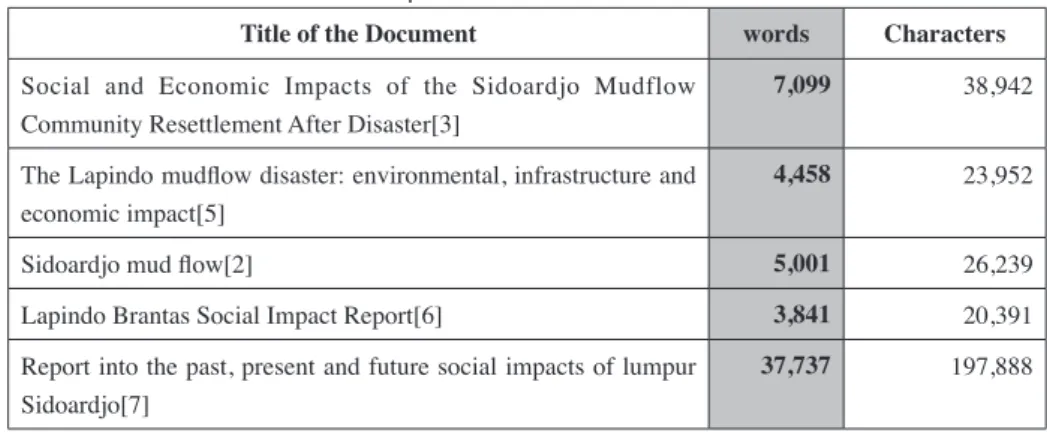
In this section, the topic extraction results by LDA model is presented. We analyzed the LUSI Mudflow reports, paper, and news articles [2, 3, 5-7]. To create the source input file, first we have to remove figures and reference list parts from the documents. The volume of each documents is shown in Table 3:
Table 3: Input volume of each document
Title of the Document words Characters
Social and Economic Impacts of the Sidoardjo Mudflow Community Resettlement After Disaster[3]
7,099 38,942
The Lapindo mudflow disaster: environmental, infrastructure and economic impact[5]
4,458 23,952
Sidoardjo mud flow[2] 5,001 26,239
Lapindo Brantas Social Impact Report[6] 3,841 20,391
Report into the past, present and future social impacts of lumpur Sidoardjo[7]
37,737 197,888
If a document is too long, we divide that file to several text files. Input the source text, and conducted topic extraction by the Latent Dirichlet Allocation (LDA) model and Gibbs samplings. The number of the topics selected was four, because that offers more clear classification than five or six.
We used both unigram and noun-noun bigram segmentations. This is because noun-noun bigrams
analysis can prevent lack of connections meaning between words. To make the LDA model, at first, only
noun-noun bigrams are extracted from the input files and we count the number of the appearance (See
1) https://www.wolfram.com/cdf-player/
Table 4). However, we could not interpret the latent semantics from the result clearly. Therefore, we took a different approach as follows:
1. We remove the only one time appearance from the result in Table 4.
2. Using the noun-noun bigrams and the appearance, we make a unigram based LDA model. In other words, the word distribution is made of a set of unigram nouns.
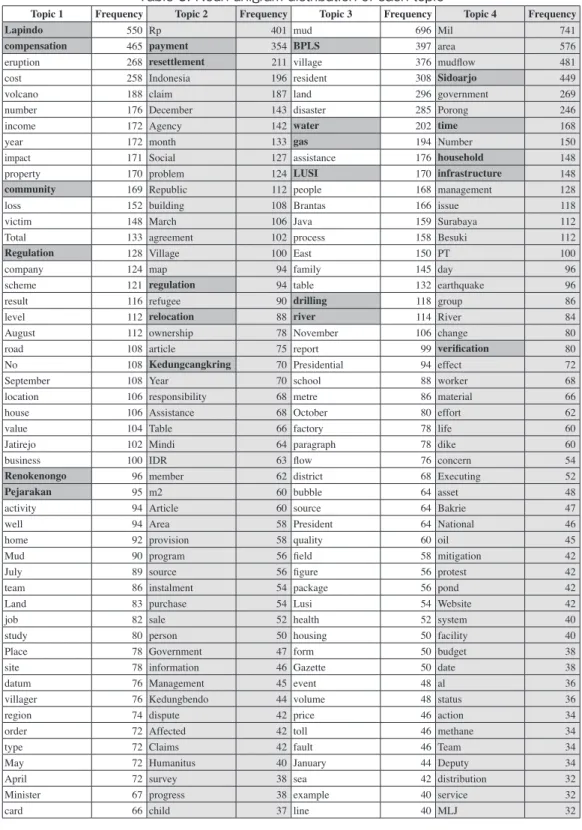
Table 5 shows the result of the term distribution of each topic. From the term frequencies, we interpreted the topic. The topic ID in Table 4 and Table 5 has no correspondence. If we cannot interpret the meaning of a term in Table 5, we can refer to a corresponding bigram that includes the noun, so that we can obtain the meaning. For example, for a noun “payment”, we found the following bigrams: “assistance payment”,
“compensation payment”, “payment compensation”, and “payment claim”. Then we can guess that the
“payment” might be a payment of compensation to devastated people or districts.
From Table 5, we make the topic titles as follows, i.e. The Lapindo compensation based on the Presidential Regulation. The following topic i to topic u explanations shows our process of analysis to the topic extraction as shown in Table 5.
Topic 1: Lapindo compensation based on the Presidential Regulation
We interpreted the implications of the topic as Lapindo compensation based on Presidential Regulation. The terms of the topic are “lapindo compensation”, “community”, “regulation”, and “Renokenongo Pejarakan”. Lapindo is the company name that is used to reter to the mud flow case. These topics are related to the process of compensation from the Lapindo disaster to the declared victims based on Presidential Regulation. Thereby Presidential Regulation refers to the “Presidential Regulation No.
14/2007 on the Sidoardjo Mudflow Settlement Board.”[16]. In the official hierarchy of Indonesia legislation, a Presidential Regulation is higher than a Regional Regulation. This Presidential Regulation is a regulation by the president of the Republic of Indonesia to declare the victim area, and the amount of compensation from Lapindo Brantas Inc.
The terms “Renokenongo” and “Pejarakan” refers to the location of the Sidoardjo Mudflow area which is located in Renokenongo Pejarakan village. Therefore, we conclude the topic is related to compensation for the affected village. To explore more about that, we found related compensation words from the bigram noun-noun result, such as “compensation payment”, “compensation scheme”, “land compensation”, “building compensation”, “demand compensation”, “regulation compensation”, and
“compensation package”. From these words, we think that it is related to the compensation scheme for land and building victims, based on the Presidential Regulation.
Topic 2: Payment of resettlement and relocation
The most frequently appeared word is “Rp” which stands from Rupiah, the currency of Indonesia, IDR. We found in Table 5 that words “payment”, “resettlement”, “regulation”, “relocation” and
“Kedungcangkring” appeared many times. Kedungcangkring is one of the affected area in Sidoardjo
regency. In Indonesia, both regency and city are at the same administration level. A regency is
immediately below a province, and consist of some districts. For the resettlement word, we found “type
resettlement”, “resettlement scheme”, and “cash resettlement” at the noun-noun bigram result. We think
Table 4: Noun-noun bigram distribution of each topic
Topic 1 Freq Topic 2 Freq Topic 3 Freq Topic 4 Freq
payment 66 Porong-river 32 mud-volcano 76 Sidoarjo-mudflow 35
land-building 32 Presidential-Regulation 30 East-Java 65 Indonesia-Year 23
Executing-Agency 25 Gazette-Republic 21 Lapindo-Brantas 62 State-Gazette 22
compensation 25 mud-Porong 19 Republic-Indonesia 53 fs 19
Social-Assistance 21 Number-year 17 Porong-River 34 Place-A 18
Indonesia-Number 21 mudflow-Sidoarjo 14 PT-Lapindo 32 Place-B 17
BPLS-Website 21 purchase-land 13 map-area 27 job-type 17
Besuki-Kedungcangkring 19 Lapindo-Brantas 12 toll-road 20 resettlement-area 14 Kedungcangkring-Pejarakan 19 cost-Rp 12 mudflow-management 19 house-holdincome 14
source-BPLS 19 Area-Map 11 Year-Number 18 mudflow-disaster 12
Rp-month 18 Affected-Area 11 eruption-site 18 source-Author 12
compensation-package 14 volume-mud 11 Lapindo-compensation 17 income-level 12
Rp-family 13 sale-purchase 11 verification-team 15 Author 11
effort-mudflow 13 compensation-property 10 LUSI-mud 14 fs-survey 11
Rp-m2 12 compensation-scheme 10 Rp-metre 12 oil-gas 11
Rp-Rp 12 resident-village 10 village-Siring 12 Renokenongo-village 10
Siring-Jatirejo 11 eruption-zone 10 mud-eruption 11 income-change 10
assistance-Rp 10 value-property 9 Sidoarjo-Mud 11 Banjar-Panji1 10
Assistance-payment 10 housing-estate 9 Head-Executing 11 Sidoarjo-Mudflow 9
president-Republic 10 land-area 9 water-quality 11 et-al 9
payment-Rp 10 compensation-payment 9 LUSI-eruption 10 resettlement-behavior 8
village-Besuki 10 Lapindo-BPLS 9 Regulation-Number 10 significance 8
mud-water 10 Siring 9 Sub-Total 10 mudflow-area 7
refugee-camp 9 resettlement-home 8 compensation-process 10 impact-Sidoarjo 7
instalment-Rp 9 Management-Agency 8 claim 10 income-household 7
Land-Buildings 9 methane-gas 8 impact-mudflow 9 Bother 7
proof-ownership 9 property-value 8 March-map 9 schoolage-child 7
Claims-Rp 9 table-status 8 Brantas-Inc 8 household-head 7
Mitigation-Agency 8 Housing-Estate 8 Bakrie-Group 8 drilling-mud 7
Mud-Mitigation 8 disaster-area 7 Yogyakarta-earthquake 8 Lusi-mud 7
courtesy-BPLS 8 area-village 7 Lapindo-Rp 8 Sidoarjo-regency 6
Total-source 8 National-Team 7 cost-mudflow 7 resettlement-dummy 6
life-insurance 8 Presidential-Decree 7 fault-reactivation 7 survey-estimation 6 month-person 7 compensation-village 7 Siring-Renokenongo 7 number-schoolage 6
percent 7 Jatirejo-Mindi 7 fault-system 6 type-resettlement 6
Government-Regulation 7 Website-table 7 Java-Indonesia 6 resettlement-preference 6
PBP-refugee 7 Mil-Claims 7 flow-mud 6 refugee-area 6
Target 7 Land-Building 7 problem-mudflow 6 mudflow-impact 6
land-ownership 6 rice-field 6 area-December 6 Aburizal-Bakrie 6
Lumpur-Sidoarjo 6 September-resident 6 Agency-article 6 paragraph-paragraph 6
Toll-road 6 Oil-Gas 6 form-assistance 6 Map-March 6
Article-paragraph 6 Perumtas-resident 6 Rail-line 6 Act-No 6
Village-Village 6 Besuki-Pejarakan 6 Regulation-No 6 Jati-rejo 6
H2S-gas 6 RT-RT 6 compensation-claim 6 Brantas-Inc 5
verification-process 6 state-budget 6 West-Siring 6 household-Renokenongo 5
Sosial-December 6 New-Market 6 I 6 business-activity 5
Kegiatan-Deputi 6 Sidoarjo-East 6 Bidang-Sosial 6 villager-relative 5
bubblea-rea 6 crop-failure 6 Kedung-cangkring 6 change-household 5
Jatirejo-Siring 6 Deputi-Bidang 6 payment-claim 6 significance-level 5
Wunut 6 PowerPoint-Presentation 6 mud-sample 6 number-relative 5
Table 5: Noun unigram distribution of each topic
Topic 1 Frequency Topic 2 Frequency Topic 3 Frequency Topic 4 Frequency
Lapindo
550 Rp 401 mud 696 Mil 741
compensation
465 payment 354 BPLS 397 area 576
eruption 268 resettlement 211 village 376 mudflow 481
cost 258 Indonesia 196 resident 308 Sidoarjo 449
volcano 188 claim 187 land 296 government 269
number 176 December 143 disaster 285 Porong 246
income 172 Agency 142 water 202 time 168
year 172 month 133 gas 194 Number 150
impact 171 Social 127 assistance 176 household 148
property 170 problem 124 LUSI 170 infrastructure 148
community
169 Republic 112 people 168 management 128
loss 152 building 108 Brantas 166 issue 118
victim 148 March 106 Java 159 Surabaya 112
Total 133 agreement 102 process 158 Besuki 112
Regulation
128 Village 100 East 150 PT 100
company 124 map 94 family 145 day 96
scheme 121 regulation 94 table 132 earthquake 96
result 116 refugee 90 drilling 118 group 86
level 112 relocation 88 river 114 River 84
August 112 ownership 78 November 106 change 80
road 108 article 75 report 99 verification 80
No 108 Kedungcangkring 70 Presidential 94 effect 72
September 108 Year 70 school 88 worker 68
location 106 responsibility 68 metre 86 material 66
house 106 Assistance 68 October 80 effort 62
value 104 Table 66 factory 78 life 60
Jatirejo 102 Mindi 64 paragraph 78 dike 60
business 100 IDR 63 flow 76 concern 54
Renokenongo
96 member 62 district 68 Executing 52
Pejarakan
![Figure 1. Location of the Brantas River basin, Surabaya city and the LUSI mud volcano(cited from [1])](https://thumb-ap.123doks.com/thumbv2/123deta/7198507.2378210/2.773.169.604.734.920/figure-location-brantas-river-basin-surabaya-lusi-volcano.webp)
![Table 1: Direct Economic Costs - 2006 - 2015 (US$) (cited from [8])](https://thumb-ap.123doks.com/thumbv2/123deta/7198507.2378210/3.773.94.689.429.536/table-direct-economic-costs-cited.webp)
![Table 2: Compensation for Resettlement (cited from [8])](https://thumb-ap.123doks.com/thumbv2/123deta/7198507.2378210/4.773.96.677.150.440/table-compensation-for-resettlement-cited-from.webp)
![Figure 2. The image of Gibbs sampler concept with the background image developed using Mathematica tools (cited from[12]).](https://thumb-ap.123doks.com/thumbv2/123deta/7198507.2378210/5.773.285.491.414.692/figure-image-gibbs-sampler-concept-background-developed-mathematica.webp)