Japanese People’s Valuation of English Skills:
Sociometric Analysis of JGSS-2010
Takunori TERASAWA Graduate School of Arts and Sciences
The University of Tokyo
「日本人」の英語力に対する価値付け
JGSS-2010を用いた計量社会学的分析
寺沢 拓敬
東京大学大学院総合文化研究科博士課程
This study examines characteristics of Japanese valuations of English skills by statistically analyzing the dataset of the JGSS-2010. In particular, the present paper focuses on an oft-claimed view of the Japanese that they have high aspirations toward English skills. According to the descriptive statistics, the majority of Japanese people do not put a high valuation on English skills, suggesting that the view above is an over-generalization. In addition, this analysis also reveals that a wide recognition gap is originated from a variety of social and occupational factors such as generations, years of schooling, stratifications, and a type of job. Furthermore, this study investigates the determinants of non-English-users’ valuation of English skills based on a series of logistic regression models. The result shows that the strata factor has a different effect between male and female workers; its effect is evident only in the female valuation of English skills for hobbies or personal relationships. Based on these findings, this paper discusses the possibility of a gender structure in attitudes toward English skills.
Key Words: JGSS, Japanese valuation of English skills, recognition gaps by social strata
本研究の目的は、「日本人」の英語力志向を JGSS-2010 の計量分析により明らかにするこ とである。特に、《その低い通用度にもかかわらず英語熱は大きい》としばしば評される日 本像を検討の俎上に乗せる。記述統計では、過半数の「日本人」は英語力の有用性を認識し ておらず、したがって上記の日本像は過度に一般化されたものであることが明らかになった。
また、有用性認識には社会グループ間で大きな差があることも示された。また、ロジスティ ック回帰分析により、「非・英語使用者」の英語有用性認識の規定要因を検討した結果、社 会階層の影響の仕方にジェンダー差が見られることが明らかとなった。すなわち、趣味等で の有用性認識への効果は女性のみに見られたが、男性には確認できなかった。また、仕事で の有用性認識への効果は男女いずれにも見られなかった。この結果に基づき、英語力への態 度にジェンダーによって異なる構造が見られる可能性について議論した。
キーワード:JGSS,「日本人」の英語力志向,認知の階層差
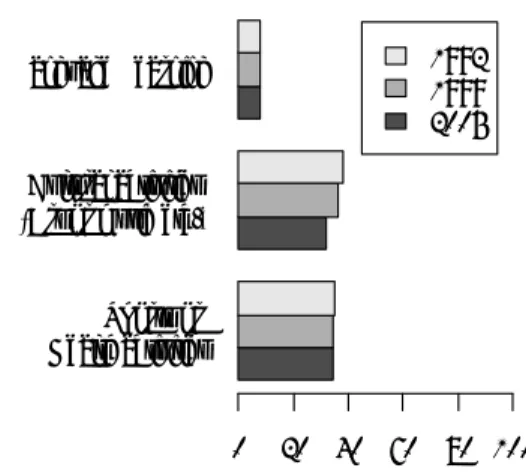
Sports or Health activities Cultural activities (Art or music etc.)
Language Learning 1992
1999 2005
Samples who want to do (%)
0 20 40 60 80 100
Figure 1 Motivation to foreign language learning (Source: “Public Opinion Poll about Lifelong Learning,” each year)
1. Introduction
Japan is sometimes viewed as a society enthusiastically oriented to English language and its skills.
For instance, this point of view is held by Phillip Seargeant’s The Idea of English in Japan, which thoroughly examines how English language has been conceptualized as a symbol of a high status by Japanese people. In the work, Seargeant states:
One of the most frequently voiced opinions about English in Japan is that the high profile of, and immense interest in, the language is not matched by an equally high level of communicative proficiency among the population. (Seargeant 2009:3)
According to Seargeant, this inconsistency between great enthusiasm and low skills has received much attention from the professional and research community of English language education, and has affected policy reform. Such a view also seems to be held by some Japanese researchers. Tsuda (1990), for example, claims that the Japanese society is characterized as people’s high aspirations toward English, and criticizes it in that it results from fanatic adoration of the West and disrespect of Japanese values and has caused irrational policies and practices of English education.
This view, however, seems to extremely over- generalize Japanese attitudes since it is probably impractical to assume that so many Japanese people wish to obtain English skills. Indeed, any social survey in recent years implies that the majority of Japanese people are not so interested in English language. For instance, according to “Public Opinion Poll about Lifelong Learning” conducted by Cabinet Office of the Government of Japan in 1992, 1999, and 2005 (samples = males and females aged 15 and older), only a tiny minority (under 10%) hope to learn foreign languages. Furthermore, this figure is much lower than the other social and cultural activities such as art, music, sports, or health activities.
The question, then, is how many people are oriented toward gaining English skills and how many
people are not. The answer of this question, however, has not been sufficiently provided by the previous works which have dealt with Japanese attitudes toward, or belief in, English (e.g. Sakui &
Gaies 1999; Yashima 2002; Erikawa 2008; Seargeant 2009) because they mainly conduct case studies or analyze symbolic examples about Japanese valuation of English, making it uncertain whether their conclusions give a general picture of the Japanese society.
Therefore, it is important to empirically examine this issue by analyzing data which properly represents Japanese people and society.
Based on the discussion above, this study specifically examines the following questions:
1) How many people in Japan put a high valuation on their acquisition of English skills?
2) What kind of Japanese people tend to do so?
The second question, because of its exploratory nature, requires appropriate reference to previous work which has empirically examined Japanese behavior toward the English language (e.g. Sugita 2004; Koiso 2009, 2010; Terasawa 2011). Therefore, the present paper is based on the analytic framework of these studies, i.e. analysis from a point of view of generation, gender, education level, social stratum, work status, and residential area.
The structure of the present paper is as follows: Section 2 explains the data used; Section 3 describes the distribution of Japanese people who set a high valuation on English skills. Section 4 examines its determinants and discusses the results.
2. Data
This study examines the questions above by analyzing the dataset of the Japanese General Social Survey conducted in early 2010 (hereafter, “JGSS-2010”). The JGSS-2010 is a 2010 version of a series, one of the largest-scale social surveys in Japan, aiming at exploring the behaviors and thoughts of Japanese people. Its sample is extracted from adult men and women (from 20 to 89 years old) living in Japan based on a method of two-stage stratified random sampling (its sample size is 9,000 and a valid response rate is 62.16%). JGSS-2010 is composed of two datasets, Form A and Form B, and the present paper uses the former, which includes questionnaire items about the English language. Its number of valid samples is 2,507.
The following two questions in the dataset are supposed to represent the people’s valuation of English skills, i.e. a dependent variable of a central interest in this study:
To what extent do you think improvement in English proficiency is of advantage to your job?
To what extent do you think improvement in English proficiency is of advantage to your hobby or personal relationships?
Table 1 Valuation of English skills
n % n %
Never 435 27.7 Never 751 30.2
Hardly 482 30.7 Hardly 746 30.0
A little 348 22.2 A little 536 21.5
To some extent 190 12.1 To some extent 291 11.7
To a great extent 113 7.2 To a great extent 165 6.6
Total 1,568 100.0 Total 2,489 100.0
Currently I don’t have a job 936 NA 18
NA 3
To job To hobby or personal relationships
The first question is concerned with a valuation of English skills related to the job, and the second one related to non-business activities. Each question is answered in a five point scale from “Never” to
“To a great extent” (see Table 1). The samples who chose the latter three choices can be regarded as people who put a relatively high valuation on English skills because they showed a more or less a positive attitude toward its usefulness, while the sample who chose the former two choices are considered to be people who do not. Thus, this study from now on analyzes these binary variables (i.e.
1 or 0) of the valuation of English skills.
3. Valuation on English skills in Japanese society
As illustrated in Table 1, it is not the majority of Japanese who recognize the usefulness of English skills. People who put importance on their improvement of English skills for their job are 41.5 % of all workers, and the counterparts for hobby or personal relationships are 39.8 % of Japanese.
Although it is difficult to conclude whether these estimations (about 40%) are too low or not, it is safe to say at least that these figures prove that the common view presented in Section 1 that Japanese put a high valuation on English is too monolithic.
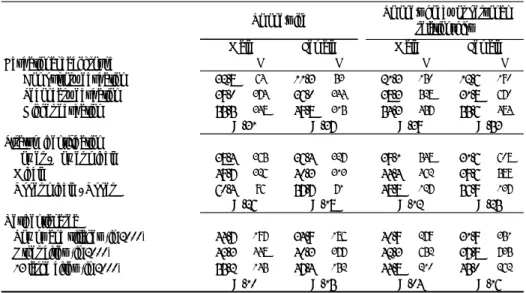
The misrepresentation of the monolithic view becomes more obvious if the percentage by generations is estimated. Table 2 estimates the percentage of each age group and its generational effect by Goodman and Kruskal’s gamma(1). Table 2 clearly shows that older people (especially, over 60s) are less likely to recognize the importance of English skills for their job, hobby, or personal relationships (men’s recognition for job is an exception). What should be noted here is that even younger generations show about 55% at most; therefore it is hard to conclude that the vast majority of young Japanese put a high valuation on English skills.
Table 2 People who put a relatively high valuation on English skills by generation
% n % n % n % n
Age: 20-29 45.7 70 46.7 90 55.3 103 50.7 134
30-39 39.4 170 54.4 149 48.6 181 54.8 219
40-49 54.5 176 36.5 208 53.4 193 46.5 273
50-59 52.1 194 42.2 154 42.7 211 38.3 240
60-69 33.1 139 24.3 103 33.6 259 26.3 270
70-89 48.8 41 0.0 11 30.4 194 14.2 212
γ = -.39
Male Female Male Female
γ: Goodman and Kruskal's gamma
To one's job To one's hobby or personal relationships
γ = -.02 γ = -.24 γ = -.24
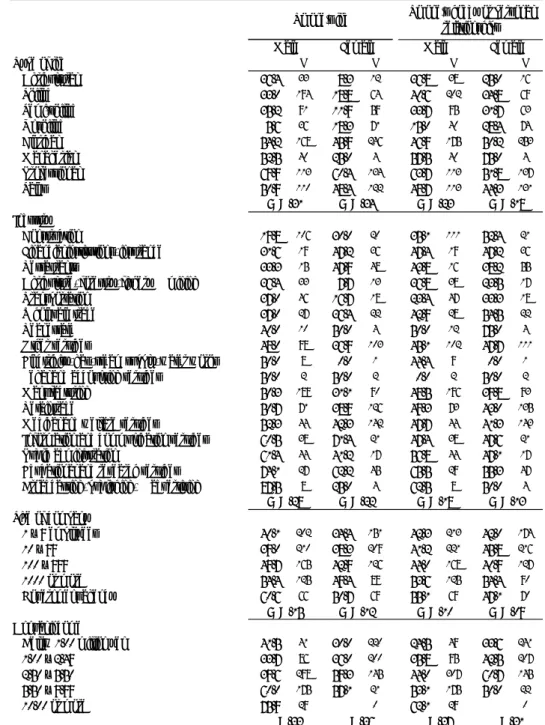
Such an uneven distribution of the valuation is also evident in education. Table 3 reveals that people who experienced higher education are more likely to recognize usefulness of English language.
However, again, it is difficult to regard even highly-educated people as generally oriented to English language since their percentages are no more than about 50%. Furthermore, factors of stratification seem to influence the valuation on English skills, too. Table 3 also shows the rate of people who recognize the usefulness of English skills for each stratum identification(2). As the results indicate, people who consider themselves to be at a higher stratum are more likely to set a relatively high valuation. Regional factors, in contrast, do not have much stronger effects on valuations than the variables discussed above. In Table 3, which also shows the percentages by residential area(3), all gamma coefficients are rather weak (.04 ~ .16), suggesting only a small correlation between the city size and the percentage.
Table 3 People who put a relatively high valuation on English skills by education, strata, and residence
Educational background % n % n % n % n
Compulsory education 32.8 64 11.3 53 21.3 150 12.6 190
Secondary education 39.0 374 36.0 344 38.3 528 31.8 670
Higher education 55.5 348 49.8 315 54.3 457 55.6 484
Stratum identification
Lower / Lower middle 38.4 365 36.4 327 39.1 548 31.6 608
Middle 49.7 326 40.3 313 44.4 462 39.6 589
Upper middle / Upper 60.4 96 57.7 71 48.8 127 56.9 137
Residential area
Towns and villages (in 2000) 44.7 197 34.9 186 40.9 279 31.9 351
Other cities (in 2000) 43.3 448 40.3 377 42.3 652 37.8 735
13 large cities (in 2000) 55.2 145 47.4 152 44.8 210 45.0 262
To one's job To one's hobby or personal relationships
Male Female Male Female
γ = .31 γ = .37 γ = .39 γ = .53
γ = .26 γ = .18 γ = .12 γ = .25
γ: Goodman and Kruskal's gamma
γ = .10 γ = .15 γ = .04 γ = .16
Table 4 shows the percentages of each work status and Cramer’s V which indicates the degree of non-ordinal association between work status and valuation. The result shows remarkably high percentages among students and low percentages among, for example, temporary workers.
Table 4 People who put a relatively high valuation on English skills by work status
% n % n % n % n
WORKER
Regular employee 47.4 519 51.3 269 47.3 526 55.4 271
Executive of company 47.7 65 41.2 17 44.8 67 66.7 18
Self-employed/family worker 38.3 128 33.3 78 39.0 136 44.2 95
Temporary worker 47.0 66 33.7 323 38.0 79 33.7 338
NON-WORKER
Student 72.2 18 75.0 16
Mainly engaged in housework 62.5 8 28.4 458
Retired 30.6 206 44.4 27
Others 43.9 66 30.4 46
V: Cramer's V
V = .07 V = .17 V = .15 V = .24
To one's job To one's hobby or personal relationships
Male Female Male Female
Finally, Table 5 shows the results of job-related variables such as types of job, industries, size of company, and annual income. Note that the number of each denominator (i.e. n) is based on jobholders.
Judging from the size of coefficients indicating the degree of association (V or γ), the types of job and annual income seems to have relatively strong association with the valuation of English skills. With regard to the type of job, in particular, professional workers are more likely to put a relatively high valuation on English skills, whereas blue-collar workers (i.e. agricultural, skilled, semi-skilled, and unskilled workers) are less likely. Highly paid workers also tend to recognize the usefulness of English skills to their jobs, which suggests that the jobs whose workers are requiring English skills are more likely to be well-paid.
Table 5 Workers who put a relatively high valuation on English skills by job-related variables
Type of job % n % n % n % n
Agricultural 36.4 33 8.3 12 36.8 38 25.0 16
Skilled 33.0 194 18.8 64 40.6 202 34.8 69
Semi-skilled 35.2 91 11.9 59 33.7 95 31.7 63
Unskilled 5.6 36 18.3 71 15.0 40 28.4 74
Clerical 54.2 168 45.9 246 46.9 175 50.2 253
Managerial 52.5 40 25.0 4 57.5 40 75.0 4
Professional 69.9 113 60.4 134 63.7 113 51.8 137
Sales 50.9 110 48.4 122 48.7 113 44.3 131
Industry
Construction 19.8 106 30.0 20 35.1 111 52.4 21
Financial institutions, insurance 31.6 19 47.2 36 47.4 19 47.2 36
Restaurants 33.3 15 47.9 48 43.8 16 38.2 55
Agriculture, forestry, fishery & mining 36.4 33 7.7 13 36.8 38 23.5 17
Transportation 37.0 46 16.7 18 23.4 47 33.3 18
Wholesale trade 37.0 27 36.4 22 42.9 28 54.5 22
Real estate 40.0 10 50.0 4 50.0 12 75.0 4
Other services 48.0 98 36.9 103 45.1 102 47.7 111
Electricity, gas, steam supply, water works 50.0 8 0.0 1 44.4 9 0.0 1
Legal and accounting services 50.0 2 50.0 2 0.0 2 50.0 2
Manufacturing 50.3 189 31.1 90 48.5 196 39.8 93
Retail trade 50.7 71 38.9 126 49.3 73 43.0 135
Medical and welfare services 52.3 44 42.3 142 47.7 44 41.3 143
Information and communication services 60.5 38 71.4 21 47.4 38 47.6 21
Public administration 61.4 44 41.2 17 56.8 44 47.1 17
Educational and research services 74.1 27 62.2 45 65.5 29 55.3 47
Broadcasting, publishing, & advertising 87.5 8 25.0 4 62.5 8 50.0 4
Size of company
1 ~ 9 employees 40.1 202 34.4 151 42.3 213 42.0 174
10 ~ 99 39.0 210 38.3 209 41.2 221 45.8 216
100 ~ 999 49.7 165 42.9 126 44.0 168 40.9 127
1000 or more 54.4 125 49.4 89 53.6 125 54.4 90
Government agency 60.6 66 50.7 69 55.1 69 47.1 70
Annual income
Below 1.00 million yen 41.5 41 30.0 220 24.5 49 33.6 241
1.00 ~ 2.49 33.7 86 36.0 200 35.8 95 42.5 207
2.50 ~ 5.50 39.6 298 59.3 145 44.0 307 60.7 145
5.50 ~ 9.99 60.0 175 57.1 21 53.1 175 50.0 22
10.00 or more 75.9 29 0 62.1 29 0
To one's job To one's hobby or personal relationships
Male Female Male Female
V = .31 V = .34 V = .23 V = .18
V = .28 V = .22 V = .18 V = .13
V: Cramer's V, γ: Goodman and Kruskal's gamma
V= .15 V= .12 V= .10 V = .09
γ = .33 γ = .36 γ = .27 γ = .31
This section has revealed some social and occupational groups who tend to recognize the usefulness of English skills. It should be noted, however, that it is still uncertain whether these variables determine the valuation directly since the associations revealed above might be spurious.
Therefore, they need to be examined in further detail. The next section investigates this issue.
4. Determinants of a valuation on English skills
This study so far has revealed a gap in the valuation of English skills among people with different social backgrounds. The question then is what kind of factors differentiate it. One plausible answer is that the use of English causes a high valuation on English skills. It is quite natural to assume that the
in the following analysis, valuation of English skills is strongly associated with the use of English.
4.1. Use of English and its valuation
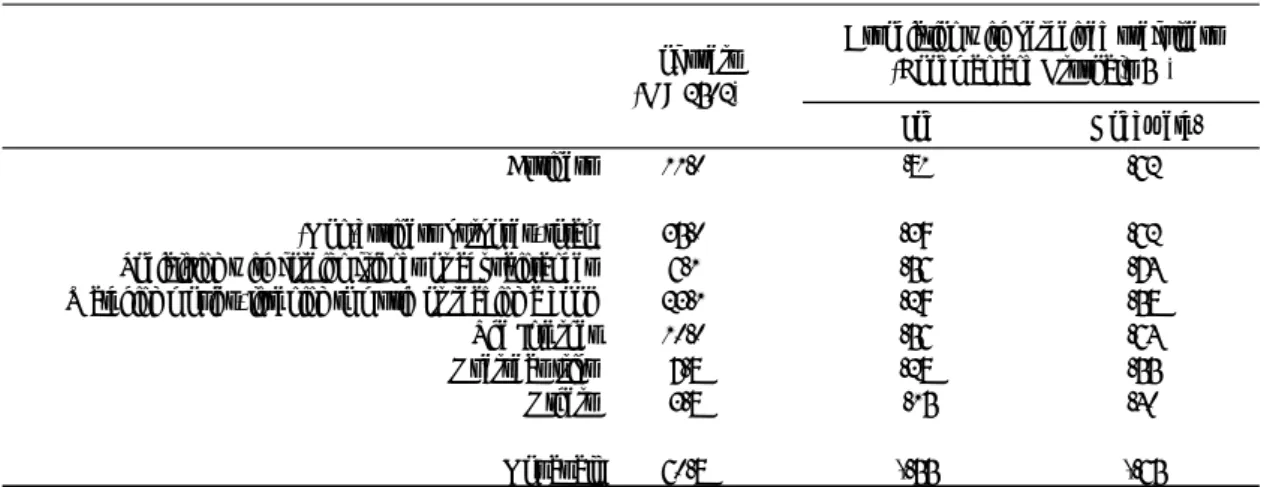
JGSS-2010 asked respondents whether they used English for the following purposes (“Have you ever read, listened, or spoken English for the following activities for the past 12 months? Choose all that apply”). As indicated by Table 6 (in which each percentage shows the rate of samples who answered that they used English, and each gamma coefficient denotes the degree of association with the recognition of the usefulness of English skills), the actual use of English is strongly associated with the perceived usefulness of English skills.
Table 6 Use of English
Job Hobby etc.
Business 11.0 .81 .62
(Non-business purposes, total) 35.0 .39 .62
Socializing with foreign friends or acquaintances 6.1 .56 .74
Watching movies, listening to music or reading a book 23.1 .29 .58
The Internet 10.0 .56 .64
Overseas trips 7.8 .28 .55
Others 3.8 .15 .40
Not at all 60.8 -.55 -.65
% of users (n = 2502)
Association with perceived usefulness (Goodman and Kruskal's γ)
What should be noted here is that, as well as the valuation of English skills, the use of English is also strongly influenced by social factors. According to Koiso (2009), the use of English for both business and non-business purposes is determined by a variety of job-related factors (e.g. type of job) and social backgrounds (e.g. education and gender). Based on these findings, it is necessary to control the use of English in order to examine the determinants of the valuation of English skills in detail, otherwise, it is hard to distinguish a direct effect (i.e. a specific type of people, other things being equal, tends to recognize the usefulness of English skills) from an indirect effect (i.e. a specific type of people tends to use English, resulting in a gap of the valuation).
For this reason, the present paper will now focus on non-users of English. This focus is important in that it is well fitted to the idea this study examines. As discussed in Section 1, Japan is recognized as a curious society in which the English language obtains much popularity but little currency; in other words, what receives much attention from researchers is not rational or natural aspirations toward English (such as a high valuation of English by a worker whose office requires him or her to use English for international transactions, for example), but rather a seemingly-irrational enthusiasm for the English language. Indeed, as exemplified by the quite bitter terms with which some researchers (e.g. Tsuda 1990; Yakushiin 2005) have used to describe Japanese aspirations toward English such as
“delusion” (môsô), “syndrome” (eigo byô), or even “a fool” (eigo baka), the Japanese valuation of English is understood as an unnatural desire which is no longer based on the necessity to use or learn English. Therefore, it is likely that people create the idea that Japanese are highly oriented to acquiring English based on the non-user’s behavior rather than the user’s one(4). Thus, the following analysis examines the determinants of the non-users’ valuation of English skills based on a series of
4.2. Analytic models and variables
This model, in particular, aims at testing the influence of gender, strata, and residential area (specifically, urban vs. rural). These factors often receive much attention from previous work on the phenomena of English language in Japan. In the previous works, one of the most important topics is the close connection between gender and English learning (e.g. Kelsky 2001; Bailey 2006; Seargeant 2009: Chapter 7). Bailey remarks:
In the modern Japanese social context the meaning of English-language learning is strongly gendered. For men, where it is necessary, it functions as a communication tool, whereas for women it opens a gateway to … atarashii jibun or transformed selfhood (2006:109)
However, this attitude of women is probably not a universal phenomenon, evident in a variety of Japanese women, but relevant to a specific group of women. For example, Kelsky (2001) focuses on
“highly-educated, urban, mostly single career women between the ages of twenty and forty-five (Kelsky 2001:5),” and, thanks to this focus, she successfully demonstrates the mechanism of their longing (akogare) toward the West, white men, and the English language. Based on this discussion, it is presupposed that urban residence(5) has a greater impact on women’s valuation of English skills than men’s valuation.
Social strata may also have a different effect on the valuation on English between men and women. Kataoka’s (2003) sociometric analysis of Japanese behavior concerning hobbies and cultural activities, although she makes no mention on behaviors related to English language, reveals that women at a high stratum are more likely to be oriented to cultural activities considered to be prestigious, whereas men do not show such a difference. Therefore, if use of English is also viewed as a prestigious activity, the valuation of English would also show gendered effects of social strata. Based on the discussion so far, the present paper sets the model which examines a gender-gap of effects of residential and stratification factors. More particularly, the model includes the variables in Table 7.
Table 7 Variables
Dependent variable
High valuation on English Recognize usefulness of English skills for business purpose or not
Recognize usefulness of English skills for hobby or personal relationships or not Independent variables
Residential area 13 large cities, other cities, or town and villages; see Table 3
Social strata Stratum identification: Lower = 1, Lower middle = 2, Middle = 3, Upper middle = 4, and Upper Control variables
Generation Age
Education Years of schooling
Type of job Blue collar, clerical, professional/managerial a), or sales job; see Table 5 Income Median of each choice of annual income (million yen); see Table 5 Employment status 4 categories in Table 4
a) Professional and managerial workers are integrated because the number of female managerial workers is very small (n = 4).
What should be noted here is that the following analysis concentrates only on jobholders (i.e.
excludes non-workers). This treatment is necessary because it enables comparison of the effects on valuations of two types of English skills (i.e. ones for job and ones for hobby or personal relationships) of the identical samples. If workers/non-workers are not distinguished, each analysis must be based on different samples, making it impossible to examine the difference between the
4.3. Results and discussion
The results of logistic regression analysis are in Table 8. One of the most remarkable points is that the valuation of English skills for the job is more greatly determined by job-related variables, such as a type of job, than the valuation of English skills for their hobby or personal relationships, whereas the latter valuation is more largely influenced by years of schooling than the former. However, since an educational background is closely connected with the valuation on job-related English skills as Table 3 indicates, this result should be understood as an indirect influence of education on the valuation of English for job via the job-related variables.
Table 8 Determinants of aspiration to English (only workers)
b (s.e.) b (s.e.) b (s.e.) b (s.e.)
Live in
Towns and villages (Ref.)
Other cities -0.36 (0.22) -0.10 (0.24) -0.21 (0.24) 0.03 (0.29)
13 large cities 0.04 (0.30) 0.37 (0.30) -0.63 (0.34) † 0.41 (0.37)
Stratum identification 0.08 (0.12) 0.09 (0.13) -0.04 (0.14) 0.35 (0.17) *
Age -0.01 (0.01) -0.01 (0.01) 0.00 (0.01) 0.00 (0.01)
Years of schooling -0.06 (0.05) 0.09 (0.06) 0.11 (0.06) * 0.21 (0.08) *
Type of job
Blue collar (Reference)
Clerical 0.69 (0.26) ** 1.26 (0.30) *** 0.34 (0.29) -0.25 (0.34)
Managerial/professional 1.05 (0.29) *** 1.58 (0.36) *** 1.04 (0.33) ** -0.42 (0.43)
Sales 0.37 (0.30) 1.37 (0.33) *** 0.39 (0.33) 0.20 (0.37)
Employment status Regular employee (Ref.)
Executive of company -0.03 (0.37) 0.25 (0.77) -0.22 (0.41) 1.05 (1.02)
Self-employed / family worker 0.05 (0.30) -0.50 (0.42) 0.03 (0.33) -0.26 (0.48)
Temporary employee 0.33 (0.35) -0.27 (0.26) -0.09 (0.39) -0.75 (0.33) *
Annual income (million yen) 0.19 (0.11) † 0.07 (0.14) 0.08 (0.11) 0.29 (0.17) †
English speaking skills 0.37 (0.14) ** 0.05 (0.15) 0.12 (0.16) 0.01 (0.21)
(Intercept) -2.48 (1.48) † -3.39 (1.90) † -3.18 (1.59) * -7.43 (2.47) **
-2LL 38.68 *** 67.95 *** 29.39 ** 37.45 ***
Negelkerke R2 0.10 0.17 0.09 0.14
n 535 513 440 360
To job a) To hobby or personal relationships b)
Estimation of log odds ratio; *** p < .001 , ** p < .01 , * p < .05 , † p < .1
a) Only respondents who answered they did not use English for business
b) Only respondents who answerred they did not use English for non-job purposes
Male Female Male Female
On the other hand, the result about the residential area is contrary to the prediction; that is, it does not show a statistically significant effect in any model. This effect, although it is evident in the cross-table (Table 3), is likely to be absorbed by other variables such as the years of schooling and types of job. Indeed, there are educational and occupational gaps among these areas: percentages of samples with a higher educational background in 13 large cities, other cities, and towns and villages are 51.7%, 37.9%, and 27.2% respectively, and percentages of white collar workers are 69.2%, 62.8%, and 54.1% respectively. Therefore, an aspiration gap between rural and urban area, which some
valuation of English skills. For the job-related valuation, neither male nor female workers have a statistically significant effect, whereas, for the valuation on English for hobby etc., a significant effect is recognized in females. This result seems to be consistent with Kataoka’s (2003) finding discussed above that women’s orientation to prestigious hobbies is determined by strata but men’s orientation is not. If, as many researchers (e.g. Seargeant 2009) have pointed out, use or learning of English for non-business purposes is regarded as a prestigious activity in the Japanese society, it is plausible that the effect of strata on the valuation of English skills for hobby etc. also shows a gender difference.
5. Conclusion
This study has revealed some characteristics of Japanese valuation of English skills. The important findings include (1) the majority of Japanese people do not put a relatively high valuation on English skills; (2) there is a wide gap in the valuation among people with different social backgrounds;
(3) the gap in the valuation between urban and non-urban areas can be largely explained by other social gaps (e.g. uneven distribution of highly-educated people or white-collar workers) between the areas; (4) a significant effect of stratification is evident only in women’s valuation for hobby or personal relationships. The first and second findings have successfully demonstrated that it is a fallacious and too-monolithic view that many Japanese put a high valuation on English. The fourth, on the other hand, implies the possibility that, since English skills for non-business purposes are deemed as prestigious, women at a higher stratum are more likely to be oriented to it than women at a lower stratum (although it should be noted, again, that this may be relevant only to workers who do not use English). These implications (especially the fourth one), of course, are still largely based on hypothetical ideas, therefore, further empirical investigation is required.
[Acknowledgment]
The Japanese General Social Surveys (JGSS) are designed and carried out by the JGSS Research Center at Osaka University of Commerce (Joint Usage / Research Center for Japanese General Social Surveys accredited by Minister of Education, Culture, Sports, Science and Technology), in collaboration with the Institute of Social Science at the University of Tokyo.
[Notes]
(1) Goodman and Kruskal’s gamma, one of the rank correlation coefficients, shows the degree of ordinal-association of two order-scale variables, and ranges from –1.00 to 1.00 and 0.00 indicates no such correlation.
(2) The wording of the questionnaire is “If we were to divide the contemporary Japanese society into the following five strata, which would you say you belong to?”
(3) The three choices, “Towns and villages,” “Other cities,” and “13 large cities,” are based on a city size of the year of 2000.
In the first decade of 21st century, many cities, towns, and villages in Japan experienced a large-scale merger (called
“the Great Merger of the Heisei Era”), in which many towns and villages (and even small cities) were absorbed into large cities. Due to this, a municipality label (especially “13 large cities” and “other cities”) in 2010 probably fails to represent the degree of urbanization of the residential area in which respondents live.
(4) Although it might be not necessary to exclude the users of English if the use of English is controlled, this treatment necessarily assumes that both English users and non-users show the same effects of each independent variable on the valuation, therefore, it is not more robust than to focus on only the non-users. However, the author has recognized the same results as in section 4.3. if it is analyzed in that way.
(6) In the preliminary analysis, the author has recognized that neither male nor female non-workers show any statistically significant effect (and even its implication) of residential area and strata.
[References]
Bailey, Keiron, 2006, “Marketing the Eikaiwa Wonderland: Ideology, Akogare, and Gender Alterity in English Conversation School Advertising in Japan,” Environment and Planning D: Society and Space, 24: 105-130.
Erikawa, Haruo, 2008, Nihonjin wa Eigo o Do Manande kitaka: Eigo Kyoiku no Shakai Bunka-shi (How have Japanese people studied English? A socio-cultural history of English language education in Japan), Kenkyusha, Tokyo.
Hogan, Jackie, 2003, “The Social Significance of English Usage in Japan,” Japanese Studies, 23(1):
43-58.
Kataoka, Emi, 2003, “‘Taishû Bunka Shakai’ no Bunkateki Saiseisan (Cultural reproduction of
‘popular-culture society’),” Ishii, Yojiro and Miyajima, Takashi [Eds.], Bunka no Kenryoku:
Hansha suru Bourdieu (Power of culture: Bourdieu and sociology in Japan), Fujiwara Shoten, Tokyo, 101-135.
Kelsky, Karen, 2001, Women on the Verge: Japanese Women, Western Dreams, Duke University Press, Durham.
Koiso, Kaoru, 2009, “Nihonjin Eigo Shiyo-sha no Tokucho to Eigo Noryoku: JGSS-2002 to JGSS-2006 no Data kara (The characteristics of English users and English proficiency of Japanese people: From the data of JGSS-2002 and JGSS-2006),” JGSS Monograph, 9: 123-137.
Koiso, Kaoru, 2010, “Joi-Yoin ga Eigo no Dokkai-ryoku to Kaiwa-ryoku ni oyobosu Eikyo:
JGSS-2008 no Data kara (The Influence of affective factors on English reading and conversation proficiency among Japanese from the data of JGSS-2008),” JGSS Monograph, 10: 163-172.
Sakui, K. and Gaies, S. J., 1999, “Investigating Japanese Learners’ Beliefs about Language Learning,”
System 27: 473–492.
Seargeant, Phillip, 2009, The Idea of English in Japan: Ideology and the Evolution of a Global Language, Multilingual Matters, Bristol.
Sugita, Hizuru, 2004, “Eigo no Gakushu-keiken ga Nihonjin no Eikaiwa-ryoku ni Oyobosu Koka:
JGSS-2002 no Data kara (The effects of English learning experience on Japanese people’s English conversation ability: From the data of JGSS-2002),” JGSS Monograph, 3: 45-57.
Terasawa, Takunori, 2011, “English skills as human capital in the Japanese labor market: An
econometric examination of the effect of English skills on earnings,” Language and Information Sciences (The University of Tokyo, Graduate School of Arts and Sciences, Language and Information Sciences), 9: 117-133.
Tsuda, Yukio, 1990, Eigo Shihai no Kozo (The structure of English hegemony), Daisan Shokan, Tokyo.
Yakushiin, Hitoshi, 2005, Eigo o Manabeba Baka ni naru (Learning English makes you stupid), Kobunsha, Tokyo.
Yashima, Tomoko, 2002, “Willingness to Communicate in a Second Language: The Japanese EFL Context,” The Modern Language Journal, 86(1): 54-66.