/
INTRODUCTION
J o h n K n a u s s : 5 0 Y e a r s o f S e r v i c e t o O c e a n o g r a p h y
Margalvt Leinen National Science Foundation • Arlington, Virginia LISA
11 of those w h o s e lives and careers h a v e b e e n touched b y John K n a u s s ' leadership in m a r i n e science, his vision of integrated and multidisciplinary a p p r o a c h e s to m a r i n e problems, and his statesman-like dignity and h u m a n i t y join m e in congratulating h i m on 50 years of distinguished contributions to oceanogra- phy. We are delighted that Oceanography has taken this o p p o r t u n i t y to reflect on the m a n y w a y s in which John has led our field a n d in which he has served as an e x a m - ple for o u r o w n careers. In m y r e m a r k s I w o u l d like to reflect on s o m e of the w o n d e r f u l stories associated with this legend of oceanography.
John's introduction to o c e a n o g r a p h y came d u r i n g World War II. He w a s one of a g r o u p of servicemen w h o w e r e assigned meteorological duties that contributed to w e a t h e r prediction in s u p p o r t of the
m a r i t i m e w a r effort. He became inter- ested in o c e a n o g r a p h y a n d its relation to w e a t h e r a n d climate as a result of this assignment. After the w a r he com- pleted his B.S. at the Massachusetts
Institute of Technology in 1946 a n d an M.S. in 1949 at the University of Michigan.
O c e a n o g r a p h y w a s a y o u n g field that h a d gained i m p o r t a n c e d u r i n g the war. Few were formally trained in the discipline. In fact, Scripps I n s t i t u t i o n of O c e a n o g r a p h y a w a r d e d the only o c e a n o g r a p h y degrees in the country at the time. So it w a s not u n u s u - al that Knauss m o v e d directly from his M.S. degree to the Office of N a v a l Research (ONR). H e spent a b o u t two years there as a p r o g r a m officer d u r i n g 1950 and 1951 w o r k i n g in the p r o g r a m that Roger Revelle h a d created at ONR. It was also no surprise that he w e n t to Scripps for his Ph.D. in 1951 a n d w o r k e d with Revelle.
Knauss told m e that "I d i d n ' t k n o w m u c h in those days, b u t h a v i n g w a t c h e d research a bit from m y post in O N R I k n e w that I n e e d e d s o m e time to fumble a r o u n d on m y o w n at m y o w n pace. Roger was director a n d too b u s y to w o r r y a b o u t me; hence he w a s ideal."
The Scripps years
An integrated a p p r o a c h to o c e a n o g r a p h y including all disciplines was the h a l l m a r k of g r a d u a t e education Oceanography • Vol. 14 • No. 2/2001
at Scripps u n d e r S v e r d r u p , d u r i n g the late 1940s (Inman, 2000). This set the stage for Jotm K n a u s s ' c o m m i t m e n t to a multidisciplinary core education for students in o c e a n o g r a p h y that has b e e n discussed in m o r e detail in this v o l u m e b y Farrington (2001). He and others trained at Scripps at this time (e.g. Wayne Burr, Dale Liepper, D o n Pritchard) served as "apostles" tak- ing this a p p r o a c h to other e m e r g i n g oceanographic institutions (e.g. Oregon State University, Texas A & M University, Johns Hopkins).
Roger Revelle a n d Jotm Knauss enjoyed a lifelong friendship. Before he died, Roger told several of us that John h a d always w a n t e d to be a playwright. Roger pro- v i d e d the script of a musical play called "Endless H o l i d a y " that Knauss wrote while a g r a d u a t e student at Scripps. The musical gives s o m e fla-
Roger Revelle and John Knauss eTqoyed a lifelong friendship.
v o r of the g r a d u a t e s t u d e n t a n d research life of the time. Some things n e v e r change: in the third scene a Scripps official is trying to get clear- ances and a p p r o v a l s f r o m a long list of entities for a cruise. As he m o v e s a r o u n d the stage he trails red tape behind him. The tape is on a spool, so that no matter w h e r e he goes he leaves a trail of red tape b e h i n d him. But other characteristics of o c e a n o g r a p h y are quite different: there were no female g r a d u a t e stu- dents or faculty in the play, only wives left on the beach.
During the time that Knauss w a s a g r a d u a t e student, he returned to O N R on a t w o year recall in J a n u a r y of 1954 to lead the physical o c e a n o g r a p h y p a r t of the early geophysics branch (under G o r d o n Lill) which w a s in the earth sciences division (under John Adkins).
K n a u s s ' Ph.D. thesis f o c u s e d on the Equatorial
U n d e r c u r r e n t in the Pacific, or C r o m w e l l Current. He
h a d originally p l a n n e d to do the thesis on the
Equatorial C o u n t e r c u r r e n t a n d the thesis w a s nearly
c o m p l e t e w h e n he m a d e his first m e a s u r e m e n t s of the
Equatorial Undercurrent. Knauss says that w h e n he
c a m e back from sea, "Revelle u r g e d m e to p o s t p o n e the
Countercurrent; w h y not be k n o w n for doing the w o r k
on the U n d e r c u r r e n t as y o u r Ph.D. dissertation? And, of
course, he w a s right." By the time he c o m p l e t e d his
Ph.D. in 1959, he h a d twice p u b l i s h e d studies of this
important feature of Pacific circulation in Nature. He extended this interest to equatorial circulation in the Indian Ocean through The International Indian Ocean Expedition, and, after moving to the University of Rhode Island (URI) as the founding dean of the new Graduate School of Oceanography, brought Jim Baker to URI as a post-doc. Neither could know that they would succeed each other as the top administrators of the nation's marine and atmospheric science agency, the National Oceanic and Atmospheric Administration (NOAA). Knauss' field studies kicked off a long legacy of tropical circulation experiments, field studies and discovery. That legacy is described in more detail in this issue by Weisberg (2001).
T h e R h o d e I s l a n d y e a r s
On New Year's Day of 1959 the Chief of Naval Operations, Admiral Arleigh Burke, distributed a report authored by Gordon Lill, Arthur Maxwell and Feenan Jermings of ONR, The Next Ten Years in Oceanography (known as TENOC; Lill et al., 1959). The report called for an expanded commitment to basic oceanographic research related to Navy responsibilities for defense. A keystone of the report was the need for more oceanog- raphers. The authors argued that investment in academic institutions was necessary to generate this new talent and ONR responded by block grants to several universities, including the University of Rhode Island, to establish academic oceanography programs.
Fred Saalfeld of ONR points out that at that time the Narragansett Bay Marine Laboratory, led by Charles Fish, was already involved in oceano-
graphic research. About 45% of the program, which at the time amounted to about $50,000 annually, was funded by Navy (Saalfeld, 2001). The Rhode Island program was focused on estu- arine oceanography, sediment studies, acoustics and biology and had 7 facul- ty, 5 research associates (most of whom later became faculty) and 17 students. Then president of URI, Dr.
Francis Horn, had met Harry Hess in
South America and after lively conversations had been convinced that the university should invest in oceanog- raphy. After URI was identified by ONR as one of the TENOC institutions, Horn's inquiries with several nationally-known oceanographers led him to John Knauss as a leader for the new academic unit. Although barely out of graduate school, Knauss had strong connections with the Office of Naval Research and could immediately link the new oceanography program with Navy research interests. In 1961 the Graduate School of Oceanography (GSO) was founded with Knauss at the helm.
John felt strongly that he needed to have a research vessel in place at URI before he came. He worked with the University to obtain a retired World War II Army
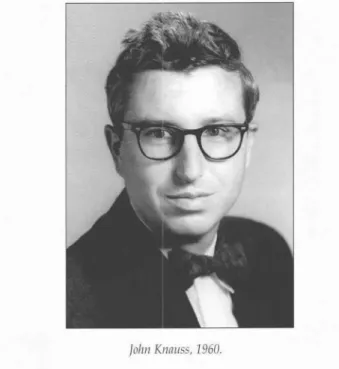
John Knauss, 1960.
machine shop vessel from surplus, which became the research vessel, Trident. As Bob Duce tells in this issue, John packed his household in containers on the ship and moved to Rhode Island (Duce, 2001). In 1961 the campus consisted of a few wooden buildings that housed the Narragansett Bay Marine Laboratory of the University.
But the times were fertile for science: in 1959 the nation was still in shock over the launch of Sputnik. As Knauss pointed out in this journal "Congress surged
After URI was identified by O N R as one of the T E N O C institutions, Horn's inquiries with several nationally-known oceanographers led him to
John Knauss as a leader for the new academic unit.
ahead with projects that promoted ocean science" (Knauss, 1990). In typ- ically modest fashion, Knauss did not mention that he was a member of the cabinet-level National Oceanographic Council, that provided advice and recommendations on much of that legislation (Miloy, 1983).
Over the next 25 years Knauss led GSO to be a major oceanographic institution. When he retired in 1987 as dean it had 41 faculty, 73 professional staff, 169 stu- dents, 12 buildings, and the ocean-going research vessel Endeavor. URI/GSO had become one of the original Sea Grant college programs, accounted for 12% of the NSF ocean science handing, and had carved out a leadership role in a number of areas of oceanographic research.
S e a G r a n t
While a newly minted Dean of Oceanography, Knauss had a pivotal role in shaping the Sea Grant pro- gram of NOAA. A few years ago I sat with John and then Senator Claiborne Pell at the Senator's home in Rhode Island as the two of them discussed the devel- opment of Sea Grant. Athelstan Spilhaus, dean at University of Minnesota and head of the National
6 ~ Oceanography • VoL 14 • No. 2/2001
Academy of Science Committee on Oceanography, had been discussing the idea of "sea-grant colleges", analogous to land grant colleges, and had proposed this idea at the 1963 annual meeting of the American Fisheries Society. A GSO faculty member who attended the meeting, Saul Saila, wrote to Spilhaus and expressed enthusiasm for the idea.
Spilhaus then discussed the idea with John and with the president of URI, Francis Horn in an exchange of sever- al letters. John and Fran Horn liked the idea and offered to convene a national conference on the concept of
a Sea Grant University. Around this time, John was working at the lab on a Saturday when the junior Senator from Rhode Island, Claiborne Pell, knocked on the door of his office. Senator Pell had his son, Toby, in tow and was looking for someone to tell him what was happening in oceanography at the University. It seems that young Toby, who would have been about 12 at the time, was interested in oceanography and the Senator took this opportunity to make an informal visit to the campus. During that afternoon conversation, John talked about the concept of a marine equivalent to the land-grant system to capitalize on university-based research to assist in economic uses of the sea.
K
Senator Claiborne PeI1 and John Knauss, date unknown.
Senator Pell explained to me that he had recently visited Japan, where he saw coastal areas in which there were submerged lands staked out and reserved for specific towns for economic development. He was interested in the possibility of an analog to the land grant model in which submerged lands would be grant- ed to universities for research. Knauss explained the need for a boundary-less and more integrated approach that would avoid the legal entanglements of submerged land ownership and provide opportunities for study of a wide range of coastal and coastal ocean problems of importance to states. Knauss saw the entire scope of problems of importance to the economies of coastal
states--recreation, marine transportation, fisheries, coastal policy and legal issues, geologic resources, marine technology-and argued that they, too, should be part of the intellectual scope of a sea grant concept.
Knauss began to work with Spilhaus to plan the national conference; Spilhaus began a vigorous letter- writing campaign and set of lectures In February 1966,
K n a u s s circulated a draft statement
" W h a t is a Sea Grant College?"
to inform a wide variety of constituencies about the concept (Miloy, 1983). In the meantime Senator Pell worked on the idea together with with Knauss, Spilhaus, and other leaders in oceanography to craft the 1965 legislation, the National Sea Grant College and Program Act (S.2439), which placed the Sea Grant Colleges in the National Science Foundation (NSF) by amendment of the NSF Act of 1950. The legislation was introduced even before the national conference was held in 1965. The conference had 224 attendees from 30 states (Difford, 1965). As a result of the conference, Knauss became chair of the National Committee on Sea- Grant Colleges that was designed to "promote the legislation and ensure that universities would help shape the Sea Grant legislation" (Miloy, 1983). In February 1966, Knauss circulated a draft statement
"What is a Sea Grant College?" to the committee for comment and revision. This document became the basis for the description of the program. Miloy (1983) gives a wonderful description of the difficult job of shepherd- ing the bill through Congress, where no less than 10 bills had been introduced to amend the NSF act to create Sea Grant programs. Eventually in May of 1966 Pell scheduled hearings on his bill. The first day the subcommittee met at the University of Rhode Island, the first time a senatorial hearing had been held at a university. The final bill, P.L. 89-688, the National Sea Grant College Program and Act, was signed by President Johnson on October 15, 1966. In recognition of Johil's leadership role in the development of Sea Grant, the flagship program of Washington DC internships was named for him in 1979, the Dean John A. Knauss Marine Policy Fellowships.
S t r a t t o n C o m m i s s i o n
During the mid-1960s the expansion of economic activity in the coastal zone and coastal ocean and con- cerns for the competitiveness of U.S. science came together. The National Academy of Science Committee on Oceanography and the Intergovernmental Committee on Oceanography had highlighted the need for national policy on issues like fisheries, coastal zone development and management and oceanographic sci- ence (Knauss, 1990). After several years with a lack of consensus, Congress authorized the Commission on Marine Science, Engineering and Resources in 1966 to ensure "full and wise use of the marine environment"
and to recommend appropriate governmental structure under the leadership of Julius Stratton, chairman of the
Oceanography • Vol. 14 • No. 2/2001 7
John Knauss, joined by Athelstan Spilhaus (left), Senator Claiborne Pell (signing) and Congressman Paul Rogers (right) at 20th Anniversary cele- bration for the Sea Grant Program, 1986.
board of the Ford Foundation and former president of MIT; the commission became known as the Stratton Commission. John Knauss was one of the 15 members of the commission appointed by President Johnson, along with Robert White (Administrator of the Department of Commerce Environmental Science Services Administration), Charles
Baird (Under Secretary of the Navy), Jacob Blaustein (founder and President of Standard Oil of Indiana), George Reedy (President Johnson's press secretary), and Leon Jaworski (a friend of President Johnson who later became the President of the American Bar Association and the independent prosecutor in the Watergate investiga- tion). Other members are listed in the article by Merrell et al. in this issue.
Knauss was the only academic oceanographer on the commission. The report of the commission (Our Nation and the Sea: A Plan for National Action, 1969) included more than 100 recommendations, including one which led to the October 3, 1970 creation of the National Oceanic and Atmospheric Administration by President Nixon. White led this new agency as the first adminis- trator and Knauss later led as Undersecretary of Commerce for Oceans and Atmosphere under the George Bush Sr. administration.
Other important actions that resulted from the Stratton Commission report included the formation of the Coastal Zone Management Act. Knauss (1990) points out that UNOLS was formed as an alternative to the National Laboratories proposed by the commission (see article by Bash in this issue).
L a w o f t h e S e a
John Knauss' strong advocacy for freedom of research on the high seas resulted in his participation in the Law of the Sea discussions and negotiations. He was appointed to a public advisory committee to the Law of the Sea delegation to represent the ocean science com- munity point of view. His conscientious work on the public advisory committee led to his appointment as a delegate for the U.S. negotiating team. Before the nego- tiations, he spoke to colleagues about freedom to do research on the high seas, but once the talks began, he soon realized that the biggest battle was to ensure the right to do research within the 200 mile limit of the Exclusive Economic Zone (EEZ). He was joined by Paul Fye of Woods Hole Oceanographic Institution in raising the importance of this issue to the oceanographic com- munity.
According to Lewis Alexander, who was the Geographer of the State Department working with Knauss on this issue (Alexander had also been a Deputy Director of Staff for the Stratton Commission), the U.S.
started to think of concessions to give to coastal states in order to provide the right to freedom of research in the EEZ. When it looked like we would not be able to pre- serve the freedom of research in the EEZ, the coastal states argued for the concessions that had been men- tioned. According to Alexander, "The Russians played a key role. We thought that we had convinced them to go along with freedom of research within
A key concession that Knauss the 200 mile limit, but they reversed
successfully helped their position during the negotiation.
It took the heart out of the U.S. team"
to negotiate w a s (Alexander, 2001). A key concession the right to do research that Knauss successfully helped to
on continental margin negotiate was the right to do research areas that e x t e n d e d on continental margin areas that extended beyond the 200 mile limit.
b e y o n d the 2 0 0 mile limit. Coastal states had made strong argu- ments that continental margin were a part of the continent and that even if they extended beyond the 200 mile limit of the EEZ, they should be considered part of the EEZ of the adjoining nations and that access should be controlled. His success with this issue allows access to many important parts of the con- tinental margins outside of the EEZ (see article by Juda in this issue).
M a r i n e p r o g r a m s at U R I
During the Law of the Sea negotiations, Alexander and Knauss began to discuss the importance of geo- graphic research in marine science issues. Alexander was associated with the University of Rhode Island's Geography department, which already had faculty interested in geography related to marine and coastal affairs. When Alexander returned from his detail to the State Department, Knauss and Alexander proposed to
8 Oceanography • Vol. 14 • No. 2/2001
the University that the d e p a r t m e n t become the Department of Geography and Marine Affairs. That department offered the first marine affairs degree in the U.S. With time, marine concerns became the hallmark of the department and Knauss and Alexander proposed that it focus exclusively on marine affairs. John felt that study of marine affairs was an essential foundation, together with marine science, for informed decision- making. He fostered the d e v e l o p m e n t of the department and, with time, it offered the first Ph.D. in marine affairs in the U.S. After John retired from NOAA, he returned to URI as an emeritus faculty mem- ber but taught in the marine affairs department.
John's vision of a university in which marine themes were important in many departments
resulted in the development of the country's first Ocean Engineering Department, a Resource Economics department with great strength in marine resource economics, and an emphasis on problems of the coastal zone that distinguished its Civil and E n v i r o n m e n t a l E n g i n e e r i n g D e p a r t m e n t , N a t u r a l R e s o u r c e s Science Department and in the evolu- tion of Animal Sciences into Fisheries, Aquaculture and Veterinary Sciences.
Marine related studies flourished in the arts and humanities as well as the sciences. In recognition of the role that he played in making this happen, Knauss was made a Vice President of Marine Affairs at the University by President Frank Newman.
He had likened John to the movie character,
Forrest Gump- certainly not in intelligence,
but for his uncanny ability to be a part of nearly every
major development in oceanography of the last 50 years.
ty. Newman says that the Board of Governors for Higher Education asked him what he was going to get control of Knauss. He responded that he was going to make him a Vice President. And he did.
After stepping down as Dean and Vice President at the University of Rhode Island, he was recruited by the George Bush Sr. administration to become the adminis- trator of NOAA. One of my favorite photos of John was taken immediately following his confirmation hearing in the Senate. He is flanked by Senator Claiborne Pell and Senator John Chafee, two major forces in marine and environmental legislation. Unknown to most, under his crisp white shirt and, of course, the signature bow tie, was a grungy Graduate School of Oceanography T-shirt, which had been auctioned off to high bidders annually at a benefit auction if they felt that they could add to its pedigree (the auction tradition had been started when Rhode Island's junior Congresswoman, Claudine Schneider, had worn it to a dinner with head- hunters in New Guinea). The bow tie was such a symbol of John that when he left URI for NOAA, the attendees at a party in his honor all wore bow ties
-