
Community Based Partnership for Sustainable Solid Waste Management in Urban Area of Developing Cities. [ PDF
4
0
0
全文
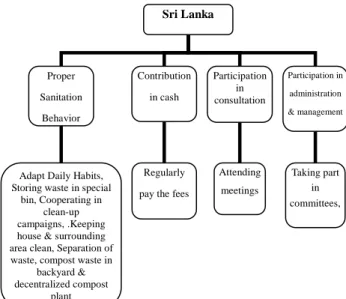
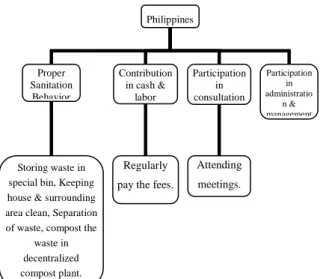
(2) participation of community. 2-1. Practice of Community Based Solid Waste management By. discussing. the. community. based. solid. waste Fig.5: Timeline of solid waste management act in Sri Lanka. management through the participation of community this research will find out why this system becomes successful. Urban area namely in Colombo, Matale, Kandy etc has. in these three countries.. initiated community based solid waste management with. (1) India. the community based partnership which is become very. In India urban areas like Delhi, Mumbai, Hyderabad,. positive in reduction and collection and composting of. Bangalore, Chennai, Agra, Kolkata, Shimla etc has. waste. For the reason this system become successful is. initiated community based SWMS in their local community.. described in figure 6.. Laws regarding solid waste management in India are: The. Sri Lanka. rules pertaining to solid-waste management are Hazardous Waste (Management and Handling) Rules (1989, amended January 2003), Biomedical Waste (Management and Handling). Rules. (1998),. Municipal. Solid. Waste. Proper. Contribution. Sanitation. in cash. Participation in consultation. administration & management. Behavior. (Management and Handling) Rules, 2000 and the Batteries. Participation in. (Management and Handling) Rules (2001). Adapt Daily Habits, Storing waste in special bin, Cooperating in clean-up campaigns, .Keeping house & surrounding area clean, Separation of waste, compost waste in backyard & decentralized compost plant. Fig. 3: Timeline of solid waste management laws in India. Regularly. Attending. pay the fees. meetings. Taking part in committees,. Fig. 6: Reasons of success of CBSWMS in Sri Lanka. Community based partnership solid Waste Management performs various kinds of activities throughout in Indian. (3) Philippines. cities and neighborhood area. The partnership is become successful. because of. the proper. participation. In Philippines, The main legal instrument governing SWM. of. in the country is the Ecological Solid-Waste Management. community. For the reason this system become successful. Act of 2000 (R.A. 9003).. is described in figure 4. India. Proper Sanitation Behavior. Contribution in Cash. Participation in Consultation. Participation in Admin. & management. Fig. 7: Timeline of solid waste management laws in Philippines Adapt Daily Habits, Storing waste in special bin, Cooperating in clean-up campaigns, .Keepin g house & surrounding area clean, Separation of waste.. Regularly pay the fees, Contribution in collection. Attending meetings, Electing representatives, giving feedback about system/ service. Taking part in committees, participating in planning through the monthly meetings.. It adopts community-based approaches to SWM and mandates. waste. diversion. through. recycling. and. composting, among others. According to the studied two cities named Manila and Cebu city scaled-up the Community based decentralized composting activities. Fig. 4: reason of success of CBSWMS in India. city-wide. In Philippines Participation in consultation and (2) Sri Lanka. participation in administration and management is not clear.. In Sri Lanka, laws regarding solid waste management in. In Figure 8 described the reasons of success of CBSWMS. Sri Lanka is described in figure 5.. in Philippines.. 19-2.
(3) Philippines. 3. Sustainable Community based SWMS in Dhaka This chapter will clarify the effectiveness of community. Proper Sanitation Behavior. Contribution in cash & labor. Participation in consultation. participation according to the findings of the element of. Participation in administratio n& management. effectiveness in a community based partnerships for sustainable. solid. waste. management in Dhaka city. Storing waste in special bin, Keeping house & surrounding area clean, Separation of waste, compost the waste in decentralized compost plant.. Regularly. Attending. pay the fees.. meetings.. 3-1. Clarify the effectiveness From. the. comparative. study. between three countries (table 1) it has found that there are four element of effectiveness. (1). Proper sanitation behavior:. Fig. 8: Reasons of success of CBSWMS in Philippines. Proper. sanitation. behavior. of. From the above discussion it is understandable that each. community residents may include: 1.. country has few similarity and difference among the. Adapting daily habits, 2. bringing. participation.. waste to collection point, 3. storing waste. Table 1: Comparative study of the element of success of CBSWMS in three countries. surrounding India. 2. 3. Sri Lanka. Philippines. Cooperate in clean up campaigns Keep house and surrounding area clean.. special in. bin,. a. 4.. clean-up. area. clean,. 6.. Fig.11: Storing waste. separating waste into inorganic and organic part, 7. composting the. Proper Sanitation Behavior. Store waste in special bin. a. Fig.10: Bringing Waste. campaigns, 5. keeping house and. countries. 1. in. cooperating. Comparative Study of reasons of success of CBSWMS in three. A. Fig.9:Adapt Daily Habits. O. O. O. O. O. -. waste. (2). Contribution in cash and labor:. O. O. O. O. O. O. It usually involve: 1.Regularly pay. Fig.12:Regularly pay fees. the fee, and 2. contributing in labor with collection (voluntary or paid).. 4. Separate of waste. 5. Compost in own back yard. -. O. O. It may take place during meetings. 6. Compost in decentralized plant. -. O. O. organized by CBOs to talk about the. 7. Adapt daily habits. O. O. -. (3). Participation in consultation:. needs and problems regarding solid waste. B. Contribution in cash, labor. 1.. Fig. 13: Contributing in labor. Attend. meetings 2. Elect representatives. 1. Regular fee payment. O. O. O. 2. contribute in labor. O. -. -. C. management.. Fig.13:Contributing in labor. who. manage. waste. collection. 3.Giving feedback about collection. Participation in Consultation. system/waste services to operating. 1. Attend meetings. O. O. O. team or management. 2. Elect representatives. O. -. -. (4). Participation in administration. 3. Give feedback about the system. O. -. -. Fig.14: Attending meetings. and management: In this type of participation, community members. D. Participation in administration. & management. may: 1.Taking part in committees, 2.. 1. Taking part in committees. O. -. -. 2. Participation in decision making during meetings. O. -. -. Fig.15: Giving feedback. Becoming member of a CBO involved in waste collection, environmental education etc, and 3. Participate in decision-making during meetings.. 19-3.
(4) According to the findings of the element of effectiveness, this study analysis of survey results of the two. Highest. level. neighborhood of Dhaka city (table 2). Community Participation is one of the main element of Mid-high level. community partnership and community partnership is the base for community based SWMS. Table 2: Analysis of the survey results in Dhaka city: Jatrabari N=52. A. Sanitation Behavior. B. Contribution. in cash, labor. C. Participation. in consultation. D. Participation in admin. & management. Adapt daily habits to agreed solid waste management system Bring waste to communal bin Store waste in special bin Cooperate in clean up campaigns Keep house and surrounding area clean. Separate waste in organic and non-organic Compost the organic part in own back yard. %. Mid level. Dholpur N=52. % First or basic level. 50. 61%. 32. 39%. Fig. 16: Level of participation of Dhaka city.. But participation of a community for a successful 45. 53%. 40. 47%. 49. 60%. 33. 40%. 22. 52%. 20. 48%. 4. Conclusion The literature study, semi structured interview and questionnaire survey were applied for this study. The. 30. 62%. 18. 38%. 21. 46%. 25. 54%. 3. 27%. 8. 73%. Regular fee payment. 49. 64%. 28. 36%. Contribute in labor. 2. 9%. 20. 91%. Attend meetings. 23. 79%. 6. 21%. Elect representatives. 0. Give feedback. 23. Taking part in committee Participation in decision making during meetings. community based partnerships has yet to reach.. results are: (1) Selected three developing cities practice community based solid waste management and the reasons of the success is discussed which are: A. Sanitation behavior, B. Contributing in cash, C. Participation in consultation, D. Participation in admin. and management. These are the four element of effectiveness. (2) The level of participation has determined by analyzing the elements of effectiveness through the questionnaire survey in two neighborhood of Dhaka city. According to. 0 70%. 10. 0. 0. 0. 0. the results, basic level of participation may be achieved in 30%. certain extent but to achieving the other level of participation this city has to go a long way. (3) To improve the community participation for a strong partnerships Dhaka city need: a. Proper law and regulations,. So, this study has determined the four level of participation. b. Modification of municipal ordinance for the inclusion of. such as:. NGOs, CBOs, and micro enterprises into the main stream. a) Basic or first Level – Sanitation behavior. of SWM. c. Public awareness should be raised through. b) Mid or Second level – Contribution in cash, labor. public campaigns and media demonstrations d. The. c) Mid-high or third level – Participation in consultation. Municipality. d) Highest level – Participation in administration &. community-based programs.. management.. should. facilitate. innovative,. References: 1) Community Report Dhaka Zila June 2012/Population and Housing Census 2011, Bangladesh Bureau of Statistics, 2) Nilanthi J.G.J. Bandara, J. Patrick A. Hettiaratchi, Environmental impacts with waste disposal practices in a suburban municipality in Sri Lanka. Int. J. Environment and Waste Management, Vol. 6, Nos. 1/2, 2010. 3) ADB. 2006. Philippines: Metro Manila Urban Services for the Poor: A report by Asian Development Bank. 4) K.M. Nurul Huda, Municipal Solid waste management: Bangladesh Perspective., 2008 5) Sunil Kumar. Municipal Solid Waste Management in India: Present Practices and Future Challenge, 2005.. Following the results the participation level of community based partnership for sustainable solid waste management system in Dhaka city given in fig.16. From the figure it is clear that, the basic level of participation is higher in Jatrabari than Dholpur.. 19-4.
(5)
図


関連したドキュメント
The findings obtained in this study can be summarized as follows: i) CD56(-)CD16(+) NK cells were increased around the small bile ducts and beneath the biliary epithelia of large
The SLE-revised (SLE-R) questionnaire despite simplicity is a high-performance screening tool for investigating the stress level of life events and its management in both community
The Beurling-Bj ¨orck space S w , as defined in 2, consists of C ∞ functions such that the functions and their Fourier transform jointly with all their derivatives decay ultrarapidly
In Section 3 the extended Rapcs´ ak system with curvature condition is considered in the n-dimensional generic case, when the eigenvalues of the Jacobi curvature tensor Φ are
Figure 12 shows that specific loss R 1 decrease sharply for small values of ω but decrease with small variation as increases further for LS and GL theories of microstretch
(Robertson and others have given examples fulfilling (a), and examples fulfilllng (b), but these examples were not solid, normed sequence spaces.) However, it is shown that
These results are motivated by the bounds for real subspaces recently found by Bachoc, Bannai, Coulangeon and Nebe, and the bounds generalize those of Delsarte, Goethals and Seidel
The following result about dim X r−1 when p | r is stated without proof, as it follows from the more general Lemma 4.3 in Section 4..
