PAPER Special Section on Information Centric Networking: Paradigms, Technologies, and Applications
NDN-Based Message Delivery with Collaborative Communication for Reducing Base Station Power Consumption in Disasters
Yuki KOIZUMI†a), Suhwuk KIM†∗,Members, Yuki URATA†,Nonmember,andToru HASEGAWA†,Fellow
SUMMARY This paper proposes an NDN-based message delivery pro- tocol over a cellular network in disasters. Collaborative communication among cellular devices is integrated into the protocol so that power con- sumed by battery-operated base stations (BSs) is reduced when a blackout occurs. A key idea is to reduce consumed radio resources by making cellular devices of which radio propagation quality are better forward messages of neighboring devices. The radio resource reduction contributes to reducing power consumed by a battery-operated BS. We empirically and analytically evaluate how the proposed message delivery protocol reduces the power consumption of a BS assuming a densely populated shelter.
key words: collaborative communication, disaster, energy efficiency, long term evolution, named data networking
1. Introduction
The cellular-based Internet plays an important role in disas- ters; however, it is difficult for cellular networks to provide connectivity with refugees in a large-scale disaster time. A large-scale disaster causes a large-scale blackout and thus many base stations (BSs) are operated by their batteries even if their backhaul links to a cellular core network are not in failure. The report of the Great East Japan Earthquake[1]
shows that about 67% of BSs in the disaster areas are battery- operated due to the blackout and that their batteries run out before the blackout is restored since it continues for about three days.
Reducing power consumed by BSs is a key to provide refugees with connectivity to the Internet during such three days. Focusing on that some of power consumed by a near- future BS is proportional to its load, this paper proposes to integrate collaborative communication among cellular de- vices [2] which have local wireless interfaces as well as cellular interfaces into LTE (Long Term Evolution)-based cellular communication. A key idea of collaborative com- munication is to reduce consumed radio resources by mak- ing cellular devices of which radio signal quality is better than neighboring devices send and receive their messages to and from a BS on behalf of them. Radio resources are reduced because the better radio signal quality of a send- ing/receiving cellular device becomes, the less an amount of radio resources used by doing so becomes. The radio
Manuscript received April 7, 2016.
Manuscript revised July 23, 2016.
†The authors are with Graduate School of Information Science and Technology, Osaka University, Suita-shi, 565-0871 Japan.
∗Presently, with Corporate Research & Development Center, TOSHIBA Corporation.
a) E-mail: [email protected] DOI: 10.1587/transcom.2016CNP0007
resource reduction leads to reduction in power consumed by a BS because power consumed by near-future BSs would be proportional to their loads[3]. Hereafter, we refer to a cellular device of sending/receiving a message from/to a BS and such a neighboring cellular device as a representative device and a delegating device, respectively.
In the previous study[4], we preliminarily designed a message delivery protocol for well-considered applications in disasters and analytically validated the protocol on a few unjustified assumptions on radio signal quality, e.g., we as- sumed that the average radio signal quality of devices is different even if the devices are in the same room. In this paper, we validate the assumptions by empirically measur- ing radio signal quality of an LTE link with a commercial smartphone. The empirical measurements enable it to vali- date the protocol and to obtain a hint for selecting a suitable periodical interval to select a representative device.
The contributions of the paper are three-fold: First, we design a simple but a practical message delivery pro- tocol based on the name-based [5] and publish/subscribe approaches. The adoption of name-based approach enables the protocol to be resilient to failures of servers such as DNS (Domain Name System) servers. On the contrary, one- to-many communication provided by the publish/subscribe approach[6]avoids repetition of crucial information deliv- ery. This enables to efficiently use radio resources which are not so plentiful in disasters as at the usual time.
Second, we empirically measure radio signal quality of an LTE link with a commercial smartphone, which will be used as a communication devices in a disaster time, and re- veal that collaborative communication reduces at least about 30% of the consumed radio resources of a BS by using the simulation with the measured radio signal quality.
Third, we analytically calculate how collaborative com- munication reduces power consumed by a BS as well as radio resources. The analysis shows that the power consumed by a BS is reduced at most about 30% compared with the proto- col without collaborative communication in ideal cases. As far as we know, this paper is one of the first papers which address BSs’ power reduction especially in a disaster time.
This paper is organized as follows. We first describe the requirements to disaster communications in Sect. 2. Sec- tion 3 describes the publish/subscribe protocol based on the name-based approach and Sect. 4 describes an analyt- ical model for evaluating how collaborative communication reduces power consumed by a BS. In Sect. 5, we empirically measure the radio signal quality of an LTE link to validate the Copyright©2016 The Institute of Electronics, Information and Communication Engineers
assumptions made for collaborative communication. Then, in Sect. 6, we evaluate how the proposal reduces radio re- sources and power consumed by a BS by using simulation with the measure radio signal quality and the developed an- alytical model. We introduce the related work in Sect. 7 and finally conclude the paper in Sect. 8.
2. Requirements in Disasters
This paper addresses situations in a disaster area several hours later after a disaster. In such situations, refugees evac- uate to shelters such as schools and many of them reside in the shelters until the infrastructures for electricity and water are restored. Since it takes about more than three days by the infrastructures are restored, an important requirement is to offer minimal connectivity to refugees under conditions that various resources for power and communication are limited.
Especially, batteries of BSs in blackout areas are the most critical resources.
2.1 Requirements from Applications
We carefully choose the applications which should be pro- vided minimally for the three days so that usage of critical resources is minimized [7]. The first application is that refugees in shelters deliver safety-confirmation messages to relatives/friends in order to confirm that they are safe. The second application is that state authorities (e.g., a local gov- ernment, a police station and a fire department) deliver disas- ter related information to refugees. Examples of information are warnings or information on where to go or how to behave.
In terms of resources, the above applications need one- to-many communication because they inherently assume multiple recipients. For example, the safety confirmation message is delivered to several relatives/friends. Besides reducing the number of messages in the down link direction is especially important because a BS usually allocates less radio resources to the uplink direction than the downlink.
2.2 Requirements to Power Consumption
A key problem during these days is a large scale blackout.
BSs in blackout areas are operated by their batteries, but it is difficult for them to have sufficient capacities for a long time.
Thus it is necessary to minimize usage of their batteries to prolong their battery lives. A main goal of this paper is to prolong BSs’ battery lives by reducing power consumed by them. We assume that the traffic amount becomes as large as usual several hours later. Since large part of power is consumed by an amplifier to emit radio signals in the downlink direction, the paper focuses on message delivery in the down link direction.
3. Message Delivery Protocol
3.1 Overview
We adopt NDN/CCN as a basis of our message delivery pro-
tocol because of the following reasons: First, NDN/CCN naturally support most of the functions of TCP, including re- liable transport and flow control, as discussed in[5]. Futher- more, NDN/CCN realize more fine-grained flow control, i.e., per-face, per-prefix and per-content performance mea- surements, congestion control and flow prioritization, than TCP/IP [5], [8]. Such fine-grained flow control is one of crucial features for message delivery protocols, especially during a disaster time [1]. Second, we adopt COPSS[6], which provides publish/subscribe communication based on NDN/CCN. The network load, i.e., the total amount of traffic in a network, due to COPSS is smaller than that due to IP multicast, as Chen et al. discussed in[6]. Since the traffic load in a disaster time is generally much higher than that in a normal time[1], employing COPSS on NDN/CCN net- works rather than IP multicast on IP networks is a reasonable solution.
3.2 Protocol Stack
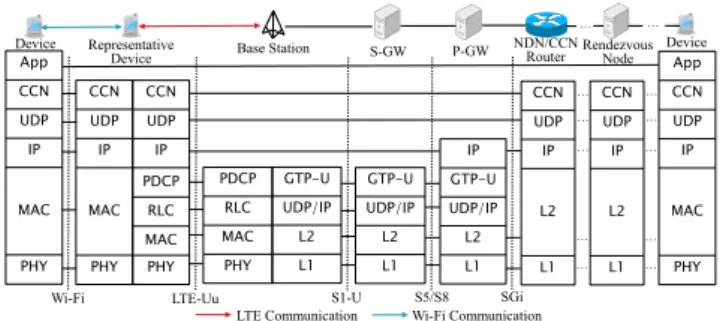
The message delivery protocol is designed assuming a cel- lular communication network based on LTE. As shown in Fig. 1, NDN/CCN routers are installed next to a cellular core network and devices forward messages based on NDN/CCN.
The S-GW (Serving Gateway) and the P-GW (Packet Data Network Gateway) are nodes which provide UDP/IP tun- nels between the NDN/CCN router and the devices. We select UDP tunnels rather than TCP ones since NDN/CCN naturally support transport functions of TCP, i.e., reliable transport and flow control[5]. We assume that devices have a local wireless interface, i.e., Wi-Fi, as well as a cellular in- terface. Representative and delegating devices communicate with each other using Wi-Fi.
3.3 One-to-Many Communication
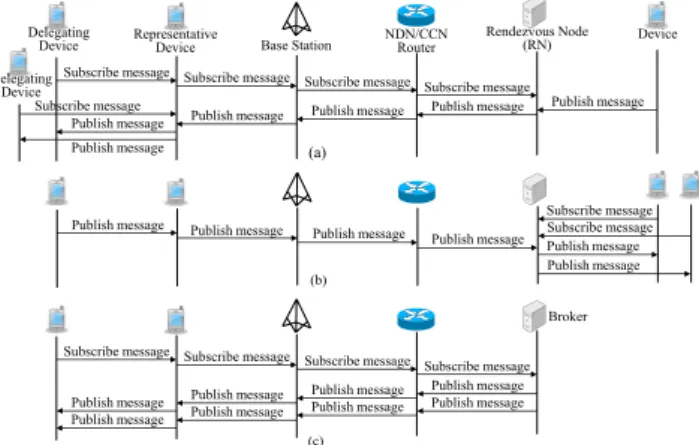
We adopt COPSS [6], which provides publish/subscribe communication based on NDN/CCN. The publish/subscribe communication naturally supports one-to-many communica- tion as shown in (a) and (b) of Fig. 2. A publisher pre-defines a name that specifies a topic and the name is recorded at a rendezvous node. Users subscribe the name by sending a subscribe message to the rendezvous node. When the pub- lisher sends a message to the rendezvous node, it is delivered to all users that subscribe to the name. Thus, one-to-many
Fig. 1 Protocol stack for message delivery in disaster.
Fig. 2 Publish/Subscribe-based Message Sequences.
communication is naturally supported. A NDN/CCN router provides routing for COPSS as well as that for NDN/CCN. It is noted that a representative device plays the role of COPSS router for its delegating devices. COPSS can have a broker, which acts as a store for all published messages in order to support asynchronous message delivery. A salient feature of COPSS is that a subscriber need not to be online when messages are published and it can asynchronously receive all the un-received messages by sending just one subscribe message to the broker, as shown in (c) of Fig. 2.
3.4 Collaborative Communication
Collaborative communication among cellular devices[2]is a promising way to reduce power consumed by a BS. A key observation is that the better their radio signal quality becomes, the less radio resources devices use. Thus, we propose that a device of which radio signal quality is better than neighbors send and receive messages to and from a BS on behalf of the neighbors. This reduces consumed radio resources and results in reduction of power consumed by an amplifier which consumes most power of a BS.
(1) Wi-Fi One Hop Adjacency
Efficiency of collaborative communication depends on probability that a device with bad radio signal quality finds a neighboring device of which quality is better than it. We decide that devices do not use Wi-Fi multi-hop communi- cation, but one-hop communication because a shelter is so highly populated that several devices exist within the dis- tances of Wi-Fi one-hop. The analytical model in Sect. 4 shows that one-hop Wi-Fi adjacency is enough for collabo- rative communication to be effective to reduce BSs’ power consumption.
(2) Selection of Representative Device
A key issue is how to select a representative device, which plays a role of a router based on NDN/CCN and COPSS. We design a simple but practical protocol with the concern about fluctuations in radio signal quality. Such fluctuations are mainly caused by shadowing and fading.
Fluctuations due to shadowing are steady and affect the av- erage radio signal quality. In contrast, those due to fad-
ing are time-varying. Assuming that fluctuations due to fading is absorbed by schedulers of BSs and considering changes in the average radio quality due to shadowing, we periodically select a representative device as follows: Each device periodically broadcasts its average SINR (Signal to Interference-plus-Noise Ratio) which is a radio signal qual- ity, to neighboring devices using Wi-Fi. A device selects the device with the best SINR among neighboring devices and including itself as a representative device.
The reasons why the simple selection scheme is enough for collaborative communication to reduce radio resources are as follows: First, schedulers of BSs may compensate for the fluctuations in radio signal quality. The radio signal quality of a representative device is degraded due to fading if a long time elapses after it is selected. However, sched- ulers of BSs allocate more radio resources to devices with the better radio signal quality [9]. It implies that the BS tentatively reduces the number of radio resources if the radio signal quality is tentatively degraded, but increases the num- ber after the tentative fluctuation finishes. Second, when a device in a disaster area sends a publish message, it selects a representative device and sends the message to it. No mes- sage is replied back from a rendezvous node in the downlink direction and thus we need not care about radio signal qual- ity fluctuations of representative devices. On the contrary, when a device in a disaster area sends a subscribe message, in order to reduce the duration between a subscribe message and the corresponding publish messages, a device does not send a subscribe message to a rendezvous node but a broker so that publish messages are immediately replied.
4. Base Station Power Reduction with Collaborative Communication
4.1 Overview
In this section, we construct an analytical model for eval- uating the power reduction of a BS due to collaborative communication. We use a BS power consumption model proposed in[3], which relies on the LTE downlink resource structure. Thus, we first describe radio resources in LTE and the power consumption of a BS before modeling the BS power reduction. The BS power consumption depends on the amount of consumed radio resources and it depends on a modulation scheme and a code rate, which are determined by the BS according to the radio signal quality. In the following subsections, we model each relation in sequence.
4.2 Radio Resources in LTE
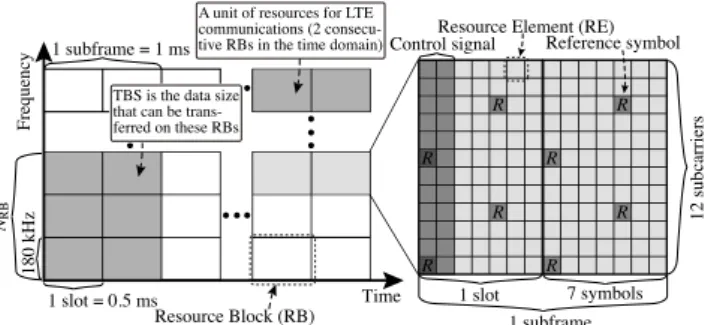
The downlink resources in LTE have domains of time and frequency, as shown in Fig. 3. In the time domain, the re- sources are divided into 1 ms subframes, each of which is split into two 0.5 ms slots. Each slot consists of seven sym- bols. In the frequency domain, 12 subcarriers constitute one unit of resources, which occupies 180 kHz in the frequency domain. One unit of 12 subcarriers for the duration of one
Fig. 3 A schematic of LTE downlink resources.
slot is called a resource block (RB) and the smallest unit of resource is a resource element (RE), which consists of one subcarrier for the duration of one symbol. That is, one RB consists of 84 REs. We simply refer to both RBs and REs as radio resources, hereafter. In LTE, a pair of RBs, i.e., 1 ms subframe and 12 subcarriers, is used as a unit of its com- munications. LTE adopts Adaptive Modulation and Coding (AMC), which changes a modulation scheme and a code rate depending on radio signal quality of devices. Thus, BSs can transfer more data to devices with better radio signal quality.
4.3 Power Consumption of Base Station
A power consumption of a BS is approximately modeled with a linear function of its load[3]. The BS power consumption e(l(t))at timetis calculated as
e(l(t))=∆El(t)+E0, (1) whereE0 is the constant power consumption regardless of the load on the BS and∆E is a coefficient of the load de- pendent power consumption. In[3], the load on the BS at timet,l(t), is defined as the ratio of the sum of the trans- mission power of REs used for data transmission at timet to maximum transmission power of the BS. Assuming that the transmission power of each RE is constant,l(t)can be defined asl(t)=n(t)/NC, wheren(t)is the number of con- sumed RBs at timetin the frequency domain andNCis that of available RBs.
NCcan be easily derived from frequency bandwidth of a BS. For instance,NCis 100 for most of current BSs with 20 MHz bandwidth. However, it is difficult to derive an exact value ofn(t)since it depends on scheduling algorithms of the BS, which are confidential. In this section, aiming at deriving the average power consumption of a BS, we use the expected number of RBs used for data transmissionn= E[n(t)]instead ofn(t). To simplify notations, we refer ton andNCas RB consumption and RB capacity, hereafter.
4.4 Modeling Power Reduction with Collaborative Com- munication
To derive the RB consumptionn, we first model the AMC and radio signal quality. Then, we modelnin the case with and without collaborative communication. Finally, we have the
power reduction due to collaborative communication from Eq. (1). In principle, we use capital letters to express constant parameters and small ones for variables, respectively.
4.4.1 Modeling Adaptive Modulation and Coding With the AMC, a BS determines a Modulation and Coding Scheme (MCS) index (IMCS), which specifies a modulation order index (IMO), which indicates a modulation scheme, and a transport block size (TBS) index (ITBS), which indicates a code rate, according to radio signal quality of devices, i.e., SINR. Regarding the AMC, we derive i) the number of RBs necessary for transmitting 1 bit data for each MCS index and ii) MCS indexes from devices’ SINR.
To obtain the number of RBs necessary for transmitting 1 bit data, we have to derive TBS, which is the data size [bit] that can be transferred on NRB RBs in the frequency domain for the duration of 1 subframe. In LTE, the TBS is determined by ITBSand NRB, which is the number of RBs in the frequency domain assigned by a BS for transmitting data and theITBSis determined byIMCS[10]. We deriveSk, which is the expected data size transmitted over a pair of RBs (1 subframe). Note that LTE uses a pair of RBs as a unit of its communications, as mentioned in Sect. 4.2. An example of NRBand TBS is shown in Fig. 3. Since NRBdepends on the scheduling algorithms of the BS, we derive the expected value forSk. We use a termSTBS(IMCS,NRB)as the TBS in the case thatIMCSandNRBis specified. In the case ofIMCS= kandNRB=i,STBS(k,i)/ibits of data can be transferred on each pair of RBs. Calculating its mean for allNRB∈[1,110], Sk is derived asSk =1/110∑110
i=1STBS(k,i)/i.
Next, we derive a map from a SINR value to a MCS index. Since the map is also confidential, we derive it via spectral efficiency. That is, we make two maps; one is a map from SINR values to the spectral efficiency based on Shannon-Hartley theorem in the similar way to[11]and another is a map from MCS indexes to the spectral efficiency based on the specifications of LTE. Then, we make the map from a SINR value to a MCS index by combining the two maps.
According to Shannon-Hartley theorem and its exten- sion used in[11], a spectral efficiency to keep the bit error rate belowBin the case that the SINR is β, is derived as,
ηSINR(β)=log2 (
1+ β
−ln(5B)/1.5 )
. (2)
To deriveηMCS(k), which is the spectral efficiency in the case of IMCS = k, we compute the data size that is actually transmitted on NRBRBs in the frequency domain and one that can be physically transmitted on the RBs with the modulation scheme specified by the MCS index IMCS andSRB(IMCS,NRB). Since LTE employs two-level Cyclic Redundancy Check (CRC) as its error detecting code, we have to consider the CRC data size SCRC. In the two-level CRC, 24 bit CRC data for all transport block is added. If the transport block, including the first CRC data, exceeds 6144 bits, the transport block is divided into blocks of 6120 bits
and additional 24 bits of CRC data is added to each divided block[12]. The data size actually transmitted on theNRB RBs isSTBS(IMCS,NRB)+SCRC.
Next, we computeSRB(IMCS,NRB). To derive this, we consider the number of REs used for data transmission, as shown in Fig. 3. A pair of RBs, i.e., 12 subcarriers for the duration of 1 subframe, contains 168 REs. 8 REs are used for reference symbols, which cannot be used for data transmission. Moreover, up to 4 REs from the beginning in the time domain are used for control signals[12]. Assuming that the first two REs are used for control signals, 138 REs can be used for data transmission among the pair of RBs. Thus, the data size that can be physically transmitted overNRBRBs is derived asSRB(IMCS,NRB)=138NRBSMO, whereSMOis the data size transmitted over one RE, which is determined according to the modulation scheme specified byIMCS. The date size that can be transmitted on one RE is equivalent to the spectral efficiency since one RE is a radio resource of 15 kHz and about 66.7µs. Hence, the spectral efficiency in the case ofIMCS=kis
ηMCS(k)= 1 110
∑110 i=1
SMO(STBS(k,i)+SCRC)
SRB(k,i) . (3) Finally, comparing ηSINR(β) and ηMCS(k), the map from the SINR valueβto the MCS indexkis determined as k=max{0≤n≤28|ηSINR(β)> ηMCS(n)}. (4) 4.4.2 Modeling Radio Signal Quality
Since fading and shadowing degrade devices’ radio signal quality, we have to incorporate those effects to model the radio signal quality.
Regarding fading effects, assuming an urban area, where there are many objects to scatter the radio signal, we employ Rayleigh fading, which is a model for the ef- fect of a propagation environment on a radio signal. The amplitude of the faded radio signal is expressed with the Rayleigh-distributed random variables. Since a signal level is the square of its amplitude, signal levels are expressed with the exponentially distributed random variables.
To express shadowing effects, we change the average SINR, in the same way as[2], i.e., we set the smaller average SINR of the above-mentioned random variables for devices that receive degraded radio signal due to shadowing effects.
We categorize devices into several classesCand change the average SINRγc, wherec∈C, according to the shadowing effects. We refer to the classes as radio signal quality classes.
Integrating the effects of fading and shadowing, the probability density function of the SINR of devices in the radio signal quality classcis expressed as,
fc(z)= 1 γc
exp (
− z γc
)
. (5)
4.4.3 Modeling Power Reduction Effects
To obtain the BS power reduction, we have to derivenwith andnwithout, which are the RB consumption with and without collaborative communication, respectively. These values are determined according to the MCS index values of devices that communicate via LTE links, i.e., representative devices in the case with collaborative communication and each de- vice in the case without collaborative communication.
Using Eq. (5), the probability of IMCS = k for de- vices in the radio signal quality class c is derived as πc,k =∫θk
θk−1 fc(z)dz, whereθkis the maximum SINR value in the case ofIMCS=k, which can be derived from Eq. (4).
By usingπc,k, the probability ofIMCS=kis derived as the average ofπc,k with the weights of the probability of being the radio signal quality classc(pc) as follows:
πk =∑
c∈C
( pc
∫ θk
θk−1
fc(z)dz )
. (6)
nwithoutis calculated as data transmission rate for the du- ration of 1 subframe,Ubit/ms, multiplied with the weighted average of the expected number of RBs for transmitting 1 bit data, which is the inverse ofSk, with the weights of the probability ofIMCS=k,πkwithoutas
nwithout=U
∑28 k=0
1
Skπwithoutk . (7)
πwithoutk is derived asπwithoutk =πk.
In the similar way,nwithis calculated as nwith=U
∑28
k=0
1
Skπwithk . (8)
πwithk is the probability that IMCS of the nearby representa- tive device with the best radio signal quality is k. Note that the time from representative devices’ selection to data transmission via them is assumed to be short enough and therefore the radio signal quality of the representative device does not change during the time interval. πkwithis derived as πwithk =πupk +πkremain, whereπupk andπkremainare the proba- bilities thatIMCSof the representative is higher than ones of devices and the same as ones of devices, respectively. To deriveπupk , we derive the probability thatIMCSof the neigh- boring device with the best radio signal quality, which can be a representative, iskas follows:
ςk =ρk−ρk−1. (9)
ρk is the probability that IMCSof all neighboring device is less than or equal tokand it is derived as
ρk =∏
c∈C
ψc,kdc, (10)
where dc is the number of neighboring devices of which radio signal quality class iscand it is derived from dc = pc(πR2d−1). Ris the range of wireless local communication and d is the population density within cell. ψc,k is the probability that IMCS is less than or equal tok for devices in the radio signal quality classcand it is derived asψc,k =
∫θk
0 fc(z)dz. By usingςk,πkupis derived as πupk =
k−1
∑
i=0
πiςk. (11)
πkremainis derived as
πremaink =πkρk. (12)
Note thatπ0up=0andπ28remain=πwithout28 sinceIMCSis defined in[0,28].
Finally, substitutingl(t)in Eq. (1) withnwithout/NCand nwith/NC, we obtain the ratio of the BS power reduction as
eRed=ewithout−ewith
ewithout =1− ∆Enwith/NC+E0
∆Enwithout/NC+E0, (13) whereewith andewithoutis the BS power consumption with and without collaborative communication, respectively.
5. Empirical Measurement of Radio Signal Quality In this section, we measure radio signal quality of an LTE link related with shadowing and fading, i.e., 1) average ra- dio signal quality and 2) intervals between changes in radio signal quality, respectively because of the following two rea- sons. First, to reduce the consumed radio resources with collaborative communication, it is an indispensable condi- tion that the average radio signal quality of devices must be different even if they are in the same small area, where they can communicate each other via Wi-Fi. Second, a radio quality of a representative device might be degraded due to fading if a long time elapses after the device is selected as the representative. Thus, it is desirable that radio signal quality of an LTE link are steady during a time from the selection of a representative device to data transmission via the represen- tative device. To validate that such conditions are satisfied in a shelter, we empirically measure radio signal quality of an LTE link by using a commercial smartphone inside/outside a building assuming areas inside/outside a shelter.
5.1 Conditions of Measurement
We measure radio signal quality of an LTE link with a com- mercial smartphone because refugees may use their smart- phones to retrieving data from the Internet. To measure radio signal quality of an LTE link, we develop an Android application that records statuses of an LTE link on changing the statuses, such as SNR (Signal to Noise Ratio). Since the current Android API does not support SINR measurements, we use SNR instead of SINR in this measurement.
For the measurements, we choose a non line of sight (NLOS) environment since many buildings in urban areas are located in NLOS environments. Since school buildings are used as shelters, we use an university building that is in an NLOS environment. The building is located 200 m away from an LTE BS. Assuming that refugees will be both inside/outside a shelter during disasters, we measure SNR values both inside/outside the building. According to the size of Japanese shelters and the number of people accom- modated in the shelters [13], the distance between people in the shelters is typically 1.5–2 m. Thus, we divide the measurement areas into a grid formed by 2,m×2 m squares and measure SNR values at the center of each square. The room inside the building and the measurement area outside the building are divided into 3×6 and 3×3 squares, respec- tively. We measure SNR values with putting the smartphone in an experimenter’s pocket assuming that many refugees will do so in shelters.
5.2 Measurement Result
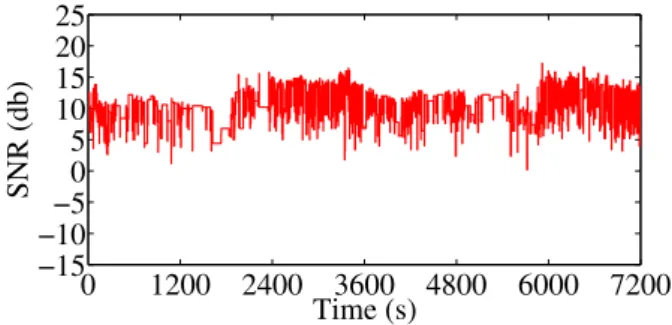
The time-series of SNR values measured inside the building is shown in Fig. 4. Due to effects of multipath fading, the SNR values are fluctuated. Furthermore, we observe that the average SNR at each square is different even if the measure- ments are performed in the same room, where the effects of shadowing might be the identical. To see the difference of the average SNR more clearly, we show that as a heat-map in Fig. 5. The average SNR around the center of the room is higher than other points in the same room.
Next, we analyze intervals between changes in mea- sured SNR values. The average, the minimum, and the max- imum of the intervals between changes in measured SNR values are 7.988, 0.021, and 382.470 seconds, respectively.
Fig. 4 An example of time-series of SNR inside the NLOS building.
Fig. 5 The average SNR inside the NLOS building.
The results imply that it is desirable to complete commu- nications via a representative within about 8 seconds after the selection of the representative. In the following section, we evaluate how the interval for selecting representative de- vices affects the radio resource reduction due to collaborative communication.
6. Evaluation of BS Radio Resource and Power Con- sumption
6.1 Conditions of Evaluation
In this section, we evaluate BS radio resource and power reduction due to collaborative communication from two per- spectives: one is a simulation for evaluating how fluctuations in radio signal quality due to fading affects the consumed ra- dio resources of a BS in a small area, e.g., a room in a shelter, and the other is an analysis with the model in Section 4 for evaluating how the collaborative communication reduces the power consumed by a BS in a highly dense and crowded large area covered by the BS.
For the simulation-based evaluation, we use a macro cell that has a BS with a proportional fair scheduler[9]and a 10 MHz LTE link. 18 devices are deployed in a NLOS room.
We use radio signal quality generated with Rayleigh fading in addition to the measured one. Each device requests a data according to a Poisson process with mean rate 0.1. The data size is exponentially distributed with a mean size of 100 Kbyte assuming that refugees mainly send/receive text mes- sages for notifying their families about their safety. A device with the best SNR value is selected as a representative device everyTI seconds. Other devices communicate via the rep- resentative devices until the next selection of representative devices.
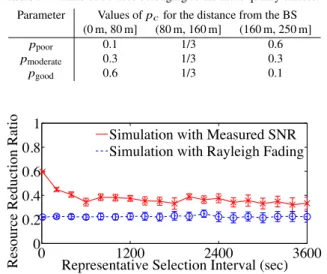
For the analysis-based evaluation, we assume a shelter in Tokyo, which is one of the crowded cities in the world. We use a macro cell with the radius of 250 m and a BS with the bandwidth of 10 MHz. We set∆E=188watt andE0=260 watt for Eq. (13) according to[3]. We set the range of wire- less local communication to 20 m assuming Wi-Fi. Devices are categorized into three radio quality classes,Poor,Mod- erate, andGood, wherein the radio signal quality of devices is poor, moderate, and good. Then, we set the average ra- dio quality of devices as γpoor = 9.54, γmoderate = 16.99, andγgood =23.87dB, so that the average data transfer rate is about 20%, 50%, and 80% compared with the best data transfer rate, i.e., in the case of the MCS index value of 28, in the same way as[2]. Radio signals to devices farther from the BS must be affected by shadowing more, we set the ratio of the radio quality classes according to distance from the BS as summarized in Table 1. We evaluate two scenarios;
one is normal time and another is disaster time. For the normal time, 1,250 devices are deployed assuming the pop- ulation density of Tokyo. For the disaster time, we deploy 40,000 devices since about 32,000 people in Tokyo will be accommodated in the Rikugien shelter of about 52,000 m2 size[13]and 3 cellular carriers in Japan serve LTE to them.
Table 1 Ratio of devices belonging to the radio quality classes.
Parameter Values ofpcfor the distance from the BS (0 m, 80 m] (80 m, 160 m] (160 m, 250 m]
ppoor 0.1 1/3 0.6
pmoderate 0.3 1/3 0.3
pgood 0.6 1/3 0.1
Fig. 6 The ratio of the consumed radio resources with and without col- laborative communication.
6.2 Evaluation Result
First, we evaluate the reduction in the consumed radio re- sources through simulation experiments in Fig. 6. The verti- cal axis is the ratio of the radio resource consumption reduced by collaborative communication to the radio resource con- sumption without collaborative communication. We choose the representative selection interval for the horizontal axis to see the effects of fluctuations in radio signal quality on the radio resource consumption. Markers and error bars in- dicate the mean and the 95% confidence intervals of results of 50 simulation trials, respectively. The solid and dashed lines indicate results with the SNR values measured with commercial smartphones and generated by Rayleigh fad- ing, respectively. We reveal the following two observations.
First, under the situation where the measured SNR values are used, collaborative communication reduces up to 60% of the consumed radio resources compared with the case without collaborative communication in the case of the short repre- sentative selection interval. Even if the representative selec- tion interval is long, it reduces about 30% of the consumed resources. However, under the situation where the SNR val- ues are generated with Rayleigh fading, the reduction in the radio resource consumption does not change regardless of the representative selection interval. In contrast to Rayleigh fading, where the SNR values are stochastically independent random variables, the measured SNR values do not change within a certain intervals as we discussed in Sect. 5. That is, the SNR values of the selected representative devices are more likely to remain high in the case of the smaller represen- tative selection interval and this results in the large reduction in the radio resource consumption. These results imply that the interval value should be carefully selected. Second, the reduction in the radio resource consumption under the mea- sured SNR is higher than the SNR generated with Rayleigh fading since fluctuations in the measured SNR are smaller
Fig. 7 The BS power reduction.
than those generated by Rayleigh fading. That is, intervals between changes in the measured SNR values are larger than that with Rayleigh fading.
Next, we evaluate the power consumption of a BS in a highly dense area by using the analytical model. The y-axis in Fig. 7 is the ratio of the BS power reduction. The x-axis indicates the load on the BS in the case without collaborative communication. The density of devices does not dominate the BS power reduction. The existence of representative devices with the higher MCS index values is one of the im- porant factors for collaborative communication to reduce the power consumption of the BS. The probability that a rep- resentative device with the higher MCS index value exist within the distances of Wi-Fi one-hop becomes high enough if the density of devices dc is sufficiently high, as shown in Eqs. (9), (10) and (11). In both the disaster and normal cases, the number of devices is sufficiently high such that representative devices with higher MCS index values would exist. Therefore, collaborative communication reduces the power consumption of the BS similarly in both the cases. In contrast, the load on the BS is a dominant factor in reducing the power consumption of the BS, as shown in Eq. (13), i.e., the ratio of reduction becomes higher as the load on the BS increases. Since the traffic load in a disaster time is generally higher than that in a normal time[1], our architecture based on collaborative communication would be effective for re- ducing the BS power consumption in disasters. We should note that the reduction in the BS power consumption in Fig. 7 is slightly overestimated since the analytical model assumes that the radio signal quality of representative devices does not change after their selection. In contrast, the simulation experiments with radio signal quality generated by Rayleigh fading may underestimate the BS power consumption as dis- cussed in Fig. 6 since the fluctuations in the radio signal quality generated with Rayleigh fading is larger than the measured one. The measurement-based simulation experi- ments for an entire macro cell are not reasonable. Thus, we have to see the both results in Figs. 6 and 7 and conclude that our messages delivery protocol reduces at most 30% of the BS power consumption if representative devices are care- fully selected so that communications via a representative are completed within about 8 seconds after the selection of representative devices, as we discussed in Sect. 5.
Finally, we discuss the power consumed by representa-
tive devices. Collaborative communication may increase the power consumed by Wi-Fi communications of representa- tive devices for transmitting messages to delegating devices though it reduces the BS power consumption. However, the power consumed by Wi-Fi interfaces of representative de- vices is a few orders of magnitude smaller than the power consumed by the BS. For instance, a currently available smartphone, Nexus One, consumes 0.0012 [joule/packet] for sending a packet via its Wi-Fi interface[14]. From these re- sults, we conclude that message delivery with collaborative communication is effective for reducing the power consumed by BSs in a disaster time.
7. Related Work
We employ NDN/CCN and COPSS [6] as a basis of our message delivery protocol. With the asynchronous message delivery of COPSS, devices need not to be online when mes- sages are published. They can asynchronously receive the messages by sending just one subscribe message to the bro- ker when they become online. Although retrieving multiple Data packets by issuing one Interest packet is supported by Interest aggregation[15], it aims at solving the link under- utilization problem originated from CCN’s one-for-one re- lation between Interest and Data packets and furthermore it implicitly requires devices to be online. In contrast, the asynchronous message delivery of COPSS is one of use- ful features for the message delivery during a disaster time, where devices might often be turned off to save their battery lives.
Collaborative communication is effective to improve ef- ficiency of cellular frequency resource usage[2]. Asadi and Mancuso propose collaborative communication and quanti- tatively analyze how it improves throughput with the same radio resources. This paper follows their approach but the differences to their study are summarized as follows: First, this paper focuses on reduction in radio resources with the same throughput. Second, mapping between SINR and MCS values are carefully decided to precisely model an LTE- compliant BS. Third, we empirically measure radio signal quality of an LTE link and validate that collaborative com- munication reduces radio resources around the NLOS envi- ronments, where the measurements are performed.
In disaster communications, a number of emergency alert systems (emergency warning systems) are developed for communication between refugees and rescue teams focusing on the “golden 72 hours” [16]. These systems focus on how to provide communication without relying on cellular networks assuming that a communication infrastructure is severely damaged. In contrast, we focus on a situation that a communication infrastructure is not severely damaged but that an infrastructure for power supply is damaged.
8. Conclusion
In this paper, we propose to apply collaborative communica- tion into disaster communication to prolong battery-operated
BSs’ life. Collaborative communication reduces power con- sumed by BSs by making devices with better radio signal quality forward messages of other neighboring devices. The author designs a message delivery architecture focusing on disaster communication. We empirically and analytically validate that the architecture reduces both radio resources and power consumed by a BS. Investigating the energy- reduction effects in the case that collaborative communi- cation is used in conjunction with BS-side energy-reduction approaches, such as cell-zooming, is one of our future re- search directions.
Acknowledgments
The research leading to these results has received funding from KDDI Foundation Research Grant Program.
References
[1] Ministry of Internal Affairs and Communications (MIC), http://www.soumu.go.jp/main_content/000117676.pdf (in Japanese).
[2] A. Asadi and V. Mancuso, “DRONEE: Dual-radio opportunistic net- working for energy efficiency,” Comput. Commun., vol.50, pp.41–
52, Feb. 2014.
[3] 3GPP, “Base station power model,” RAN1 #66-BIS R1-113495, NTT DOCOMO, Alcatel-Lucent, Alcatel-Lucent Shanghai Bell, Ericsson, and Telecom Italia, Oct. 2011.
[4] S. Kim, Y. Urata, Y. Koizumi, and T. Hasegawa, “Power-saving NDN-based message delivery based on collaborative communication in disasters,” Proc. 21st IEEE International Workshop on Local and Metropolitan Area Networks, pp.1–6, 2015.
[5] V. Jacobson, D.K. Smetters, J.D. Thornton, M.F. Plass, N.H. Briggs, and R.L. Braynard, “Networking named content,” Proc. 5th Interna- tional Conference on Emerging Networking Experiments and Tech- nologies, CoNEXT’09, pp.1–12, 2009.
[6] J. Chen, M. Arumaithurai, L. Jiao, X. Fu, and K.K. Ramakrishnan,
“COPSS: An efficient content oriented publish/subscribe system,”
Proc. ACM/IEEE 7th Symposium on Architectures for Networking and Communications Systems, pp.99–110, 2011.
[7] J. Seedorf, M. Arumaithurai, A. Tagami, K.K. Ramakrishnan, and N.B. Melazzi, “Using ICN in disaster scenarios,” Internet-Draft draft-seedorf-icn-disaster-02, IETF, Dec. 2014.
[8] C. Yi, A. Afanasyev, I. Moiseenko, L. Wang, B. Zhang, and L. Zhang,
“A case for stateful forwarding plane,” Comput. Commun., vol.36, no.7, pp.779–791, April 2013.
[9] S. Sesia, I. Toufik, and M. Baker, LTE — The UMTS Long Term Evolution: From Theory to Practice, Second ed., John Wiley &
Sons, 2011.
[10] 3GPP, “Evolved universal terrestrial radio access (E-UTRA); physi- cal layer procedures (release 12),” Technical Specification TS 36.213 V12.4.0, 3GPP, Dec. 2014.
[11] G. Piro, N. Baldo, and M. Miozzo, “An LTE module for the ns- 3 network simulator,” Proc. 4th International ICST Conference on Simulation Tools and Techniques, pp.415–422, 2011.
[12] 3GPP, “Evolved universal terrestrial radio access (E-UTRA); mul- tiplexing and channel coding (release 12),” Technical Specification TS 36.212 V12.3.0, 3GPP, Dec. 2014.
[13] Bunkyo City, http://www.city.bunkyo.lg.jp/var/rev0/0093/2172/
07hinannjyohinannbasyo.pdf (in Japanese).
[14] C. Yoon, D. Kim, W. Jung, C. Kang, and H. Cha, “Appscope: Ap- plication energy metering framework for android smartphone using kernel activity monitoring,” Proc. USENIX Annual Technical Con- ference (USENIX ATC 12), pp.387–400, June 2012.
[15] D. Byun, B.-J. Lee, and M.-W. Jang, “Adaptive flow control via
Interest aggregation in CCN,” Proc. IEEE International Conference on Communications (ICC), pp.3738–3742, 2013.
[16] Y. Li, “A survey on communication networks in emergency warning systems,” 2011. http://openscholarship.wustl.edu/cse_research/54/
Yuki Koizumi received his Master of In- formation Science and Ph.D. of Information Sci- ence degrees from Osaka University, Japan, in 2006 and 2009, respectively. He is currently an Assistant Professor at the Graduate School of Information Science and Technology, Osaka University, Japan. His research interests include information centric networking and mobile net- working. He is a member of IEEE, ACM, and IEICE.
Suhwuk Kim received his Master of In- formation Science and Technology degree from Osaka University, Japan, in 2015. He is cur- rently work at Corporate Research & Develop- ment Center, TOSHIBA Corporation. His re- search interests include mobile networking and wireless networks. He is a member of IEICE.
Yuki Urata received his Master of Infor- mation Science degree from Osaka University, Japan, in 2016. He is currently work at Toshiba Solutions Corporation. His research interests in- clude wireless communications.
Toru Hasegawa is a professor of Gradu- ate school of Information and Science, Osaka University. He received the B.E., the M.E. and Dr. Informatics degrees in information engineer- ing from Kyoto University, Japan, in 1982, 1984 and 2000, respectively. After receiving the mas- ter degree, he worked as a research engineer at KDDI R&D labs. (former KDD R&D labs.) for 29 years and moved to Osaka University. His current interests are future Internet, Information Centric Networking, mobile computing and so on. He received the Meritorious Award on Radio of ARIB in 2003, the best tutorial paper award in 2014 from IEICE and the best paper award in 2015 from IEICE. He is a fellow of IPSJ and IEICE.