Page 1 of 19
Consideration on the Improvement of Assistive Products’ Availability and the Awareness of Rehabilitation Professionals
in Bangladesh
Md Mehedi Hasan KHAN a,*, Hidehisa OKU a, Akio NAKAGAWAa and Mitsuhiko SANO a
a Graduate School of Rehabilitation, Kobe Gakuin University, Kobe, 651-2180 Japan
Abstract.
BACKGROUND AND OBJECTIVES: In Bangladesh, 9.1% of people are disabled, but production and distribution of assistive products (AP) have not been sufficient up to now.
Ensuring APs are in the market, and suggesting appropriate APs to the users, are two crucial points in Bangladesh, but there are no data about available APs and the awareness of rehabilitation professionals (RP). To improve this situation, this research was carried out to reveal the number of available APs and the awareness of RPs about APs.
METHOD: Data from two important disability-oriented organizations in Bangladesh were collected, including RPs from those organizations.
RESULTS: The result revealed that 23 out of 50 kinds of APs from the assistive products list (APL) of WHO were available in Bangladesh. In terms of awareness, an average of 24 APs from the APL were known by the RPs. Only 6% of RPs knew all the 23 APs available in Bangladesh. A total of 47% of RPs got information on APs from the internet, but 92% of them didn’t know any database of APs.
CONCLUSION: The study indicated that APs are insufficient, and the awareness of RPs about APs is inadequate in Bangladesh.
Keywords: Rehabilitation professional, assistive products list, Bangladesh.
*Corresponding author: Md Mehedi Hasan KHAN, Graduate School of Rehabilitation, Kobe Gakuin University, Kobe, Hyogo, 651-2180 Japan, Tel. 81-80-4232-2282, E-mail: [email protected]
Page 2 of 19 1. Background
According to the World Health Organization’s (WHO) estimation, more than 1 billion people around the world are living with some form of disability, and a significant portion of them are residing in developing countries [1]. Several studies indicated that persons with disabilities (PWD) living in developing countries suffer more than those living in developed countries [2,3]. The use of Assistive Products (APs) by people with disabilities can improve their living standard and lead to better human rights enjoyment [4]. The WHO report indicated that only 1 out of 10 people have access to the APs they need, because of high costs, limited availability, lack of awareness, lack of suitably trained personnel, lack of governance, and inadequate financing of assistive technologies [5,6]. The United Nations (UN) Convention on the Rights of Persons with Disabilities (CRPD), which has been ratified by 177 states, commits states to ensure access to assistive technology at an affordable cost, and to foster international cooperation to achieve this goal [6-8].
However, according to the categories of the World Bank in 2019 [9], Bangladesh is considered a lower-middle-income country with a population of approximately 164 million as of 2018. The welfare system of the country has not reached a satisfactory level up to now. The Ministry of Social Welfare is the prime body for providing welfare services to the poor and destitute people, including PWDs. The ministry has 4 different departments to go about its tasks. They are: the Department of Social Services, the Bangladesh National Social Welfare Council, the National Foundation for the Development of Disabled Persons, and the Sheikh Zayed bin Sultan al Nahian Trust. Among these 4 departments, the Department of Social Services mostly works for the PWDs. According to the UN report in 2016 [10], 9.1% of the total population of Bangladesh have some disability, but government registered PWDs only amount to about 1.7 million [11]. Through the Department of Social Services, the government has established 103 Disabled Service Centers (DSC) all over the country. These DSCs collect information about PWDs, provide ID cards and deliver primary assistive products; wheelchairs, crutches, etc. As there are 492 sub-districts in Bangladesh, it is quite difficult to provide welfare services to all the PWDs from only 103 DSCs. The country has plenty of acts, laws, and ordinances regarding the rights and welfare of PWDs, including the latest “Persons with Disabilities Rights and Protection Act 2013”. However, all these acts and laws are hardly executed. And until now, there is no proper system of production and distribution of assistive products. The educational institutions for the rehabilitation professionals are insufficient, and there is no national database so far of assistive products in Bangladesh.
Page 3 of 19 The prevalence of disability in Bangladesh is high [12], for reasons relating to overpopulation, extreme poverty, illiteracy, and lack of awareness and proper medical services [13]. As a ratifier of CRPD [14], Bangladesh is obliged to ensure the availability of APs at an affordable price, but until now the country hasn’t been able to accelerate the delivery system of APs, as government facilities have provided only 1% of the total APs needed [15]. In developed countries, all required APs are commercially available and they are provided to its citizens free of charge, and rehabilitation professionals (RPs), such as physical therapists, occupational therapists, speech and language therapists, prosthetists and orthotists, and so on, play an important role for the assessment of the PWD's needs, the selection of the most suitable APs, distribution of the APs, and follow-up. [16-19]. Although Bangladesh has made remarkable progress in recent decades to improve the health status of its people [20], facilities for the PWDs, including production and distribution of APs, are considered to be in the primitive stage [21]. In Bangladesh, financial insufficiency, and insufficient industrial capability, are basic problems for most issues. The situation of APs is no exception, and is affected by the following two problems. The first problem, financial insufficiency, prevents both the construction of the national distribution system of APs and the financial support to the disabled who need APs. The second one, insufficient industrial capability, hinders the development of domestic APs. As these two issues are deeply affected by the economic development of the country, like other developing countries, it is thought that the solution within a short period of time is difficult.
The result of our previous research [22] indicated not only the issues described above, but also the lack of fundamental data about the situation of APs, which is hindering the improvement of PWDs in Bangladesh. These fundamental data refer to the kind of APs available in Bangladesh, including domestic and imported APs, and the awareness of RPs about APs. The first issue is due to the lack of statistical data of APs in Bangladesh. Although there has been some research done about the situation of APs, the results were only for specific areas of Bangladesh, not the whole country. The second issue is, RPs’ awareness about APs is very crucial, as they play an important role to find and suggest the most appropriate APs for a specific PWD. To complete this role successfully, knowledge about APs is required, in addition to their professional knowledge. Among all these issues, unavailability of APs, and inadequate knowledge of RPs, could be the biggest problems, as a different study found that overall unmet needs of APs is 70.7% in Bangladesh [23], and RPs (CBR workers, doctors, and nurses) were the major source of awareness for PWDs [15]. Meanwhile, some studies have been carried out
Page 4 of 19 about the disability situation, user perspectives, and unmet needs of APs in Bangladesh, but no study has been done so far to identify the kind of available APs in the country, and to measure the level of awareness of RPs.
In these circumstances, two kinds of data are considered necessary for improving this situation. The first one is identifying the kind of available APs in Bangladesh, including both domestic APs and imported APs. The second is to clarify the RPs' awareness about standard APs that are generally considered effective for PWDs. This paper deals with the results of our research about the two issues mentioned above.
2. Methods 2.1 Context
In Bangladesh, there has been no private business enterprise that produces APs up to now. Given this situation, only two rehabilitation facilities have been producing APs for their patients. One is the Center for the Rehabilitation of the Paralysed (CRP), which is the only rehabilitation center in Bangladesh, founded in 1979, and the other is the Center for the Development of the Disabled (CDD), being established in 1996. The government and other disability-oriented organizations’ activities have not reached a satisfactory level of production of APs.
CRP is one of the pioneers of establishing the Bangladesh Health Professions Institute (BHPI) [24], a higher education institution that creates highly skilled RPs in the South Asian subcontinent. The CRP has a main center in Dhaka and has 11 branches across the country. As of 2019, 288 RPs are working in all the centers of CRP, which is the highest number of RPs working in a single organization among all the other disability-related organizations in Bangladesh. On the other hand, CDD works as a coordinator among more than 300 disability- related organizations of Bangladesh to provide training and infrastructural facilities. CDD’s mission is to address disability problems in Bangladesh by simultaneously educating the community in how to be more inclusive, whilst also enabling persons with a disability to participate in society by providing them with essential support. It has only one center, and 46 RPs are working for CDD as of 2019. The CDD also acts as a resource center for disability information in Bangladesh with the cooperation of the government. These two organizations mostly cover information, production and distribution of APs in Bangladesh, and a significant
Page 5 of 19 number of RPs are working for them. Only these two organizations in Bangladesh have factories with workshop facilities to produce assistive products on their own. It should be mentioned that a few more local disability-related organizations are operating in Bangladesh, but their overall activities for PWDs are very minimal, as they all have less than 10 personnel including RPs. In these circumstances, it was considered rational to research and survey about both CRP and CDD to gather the desired results of this research.
2.2 Procedure
To undertake this research, two kinds of methods were applied to accumulate data. The first one was literature review and interview of CRP and CDD authorities to discover the number of APs in Bangladesh. And the second one was to survey all the RPs of both CRP and CDD by questionnaire, to know their awareness about APs. In both methods, a set of APs that is considered useful for all countries was necessary to objectively measure the availability and the awareness of APs in Bangladesh. Although this kind of standard set of APs did not exist in the world until 2016, when WHO made an assistive products list (APL) of 50 priority items.
The APL was developed by gathering the opinions of assistive technology stakeholders, professionals, users and organizations related to PWDs, to improve access to high quality, affordable APs for all. More than 10,000 participants from 161 countries were involved in the process of preparing the APL. Therefore, this APL has been adopted in this research, as the objective standard set of APs that are considered necessary in Bangladesh to identify available APs and to measure the awareness of RPs about APs. Statistical data, including publications and interviews with key personnel from CRP and CDD, were obtained for identifying available APs in the country. And to measure the level of awareness of RPs about APs, all the RPs from CRP and CDD were surveyed by questionnaire, where they were asked about their knowledge of APs from the APL.
2.3 Participants
As mentioned earlier, CRP and CDD are the core organizations of information, production, and distribution of APs in Bangladesh, and this research was intended to ensure the inclusion of participants from these two organizations. To figure out the available APs in Bangladesh, statistical data including annual reports, books, brochures from CRP and CDD, were studied and analyzed. To confirm the production and distribution of APs, officials in charge of production and distribution sections of CRP and CDD were interviewed. The list of
Page 6 of 19 APs from the APL which are available in Bangladesh, including government production and imports, was collected from the Department of Prosthetics and Orthotics of CRP.
To identify the awareness of RPs, all the RPs of CRP and CDD were requested to participate in the survey by filling out a questionnaire. We made sure to include all RPs of the CRP head center in Dhaka, and all other sub-centers in Chittagong, Rajshahi, Sylhet, Barisal, Mymensingh, Maulavibazar and Pabna. As the CDD doesn’t have any other sub-centers, the participation of RPs was taken from the only center in Dhaka. All four professions of RPs;
Physical Therapists (PT), Occupational Therapists (OT), Speech and Language Therapists (SLT) and Prosthetists and Orthotists (P&O) participated in the survey.
In the questionnaire, participants were asked about their personal, academic, professional information, along with the point of how they learned about the latest APs. Their information about participating in foreign AP related exhibitions and conferences, and knowledge about APs databases, was also collected. Then participants were shown all 50 of the APs from the APL to ascertain whether they knew these APs. They were requested to confirm their actual knowledge about the AP, where four multiple and one open ended option were provided in the questionnaire to answer. The participants also needed to answer where and how they received information on that particular AP. And lastly, they were requested to rate all the 50 APs from the APL, using a scale of 1 to 5, according to the necessity in the country.
2.4 Ethical Consideration
To perform this research, permission from the CRP Research Ethics Review Committee was obtained, where the approval number was CRP-R&E-0401-236. As there is no Research Ethics Review Committee at CDD, only verbal agreement was received from them.
This research was carried out from September 2018 to April 2019 in 8 districts of Bangladesh, where CRP sub-centers are located. Written consent letters from each participant were obtained to allow their personal and professional information to be used for this research purpose.
Page 7 of 19 3. Results
All the participants were provided the questionnaire to return within a specific time frame. As a large number of RPs from CRP and CDD were providing services in the Rohingya (Refugee) Camp of Bangladesh, and some were on study or maternity leave, we were able to get 250 RPs to provide questionnaires. In total, 223 participants’ questionnaires were received, where the return rate of the questionnaire was 89.2%. The number of received questionnaires from RPs was as follows; PT- 108, OT- 64, SLT- 32, and P&O- 19.
3.1 Available APs in Bangladesh
The primary survey result revealed that 23 out of 50 kinds of APs from the APL were available in Bangladesh. The APs which were found in the country were mostly from the Mobility, Communication and Environment categories of the APL. It is important to mention that CRP and CDD mostly deal with physical disabilities, so they are not so much concerned with vision and hearing disabilities. The study found that from the 23 kinds of available APs from the APL in Bangladesh, CRP as a single entity produces 17 kinds of them. Figure 1 shows some of the APs produced by CRP which were mentioned in the survey.
On the other hand, CDD produces 12 kinds of APs from the 50 APs of the APL. The APs which are produced by CDD are mostly connected to mobility items. There weren’t any vision, hearing, cognition and communication categories of APs in CDD. Figure 2 indicates some of the APs produced by CDD which were mentioned in the survey.
APs produced by the government and imported from other countries meet the demand of 6 kinds of APs from the APL. Among the 23 kinds of available APs in Bangladesh, 14 are from the mobility category, 1 each from the vision and hearing categories, 2 from the communication category, and 5 from the environment category of the APL. No AP from the cognition category was found in Bangladesh in our survey. Table 1 indicates the available APs in Bangladesh, relating to CRP, CDD, government and imported items from other countries.
The study also found that 10 more small organizations were producing assistive products in a limited manner [26] and all those organizations produce less than 8 kinds of APs from the APL.
Page 8 of 19 3.2 Awareness of RPs about APs
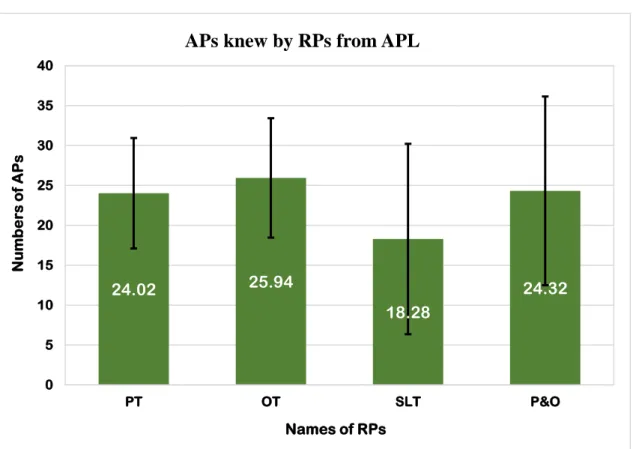
In terms of awareness of RPs about APs, on average 24 kinds of APs are known by all the RPs. And only 1 out of the 223 participants knew all the 50 APs from the APL. However, there were 11 more participants (PT-3, OT-3, SLT-3, and P&O-2) who knew 40-49 APs from the APL. About 21% of RPs knew 25-29 APs, and 17% of RPs knew 30-39 APs from the APL.
The study also found that only 6% of the total participants knew all the 23 APs available in Bangladesh. Table 2 shows information about the awareness of RPs regarding APs in Bangladesh. The result also indicated that the average awareness of APs in OT was higher than that in PT. And SLT has the lowest level of awareness about APs. Figure 3 indicates the level of awareness of different RPs in Bangladesh. As mentioned earlier, CRP and CDD mostly deal with physical disability issues, so awareness about only physical disability-related APs were surveyed. It should be noted that the APL has a total 34 physical disability-related APs in it.
From the survey, it was found that an average of 19 kinds of APs from those 34 APs were known by RPs of CRP and CDD. Figure 4 shows the awareness of RPs about the physical disability-oriented APs. The study also found that the 12 RPs who knew 40-50 APs, 10 of them also knew 30-34 physical disability-related APs from the APL. And about 37% of RPs knew 20-24 APs and 18% of RPs knew 25-29 APs from the 34 physical disability-related APs from the APL.
The survey results further indicated that about 47 % of RPs obtained information on the latest APs from the internet and broadcasting media, and only 5% of them got information mostly from international exhibitions/conferences. About 14% of RPs informed that they didn’t have any means to get information about APs. Figure 5 explains the medium of learning about APs by the RPs. In terms of knowledge about the AP databases like Abledata, DLF data etc, the study found that 92% of RPs didn’t have any knowledge about the databases of APs, although most RPs got information about APs from the internet. The study further illustrated that more than 85% of RPs never had an opportunity to participate in any AP related seminar/conference outside Bangladesh. But survey data confirmed that RP professionals who participated in foreign conferences/exhibitions had a higher level of awareness than those who didn’t.
In the final stage of the questionnaire, all the participants were asked to evaluate the importance of 50 APs from the APL in Bangladesh, as there was no such study before. Five different scales (1-5) of importance were mentioned in the questionnaire for them to judge.
Page 9 of 19 This survey result revealed that about 49% of RPs rated the 50 APs of the APL as “most important” for Bangladesh, whereas around 2% of RPs indicated the APL as “not important”
for Bangladesh. Figure 6 shows the importance of the APL in Bangladesh by RPs.
4. Discussion
4.1 Insufficiency of APs
Although WHO launched the APL three years ago to improve the situation of PWDs, a developing country like Bangladesh, with the highest GDP growth rate in South Asia, only has 23 APs from the 50 APs on the APL so far. It is therefore considered that a more effective initiative from the WHO, including productive communication with member countries, is necessary, along with providing logistic support to ensure the availability of the 50 APs in the country. Apart from this, 11% vision, 14% hearing and 0% cognition categories of the APs from the APL were found in the country. This amount of availability of APs can be considered insufficient, as the United Nations report (2016) revealed that there were 44.2% vision, 16.6%
hearing and 15.8% cognition disabilities among people living in Bangladesh [27].
The study revealed that Bangladesh only imports 5 kinds of APs from the APL from different countries. To meet the lack of APs in the market, increasing the number of imports of APs could be a positive initiative until sufficient domestic production is attained.
4.2 Awareness of RPs
The study indicated that 12 RPs out of 223 knew more than 40 APs on the APL, 9 of them aged between 24 and 28 years. From this point of view, it can be considered that the young generation is much more aware of the APs than others. In terms of overall knowledge between two major professionals, OT has a slightly higher awareness about APs than PT. As the working place is the same for both RPs, internal factors, including the scope of learning, the number of patients, academic background, etc. may be the reason for the difference of awareness. To improve the situation, the group with less awareness should be provided with better environmental and working facilities.
Around half of the total participants got knowledge about the latest APs from the internet, print and electronic media, but surprisingly more than 92% of total participants didn’t know anything about the databases of Assistive Products. It therefore indicates that their way
Page 10 of 19 of using the internet is inappropriate to find out about new APs. Effective on the job and off the job training of appropriate methods of using computers can minimize this problem. The study also revealed that knowledge about APs by RPs who attended APs related international seminars, exhibitions, conferences, etc. was significantly higher than those who did not, but more than 80% of total participants never got such opportunity. A number of participants claimed that they didn’t have any way to get knowledge about the latest AP, which means that if they got the opportunity to know about the latest APs, their knowledge would have been upgraded. The institution should ensure a standard way of learning about the latest APs for their professionals, with the help of the government if necessary.
In developed countries, the databases of assistive products have been developed and utilized. This is the result of both the development of assistive products and the utilization of information and communications technology (ICT). It is well known that the diffusion rate of the cell-phone in Bangladesh is almost equal to developed countries. This indicates the possibility to get information about assistive products through the Internet. The introduction to an incumbent unfamiliar with the Internet may be difficult, but it is thought that learning at the education stage is effective. For example, there are famous web-based databases which can be accessed freely in English. Therefore, these can be used as one of the useful tools to learn about assistive products, because it is difficult to gather actual assistive products as samples in developing countries.
5. Conclusion
The result of the research described in this paper revealed that the number of available APs in Bangladesh was less than the number of APs on the APL, as defined by WHO. This indicates that persons with disabilities in Bangladesh don’t have access to some of the assistive products, even if those are included in the APL. In developed countries like the USA, UK and Japan, they have all 50 APs of the APL in their national database systems of AbleData, DLF data, and TAIS data. PWDs in those countries can easily get these assistive products from their country whenever they need them. But in developing countries like Bangladesh, PWDs can’t access those assistive products.
The awareness level of RPs about APs can be considered insufficient. As the RPs are the key determiner of AP delivery in a country, this result indicates an unstable situation in Bangladesh, which needs to be improved. The monetary and technological constraint regarding
Page 11 of 19 the awareness of RPs needs to be addressed effectively. Establishment of a worthy environment to learn more APs effectively is highly needed, along with solving priority issues like production and distribution.
To increase the availability of assistive products in Bangladesh is thought of as a time- consuming issue to solve, because this is closely related to both the production and importing methods at the national level. In addition, the development of associated field experts, such as researchers, engineers, developers, distributors and so on, is also included. On the other hand, although it has not been authorized as a national qualification yet (as of August 2019), there is an education system for rehabilitation professionals in Bangladesh. Therefore, it is thought that the upgrade of the rehabilitation professionals’ awareness about assistive products by utilizing ICT would be an appropriate initiative for Bangladesh.
Conflict of interest None to report.
Acknowledgement
This research was funded by the Univers Foundation Japan.
Page 12 of 19 References
[1] World Health Organization. The World Bank. World Report on Disability, Geneva, Switzerland. World Health Organization; 2011. [cited 2019 Jan 3] Available from:
https://www.who.int/disabilities/world_report/2011/report.pdf
[2] Elwan A. Poverty and Disability: A Survey of the Literature. The World Bank;
December 1999. [cited 2018 Dec 18] Available from:
http://siteresources.worldbank.org/INTPOVERTY/Resources/WDR/Background/elwa n.pdf
[3] Turmusani M. Poverty and Disabled People in Development Context: Examples from Jordan and Afghanistan. Staying Poor: Chronic Poverty and Development Policy Conference, 7th-9th April 2003 – Manchester, UK. [cited 2018 Dec 18] Available from:
https://assets.publishing.service.gov.uk/media/57a08cdced915d622c001623/Turmusa ni.pdf
[4] Borg J, Larsson S, Ostergren PO, Rahman AA, Bari N, Khan AN. Assistive technology use and human rights enjoyment: A cross-sectional study in Bangladesh. BMC International Health Human Rights. September 2012; 19; 12:18. Available from:
https://bmcinthealthhumrights.biomedcentral.com/articles/10.1186/1472-698X-12-18 [5] World Health Organization. Fact Sheets. Assistive Technology; May 2018. [cited 2019
Feb 10] Available from: https://www.who.int/news-room/fact-sheets/detail/assistive- technology
[6] Rohwerder B. Assistive technologies in developing countries. K4D Helpdesk Report.
Brighton, UK: Institute of Development Studies; March 2018. [cited 2019 Feb 19]
Available from: https://gsdrc.org/publications/assistive-technologies-in-developing- countries/
[7] World health Organization. Priority Assistive Products List (APL). WHO; 2016.
[cited 2018 Jan 10] Available from:
http://www.who.int/phi/implementation/assistive_technology/low_res_english.pdf [8] Visagie S, Eide AH, Mannan H, Schneider M, Swartz L, Mji G, Munthali A, Khogali
M, Van Rooy G, Hem KG, MacLachlan M. A description of assistive technology sources, services and outcomes of use in a number of African settings. Disability and Rehabilitation: Assistive Technology; 2016. [cited 2019 Feb 7] Available from:
http://dx.doi.org/10.1080/17483107.2016.1244293
[9] The World Bank. Country Classification. World Bank Country and Lending Groups.
LOWER-MIDDLE INCOME ECONOMIES ($1,026 TO $3,995). [cited 2019 Jan 10]
Available from: https://datahelpdesk.worldbank.org/knowledgebase/articles/906519- world-bank-country-and-lending-groups
[10] United Nations. Economic and Social Commission for Asia and the Pacific. Disability at a Glance; 2016 P-144. [cited 2018 Dec 22] Available from:
https://www.unescap.org/publications/disability-glance-2015-strengthening- employment-prospects-personsdisabilities-asia-0
Page 13 of 19 [11] Ministry of Social Welfare. Bangladesh, Department of Social Services. Disability
Information System. Updated Report; July 2019. [cited 2019 Jul 23] Available from:
https://www.dis.gov.bd/bn/
[12] Hosseinpoor AR, Stewart JA, Gautam J, Posarac A, Officer A, Verdes E, et al.
Socioeconomic Inequality in Disability Among Adults: A Multicounty Study Using the World Health Survey. American Journal of Public Health; July 2013. 103(7). [cited 2019 Jan 5] Available from: https://www.ncbi.nlm.nih.gov/pubmed/23678901
[13] Planning and Evaluation Department JICA. Country, Profile on Disability People’s Republic of Bangladesh; 2002. P.- 10. [cited 2018 Dec 30] Available from:
http://siteresources.worldbank.org/DISABILITY/Resources/Regions/South%20Asia/J ICA_Bangladesh.pdf
[14] United Nations. Convention on the Rights of Persons with Disabilities (CRPD); 2007.
Available from: https://www.un.org/development/desa/disabilities/convention-on-the- rights-of-persons-with-disabilities.html
[15] Borg, J, Ӧstergren PO. Users’ perspectives on the provision of assistive technologies in Bangladesh: awareness, providers, costs and barriers. Disability and Rehabilitation:
Assistive Technology; 2015. 10:4, P.- 301-308. [cited 2019 Mar 25] Available from:
http://dx.doi.org/10.3109/17483107.2014.974221
[16] Sund T. Assistive Technology in Norway- a part of a larger system. Department of Assistive Technology. Norway; February 2017. [cited 2019 Mar 15] Available from:
https://www.nav.no/en/Home/About+NAV/Publications/_attachment/429663?_downl oad=true&_ts=15a5f9dfd90
[17] Kanto-Ronkanen A, Miettinen T, Airaksinen O. Developing the Assistive Technology Device Services in North Savo Hospital District. Finland. Assistive Technology: From Research to Practice. AAATE. IOS Press; 2013, V. 33. P.- 273-277.
[18] Lyhne T. The Danish National Database on Assistive Technology. Everyday Technology for Independence and Care. AAATE. IOS Press; 2011. V. 29. P.- 205-213.
[19] Sund T, Iwarsson S, Brandt A. Documentation of the Service Delivery Process of Powered Wheelchairs and Scooters in Two Nordic Countries. Everyday Technology for Independence and Care. AAATE. IOS Press; 2011. V. 29. P.- 1161-1168.
[20] World Health Organization. Country Cooperation Strategy. Bangladesh 2014-2017.
Country Office for Bangladesh; 2014. P.-10. [cited 2019 Mar 5] Available from:
http://www.searo.who.int/bangladesh/publications/ccs_2014_17/en/
[21] Khan MH, Oku H, Sano M. Assistive Products in Bangladesh: The State of the Art and Problems. Proceeding of the 11th International Convention on Rehabilitation Engineering and Assistive Technology (i-CREATe 2017 Proceeding). Article No. 29;
July 2017. Available from:
https://dl.acm.org/citation.cfm?id=3162145&dl=ACM&coll=DL
[22] Khan MH, Oku H, Sano M. Availability of Assistive Products in Bangladesh from the Priority Assistive Products List of World Health Organization. Kobegakuin Journal of Rehabilitation Research; March 2019. Vol. -14(2), P.- 53-61.
Page 14 of 19 [23] Pryor W, Nguyen L, Islam, Qumrun N, Jalal FA, Marella, M. Unmet Needs and Use of Assistive Products in Two Districts of Bangladesh: Findings from a Household Survey.
Int. J. Environ. Res. Public Health; 2018. 15(12), 2901. [cited 2019 Feb 10] Available from: https://www.mdpi.com/1660-4601/15/12/2901
[24] Bangladesh Health Professions Institute (BHPI). Chapain, Savar, Dhaka – 1343. [cited 2019 May 10] Available from: https://www.bhpi.edu.bd/
[25] Center for the Rehabilitation of the Paralysed. Department of Orthotics and Prosthetics.
Special Seating Unit. Metal Workshop Unit; 2018. [cited 201 Jan 25] Available from:
http://www.crp-bangladesh.org/
[26] Assistive Products Manuals (Bangla). Center for the Development of the Disabled.
European Union. UK Aid. Dhaka; 2011. P- 21.
[27] Economic and Social Commission for Asia and the Pacific (ESCAP). Disability at a Glance; 2016. [cited 2018 Dec 20] Available from:
https://www.unescap.org/publications/disability-glance-2015-strengthening- employment-prospects-persons-disabilities-asia-0
Page 15 of 19 TABLES:
Table 1
Assistive Products of CRP, CDD and others from the APL of WHO [25]
Category of APL Names of APs CRP CDD Others
1. Mobility
Canes/sticks √ ---
Crutches, axillary/ elbow √ √
Orthoses, lower limb √ √
Orthoses, spinal √ ---
Orthoses, upper limb √ √
Prostheses, lower limb √ √
Standing frames, adjustable √ √
Tricycles √ √
Walking frames/walkers √ √
Wheelchairs, manual for active use √ √
Wheelchairs, manual assistant-controlled √ √ Wheelchairs, manual with postural support √ ---
White Cane --- --- √ import
Therapeutic footwear --- --- √ import
2. Vision Spectacles; low vision, short/long distance --- --- √ import
3. Hearing Hearing aids and batteries --- --- √ import
4. Communication
Communication boards/books/cards √ √
Braille writing equipment --- --- √ govt.
5. Cognition --- --- ---
6. Environment
Chairs for shower/ bath/toilet √ √
Hand rails/grab bars √ ---
Pressure relief cushions √ ---
Ramps, portable √ √
Pressure relief mattresses --- --- √ import
Page 16 of 19 Table 2
Information about awareness of APs received from the RPs by questionnaires
Content of information Result in number and percentage (%)
Participants (N- 223) Male- 104 (46.63%)
Female- 119 (53.36%)
Age 21~30 – 166 (74.43%)
31~40- 41 (18.38%) 41~50- 11 (4.93%) 50+ - 05 (2.24%)
Profession PT- 108 (48.43%)
OT- 64 (28.69%) SLT- 32 (14.13%) P&O- 19 (8.52%)
Job experience <1- 48 (21.52%)
1~5- 120 (53.81%) 5~10- 28 (12.55%) 10~15-19 (8.52%) 15~20- 04 (1.79%) 20+ - 05 (2.24%) Knowledge about APs of APL 50 – 01 (0.44%)
40-49 - 11 (4.94%) 30-39 - 37 (16.60%) 25-29 - 46 (20.63%)
Way of getting information of APs Domestic conference- 63 (28.25%) Internet- 105 (47.08%) Int. conference- 11 (4.93%) Others- 13 (5.82%) No scope- 31 (13.90%) Prescribed APs to the patients Yes- 212 (95.06%)
No- 11 (4.93%)
Knowledge about database Yes- 17 (7.62%)
No- 206 (92.37%) Participated foreign conference Yes- 33 (14.79%) No- 190 (85.20%)
Page 17 of 19 FIGURES:
Figure 1. Assistive Products of CRP
Figure 2. Assistive Products of CDD
Page 18 of 19 Figure 3 APs known by RPs from the APL
Figure 4 Physical disability-related APs of APL known by RPs
24.02 25.94
18.28
24.32
0 5 10 15 20 25 30 35 40
PT OT SLT P&O
Numbers of APs
Names of RPs
APs knew by RPs from APL
20.96 21.73
13.16
20.53
0 5 10 15 20 25 30 35 40
PT OT SLT P&O
Numbers of APs
Names of RPs
APs knew by RPs except Vision & Hearing
Page 19 of 19 Figure 5. Way of getting information about APs by RPs
Figure 6 Importance of APL in Bangladesh by RPs
48.50%
21.50%
18.60%
9.50%
0%
10%
20%
30%
40%
50%
60%
Most important Fairly important Important Less important
Percentage of Importance
Scale of Importance
Importance of APL in Bangladesh by RPs 28%
47%
5%
6%
14%
Way of getting information about APs by RPs
Domestic conference of RPs 28%
Internet, print and broadcasting media 47%
International conference, exhibition 5%
Others 6%
Don’t have any scope to get info. 14%
Appendix | 1
APPENDIX
Serial Contents Page no.
1 Survey questionnaire 2 - 22
2 Summary of the Information of all Participants 23 - 24
3 Priority Assistive Products List (APL) 25
4 Categories of Assistive Products List 26
5 Assistive Products List and ISO Classification 27
6 Importance of Assistive Products List in Bangladesh 28 - 32
Appendix | 2
Consideration on the Improvement of Assistive Products’ Availability and the Awareness of Rehabilitation Professionals in Bangladesh
4th September, 2018
Dear Concern,
I am a PhD researcher of Graduate School of Rehabilitation of Kobe Gakuin University Japan. At present, I am conducting a research study on availability of assistive products in Bangladesh from the Priority Assistive Products List (APL) of World Health Organization and awareness of Rehabilitation Professionals about assistive products.
The aim of this research is to discover availability of assistive product in Bangladesh and identify the awareness of Rehabilitation Professionals by accepting valuable consideration from them. This study also rationalize the effectiveness of priority assistive product list for Bangladesh by taking expert opinion of Bangladeshi Rehabilitation Professionals.
Rehabilitation Professionals’ of your organization are humbly requested to participate in this short questionnaire survey which will take 15~20 minutes to finish. However, in this survey, participants’
personal, academic and professional information will be asked to provide to ensure the credibility of the study. All the information provided here will be strictly protected and it will be used on the purpose of research only.
This research has been approved by the faculty of Rehabilitation of Kobe Gakuin University under the supervision of Professor Hidehisa OKU, PhD, Akio Nakagawa, PhD, and Mitsuhiko SANO, PhD. A comprehensive research paper will be published based on this study.
Thanks a lot for your kind participation and cooperation.
Sincerely Yours,
Md Mehedi Hasan Khan Ph.D Researcher
Kobe Gakuin University, Japan.
E-mail: [email protected]
Appendix | 3
Survey Questionnaire
Section 01: Personal & Career Profile 1. Personal Information:
[Please fill up the information and put a tick mark (√) where applicable]
i) Name: _____________________________________ ii) Age: ____ Years
iii) Sex: Male/Female iv) Educational Institution &Latest Degree: _________________________
v) E-mail Address: _________________________ vi) Mobile No (If you have)___________________
2. Career Information:
[Please fill up the information and put a tick mark (√) where applicable]
i) Profession: PT/ OT/ SLT/ P&O/Other _____ ii) Working Organization: ________________
iii) Position: _____________________ iv) Total Job Experiences: _______ Years
v) How do you get information about latest Assistive Products which you don’t know?
( 1 ) From the domestic conference of Rehabilitation Professionals ( 2 ) From internet, printed media, broadcasting agency etc.
( 3 ) From international conference, exhibition, seminar etc.
( 4 ) From other means; ________________________________
( 5 ) Don’t have any scope to get latest information of assistive products
vi) Have you participated job related Conference/Exhibition/seminar etc. outside of Bangladesh?
( 1 ) Yes, --- times, [Years --- Countries ---] ( 2 ) No vii) Do you know about international database of Assistive Products?
( 1 ) Yes, Name/s ______________________________________________________________ ( 2 ) No viii) Do you prescribe/suggest assistive products to your patients in you work duties?
( 1 ) Yes, I do ( 2 ) No, I don’t
ix) To how many patients you have given services/prescriptions/recommendations/suggestions of Assistive Products till now (in your total service time)?
( 1 ) About ___________ patients ( 2 ) No one
Appendix | 4
Section 02: About Assistive Products
Please, read the Assistive Products names below (from 1~50) carefully and answer the questions followed. The picture shown right side of each question is just an example; it doesn’t represent all the products of that category. While answering the question, put a tick (√) mark on your appropriate answer only.
1. Alarm signalers with light/sound/vibration
a. Do you know this above Assistive Product?
( 1 ) Yes, I know this Assistive Product, and I can explain its usages and functions properly. [go to a.1]
( 2 ) Yes, I know this Assistive Product but can’t explain its usages and functions. [go to a.1]
( 3 ) I know the name only, not more than that. [go to a.1]
( 4 ) No, I don’t. This is first time for me to read/see about this Assistive Product.
a.1 If you know this Assistive Product, where did you get the information?
( 1 ) I knew this assistive product from my academic study
( 2 ) I got idea about this assistive product in my professional career
( 3 ) I participated international exhibition, conference, seminar etc. and knew this product ( 4 ) I read this assistive product in the books/journals etc.
( 5 ) I knew this assistive product from ________________________________________
2. Audio players with DAISY capability
a. Do you know this above Assistive Product?
( 1 ) Yes, I know this Assistive Product, and I can explain its usages and functions properly. [go to a.1]
( 2 ) Yes, I know this Assistive Product but can’t explain its usages and functions. [go to a.1]
( 3 ) I know the name only, not more than that. [go to a.1]
( 4 ) No, I don’t. This is first time for me to read/see about this Assistive Product.
a.1 If you know this Assistive Product, where did you get the information?
( 1 ) I knew this assistive product from my academic study
( 2 ) I got idea about this assistive product in my professional career
( 3 ) I participated international exhibition, conference, seminar etc. and knew this product ( 4 ) I read this assistive product in the books/journals etc.
( 5 ) I knew this assistive product from ________________________________________
3. Braille displays (note takers)
a. Do you know this above Assistive Product?
( 1 ) Yes, I know this Assistive Product, and I can explain its usages and functions properly. [go to a.1]
( 2 ) Yes, I know this Assistive Product but can’t explain its usages and functions. [go to a.1]
( 3 ) I know the name only, not more than that. [go to a.1]
( 4 ) No, I don’t. This is first time for me to read/see about this Assistive Product.
Appendix | 5 a.1 If you know this Assistive Product, where did you get the information?
( 1 ) I knew this assistive product from my academic study
( 2 ) I got idea about this assistive product in my professional career
( 3 ) I participated international exhibition, conference, seminar etc. and knew this product ( 4 ) I read this assistive product in the books/journals etc.
( 5 ) I knew this assistive product from ________________________________________
4. Braille writing equipment/braillers
a. Do you know this above Assistive Product?
( 1 ) Yes, I know this Assistive Product, and I can explain its usages and functions properly. [go to a.1]
( 2 ) Yes, I know this Assistive Product but can’t explain its usages and functions. [go to a.1]
( 3 ) I know the name only, not more than that. [go to a.1]
( 4 ) No, I don’t. This is first time for me to read/see about this Assistive Product.
a.1 If you know this Assistive Product, where did you get the information?
( 1 ) I knew this assistive product from my academic study
( 2 ) I got idea about this assistive product in my professional career
( 3 ) I participated international exhibition, conference, seminar etc. and knew this product ( 4 ) I read this assistive product in the books/journals etc.
( 5 ) I knew this assistive product from ________________________________________
5. Canes/sticks
a. Do you know this above Assistive Product?
( 1 ) Yes, I know this Assistive Product, and I can explain its usages and functions properly. [go to a.1]
( 2 ) Yes, I know this Assistive Product but can’t explain its usages and functions. [go to a.1]
( 3 ) I know the name only, not more than that. [go to a.1]
( 4 ) No, I don’t. This is first time for me to read/see about this Assistive Product.
a.1 If you know this Assistive Product, where did you get the information?
( 1 ) I knew this assistive product from my academic study
( 2 ) I got idea about this assistive product in my professional career
( 3 ) I participated international exhibition, conference, seminar etc. and knew this product ( 4 ) I read this assistive product in the books/journals etc.
( 5 ) I knew this assistive product from ________________________________________
6. Chairs for shower/bath/toilet
a. Do you know this above Assistive Product?
( 1 ) Yes, I know this Assistive Product, and I can explain its usages and functions properly. [go to a.1]
( 2 ) Yes, I know this Assistive Product but can’t explain its usages and functions. [go to a.1]
( 3 ) I know the name only, not more than that. [go to a.1]
( 4 ) No, I don’t. This is first time for me to read/see about this Assistive Product.
Appendix | 6 a.1 If you know this Assistive Product, where did you get the information?
( 1 ) I knew this assistive product from my academic study
( 2 ) I got idea about this assistive product in my professional career
( 3 ) I participated international exhibition, conference, seminar etc. and knew this product ( 4 ) I read this assistive product in the books/journals etc.
( 5 ) I knew this assistive product from ________________________________________
7. Closed captioning Displays
a. Do you know this above Assistive Product?
( 1 ) Yes, I know this Assistive Product, and I can explain its usages and functions properly. [go to a.1]
( 2 ) Yes, I know this Assistive Product but can’t explain its usages and functions. [go to a.1]
( 3 ) I know the name only, not more than that. [go to a.1]
( 4 ) No, I don’t. This is first time for me to read/see about this Assistive Product.
a.1 If you know this Assistive Product, where did you get the information?
( 1 ) I knew this assistive product from my academic study
( 2 ) I got idea about this assistive product in my professional career
( 3 ) I participated international exhibition, conference, seminar etc. and knew this product ( 4 ) I read this assistive product in the books/journals etc.
( 5 ) I knew this assistive product from ________________________________________
8. Club foot braces
a. Do you know this above Assistive Product?
( 1 ) Yes, I know this Assistive Product, and I can explain its usages and functions properly. [go to a.1]
( 2 ) Yes, I know this Assistive Product but can’t explain its usages and functions. [go to a.1]
( 3 ) I know the name only, not more than that. [go to a.1]
( 4 ) No, I don’t. This is first time for me to read/see about this Assistive Product.
a.1 If you know this Assistive Product, where did you get the information?
( 1 ) I knew this assistive product from my academic study
( 2 ) I got idea about this assistive product in my professional career
( 3 ) I participated international exhibition, conference, seminar etc. and knew this product ( 4 ) I read this assistive product in the books/journals etc.
( 5 ) I knew this assistive product from ________________________________________
9. Communication boards/books/cards
a. Do you know this above Assistive Product?
( 1 ) Yes, I know this Assistive Product, and I can explain its usages and functions properly. [go to a.1]
( 2 ) Yes, I know this Assistive Product but can’t explain its usages and functions. [go to a.1]
( 3 ) I know the name only, not more than that. [go to a.1]
( 4 ) No, I don’t. This is first time for me to read/see about this Assistive Product.
Appendix | 7 a.1 If you know this Assistive Product, where did you get the information?
( 1 ) I knew this assistive product from my academic study
( 2 ) I got idea about this assistive product in my professional career
( 3 ) I participated international exhibition, conference, seminar etc. and knew this product ( 4 ) I read this assistive product in the books/journals etc.
( 5 ) I knew this assistive product from ________________________________________
10. Communication Software
a. Do you know this above Assistive Product?
( 1 ) Yes, I know this Assistive Product, and I can explain its usages and functions properly. [go to a.1]
( 2 ) Yes, I know this Assistive Product but can’t explain its usages and functions. [go to a.1]
( 3 ) I know the name only, not more than that. [go to a.1]
( 4 ) No, I don’t. This is first time for me to read/see about this Assistive Product.
a.1 If you know this Assistive Product, where did you get the information?
( 1 ) I knew this assistive product from my academic study
( 2 ) I got idea about this assistive product in my professional career
( 3 ) I participated international exhibition, conference, seminar etc. and knew this product ( 4 ) I read this assistive product in the books/journals etc.
( 5 ) I knew this assistive product from ________________________________________
11. Crutches, auxiliary/Elbow
a. Do you know this above Assistive Product?
( 1 ) Yes, I know this Assistive Product, and I can explain its usages and functions properly. [go to a.1]
( 2 ) Yes, I know this Assistive Product but can’t explain its usages and functions. [go to a.1]
( 3 ) I know the name only, not more than that. [go to a.1]
( 4 ) No, I don’t. This is first time for me to read/see about this Assistive Product.
a.1 If you know this Assistive Product, where did you get the information?
( 1 ) I knew this assistive product from my academic study
( 2 ) I got idea about this assistive product in my professional career
( 3 ) I participated international exhibition, conference, seminar etc. and knew this product ( 4 ) I read this assistive product in the books/journals etc.
( 5 ) I knew this assistive product from ________________________________________
12. Deaf blind Communicators
a. Do you know this above Assistive Product?
( 1 ) Yes, I know this Assistive Product, and I can explain its usages and functions properly. [go to a.1]
( 2 ) Yes, I know this Assistive Product but can’t explain its usages and functions. [go to a.1]
( 3 ) I know the name only, not more than that. [go to a.1]
( 4 ) No, I don’t. This is first time for me to read/see about this Assistive Product.
Appendix | 8 a.1 If you know this Assistive Product, where did you get the information?
( 1 ) I knew this assistive product from my academic study
( 2 ) I got idea about this assistive product in my professional career
( 3 ) I participated international exhibition, conference, seminar etc. and knew this product ( 4 ) I read this assistive product in the books/journals etc.
( 5 ) I knew this assistive product from ________________________________________
13. Fall detectors
a. Do you know this above Assistive Product?
( 1 ) Yes, I know this Assistive Product, and I can explain its usages and functions properly. [go to a.1]
( 2 ) Yes, I know this Assistive Product but can’t explain its usages and functions. [go to a.1]
( 3 ) I know the name only, not more than that. [go to a.1]
( 4 ) No, I don’t. This is first time for me to read/see about this Assistive Product.
a.1 If you know this Assistive Product, where did you get the information?
( 1 ) I knew this assistive product from my academic study
( 2 ) I got idea about this assistive product in my professional career
( 3 ) I participated international exhibition, conference, seminar etc. and knew this product ( 4 ) I read this assistive product in the books/journals etc.
( 5 ) I knew this assistive product from ________________________________________
14. Gesture to voice Technology
a. Do you know this above Assistive Product?
( 1 ) Yes, I know this Assistive Product, and I can explain its usages and functions properly. [go to a.1]
( 2 ) Yes, I know this Assistive Product but can’t explain its usages and functions. [go to a.1]
( 3 ) I know the name only, not more than that. [go to a.1]
( 4 ) No, I don’t. This is first time for me to read/see about this Assistive Product.
a.1 If you know this Assistive Product, where did you get the information?
( 1 ) I knew this assistive product from my academic study
( 2 ) I got idea about this assistive product in my professional career
( 3 ) I participated international exhibition, conference, seminar etc. and knew this product ( 4 ) I read this assistive product in the books/journals etc.
( 5 ) I knew this assistive product from ________________________________________
15. Global positioning system (GPS) locators
a. Do you know this above Assistive Product?
( 1 ) Yes, I know this Assistive Product, and I can explain its usages and functions properly. [go to a.1]
( 2 ) Yes, I know this Assistive Product but can’t explain its usages and functions. [go to a.1]
( 3 ) I know the name only, not more than that. [go to a.1]
( 4 ) No, I don’t. This is first time for me to read/see about this Assistive Product.
Appendix | 9 a.1 If you know this Assistive Product, where did you get the information?
( 1 ) I knew this assistive product from my academic study
( 2 ) I got idea about this assistive product in my professional career
( 3 ) I participated international exhibition, conference, seminar etc. and knew this product ( 4 ) I read this assistive product in the books/journals etc.
( 5 ) I knew this assistive product from ________________________________________
16. Hand rails/grab bars
a. Do you know this above Assistive Product?
( 1 ) Yes, I know this Assistive Product, and I can explain its usages and functions properly. [go to a.1]
( 2 ) Yes, I know this Assistive Product but can’t explain its usages and functions. [go to a.1]
( 3 ) I know the name only, not more than that. [go to a.1]
( 4 ) No, I don’t. This is first time for me to read/see about this Assistive Product.
a.1 If you know this Assistive Product, where did you get the information?
( 1 ) I knew this assistive product from my academic study
( 2 ) I got idea about this assistive product in my professional career
( 3 ) I participated international exhibition, conference, seminar etc. and knew this product ( 4 ) I read this assistive product in the books/journals etc.
( 5 ) I knew this assistive product from ________________________________________
17. Hearing aids (digital) and batteries
a. Do you know this above Assistive Product?
( 1 ) Yes, I know this Assistive Product, and I can explain its usages and functions properly. [go to a.1]
( 2 ) Yes, I know this Assistive Product but can’t explain its usages and functions. [go to a.1]
( 3 ) I know the name only, not more than that. [go to a.1]
( 4 ) No, I don’t. This is first time for me to read/see about this Assistive Product.
a.1 If you know this Assistive Product, where did you get the information?
( 1 ) I knew this assistive product from my academic study
( 2 ) I got idea about this assistive product in my professional career
( 3 ) I participated international exhibition, conference, seminar etc. and knew this product ( 4 ) I read this assistive product in the books/journals etc.
( 5 ) I knew this assistive product from ________________________________________
18. Hearing loops/FM Systems
a. Do you know this above Assistive Product?
( 1 ) Yes, I know this Assistive Product, and I can explain its usages and functions properly. [go to a.1]
( 2 ) Yes, I know this Assistive Product but can’t explain its usages and functions. [go to a.1]
( 3 ) I know the name only, not more than that. [go to a.1]
( 4 ) No, I don’t. This is first time for me to read/see about this Assistive Product.
Appendix | 10 a.1 If you know this Assistive Product, where did you get the information?
( 1 ) I knew this assistive product from my academic study
( 2 ) I got idea about this assistive product in my professional career
( 3 ) I participated international exhibition, conference, seminar etc. and knew this product ( 4 ) I read this assistive product in the books/journals etc.
( 5 ) I knew this assistive product from ________________________________________
19. Incontinence products, absorbent
a. Do you know this above Assistive Product?
( 1 ) Yes, I know this Assistive Product, and I can explain its usages and functions properly. [go to a.1]
( 2 ) Yes, I know this Assistive Product but can’t explain its usages and functions. [go to a.1]
( 3 ) I know the name only, not more than that. [go to a.1]
( 4 ) No, I don’t. This is first time for me to read/see about this Assistive Product.
a.1 If you know this Assistive Product, where did you get the information?
( 1 ) I knew this assistive product from my academic study
( 2 ) I got idea about this assistive product in my professional career
( 3 ) I participated international exhibition, conference, seminar etc. and knew this product ( 4 ) I read this assistive product in the books/journals etc.
( 5 ) I knew this assistive product from ________________________________________
20. Keyboard and mouse emulation software
a. Do you know this above Assistive Product?
( 1 ) Yes, I know this Assistive Product, and I can explain its usages and functions properly. [go to a.1]
( 2 ) Yes, I know this Assistive Product but can’t explain its usages and functions. [go to a.1]
( 3 ) I know the name only, not more than that. [go to a.1]
( 4 ) No, I don’t. This is first time for me to read/see about this Assistive Product.
a.1 If you know this Assistive Product, where did you get the information?
( 1 ) I knew this assistive product from my academic study
( 2 ) I got idea about this assistive product in my professional career
( 3 ) I participated international exhibition, conference, seminar etc. and knew this product ( 4 ) I read this assistive product in the books/journals etc.
( 5 ) I knew this assistive product from ________________________________________
21. Magnifiers, digital hand-held
a. Do you know this above Assistive Product?
( 1 ) Yes, I know this Assistive Product, and I can explain its usages and functions properly. [go to a.1]
( 2 ) Yes, I know this Assistive Product but can’t explain its usages and functions. [go to a.1]
( 3 ) I know the name only, not more than that. [go to a.1]
( 4 ) No, I don’t. This is first time for me to read/see about this Assistive Product.
Appendix | 11 a.1 If you know this Assistive Product, where did you get the information?
( 1 ) I knew this assistive product from my academic study
( 2 ) I got idea about this assistive product in my professional career
( 3 ) I participated international exhibition, conference, seminar etc. and knew this product ( 4 ) I read this assistive product in the books/journals etc.
( 5 ) I knew this assistive product from ________________________________________
22. Magnifiers, optical
a. Do you know this above Assistive Product?
( 1 ) Yes, I know this Assistive Product, and I can explain its usages and functions properly. [go to a.1]
( 2 ) Yes, I know this Assistive Product but can’t explain its usages and functions. [go to a.1]
( 3 ) I know the name only, not more than that. [go to a.1]
( 4 ) No, I don’t. This is first time for me to read/see about this Assistive Product.
a.1 If you know this Assistive Product, where did you get the information?
( 1 ) I knew this assistive product from my academic study
( 2 ) I got idea about this assistive product in my professional career
( 3 ) I participated international exhibition, conference, seminar etc. and knew this product ( 4 ) I read this assistive product in the books/journals etc.
( 5 ) I knew this assistive product from ________________________________________
23. Orthoses, lower limb
a. Do you know this above Assistive Product?
( 1 ) Yes, I know this Assistive Product, and I can explain its usages and functions properly. [go to a.1]
( 2 ) Yes, I know this Assistive Product but can’t explain its usages and functions. [go to a.1]
( 3 ) I know the name only, not more than that. [go to a.1]
( 4 ) No, I don’t. This is first time for me to read/see about this Assistive Product.
a.1 If you know this Assistive Product, where did you get the information?
( 1 ) I knew this assistive product from my academic study
( 2 ) I got idea about this assistive product in my professional career
( 3 ) I participated international exhibition, conference, seminar etc. and knew this product ( 4 ) I read this assistive product in the books/journals etc.
( 5 ) I knew this assistive product from ________________________________________
24. Orthoses, spinal
a. Do you know this above Assistive Product?
( 1 ) Yes, I know this Assistive Product, and I can explain its usages and functions properly. [go to a.1]
( 2 ) Yes, I know this Assistive Product but can’t explain its usages and functions. [go to a.1]
( 3 ) I know the name only, not more than that. [go to a.1]
( 4 ) No, I don’t. This is first time for me to read/see about this Assistive Product.
a.1 If you know this Assistive Product, where did you get the information?
Appendix | 12 ( 1 ) I knew this assistive product from my academic study
( 2 ) I got idea about this assistive product in my professional career
( 3 ) I participated international exhibition, conference, seminar etc. and knew this product ( 4 ) I read this assistive product in the books/journals etc.
( 5 ) I knew this assistive product from ________________________________________
25. Orthoses, upper limb
a. Do you know this above Assistive Product?
( 1 ) Yes, I know this Assistive Product, and I can explain its usages and functions properly. [go to a.1]
( 2 ) Yes, I know this Assistive Product but can’t explain its usages and functions. [go to a.1]
( 3 ) I know the name only, not more than that. [go to a.1]
( 4 ) No, I don’t. This is first time for me to read/see about this Assistive Product.
a.1 If you know this Assistive Product, where did you get the information?
( 1 ) I knew this assistive product from my academic study
( 2 ) I got idea about this assistive product in my professional career
( 3 ) I participated international exhibition, conference, seminar etc. and knew this product ( 4 ) I read this assistive product in the books/journals etc.
( 5 ) I knew this assistive product from ________________________________________
26. Personal digital assistant (PDA)
a. Do you know this above Assistive Product?
( 1 ) Yes, I know this Assistive Product, and I can explain its usages and functions properly. [go to a.1]
( 2 ) Yes, I know this Assistive Product but can’t explain its usages and functions. [go to a.1]
( 3 ) I know the name only, not more than that. [go to a.1]
( 4 ) No, I don’t. This is first time for me to read/see about this Assistive Product.
a.1 If you know this Assistive Product, where did you get the information?
( 1 ) I knew this assistive product from my academic study
( 2 ) I got idea about this assistive product in my professional career
( 3 ) I participated international exhibition, conference, seminar etc. and knew this product ( 4 ) I read this assistive product in the books/journals etc.
( 5 ) I knew this assistive product from ________________________________________
27. Personal emergency alarm systems
a. Do you know this above Assistive Product?
( 1 ) Yes, I know this Assistive Product, and I can explain its usages and functions properly. [go to a.1]
( 2 ) Yes, I know this Assistive Product but can’t explain its usages and functions. [go to a.1]
( 3 ) I know the name only, not more than that. [go to a.1]
( 4 ) No, I don’t. This is first time for me to read/see about this Assistive Product.