i
The U.S. Rebalance to Asia through the
Eyes of Neoclassical Realism:
Maintaining the Order in
the Asia Pacific amid
the Rise of China
by SEK Sophal
51114603
September 2016
Master‘s Thesis Presented to Ritsumeikan Asia Pacific University In Partial Fulfillment of the Requirements for the Degree of
ii
Contents
Certification ... iv
Acknowledgement ... v
Abstract ... vi
List of Abbreviations ... vii
Chapter One: Introduction ... 1
1.1. Overview of Sino-U.S. relations and Rebalance ... 1
1.2. Research Objectives ... 16
1.3. Research Questions ... 17
1.4. Research Methodology ... 17
1.5. Research Significance ... 19
Chapter Two: Literature Review ... 22
2.1. Basic Concepts of Realism ... 22
2.2. The Debates of the Three Variants of Realism ... 24
2.2.1. Classical Realism: Domestic Politics Drives States‘ Foreign Policy 25 2.2.2. Neorealism: International System Drives States‘ Foreign Policy . 30 2.2.3. Neoclassical Realism: Domestic Politics, International System, Gaps in Relative Gains Drive States‘ Foreign Policy ... 34
2.3. The U.S. Rebalance in Realist Thought ... 44
Chapter Three: the U.S. Interests and Its Relevance to the Rebalance ... 47
3.1. Economic Interests ... 47
3.2. Security Interests ... 49
3.3. Diplomatic Interests ... 55
Chapter Four: The U.S. Rebalance in Neoclassical Realism ... 59
4.1. The Rebalance in Classical Realism ... 59
4.2. The Rebalance in Neorealism ... 62
4.3. The Rebalance in Neoclassical Realism ... 65
4.3.1. The TPP: From Economic Interests to Economic Leadership ... 66
4.3.2. The Security Allies and Strategic Partners: Narrowing the Gaps in Relative Power ... 71
iii
4.5. Is the U.S. military structure in the Asia-Pacific changed by the U.S.
Rebalance? ... 79
Chapter Five: Conclusion ... 83
5.1. Why Neoclassical Realism? ... 86
5.2. Gaps in this Research ... 90
iv
Certification
I, Sek Sophal, hereby declare that this master thesis is my own work which contains ideas and information from published as well as unpublished works of different scholars who are recognized through the references listed in the thesis. The main arguments and ideas that are not cited are ideas and agreements written by author of this thesis.
v
Acknowledgement
Writing this thesis is solely my responsibility, but the thesis can never be achieved without kind assistance from several people around me.
First, I would like to thank my commander, Brigadier General Nhem Boraden for his kindness and supports for my study in Japan. General Nhem Boraden has helped me discover who I am, and where I should stay. The jobs at the Ministry of National Defense of Cambodia have always been interesting and exciting. We have worked as a team, and I have learned a lot of things that cannot be instructed at the universities I have attended.
Second, I would like to thank Professor SATO Yoichiro for working tirelessly to supervise my thesis. What I have learned from Professor SATO is not only academic skills, but also his experience and principles of life, which are the fundamental basis for success in the real life. To Professor SATO, I am in debt.
Third, I would like to thank my family and friends. I would like to thank my sister who has always supported whenever I need help. I would like to thank my Cambodian friends: Taing Koungveng, Eh Sophea, Huot Phanit, Thet Kanika, Seang Samart, Houn Chanvy, Peang Srey Nith, Yen Navin who have never said no whenever I ask for help. Taing Kounveng, in particular, encouraged me to apply for this scholarship, and coordinated my living in Japan even before I arrived in Japan. Without them, my living and studying in Japan must be much more difficult.
Finally, I would like to thank a Japanese restaurant manager who hired me to work. The manager is so kind and helpful. Without the job there, I can never support myself to finish my study in Japan. I consider this thesis is the achievement of everyone who supports me.
vi
Abstract
The U.S. rebalance to Asia announced in 2011 by the Obama administration is a remarkable turning point of the U.S. foreign policy to the Asia-Pacific. The U.S. rebalance to Asia, however, is understood differently by different people from different background. The liberals, for example, see the rebalance as an ongoing engagement of the United States with China. The realists, however, see the policy as the U.S. tough diplomacy to contain the rise of China.
Although several previous researches have discussed the rebalance for years since its announcement, those researches tend to analyze the shift in the U.S. foreign policy based on general theories of international relations. Not many of them have so far offered a more precise theoretical explanation of the U.S. rebalance.
The thesis argues that the U.S. rebalance is theoretically explained by realism. Given the U.S. selective engagements under the policy of the rebalance, this thesis argues that the rebalance is the U.S. strategy to maintain order in the Asia-Pacific amid the rise of China. While seeking to maintain the regional supremacy in the Asia-Pacific, the United States tries to avoid confronting China in a direct way. The thesis argues the United States is seeking to increase its relative power against China. Thus, the U.S. rebalance to Asia is best explained by neoclassical realism.
vii
List of Abbreviations
ADMM Plus ASEAN Defense Ministerial Meeting Plus AIIB Asian Infrastructure Investment Bank AOR Area of Responsibility
ARF ASEAN Regional Forum
ASAT Anti-Satellite
ASBMs Anti-Ship Ballistic Missiles ASCMs Anti-Ship Cruise Missiles
ASEAN Association of Southeast Asia Nations A2/AD Anti-Access/Access Denial
BRICS Brazil, Russia, India China and South Africa CBMs Confidence Building Measures
CCP Chinese Communist Party
C4ISR Command, Control, Communications, Computers, Intelligence, Surveillance and Reconnaissance
EAS East Asia Summit
ECS East China Sea
FTA Free Trade Agreement
GWOT Global War on Terrorism
HA/DR Humanitarian Assistance/Disaster Relief IISS Institute of International Strategic Studies IMF International Monetary Fund
IPRs Intellectual Property Rights
NDB New Development Bank
LCSs Littoral Combat Ships
PACOM Pacific Command
PLA People‘s Liberation Army
PLAAF People‘s Liberation Army Air Force PLAN People‘s Liberation Army Navy
viii
R&D Research and Development RIMPAC Rim of the Pacific
RMAs Revolution in Military Affairs SALT-II Strategic Arms Limitation Talks-II
SCS South China Seas
S&ED Strategic and Economic Dialogue SLOC Security of Sea Lines of Communication
SIPRI Stockholm International Peace Research Institute SOEs State-Owned Enterprises
SSGNs Guided Cruise Missile Submarines TAC Treaty of Amity and Cooperation TPP Trans-Pacific Partnership
UNSC United Nations Security Council
WB World Bank
WMD Weapon of Mass Destruction
1
The U.S. Rebalance to Asia through the Eyes of
Neoclassical Realism: Maintaining the Order
in the Asia-Pacific amid the Rise of China
We are in the remarkable position of not wanting to quarrel with anybody because we have got most of the world already or the best parts of it and we only want to keep what we have got and prevent other from taking it away from us. (the statement of delivered by Britain‘s First Lord of the Admiralty in June 1934 cited in Scheweller,1998, p. 24)
Chapter One: Introduction
1.1. Overview of Sino-U.S. relations and Rebalance
In December 2011, the last convoys of the American troops finally left Iraq crossing the border to Kuwait where the preparations for the complete withdrawal were ready to bring the men and women in uniforms back home after almost a decade of war. The same is happening in Afghanistan. Even though the Afghan war is still going on, the fact is that it has already reached a transitional period. Leaving Afghanistan is just a matter of time. The wars in Afghanistan and Iraq started in 2001 and 2003 respectively seem to be the longest wars in the history of the United States except for the Cold War. As the two protracted and unfortunate wars were waning, it looks like the interests of the United States are no longer in the Middle East as it used to be during the previous U.S. administrations.
2
The shift in the U.S. interests and foreign policy, in fact, came to exist since the first day of new U.S. administration when President Obama took office in January 2009. The recognition of the growing significance of the Asia-Pacific became clear when Hillary Clinton, then the U.S. Secretary of State started her first Asia trip to Japan, Republic of Korea and China in February 2009 right after being confirmed by the Senate as Secretary of State. The importance of the trip was highlighted in the sense that neither Europe nor the Middle East is central to the new U.S. foreign policy in the new dynamic of international politics in the 21st century. The key interests of the United States now are in the Asia-Pacific region. As former Secretary of State Hillary Clinton (2011, p. 56) wrote in her article of America’s Pacific Century in 2011 ―the future geopolitics is decided in Asia, not in Afghanistan or Iraq, and the United States should be right in the center of the actions.‖
The changes of the American foreign policy went beyond its traditional region of Northeast Asia to Southeast Asia and South Asia. The United States became the first non-ASEAN member to appoint an Ambassador to ASEAN, and also became the first non-ASEAN member to appoint the first resident Ambassador to ASEAN in 2008 and 2011 respectively. President Obama also became the first American President to attend ASEAN-led East Asia Summit (EAS) in 2011. As India has emerged as one of the fast-growing economies in Asia, the strategic links between the Pacific Ocean and the Indian Oceans become even more crucial, given the
3
growing trends of the flow of energy and goods through the Indian Ocean. Thus, the United States has upgraded its diplomatic relations with India, and encouraged India to ―act East‖ rather than ―look East‖ (White House, 2011). The shift in the American foreign policy was even noticeable after President Obama, during his visit to Australia in November 2011, announced the policy of the U.S. Pivot to Asia, which was renamed the U.S. Rebalance to Asia (White House, 2011).
Historically, the U.S. national interests have long been embedded in the Asia-Pacific region. This is not to recall the history when the first American ship Empress of China sailed from New York to Guangzhou in China in 1784 soon after the American Revolution (Shambaugh, 2013b, p. 11). For the security interests, the United States fought three major wars in the Asia-Pacific during the second half of the 20th century. Moreover, five of the U.S. security allies are in the Asia-Pacific. After the end of the Cold War, the United States still maintains its regional security architecture of the hub-and-spoke system, which has empowered its bilateral security alliances and forwards military deployment. The United States has permanent bases in both South Korea and Japan with thousands of troops. For economic interests, the Asia-Pacific region is home to key trading partners of the United States. They are China, Japan, South Korea, India, Australia, and countries of the Association of Southeast Asian Nations (ASEAN).
Even though the Asia-Pacific region is of importance for the U.S. interests, the shift in the U.S. foreign policy took place amid the growing economic and
4
security tensions between China and the United States. As a matter of fact, the Sino-U.S. relations are categorized as cooperative and competitive. On the economic side, the United States and China are locked in economic interdependence. America is the most important market and source of investment for China, while America enjoys taking advantages of investment in China and cheap Chinese products. On the political and security side, however, the relations are very competitive. The United States and China has differences over a wide range of issues ranging from trade and currency policies, freedom and human rights to military modernization and transparency to name a few. These issues are subject to controversial discussions among the U.S. and the Chinese policymakers.
As the 21st century has begun, the Sino-U.S. relations have become even more important but not less competitive. China is rising economically, diplomatically and militarily. China‘s economic development is a miracle in the sense that it has enjoyed double-digits of uninterrupted growth for 30 years. According to Wayne M. Morrison (2015a, p. 1), China is one of the fastest growing countries in the Asia-Pacific region with the average annual growth rate about 10 % from 1979 to 2014. The Chinese diplomacy has been promoted regionally and internationally enabling China to become a key player in the international politics. For example, China started to engage with regional institutions, such as ASEAN and ASEAN Regional Forum (ARF) shortly after the end of the Cold War in the early 1990s. In 1997, China became a strategic partner of ASEAN before becoming the first
5
non-ASEAN member to accede to ASEAN‘s Treaty of Amity and Cooperation (TAC) in 2003.
As one of five members of the fast-growing economies of BRICS (an acronym representing an association of the fast-growing economies that is made of Brazil, Russia, India, China and South Africa), China has come up with a number of initiatives to create international institutions to promote economic cooperation. In 2015, for instance, China initiated to establish the Shanghai-based New Development Bank (NDB). In early 2016, another bank was created. It is called the Asian Infrastructure Investment Bank (AIIB). Moreover, China has lately initiated the Silk Road project, widely known as a mega infrastructure project to link China to Southeast Asia and the Middle East under the name of One Belt, One Road. It is noticeable that among these initiatives, China is the biggest contributor.
Empowered by the steady economic growth, China has rapidly modernized its military power. China‘s defense budget has increased dramatically from year to year. According to Stockholm International Peace Research Institute (SIPRI) (2014, p. 173), China‘s military spending increased up to 62 % from 2004 to 2013. In 2004, China‘s official defense budget was only US$ 63 billion. By 2009, the defense spending was increased to US$ 129 billion before reaching US$ 171 billion in 2013 (SIPRI, 2014; p. 232). With such an increase, China has become the second largest country to spend on the military after the United States.
6
However, the rise of China is closely connected to the growing tensions and strategic mistrust between the United States and China. First and the most important factor is the security reason. The United States has perceived modernization of the Chinese military power as a security concern for the U.S. military posture in the Asia-Pacific. According to the 2010 and 2014 Quadrennial Defense Review (QDR) (Department of Defense, 2010, p. 37; Department of Defense, 2014, p. 17), the U.S. Department of Defense clearly expressed deep security concerns related to the Chinese military modernization, given the lack of transparency and unclear ultimate goal of the military modernization. More importantly, the development of Anti-Access/Access Denial (A2/AD) capabilities of China has posed a serious security threat to the U.S. military bases and freedom of navigation of the U.S. Navy in the Pacific Ocean (Department of Defense, 2010, p. 32). The development of Ship Ballistic Missiles (ASBMs), Anti-Ship Cruise Missiles (ASCMs), and submarines, for instance, are believed to aim at deterring American carrier strike groups from entering the contested area in the Western Pacific.
Moreover, China‘s space and cyberspace programs are even more harmful to the U.S. security. In 2007, China successfully tested its direct-ascent anti-satellite (ASAT) weapons. This is a remarkable turn of China‘s development of military technology, and this contributes to China‘s Anti-Access/Access Denial (A2/AD) capabilities. China‘s People‘s Liberation of Army (PLA) is believed to have
7
closely observed and been impressed by the significance of information technology warfare in the first Gulf War, the war in former Yugoslavia, and the recent wars in Iraq and Afghanistan. PLA Senior Colonel Wang Baocun, an expert on information technology and cyber warfare at the PLA affiliated Academy of Military Sciences, acknowledged that the PLA closely monitored the progress of the first and second Gulf Wars in terms of strategic and tactical operations employed by the U.S. military in combat missions (Cheng, 2011, p. 158).
Similarly, a group of experts in security studies at Strategic Studies Institute of the U.S. Army War College argued that even though China strongly opposed the bombing campaign by NATO in former Yugoslavia, China paid a very close attention to the military operation of NATO in terms of a new Revolution in Military Affairs (RMAs), the awesome presentation of air power, and the integration of information technology warfare (Scobell, Lai, & Kamphausen, 2011, p. 9-10). In what is called ―informatized warfare,‖ June Teufel Dreyer observes:
The key to victory would no longer involve the integration of land, sea, and air forces on a three-dimensional battlefield; instead, war would be fought on a five-dimensional battlefield comprising land, sea, sky, space, and electromagnetic spheres embedded in a network-centric context (Dreyer, 2011, p. 38).
8
China‘s People‘s Liberation Army (PLA) is impressed by operational integration: Command, Control, Communication, Computer, Intelligent, Surveillance and Reconnaissance (C4ISR). The PLA, however, sees C4ISR as both a strength and weakness. Technological advancement has given advantages to military warfighting power, while dependence on technology represents a weakness of the military in case of unexpected interruption of the integration process. China understands this problem well. China‘s development of anti-satellite missiles is the clear evidence. Once the U.S. satellite is shot and destroyed, troops on the ground, fighter jets in the sky, and warships in the sea will be blind. In this context, the U.S. military, particularly the U.S. Navy, is subject to vulnerability, should its integration operation is interrupted by the adversary‘s cyber attacks.
A second factor contributing to the growing tensions between the United States and China is economic issues. Even though China and the United States share the same common interests of economic gain, it does not mean that their economic relations are smooth. Henry Kissinger (2011, p. 494), a former U.S. Secretary of State and a key architecture of the Sino-U.S. normalization process, pointed out that the common economic interests China and America share are interpreted based on different perspectives. This is obviously true, given their differences over trade policies and regulations. For example, China has taken advantages of currency undervaluation to weaken the American export competitiveness in the markets where Chinese products are relatively much cheaper than those of
9
America. Equally important, China has paid less attention to the protection of intellectual property rights (IPRs) highly demanded by the United States. The vast of majority of Chinese business organizations, if not all, has illegally used foreign technologies, and innovations to produce and sell their productions around the world. To respond to this, America has imposed restrictions on sales of high-tech products to China. America, however, has paid the high price for this strategy since imposing such kind of restrictions also limits the American business opportunities to export its products to sell in the international markets.
A third factor contributing to the tensions in Sino-U.S. relations is their differences over political ideology. The universal values of democracy, human rights, and freedom have long been central to the U.S. foreign policy. The long-term political engagement and economic incentive were the U.S. policies of choice with the hope that as China becomes richer, China will become more democratic. In the wake of Shanghai Communique in 1972, the U.S. politicians and the U.S. experts in Chinese politics believed that China would be integrated into the international system empowered by the Western values, and it was likely that the growing China will be freer and more democratic (Bernstiein & Munro, 2003, p. 2).
The same was true to the projection of former Japanese Prime Minister Yoshida that the perspective of economic interdependence between Japan and China would certainly shape the behavior of the Chinese government (Green, 2014, p. 201).
10
However, half is true. China became prosperous after the integration, and the projection of economic interdependence between Japan and China by Prime Minister Yoshida is perfectly correct, but China has never adopted any Western political value as wished by the United States and Japan.
From the crackdown on the students protesting at the Tiananmen Square, a series of arrests of dissidents and pro-human rights activists, the censorships of internet freedom, democracy, and other issues of human rights abuses remain the subjects of controversial relations between the United States and China. A fluctuation of the Sino-U.S. relations with regard to the promotions of democracy should be articulated by the most recent cases during the first term of the Obama administration.
The first disagreement emerged when President Obama hosted the visit of Dalai Lama. During the visit to China in 2010, President Obama was told by his counterpart, Chinese President Hu Jintao, that China would be unhappy if the United State welcomes the visit of Dalai Lama (Bader, 2012, p. 71.). Referring to the ―core interests‖ of China, any meeting with Dalai Lama from Beijing‘s perspective is simply a diplomatic gesture to recognize the existence of ―Greater Tibet‖ beyond an autonomous zone in Chinese sovereignty (Bader, 2012, p. 75). Chinese Ambassador Zhou Wenzhong, according to Bader (2012, p. 74), threatened that the decision of Washington to host Dalai Lama could result in a cancellation of the trip of President Hu to attend Nuclear Security Summit in the
11
United States. Even though President Hu did not cancel the trip to Washington after President Obama hosted Dalai Lama, Chinese Foreign Minister Yang Jiechi and State Councilor Dai Bingguo, as Bader (2012, p. 76-77) revealed, sharply criticized the U.S. decision during his private conversation with them.
Second, it was the case of Chen Guang Cheng, a blind lawyer and a human rights activist who successfully escaped from house arrest in Shandong province, and managed to sneak into the American embassy in Beijing in April 2012. Helping Chen, whose leg was injured while he was attempting to cross the house gate to escape, is consistent with the American commitments to universal values of human rights and freedom. However, the American values, as Secretary Clinton recalls in her memoir (2014, p.84-85), were in dilemma whether the United States should help Chen, and take the risk of losing the chance to have an important annual Strategic and Economic Dialogue (S&ED) with China.
Chinese authorities were quickly aware of Chen‘s presence at the U.S. embassy in Beijing and demanded the embassy handover Chen to the Chinese authorities. Cui Tiankai, who was later appointed as a Chinese Ambassador to the United States, warned of serious consequences of the U.S.-China relations if the problem was not properly solved. Cui reportedly has threatened the U.S. Assistant Secretary of State Kurt Campbell during their private discussion: ―turn Chen over to us immediately. If you really care about the U.S.-China relationship, that is what you‘ll do‖ (Clinton, 2014, p. 88). Although the negotiation was finally reached
12
between the United States and China on the ground that Chen would go to the United States where he was admitted to studying law at the New York University, the case is an example of how the controversial human rights issues affect Sino-U.S. relations.
The last and the most controversial issue is Taiwan. The U.S. commitments to democracy, and pressure of domestic politics, and law have obligated the United States to protect Taiwan from being militarily invaded by China. The U.S. sales of weapons to Taiwan, of course, have been strongly protested by China bringing the U.S.-China relations down. For example, a US$ 6.4 billion long-awaited sale of arms package was approved by President Bush in October 2008, just months before he left the office. In early 2010, President Obama authorized another sale of arms to Taiwan. None of the arms sales has gone unprotested by China.
As China‘s economy continues to grow, so does the progress of its military modernization. In addition to the rapid and massive military build-up, which is causing a security concern for its Asian neighbors, China has become even more assertive in the recent years when dealing with maritime territorial disputes in both the South China Sea (SCS) and the East China Sea (ECS). China has aggressively expanded the areas of its military operation and patrol in the contested zones. The People‘s Liberation Army Navy (PLAN), for instance, forcibly took control of the Scarborough Shoal from the Philippines in 2012. In the same year of 2012, the long-standing unsettled territorial disputes of
13
Senkaku/Diaoyu in the ECS between China and Japan became a flashpoint again when Tokyo Governor Shintaro Ishihara announced that he would like to buy, and nationalize the islands into the properties of the Japanese government. Soon after that, the tensions started to grow. China‘s PLAN, People‘s Liberation Army Air Force (PLAAF), and coast guard have increased their patrol missions around the disputed islands. The PLAAF has many times illegally entered Japanese airspace prompting Japan to scramble its fighter jets to intercept, and push China‘s PLAAF out of its airspace.
It looks like there is no sign of any retreat from the Chinese military forces. In contrast, the trends of assertiveness of PLA keep growing. Japan‘s Air Self-Defense Force in 2014, for example, scrambled their fighter jets to intercept Chinese planes for 400 times (Reynolds, 2015). In the South China Sea (SCS), China successfully constructed the artificial islands and built military bases where at least one of the two runways is ready for Chinese planes to land and take off. As Robert D. Blackwill and Kurt M. Campbell (2016, p. 17) have pointed out in their recent report, China has so far conducted at least 17 times of land reclamations on some reefs in the SCS in less than two years. A 3,000-meter long runway, for example, was completely constructed on Fiery Cross Reef, and another similar runway is under the construction on Subi Reef.
The rise of China has become a subject of debates in the United States. A rising China is perceived differently by a different group of people. From the
14
perspective of liberalism, the roles of the military are limited by the economic interdependence (Keohane & Nye, 2003, p. 239). The interests generated by economic cooperation will prevent states from going to war against each other. Some liberals, such as Robert Sutter and Russell Ong acknowledge that there are competitions between the United States and China, but argue that the gains from cooperation between the two countries can outweigh the negative impacts (Sutter, 2010, p. 275; Ong, 2012, p. 146). Economic interdependence and a number of common security issues, such as North Korea‘s nuclear program, terrorism, the proliferation of Weapons of Mass Destruction (WMD) and piracy are important to shape Sino-U.S. relations not to escalate into wars (Ikenberry, 2013, p. 72). The competitions, according to John Ikenberry (2013, p. 57), are taking place in the current international system as China is rising within the system with no intention to challenge the existing order. Ikenberry is optimistic that the Westphalian system is still practical, and it will manage security stability.
On the contrary, those believing in realism are pessimistic about the rise of China. According to realism, when a state becomes more wealthy, it tends to build up its army and seek to change the existing status quo, which is not in its favor (Gilpin, 1981; Schweller, 1999, p. 2). Within this context, the armed conflict is highly likely. Some realists including John Mearsheimer, Aaron Friedberg, and Michael Green are concerned about the rise of China, given the growing security tensions between China and the United States, and fears that the tensions will escalate into a war between the rising power and the existing hegemonic power. John
15
Mearsheimer (2001a, p. 57, 401; 2006, p. 162), for example, argued that China is not a status quo state. Thus, if China keeps rising, its area of interests will expand. China will develop its own version of the Monroe Doctrine to push the United States out of the Asia-Pacific. Sharing the same bed and having different dreams, economic interdependence and constructive engagement cannot shape China‘s foreign policy (Mearsheimer, 2001a, p. 57-58; Friedberg, 2011, p. 38; 2012, p. 55; Green, 2016, p. 16). The growing assertiveness of China is a clear evidence of the realist argument. In this context, the U.S. engagement strategy does not work effectively.
At the beginning of the Obama administration, Michael Green (2009, p. 17), a senior adviser at the Center for Strategic and International Studies, and an associate professor of international relations at Georgetown University criticized both the Clinton and Bush administrations for not having strong Asia policy. Green (2009, p. 18) argues that China‘s military modernization has gone far beyond what is needed for deterring Taiwan independence, and posed threats to the American military posture in the Asia-Pacific. As China continues to rise, realists have called for a stronger and tougher policy toward China (Mearsheimer, 2001b, p. 401-402; Friedberg, 2007, p.43).
As the debate between realists and liberals is going on, the announcement of the U.S. rebalance to Asia by President Obama in 2011 signified a remarkable turning point of the U.S. foreign policy in the early 21st century. The U.S. rebalance, as
16
the U.S. Secretary of State Hillary Clinton outlined (2011, p. 58), covers ―six key lines of actions:‖
(1) Strengthening bilateral security alliances;
(2) Deepening our working relationships with emerging powers, including China;
(3) Engaging with regional multilateral institutions; (4) Expanding trade and investment;
(5) Forging abroad-based military presence; (6) And advancing democracy and human rights.
Based on the key lines above, the U.S. rebalance is made of prescriptions of both realism and liberalism. However, it looks like the U.S. regional engagement is more selective in terms of security cooperation with the allies and strategic partners, negotiations of free trade agreement, and promotion of the Trans-Pacific Partnership (TPP), which exclude China. The implication of this exclusion is that balance of power is at work. The U.S. rebalance to Asia is, therefore, realism. While there are variants of realism, the thesis argues that the U.S. rebalance to Asia is best explained by neoclassical realism.
1.2. Research Objectives
1.2.1. To examine why the United States adopted the rebalance as its new foreign policy in the Asia-Pacific.
17
1.2.2. To contribute to existing literature in the field of international relations, particularly the U.S.-China relations in the 21st century.
1.2.3. To find out what theory of international relations can best explain the rebalance.
1.3. Research Questions
1.3.1. Primary research question: Why the U.S. rebalance to
Asia is best explained by neoclassical realism? 1.3.2. Secondary research questions:
1.3.2.1 Why did the United States adopt the rebalance to Asia?
a. What are the interests of the United States in Asia and how can the United States maintain its interests?
b. Is the U.S. military strategy in the Pacific changed by the rebalance?
1.4. Research Methodology
The research is conducted in the form of qualitative research, and based on both primary and secondary data. For the primary data, information will be collected from official institutions such the U.S. Department of Defense, Department of States and the Ministry of Defense of China and Japan. Equally important, the information of statistics of trade and economic cooperation will be collected from
18
official sources such International Monetary Fund (IMF), World Bank (WB), and the U.S. Census Bureau. For the secondary data, the research will use the existing literature such as books, journal articles, working papers and newspapers.
In order to carry out this research, doing the literature review is the first and most important step. As mentioned in the background above, the rebalance literally matches policy prescriptions of both realism and liberalism. However, it seems that the rebalance is theoretically realism rather than liberalism, given the U.S. selective engagements in the region that discriminate against China. In the Chapter Two, I will first review the literature for general concepts of realism. Next, I will discuss the debates of each variant of realism. Finally, I will examine the rebalance in the light of theoretical predictions of the variants of realism.
In Chapter Three, I will answer the first secondary research question: why did the United States adopt the rebalance to Asia? I argue that the shift in the American foreign policy to the Asia-Pacific is driven by the growing economic and security interests of the United States in the Asia-Pacific. The promotion of the Trans-Pacific Partnership (TPP), the conclusion of the new U.S.-Japan security guidelines, and the expansion of the U.S. strategic partnerships with some Asian countries are the evidence to prove the reasons why the United States shifted its foreign policy to the Asia-Pacific.
19
In Chapter Four, I will analyze which variant of realism best explains the rebalance. In order to do so, I depend on the debates of each variant of realism in the literature review part of Chapter Two. Also, I will answer the secondary research question: Is the U.S. military strategy changed by the U.S. rebalance? I argued that the U.S. military strategy is not driven by the announcement of the U.S. rebalance policy. In fact, the U.S. defense posture had changed years before the rebalance was announced in 2011. In the concluding chapter, I will wrap up the arguments and explain briefly why neoclassical realism best explains the U.S. rebalance to Asia. Also, I will highlight some of the research gaps that this thesis leaves unanswered.
1.5. Research Significance
None of the past great powers has maintained its ever-lasting dominant role in the history of international politics. The rises and the falls of great powers, therefore, are common cycles. Managing the rising power, however, is not common and easy. Some cases of the rising powers ended up with wars. The Peloponnesian War, the Napoleonic War, the First and Second World Wars, for examples, were fought by the rising powers seeking changes in the international system. The pattern of the current Sino-U.S. relations seems to make no difference from the competition between the rising power and the established power, given the rise of China in the system dominated by the United States. However, what makes Sino-U.S. relations unique is their special relations, in which cooperation and competition for the sphere of influence take place at the same time.
20
Several researches of the U.S. foreign policy towards China under the U.S. rebalance to Asia have been done. However, many previous discussions paid more attention to the evolution of the U.S. foreign policy to China during the Obama administration rather than tracing back to see some changes of the U.S. foreign policy toward China prior to the Obama administration. Changes of the deployments of the U.S. naval assets, for example, were initiated in the 2006 Quadrennial Defense Review. Similarly, the current Strategic and Economic Dialogue (S&ED) between the United States and China is originally from the Strategic Economic Dialogue initiated during the Bush administration.
Moreover, some researchers have discussed the rebalance based on the general theories of international relations. Some see the rebalance as a containment strategy (White, 2012, p. 28; Kurlantzick, 2015, p. 5; Macausland, 2015, p. 69). Of course, it is realism. Some others see the rebalance as an engagement strategy, which is supported by liberalism (Shambaugh, 2013a, p. 22; 2013b, p. 17; Ikenberry, 2013, p. 72; Bateman, 2015, p. 71). However, not many of them have given a more precise theoretical explanation to the rebalance.
This thesis agrees that the U.S. rebalance is theoretically realism. Realism, however, is quite broad, given its variants of classical realism, neorealism, and neoclassical realism. In order to explain the rebalance in a comprehensive way, a more specific theoretical explanation is needed. Therefore, the significance of this research is: first, to construct a much clearer image of the rebalance by offering a
21
theoretical explanation in neoclassical realism, which has been left unanswered by the previous researchers; second, to examine if the changes of the U.S. military strategy are driven by the U.S. rebalance to Asia.
22
Chapter Two: Literature Review
In this chapter, I will start first by reviewing the general concepts of realism because understanding the general concepts of realism provides me the fundamental basis and advantages to examine the three variants of realism: classical realism, neorealism and neoclassical realism in a more critical way. Next, I will examine the U.S. rebalance through the lens of realism.
2.1. Basic Concepts of Realism
Realism is one of the prominent theories of international relations. Realism, however, has three main variants. They are classical realism, neorealism and neoclassical realism. Even though each variant offers a different theoretical explanation, there are some significant assumptions that every variant of realism shares in common. The first assumption is state (nation-state) as an actor in the international system (Waltz, 1979, p. 95; Mearsheimer, 1994-95, p. 10; Morgenthau, 2006, p. 4). Studying the Western political thoughts in the ancient time, a political scientist Robert Gilpin (1996, p. 7) makes a good conclusion that ―the fundamental idea of realism is Aristotle's observation that man is a political animal. Men find their being as members of social groups to which they give their loyalty and for which they are willing to die.‖ In other words, people do not confront each other individually, but in a group within a unified society. State, therefore, is an actor.
23
The second assumption is the state of anarchy. As Mearsheimer (1994-95, p. 10) argues a nation-state is an ―independent political unit in the international system.‖ There is no higher structure of power than a nation-state. With the absence of world government, the international system generates anarchy, uncertainty, and sense of mistrust. Living in such an anarchic environment, as Waltz (1979, p. 111) argues, states must rely on their own means to survive, and that is a ―self-help‖ system. Anarchy, as Waltz (1979, p. 114) pointed out, does not only mean there is no world government, but also disorder and chaos. ―Self-help‖ is then an important action states need to depend on whatever means and resources they have to protect their own security.
The third assumption is that inter-state relations are prone to conflicts. Even though states cooperate in the international system, competitions do not entirely disappear. Cooperation, in a realist thought, is possible if such cooperation gives states the relative gains (Waltz, 1979, p. 105; Mastanduno, 1991, p. 80; Mearsheimer, 1994-95, p. 12). In this context, states keep struggling to compete with each other to maximize their interests. The balance of power, therefore, becomes a law of nature (Morgenthau, 2006, p. 179; Waltz, 2000, p. 27). As Nicolas Spykman argues ―a world without struggle would be a world in which life had ceased to exist‖ (cited in Schweller & Priess, 1997, p. 6). Whether conflicts are driven by the human nature or the consequences of interactions between states in the international system as classical realists and neorealists argue in their
24
debates (which I will discuss in the section of theoretical debates), the conflicts, in the realist thought, are inevitable.
The last important assumption is power as the fundamental factor of international politics. In a letter to respond to his friends, Marcus Tullius Cicero, a Roman philosopher and politician simply asked ―for what can be done against force without force?‖ (cited in Waltz, 2001, p. 159). Realism believes that the final resolution of the conflicts is the use of force. Since each nation-state has its own military power, we can never be sure if we will not be attacked by others sometime in the future. Thus, the only way to survive is to maximize the power (Mearsheimer, 1994-95, p. 12; Morgenthau, 2006, p. 29).
In short, although there are different variants of realism, the concepts of states as actors, the system of anarchy, international relations as sources of conflicts, and the power maximization are all the basic assumptions that all realists share in common. While the different variants of realism provide different theoretical explanations in different contexts, examining the critical debates of each variant of realism is fundamentally important to analyze state‘s foreign policy.
2.2. The Debates of the Three Variants of Realism
Even though the three variants of realism share a number of key assumptions in common, disagreements still exist. The ―disagreements within the realist tradition,‖ as Schweller and Priess observed (1997, p. 6-7), ―arise from basic
25
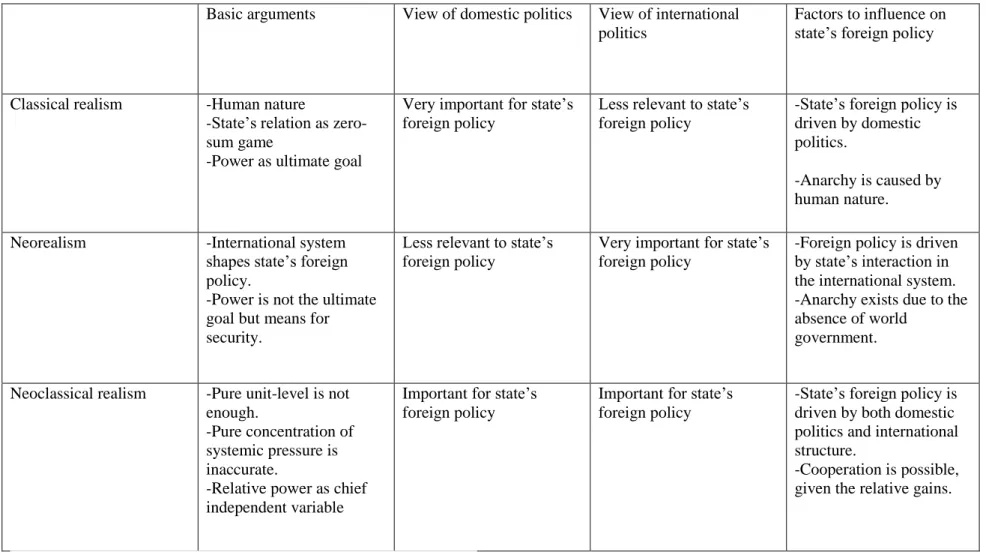
philosophical differences, from placing emphasis on different assumptions or, more often, from varying interpretations of the preceding assumptions.‖ The different view of power, for instance, is a good case to compare. Classical realists argue that power is the ultimate goal of states (Morgenthau, 2006, p. 10). Neorealists, however, argue that power is not the ultimate goal, but just means to maintain security. In the system of anarchy, the ultimate goal of states is to maximize the security to survive (Waltz, 1979, p. 126; 1990, p. 34-36). Within this sense, a comprehensive analysis of state‘s foreign policy is impossible unless and until we understand the disagreements among the three variants of realism.
2.2.1. Classical Realism: Domestic Politics Drives States’ Foreign Policy
Classical realism is one of the key theories in international relations. The assumptions of classical realism are basically drawn from sociology and history, particularly from the Western European history (Taliaferro; Lobell & Ripsman, 2009, p. 19-21). The primary conception of classical realism is central to the human behavior in the state of nature. Individual perceptions of people, therefore, is an essential driving force of state‘s foreign policy.
In the state of nature, as classical realism argues, the human nature is bad, selfish, cruel and untrusted. According to Thomas Hobbes (1998, p. 82-83), men were equally born, and this equality leads to equal freedom to compete for interest, security, and reputation. In the state of nature, people tend to have conflict when they want the same thing, which they cannot share in common. Living in the state
26
of anarchy, security is what people concern the most. Hobbes (1998, p. 84) argued that ―out of civil states, there is always war of everyone against everyone.‖ That is why people sacrifice some of their freedom to live in a civil state in exchange for security protection. As a French philosopher Jean-Jacques Rousseau argues, in the state of nature even farming is not possible for people. The disorder of society caused by the human nature makes it possible that whoever comes first can harvest the crops cultivated by other people (cited in Waltz, 2001, p. 171). As time passes for centuries, the human nature does not change, and it will remain unchanged in the future. It is true. As Morgenthau observes:
Human nature, in which the laws of politics have their root, has not changed since the classical philosophies of China, India, and Greece endeavored to these law. Hence, novelty is not necessarily a virtue in political theory, nor is old age a defect (Morgenthau, 2006, p. 4)
In the history of the Peloponnesian War between the two most powerful Greek city-states, Thucydides (1998, p. 481) argues that ―war is waged by interest, pride, and fears.‖ The rise of Athens, as Thucydides wrote, was then perceived by Sparta as a looming threat to its interests and security. Similarly, even Kenneth Waltz, a prominent supporter of neorealism, agrees that state‘s foreign policy is partly influenced by man‘s behavior. To explain the human behavior, which is known as the First Image in his book Man, the State and War: A Theoretical Analysis, Waltz (2001, p. 16) argues ―the locus of important causes of war is found in the
27
nature and behavior of man. Wars result from selfishness, from misdirected aggressive impulses, from stupidity.‖
While all of these are discussed to reflect how the human nature or domestic politics matters in state‘s foreign policy, it is important to emphasize that the human nature in this context refers to the perceptions of statesmen rather than people in general. Waltz (2001, p. 80) carefully clarifies ―To that the state acts is to speak metonymically. We say that the state acts when we people in it act, just as we say that the pot boils when we mean that the water in it boils.‖ Even though states are actors in the international politics, states cannot make foreign policy on their own, but states‘ political leaders do (Schweller, 2006, p. 47). Based on this, the perceptions of the President, Prime Minister, Ministers, military commanders, and other people involving in decision-making process matter in states‘ foreign policy. Thus, state‘s foreign policy is driven by domestic politics.
Equally important, classical realism sees interstates relations as a zero-sum game. To put in a simple term, classical realism believes that ―my loss is your gain, and my gain is your loss.‖ Thucydides once famously said ―the strong do what they can and the weak suffer what they must‖ (Strassler, 1996, p. 352). The state of nature has never liberated people from such an untrusted environment. As Rousseau argues:
28
It is quite true that it would be much better for all men to remain always at peace. But so long as there is no security for this, everyone, having no guarantee that he can avoid war, is anxious to begin it at the moment which suits his own interest and so forestall a neighbour, who would not fail to forestall the attack in his turn, at any moment favourable to himself, so that many wars, even offensive wars, are rather in the nature of unjust precautions for the protection of the assailant's own possessions than a device for seizing those of others (cited in Lipson, 1984, p. 15).
With the absence of higher authority to guarantee security and order, a reciprocal cooperation is highly unlikely. If we treat someone as a friend, that person may or may not treat us back as a friend, but if we treat someone as an enemy, that person will become our enemy.
To defend his position not to launch a policy to contain China after Deng Xiaoping ordered the crackdown on a peaceful protest at the Tiananmen Square in 1989, Joseph Nye (2013, p. 13), then an Assistant Secretary of Defense during the Clinton Administration, argues that the United States cannot contain China for two reasons: ―if we treated China as an enemy, we were guaranteeing an enemy in the future. If we treated China as a friend, we could not guarantee friendship, but we kept open the possibility of more benign futures.‖ Nye‘s argument reflects an important point, which is central to concerns of classical realism, the unreciprocated cooperation.
29
As Mearsheimer (1994-95, p. 13) points out, even though realism focuses fundamentally on power competition, it does not mean that inter-state cooperation is impossible. States, in fact, are concerned that their partners will finally get a greater share of relative gains from the cooperation. Classical realism, according to Mearsheimer, considers the relative gains as cheating in state cooperation.
The case of Strategic Arms Limitation Talks-II (SALT-II) is a good case to study. Opponents of the treaty argued that the treaty gave the Soviet Union more advantages than the United States, given the lack of mechanisms to monitor the compliance of the Soviet Union, and the difficulties to conduct on-site inspections of some specific weapon systems (Lipson, 1984, p. 16). On surface, SALT-II gave the United States a great deal of advantages for national security as the nuclear arsenals were significantly reduced. Technically, it did not. The lacks of technical mechanisms to fully inspect the implementation of the treaty gave the Soviet Union technical advantages not to fully comply with the agreed principles. In other words, there were rooms for the Soviet Union to cheat. In principle, it seemed that the United States was winning the game. In reality, the United States was not.
All in all, the key assumption of classical realism is state of nature, in which human nature is selfish, cruel and untrusted. While classical realists discuss state‘s foreign policy, they make it clear that states cannot make foreign policy
30
themselves, but their governments do. The perceptions of statesmen matter in states‘ foreign policy. Equally important, selfishness of human being and the absence of world government generate the state of anarchy and insecurity. States, therefore, must depend on their own means for security and survival. Inter-state relations, in the view of classical realism, are zero-sum games. Maximizing the power, of course, is the only thing a state can do to survive.
2.2.2. Neorealism: International System Drives States’ Foreign Policy
Another variant of realism is neorealism. Even though neorealism derived from classical realism, the views of the two theories over the issues of international politics are different. For example, the state of anarchy, from the perspective of classical realism, is caused by unchanged human nature struggling for power and interests (Morgenthau, 2006, p. 179). However, neorealism argues the state of anarchy is caused by the absence of world government in the international system, in which states interact (Waltz, 1979, p. 114). In this section, I will discuss the key concepts of neorealism, and examine how neorealism views the international politics differently from classical realism.
First, unlike classical realism, which argues state‘s foreign policy is driven by domestic politics, neorealism argues that state‘s foreign policy is driven by state‘s interactions in the international system. By distinguishing the three images, Waltz provides an excellent level of analysis of state‘s foreign policy. In the First Image, Waltz (2001, pp. 16; 80-81) acknowledges that human nature matters in
31
foreign policy. However, he argues further that everything is based on human decision, and humans are influenced by several motives. If so, assuming that humans are ―single-minded‖ as ―economic maximizers,‖ is not accurate (Waltz, 1990, p. 27). Therefore, in order to explain things in a more comprehensive way, Waltz suggests that it is important to look beyond the human factors. Waltz argues that the Second Image, domestic political system, is also relevant to state‘s foreign policy. Capitalist countries, for example, support free trades, while Socialist countries view free trades as another form of exploitation, given their disadvantages in free trades.
The Second Image, according to Waltz (2001, p. 125), is that ―the internal structure of states determines not only the form and use of military force but external behavior generally.‖ The ideological competition between the United States and the Soviet Union during the Cold War, for example, took place due to the different domestic political system. The United States perceived the Communism as threat. For example, in 1953, Richard Nixon, then the U.S. Vice President, claimed that people could have lived in a peaceful world if there were no Communist threat (cited in Waltz, 2001, p. 157). The ideological competition is the evidence of how different domestic political system matters in a state‘s foreign policy.
Even though the First and Second Images are relevant to state‘s foreign policy, they are domestic politics. Hence, they have less influence on states‘ foreign
32
policy. However, the Third Image, the international system, is different. The international system, according to Waltz (1990, p. 29), is defined by two important factors: ―the ordering principles of the system,‖ and ―the distribution of capability across units.‖ The state of anarchy is generated when a state interacts with other states within the international system. Because states have a different level of power, their relative power distributions in the system constrain them from doing some certain things. This is how the international system reshapes states‘ foreign policy and that is the core value of Waltz‘s Third Image.
Second, the concept of power as means and ends are also differently viewed by classical realism and neorealism. As briefly mentioned above, classical realism sees power as the ultimate goal, but neorealism sees power as means for security, the ultimate goal of state. Maximizing the power does not always guarantee state‘s survival because having too much power is as dangerous as having too little power. ―Weakness,‖ according to Waltz (1990s, p. 36), ―may invite an attack that greater strength would dissuade an adversary from launching. Excessive strength may prompt other states to increase their arms and pool their effort.‖ A coalition of states in Europe, for instance, was formed to stop the expansion of French Emperor Napoleon in the early 19th century. Two similar coalitions were formed to stop German expansions in both First and Second World Wars. That is why power is not the ultimate goal, but security is.
33
concept of ―capability.‖ When classical realism discusses the term ―capability,‖ according to Schweller and Priess (1997, p. 7), it tends to see capabilities as a relative power distribution of power between state and state rather than the relative power distribution among states within the international system. Waltz (1990, p. 34) points out that classical realism sees causes and effects of state‘s foreign policy run in ―one direction‖ from state‘s interaction to the result of the interaction.
In contrast, neorealism sees the causal relations run in ―two directions.‖ The states‘ capabilities are not just a relative distribution of power between state and state, but also a relative distribution of power among states within the international system (Waltz, 1990, p. 34; Schweller and Priess, 1997, p. 7). In other words, classical realism sees relative power as relations between state and state, while neorealism sees relative power as not just relations between state and state, but also relations that a state has with other states in the international system.
Finally, different from classical realism focusing on the absolute gains, neorealism argues that if the absolute gains are not possible, states are still willing to cooperate if they can get a greater share of relative gains. Waltz contends:
When faced with possibility of cooperating for mutual gain, states that feel insecure must ask how the gain will be divided. They are compelling to
34
ask not ―Will both of us gain?‖ but ―Who will gain more?‖ If an expected gain is to be divided, say, in the ratio of two to one, one state will use its disproportionate gain to implement a policy intended to damage or destroy the other (Waltz, 1979, p. 105).
The unequal gains generated from cooperation among states will enable states gaining a greater share of relative gains to have more political power than other states. While no security guarantee is available in the anarchic international system, the more state gains, the more security it has.
2.2.3. Neoclassical Realism: Domestic Politics, International System, Gaps in Relative Gains Drive States’ Foreign Policy
Thucydides said ―the strong do what they can and the weak suffer what they must,‖ for more than two thousand years ago (Strassler, 1996, p. 352). During the wars in the early 19th century, French Emperor Napoleon once famously said that ―God stand at the big battalion,‖ (cited in Nye, 2011, p. 25). In the mid-20th century, Mao Zedong, who was then leading the people‘s revolutionary war in China, was quoted as saying ―political power grows from barrel of guns‖ (Wei, 2002, p. 229).
As time passes, there is no doubt that material resources remain the fundamental power parameter of state‘s foreign policy. However, the causal relations linking power to the foreign policy making process are not clearly articulated. In other words, it is not clear how power can change a state‘s foreign policy. Seeking a
35
middle way between classical realism and neorealism, neoclassical realism manages to fill this gap by offering a theoretical explanation of causal relations between power and states‘ foreign policy.
Not different from classical realism and neorealism, neoclassical realism shares the common sense of the anarchy in the international politics, security and state‘s survival. However, neoclassical realism, according to Gideon Rose (1998, p. 146-147), argues that the causal relations between power and foreign policy are central to the perceptions of political leaders over their relative power or resources and the systemic pressures. To put it in a simple term, neoclassical realism argues that both perception and the system pressures matter in a state‘s foreign policy. We might not fully understand power if we fail to understand what people are thinking about their relative power and the external environment. Rose, who coined the term of neoclassical realism in 1998, argues:
The scope and ambition of a country‘s foreign policy is driven first and foremost by its place in the international system and specifically by its relative power capabilities. This is why they are realist. However, the impact of such power capabilities on foreign policy is indirect and complex, because systemic pressure must be translated through intervening variables at the unit level. This is why they are neoclassical (Rose, 1998, p. 146).
36
Although classical realism and neorealism are important theories for international politics, both theories have their own weaknesses. Classical realism, for example, focuses mainly on domestic politics. The ―pure unit-level explanations,‖ as Rose (1998, p. 148) points out, are insufficient to analyze states‘ foreign policy simply because states with the similar political system do not always do the same things. The United States and Britain, for instance, are democratic states, but Britain‘s foreign policy expansions are not as active as those of the United States. In addition, analyzing states‘ foreign policy by focusing purely on domestic politics, as Waltz (1990, p. 27) argues, seems to be misguided in the sense that we assume that men are single-minded, while they are not.
Neorealism, on the contrary, pays attentions largely to the systemic structure and gives less significance to domestic politics. Neoclassical realism, however, argues that paying attention to ―systemic factors alone is bound to be inaccurate much of the time‖ (Rose, 1998, p. 152). Fareed Zakaria (1998, p. 187) argues ―nations do not formulate and implement foreign policy and extract resources to that end, governments do.‖ ―State-centered realism,‖ as Zakaria calls, is about the behavior of statesmen as decision makers to influence foreign policy. Neoclassical realists believe that analyzing states‘ foreign policy is not only about how the international system changes, but also about how the changes within the international system are perceived by political leaders. The translations of the changes, as neoclassical realists argue, are certainly a product of unit-level intervening variables, in which perceptions of decision makers and state‘s
37
domestic politics matter in foreign policy making processes.
In addition to linking the perceptions and the systemic pressures together, neoclassical realism also concentrates mainly on states‘ relative power. ―By making relative power as their chief independent variable,‖ neoclassical realists argue that neoclassical realism does not seek security maximization as ―the highest end‖ like neorealism does (Waltz, 1979, p. 126), but neoclassical realism reacts in response to the growing uncertainties and anarchy in the international system by seeking greater control to shape the uncertain external environment (Rose, 1998, 152). Theoretically, neoclassical realism is a status quo strategy that a hegemonic state applies in order to maintain its existing leadership in the current system. As Rose portrays:
Regardless of the myriad ways that states may define their interests, this school argues, they are likely to want more rather than less external influence, and pursue such influence to the extent that they are able to do so. The central empirical prediction of neoclassical realism is thus that over the long term the relative amount of material power resources countries possess will shape the magnitude and ambition – the envelope, as it were – of their foreign policies: as their relative power rises states will seek more influence abroad, and as it falls their actions and ambitions will be scaled back accordingly (Rose, 1998, p. 152).
38
distribution. Nonetheless, they see relative power distribution in different ways. Classical realism sees the relative power distributions as a form of the balance of power between state and state, while neorealism sees the relative power distributions as a form of the balance of power among states in the international system. Neither of them discusses how the changes in relative power, particularly the changes accumulated in the long run, will shape a state‘s foreign policy. Waltz (1979, p. 105), indeed, came very close to discussing the relative gains as he wrote that when states cooperate, they do not simply ask ―will both of us gain?‖ but they tend to ask ―who will gain more?‖ Waltz, however, failed to explain clearly how the changes in relative gains affect a state‘s foreign policy in the long run.
In addition to the unit-level intervening variables, neoclassical realism concentrates on another intervening variable, the changes of state‘s strength (changes of power and material resources). In his book From Wealth to Power: the Unusual Origins of America's World Role, Fareed Zakaria (1998, p.5) observes that the U.S. foreign policy did not expand much before 1890 even though the United States by the end of the 19th century might have already become one of the three or four richest counties in the world. The main reason, as Zakaria argues, is because ―policymakers fail to perceive the shift in their country‘s relative economic position.‖ Within this sense, the expansion of state‘s foreign policy depends on not only changes of relative power but also the perceptions of political leaders over the changes.
39
In the early 19th century, U.S. President John Quincy Adams warned ―country should not go abroad in search for monsters to destroy.‖ The U.S. foreign policy, however, reversed in the early 20th century when President Woodrow Wilson decided to go to war to make ―the world safe for democracy‖ (Rose, 1998, p. 169). These changes, according to neoclassical realists, were driven by the increase in relative power the United States acquired for decades between the Adams and Wilson administrations (Rose, 1998, p. 170). Brian Rathbun (2008, p. 301-302) argues that ―power is powerful only if it can be used, and power can be used only if it can be mobilized.‖ Mobilizing the power is what states are expected to do to have a political unity in order to respond to the external environment through foreign policy designs and implementations. Neoclassical realism offers an explanation how domestic politics is connected with state‘s foreign policy. That is why the U.S. expansion of foreign policy took place in the early 1900s, but not sooner than that.
In neoclassical realism, the term ―relative power‖ does not mean just how much power a state has, but it also means how well the power can help a state to survive and lead the system in the long term perspectives (Snidal, 1993, p. 172). Waltz (2000, p. 27) wrote that the balance of power is not the things that states do for today, but for tomorrow. This is simply because realist theory can only predict that if the balance of power is interrupted, it will be naturally restored at sometime in the future. Unfortunately, realist theory cannot say when exactly the balance of