Japan Advanced Institute of Science and Technology
Title 薬剤及び細胞の放出制御を目指したポリペプチド系の
構築
Author(s) Patel, Monika Citation
Issue Date 2017‑09
Type Thesis or Dissertation Text version ETD
URL http://hdl.handle.net/10119/14837 Rights
Description Supervisor:松村 和明, マテリアルサイエンス研究科
, 博士
Tunable polypeptide systems and their application in controlled delivery of drugs and cells.
Monika Patel s1440207 Kazuaki Matsumura Lab, School of Material Science, JAIST
Background: In the current situation of drug delivery and therapeutics, combination drugs are progressively being developed to improve the curative effect and patient compliance. Several approaches have been employed to co- deliver drugs through a single system, such as multi-shell particles, hydrogels etc. But, to accelerate wound healing and decrease the side effects, a system which can release multiple drugs in suitable doses over a period of required time is the current need. Thus, it is highly desirable, to develop a drug delivery system that can control the release of multiple drugs with distinct release kinetics. For this, we designed a facile polypeptide based dual drug delivery system composed of micelle hydrogel composite.
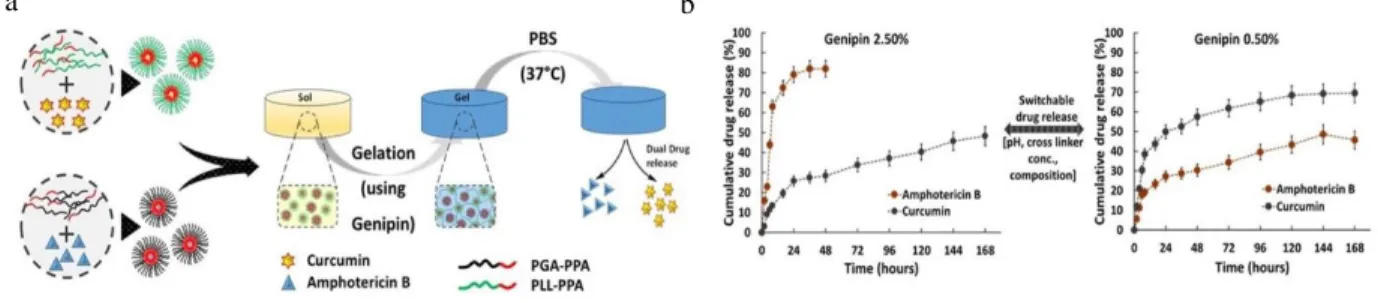
Results and Discussion: Firstly, two differently charged amphiphilic polypeptides were prepared via ring opening polymerization of their specific amino acid NCAs (N-carboxy anhydrides). Thus formed polymers were cationic poly (L-lysine-b–L-phenylalanine) called PLL-PPA, and anionic poly (L- glutamic acid-b-L-phenylalanine) called PGA-PPA. These self-assembling polymers of PLL-PPA and PGA-PPA were loaded with Curcumin (Cur) and Amphotericin B (AmpB) to form stable micelles. The mixture of these drug loaded micelles was then further cross- linked using the free -NH2 groups in PLL-PPA to successfully yield micelle hydrogel composite (Fig. 1a) with cross- linked PLL-PPA micelles and trapped PGA-PPA micelles. Thus, formed composites were studied for drug release properties.
Figure 1 a) Schematic representation of formation of drug loaded micelle-hydrogel composites, b) profile switching of the composites at different cross linker concentration.
The formed drug loaded PLL-PPA and PGA-PPA micelles were found to have spherical morphology with high drug loading efficiency (~80%) and were readily soluble in aqueous medium being stable for up to 14 days. The prepared composites were studied for different parameters: pH, cross-linker conc. and surface potential.
Interestingly, the different environment and charges in the two different micelle components showed controllable yet opposite release kinetics of the drugs. As shown in Fig. 1b, when the micelle-hydrogel composite was subjected to varying degree of crosslinking, the drug release profile of both the drugs showed a switching among
a b
themselves. Cur loaded in PLL-PPA which showed lower drug release at low cross linker concentration switch its profile at higher cross linker concentration where as an opposite trend is seen for Amp B loaded in PGA-PPA.
In summary, a polypeptide based facile drug loaded micelle hydrogel composite was successfully formulated. The release results demonstrated that simple parameters such as pH, resultant zeta potential and crosslinking degree determined release profiles of drugs. And a unique switchable kinetics is observed in drug release profile of drugs.
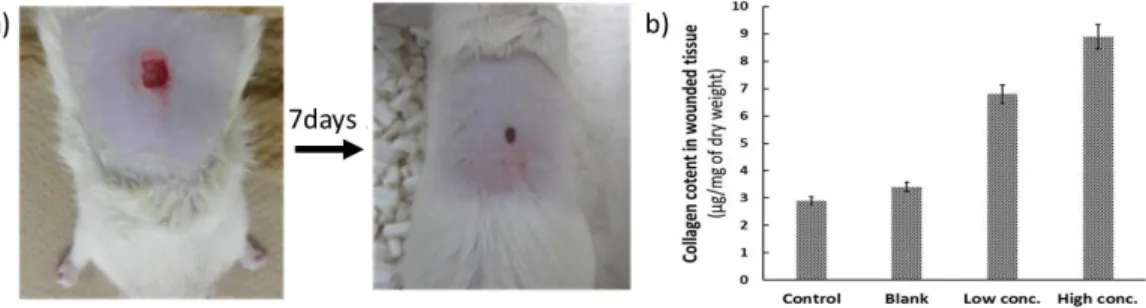
To further evaluate drug release in vivo, rat models were used, excision wounds were created and hydrogel implant was made to cover the wounds and test the release of drug and wound healing. For the same, four different animal groups were created i.e. control (no gel), blank (gel without drug), low concentration (gel with curcumin 1mg/ml) and high concentration (gel with 2.5 mg/ml curcumin). Within 7 days wound size showed a significant decrease among the test animals, as well as increased collagen content was seen in the scared tissue compared to the control groups. And, in rat models tested with high concentration of drug in the gel showed a significant 1.5 times higher collagen content in comparison to control models corresponding to faster healing (figure 2).
Figure 2. In-vivo testing of the hydrogel composites (a) wound reduction in rat model on application of drug loaded hydrogel-micelle composite; (b) amount of collagen in the wounded tissue sample from the animals.
Microencapsulation within hydrogel microspheres holds much promise for drug and cell delivery applications.
Synthetic hydrogels have many advantages over more commonly used natural materials such as alginate1, however their use has been limited due to a lack of appropriate methods for manufacturing these microspheres under conditions compatible with sensitive proteins or cells.
In the meanwhile emulsion techniques such as electrospray has risen as an answer to it. And encapsulation with this technique not only over comes the drawbacks of conventional encapsulation techniques but also provides additional benefits of size control and homogeneity. In this study investigated the use of synthetic polypeptide polymers to form cell encapsulating microspheres via submerged electrospray technique.
L929 murine fibroblasts were cultured in Eagles Minimum Essential Media (EMEM) supplemented with 10%
foetal bovine serum and 100 mg/ml penicillin/streptomycin. When required for experiments, cells were trypsinized and re-suspended in PBS. The polymer solution of poly (L-lysine-co-L-glutamic acid) was dissolved in sterile PBS and the cell suspension was added to give a final cell concentration of 1x10⁶ cells/mL and 5 wt% of polymer. Sterile tetrakis (hydroxymethyl) phosphonium chloride (THPC) was added to a final concentration of 0.05wt% and the solution gently mixed to ensure even cell distribution. The whole solution was transferred to a syringe and electro sprayed.
Spheres produced were smaller for higher voltages and mean size could be tailored from 10 to 300μm. The microspheres exhibited a smooth, spherical morphology, did not aggregate. Also, the L929 fibroblasts were encapsulated within the polypeptide microspheres and showed viability >90% after 24 h and almost 80% viability after 3 days. Cell viability showed no visible influence by the high voltage proving it safe method of cell encapsulation.
Also, the polymer concentration was seen to influence the size of microsphere formation may be due to change in viscosity as the viscous force at meniscus drive the formation of microsphere by electrospray. But still the size was under tailored limits.This process shows great promise for the production of synthetic hydrogel microspheres, and specifically supports encapsulation of cells. The polymeric system shows high cell viability and can be tuned for various sizes of microsphere.
Keywords: Synthetic polypeptide, drug delivery, controlled release, wound healing, cell encapsulation
TABLE OF CONTENTS
Chapter 1: General Introduction 1-49
Chapter 2: Facile amphiphilic polypeptide based micelle-hydrogel composites for controlled dual drug delivery
50-79
Chapter 3: In-vivo testing and measurement of efficacy of the composites in wound healing
80-113
Chapter 4: Polypeptide based microspheres gels for cell encapsulation and delivery 114-137
Chapter 5: General Conclusion 138-140
ACHIEVEMENTS
Publications
Switchable release nano-reservoirs for co-delivery of drugs via a facile micelle-hydrogel composite; Monika Patel, Tatsuo Kaneko, Kazuaki Matsumura, Journal of Materials Chemistry B (2017) 5, 3488-3497; doi: 10.1039/c7tb00701a.
In vivo efficacy of diblock polypeptide based micelle hydrogel composites in wound healing;
Monika Patel, Tadashi Nakaji Hirabayashi, Kazuaki Matsumura (manuscript in preparation)
Polypeptide based microspheres gels for cell encapsulation and delivery; Monika Patel, Yuzuru Takamura, Kazuaki Matsumura (manuscript in preparation)
Patents
JP Application number: 特願2016-221045. 松村和明、Monika Patel 薬物放出制御用ハイドロゲル及びその製造方法
Proceedings and other publications
Facile preparation of transparent poly(vinyl alcohol) hydrogels with uniform microcrystalline structure by hot-pressing without using organic solvents; Tomoyo Sakaguchi, Shusaku Nagano, Mitsuo Hara, Suong-Hyu Hyon, Monika Patel and Kazuaki Matsumura, Polymer Journal (2017) 49, 535–542; doi:10.1038/pj.2017.18
Hierarchical hydrogel formation through micellization of amphiphilic block polypeptide in aqueous media; Monika Patel, Kazuaki Matsumura, 10th World Biomaterials Conference (WBC), Montreal, Canada, May 2016.
A tunable polypeptide based micelle-hydrogel composite for controlled dual drug release;
Monika Patel, Kazuaki Matsumura, Biyani International Conference (BICON-2016), Rajasthan, India, October 2016.