Japan Advanced Institute of Science and Technology
JAIST Repository
https://dspace.jaist.ac.jp/
Title
脂質二分子膜界面における粒子の拡散・透過ダイナミ
クス
Author(s)
執行, 航希
Citation
Issue Date
2017‑03
Type
Thesis or Dissertation
Text versionETD
URL
http://hdl.handle.net/10119/14256
RightsDescription
Supervisor:濱田 勉, マテリアルサイエンス研究科,
博士
氏 名
執行 航 希 学 位 の 種 類
学 位 記 番 号 学 位 授 与 年 月 日
博士(マテリアルサイエンス)
博材第
419号 平成
29年
3月
24日
論 文 題 目
Lateral diffusion and penetration of particles on a lipid bilayer membrane(脂質二分子膜界面における粒子の拡散・透過ダイナミクス)
論 文 審 査 委 員 主査 濵田 勉 北陸先端科学技術大学院大学 准教授 藤本 健造 同 教授 前之園 信也 同 教授 松村 和明 同 准教授 村上 達也 富山県立大学 教授
論文の内容の要旨
General Introduction
Over the past several decades, nanoscience has attracted considerable attention to
develop functional particles for the application to biological system. Nano/submicron
particles can be modified with many kinds of unique properties. For example, gold and
magnetic nanoparticles were used to kill cancer cells by near infrared light and
magnetic field, and carbon particles delivered drug molecules into a cell. For the
development of engineering to control cell function with particle, it is important that
understand the physical mechanisms to govern the emergent behavior between
particles and cellular interface system. Einstein-Storks model has described the
diffusion of single particle in bulk solution. Helfrich free energy has explained
membrane deformation. Each single system well understood. However, emergent
behaviors between particle and cell membrane have been unclarified. In this paper, we
experimentally investigated particle behaviors within artificial lipid bilayer membranes
to clarify physical mechanism of a colloid-membrane system, i.e. composite soft matter.
We focused on typical two motions of particles within the membrane, such as thermal
diffusion and penetration. Particles exhibit a thermal motion under a drag force of
membrane viscosity, once particles are applied to a cell and adhered on the membrane
surface. We analyzed the particle movements and discussed the coupling between
particle lateral diffusions and deformable membranes. Then, particles are expected to
be introduced into a cell interior space by membrane dynamics, such as endocytosis. We
demonstrated the particle penetration process and revealed that an intrinsic
mechanical property of membranes determine the uptake of particles.
Lateral diffusion of submicron particle on a lipid bilayer membrane.
Cells use membrane proteins diffusing on the membrane surface to regulate
the traffic of molecules between their interior and exterior through osmosis, ion channel,
endocytosis, exocytosis and phagocytosis. Control of the motion of proteins diffusing on
the membrane would lead to developing the regulation of physiological functions. There
are two main methods by which the motion of objects on the membrane are controlled.
First, molecules regulate membrane components, such as membrane lipids and
cytoskeletal proteins that reinforce the membrane surface. Second, materials can be
controlled using external stimuli. For example, the motion of self-propelled 10 particles
can be controlled by light, which leads to a change in membrane fluidity and it motion.
However, dynamical properties of such submicron particles on a lipid membrane still
remain unclear.
In this study, we controlled the adsorption states of particles with a diameter of
200-800nm on cell-sized liposomes and investigated lateral diffusion of the adhered
particles. We determined the particle-size-dependence of diffusion. We then studied two
different adsorption states for particles: i) a fully wrapped state and ii) a partially
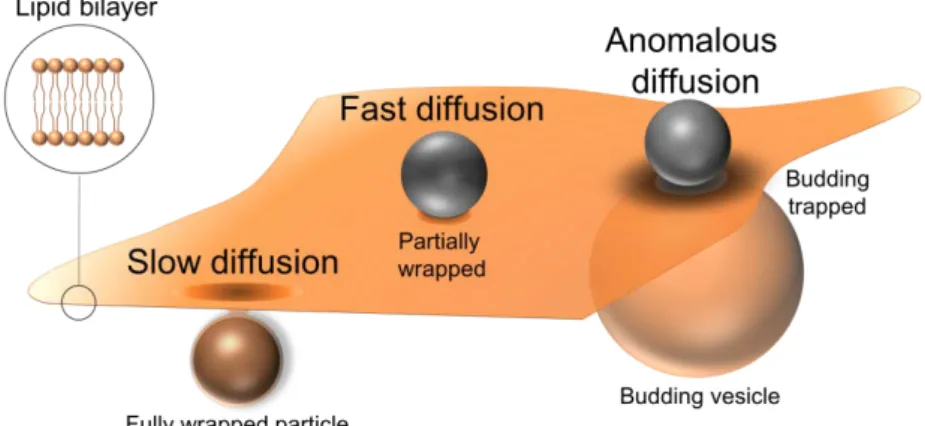
wrapped state. Fully wrapped particles diffused more slowly than partially wrapped
particles. An anomalous diffusion was observed when particles were adhered to a
membrane with buds.
Fig. 1 The behavior of adhered particle on a lipid bilayer membrane.
Tension-induced penetration of particles into lipid bilayers
Nano/Submicron particles have important properties for controlling living cells, such as
drug delivery, local heating and visualization of cell inside. To express these functions,
the particles need to be transported into the cell. For transporting the particles,
normally, cellular functions that are controlled by proteins are used. Recently, we
reported a new particle penetration system without proteins. This indicated that
membrane mechanical properties should play an important role on penetration
behaviors. However, the physico-chemical mechanisms of penetration are unclear. It is
useful that we used model membrane system for physical understand of phenomenon
related with lipid membrane. Here, we had successed the expression of the
self-penetration without any proteins using controlling lateral tension and adhesion
state. In this study, we clarify that the mechanism of the penetration without the
protein. This mechanism is that increasing the lateral tension creates a pore formation
at the neck part of fully wrapped membrane using pore nucleation theory considering
with additional curvature energy.
Fig.2 Lateral tension induced penetration of particle into the cell.
Table of contents
1 Chapter I. General Introduction p13
2 Chapter II Lateral diffusion of a submicron particle on a lipid bilayer
membrane p39
3 Chapter III Tension-induced penetration of particles into lipid bilayers p66
4 Chapter IV. General conclusion p88
List of publication
1. Shigyou, K.; Nagai, K. H.; Hamada, T. Lateral Diffusion of a Submicrometer Particle on a Lipid Bilayer Membrane. Langmuir 2016, 32, 13771–13777.
2. Kawasaki, S.; Muraoka, T.; Hamada, T.; Shigyou, K.; Nagatsugi, F.; Kinbara, K.
Synthesis and Thermal Responses of Polygonal Poly(ethylene Glycol) Analogues. Chem Asian J 2016, 11, 1028–1035.
3. Seemork, J.; Sansureerungsikul, T.; Sathornsantikun, K.; Sinthusake, T.;
Shigyou, K.; Tree-udom, T.; Jiangchareon, B.; Chiablaem, K.; Lirdprapamongkol, K.; Svasti, J.; et al.Penetration of Oxidized Carbon Nanospheres through Lipid Bilayer Membrane: Comparison to Graphene Oxide and Oxidized Carbon Nanotubes, and Effects of pH and Membrane Composition. Acs Appl Mater Interfaces 2016, 8(36):23549-57.
4. Tree-Udom, T.; Seemork, J.; Shigyou, K.; Hamada, T.; Sangphech, N.; Palaga, T.;
Insin, N.; Pan-In, P.; Wanichwecharungruang, S. Shape Effect on Particle-Lipid Bilayer Membrane Association, Cellular Uptake, and Cytotoxicity.Acs Appl Mater Interfaces 2015, 7, 23993–4000.
5. Arayachukiat, S.; Seemork, J.; Pan-In, P.; Amornwachirabodee, K.; Sangphech, N.; Sansureerungsikul, T.; Sathornsantikun, K.; Vilaivan, C.; Shigyou, K.;
Pienpinijtham, P.; et al. Bringing Macromolecules into Cells and Evading Endosomes by Oxidized Carbon Nanoparticles. Nano Lett 2015, 15, 3370–3376
Key words
Lipid membrane, lateral diffusion, colloidal particle, pore nucleation theory, lateral-tension, penetration.
論文審査の結果の要旨
本論文は、脂質二分子膜界面に吸着したサブミクロン粒子の側方拡散および膜透過プロセスに ついて光学顕微鏡による詳細な観察を行い、そのメカニズムを理論的に説明したものである。
近年、ドラッグデリバリーシステムなどの生体系への応用を目指した粒子の開発が進められて いる。外部から来た粒子は、先ず細胞の表面である脂質二分子膜に吸着し、膜上で拡散する。そ して、膜の変形を伴い内部へと取り込まれることになる。この様な粒子の動きを制御していくに
は、ソフト界面である脂質膜が粒子のダイナミクスに与える物理的効果を理解することが重要と なる。これまでに粒子吸着による膜変形や膜上で凝集した粒子に関する報告があるものの、膜面 上における粒子の動きを明らかにした実験的研究は数少ない。ここでは、細胞をモデル化した細 胞サイズの人工脂質膜小胞を用いて、膜界面に粒子を吸着させ、膜面上における粒子の拡散現象 および透過現象のダイナミクスを明らかにした。
本論文の前半(第二章)では、膜面上における粒子のブラウン運動を解析した。先ず、顕微鏡 像の画像解析から、粒子運動の平均二乗変位を測定した。拡散係数の粒子サイズ依存性を明らか にし、理論モデルとの比較を行った。実験結果をフィッティングすることで得られた膜粘性の値 は、過去の測定値と良く一致した。そして、粒子と膜の吸着力をコントロールして拡散現象への 影響を調べると、膜に包まれた吸着状態の粒子は小さい拡散係数を持つことを発見した。さらに、
膜が出芽変形した部位に粒子が局在化し、異常拡散性を示すことが分かった。本成果は、ソフト な膜界面とカップルした粒子の拡散挙動を初めて明らかにしたものである。
本論文の後半(第三章)では、吸着した粒子が膜面を透過して内部に取り込まれるダイナミク スを解析した。浸透圧を利用して膜に張力を印加することで、吸着粒子が膜から切り離され内部 に移動する現象を発見した。そして、取込みに必要な張力値を実験的に明らかにした。加えて、
膜の曲率弾性エネルギーを考慮した核生成理論を考案し、張力が誘起する膜孔形成が曲率の高い 膜面部位に生じやすいことを示した。この高い曲率部位は粒子が吸着している膜領域の接続部
(くびれ)に対応しており、膜孔の形成が膜を分裂させて粒子を内部へと導いたことを説明して いる。この成果は、外部環境から細胞内に物質を取り込ませる過程の一部が物理現象として理 解・制御できる可能性を示すものであり、生物医学上有用な知見である。
以上、本論文は、脂質二分子膜界面における粒子の拡散および透過ダイナミクスの物理化学的 機構を明らかにしたものであり、学術的に貢献するところが大きい。よって博士(マテリアルサ イエンス)の学位論文として十分価値あるものと認めた。