A new type of intra-plate volcanism; young
alkali-basalts discovered from the subducting
Pacific Plate, northern Japan Trench
著者
Hirano N., Kawamura K., Hattori M., Saito
K., Ogawa Y.
journal or
publication title
Geophysical Research Letters
volume
28
number
14
page range
2719-2722
year
2001-05
URL
http://hdl.handle.net/10097/53876
doi: 10.1029/2000GL012426
GEOPHYSICAL RESEARCH LETTERS, VOL. 28, NO. 14, PAGES 2719-2722, JULY 15,2001
A new type of intra-plate volcanism; young alkali-basalts
discovered from the subducting Pacific Plate, northern Japan
Trench
N. Hirano
l, K. Kawamura
?,
M. Hattori
3,
K. Saito
4 and
Y. Ogawa
-•
Abstract. Alkali pillow basalts were collected from the toe of the oceanward slope of the northern Japan Trench. These alkali-basalts formed as a result of a low degree of partial melting of Pacific Ocean mantle and rapid rise of the magma (no fractionation in shallow magma chambers). Reconstructing Pacific Plate motion based on 40Ar-•9Ar age dates of 5.95_ 0.31 Ma for these basalts indicates that they erupted outboard of outer swell or forebulge of the Japan Trench in the NW Pacific. We suggest that these alkali-basalts represent a new form of intra-plate volcanism, whereby magmatic activity occurs off the forebulge of the downgoing Pacific slab, perhaps using conduits related to fracturing of the slab during bending prior to subduction.
1. Introduction
Alkali-basalts occur on various parts on the surface of the earth, most particularly in continental and hotspot areas. These alkali-basalts are products of deep-origin magma from the upper mantle or lower depths. Occurrences of such alkali-basalt are also documented from tectonically unique locations, such as along deep fractures in oceanic crust.
Alkali olivine basalt and trachyandesite representative of the
ocean island basalt series have been documented around the
Japan Trench on the Joban, Erimo and Takuyo Seamounts [Kobayashi et al., 1987; Cadet et al., 1987]. The 40Ar•9Ar ages of these volcanic rocks range from 120 Ma (Daiichi-Kashima
Seamount in the Joban Seamount Chain) to 104 Ma (Erimo
Seamount) [Takigami et al., 1989], indicating that these are the products of Cretaceous off-ridge seamount volcanism (Fig. 1A). In contrast, the bathymetry of the study area does not show any evidence for a large volcanic edifice or seamount, but only a small mound (Fig. lB).
This paper describes an occurrence of young alkali-basalt on the downgoing oceanic slab of a subduction zone. We present the geologic setting, major and trace element compositions, and 40Ar-39Ar age of these basaltic rocks. We then discuss the tectonic and geophysical implications for this first documentation of alkali-basaltic magmatism outboard of outer swell of a subducting oceanic slab.
2. Occurrence and description
of samples
Continuous outcrops of pillow basalt were documented and sampled at depths of 7325 to 7360 m on the oceanward slope toe IDoctral Program in Geoscience, University of Tsukuba, Tsukuba, Japan.Now at Ocean Research Institute, University of Tokyo, Tokyo, Japan.
2Fukada Geological Institute, Tokyo, Japan
3Japan Marine Science and Technology Center, Yokosuka, Japan
4Department of Earth and Environmental Sciences, Faculty of Science,
Yamagata University, Yamagata, Japan
5Institute of Geoscience, University of Tsukuba, Tsukuba, Japan Copyright 2001 by the American Geophysical Union.
Paper number 2000GL012426.
0094-8276/01/2000GL012426505.00
of the northern Japan Trench (39023 ' N, 144016 ' E) during
JAMSTEC (Japan Marine Science and Technology Center) R/V Kairei/ROV KAIKO cruise KR97-11. The slope is characterized by trench-parallel (N-S) normal faults with some NNW or NNE faults, due to warping of the downgoing Pacific Plate (the age of the Pacific Plate here is Early Cretaceous [Kobayashi et al., 1998]) (Fig. 1). These normal faults bound horst and graben structures that are approximately 5 km in horizontal extent with
100 to 500 m vertical separations [Ogawa and Kobayashi, 1993;
140øE 145'E 1501E
0%•
[ • •J.•_
Rise ,]
...
Figure 1. Index maps of the dive site. A: The general bathymetric map of the northwest Pacific ocean floor based on Kobayshi et al. (1998). Black area is trench floor deeper than 7000 m, and grey-shaded area is the outer swell (<5400 m in depth). Radiometric ages of Erimo (a), Ryofu (b), Daini-Kashima (c) and Daiichi-Kashima (d) Seamounts are obtained as follows respectively; (a) 104 Ma and (d) 120 Ma 40Ar-39Ar age [Takigami et al., 1989], (b) 70-72 Ma and (c) 81 Ma K-Ar age [Ozima et al.,
1977]. The approximate eruption site is plotted as asterisk. B: Seabeam bathymetric map of the dive site 10K#56 by R/V KAIREI at the northern Japan Trench. Contour interval is 250 m. Trench axis is shown by white arrow.
2720 HIRANO ET AL.' A NEW TYPE OF INTRA-PLATE VOLCANISM
Figure 2. Outcrop photograph of the pillow basalt taken by R/V KAIREI video record, indicating a large pillow structure. The field of view is approximately 1 m in length.
Ogawa eta/., 1996]. There is no distinct seamount topography
associated with the alkali pillow basalt outcrops, however a subdued moundqike feature (100 to 200 m hight, 1 to 2 km in diameter) is recognized using seabeam sonar bathymetric mapping (Fig. lB).
The ROV KAIKO was used to sample rocks from the toe of the oceanward slope (downgoing Pacific Plate) of the subduction
zone. The slopes have an average dip of 25 ø but are locally very
steep, forming escarpments along which there are exposures of
I mm,J, . ,,,, , ,, , ,,,,,,,, ,
....
,•:;:'•'•
•: .: ";,,'-:"'.-
•'• ' ""•*"•'r olivine
, •,.,.•'•
Micro
crystaline• B
around •,.•
-m.:• ,', •
Ol•wne phenocryst
Groundmass
lmm•' '
Figure 3. Photomicrographs
of thin section
of sample
(10K#56
R-002). A: groundmass. B' Olivine phenocryst surrounded by
micro crystalline olivine.
0.6 A Phenocryst
z•
O Micro crystals around phenocryst _.
•
I'-!
In
groundmass
%
0 •
z
o
•
I I
%5
8'o
•o olivine •o
•5
Figure 4. Fo value rs. NiO plot of olivine from 10K#56 R-001 and R-002. Open box zone is mantle olivine array after
Taka• ½• M. (198?). A•ows show trends of oilyinc frsction•
crystallization after •o (19??).
alkali pillow basalt outcrops at depths of 7325 to 7360 m. The cliffs are covered with thin drapings of soft, black, muddy sediments. The total thickness of the basalt outcrops is more than 35 m. The outcrops are alternations of pillow lava (Fig. 2) and hyaloclastite.
Two samples, 10K#56 R-001 and R-002, were collected from pillow lava outcrops at around 7360 m depth (Fig. 2). Both samples exhibit curved foliations, representing the surface of a pillow of around 30 cm in diameter. The samples contain a large proportion of vesicles, reaching 10-30 volume percent. The rocks and minerals, which have a dendritic texture, are very fresh, even in vesicles. Large olivine phenocrysts make up from 1.0 % to 2.4 % in volume (R-001 and R-002, respectively), and the groundmass is composed of olivine, Ti-augite, microcline and opaque minerals (Fig. 3A). The olivine phenocrysts (Fo values, 90-93, and NiO contents, 0.3-0.5 wt%) (Fig. 3B) are more primitive in origin than those in the groundmass (Fo values, 80-90, and NiO contents, 0.1-0.5 wt%), and have compositions in equilibrium with the mantle olivine array [Sato, 1977; Takahashi et at., 1987] (Fig. 4). Small crystalline olivines around phenocrysts have the same composition as groundmass olivines. Potassium rich contents of microcline, and Ti-augite (TiO•; 2.0 to 5.0 wt%) characterize the highly alkaline magma. Ilmenite is the most common opaque mineral in the groundmass (Fig.3A). Bulk chemical compositions (Table 1 and 2), trace elements spidergram (Fig. 5A) and REE pattern (Fig. 5B) show that these rocks are enriched in incompatible elements and can be characterized as potassium-rich alkali-basalts, shoshonites.
3. 40AF-39AF
dating
Sample 10K#56 R-002 was irradiated in the Japan Material Testing Reactor (JMTR) along with three flux monitors (HD-B 1 biotite) and synthetic salts to permit the corrections for interfering isotopes. The sample was subjected to eight step-heating intervals by induction heating. The method of Ar isotopic analysis follows Saito et at. (1991). Precision limits represent propagated measurement and J-value uncertainties and are reported throughout this paper at the 2 o level. The detailed
data can be obtained through URL [http://www.f2.dion.ne.jp/- nhirano/JT/].
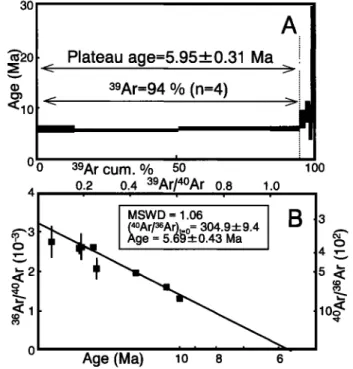
In order to obtain a plateau age in age-spectrum, we need consistent age over three continuous fractions at 2 o level. A plateau age of 5.95 _ 0.31 Ma for the sample 10K#56 R-002 was
calculated in the age spectrum (Fig. 6a). The J-value error was
not used in the age spectrum, and was included at the last stage of age calibration as a plateau age. In addition, we obtained a well-defined isochron using the inverse isochron method (Fig. 6b), and the derived isochron age (5.69__+0.43 Ma) is in accord
HIRANO ET AL.: A NEW TYPE OF INTRA-PLATE VOLCANISM 2721
Table 1. Bulk compositions of 10K#56 R-001 and R-002 by XRF analysis.
sample major element (wt%)
SiO 2 TiO 2 AI203 Fe203 FeO MnO MgO CaO Na20 K20 P205 H20+ H20-
R-001 bulk 48.22 2.56 10.30 6.38 4.23 0.14 11.68 7.47 2.95 3.17 0.78 1.76 0.36 groundmass a 48.84 2.72 11.60 10.44 - 0.13 8.23 7.68 3.04 3.88 0.83 1.23 1.39 R-002 bulk 48.45 2.84 11.26 6.12 4.36 0.13 7.83 8.14 3.28 3.63 0.84 2.49 0.64 groundmass a 49.27 2.84 12.18 10.00 - 0.12 6.61 7.61 3.13 4.11 0.87 1.47 1.81 trace element (ppm) Ba Ce Co Cr sample Total 100.00 100.00 100.00 100.00 Ga Nb Ni Pb Rb Sr Th V Y Zr R-001 bulk 1202.3 94.4 56.7 527.8 17•7 36.6 418.1 7.2 47.0 1076.5 2.0 140.1 groundmass d 1176.8 -154.0 424.0 - 37.4 163.1 6.9 56.2 1212.4 4.7 - R-002 bulk 1209.5 108.7 46.7 400.5 20.2 40.3 227.8 7.3 53.1 1092.4 2.0 143.4 groundmass d 1191.2 - 129.0 353.0 - 39.4 117.2 7.3 59.0 1140.4 4.9 -
a Data for the samples separated the olivine phenocryst from the groundmass. In this data a, Fe203 show the total Fe-oxide.
14.2 243.0
18.8 263.8
15.3 259.9
19.7 273.8
Table 2. REE compositions of the bulk samples by the ICP-MS analysis. Analyzed by Dr. M. Komuro and Ms. K. Fujii, Institute of Geoscience, University of Tsukuba (personal communication).
ppm
Y La Ce Pr Nd Sm Eu Gd Tb Dy Ho Er Tm Yb Lu
R-001 19.17 54.07 106.95 12.03 49.35 9.41 2.98 7.74 1.00 4.63 0.77 1.83 0.23 1.41 0.19 R-002 20.78 58.69 114.28 12.97 53.61 10.02 3.22 8.38 1.08 4.72 0.88 1.93 0.23 1.46 0.20
4. Tectonic interpretation and geophysical
implication
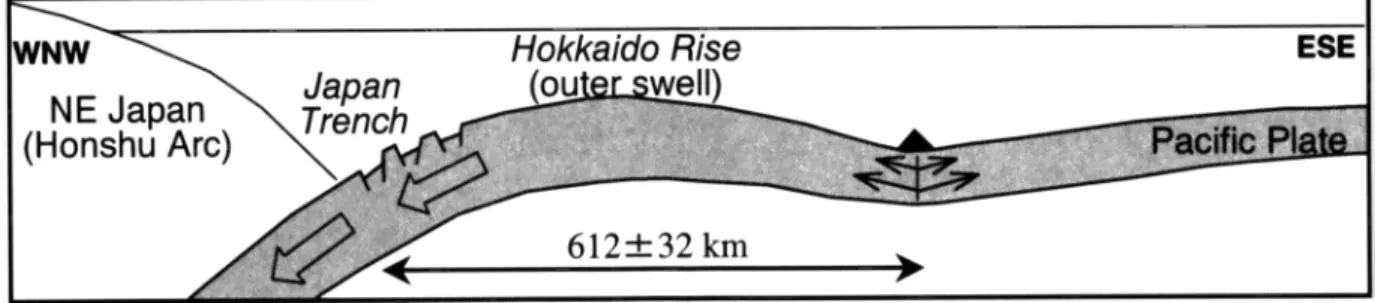
The alkali-basalts documented here are very young, much younger than the ocean floor in this area (identified isochron M9 or M10; around 130 Ma [Gradstein et al., 1994; Kobayashi et al., 1998]). Seamounts in this region are also Cretaceous, with ages ranging from 120-104 Ma. In contrast, the rocks analyzed in this study have ages of 5.95+0.31 Ma (latest Miocene), and are found in small-volumes along seafloor escarpments rather than on seamounts or large volcanic constructions. By performing a plate tectonic reconstruction we have determined that there is no plausible hotspot that could have produced these basalts. We have reconstructed the eruption location of these basalts using the 40Ar-39Ar age of 5.95 + 0.31 Ma and the present "absolute" motion of the Pacific Plate (10.29 cm/yr to 295.26 degrees [ Gripp and Gordon, 1990]). Using this method we have derived a position of approximately 612+32 km ESE off the northern Japan Trench, now approximately at 37øN, 149øE. As the volcanic front in the NE Japan Arc has scarcely shifted since the latest Miocene [Ohki et al., 1993], the kinematics of the Pacific slab at 5-6 Ma are the same as at present. According to the
lOO
o.1
sr K RI:BaThTaNI:CeP ZrHfSmTi Y YbScCr LaCePr Nd SmEuGdT'bDyHoErTmYbLu
Figure $. Spidergrams of trace element concentrations in samples 10K#56 R-001 and R-002. A: Normalized by average
MORB [Pearce, 1982, 1983]. B: Chondrite-normalized REE
pattern [Evensen et al., 1978]. U, Ta and Hf were not analyzed.
bathymetric chart of the northwest Pacific, this area corresponds to a site just oceanward of the current outer swell or forebulge (Hokkaido rise), with an inferred paleo-depth of-6000 m (asterisk in Fig. 1A).
Enriched incompatible element concentrations and REE pattern indicate that the magma source for these alkali-basalts formed as a result of low degree of partial melting. Disequilibrium between olivine phenocrysts and groundmass olivines suggest that the phenocrysts may be xenocrysts transported from deep in the mantle with rapid rise of the alkali-basaltic magma. If a fracture occurs or is rejuvenated in the
03201.
q:10
Plateau age=5.95_0.31 Ma
39Ar=94 % (n=4)
A.
•3
0 o
39Ar cum. % 500.2
0.4 39Ar/4øAr 0.8
1.0
ß . ,MSWD
40 36= 1 .O6
-I- 4B
"',k (4 Ar/ Ar),=o= 304.9_9.Age (Ma)
lO
8
6
100 310•
Figure 6. Age determination results by 40Ar-39Ar method of sample 10K#56 R-002. Correction factors and J-value are as follows; (36Ar/37Ar)ca = (3.744-1-0.082) X 10 -4, (39Ar/37Ar)ca = (9.30+0.44)X 10-4 and J = (3.412+_.0.063)x 10-3. Calculated using decay constants and potassium isotope ratios from Steiger and Jager (1977).
2722 HIRANO ET AL.: A NEW TYPE OF INTRA-PLATE VOLCANISM
Hokkaido Rise
Japan
I)
NE Japan
Trench
(Honshu
Arc)
Pacific
612___32 km
ESE
Figure
7. A model
of possible
alkali-basalt
eruption
on
the
old
oceanic
crust
toward
the
subduction
zone.
Fracturing
of Pacific
Plate
toward
the outer
swell
may
result
in the formation
of conduits
for magma
flow to the surface.
oceanic lithosphere, magma from the lowest part where fracture reached may erupt to the seafloor. It can be also assumed that melting was induced by decompression in the upper mantle. The occurrence, mineralogical and chemical characteristics of the basalt samples documented here show that the magma could have
ascended toward the surface in this way.
We suggest a possible scenario for the formation and eruption of this new type of intra-plate alkali-basalt (Fig. 7). 1) The oceanic crust undergoes lithosphere scale orthogonal flexure as it begins to enter the outer swell. 2) Extension on the inside of the lithosphere folding on this large-scale causes decompression melting in the upper portions of the lower mantle. 3) Fracturing during folding results in the formation of conduits for magma
flow to the surface. If these processes are intrinsic to the subduction of oceanic crust, alkali-basalts should be common in forebuldge regions worldwide.
Geophysical investigations may reveal more about this new type of intra-plate volcanism, specifically about the relationship
between subduction and the formation and eruption of alkali- basalts on the outer swell or forebuldge of a subducting slab. If
orthogonal flexure, decompression melting, and fracturing occur
in the downgoing slab as it enters the subduction zone, they
should impart specific physical characteristics (density, velocity,
faults and fractures) to the crust and lithospheric mantle. Seismic
tomography, seismic reflection/refraction surveys, gravity, and earthquake seismicity should all reflect these changes to the
oceanic slab as it moves through the forebulge into the subduction zone.
Acknowledgments. We owe much to the crew of the mother vessel R/V KAIREI of JAMSTEC and ROV operation team, particularly Captain H. Tanaka and Commander T. Fukui. We highly appreciate the staff of the Institute for Material Research, Tohoku University (Oarai Branch) for irradiating samples in the Japan Material Testing Reactor (JMTR). Drs. T. Ishii and H. Sato of Ocean Research Institute, University of Tokyo, Dr. N. Iwata, Faculty of Science, Yamagata University, and Dr. T. Yoshida, Faculty of Science, Tohoku University, and Dr. K. Komuro and Ms. K. Fujii, Institute of Geoscience, University of Tsukuba, for chemical analysis and age determination. Discussions by Prof. K. Miyano and Dr.
M. Kurosawa of Institute of Geoscience, University of Tsukuba are also
greatly appreciated. Early draft was critically reviewed and revised by Dr.
D. Curewitz of Ocean Research Institute, University of Tokyo, to whom
we are grateful.
References
Cadet, J.P., K. Kobayashi, J. Aubouin, J. Boulegue, C. Deplus, R. Von Huene, L. Jolivet, T. Kanazawa, J. Kasahara, K. Koizumi, S. Lallemand, Y. Nakamura, G. Pautoto, K. Suyehiro, S. Tani, H.
Tokuyama and T. Yamazaki, The Japan Trench and its juncture with
the Kuril Trench: cruise results of the Kaiko project, Leg 3, Earth
Planet. Sci. Lett., 83, 267-284, 1987.
Evensen, N.M., Hamilton, P. J. and O'Nions, R. K., Rare-earth
abundances in chondritic meteorites, Geochim. Cosmochim. Acta, 42, 1199-1212, 1978.
Gradstein, F. M., F. P. Agterberg, J. G. Ogg, J. Hardenbol, P. V. Veen, J.
Thierry and Z. Huang, A Mesozoic time scale, J. Geophys. Res., 99,
24051-24074, 1994.
Gripp, A. E. and R. G. Gordon, Current plate velocities relative to the
hotspots incorporating the NUVEL-1 global plate motion model, Geophys. Res. Lett., 17, 1109-1112, 1990.
Kobayashi, K., J.P. Cadet, J. Aubouin, J. Boulegue, J. Dubois, R. Von Huene, L. Jolivet, T. Kanazawa, J. Kasahara, K. Koizumi, S.
Lallemand, Y. Nakamura, G. Pautot, K. Suyehiro, S. Tani and H.
Tokuyama, T. Yamazaki, Normal faulting of the Daiichi-Kashima
Seamount in the Japan Trench revealed by the Kaiko I cruise, Leg 3.,
Earth Planet. Sci. Lett., 83, 257-266, 1987.
Kobayashi, K., M. Nakanishi, K. Tamaki and Y. Ogawa, Outerslope
faulting associated with the eastern Kuril and Japan Trenches, Geophysical Journal International, 134, 356-372, 1998.
Ogawa, Y. and K. Kobayashi, Mud ridge on the crest of the outer swell off Japan Trench. Marine Geology, 111, 1-6, 1993.
Ogawa, Y., K. Kobayashi, H. Hotta and K. Fujioka, Tension cracks on the oceanward slopes of the northern Japan and Mariana Trenches,
Marine Geology, 114, 111-123, 1996.
Ohki, J., Watanabe, N., Shuto, K., and Itaya, T., Shifting of the volcanic
fronts during Early to Late Miocene in the northeast Japan arc, The
Island Arcs, 2, 87-93, 1993.
Ozima, M., Honda, M. and Saito, K., 40Ar/39Ar ages of guyots in the western Pacific and discussion of their evolution, Earth Planet. Sci. Lett., 51,475-485, 1977.
Pearce, J. A., Trace element characteristics of lavas from destructive plate boundaries, in Andesites, edited by R. S. Torpe, pp.525-548, John Wiley and Sons, New York, 1982.
Pearce, J. A., Role of the sub-continental lithosphere in magma ganasis at active continental margins, in Continental Basalts and Mantle
Xenoliths, edited by C. J. Hawkesworth and M. J. Norry, pp.230-249,
Shiva, Nantwich, 1983.
Saito, K., Otomo, I. and Takai, T., K-Ar dating of the Tanzawa tonalitic body and some restrictions on the collision tectonics in the south Fossa Magna, cantral Japan, J. Geomag. Geoelectr., 43, 921-935,
1991.
Sato,
H., Nickel
content
of basaltic
magma:
identification
of primary
magmas and a measure of the degree of olivine fractionation, Lithos, 10, 113-120, 1977.
Steiger, R. H. and Jager, E., 1977, Subcommission on geochronology: convection on the use of decay constants in geo- and cosmochronology, Earth Planet. Sci. Lett., 36, 359-362.
Takahashi, K., K. Uto and J. G. Schilling, Primary magma compositions
and Mg/Fe ratio of their mantle residues along Mid Atlantic Ridge 29
-N to 73-N, Technical Report oflSEl, Okayarea Univ., 1-4, 1987. Takigami, Y, I. Kaneoka, T. Ishi, Y. Nakamura, 40Ar-39Ar ages of
igneous rocks recovered from Daiichi-Kashima and Erimo Sea mounts
during the KAIKO project, Palaeogeography, Palaeoclimatology,
Palaeoecology, 71, 71-81, 1989.
N. Hirano, Ocean Research Institute, University of Tokyo, 1-15-1
Minamidai, Nakano, Tokyo, 164-8639, Japan. (nhirano@ ori.u-tokyo.ac.jp)
K. Kawamura, Fukada Geological Institute, Tokyo, Japan.
M. Hattori, Japan Marine Science and Technology Center, Yokosuka, Japan.
K. Saito, Department of Earth and Environmental Sciences, Faculty of
Science, Yamagata University, Yamagata, Japan.
Y. Ogawa, Institute of Geoscience, University of Tsukuba, 1-1-1
Tennoudai, Tsukuba, 305-8571, Japan. (yogawa @ arsia.geo.tsukuba.ac.jp)
(Received Octorber 03, 2000; revised April 19, 2001; accepted May 02, 2001.)