Japan Advanced Institute of Science and Technology
JAIST Repository
https://dspace.jaist.ac.jp/
Title
微量の反応性官能基を有するポリプロピレンの複合材料への応用
Author(s)
Kurahashi, EijiCitation
Issue Date
2020‑03‑25Type
Thesis or DissertationText version
ETDURL
http://hdl.handle.net/10119/16664Rights
Description
Supervisor:谷池 俊明, 先端科学技術研究科, 博士Application of Functionalized Polypropylene with a Trace Amount of Reactive Functional Groups for Composite Materials
Taniike Laboratory, Student Number: 1720007, Eiji Kurahashi
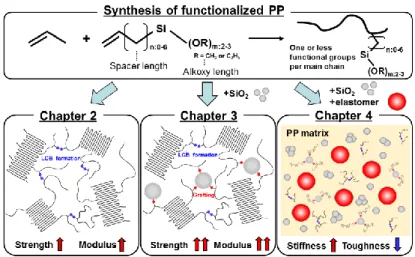
Polypropylene (PP)-based nanocomposites have been an important class of materials, especially in industry, due to their wide range of potential applications. However, the chemical inertness of PP results in the poor dispersion and weak interfacial bonding for most of fillers, and thus performant nanocomposites are not attained. In my thesis, PP having a trace amount of reactive functional groups was synthesized by means of direct copolymerization, and it was utilized as a reactive matrix for preparing graft-type nanocomposites (Fig. 1). The presence of a trace amount of reactive functional groups, in particular, one or less silicon alkoxy groups per main chain, were expected to solve both the dispersion and interface problems through in-situ grafting to fillers during melt-mixing without deteriorating physical properties of PP.
In Chapter 2, the synthetic feasibility was investigated for PP functionalized with a trace amount of reactive functional groups. Propylene was copolymerized with various olefins containing alkoxysilanes having different alkoxy groups and/or different spacer lengths between the alkoxy groups and olefinic bond. It was found that keeping the polar alkoxy groups away from the olefinic bond via a longer spacer was most effective in achieving comonomer incorporation at a reasonable activity. On the other hand, steric hindrance around alkoxy groups mask them to suppress catalytic poisoning but at the cost of incorporation. PP bearing a trace amount of methoxysilane groups in the side chain (defined as PP-OTMS) was successfully synthesized using (7-octen-1-yl)trimethoxysilane as a comonomer. PP-OTMS formed a long-chain branched (LCB) structure by intermacromolecular reaction during melt mixing, resulting in enhanced yield strength and Young’s modulus without deteriorating other important properties of PP.
In Chapter 3, PP-OTMS having 0.02–0.12 side chains per main chain was synthesized and melt-mixed with SiO2
nanoparticles. The consumption of functional groups during melt mixing was found to increase in the presence of SiO2 nanoparticles, which suggested that PP-OTMS not only reacted with each other but also in-situ grafted to the SiO2 nanoparticles. The obtained PP-OTMS/SiO2 nanocomposites exhibited properties unique for graft-type nanocomposites such as i) suppression of a viscosity increment caused by the addition of SiO2 nanoparticles, ii) acceleration of crystallization, and iii) improvement of SiO2 dispersion. Hence, graft-type nanocomposites were successfully prepared. Combination of the LCB structure and grafting to SiO2 nanoparticles further enhanced the yield strength and Young’s modulus.
In Chapter 4, PP-OTMS was applied for PP/elastomer/SiO2 nanocomposites to understand the effects of grafting in a ternary system. In the presence of reactive functional groups, the dispersion of SiO2
nanoparticles in the PP matrix was improved while the dispersion of the droplet phase was not affected. The results of tensile and impact tests indicated that the grafting was advantageous for stiffness but detrimental for the toughness. Based on these results, a guideline to design nanocomposites with balanced toughness and stiffness was proposed.
In conclusion, PP having less than one reactive functional groups per chain was efficiently synthesized by copolymerization, and successfully applied in in-situ grafting to fillers during melt mixing. This technical development will greatly contribute to the practical application of PP-based nanocomposites.
Keywords: Polypropylene, functionalization, nanocomposites, silica, in-situ grafting
Fig. 1 Schematic summary of this study.