*Correspondence to: Yoshikawa, Y.: [email protected]
(Supplementary material: refer to PMC https://www.ncbi.nlm.nih.gov/pmc/journals/2350/) ©2021 The Japanese Society of Veterinary Science
Identification of the core motif of the BRCA2
C-terminal RAD51-binding domain
by comparing canine and human BRCA2
Yasunaga YOSHIKAWA
1)*, Masami MORIMATSU
2), Kazuhiko OCHIAI
3),
Toshina ISHIGURO-OONUMA
4), Ryo MORIOKA
1), Kento OKUDA
1)and
Koichi ORINO
1)1)Laboratory of Veterinary Biochemistry, School of Veterinary Medicine, Kitasato University, Aomori 034-8628, Japan
2)Laboratory of Laboratory Animal Science and Medicine, Department of Disease Control, Graduate School of Veterinary Medicine, Hokkaido University, Hokkaido 060-0818, Japan
3)Department of Basic Science, School of Veterinary Nursing and Technology, Nippon Veterinary and Life Science University, Tokyo 180-8602, Japan
4)Laboratory of Veterinary Physiology, Cooperative Department of Veterinary Medicine, Faculty of Agriculture, Iwate University, 3-18-8 Ueda, Morioka, Iwate 020-8550, Japan
ABSTRACT. Mammary tumors are the most common tumors in women and non-spayed female dogs. One of the reasons for mammary tumors is mutations of the tumor suppressor gene, BRCA2. BRCA2 participates in homologous recombination repair by interacting with the RAD51 recombinase. BRCA2 has two RAD51-binding domains, consisting of BRC repeats and the C-terminal RAD51-binding domain, respectively. Although several studies have addressed the function of the C-terminal RAD51-binding domain of human BRCA2, the amino acid sequences required for the interaction activity remain unclear. In this study, the C-terminal RAD51-binding domains of canine and human BRCA2 were compared; the canine domain displayed a weaker interaction with RAD51. This difference was attributed to the C-terminal portion of the domain via a comparison between canine and human domains. Furthermore, peptides shorter than those previously reported displayed RAD51-interacting activity, and a core motif of this domain consisting of 25 amino acids was identified. Since a mutation (S3323N) was reported in the core motif of this domain, the effect of this mutation was evaluated. The mutant exhibited similar RAD51-binding activity as that of the wild-type protein, suggesting that the mutation was functionally neutral. These data suggested that the C-terminal portion of the BRCA2 C-terminal RAD51-binding domain influenced its RAD51-interaction activity, and a minimum core motif of 25 amino acids was identified in this domain. These data may help clarify BRCA2 function, as well as the tumorigenic effects of BRCA2 mutation.
KEY WORDS: BRCA2, C-terminal RAD51-binding domain, interaction activity, RAD51
Mammary tumors are the most common tumor type in female humans and non-spayed female dogs and exhibit molecular biological similarities in both species [4, 5, 16, 17, 20]. In humans, mutations in the breast cancer susceptibility gene, BRCA2, have been identified as one of the reasons for tumorigenesis. Germline mutations in BRCA2 confer a high risk of female breast cancer. The lifetime risk of breast cancer is high (81–88%) in women carrying mutations in BRCA2 [9, 13]. Therefore, genetic analysis aimed at the identification of carriers of deleterious BRCA2 mutations is strongly advocated. Single-nucleotide polymorphism analysis of intronic markers in female dogs with mammary tumors has suggested that the canine BRCA2 gene locus is associated with mammary tumors [21]. Consistent with this notion, we, along with other researchers, have previously demonstrated the presence of loss of heterozygosity, which is one of the mechanisms of canine and human BRCA2 inactivation and tumor-related mutations in mammary tumors [1, 6, 11, 15, 19, 21, 24, 25].
The BRCA2 protein is involved in homologous recombination repair by its interaction with the RAD51 recombinase, an event mediated by BRC repeats and the C-terminal RAD51-binding domain [10]. BRC repeats comprise eight conserved repeat motifs located at the center of the BRCA2 gene, encoding approximately 26 amino acids, which interact with the RAD51 monomer [2].
Received: 4 January 2021 Accepted: 6 March 2021 Advanced Epub:
16 March 2021 J. Vet. Med. Sci.
83(5): 759–766, 2021 doi: 10.1292/jvms.21-0006
Y. YOSHIKAWA ET AL.
C-terminal RAD51-binding domain is located in the C-terminal region of BRCA2, and it interacts with the RAD51 oligomer and RAD51 polymer wrapping DNA, RAD51 nucleofilament, but not with the monomer [3, 8]. Both domains are required for effective homologous recombination repair [12]. BRC repeats have been thoroughly studied in humans, and their RAD51-binding activity differs between canine and human BRCA2 [18, 27]. There are not many reports on the C-terminal RAD51-binding domain. RAD51 binding to the C-terminal RAD51-binding domain of human BRCA2 is regulated by BRCA2 phosphorylation at Ser3291 [7] (Fig. 1). Notably, the S3291E mutation, which abolishes RAD51-binding activity, attenuates resistance to DNA-damaging agents [7]. To date, most of the available data on the C-terminal RAD51-binding domain are derived from studies on human but not canine BRCA2. The only information available about canine BRCA2 is that its C-terminal region (amino acids 3236–3447) interacts with RAD51 and that the M3332IK polymorphism influences this interaction [26]. There are still unclear points on how the C-terminal RAD51-binding domain functions and is regulated in human and canine BRCA2.
Comparing functional domains among animal species potentially provides us with novel important amino acid sequences for regulating protein interaction. Indeed, our previous studies indicated the important amino acids for RAD51-interaction activity in BRC repeats by comparing canine and human BRCA2 [18, 27]. Thus, to further characterize the C-terminal RAD51-binding domain of BRCA2, we here compared the RAD51-binding activity between the C-terminal domains of canine and human BRCA2.
MATERIALS AND METHODS
Cell cultureHeLa cells and Phoenix A cells were grown in Dulbecco’s modified Eagle’s medium supplemented with 10% fetal bovine serum.
Generation of HeLa cells expressing the C-terminal RAD51-binding domain
The HeLa cells expressing the N-terminal Flag-HA-tagged canine or human C-terminal RAD51-binding domains (3280–3350 aa or 3260–3331 aa in canine or human BRCA2) were generated by retroviral transduction and magnetic sorting [14]. In brief, the Phoenix A cells were transfected with the pOZ vector carrying the C-terminal RAD51-binding domain, and two days after transfection, the viral supernatant was used to infect HeLa cells. Two days after retroviral transduction, the infected cells were subjected to magnetic sorting using Dynabeads M-450 goat anti-mouse IgG coupled to the mouse anti-Interleukin-2 receptor antibody (Merck, Darmstadt, Germany). Washing with Dulbecco’s modified Eagle’s medium supplemented with 10% fetal bovine serum was repeated thrice, and the obtained polyclonal cell population was used for further experiments.
Immunoprecipitation
HeLa cells stably expressing the C-terminal RAD51-binding domain of canine or human BRCA2 were washed in phosphate-buffered saline, harvested by scraping, and centrifuged for 5 min at 500 × g. The pelleted cells were resuspended at 4°C with an equal volume of Benzonase buffer (20 mM Tris-HCl, pH 8.0; 50 mM KCl; 2 mM MgCl2; 0.5% Triton X-100; 10% glycerol;
and 200 U/ml Benzonase) to digest genomic DNA. The resuspended cells were treated with a 10 × volume of IP buffer (20 mM Tris-HCl, pH 8.0; 150 mM KCl; 2 mM MgCl2; and 10% glycerol) to extract proteins. The extracts were centrifuged for 10 min at
17,000 × g at 4°C, and the supernatants were combined with Flag M2 affinity agarose (Merck, Darmstadt, Germany) and mixed for 3 hr at 4°C. The immunoprecipitates were recovered by centrifugation for 5 min at 500 × g and washed twice with IP buffer. The samples were eluted into 50 µl of 1 × LDS loading buffer (Thermo Fisher Scientific, Waltham, MA, USA).
Mammalian two-hybrid assay
The coding regions of the C-terminal RAD51-binding domains of canine and human BRCA2 were cloned into pM and pVP16 plasmids (TaKaRa Bio, Kusatsu, Japan). The methods employed for the mammalian two-hybrid assays have been described previously [27]. In brief, using FuGENE HD transfection reagent (Promega, Madison, WI, USA), approximately 2 × 10⁵ cells
were co-transfected with the pM and pVP16 vectors, the luciferase reporter plasmid pGluc, and the pRL-tk normalization plasmid (Promega). The luciferase activity of the cell extracts was measured using a Dual-Luciferase Reporter Assay System (Promega).
Fig. 1. Alignment of the C-terminal RAD51-binding domains of BRCA2 from different species. An alignment of the C-terminal RAD51-binding domain of BRCA2 from dog, human, mouse, and rat is shown. Two peptides, the TR2 peptide [7] and the BRCA2exon 27 peptide [3], were
re-ported for RAD51 binding ability. Boxes indicate the cyclin-binding motif, the cyclin-dependent kinase (CDK)-phosphorylation site, or S3323N mutation in canine BRCA2 [6].
Statistical analysis
All statistical analyses were performed by one-way analysis of variance (ANOVA) followed by Dunnett’s or Tukey’s test or an
F-test followed by Student’s t-test using GraphPad Prism 8 software and statistical significance was set at P<0.05.
RESULTS
Alignment of BRCA2 C-terminal RAD51-binding domain among animal species
Overall conservation of BRCA2 among animal species was around 70% identity and around 80% similarity. However, most of the functional domains were well conserved among animals. For example, their percentage of identity between human and canine BRCA2 was more than 80% (Supplementary Fig. 1). The amino acid sequences of canine, human, mouse, and rat BRCA2 C-terminal RAD51-binding domain were aligned (Fig. 1). Overall sequences in the BRCA2 C-terminal RAD51-binding domain were similar among these animal species. However, five amino acids in the domain were different between canine and human BRCA2. The Pro3282, Thr3284, Ser3302, and Leu3331 residues in canine BRCA2 were used in place of the corresponding human glutamine, asparagine, proline, and proline, respectively, and the Phe3345 residue in dogs was lacking (Fig. 1).
The C-terminal RAD51-binding domain of canine BRCA2 interacts with RAD51
First, we verified whether the region of canine BRCA2 corresponding to the C-terminal RAD51-binding domain of human BRCA2 interacted with RAD51. To assess this, immunoprecipitation was employed using HeLa cells expressing a Flag-HA epitope fused with the canine or human BRCA2 C-terminal RAD51-binding domain (canine BRCA2: 3280–3350 aa; human BRCA2: 3260–3331 aa) (Fig. 2A). The canine BRCA2 region corresponding to the C-terminal RAD51-binding domain of human BRCA2 also interacted with human RAD51. The human domain exhibited a slightly stronger interaction with human RAD51 than the canine domain since the immunoprecipitated peptide of the human BRCA2 C-terminal RAD51-binding domain was slightly less than that of canine, but the co-immunoprecipitated RAD51 were comparable between human and canine. However, exact quantification of this binding by immunoprecipitation was difficult because the expression level was not high, and western blotting could only enable semi-quantification. Thus, the mammalian two-hybrid assay was employed for a more accurate estimate. In line with the immunoprecipitation results, the two-hybrid assay revealed a slightly weaker interaction of the C-terminal RAD51-binding domain of canine BRCA2 with both human and canine RAD51 compared to the corresponding domain of human BRCA2 (Fig. 2B, 2C).
Our previous study demonstrated that canine and human BRC repeats, the other RAD51-binding domain, interacted with canine or human RAD51 with different affinity based on the origin of RAD51 [27]. Thus, we speculated that the BRAC2 C-terminal
Fig. 2. The terminal RAD51-binding domain of canine BRCA2 interacted with RAD51, like human BRCA2. (A) The interaction of the C-terminal RAD51-binding domains of human and canine BRCA2 with RAD51 were confirmed by immunoprecipitation in HeLa cells expressing the C-terminal RAD51-binding domain. (B and C) The interaction between the C-terminal RAD51-binding domains of human or canine BRCA2 and human or canine RAD51 was analyzed using the mammary two-hybrid assay. Human BRCA2 was bound to RAD51 with a slightly stronger efficiency than canine BRCA2. (D and E) The binding between canine or human RAD51 and the C-terminal RAD51-binding domains of hu-man and canine BRCA2 was compared using the mammary two-hybrid assay. The results are given as the mean (± standard error) (n=3). ‘**’ indicates P<0.01; N.S. means non-significant. The arrow indicates anti-Flag mouse IgG.
Y. YOSHIKAWA ET AL.
RAD51-binding domains of the two species could also differ in interaction affinity depending on the origin of RAD51. We assessed the effect of the origin of RAD51 on their interaction (Fig. 2D, 2E). The human or canine RAD51 interaction activity of human and canine C-terminal RAD51-binding domains was comparable; thus, the origin of RAD51 did not influence RAD51 interaction activity.
Serine residue, the phosphorylation site in the C-terminal RAD51-binding domain of canine BRCA2, is also required for RAD51 binding
The interaction between BRCA2 and RAD51 is regulated by the status of Ser3291 phosphorylation in human BRCA2, and the S3291E mutation, mimicking phosphorylation, abolishes BRCA2 binding to RAD51 [7]. The P3292L mutant reported in human breast cancer samples constitutively interacts with RAD51 due to the loss of the cyclin-dependent kinase (CDK)-phosphorylation site (Fig. 1). Next, we attempted to confirm whether the canine BRCA2 CDK-phosphorylation site was also important for the interaction with RAD51. To confirm the ability of our established mammalian two-hybrid assay to detect the effects of these mutations, we analyzed the RAD51 interaction activity of S3291E and P3292L mutants of the human BRCA2 C-terminal RAD51-binding domain. In line with a previous report, the S3291E mutation almost abolished the RAD51/BRCA2 interaction, while the P3292L mutant could still interact with RAD51, albeit to a slightly lower extent (Fig. 3A). Next, we analyzed the effect of the corresponding mutations (S3311E and P3312L) in the C-terminal RAD51-binding domain of canine BRCA2 (Fig. 4B). Both mutants showed similar results as those obtained with human BRCA2.
Identification of a core motif of 25 central amino acids in the C-terminal RAD51-binding domain of canine BRCA2
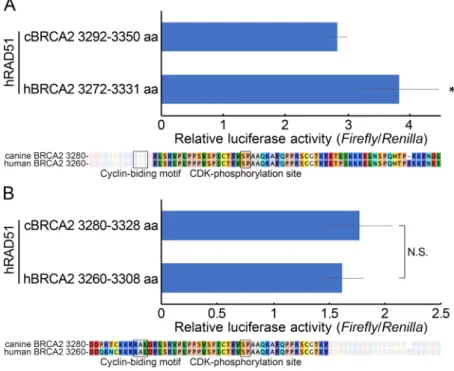
Since the C-terminal RAD51-binding domain of canine BRCA2 showed weaker interaction-activity to RAD51 than that of the human domain, we next attempted to identify which amino acid sequences influenced their interaction. We generated deletion constructs and compared RAD51 binding in human and canine BRCA2. When the 12 N-terminal amino acids were deleted from both canine and human domain, the interaction of the canine C-terminal RAD51-binding domain with RAD51 was still slightly weaker than that of the human domain (Fig. 4A). However, when a C-terminal portion was deleted from the human and canine domains, a comparable interaction with RAD51 was detected (Fig. 4B). Thus, the C-terminal amino acids were contributed to confer the differences.
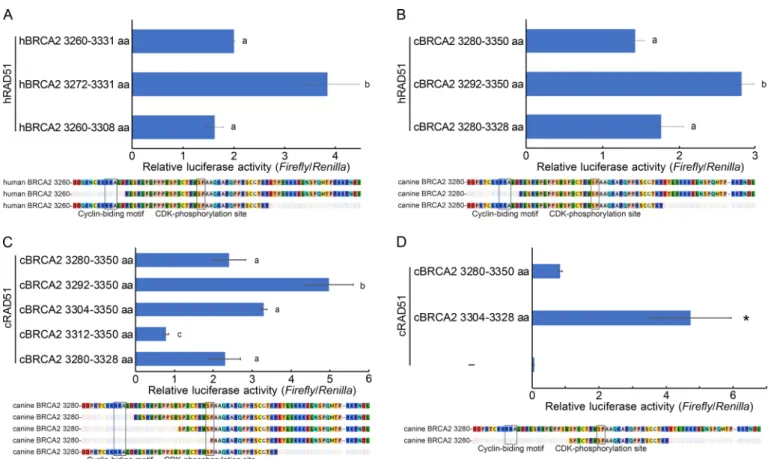
When we performed the deletion experiments on the C-terminal RAD51-binding domain, we noticed the possibility that RAD51 interaction activity was increased by N-terminal deletion. Next, we compared the effect of N- or C-terminal deletion on RAD51 interaction activity. The removal of the N-terminal portion increased BRCA2 binding to RAD51 in human and canine BRCA2, and the removal of the C-terminal portion still interacted with RAD51. (Fig. 5A, 5B). This result indicated that the previously reported C-terminal RAD51-binding domain was not the minimum amino acid motif needed for binding. We next attempted to determine the minimum motif required for RAD51 binding by the generation of deletion constructs. The C-terminal RAD51-binding domain deleted for the 24 N-terminal amino acids could still interact with RAD51, whereas further deletion attenuated RAD51 binding (Fig. 5C). Both the N- and C-terminally deleted peptide, which was the central conserved region of 25 amino acids (canine BRCA2 3304–3328 aa), could interact with RAD51, indicating that these 25 amino acids were the minimum domain required for RAD51 binding (Fig. 5D).
Fig. 3. A conserved phosphorylation site was important for RAD51 binding. The interaction of human or canine RAD51 with the C-termi-nal RAD51-binding domains of human (A) or canine (B) BRCA2 with cyclin-dependent kinase (CDK)-phosphorylation site mutations was analyzed using the mammary two-hybrid assay. The results are given as the mean (± standard error) (n=3). ‘**’ indicates significant differences (P<0.01) compared to wild-type (WT) peptides.
A mutation within the C-terminal RAD51-binding domain of BRCA2, previously found in canine mammary tumors, did not affect RAD51 binding
Several groups have reported BRCA2 mutations in canine mammary tumors [1, 6, 11, 15, 19, 21, 24, 25]. One of these (S3323N) was found to be located in the core motif of the C-terminal RAD51-binding domain (Fig. 1). Thus, the effect of this mutation was evaluated. The S3323N mutation did not affect the ability of the C-terminal RAD51-binding domain of canine BRCA2 to interact with RAD51 (Fig. 6).
DISCUSSION
In a previous study, we demonstrated that the C-terminal region (amino acids 3236–3447) of canine BRCA2 interacts with RAD51 [26]. However, this region was not functionally characterized, and the possible differences from the corresponding domain of human BRCA2 were unclear. In this study, we compared the C-terminal RAD51-binding domains of canine and human BRCA2. In addition, the S3311E and P3312L mutations corresponding to the S3291E and P3292L mutations of human BRCA2, respectively, showed similar effects to those of their human counterparts. These results indicated that the regulation of the C-terminal RAD51-binding domain of BRCA2 was conserved between humans and dogs.
We also demonstrated that the binding efficiency of the canine domain to RAD51 was slightly weaker than that of the corresponding human domain. This interaction activity becomes comparable by the deletion of the C-terminal portion of the C-terminal RAD51-binding domain. Thus, there are important amino acids for conferring species difference in this C-terminal portion. There are two major amino acid differences in the C-terminal portion between dogs and humans. The first is a Leu3331 residue in canine BRCA2 in place of the corresponding human proline; the other is the lack of Phe3345 in dogs (Fig. 1). We previously reported that the M3332IK polymorphism increases RAD51 binding [26]. Thus, the Leu3331 residue, which is next to M3332IK polymorphism, is likely a determinant of the slightly weaker binding of the canine BRCA2 C-terminal domain to RAD51 compared to the corresponding human domain. We also tested the effect of origin of RAD51 on their interaction activity since the activity of BRC repeats, the other RAD51-binding domain, on RDA51 interaction affinity was influenced by the origin of RAD51 [27]. However, the origin of RAD51 was not influenced the RAD51 interaction activity of the BRCA2 C-terminal domain.
A deletion of 12 N-terminal amino acids from the C-terminal RAD51-binding domain of both canine and human BRCA2 resulted in increased RAD51 binding. This might be because the CDK-binding motif was localized in the N-terminal deleted region of the C-terminal RAD51-binding domain, and the phosphorylation site, S3291 or S3311 in human or canine BRCA2
Fig. 4. The C-terminal region of the C-terminal RAD51-binding domain accounted for the differences in RAD51 binding between canine and human BRCA2. (A) Deletion mutants of the C-terminal RAD51-binding domains of canine and human BRCA2 lacking the 12 N-terminal amino acids were compared for RAD51 binding to the corresponding undeleted peptides using the mammary two-hybrid assay. (B) Deletion mutants of the C-terminal RAD51-binding domains of canine and human BRCA2 lacking 23 or 22 C-terminal amino acids were compared for RAD51 binding to the corresponding undeleted peptides using the mammalian two-hybrid assay. The amino acid sequences in the graph indicate the used amino acid sequences, and white shadowed sequences indicate the deleted amino acids. The results are given as the mean (± standard error) (n=3). ‘*’ indicates significant differences (P<0.05); N.S. means non-significant.
Y. YOSHIKAWA ET AL.
Fig. 5. Identification of a core motif consisting of 25 amino acids centrally located in the C-terminal RAD51-binding domain of BRCA2. The interaction of human RAD51 with the C-terminal RAD51-binding domain of human (A) and canine (B) BRCA2 with N- or C-terminal deletions was analyzed using the mammary two-hybrid assay. (C) The interaction of canine RAD51 with C-terminal RAD51-binding domains with the indicated deletions was analyzed using the mammary two-hybrid assay. (D) The interaction of canine RAD51 with the C-terminal RAD51-binding domain and its central region was analyzed using the mammary two-hybrid assay. The amino acid sequences in the graph indicate the used amino acid sequences, and white shadowed sequences indicate the deleted amino acids. The results are given as the mean (± standard error) (n=3). Different letters indicate statistically significant differences (P<0.05). ‘*’ indicates significant differences (P<0.05) compared to canine BRCA2 3280–3350 aa.
Fig. 6. A mutation previously identified in canine mam-mary tumors had no effect on the BRCA2/RAD51 interaction. The interaction of canine RAD51 with the C-terminal RAD51-binding domain of canine BRCA2 carrying the S3323N mutation, previously identified in mammary gland tumors, was analyzed using the mam-mary two-hybrid assay. The results are given as the mean (± standard error) (n=3). N.S. means non-significant.
of N-terminal deleted peptides, respectively, was no longer phosphorylated, resulting in increased RAD51 interaction activity. N-terminal deletion of 24 amino acids from canine domains still showed RAD51-interacting activity. However, the removal of the CDK-phosphorylation sites attenuated RAD51 binding. Again, this result indicated that Ser3311 was important for the BRAC2/ RAD51 interaction. We also identified a core RAD51-binding motif in the C-terminal RAD51-binding domain of canine BRCA2. The peptide was derived from BRC repeats to inhibit the endogenous function of RAD51, and cells treated with this peptide were found to have increased X-ray sensitivity [23]. Thus, the peptide derived from the core motif of the C-terminal RAD51-binding domain has potential for applications as a molecular drug. Our findings identifying the core motif may represent the first step toward applying molecular drugs targeting the endogenous RAD51 oligomer and RAD51 nucleofilament, which is intermediate of homologous recombination repair.
Since a previous study, based on a mutational analysis in canine mammary tumors, identified the S3323N mutation [6], the effect of this mutation on the BRCA2/RAD51 interaction was tested. No significant differences in this interaction were observed compared to wild-type BRAC2, indicating that the mutation was neutral with respect to the function of the BRCA2 C-terminal RAD51-binding domain. In human BRCA2, the S3303C mutation, a mutation at the corresponding amino acid of S3323 in canine BRCA2, was also reported [22]. The S3303C mutation was reported as a functionally neutral mutation [22]. Together with these results, the S3323N mutation is probably a neutral mutation. However, our data here only included isolated peptides; hence, we need to keep in mind that these data are limited and may not be extrapolated to full-length proteins in terms of functions.
In this study, we demonstrated that the canine C-terminal RAD51-binding domains displayed a slightly weaker interaction with RAD51 compere to the human domain, and this difference was attributed to the C-terminal portion of the domain. In addition, we also identified the core motif of this domain. These data may help understand BRCA2 function and the tumorigenic effects of BRCA2 mutations and prompt further investigations aimed at the development of molecular drugs.
CONFLICT OF INTEREST. None of the authors have any financial or personal relationships that could inappropriately influence or bias the content of the paper.
ACKNOWLEDGMENTS. This work was supported in part by a Kitasato University Research Grant for Young Researchers and Grants-in-Aid for Young Scientists (B) [grant number 16K18817] and Grant-in-Aid for Scientific Research (C) [grant number 20K06417] from the Japan Society for the Promotion of Science.
REFERENCES
1. Borge, K. S., Børresen-Dale, A. L. and Lingaas, F. 2011. Identification of genetic variation in 11 candidate genes of canine mammary tumour. Vet.
Comp. Oncol. 9: 241–250. [Medline] [CrossRef]
2. Carreira, A. and Kowalczykowski, S. C. 2011. Two classes of BRC repeats in BRCA2 promote RAD51 nucleoprotein filament function by distinct mechanisms. Proc. Natl. Acad. Sci. USA 108: 10448–10453. [Medline] [CrossRef]
3. Davies, O. R. and Pellegrini, L. 2007. Interaction with the BRCA2 C terminus protects RAD51-DNA filaments from disassembly by BRC repeats.
Nat. Struct. Mol. Biol. 14: 475–483. [Medline] [CrossRef]
4. DeSantis, C. E., Ma, J., Gaudet, M. M., Newman, L. A., Miller, K. D., Goding Sauer, A., Jemal, A. and Siegel, R. L. 2019. Breast cancer statistics, 2019. CA Cancer J. Clin. 69: 438–451. [Medline] [CrossRef]
5. Egenvall, A., Bonnett, B. N., Öhagen, P., Olson, P., Hedhammar, A. and von Euler, H. 2005. Incidence of and survival after mammary tumors in a population of over 80,000 insured female dogs in Sweden from 1995 to 2002. Prev. Vet. Med. 69: 109–127. [Medline] [CrossRef]
6. Enginler, S. O., Akış, I., Toydemir, T. S. F., Oztabak, K., Haktanir, D., Gündüz, M. C., Kırşan, I. and Fırat, I. 2014. Genetic variations of BRCA1 and BRCA2 genes in dogs with mammary tumours. Vet. Res. Commun. 38: 21–27. [Medline] [CrossRef]
7. Esashi, F., Christ, N., Gannon, J., Liu, Y., Hunt, T., Jasin, M. and West, S. C. 2005. CDK-dependent phosphorylation of BRCA2 as a regulatory mechanism for recombinational repair. Nature 434: 598–604. [Medline] [CrossRef]
8. Esashi, F., Galkin, V. E., Yu, X., Egelman, E. H. and West, S. C. 2007. Stabilization of RAD51 nucleoprotein filaments by the C-terminal region of BRCA2. Nat. Struct. Mol. Biol. 14: 468–474. [Medline] [CrossRef]
9. Evans, D. G., Shenton, A., Woodward, E., Lalloo, F., Howell, A. and Maher, E. R. 2008. Penetrance estimates for BRCA1 and BRCA2 based on genetic testing in a Clinical Cancer Genetics service setting: risks of breast/ovarian cancer quoted should reflect the cancer burden in the family.
BMC Cancer 8: 155. [Medline] [CrossRef]
10. Fradet-Turcotte, A., Sitz, J., Grapton, D. and Orthwein, A. 2016. BRCA2 functions: from DNA repair to replication fork stabilization. Endocr. Relat.
Cancer 23: T1–T17. [Medline] [CrossRef]
11. Hsu, W. L., Huang, Y. H., Chang, T. J., Wong, M. L. and Chang, S. C. 2010. Single nucleotide variation in exon 11 of canine BRCA2 in healthy and cancerous mammary tissue. Vet. J. 184: 351–356. [Medline] [CrossRef]
12. Hucl, T., Rago, C., Gallmeier, E., Brody, J. R., Gorospe, M. and Kern, S. E. 2008. A syngeneic variance library for functional annotation of human variation: application to BRCA2. Cancer Res. 68: 5023–5030. [Medline] [CrossRef]
13. King, M. C., Marks, J. H., Mandell, J. B., Group and New York Breast Cancer Study Group. 2003. Breast and ovarian cancer risks due to inherited mutations in BRCA1 and BRCA2. Science 302: 643–646. [Medline] [CrossRef]
14. Liang, C. C., Zhan, B., Yoshikawa, Y., Haas, W., Gygi, S. P. and Cohn, M. A. 2015. UHRF1 is a sensor for DNA interstrand crosslinks and recruits FANCD2 to initiate the Fanconi anemia pathway. Cell Rep. 10: 1947–1956. [Medline] [CrossRef]
15. Maués, T., El-Jaick, K. B., Costa, F. B., Araujo, G. E. F., Soares, M. V. G., Moreira, A. S., Ferreira, M. L. G. and Ferreira, A. M. R. 2018. Common germline haplotypes and genotypes identified in BRCA2 exon 11 of dogs with mammary tumours and histopathological analyses. Vet. Comp. Oncol. 16: 379–384. [Medline] [CrossRef]
16. Moe, L. 2001. Population-based incidence of mammary tumours in some dog breeds. J. Reprod. Fertil. Suppl. 57: 439–443. [Medline] 17. Moulton, J. E., Rosenblatt, L. S. and Goldman, M. 1986. Mammary tumors in a colony of beagle dogs. Vet. Pathol. 23: 741–749. [Medline]
Y. YOSHIKAWA ET AL. [CrossRef]
18. Ochiai, K., Yoshikawa, Y., Oonuma, T., Tomioka, Y., Hashizume, K. and Morimatsu, M. 2011. Interactions between canine RAD51 and full length or truncated BRCA2 BRC repeats. Vet. J. 190: 293–295. [Medline] [CrossRef]
19. Ozmen, O., Kul, S., Risvanli, A., Ozalp, G., Sabuncu, A. and Kul, O. 2017. Somatic SNPs of the BRCA2 gene at the fragments encoding RAD51 binding sites of canine mammary tumors. Vet. Comp. Oncol. 15: 1479–1486. [Medline] [CrossRef]
20. Rivera, P. and von Euler, H. 2011. Molecular biological aspects on canine and human mammary tumors. Vet. Pathol. 48: 132–146. [Medline] [CrossRef]
21. Rivera, P., Melin, M., Biagi, T., Fall, T., Häggström, J., Lindblad-Toh, K. and von Euler, H. 2009. Mammary tumor development in dogs is associated with BRCA1 and BRCA2. Cancer Res. 69: 8770–8774. [Medline] [CrossRef]
22. Sullivan, T., Thirthagiri, E., Chong, C. E., Stauffer, S., Reid, S., Southon, E., Hassan, T., Ravichandran, A., Wijaya, E., Lim, J., Taib, N. A. M., Fadzli, F., Yip, C. H., Hartman, M., Li, J., van Dam, R. M., North, S. L., Das, R., Easton, D. F., Biswas, K., Teo, S. H., Sharan, S. K., SGBCC Investigators and MYBRCA Investigators. 2021. Epidemiological and ES cell-based functional evaluation of BRCA2 variants identified in families with breast cancer. Hum. Mutat. 42: 200–212. [Medline] [CrossRef]
23. Trenner, A., Godau, J. and Sartori, A. A. 2018. A short BRCA2-derived cell-penetrating peptide targets RAD51 function and confers hypersensitivity toward PARP inhibition. Mol. Cancer Ther. 17: 1392–1404. [Medline] [CrossRef]
24. Yoshikawa, Y., Morimatsu, M., Ochiai, K., Nagano, M., Tomioka, Y., Sasaki, N., Hashizume, K. and Iwanaga, T. 2008. Novel variations and loss of heterozygosity of BRCA2 identified in a dog with mammary tumors. Am. J. Vet. Res. 69: 1323–1328. [Medline] [CrossRef]
25. Yoshikawa, Y., Morimatsu, M., Ochiai, K., Nagano, M., Yamane, Y., Tomizawa, N., Sasaki, N. and Hashizume, K. 2005. Analysis of genetic variations in the exon 27 region of the canine BRCA2 locus. J. Vet. Med. Sci. 67: 1013–1017. [Medline] [CrossRef]
26. Yoshikawa, Y., Morimatsu, M., Ochiai, K., Nagano, M., Yamane, Y., Tomizawa, N., Sasaki, N. and Hashizume, K. 2005. Insertion/deletion polymorphism in the BRCA2 nuclear localization signal. Biomed. Res. 26: 109–116. [Medline] [CrossRef]
27. Yoshikawa, Y., Ochiai, K., Morimatsu, M., Suzuki, Y., Wada, S., Taoda, T., Iwai, S., Chikazawa, S., Orino, K. and Watanabe, K. 2012. Effects of the missense mutations in canine BRCA2 on BRC repeat 3 functions and comparative analyses between canine and human BRC repeat 3. PLoS One 7: e45833–e45833. [Medline] [CrossRef]