Author(s)
Higaonna, Miki; Odo, Sumie; Kajiki, Yorie; Iramina, Mika
Citation
琉球医学会誌 = Ryukyu Medical Journal, 37(1-4): 29-39
Issue Date
2018
URL
http://hdl.handle.net/20.500.12001/24349
INTRODUCTION
Prevention of inpatient falls has been of great interest to clinicians and researchers for several decades; however, falls remain a significant concern for the safety of hospitalized patients. The fall rate per 1000 patient-days doubled from .41 in 1998 to
.88 in 2008 in Australian hospitals 1), and Danish
hospitals reported that the rate of fall-related major
injuries increased 11.4% annually between 2007
and 2012 2). While 16-29% of inpatient fallers suffer
injuries, 1.5-2.0% of fallers died from hip fractures or intracranial hemorrhage due to falls in the United
States 3, 4). In the United States, the Centers for
Medicare and Medicaid Services not only ceased reimbursement for the costs associated with treating
fall injuries during hospitalization 5), but also
withheld 1% of their reimbursement if the hospital performed poorly on the “Hospital Acquired ABSTRACT
Falls remain a significant concern for the safety of hospitalized patients internationally. We developed a short form of the modified Japanese Nursing Associationʼs fall-risk assessment tool to assess inpatientsʼ fall risks. We conducted a retrospective cohort study to evaluate the predictive validity of two brief versions of a fall-risk assessment tool in 7-, 14-, 21-, and 28-day observation periods. The study was conducted at a Japanese university hospital. Among 11,333 patients (median age: 61 years, 51.3% women), 123 patients fell within 28 days of admission. Neither the modified Japanese Nursing Associationʼs fall-risk assessment tool nor the short-form version 1 achieved sensitivity and specificity of>.70; therefore, we developed a 2nd version by eliminating two items (i.e., bone/joint problems and laxatives) and adding two items (i.e., impaired extremities and decreased strength). The second version exhibited good predictive validity used as a brief assessment of fall risks: sensitivity=.76, specificity=.78, positive likelihood ratio=3.47, negative likelihood ratio=.30, and the area under the receiver operating characteristics curve of .83 in a 7-day observation sample. We recommend that the study hospital implements the short-form (version 2) with careful monitoring of patientsʼ fall rate and collects feedback from clinical nurses.
Ryukyu Med. J., 37 (1~4) 29~40, 2018
Key words: accidental falls, assessment tool development, inpatients, nursing assessment, reproducibility of the results
1)Gerontological Nursing, School of Health Sciences, Faculty of Medicine, University of the Ryukyus 2)Nursing department, University of the Ryukyu Hospital
3)Nursing department & Safety management office, University of the Ryukyu Hospital
(Received on July 28, 2017, accepted on September 11, 2017 ) Miki Higaonna1), Sumie Odo2), Yorie Kajiki3), Mika Iramina2)
A short form of the modified Japanese Nursing Association s fall-risk
assessment tool
Corresponding Author: Miki Higaonna, Gerontological Nursing, School of Health Sciences, Faculty of
Medicine, University of the Ryukyus, 207 Uehara, Nishihara 903-0215, Okinwa, Japan. Tel: +81-98-895-3331, E-mail: [email protected]
Conditions” score, which is calculated by hospital acquired infection and patient safety indicators
(including postoperative hip fracture rates) 6). While
human factors, such as communication and leadership, are the most common root causes of sentinel events reported to the Joint Commission, assessment was the most frequently reported root cause of fall-related events resulting in patient death
or permanent loss of function 7).
The Joint Commission 8) and Australian
Commission on Safety and Quality in Healthcare 9)
recommends using a standardized and validated fall-risk assessment tool to prevent patient falls. This modified Japanese Nursing Association (JNA) tool comprises many (37) items compared with well validated and commonly used tools overseas: the
STRATIFY (five items) 10), the Morse Fall Scale (six
items) 11), and the Hendrich II Fall Risk Model (eight
items) 12). A systematic review concluded that neither
the Hendrich II Fall Risk Model nor STRATIFY displayed strong enough predictive validity among
older adults in acute hospital settings 13).
Lee et al. developed an automated fall-risk assessment system using 10 variables available in an electronic medical record to eliminate additional
nursing workload 14). The effort to reduce nurse
workload is important; however, there is a concern if this risk assessment could lead to nursing interventions to prevent falls because most items included in this automated system, such as maximum pulse, length of stay, medical department, and type of room, are not linked to fall risk factors. A rigorous, large, randomized controlled study conducted in Australian acute hospitals found that their program combining modified STRATIFY and six interventions was ineffective in decreasing neither fall rate nor injurious fall rate 15).
Study aims
This study aimed to develop a short form of the modified JNA fall-risk assessment tool and to evaluate its predictive validity.
METHODS
Study design, setting, and patients
This study was a retrospective cohort design and conducted at a Japanese university hospital. We included patients aged 15 years and older with a length of stay≧2 days and who were admitted from
October 2014 to November 2015. We adopted the
inclusion and exclusion criteria of a previous study 16)
as follows. Patients admitted to the neuropsychiatry, intensive care unit, or clinical decision unit were excluded because of the difference in patientsʼ characteristics and nurse-to-patient ratio. We also excluded patients with no fall-risk assessment conducted within two days of admission, an assessment conducted on the discharge date, or patients with inconsistent assessment results (Fig. 1).
In a previous study 16), patients discharged
before observation points were excluded when calculating predictive validity indices in different observation periods to reduce the risk of information bias. However, this could result in excluding more than half of the patients at a 7-day observation point because of the shorter length of stays in the hospital. Therefore, we decided not to exclude patients by their length of stay in this study.
Fall definition and identification
The theoretical definition of falls was
“inadvertently coming to rest on the ground, floor,
or other lower level, excluding intentional change in
position to rest in furniture, wall, or other objects” 17).
The operational definition was a free-text description of one of the following: patients found on the floor either laying or sitting; report of falls from patients him/herself, patientsʼ family, other patients, or other hospital staff; hospital staff assisted transfer of patients, but had to lower the patient to the floor; patient dropped from bed/chair; patient was unable to maintain sitting position and unintentionally leaned on the bed or bedrails; and healthcare professionals used the word “fell” or “fell down.” All the free-text descriptions in the incident reports were reviewed by two of the researchers independently.
Measurements
1. Modified JNA tool
The fall-risk assessment tool used in this study (Fig. 2) was a modified version of the JNA fall-risk
assessment tool 18). Two items targeting younger
inpatient populations, aged≦9 years and infantsʼ developmental stage, were not included in the analyses. The predictive validity of the modified JNA tool was sufficient for clinical practice: sensitivity=.82, specificity=.71, positive likelihood
ratio=2.83, negative likelihood ratio=.26 at a cut-off
point of≧6, and the area under the receiver operating characteristic (ROC) curve=.83; however,
Patients (Age ≥15 years, LOS≧2 days) admitted to the hospital Oct. 2014–Nov. 2015
N= 12,291 patients
11,333 patients
Inconsistent assessment data (n=609) Up ad lib/mobility assistance (n=439)
Age on administrative record/item of age (n=149) Up ad lib/bedridden/mobility assistance (n=12) Up ad lib/bedridden (n=6)
Infant’s developmental stage (n=2)
Age inconsistency & up ad lib/mobility assistance (n=1) 11,942 patients
No assessment during hospitalization (n=152) No assessment within 2 days of admission (n=185) Assessed on discharge date (n=12)
Fig.1 Flowchart of patient selection
Items Score
Age 65 years and oldera or 9 years and younger b 1
History Fall history within 1 year 1
Sensory Functions Visual impairment that affects daily life 1 Hearing impairment that affects daily life
Motor Functions Problems in the extremities (paralysis, numbness)
1 Bone and/or joint problem
Muscle weakness 1
Mobility Up ad lib 1
Unstable when standing and/or walking 1
Use wheelchair, cane, or walker 1
Requires mobility assistance 1
Bedridden but able to move extremities
Cast, IV lines, or other tubes 1
Infant’s developmental stage (roll over, crawl, etc.)b 1
Cognition Feeling restless because of anxiety or worried about something 1 Recently feeling forgetful
Impaired judgment and/or understanding
Unable to use a call light 1
Medications Analgesics 1 Laxatives Diuretics Chemotherapy Antiparkinsonians Hypnotics/tranquilizers 1 Antihypertensives
Elimination Waking up more than 2 times at night for toileting 1 Urinary and/or bowel incontinence
1 Requiring toileting assistance
Using a commode chaira
Treatment stage In rehabilitation stagea 1
Anemia and/or orthostatic hypotensiona
1 Decreased strength due to fever, diarrhea, vomiting, etc.a
Within 3 days of surgerya 1
Personality Hesitant to use a call light to ask for nurse’s helpa
1 Does not like to depend on othersa
Environment New to the ward or hospital environmenta 1 aNot included in the Japanese Nursing Association’s tool. bNot included in the analyses.
© University of the Ryukyus Hospital: reproduced and translated with permission of the copy right owner.
only 21 out of 35 items showed significantly larger
proportions among fallers compared to non-fallers 16).
2. The short form of the modified JNA tool
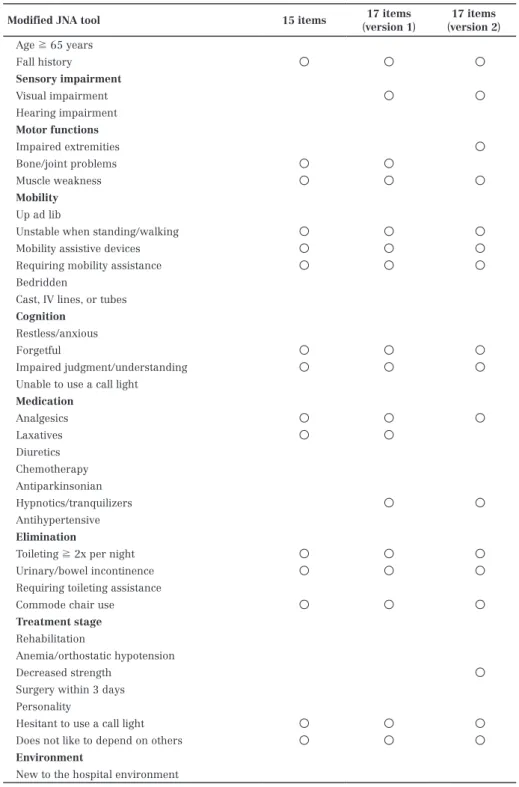
The items selected for the version 1 and the version 2 of the 17-item tools are shown in Table 1. 1) The 17-item tool (version 1)
First, we used the cohort from a previous
study 16) and calculated the area under the ROC
curve by adding items one-by-one following the order of highest to the lowest value of relative risk for 21 items that demonstrated a significantly larger proportion among fallers
compare to non-fallers in the previous study 16).
The area under the ROC curve (AUC) was highest with 15 items (0.86); however, it demonstrated a decrease in sensitivity (.78)
Modified JNA tool 15 items (version 1)17 items (version 2)17 items
Age ≧ 65 years Fall history ○ ○ ○ Sensory impairment Visual impairment ○ ○ Hearing impairment Motor functions Impaired extremities ○ Bone/joint problems ○ ○ Muscle weakness ○ ○ ○ Mobility Up ad lib
Unstable when standing/walking ○ ○ ○
Mobility assistive devices ○ ○ ○
Requiring mobility assistance ○ ○ ○
Bedridden
Cast, IV lines, or tubes
Cognition
Restless/anxious
Forgetful ○ ○ ○
Impaired judgment/understanding ○ ○ ○
Unable to use a call light
Medication Analgesics ○ ○ ○ Laxatives ○ ○ Diuretics Chemotherapy Antiparkinsonian Hypnotics/tranquilizers ○ ○ Antihypertensive Elimination
Toileting ≧ 2x per night ○ ○ ○
Urinary/bowel incontinence ○ ○ ○
Requiring toileting assistance
Commode chair use ○ ○ ○
Treatment stage
Rehabilitation
Anemia/orthostatic hypotension
Decreased strength ○
Surgery within 3 days Personality
Hesitant to use a call light ○ ○ ○
Does not like to depend on others ○ ○ ○
Environment
New to the hospital environment
Note: JNA: Japanese Nursing Association; IV: intravenous.
compared to the modified JNA (.82) 16). Therefore, the researchers considered adding two more items (i.e., visual impairment and hypnotics/tranquilizer). Visual impairment is an important risk factor newly added to the guideline regarding assessment and prevention of falls in older adults by the National Institute
for Health and Care Excellence 19). Hypnotics/
tranquilizer is a risk factor consistently showed
to increase fall risks in meta-analyses 20-22).
We did not use a logistic regression analysis to select items for the short-form because key risk factors could be eliminated if they had a strong association with other risk factors and there was not a sufficient number of fallers in the previous study cohort (at least 210 fallers) to enter 21 items in a logistic
equation 23). We wanted a tool not only to
predict falls, but also to address crucial fall risk factors identified in the guidelines and in previous studies.
2) The 17-item tool (version 2)
Neither the modified JNA tool nor version 1 of 17-item tool achieved both a sensitivity and specificity of>.70 in the validation cohort. Therefore, we developed a second version of 17-item tool by eliminating two 17-items that showed no significant association with falls (i.e., bone/ joint problems and laxatives) and adding two items that had a significant association with
falls in both a previous study 16) and validation
cohort (i.e., impaired extremities and decreased strength) (Table 1).
Data collection
The hospitalʼs information systems department extracted patientsʼ background information and their fall risk assessment results from the electronic
charting system and provided the data in an Excel®
file (Microsoft Corporation, Redmond, USA). A clerical assistant from the hospitalʼs safety management department obtained falls/fallers information from the incident reporting system in an Excel file. Lastly, a lead researcher created a database for analyses by combined information on two Excel files by patient ID number and their dates of admission and discharge.
Statistical analysis
Descriptive statistics were used to summarize patientsʼ characteristics. The length of stay of patients discharged after December 28, 2015 was calculated
as if they were discharged on December 28, 2015 as falls followed this date. Pearsonʼs chi-square test and Fisherʼs exact test was used to examine the associations between nominal variables and fall status within 28 days of admission. Patientsʼ age, length of stay, and total assessment score were compared between fallers and non-fallers using the Mann-Whitney U test because their distributions were skewed. Relative risks and associated 95% confidence intervals were also calculated for each item of the modified JNA tool. Predictive validity was estimated in different observation periods of 7-, 14-, 21-, and 28-days using the ROC curve, the AUC, sensitivity, specificity, and positive and negative likelihood ratios. The optimal cut-off points were determined for each tool as the point that achieved
sensitivity and specificity to be>.70 per Oliver et al.ʼs
criteria 24) or nearest to .70. The cut-off points of the
modified JNA tool, version 1, and version 2 were≧6,≧3, and≧4, respectively. Finally, differences in AUCs among the three tools were compared by Pearsonʼs chi-square test. Statistical analyses were performed using SPSS version 19 (IBM Corp, Armonk, NY) or MedCalc Statistical Software version 13.0 (MedCalc Software, Ostend, Belgium); p-values less than .05 were considered statistically significant; and associated 95% confidence intervals were calculated when applicable.
Ethical considerations
The Ethics Committee for Epidemiological Research of the researchersʼ university approved this study (approval number 322). Consistent with the ethical guidelines by Japanʼs Ministry of Health, Labour and Welfare and Ministry of Education,
Culture, Sports, Science and Technology 25), no
informed consent was obtained; however, research information was disclosed by posting to inpatient wards and outpatient areas. This study was conducted in accordance with the Declaration of Helsinki in 1995 (as revised in Edinburgh 2000 and Brazil 2013).
RESULTS
Patients characteristics
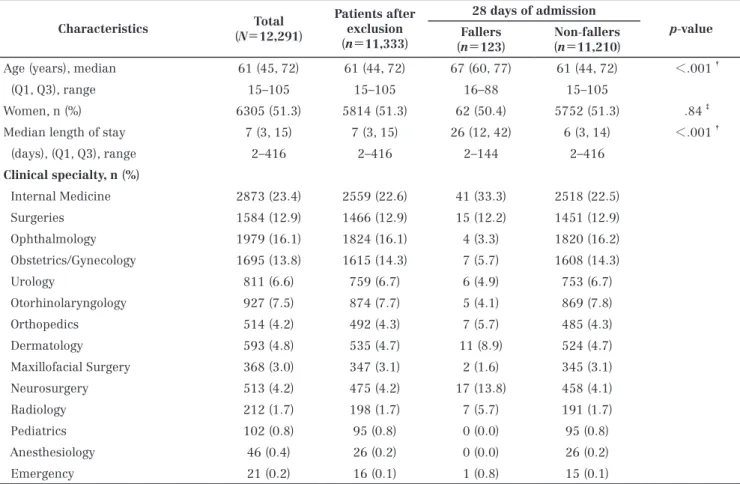
Patientsʼ characteristics are shown in Table 2. During their hospital stay, 241 falls occurred by 206 patients (1.42 falls per 1,000 patient-days; faller rate=1.7%). The first falls were most frequently
occurred in 1-7 days after admission (32%).
We excluded 337 patients without fall-risk assessment results within two days of admission, 12 patients with an assessment on their discharge date, and 609 patients for inconsistent assessment results (Fig. 1). The number of patients included in the analyses was 11,333, and 123 patients fell within 28 days of admission. Fallers were significantly older (median 67 years vs. 61 years) and had longer hospital stays (median 26 days vs. 6 days) than non-fallers did.
Assessment results of the modified JNA tool
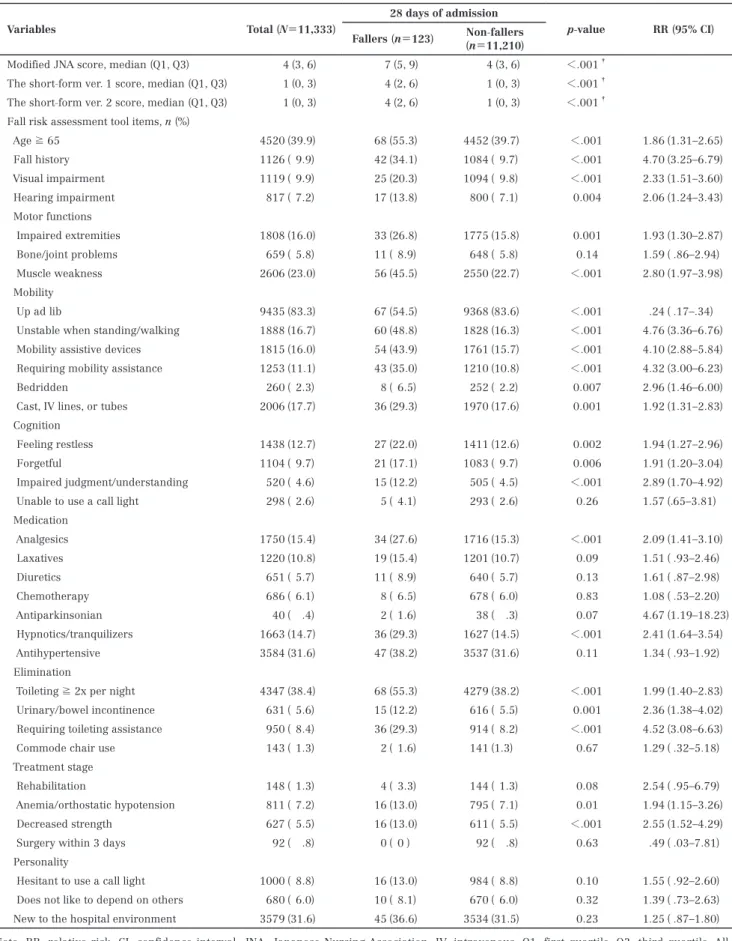
Fall risk assessment scores of fallers were significantly higher than non-fallers (median 7 vs. 4,
p<.001). Twenty-one items out of 35 items from the
modified JNA tool showed significantly larger proportions among fallers compared to non-fallers. “Up ad lib” was the only item with a significantly larger proportion among non-fallers than fallers (Table 3).
Predictive validity
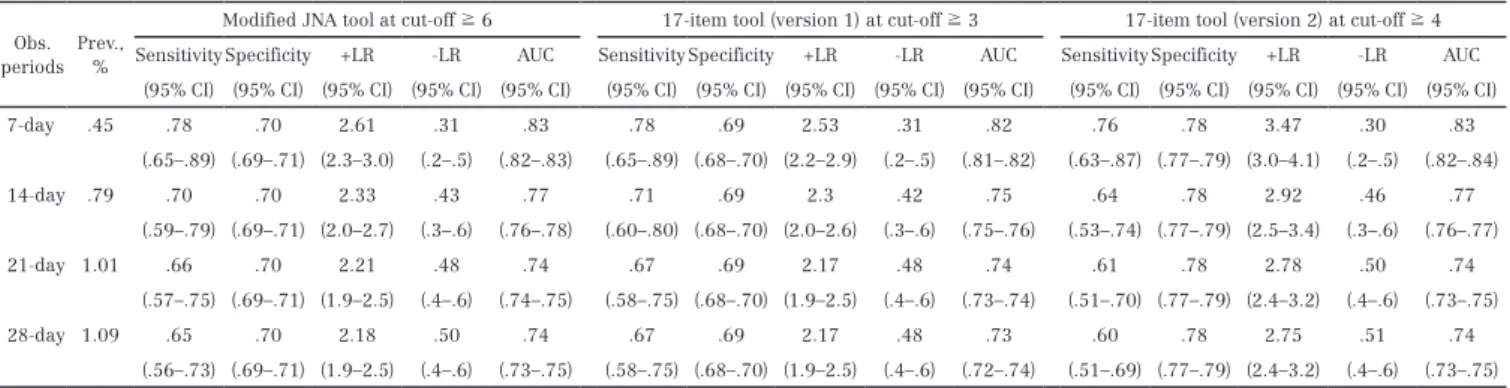
Predictive validity indices of the modified JNA tool and 17-item tool of versions 1 and 2 are shown in Table 4. In all three tools, predictive validity indices were achieved best in the 7-day observation samples. The modified JNA tool in 7-day observation samples and version 1 of the 17-item tool in 7- and 14-day
observation samples demonstrated sensitivity >.70;
however, their specificity was slightly lower (.70 or
.69) than Oliverʼs criteria 24). The second version of the
17-item tool exhibited sensitivity of .76 and specificity of .78 in the 7-day observation sample and showed a positive likelihood ratio of 3.47, a negative likelihood ratio of .30, and an AUC of .83. The AUCs of the 17-item tool (version 2) were significantly larger than the AUCs of the 17-item tool (version 1) on 7-day (p=.047); however, the difference was not significant for the other observation periods. There was no statistical difference between the modified JNA tool and the 17-item tools (version 1 and version 2).
Characteristics (N=12,291)Total Patients after exclusion
(n=11,333)
28 days of admission
p-value
Fallers
(n=123) (n=11,210)Non-fallers
Age (years), median 61 (45, 72) 61 (44, 72) 67 (60, 77) 61 (44, 72) <.001†
(Q1, Q3), range 15–105 15–105 16–88 15–105
Women, n (%) 6305 (51.3) 5814 (51.3) 62 (50.4) 5752 (51.3) .84‡
Median length of stay 7 (3, 15) 7 (3, 15) 26 (12, 42) 6 (3, 14) <.001†
(days), (Q1, Q3), range 2–416 2–416 2–144 2–416 Clinical specialty, n (%) Internal Medicine 2873 (23.4) 2559 (22.6) 41 (33.3) 2518 (22.5) Surgeries 1584 (12.9) 1466 (12.9) 15 (12.2) 1451 (12.9) Ophthalmology 1979 (16.1) 1824 (16.1) 4 (3.3) 1820 (16.2) Obstetrics/Gynecology 1695 (13.8) 1615 (14.3) 7 (5.7) 1608 (14.3) Urology 811 (6.6) 759 (6.7) 6 (4.9) 753 (6.7) Otorhinolaryngology 927 (7.5) 874 (7.7) 5 (4.1) 869 (7.8) Orthopedics 514 (4.2) 492 (4.3) 7 (5.7) 485 (4.3) Dermatology 593 (4.8) 535 (4.7) 11 (8.9) 524 (4.7) Maxillofacial Surgery 368 (3.0) 347 (3.1) 2 (1.6) 345 (3.1) Neurosurgery 513 (4.2) 475 (4.2) 17 (13.8) 458 (4.1) Radiology 212 (1.7) 198 (1.7) 7 (5.7) 191 (1.7) Pediatrics 102 (0.8) 95 (0.8) 0 (0.0) 95 (0.8) Anesthesiology 46 (0.4) 26 (0.2) 0 (0.0) 26 (0.2) Emergency 21 (0.2) 16 (0.1) 1 (0.8) 15 (0.1)
Q1: first quartile; Q3: third quartile.
†Mann-Whitney test, ‡Pearsonʼs χ2 test.
Variables Total (N=11,333)
28 days of admission
p-value RR (95% CI)
Fallers (n=123) (n=11,210)Non-fallers
Modified JNA score, median (Q1, Q3) 4 (3, 6) 7 (5, 9) 4 (3, 6) <.001†
The short-form ver. 1 score, median (Q1, Q3) 1 (0, 3) 4 (2, 6) 1 (0, 3) <.001†
The short-form ver. 2 score, median (Q1, Q3) 1 (0, 3) 4 (2, 6) 1 (0, 3) <.001†
Fall risk assessment tool items, n (%)
Age ≧ 65 4520 ( 39.9) 68 ( 55.3) 4452 ( 39.7) <.001 1.86 ( 1.31–2.65) Fall history 1126 ( 9.9) 42 ( 34.1) 1084 ( 9.7) <.001 4.70 ( 3.25–6.79) Visual impairment 1119 ( 9.9) 25 ( 20.3) 1094 ( 9.8) <.001 2.33 ( 1.51–3.60) Hearing impairment 817 ( 7.2) 17 ( 13.8) 800 ( 7.1) 0.004 2.06 (1.24–3.43) Motor functions Impaired extremities 1808 ( 16.0) 33 ( 26.8) 1775 ( 15.8) 0.001 1.93 ( 1.30–2.87) Bone/joint problems 659 ( 5.8) 11 ( 8.9) 648 ( 5.8) 0.14 1.59 ( .86–2.94) Muscle weakness 2606 ( 23.0) 56 ( 45.5) 2550 ( 22.7) <.001 2.80 ( 1.97–3.98) Mobility Up ad lib 9435 ( 83.3) 67 ( 54.5) 9368 ( 83.6) <.001 .24 ( .17–.34) Unstable when standing/walking 1888 ( 16.7) 60 ( 48.8) 1828 ( 16.3) <.001 4.76 ( 3.36–6.76) Mobility assistive devices 1815 ( 16.0) 54 ( 43.9) 1761 ( 15.7) <.001 4.10 ( 2.88–5.84) Requiring mobility assistance 1253 ( 11.1) 43 ( 35.0) 1210 ( 10.8) <.001 4.32 ( 3.00–6.23) Bedridden 260 ( 2.3) 8 ( 6.5) 252 ( 2.2) 0.007 2.96 ( 1.46–6.00) Cast, IV lines, or tubes 2006 ( 17.7) 36 ( 29.3) 1970 ( 17.6) 0.001 1.92 ( 1.31–2.83) Cognition
Feeling restless 1438 ( 12.7) 27 ( 22.0) 1411 ( 12.6) 0.002 1.94 ( 1.27–2.96) Forgetful 1104 ( 9.7) 21 ( 17.1) 1083 ( 9.7) 0.006 1.91 ( 1.20–3.04) Impaired judgment/understanding 520 ( 4.6) 15 ( 12.2) 505 ( 4.5) <.001 2.89 ( 1.70–4.92) Unable to use a call light 298 ( 2.6) 5 ( 4.1) 293 ( 2.6) 0.26 1.57 (. 65–3.81) Medication Analgesics 1750 ( 15.4) 34 ( 27.6) 1716 ( 15.3) <.001 2.09 ( 1.41–3.10) Laxatives 1220 ( 10.8) 19 ( 15.4) 1201 ( 10.7) 0.09 1.51 ( .93–2.46) Diuretics 651 ( 5.7) 11 ( 8.9) 640 ( 5.7) 0.13 1.61 ( .87–2.98) Chemotherapy 686 ( 6.1) 8 ( 6.5) 678 ( 6.0) 0.83 1.08 ( .53–2.20) Antiparkinsonian 40 ( .4) 2 ( 1.6) 38 ( .3) 0.07 4.67 ( 1.19–18.23) Hypnotics/tranquilizers 1663 ( 14.7) 36 ( 29.3) 1627 ( 14.5) <.001 2.41 ( 1.64–3.54) Antihypertensive 3584 ( 31.6) 47 ( 38.2) 3537 ( 31.6) 0.11 1.34 ( .93–1.92) Elimination
Toileting ≧ 2x per night 4347 ( 38.4) 68 ( 55.3) 4279 ( 38.2) <.001 1.99 ( 1.40–2.83) Urinary/bowel incontinence 631 ( 5.6) 15 ( 12.2) 616 ( 5.5) 0.001 2.36 ( 1.38–4.02) Requiring toileting assistance 950 ( 8.4) 36 ( 29.3) 914 ( 8.2) <.001 4.52 ( 3.08–6.63) Commode chair use 143 ( 1.3) 2 ( 1.6) 141 (1.3) 0.67 1.29 ( .32–5.18) Treatment stage
Rehabilitation 148 ( 1.3) 4 ( 3.3) 144 ( 1.3) 0.08 2.54 ( .95–6.79) Anemia/orthostatic hypotension 811 ( 7.2) 16 ( 13.0) 795 ( 7.1) 0.01 1.94 ( 1.15–3.26) Decreased strength 627 ( 5.5) 16 ( 13.0) 611 ( 5.5) <.001 2.55 ( 1.52–4.29) Surgery within 3 days 92 ( .8) 0 ( 0 ) 92 ( .8) 0.63 .49 ( .03–7.81) Personality
Hesitant to use a call light 1000 ( 8.8) 16 ( 13.0) 984 ( 8.8) 0.10 1.55 ( .92–2.60) Does not like to depend on others 680 ( 6.0) 10 ( 8.1) 670 ( 6.0) 0.32 1.39 ( .73–2.63) New to the hospital environment 3579 ( 31.6) 45 ( 36.6) 3534 ( 31.5) 0.23 1.25 ( .87–1.80) Note: RR: relative risk; CI: confidence interval; JNA: Japanese Nursing Association; IV: intravenous; Q1: first quartile, Q3: third quartile. All Pearsonʼs χ2 test or Fisherʼs exact test, except †
Mann-Whitney U test.
DISCUSSION
We developed and evaluated the predictive validity of a short form of the modified JNA fall-risk assessment tool. While the number of items was decreased from 35 items to 17 items, the predictive validity of the second version of the short form in 7-day observation samples was adequate for use in
clinical practice per Oliver et al.ʼs criteria 24), as
sensitivity and specificity were>.70. Predictive validity indices in 14-, 21-, and 28-day observation samples were inferior to the 7-day observation samples, which was consistent with a previous
study 16). This could be because patientsʼ conditions
changed during hospitalization.
The 17 items selected for the second version were not only useful in predicting patientsʼ falls, but also addressed most risk factors identified in the National Institute for Health and Care Excellenceʼs
(NICE) guidelines 19). Unstable or missing footwear
and syncope syndrome were included in the NICE guidelines and the Australian Commission on Safety
and Quality in Healthcare 9); however, they are not
included in the modified JNA or the short form. When reviewing descriptions of fall situations in the incident reports, we came across several falls possibly related to vasovagal syncope. Vasovagal syncope is the most common causes of syncope and other common causes include cardiac arrhythmias, transient ischemic attacks, migraine, orthostatic hypotension, decrease in cardiac output, and
situations such as micturition and defecation 26). If a
patient reports a history of syncope during a fall risk
assessment, a nurse would ask about the situation and symptoms in detail, which would trigger a nurse to perform a physical examination or refer the patient to a physician for a medical examination and treatment. Additionally, educating patients to sit up or stand up slowly, lower the body when experiencing premonitory symptoms of the syncope, or ensuring a nurse is present to supervise a situation where a patient often experiences syncope could prevent falls. Therefore, history of syncope should be included in the short-form.
Commode chair use showed the highest relative
risk in a previous study 16); however, no significant
association was found on the validation cohort. The nursing staff carefully evaluated patientsʼ fall risk when using a commode chair and followed hospitalʼs guidelines of removing the chair from the bedside after the patient used it. Additionally, the fact that nurses encourage patients to use a restroom instead of a bedside commode might influence the association between patient falls and commode chair use.
Personality traits, hesitant to use a call light, patients not wishing to depend on others were unique items included in the modified JNA and on the short-form. They are not included in other common assessment tools such as the Morse Fall
scale 11), Hendrich II Fall Risk Model 12), or the
STRATIFY 10). These two items showed significant
association with falls in a previous study 16), but not
in the current study. While the proportion of patients with these personality traits did not differ in a total sample and non-fallers, the proportion of these traits in fallers reduced by half (hesitant 26.5% vs. 13.0%; do not like to depend 16.3% vs. 8.1%). This could be
Obs. periods
Prev., %
Modified JNA tool at cut-off ≧ 6 17-item tool (version 1) at cut-off ≧ 3 17-item tool (version 2) at cut-off ≧ 4 Sensitivity Specificity +LR -LR AUC Sensitivity Specificity +LR -LR AUC Sensitivity Specificity +LR -LR AUC
(95% CI) (95% CI) (95% CI) (95% CI) (95% CI) (95% CI) (95% CI) (95% CI) (95% CI) (95% CI) (95% CI) (95% CI) (95% CI) (95% CI) (95% CI) 7-day .45 .78 .70 2.61 .31 .83 .78 .69 2.53 .31 .82 .76 .78 3.47 .30 .83 (.65–.89) (.69–.71) (2.3–3.0) (.2–.5) (.82–.83) (.65–.89) (.68–.70) (2.2–2.9) (.2–.5) (.81–.82) (.63–.87) (.77–.79) (3.0–4.1) (.2–.5) (.82–.84) 14-day .79 .70 .70 2.33 .43 .77 .71 .69 2.3 .42 .75 .64 .78 2.92 .46 .77 (.59–.79) (.69–.71) (2.0–2.7) (.3–.6) (.76–.78) (.60–.80) (.68–.70) (2.0–2.6) (.3–.6) (.75–.76) (.53–.74) (.77–.79) (2.5–3.4) (.3–.6) (.76–.77) 21-day 1.01 .66 .70 2.21 .48 .74 .67 .69 2.17 .48 .74 .61 .78 2.78 .50 .74 (.57–.75) (.69–.71) (1.9–2.5) (.4–.6) (.74–.75) (.58–.75) (.68–.70) (1.9–2.5) (.4–.6) (.73–.74) (.51–.70) (.77–.79) (2.4–3.2) (.4–.6) (.73–.75) 28-day 1.09 .65 .70 2.18 .50 .74 .67 .69 2.17 .48 .73 .60 .78 2.75 .51 .74 (.56–.73) (.69–.71) (1.9–2.5) (.4–.6) (.73–.75) (.58–.75) (.68–.70) (1.9–2.5) (.4–.6) (.72–.74) (.51–.69) (.77–.79) (2.4–3.2) (.4–.6) (.73–.75) Note: Obs. periods: observation periods; Prev: prevalence of fallers; +LR: positive likelihood ratio; -LR: negative likelihood ratio; CI; confidence interval; AUC: area under the receiver operating characteristic curve.
Table 4 Predictive validity indices of the modified Japanese Nursing Association fall risk assessment tool and its
because of successful fall prevention education explaining their fall risk and asking patients to use a call-light. Additionally, in 2013, the hospital implemented a new nursing delivering model called
the Partnership Nursing System® (PNS®), where two
nurses were assigned per patient 27). In a survey
conducted in an acute hospital using PNS®, more
than 80% of patients reported that nurses responded to their needs promptly and frequently visited
patientsʼ rooms 28). If nurses delay responding to
patientsʼ calls, patients may attempt to transfer to a wheelchair or ambulate without assistance or no longer use a call light for assistance. Therefore, it is possible that changing the nursing delivery model will influence the association between falls and personality traits. Further studies are necessary to examine this theory.
Fall rate per 1000 patient days increased from
1.38 in a previous cohort study 16) to 1.42 in the
validation cohort. The median age of the patients in the two cohorts did not differ (60 years vs. 61 years); however, the median length of stay decreased from 10 days to 7 days. Because no information was gained on patientsʼ acuity level or comorbidities, it is unclear if the increase in fall rate was due to a change in patientsʼ characteristics, an improvement in healthcare staffʼs attitudes toward reporting fall incidents, or dysfunction in fall prevention care. The fall rate in the study hospital was lower than the average fall rate (2.66 per 1000 patient days) among
308 Japanese general hospitals 29). This is partly
explained by the fall rate in the general hospitals, which was calculated using all submitted incident reports and usually includes near fall events and duplicate reports for the same fall event.
Implications for practice
The short form (version 2) demonstrated strong enough predictive validity to be used in the Japanese university hospital. When implementing the short form in clinical practice, we need to carefully monitor patientsʼ fall rate and actively listen to clinical nursesʼ perspectives as the number of items was reduced by half. The findings from the study also suggest that evaluating toolsʼ validity once is not sufficient and re-evaluation is especially important when a change in patientsʼ characteristics and nursing practice occurred.
Limitations
This study had several limitations. First, the study was conducted in a single hospital in Japan;
therefore, generalization of the findings to other patient groups or settings is limited. Second, the underreporting of falls (approximately 28-40%) should be considered as falls were only identified by
submitted incident reports 30, 31). The underreporting
of falls could underestimate sensitivity and overestimate specificity, which also influences other predictive validity values. Third, inaccurate entry of fall risk assessment results might be present; however, we attempted to eliminate inaccurate entries by crosschecking item inconsistencies.
CONCLUSIONS
The devised short form (version 2) of the modified JNA fall-risk assessment tool demonstrated satisfactory predictive validity in 7-day observation samples even though we decreased the number of items to 17. However, repeating periodical assessment is required as predictive validity declined with longer observation periods.
ACKNOWLEDGMENTS
The hospitalʼs information systems department contributed to develop a database for patientsʼ administrative records and fall-risk assessment results. The medical safety management department extracted fall incident data from the incident reporting system. This study was partly supported by the Japan Society for the Promotion of Science KAKENHI (grant no. 24792397). The authors declare no conflict of interest.
REFERENCES
1) Brand C.A. and Sundararajan V.: A 10-year cohort study of the burden and risk of in-hospital falls and fractures using routinely collected hospital data. Qual Saf Health Care. 19: e51, 2010.
2) Jørgensen T.S., Hansen A.H., Sahlberg M., Gislason G. H., Torp-Pedersen C., Andersson C. and Holm E.: Nationwide time trends and risk factors for in-hospital falls-related major injuries. Int. J. Clin. Pract. 69: 703-709, 2015.
3) Mion L.C., Chandler A.M., Waters T.M., Dietrich M.S., Kessler L.A., Miller S.T. and Shorr R.I.: Is it possible to identify risks for injurious falls in hospitalized patients? Jt. Comm. J. Qual. Patient Saf. 38: 408-413, 2012.
4) Waters T.M., Chandler A.M., Mion L.C., Daniels M.J., Kessler L.A., Miller S.T. and Shorr R.I.: Use of International Classification of Diseases, ninth revision, clinical modification, codes to identify inpatient fall-related injuries. J. Am. Geriatr. Soc. 61(12): 2186-2191, 2013.
5) Centers for Medicare & Medicaid Services: Medicare program: changes to the hospital inpatient prospective payment systems and fiscal year 2008 rates. Fed. Regist. 72 (162): 47129-48175, 2007.
6) Centers for Medicare & Medicaid Services. Hospital-Acquired Condition Reduction Program (HACRP) fiscal year 2017 fact sheet. 2016. https:// www.cms.gov/Medicare/Medicare-Fee-for- Service-Payment/AcuteInpatientPPS/HAC-Reduction-Program.html
7) Joint commission. Sentinel event data root causes by event type 2004-2015. http://www. jointcommission.org/assets/1/18/Root_Causes_ by_Event_Type_2004-2015.pdf.
8) Joint Commission. Preventing falls and fall-related injuries in health care facilities. Sentinel event alert 55. 2015. http://www.jointcommission. org/assets/1/18/SEA_55.pdf.
9) Australian Commission on Safety and Quality in Healthcare. Preventing falls and harm from falls in older people. Best practice guidelines for Australian Hospitals. 2009. http://www. s a fet y a ndq u a l it y.gov.au /pu bl ic at ion s / preventing-falls-and-harm-from-falls-in-older- people-best-practice-guidelines-for-australian-hospitals-2009/.
10) Oliver D., Britton M., Seed P., Martin F.C. and Hopper A.H.: Development and evaluation of evidence based risk assessment tool (STRATIFY) to predict which elderly inpatients will fall: case-control and cohort studies. BMJ. 315(7115): 1049-1053, 1997.
11) Morse J.M., Morse R.M. and Tylko S.J.:
Development of a scale to identify the fall-prone patient. Can. J. Aging. 8(4): 366-377, 1989.
12) Hendrich A.L., Bender P.S. and Nyhuis A.: Validation of the Hendrich II Fall Risk Model: a large concurrent case/control study of
hospitalized patients. Appl. Nurs. Res. 16(1): 9-21, 2003.
13) Matarese M., Ivziku D., Bartolozzi F., Piredda M. and De Marinis M.G.: Systematic review of fall risk screening tools for older patients in acute hospitals. J. Adv. Nurs. 71(6): 1198-1209, 2015. 14) Lee J.Y., Jin Y., Piao J. and Lee S.M.: Development
and evaluation of an automated fall risk assessment system. Int. J. Qual. Health Care. 28(2): 175-182, 2016.
15) Barker A.L., Morello R.T., Wolfe R., Brand C.A., Haines T.P., Hill K.D., Brauer S.G., Botti M., Cumming R.G., Livingston P.M., Sherrington C., Zavarsek S., Lindley R.I. and Kamar J.: 6-PACK programme to decrease fall injuries in acute hospitals: Cluster randomised controlled trial. BMJ 352: h6781, 2016.
16) Higaonna M.: The predictive validity of a
modified Japanese Nursing Association fall risk assessment tool: a retrospective cohort study. Int. J. Nurs. Stud. 52(9): 1484-1494, 2015.
17) World Health Organization. WHO global report on falls prevention in older age. 2007. http://ww w.who.int/ageing/publications/Falls_pre vention7March.pdf.
18) Japanese Nursing Association. Standard of
nursing practice. 2007. Japanese Nursing Association Press, Tokyo. (In Japanese).
19) National Institute for Health and Care Excellence. Falls: assessment and prevention of falls in older people. NICE clinical guideline, 161.2013. http:// www.nice.org.uk/guidance/cg161.
20) Bloch F., Thibaud M., Dugue B., Breque C., Rigaud A.S. and Kemoun G.: Psychotropic drugs and falls in the elderly people: updated literature review and meta-analysis. J Aging Health. 23(2): 329-346, 2011.
21) Leipzig R.M., Cumming R.G. and Tinetti M.E.: Drugs and falls in older people: a systematic review and meta-analysis: I. Psychotropic drugs. J. Am. Geriatr. Soc. 47(1): 30-39, 1999.
22) Woolcott J.C., Richardson K.J., Wiens M.O., Patel B., Marin J., Khan K.M. and Marra C.A.: Meta-analysis of the impact of 9 medication classes on falls in elderly persons. Arch. Intern. Med. 169(21): 1952-1960, 2009.
23) Peduzzi P., Concato J., Kemper E., Holford T.R. and Feinstein A.R.: A simulation study of the number of events per variable in logistic regression analysis. J. Clin. Epidemiol. 49(12):
1373-1379, 1996.
24) Oliver D., Daly F., Martin F.C. and McMurdo M.E.: Risk factors and risk assessment tools for falls in hospital in-patients: a systematic review. Age Ageing. 33(2): 122-130, 2004.
25) Ministry of Health, Labour and Welfare,
Ministry of Education, Culture, Sports, Science and Technology. Ethical guidelines for medical and health research involving human subjects. 2014. (in Japanese). http://www.mhlw.go.jp/file /06-Seisakujouhou-10600000-Daijinkanboukou seikagakuka/0000069410.pdf.
26) Simon R.P.: Syncope. In: Goldman L. and Ausiello D. (eds). Textbook of Medicine. pp. 2268-2272, Saunders, Philadelphia, 2004.
27) Tachibana S. and Kamiyama K.: Text of
implementation and management of new nursing delivery model PNS, Nissoken, Nagoya, 2016. (In Japanese).
28) Murata M., Sakai N., Tsuji M., Maeda Y., Takase
I., Kamiyama K. and Kawanami K.: Patientsʼ satisfaction survey related to nursing: influence of PNS on patientsʼ satisfaction. Jpn. Nurs. Assoc. Collec Pap Nurs. Admin. 44: 208-211, 2014. (In Japanese).
29) Japan Hospital Association. Fiscal year 2015 QI project report. 2016. https://www.hospital.or.jp/ pdf/06_20161118_01.pdf.
30) Hill A.M., Hoffmann T., Hill K., Oliver D., Beer C., McPhail S., Brauer S. and Haines T.P.: Measuring falls events in acute hospitals: a comparison of three reporting methods to identify missing data in the hospital reporting system. J. Am. Geriatr. Soc. 58(7): 1347-1352, 2010.
31) Shorr R.I., Mion L.C., Chandler A.M., Rosenblatt L.C., Lynch D. and Kessler L.A.: Improving the capture of fall events in hospitals: combining a service for evaluating inpatient falls with an incident report system. J. Am. Geriatr. Soc. 56(4), 701-704, 2008.