INTRODUCTION
About 150 million people in the world were living with diabetes in the year 2000, and the number is anticipated to increase to 220 million in 2015. In Asia,
the great increase is estimated in India, China and Japan (1).
Major risk factors of type 2 diabetes are genetics, age and obesity. The risk increases by life style such as smoking, physical activity and alcohol drinking (2-5). In the latest research, high postprandial blood glucose and insulin concentrations are the risk-factors of diabetes or cardiovascular disease (6, 7). The inci-dence of cardiac infarction in type 2 diabetes patients was shown to relate positively with blood glucose
con-ORIGINAL
Postprandial blood glucose and insulin responses to
pre-germinated brown rice in healthy subjects
Yukihiko Ito
*, Aya Mizukuchi
*, Mitsuo Kise
*, Hiromichi Aoto
*, Shigeru Yamamoto
†,
Rie Yoshihara
‡, and Jyunichi Yokoyama
‡ *Central Research Laboratory, FANCL CORPORATION, Yokohama, Japan; †
Department of Inter-national Public Nutrition, Institute of Health Biosciences, The University of Tokushima Graduate School, Tokushima, Japan ; and ‡
Department of Internal Medicine, Jikei University, School of Medicine, Tokyo, Japan
Abstract : Effects of pre-germinated brown rice (PGBR) on postprandial blood glucose and insulin concentrations were compared with brown rice (BR) and white rice (WR) in two studies. In the first study, we investigated the time course of postprandial blood glucose and insulin concentrations after ingesting 25% (W/V) glucose solution, PGBR, BR or WR in 19 healthy young subjects. In the second study, dose-dependent effect of PGBR on the time course of postprandial blood glucose concentrations was compared among 4 different mixtures of PGBR and WR in 13 healthy young subjects. They were solely PGBR, 2/3 PGBR (PGBR : WR= 2 : 1), 1/3 PGBR (PGBR : WR=1 : 2) and solely WR. Each sample was studied on a different day. The samples were selected randomly by the subjects. All the rice samples contained 50g of available carbohydrates. The previous day the subjects ate the assigned dinner by 9 : 00 pm and then were allowed only water until the examination. The next morning, they ingested each test rice sample with 150ml of water in 5-10 min. Blood was collected into capillary tubes from finger at 0, 30, 60, 90 and 120 min after the ingestion. The incremental areas under the curve (IAUC) of blood glucose concentrations (IAUC-Glc) for 120 min after the administration of PGBR and BR were lower than those after WR. In contrast the IAUC-Glc of BR and PGBR were not different (Study 1). The higher the ratio of PGBR/WR, the lower the glycemic index became (Study 2). These results suggest that intake of PGBR instead of WR is effective for the control of postprandial blood glucose concentration without increasing the insulin secretion. J. Med. Invest. 52 : 159-164, August, 2005
Keywords : pre-germinated brown rice, brown rice, white rice, blood glucose, blood insulin, human
Received for publication January 11, 2005 ; accepted February 16, 2005.
Address correspondence and reprint requests to Yukihiko Ito, Central Research Center, FANCL Corporation, 12-13 Kamishinano, Totsuka-ku, Yokohama 244-0806, Japan and Fax : +81-45-820-3509.
The Journal of Medical Investigation Vol. 52 2005 159
centration one hour after breakfast (8). A strong re-lationship was observed among a high carbohydrate diet, high blood glucose concentration and risk of cardiovascular diseases (9). DECODE (Diabetes Epi-demiology : Collaborative analysis of Diabetic criteria in Europe) study involving 25,000 subjects showed that the high blood glucose concentration, as measured by oral glucose tolerance test (OGTT), increased the relative risk of mortality from large artery disease (10). These results suggest that high blood glucose con-centration is a risk-factor for diabetes and its compli-cations. These results indicate the importance of staple carbohydrate-rich foods which do not increase the postprandial blood glucose level quickly.
Jenkins, et al. (11, 12) proposed in 1981 glycemic index (GI) to indicate the level of postprandial blood glucose concentration after ingesting foods. White rice (WR), the most important staple food for Asians, has high GI due to the elimination of fiber-rich bran layer (13 -15). Pre-germinated brown rice (PGBR) is a brown rice (BR) soaked in water for slight germi-nation and is eaten in Japan. During the germigermi-nation
γ-aminobutyric acid (GABA) is produced, and there-fore, PGBR is rich in GABA (16). PGBR also contains abundant dietary fiber, vitamins and minerals in the bran layer and germ. Previously, beneficial effects of PGBR on fasting blood glucose level in streptozotocin-induced diabetic rats was reported (17). However, influence of difference between PGBR, BR, and WR on blood glucose and insulin levels in humans is unclear. In the present study, our purpose was to determine the difference of PGBR, BR and WR for the control of postprandial blood glucose and insulin levels in humans.
SUBJECTS AND METHODS
The study was divided into two parts. In the first study, 19 healthy subjects were included (7 women and 12 men). Their mean age was 29±1 y (mean± SE, range 23 - 41) and mean body mass index was 21.4±0.8 kg/m2
(mean±SE, range 15.4-28.8). In the second study 13 healthy subjects were enrolled (8 women and 5 men) with the mean age of 28±1 y (mean±SE, range 25-32)and the mean body mass index of 19.2±0.8 kg/m2
(mean±SE, range 15.4 -25.6).
The subjects had fasting blood glucose level less than 110mg/dl and did not have a report of abnormal blood glucose level by the regular annual medical ex-amination within the last one year. All the subjects had given their informed consent before entering into the study and the protocol was approved by the Insti-tutional Review Board, FANCL CORP., which con-formed to the Helsinki Declaration.
The study included six test meals : 25% (W/V) glu-cose solution, WR, BR, PGBR (18) and two kinds of mixed WR with PGBR (1/3 PGBR and 2/3 PGBR ; WR/PGBR ratios were 2 : 1 and 1 : 2, respectively). All the test samples contained 50g of available carbo-hydrate. Characteristics of the test meals are given in Table 1. WR, BR and PGBR were the same type of short grain rice (Japonica) produced in the same area in Japan (Hokkaido). One test sample was given in a day for each subject. The order of the samples was decided randomly by the subjects. WR were cooked with 412 g of water, and 1/3 PGBR, 2/3 PGBR, and PGBR were cooked with 512g of water by normal elec-tric rice cooker (Mitsubishi Co. Ltd., Tokyo, Japan). On the other hand, induction heating rice cooker (Mitsubishi Co. Ltd., Tokyo, Japan) was used to cook
Table 1. Composition of test meals Test meal Serving weight (g) Available carbohydrate (g) Energy (kcal) Protein (g) Fat (g) Dietary fiber (g) 25%(w/v) glucose 200 50 0 0 0 WR 161 49.3 221.5 4.5 0.7 0.4 1/3 PGBR 169 49.7 227.4 4.6 1.1 0.9 2/3 PGBR 177 50.2 233.3 4.7 1.6 1.4 PGBR 185 50.6 239.2 4.8 2.0 1.9 BR 178 49.4 233.1 4.8 1.9 2.0 WR : white rice. 1/3 PGBR : mixture of pre-germinated brown rice to WR (WR/PGBR ratio is 2 : 1)
2/3 PGBR : mixture of pre-germinated brown rice to WR (WR/PGBR is 1 : 2). PGBR : pre-germinated brown rice. BR : brown rice.
Values are calculated by the data of raw rice.
Y. Ito, et al. Glycemic indexes of rice with different processing
BR after 563g of water was added. The quantity of the water was determined by a preliminary study that gave the best taste. Hard physical activity and alcohol were not allowed during the study period. Exclusion criteria of the subjects were bad health condition, lack of sleep and menstruation for women. Previous night all the subjects were given the same dinner which was nu-tritionally defined and ate it by 9 : 00 pm and then only the water was allowed. In the next morning, they ingested each test food with 150ml of water in 5 -10 min. Before and after that, at 0 and 30, 60, 90 and 120 min., blood was collected into capillary tubes from finger. The blood glucose concentration was measured with DexterZⅡ(Bayer Medical Co., Ltd., Leverkusen, Germany) soon after collection. In the first study, an-other blood sample was also sampled from the cubital fossa vein at the same time only from 15 participants who agreed to participate. The blood sample was cen-trifuged and serum was used for the analysis of insu-lin by enzyme immunoassay (by blood analysis com-pany, SRL Inc, Tokyo, Japan).
Statistical analysis
Data were shown as mean±SE. The incremental areas under the glucose curve (IAUC -Glc) and insu-lin curve (IAUC - I) were calculated according to the method of Wolever ignoring values beneath basal level. Glycemic index (GI) was also calculated by the same method (19). In the first study, glucose and insulin data were analyzed by one-way analysis of vari-ance (ANOVA), followed by Bonferroni multiple com-parison test of means if the ANOVA indicated signifi-cant differences. In the first and second studies, the GIs were analyzed by the Student’s t-test. Statistical analysis was done by Stat View 5.0 (SAS Institute, Inc., USA). The limit of significance was set at p<0.05
(2-tailed).
RESULTS
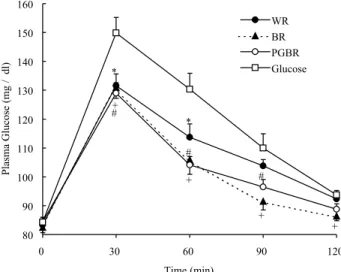
In the first study, all the rice samples were well ac-cepted and consumed within 10 min. Time courses of the blood glucose concentration after the ingestion of 25% (W/V) glucose solution, WR, BR and PGBR are shown in Figure 1. Table 2 shows the GIs. They were significantly lower for BR and PGBR than for WR (p<0.05). The concentrations reached the peak
at 30 min (glucose solution 149.9±5.3 ; WR 131.6± 4.1 ; BR 130.9±4.1 and PGBR 129.0±3.7mg/dl) and returned to the initial level at 120 min for all the sam-ples. The values of 30 min were significantly lower
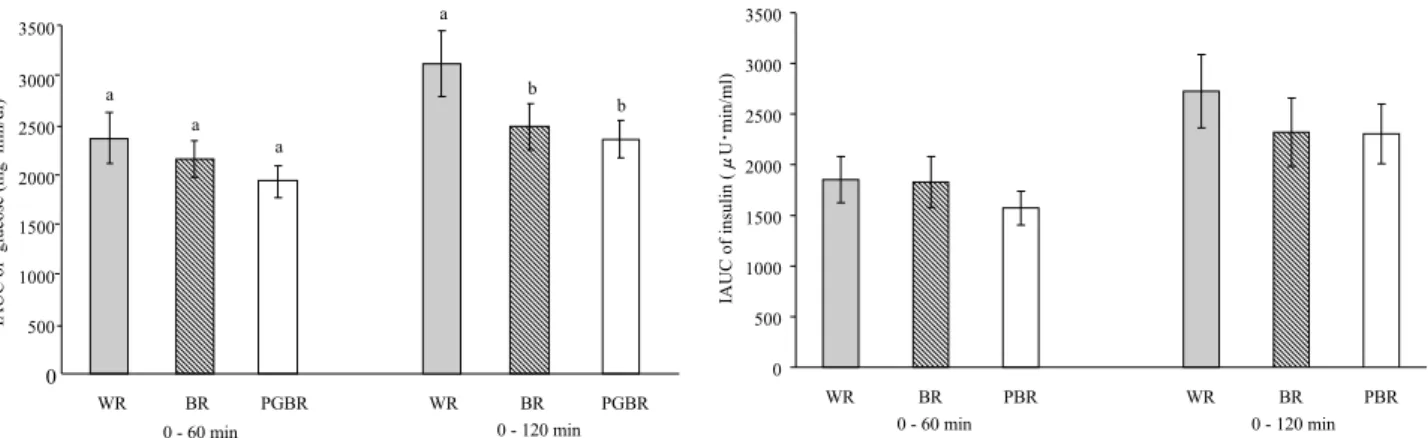
for the WR, BR and PGBR than for the glucose group (p<0.05). The IAUC-Glc and IAUC-I for the first 60
min and for the entire 120 min of the study are shown in Figure 2. There was no significant difference among the IAUC-Glc of all the rice samples for the first 60 min (WR 3109±326.1 ; BR 2484.8±233.9 and PGBR 2354.2±189.9mg・min/dl). However, IAUC-Glc dur-ing the 120 min were significantly lower for the PGBR (2354.2±189.9mg・min/dl) and the BR (2484.8±233.9 mg・min/dl) than for WR (3109±326.1mg・min/dl). In contrast, the IAUC-Glc of BR and PGBR were not significantly different. IAUC-I for the entire 120 min (WR 2724.6±360.7 ; BR 2319.9±339.9 and PGBR 2304.6±294.8µU・min/ml) was not significantly dif-ferent among all the food samples.
Figure 3 shows the time courses of blood glucose concentrations after ingesting 25% (W/V) glucose solution, WR, 1/3 PGBR, 2/3 PGBR and PGBR in the
Figure 1. Postprandial blood glucose responses to each of the meals
WR : white rice. BR : brown rice. PGBR : pre-germinated brown rice. Each value represents the mean±SE of 19 subjects
*Values of WR group are significantly different from those of
Glucose group (p<0.05)
+Values of BR group are significantly different from those of
Glucose group (p<0.05)
#Values of PGBR group are significantly different from those
of Glucose group (p<0.05)
Table 2. Glycemic Index of test meals (Study 1) GI (Glucose = 100) WR 75.9±6.6
BR 61.5±4.7*
PGBR 56.9±2.9*
WR : white rice, BR: brown rice, PGBR : pre-germinated brown rice. Each value represents the mean±SE
*Significant difference compared to WR of Study 1 by Student’s
t-test ; p<0.05(n=19)
second study. The blood glucose concentrations were significantly higher for the glucose than all the rice samples at 30 and 60 min (p<0.05). The GIs are shown
in Table 3. The GIs of all the rices were lower than that of glucose solution. The GIs of PGBR (55.2±2.9 and 54.4±5.1) were significantly lower than those of WR (73.0±6.6 and 74.6±6.2). However, there was no significant difference among the WR (74.6±6.2) and 1/3 PGBR (67.4±2.9) and 2/3 PGBR (63.7±5.3).
DISCUSSION
IAUC-Glc during 120 min was significantly lower for BR and PGBR than for WR in healthy individuals in the first study and the GI decreased by the increase of PGBR/WR ratio in the second study. These results suggest that PGBR and BR are better than WR to pre-vent the rapid increase of postprandial blood glucose concentration without increasing the insulin secretion. The mechanism of it may be the higher dietary fiber concentration of BR and PGBR than WR. The concen-trations of dietary fiber in BR, PGBR and WR were 2.0, 1.9 and 0.4 g/100 g (Table 1). The fiber in the intestine inhibits theα-amylase activity, the enzyme to digest starch, by rapping it. The fiber also raps the substrates (starch) in the small intestine. Our present finding and its postulated mechanism may be supported by the reports from the other researchers. There are a few studies which compared the postprandial blood glucose and/or insulin concentrations after taking BR
Figure 2. Incremental areas under the glucose and serum insulin corves to each of the meals
WR : white rice. BR : brown rice. PGBR : pre-germinated brown rice. IAUC of the glucose value represents the mean±SE of 19 subjects. IAUC of the insulin value represents the mean±SE of 15 subjects.
a, bIAUC values of glucose concentration not sharing a common letter are significantly different (p<0.05 by Bonferroni multiple
comparisons test ).
IAUC values of the insulin concentration are not significantly different among the 3 groupst (p<0.05 by Bonferroni multiple comparisons test ).
Figure 3. The influence of pre-germinated brown rice mixture on postprandial blood glucose responses
WR : white rice. 1/3 PGBR : mixture of pre-germinated brown rice to WR (WR/PGBR ratio is 2 : 1)
2/3 PGBR : mixture of pre-germinated brown rice to WR (WR/ PGBR ratio is 1 : 2). PGBR : pre-germinated brown rice. Each value represents the mean±SE of 13 subjects
*Values of WR group are significantly different from those of
Glucose group (p<0.05)
+Values of 1/3 PGBR group are significantly different from those
of Glucose group (p<0.05)
‡Values of 2/3 PGBR group are significantly different from those
of Glucose group (p<0.05)
#Values of PGBR group are significantly different from those of
Glucose group (p<0.05)
Table 3. Glycemic Index of test meals (Study 2) GI (Glucose = 100) WR 74.6±6.2 1/3 PGBR 67.4±2.9 2/3 PGBR 63.7±5.3 PGBR 54.4±5.1#
WR : white rice, 1/3 PGBR : ratio of PGBR and WR=1 : 2, 1/2 PGBR : ratio of PGBR and WR=1 : 2, PGBR : pre-germinated brown rice.
Each value represents the mean±SE
#
p significant difference compared to WR of Study 2 by Student’s t-test ; p<0.05(n=13)
Y. Ito, et al. Glycemic indexes of rice with different processing
and WR. O’Dea, et al. (14) observed that the glucose and insulin responses to BR tended to be smaller than those to WR, and that BR was hydrolyzed more slowly than WR in vitro (20). Hagiwara, et al. (17) re-ported that the blood glucose level and blood type-1 plasminogen activator inhibitor (PAI-1), which has been shown to be a major risk factor for cardiovascular disease in diabetes mellitus, significantly decreased in streptozotocin-induced diabetic rats by taking PGBR for 7 weeks. There are many reports which show the favorable effect of dietary fiber on the blood glucose concentration (21-25). A cohort study of 6 years also showed that foods rich in cereal fiber lower the risk of diabetes (23). Whole grains rich in fiber have bene-ficial effects of lowering fasting insulin level and de-creasing the risk of cardiac disease in diabetes and obese adults (24, 25). From our results, together with the data of others, it could be concluded that BR and PGBR are good foods to prevent diabetes.
Some of our results were not consistent with the expected results. For instance, the time course of se-rum insulin concentration was not different signifi-cantly among the BR, PGBR and WR. IAUC-Glc for the first 60 min of the 3 samples were not significantly different, either. Such unexpected results may be due to small quantity of the test rice samples. In the pre-vious studies in which subjects were given BR and WR, postprandial glucose concentrations at 30 min were similar when the starch was 50 g (26) but tended to be different when it was 75 g (14).
PGBR contains more GABA as compared with WR and BR (the contents of GABA in raw PGBR, BR and WR were 15 mg/100 g, 7 mg/100 g and 3 mg/100 g, respectively). GABA is reported to stimulate the pan-creatic beta cell and insulin secretion from pancreas (27). It was also reported that, when streptozotocin-induced diabetic rats were injected with GABA agonist, their insulin levels increased and the blood glucose levels decreased (28). In this study, although PGBR was richer in GABA than BR, postprandial blood glu-cose and insulin responses of PGBR were similar to those of BR. Such results also indicate that GABA was not the factor to decrease the postprandial blood glu-cose concentration when the subjects took PGBR. However, we can not conclude from this study that GABA is not effective to control insulin secretion by the same reason that the quantity of the rice samples in this study was little.
The results of the present study suggest that the highly polished WR which is commonly used in Asian countries may easily increase the blood glucose con-centration and the risk of diabetes. Asian people prefer
WR to BR because WR is softer and tastier than the BR. However, PGBR has less problems of BR by main-taining the benefits of BR. Therefore, PGBR may be recommended for more use considering its benefits.
ACKNOWLEDGEMENTS
The authors thank Naoko Fujimura and Hitomi Takano for expert technical assistance.
REFERENCES
1. Zimmet P, Alberti KG, Shaw J : Global and societal implications of the diabetes epidemic. Nature 414 : 782-787, 2001
2. Chan JM, Rimm EB, Colditz GA, Stampfer MJ, Willett WC : Obesity, fat distribution, and weight gain as risk factors for clinical diabetes in men. Diabetes Care 17 : 961-969, 1994
3. Manson JE, Rimm EB, Stampfer MJ, Colditz GA, Willett WC, Krolewski AS, Rosner B, Hennekens CH, Speizer FE : Physical activity and incidence of non-insulin-dependent diabetes mellitus in women. Lancet 338 : 774 -778, 1991
4. Jarrett RJ : Epidemiology and public health as-pects of non-insulin-dependent diabetes mellitus. Epidemiol Rev 11 : 151-171, 1989
5. Barrett-Connor E : Epidemiology, obesity, and non-insulin-dependent diabetes mellitus. Epide-miol Rev 11 : 172-181, 1989
6. Salmeron J, Ascherio A, Rimm EB, Colditz GA, Spiegelman D, Jenkins DJ, Stampfer MJ, Wing AL, Willett WC : Dietary fiber, glycemic load, and risk of NIDDM in men. Diabetes Care 20 : 545-550, 1997
7. Leeds AR : Glycemic index and heart disease. Am J Clin Nutr 76 : 286S -289S, 2002
8. Hanefeld M, Fischer S, Julius U, Schulze J, Schwanebeck U, Schmechel H, Ziegelasch HJ, Lindner J : Risk factors for myocardial infarction and death in newly detected NIDDM : the betes Intervention Study, 11-year follow-up. Dia-betologia 39 : 1577-1583, 1996
9. Amano Y, Kawakubo K, Lee JS, Tang AC, Sugi-yama M, Mori K : Correlation between dietary glycemic index and cardiovascular disease risk factors among Japanese women. Eur J Clin Nutr 58 : 1472-1478, 2004
10. The DECODE study group. European Diabetes Epidemiology Group : Glucose tolerance and
mortality : comparison of WHO and American Diabetes Association diagnostic criteria. Lancet 354 : 617- 621, 1999
11. Jenkins DJ, Wolever TM, Taylor RH, Barker H, Fielden H, Baldwin JM, Bowling AC, Newman HC, Jenkins AL, Goff DV : Glycemic index of foods : a physiological basis for carbohydrate exchange. Am J Clin Nutr 34 : 362-366, 1981 12. Foster-Powell K, Holt SH, Brand-Miller JC :
In-ternational table of glycemic index and glycemic load values. Am J Clin Nutr 76 : 5 -56, 2002 13. Holt SH, Miller JC, Petocz P: An insulin index
of foods : the insulin demand generated by 1000-kJ portions of common foods. Am J Clin Nutr 66 : 1264 -1276, 1997
14. O’Dea K, Nestel PJ, Antonoff L : Physical factors influencing postprandial glucose and insulin re-sponses to starch. Am J Clin Nutr 33 : 760 -765, 1980
15. Ayuo PO, Ettyang GA : Glycaemic responses after ingestion of some local foods by non-insulin de-pendent diabetic subjects. East Afr Med J 73 : 782-5, 1996
16. Saikusa T, Horino T, Mori Y : Distribution of free amino acids in the rice kernel and kernel fractions and the effect of water soaking on the distribution. J Agric Food Chem 42:1122-1125, 1994
17. Hagiwara H, Seki T, Ariga T:The effect of pre-germinated brown rice intake on blood glucose and PAI-1 levels in streptozotocin-induced dia-betic rats. Biosci Biotechnol Biochem 68 : 444-447, 2004
18. Aoto H, Sugino T, Shinmura H, Mizukuchi A, Kise M, Teramoto S, Someya S, Tsuchiya K, Ishiwata K : Germinated brown rice, Patent No. P3423931, JP, Jul. 7, 2003
19. Wolever TM, Jenkins DJ : The use of glycemic index in predicting the blood glucose response
to mixed meals. Am J Clin Nutr 43 : 167-172, 1986 20. O’Dea K, Snow P, Nestel P : Rate of starch hy-drolysis in vitro as a predictor of metabolic re-sponses to complex carbohydrate in vitro. Am J Clin Nutr 34 : 1991-1993, 1981
21. Madar Z : Effect of brown rice and soybean die-tary fiber on the control of glucose and lipid me-tabolism in diabetic rats : Am J Clin Nutr 38 : 388-93, 1983
22. Montonen J, Knekt P, Jarvinen R, Aromaa A, Reunanen A : Whole-grain and fiber intake and the incidence of type 2 diabetes. Am J Clin Nutr 77 : 622-629, 2003
23. Salmeron J, Manson JE, Stampfer MJ, Colditz GA, Wing AL, Willett WC : Dietary fiber, glycemic load, and risk of non-insulin-dependent diabetes mellitus in women. JAMA 277 : 472-477, 1997 24. Pereira MA, Jacobs DR Jr, Pins JJ, Raatz SK,
Gross MD, Slavin JL, Seaquist ER : Effect of whole grains on insulin sensitivity in overweight hyper-insulinemic adults. Am J Clin Nutr 75 : 848 -55, 2002
25. Liu S : Intake of refined carbohydrates and whole grain foods in relation to risk of type 2 diabetes mellitus and coronary heart disease. J Am Coll Nutr 21 : 298 -306, 2002
26. Noriega E, Bouix O, Brun JF, Mestres C, Gauthier J, Oresetti A : Glycaemic and insulinaemic re-sponses to white, brown and germinated rices in healthy subjects. Diab Nutr Metab 6 : 215-221, 1993
27. Adeghate E, Ponery AS : GABA in the endocrine pancreas : cellular localization and function in normal and diabetic rats. Tisuue Cell 34 : 1-6, 2002
28. Gomez R, Asnis N, Tannhauser SL, Barros HM : GABA agonists differentially modify blood glu-cose levels of diabetic rats. Jpn J Pharmacol 80 : 327-331, 1999
Y. Ito, et al. Glycemic indexes of rice with different processing