Legal, Political, and Economic Constraints on
Japanese Strategies for Distant-Water Tuna and
Skipjack Fisheries in Southeast Asian Seas and
the Western Central Pacific
著者
MATSUDA Yoshiaki, OUCHI Kazuomi
journal or
publication title
南海研紀要
volume
5
number
2
page range
151-232
URL
http://hdl.handle.net/10232/15656
Mem. Kagoshima Univ. Res. Center S. Pac, Vol.5, No. 2, 1984 151
Legal, Political, and Economic Constraints on
Japanese Strategies for Distant-Water
Tuna and Skipjack Fisheries in Southeast Asian
Seas and the Western Central Pacific*
Yoshiaki MATSUDA** and Kaiuomi OlJCHI***
Abstract
Together with cost inflation and stagnant market prices, the new 200-nautical-mile regime has hit the conventional tuna and skipjack fishing industry very hard. Japanese countermeasures consist of domestic adjustments such as cost and risk-reducing devices, withdrawals of fishing vessels, employment of purse-seine fisheries, nearshore fishing ground adjustments, and demand expansion; and external strategies such as
historical fishing rights, legal-Informal Composite Negotiating Text (ICNT), and
bilateral arrangements.
The Japanese claim on historical tuna and skipjack fishing rights in the EEZs and archipelagic waters of coastal states in Southeast Asia and the western central Pacific
is based on 1) discovery of the fishing grounds by the Japanese, 2) risk-taking for
development by the Japanese, 3) continuous and habitual Japanese fishing activities in
the region, 4) long legal practices under the Japanese fisheries licensing system, and
5) the importance of the fishery.
Although most coastal nations in Southeast Asia and the western central Pacific treat tuna and skipjack in their EEZs as their national properties, the position of the ICNT emphasizes that highly migratory species such as tuna and skipjack are managed
by cooperation among the countries concerned and international cooperation is
essential to manage those fishery wisely.
Bilateral arrangements such as fee fishing and joint-ventures, associated with overseas
cooperation, have been successful in terms of fishing access to the EEZs and archipelagic waters of coastal states in the region, but current arrangements become increasingly difficult due to coastal nations' desires to increase fishing fees and take part in
joint-ventures. Emergence of subregional management schemes will become more important
for dealing with highly migratory species like tuna and skipjack, but Japan is not yet
ready for such schemes. The legal, political, and economic constraints on each of the
* Published with permission of the Director, the East-West Environment and Policy Institute, Honolulu, Hawaii 96848, U.S.A.
Lab. of International Marine Policy, Faculty of Fisheries, Kagoshima University, Shimoarata 4-chome,
Kagoshima 890, Japan.
152 Matsuda: Legal, Political, and Economic Constraints
strategies are numerous and combine to aggravate the problem. Although the Japanese
government has committed to easing the adjustment of Japanese fishermen to the new
ocean regime, the job is not easy.
The problem involves not only the Japanese, but also coastal, resource-owning nations as well. Joint arrangements have many advantages over attempts by any one nation to go it alone. However, in order to arfive at successful arrangements, it is essential for each party to understand the interests, capabilities, and limitations of the other. A new international cooperation toward sound tuna and skipjack management can emerge only if each sets reasonable goals and recognizes a gradual growth process
while seeking benefits for the welfare of both.
Introduction
The United Nations Law of the Sea Conference has led to an "extended maritime
jurisdictions" boom all over the world. Although extended maritime jurisdictions
have been declared unilaterally and require further refinement, they are already part
of customary international law.
Despite the position of the Informal Composite
Negotiating Text (ICNT) at the third United Nations Law of the Sea Conference
(UNCLOS III) that highly migratory species such as tuna and skipjack are a common
heritage of mankind, most nations of Southeast Asia and the western central Pacifictreat them as their own national property. Skipjack belongs to the tuna family, but
the Japanese traditionally treat skipjack separately from other tuna due to differences in production, processing and marketing. Skipjack tuna are conventionally caught
by pole-and-line vessels, processed to "katsuobushi" (a smoke-dried fish) and marketed
as an essence, whereas other tuna are caught by longline vessels, kept fresh or frozen,
and marketed as "sashimi" (raw fish).It is realistic to recognize that most tuna and skipjack fishing grounds in the world eventually will be controlled by coastal states under the new regime. On the other hand, there is a large number of Japanese tuna and skipjack fishermen who have
depended on fishing in the extended maritime jurisdictions of coastal nations, particular
ly in Southeast Asia and the western central Pacific. In addition to cost inflation and
stagnant market prices, the new 200-nautical-mile regime has hit the conventional tuna and skipjack fishing industry very hard. This industry has been very important
in Japan because of its leading role in Japanese distant-water fisheries. However, the
industry is now confronted with serious problems of survival.
The purpose of this study is to review critically Japanese strategies for
distant-water tuna and skipjack fishing in Southeast Asia and the western central Pacific under
the new maritime regime. An interdisciplinary approach was employed, drawing upon economic information and legal claims in order to identify Japanese strategies and review the legal, political, and economic constraints associated with these strategies.
The elements of Japanese strategies consist of domestic adjustments such as cost-and risk-reducing devices, withdrawals of fishing vessels, involvement in purse-seine
Mem. Kagoshima Univ. Res. Center S. Pac, Vol. 5, No. 2, 1984 153
strategies such as historical fishing rights, legal-Informal Composite Negotiating Text
(ICNT), and bilateral arrangements. Our inquiry first reviews the practices of
Japanese fishermen in Southeast Asian seas and the western central Pacific to reveal
how intense and continuous they have been, to clarify the "historical or habitual rights"
which entitle Japan to certain privileges under the new Law of the Sea. Secondly,
we review representative countries' claims to extended maritime jurisdictions and the
Japanese current fishing access to such extended maritime jurisdictions. Thirdly, we
survey the current strategies of Japanese distant-water tuna and skipjack fisheries
with special attention given to external strategies. Can Japan successfully establish the
historical tuna and skipjack fishing right in the region I If not, what are the- alter
natives 1 Can the highly migratory species clause in ICNT help Japan 7. If not, what
are the alternatives ? Can bilateral arrangements of fee fishing and joint-ventures combined with overseas technical and economic cooperation be the only solution for the continuation of Japanese tuna and skipjack fishing in the region ? If not, what are
the alternatives? Finally, we discuss all conceivable constraints-legal, political, eco
nomic, or otherwise-that any desirable method of Japanese fishery participation in
Southeast Asian seas and the western central Pacific regions will have to face.
I. History of Japanese Tuna and Skipjack Fishing Activities in Southeast
Asian Seas and the Western Central Pacific
Development of tuna and skipjack fisheries in Japan has been closely tied to Japanese development policy since the Meiji Era (1868-1912). Fisheries policy of the
Meiji government was characterized by maintenance of order in coastal fisheries and
the promotion of distant-water fisheries. Foreign whaling by English, American and French whalers had been undertaken in waters around Japan since the beginning of the Meiji Era. Their activities increased drastically after 1892, while Japanese whaling and fisheries rernained at subsistence levels. For national security purposes, the govern
ment had to promote coastal fisheries, whaling and distant-water fisheries. In 1897,
the Distant-Water Fisheries Promotion Act was enacted. Since then, tuna and skipjack
fisheries have been directly or indirectly aided by the government. Since 1906, availability and/or improvement of power-driven boats, larger vessels, line hauler, live-bait tanks, and cold storages contributed to the fisheries development (36).
1) Pre-war Fishing Activities
Southeast Asian and Pacific countries and islands have long colonial histories. Except for the Japanese, colonial leaders never paid attention on fisheries. Thus, fishing activities were mostly traditional and subsistence oriented before Japanese
involvement in these areas. Further, traditional fisheries had established a consumer
preference for small fish in local markets, not large tuna. Thus, except for juvenile tuna and skipjack in the Philippines and Indonesia, there was little demand for large
tuna in Southeast Asia and the western central Pacific.
154 MaTSUDA: Legal, Political, and Economic Constraints
to the nearshore fisheries around Japan before World War I. In 1914, Japan occupied
islands in the western central Pacific. After World War I, all islands in the area
bounded by 130°E, 170°E, 0"N, and 22°N (an area about 2,700miles from east to west and 1,300miles from north to south) were put under Japanese trusteeship which continued until the Japanese surrender at the end of World War II in 1945 (114). This area has more than 1,400 islands including the Marianas, Carolines, and Marshall
islands. Japanese interest in tuna and skipjack resources increased greatly along with
this territorial expansion (42). The main interest was in "Katsuobushi (a
smoke-dried skipjack)" supply for domestic markets, fish supply for the overseas Japanese in Southeast Asia and the western central Pacific, and of foreign exchange earnings from canned tuna which later became of use to its military force.
i) Japanese distant-water fishery policy
In 1922, Nanyo Cho (Agency for the Southwestern North Pacific) was established
to manage the area under the Japanese trusteeship. The Japanese government took,
directly or indirectly, various promotion measures for distant-water tuna and skipjack
fisheries development. These included subsidies for fishing and construction of fishing
vessels beginning in 1922, grants for fish supply for the overseas Japanese beginning in 1923, subsidies for fish processing beginning in 1924, grants for the "Katsuobushi" export to mainland Japan beginning in 1929, grants for tuna fisheries development
beginning in 1933, and revision of the Fisheries Promotion Act in 1935. The 1935
revision emphasized integrated fisheries promotion to coordinate all necessary factors for effective development such as types of fishing, processing, ice making, cold storages, freezer carriers, transportation, fisheries organization, utility and common use of instru
ments and facilities (115).
The government also constructed two base ports in the western central Pacific :
Saipan and Koror (Palau). By 1935, the piers were improved so that 3,000 gross
metric ton (gmt) vessels could land without difficulty at both ports. At Saipan
two oil tanks of 500 metric tons (mt) and 2,000 metric tons, an ice plant (capacity:
15 mt/day), a freezer room (2.9 mt), a cold storage (5.3 mt), and two shipyards
(capacity: 20-30 gmt vessel construction) served the fishing industry while fish landing and storing places, two oil tanks (500 mt and 3,000 mt), an ice plant (20 mt/day) and 12 shipyards were operating at Koror (114).
In addition, the government initiated fisheries research in the western central
Pacific in 1924. With two small research vessels, the 10 gmt Hakuo-maru I and II,
fisheries investigations were first conducted in coastal waters around Palau and Truk
islands. The Zuiho-maru (a 183 gmt iron vessel) was built in 1931 and used for
extensive fisheries research in Southeast Asian seas and the western central Pacific.
A fisheries experiment station (with 57 staff) was established at Koror on Palau in
1937. Their investigations included fisheries surveys in waters around the Marianas
(1924), Palau (1925-29), Marshalls (1926-27), Ponape (1927-29), Truk (1930-35), Celebes and Halmahera (1931), Irian Jaya (1932), the Arafura Sea (1934) and
the Banda and Arafura Seas (1936). By 1941, fisheries resource surveys had covered
Mem. Kagoshima Univ. Res. Center S. Pac, Vol. 5, No. 2, 1984 155
East Indies (3 and 4). Other Japanese research and training vessels studied coastal
areas of New Guinea and the Solomon Islands, Sumatra, and the Andaman and
Nicobar islands.
The average and highest catch per unit effort (number of fish caught per 100 hooks) for tuna longline during the prewar period are shown in Figure 1. Together with the government promotion policy, these research and actual fishing results en couraged the development of tuna and skipjack fisheries in Southeast Asian seas and
the western central Pacific.
ii) Japan-based tuna and skipjack fisheries
The history of tuna and skipjack fisheries in Japan can be traced back as far as
the Stone Age. However, development of offshore fisheries started in the Meiji Era.
Traditional tuna and skipjack fisheries gradually expanded from coastal to offsore areas
and to distant-waters after 1909. With non-power-driven boats, Chiba fishermen
extended their skipjack fishing grounds to waters around Hachijo-jima in 1909; Yaizu (Shizuoka) fishermen went to 80 to 90 miles off Yaizu in 1895; Bonotzu (Kagoshima) fishermen went to 40 to 50 miles off Bonotzu at the beginning of the Meiji Era and
to 90 to 100 miles off Bonotzu in 1891. A successful operation of Fuji-maru (a
25 gmt power-driven vessel) in 1906 led to rapid development" of offshore skipjack
fisheries. By 1913, waters around Smith Island became good skipjack fishing grounds
for Shizuoka fishermen and by 1916 Bonotzu fishermen had extended their fishing
grounds up to 150 miles off Bonotzu (36).
With the government promotion, Japanese fishermen had, by 1922, explored
skipjack fishing grounds around Saipan, Truk and Ponape (114). Due to problems associated with shortages of live-bait and cold storage, fishing grounds for Japan-based
vessels were limited to the North Pacific within 2,000 miles from Misaki (Kanagawa). Initially skipjack pole-and-line fishing was the dominant form of fishing in the western
central Pacific, and tuna were an incidental catch. However, skipjack fishing was
seasonal, and some fishermen found that the periods before and after the skipjack
fishing season were good for tuna fishing. Thus, skipjack pole-and-line fishermen
applied the same techniques to tuna fishing. Eventually, tuna pole-and-line fishing
became popular in the western central Pacific. The best example was tuna fishing
with motherships in waters around the Marianas developed by Omaezaki (Shizuoka)
fishermen in the 1920s (55).
Although offshore tuna fishing had been regarded until the 1930s as a secondary winter activity after the summer (skipjack) season, the introduction of power-driven tuna longliners (Seishin-maru) in 1914 opened a new era for tuna longline fishing. Almost all tuna longliners were converted to power-driven vessels (30 to 70 gmt) by
1926 (36). Using Shinmei-maru (1,537 gmt), the first mothership operation for tuna
longline fishing was also conducted by the government in waters south of Dutch East Indies from Nicobar islands to Timor in 1932-33, and proved the economic feasibility
of the operation. By 1939, the number of Japan-based tuna vessels (60 to 270 gmt)
operating in the western central Pacific increased to 72. In that year, they made
156
o
E3:
*x*j^
MatSUDA: Legal, Political, and Economic Constraints
Average CPUE (catch per unit effort) Highest CPUE
Area under the Japanese trusteeship
(1918-1944)
Area occupied by Japan during WW II
South Pacific Commission (SPC)
Area in 1982
Tuna and skipjack fishing base
Figure 1. Catch per unit effort (number of fish caught per 100 hooks) for tuna longline
fishing in Southeast Asian seas and the western central Pacific before world
Mem. Kagoshima Univ. Res. Center S. Pac, Vol. 5, No. 2, 1984 157
and swordfish, which yielded 4,815,927 yen at the market price (42). The best example was tuna longline fishing in waters around the Carolines developed by Misaki fishermen. From October 1938 to March 1939, 39 Misaki vessels took 145 round trips between these fishing grounds and Japan, and yielded over 1,600,000 yen worth of tuna (55). In the Sulu Sea, Yaizu skipjack pole-and-line vessels were actively involved in skipjack
fishing during the off-season. In 1938, 8 vessels made 19 trips, producing a catch
worth 166,775 yen.
iii) Non-Japan-based tuna and skipjack fisheries
The South China, Sulu, Celebes and Philippine seas were explored by Taiwan-based tuna and skipjack vessels. At the same time, many fisheries companies were established to fish tuna and skipjack in Southeast Asian seas and the western central Pacific.
Taiwan
In 1895, after the Sino-Japanese War, Taiwan was ceded to Japan. Japanese
colonial policy in Taiwan continued until 1945. During this period, Taiwan played an important role in the Japanese industrial development supplying raw materials, providing capital and product markets, and serving as a base for further political and economic expansion in Southeast Asia and the western central Pacific.
Although statistics are not available, Taiwan-based tuna and skipjack vessels fished in the South China, Sulu, and Celebes seas and east of Taiwan and the Philippines.
Kaohsiung base was established in around 1928-29. The average size of tuna and
skipjack vessels was about 14 to 15 gross metric tons. By 1937, a number of vessels
increased to 200 and fishing grounds were expanded to waters within 1,000 miles from
Kaohsiung. Major species caught were yellowfin and swordfish. Some of these enter
prises became large fisheries companies like Nanyo Kaihatsu Kumiai (Southern Ocean
Development Association). In 1939, Tobu Suisan Co., Ltd., was established. Based at
Hualien, this company in 1940 initiated a mothership operation with 6 tuna fishing
vessels (each about 17 gmt) and 4 factory ships (2-500 gmt, 1-100 gmt and 1-50 gmt) in
the Celebes Sea (43). At the same time, Takuyo Suisan Co., Ltd. also conducted tuna
fishing in the South China Sea with the Seifuku-maru (172 gmt) and 7 small tuna fishing vessels (each about 20 gmt) (36).
Borneo
In 1918, a Taiwan-based Japanese organization, Nanyo Kaihatsu Kumiai was
granted rights for coastal fishing from the Borneo government, leased an island 60
miles east of Taiwan, and established a tuna longline and processing base (41). Although
the operation of this association once ceased in 1923, Nanyo Kaihatsu Kumiai re organized and became Borneo Suisan Koshi (Borneo Fishing Association) in 1926. Borneo Suisan Koshi successfully operated tuna and skipjack fishing and "Katsuobushi"
processing and in 1933 became Borneo Suisan Co., Ltd. With 16 powered boats (10
to 50 gmt) based on Tawau, Sheamil and Banggi, about 290 fishermen from Okinawa and KSchi harvested skipjack throughout the year in the coastal waters of Borneo, the Celebes Sea, and the South China Sea. Further, about 280 employees worked at these
158 MATSUDA : Legal, Political, and Economic Constraints
"Katsuobushi" processing factories. In 1934, canning factories, ice plants, cold storages
and hospitals were added.
British Malaya
S. SAKAMOTO from Yamaguchi started longline, pole-and-line and gill net fishing in 1913 based at Singapore and Japanese fishing from Singapore increased since that time (24), reaching 1,752 Japanese fishermen in 1936. Japanese landings at Singapore's
fish market comprised 45.8 % of total landings (11,828 mt) in 1938. However, tuna
and skipjack were not the major target species as only 179 tons of tuna and skipjack
were included (65).
Indonesia
Japanese skipjack fishing in Indonesia was initiated in 1927 by K. HARA of
Makurazaki, a Japanese medical doctor and congressman who experimentally fished
skipjack near Menado, Sulawesi, and north Celebes. The successful operation led to
a fishing base at Menado, and four years later the base was moved to Ambon, where Dr. HARA trained the local people in skipjack fishing and processing techniques (1).
At about the same time, KlNJO, TAMASHIRO, NlWA and KOKUBA from Okinawa also
undertook skipjack pole-and-line fishing in the Banda Sea. Based on Ambon, they
used many native crews (40). Other Japanese organizations also established fishing
bases at Menado and Ternate though the years of establishment are unknown. These
included Oiwa Gyogyo Kumiai (Menado and Ternate), Nichiran Gyogyo Kaisha
(Menado), and Bijack Gyogyo Kumiai (Menado). Oiwa Gyogyo Kumiai amalgamated
with Bijack Gyogyo Kumiai in 1939 and with Nichiran Gyogyo Kaisha in 1940, and eventually established Toin Suisan Co., Ltd., at Butung with a capital of 1.5 million
yen. Toin Suisan Co., Ltd. operated tuna and skipjack fishing under an agreement
with the Dutch East Indies Authority. The agreement provided that 1) skipjack
pole-and-line fishing must be operated on the high seas under the Japanese flag; 2) the fishermen must purchase bait fish from native fishermen ; and 3) export and
import duties on fish and processed goods be exempted. In 1941, 6 vessels (9 to
26 gmt) fished with 130 Japanese (mainly Okinawan) fishermen and 500 native
employees. The fishing season was year-round, but the best season was from July to
September. On-shore facilities provided by the company included a fish landing place, skipjack storage, a "Katsuobushi" processing plant (3,000 to 4,000 pieces per day)
and a canning factory. In Ternate, Oiwa Gyogyo Kumiai undertook skipjack
pole-and-line fishing with 2 vessels, employing 26 Japanese and 110 natives (10).
Philippines
K. SAKUHARA initiated tuna longline fishing based on Davao in 1928, and I.
NEGAMIYA started skipjack pole-and-line fishing with a 13 gmt vessel in 1933. Further,
with a capital of 300,000 yen, Seafood Corporation, a Japan-Philippines joint-venture
was established at Zamboanga in 1937. Seafood Corporation was involved in tuna
and skipjack pole-and-line fishing, processing (canning) and marketing. In 1940, 4
Mem. Kagoshima Univ. Res. Center S. Pac, Vol. 5, No. 2, 1984 159
off Zamboanga, employing 21 Japanese and many Filipinos, while 10 vessels (1-23 gmt and 5 less than 3 gmt tuna longline vessels, and 4 less than 3 gmt skipjack
pole-and-line vessels) operated off Davao. Tuna fishing was year-round operation, but skipjack
fishing was good only from May to July. Some Japanese tuna longline fishermen
were also involved in fishing off Negros Island. The harvest was good but the market
was not and this operation folded (117, 118 and 119).
The western central Pacific
Based on Saipan, Truk and Ponape, Japanese skipjack pole-and-line fishing started
in the western central Pacific in 1922 (116). These activities were at a low level until
1927, when Tamashiro Gumi from Okinawa joined the skipjack pole-and-line fishery based in Truk (12). Since then, many Okinawan fishermen emigrated to the islands under the Japanese trusteeship in the western central Pacific, eventually bringing their families to the islands settling there (28).
In 1930, Shizuoka fishermen joined the skipjack pole-and-line fishing fleet based in Palau, establishing the Nanko Kohatsu Co., Ltd., in 1931, which in turn was the
foundation of Nanko Suisan Co., Ltd., established at Koror, Palau in 1935. With an
initial capital of 2 million yen (which increased to 2.7 million yen in 1938, 5 million
yen in 1939, and 10 million yen in 1941), Nanko Suisan Co., Ltd., developed
branches in Saipan, Truk, Ponape, Kusaie, Jaluit, Ambon, Kavieng, and Rabaul; and became involved in tuna and skipjack fishing and "Katsuobushi" processing in Saipan, Palau, Truk and Ponape in 1935, canning in Palau in 1936 and in Truk and Kusaie in 1941 ; ice making, freezing and cold storage in Palau, Truk, Saipan, Ponape, Kusaie, Jaluit, Ambon, Kavieng and Rabaul and marketing, marine transportation, shipbuilding and repair yards, iron works, fisheries finance and research (44).
In addition, three fisheries companies (Nanyo Boeki Co., Ltd., Hamaichi Shoji Co., Ltd., and Kimi Suisan Goshi Co.) became involved in tuna and skipjack fishing,
processing and marketing. Nanyo Boeki Co., Ltd. (a trading company) was established
at Koror in 1899, and branches were established in Truk and Ponape. Earlier
Japanese skipjack fisheries in the western central Pacific were more or less associated
with this company. In 1931, Hamaichi Shoji Co., Ltd. (a trading company) was also
established at Koror, and branches were later established in Truk. The company
started a canning industry in addition to tuna and skipjack fishing. In 1932, Kimi
Suisan Goshi Company was also established at Koror, and joined the "Katsuobushi" processing as well as tuna and skipjack fishing (116).
Development of these companies stimulated emigration of Japanese fishermen to
the western central Pacific. As a result, 4 tuna and skipjack fisheries cooperatives and
one federation (the Japanese Federation of Southern Islands Fisheries Cooperatives)
were formed during the 1930s. The cooperatives included the Palau Fisheries
Cooperative at Koror (1932), the Truk Islands Skipjack Fisheries Cooperative (1936), the Saipan Skipjack Fisheries Cooperative (1937), and the Tinian Fisheries Cooperative
(1937) (116). The number of Japanese fishermen in the western central Pacific
increased from 475 in 1930 to 7,616 in 1938; many were involved in skipjack fishing. In 1940, licensed skipjack vessels reached 128, 69 of which belonged to Nanko Suisan
160 MATSUDA : Legal, Political, and Economic Constraints
Co., Ltd. Eighty percent of these licensed vessels were involved in year-round fishing.
The highest skipjack catch was recorded as 28,688 metric tons in 1937. Most of the
catch was processed into "Katsuobushi," of which 50 to 60 % were produced by
Nanko Suisan Co., Ltd. alone (12). By 1937, the number of "Katsuobushi" processing
plants in the area increased up to 63. With 1,810 employees, they produced 5,812
tons of "Katsuobushi" in 1937 and earned 5,081,774 yen (116). Tuna were also canned. Palau canneries received 681 metric tons of tuna (mainly yellowfin) in 1937.
iv) A summary
Table 1 shows the prewar Japanese tuna and skipjack production. As early as
1894, Japanese production of tuna and skipjack was 14,300 metric tons and 34,315 metric tons, respectively. Statistics for production of offshore tuna and skipjack before 1904 are not available. Nevertheless, statistics for offshore fisheries development began to be reported with the introduction of power-driven boats (for skipjack in 1906 and
for tuna in 1914). Rapid increases in offshore production in 1915 corresponded with
the Japanese territorial expansion to the western central Pacific. In Table 1, it is
difficult to identify the share of production from Southeast Asian seas and the western
central Pacific on the total offshore fisheries production. However, these offshore
fisheries production figures certainly included the production from that region. Skipjack
pole-and-line fishing activity was again accelerated by construction of "Katsuobushi"
processing plants in the region during the 1920s, while tuna longline activity was
promoted by canning and/or mothership operations in the 1930s. With oil, water,
live-bait and food supply bases in the region, distant-water tuna and skipjack fisheries became year-round operations. The size of vessels were increased, and fishing grounds
were extended to almost all fishing areas under the Japanese trusteeship, and waters around New Guinea, the Solomon islands, and major fishing grounds in Southeast Asian seas including the area south of the Dutch East Indies, and in the Andaman
Sea (36).
Before World War II, Japanese fishermen have long fished continuously and habit ually in Southeast Asian seas and the western central Pacific and developed most of
the tuna and skipjack fishing grounds in the region. Their fishing did not conflict
with local fishermen in the region because there was little demand for tuna and skipjack
in most of the region. Through fishing base construction, the Japanese provided local
employment opportunities and technology transfer.
2) Postwar Fishing Activities
Japan's involvement in World War II marked the transfer of the tuna and skipjack fisheries to military government control in 1942. As a result of the war, sixty percent of tuna and skipjack vessels and all overseas bases were lost (36). Many fisheries
emigrants to Southeast Asia and the western central Pacific were forced to return to
Japan after the war. Consequently, only a few Japanese remained in the region.
Immediately after the war, production of food and export commodities became one of the most important objectives under the occupational policy of General McArthur.
Mem. Kagoshima Univ. Res. Center S. Pac, Vol. 5, No. 2, 1984 161
Table 1. Japanese tuna and skipjack production before World War II: 1894-1945 (modefied from JAPAN MINISTRY OF AGRICULTURE, FORESTRY AND FISHERIES et al, ed., 1979)
Year
Grand total Offshore fisheries
Skipjack Tuna1 Total Skipjack Tuna1 Total
m t m t m t tat[%) mt(%) mt(%) 1894 34,315 14,300 48,615 - — — 1905 41,943 10,683 52,626 3,014 ( 7.2) 325 ( 3.0) 3,339 ( 6.3) 6 43,736 10,241 53,977 3,108 ( 7.1) 236 ( 2.3) 3,344 ( 6.2) 7 33,041 10,250 43,291 5,551 (16.8) 1,124(11.0) 6,675(15.4) 8 50,102 11,158 61,260 7,569 (15.1) 860 ( 7.7) 8,429(13.8) 9 51,530 14,836 66,366 6,625 (12.9) 1,197 ( 8.1) 7,822(11.8) 10 41,392 13,773 55,165 8,580 (20.7) 1,192 ( 8.7) 9,772(17.7) 11 49,470 15,983 65,453 9,463 (19.1) 813 ( 5.1) 10,276(15.7) 12 49,867 12,017 61,884 8,266 (16.6) 559 ( 4.7) 8,825(14.3) 13 42,283 14,159 56,442 5,859 (13.9) 637 ( 4.5) 6,496(11.5) 14 53,768 16,403 70,171 7,052 (13.1) 537 ( 3.3) 7,589(10.8) 15 101,750 18,509 120,259 29,730 (29.2) 3,607(19.5) 33,337 (27.7) 16 60,917 14,481 73,398 25,376 (41.7) 3,293 (22.7) 28,669(38.0) 17 82,802 11,164 93,966 49,551 (59.8) 4,281 (38.3) 53,832(57.3) 18 70,098 17,425 87,523 41,238 (58.8) 4,899(28.1) 46,137(52.7) 19 64,396 20,038 84,434 39,345 (61.1) 9,038(45.1) 48,383(57.3) 20 88,201 21,360 109,561 52,432 (59.4) 8,074(37.8) 60,506(55.2) 21 81,614 18,780 100,394 50,946 (62.4) 7,524(40.0) 58,470(58.2) 22 65,285 17,759 83,044 45,872 (70.3) 7,003 (39.4) 52,875(63.7) 23 67,791 26,133 93,924 47,760 (70.5) 15,937(61.0) 63,697 (67.8) 24 68,282 31,935 100,217 45,415 (66.5) 16,528(51.8) 61,943(61.8) 25 69,541 33,060 102,601 47,568 (68.4) 18,429(55.7) 65,997(64.3) 26 68,768 44,258 113,026 54,030 (78.6) 27,343(61.8) 81,373(72.0) 27 85,706 40,516 126,222 72,217 (84.3) 29,470(72.7) 101,687 (80.6) 28 76,989 43,864 120,853 64,847 (84.2) 28,734(65.5) 93,581 (77.4) 29 72,137 60,327 132,464 60,151 (83.4) 42,564(70.6) 102,715(77.5) 30 68,793 63,102 131,895 57,667 (83.8) 42,306 (67.9) 99,973(75.8) 31 80,347 65,133 145,480 68,979 (85.9) 45,769(70.3) 114,748(78.9) 32 67,148 59,937 127,085 53,441 (79.6) 39,968(66.7) 93,409(73.5) 33 77,309 63,173 140,482 65,153 (84.3) 41,683 (66.0) 106,836 (76.0) 34 84,917 58,120 143,037 68,942 (81.2) 36,010(62.0) 104,952(73.4) 35 72,885 68,476 141,361 61,968 (85.0) 34,217(50.0) 96,185 (68.0) 36 101,035 75,963 176,998 85,802 (84.9) 42,178.(55.5) 127,980(72.3) 37 105,909 62,169 168,078 93,076 (87.9) 36,997 (59.5) 130,073 (77.4) 38 120,818 57,376 178,194 104,465 (86.5) 39,953 (69.6) 144,418(81.0) 39 100,522 85,919 186,441 86,263 (85.8) 51,342(59.8) 137,605(73.8) 40 116,349 86,090 202,439 96,110(82.6) 42,923 (49.9) 139,033 (68.7) 41 91,626 46,128 137,754 ? 7 42 79,715 46,685 126,400 ? 7 43 51,691 38,902 90,593 7 ? 44 39,642 23,310 62,952 7 7 45 19,653 12,386 32,039 0 0 0
162 MATSUDA: Legal, Political, and Economic Constraints
government finance for vessel construction, tuna and skipjack fisheries recovered quickly.
i) Expansion of fishing grounds and conventional tuna and skipjack fisheries
Although any movement of Japanese fishing vessels was prohibited immediately after the war, fishing by wooden vessels was allowed within 12 miles off Japan's coasts
on as early as September 14, 1945 (49). Subsequently, four successive expansions were
allowed under the General Headquarters Administration (Figure 2). The first large
expansion was on September 27, 1945; the second on June 22, 1946; the third on
September 19, 1949; and the fourth on May 11, 1950. These new boundaries were
called McArthur's lines. The last expansion was for mothership operations. The last
McArthur's line was removed on April 25, 1952.
After the removal of the McArthur's line, Southeast Asian seas and the western
central Pacific were divided by "A", "B", and "C" zones for tuna and skipjack fisheries
(Figure 3), and less than 20 gmt vessel operation were left as free fisheries. Zone "A"
was for 20-100 gmt vessels (medium scale tuna and skipjack fisheries); zone "B" was
for vessels over 100 gmt (distant-water tuna and skipjack fisheries); and zone "C" was
for mothership operations. All of these fisheries were under the licensing system
created by the 1949 New Fisheries Law. On July 10, 1953, the government enacted
a special law for licensing to promote distant-water tuna and skipjack fisheries. As a
result, vessels over 70 gmt were allowed to fish in the "B" zone, and enlargement of fishing vessels was promoted (36).
The tuna and skipjack fisheries administration has been revised many times since,
but the zoning of A and B has almost succeeded. The 1957 revision made less than
40 gmt vessel operation as free fisheries, 40 to 100 gmt vessel operation as medium scale tuna and skipjack fisheries, and over 100 gmt vessel operation as distant-water fisheries (83). The 1963 revision created a nearshore tuna and skipjack fisheries system
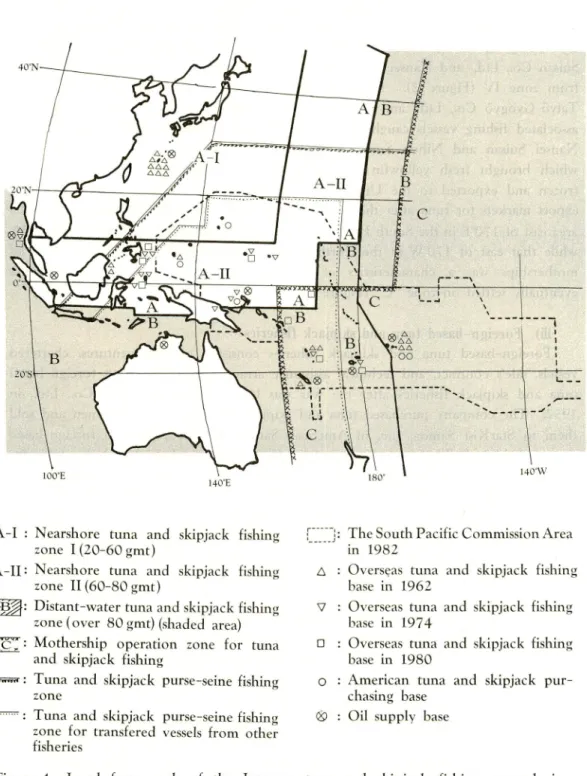
for 20 to 50 gmt vessel operation in zone "A". A 1967 revision raised the upper
limit of vessel tonnage to 70 gmt for zone "A" operations, and divided the zone into "A-I" (north of 10°N and west of 160°E) for 20 to 50 gmt vessels and "A-II" (the
rest) for 50 to 70 gmt vessel operation as shown in Figure 4. A 1972 revision raised
the upper limit to 60 gmt for zone "A-I" and 80 gmt zone for "A-II" operations, and
lowered the limit to 80 gmt for zone "B". A 1977 revision expanded zone "A-II" in
the Banda Sea according to the agreement between Indonesia and Japan. The nearshore tuna and skipjack fisheries in Japan in zone "A" were rooted in the original free
fisheries for less than 20 gmt vessels in 1949. The distant-water tuna and skipjack
fisheries fish in zone "B" were rooted in the original medium scale tuna and skipjack
fisheries (83). In addition to conventional Japan-based tuna longline and skipjack pole-and-line fisheries, there are three different types of Japanese tuna and skipjack fisheries in the region: the tuna longline fishery with motherships, foreign-based fisheries, and
purse-seine fisheries.
ii) Tuna longline fishery with mothership operations
Taiyo Gyogyo Co., Ltd. conducted a tuna fishing feasibility study with a mother-ship Banshu-maru (1,066 gmt) in 1948, and Nihon Suisan Co., Ltd. did so with the
20°N/
Mem. Kagoshima Univ. Res. Center S.Pac, Vol. 5, No. 2, 1984
V\ J V•*\ /
O
o
45'30isr 140'E
Area expanded by the 1st McCarthur's line (9/27/'45)
Area expanded by the 2nd McCarthur's line (6/22/'46)
Area expanded by the 3rd McCarthur's line (9/19/"49) Area expanded for mothership operations
by the 4th McCarthur's line (5/ll/'50) Major skipjack fishing grounds in 1950 Major albacore fishing grounds in 1950 Major yellowfin fishing grounds in 1950 Major bigeye fishing grounds in 1950 Major billfish fishing grounds in 1950 Japanese tuna and skipjack fishing base
The South Pacific Commission Area in 1982
163
Figure 2. Legal expansions of the Japanese tuna and skipjack fishing grounds :
161
20'S
MATSUDA : Legal, Political, and Economic Constraints
A
IP
C o .JS , .v.<.,^rfxXK,l*.<»r)0'>t><xx|t*l'yffl*x;"**>'X't*> 140 EFree fisheries zone (20-70 gmt)
Distant-water tuna and skipjack
fishing zone (over 70 gmt) (shaded area)
Mathership operation zone for tuna and skipjack fishing
Japanese tuna and skipjack fishing
base
The South Pacific Commission Area in
1982
140'W
Figure 3. Legal framework of the Japanese tuna and skipjack fishing grounds in
Southeast Asian seas and the western central Pacific after the removal of
the McCarthur's line on April 25, 1952: 1952-1953 (modified from
A-I
A-II
Ls^wwri
Mem. Kagoshima Univ. Res. Center S. Pac, Vol. 5, No. 2, 1984 165
140"E
Nearshore tuna and skipjack fishing
zone I (20-60 gmt)
Nearshore tuna and skipjack fishing
zone II (60-80 gmt)
Distant-water tuna and skipjack fishing
zone (over 80 gmt) (shaded area)
Mothership operation zone for tuna
and skipjack fishing
Tuna and skipjack purse-seine fishing z o n e
Tuna and skipjack purse-seine fishing zone for transfered vessels from other
fisheries
I40"W
f"~ j; The South Pacific Commission Area
in 1982
A : Overseas tuna and skipjack fishing
base in 1962
V : Overseas tuna and skipjack fishing
base in 1974
D : Overseas tuna and skipjack fishing
base in 1980
O : American tuna and skipjack pur chasing base
® : Oil supply base
Figure 4. Legal framework of the Japanese tuna and skipjack fishing grounds in
Southeast Asian seas and the western central Pacific in 1980 (modified from SUISAN-SHA 1984)
166 MATSUDA : Legal, Political, and Economic Constraints
mothership Kaiko-maru (2,940 gmt) in 1949. Although the economic feasibility was
not proven, the expansion of McArthur's line in 1950 provided an opportunity for
mothership operations. In 1950, three fleets from Taiyo Gyogyo Co., Ltd., Hoko
Suisan Co., Ltd. and Nansei Suisan Co., Ltd. fished about 6,500 metric tons of tuna
from zone IV (Figure 2). Further, 3 fleets from Nansei Suisan Co., Ltd., 2 from
Taiyo Gyogyo Co., Ltd. and one from Nihon Suisan Co., Ltd., with a total of 96
associated fishing vessels caught 11,000 metric tons of tuna in 1951. In particular,
Nansei Suisan and Nihon Suisan Companies' fleets included 8 small catcher boats which brought fresh yellowfin to their respective motherships, which were quickly
frozen and exported to the United States. The success of this venture opened up
export markets for tuna after the war. After the removal of the McArthur's line, the
area east of 170°E in the South Pacific was included for mothership operations in 1956,
while that east of 170°W in the North Pacific was developed in 1957 (36). Use of
motherships was a characteristics of the post-war activities, and these activities
eventually settled on zone "C" (Figure 4).
iii) Foreign-based tuna and skipjack fisheries
Foreign-based tuna and skipjack fisheries consisted of joint-ventures, chartered
vessels, sale's contract, and technical assistance arrangements. The first foreign-based
tuna and skipjack fisheries after the war was led by Mitsubishi Shoji Co., Ltd., in
1952. The company purchased tuna and skipjack from Japanese fishermen and sold
them to StarKist Samoa, Inc. in American Samoa. By 1962, 39 such foreign-based tuna and skipjack fishing were operated in effect. These include 9 in Naha, Okinawa
(Kaiko Gyogyo-Ryukyu Suisan, S. Sumie-Nankai Gyogyo, Taiyo Gyogyo-Ryukyu
Gyogyo, Wada Shoten-Ryukyu Gyogyo, Uchida Zosen-Hichiyo Suisan, Nanko Gyogyo Okinawa Reito Shokuhin, Sanbe Fisheries Cooperative-Koyo Suisan, Z. Masuda-Kyuyo' Suisan, Uchida Zosen-Nankai Gyogyo); one in Malaysia (Kaigai Gyogyo-NIKKA-TSUREN); two in Sabah (Taiyo Gyogyo-North Borneo Taiyo); five in American Samoa (Nihon Reizo-Van Camp, Nihon Reizo-Van Camp, Mitsubishi-Van Camp, Nichiro, Chuo Kosha); and two in New Hebrides (Mitsui Bussan-Taiheiyo
Suisan-D. J. Gubboy, Taiheiyo Gyogyo Suisan-Minami Taiheiyo) (Figure 4) (36 and 45). An
additional 14 bases were established by 1974. These include Hokoku Suisan-Itochu
Shoji, Madang, New Guinea; Kyokuyo-Mitsubishi Shoji, Kavieng, New Guinea ; Kaigai
Gyogyo-Mitsubishi Shoji, Rabaul, New Guinea ; Nichiro Gyogyo-Mitsubishi Shoji and
Hoko Suisan-Tomen, Ternate, Indonesia; Takeda Kigyo, Truk; Yanagida Honten-Okura Shoji, Bangkok, Thailand; Nichimen Jitsugyo, Sumatora, Indonesia; Nanko Bussan, Ternate, Indonesia; Taiyo Gyogyo, Solomon islands; Sanyo Gyogyo-Mitsui Bussan, Ponape ; Kumejima Suisan, Palau ; and Ajinomoto-Yanagiya Honten and Sugabu
Fishing Company in the Philippines (71 and 78). Further, oil supply bases were
established in Penang, Malaysia; Singapore; Darwin, Fremantle, Hobart, Sydney in Australia; Wellington, Auckland, and Littleton in New Zealand ; Noumea in New Caledonia ; Suva in Fiji; Rabaul in P. N. G.; Papeete in Tahiti; and Honolulu in the
United States by 1974 (70). Futhermore, Japanese fishermen have also used American
Mem.Kagoshima Univ.Res. Center S.Pac, Vol.5, No. 2, 1984 167
in Papua New Guinea ; Koror in Palau ; and Guam and Honolulu in the United States.
iv) Tuna and skipjack purse-seine fisheries
Purse-seines are regarded as more economical than conventional tuna and skipjack fishing methods based on longline and pole-and-line, because they do not require bait and have a higher labor efficiency and lower fuel consumption. However, Japanese tuna and skipjack fishermen long hesitated to adopt purse-seines because of inexperience, competition among conventional pole-and-line or longline tuna fishermen and with conventional purse-seiners, the lack of suitable fishing grounds, insufficient technological
development for deep water purse-seining, high construction costs, and the stock
conservation implications of purse-seines. Some of these problems have been overcome after a number of years of trial and error.
Purse-seine test operations in the western central Pacific began around 1960. After a successful operation of Taikei-maru (210 gmt) by Taiyo Gyogyo in 1964, three
300 gmt purse-seiners joined the operation (70). However, economic feasibility was
still not proven. In 1967, the Japanese government conducted an investigation of
potential fishing grounds for tuna and skipjack purse-seiners. The Japan Marine
Resource Research Center was established in 1971, and conducted an economic
feasibility study of year-round tuna and skipjack purse-seine fishery in the western
central Pacific since 1974. Since then, the number of Japanese purse-seiners in the
western central Pacific has increased, reaching fourteen in 1980 (102).
Landings amounted to 31,000 metric tons of tuna and skipjack in 1979, the average catch per fishing day being about 12-15 metric tons, as compared to 2.6
metric tons for conventional pole-and-line vessels. Their catch was skipjack (80%),
yellowfin and others (96).
v) Statistical summary
Japanese tuna and skipjack fisheries quickly expanded their activities within the framework of the legal limits on fishing grounds and limited entry schemes. With low
interest loans from the government, fishermen often enlarged their vessels. Zones
within McArthur's lines quickly became smaller so that the government frepuently had to extend the fishing grounds. By 1950, the fishing grounds were extensively used (Figure 2). The 1951 tuna and skipjack catch of 235,912 metric tons (Table 2)
exceeded the prewar highest catch of 202,439 metric tons in 1940 (Table 1). As of
May 1958, there were 1,104 Japanese tuna and skipjack fishing vessels over 20 gmt in
operation. Due to the rapid expansion of the tuna longline fishery, total tuna and
skipjack fisheries production reached 722,364 metric tons in 1962. By then, Japanese
tuna longliners were fishing throughout Southeast Asian seas and the western central
Pacific (Figures 5,6 and 7). Their activities continued year-round to date except for
the southeastern portion of the region. Although the major fishing grounds were in
the western central Pacific, Southeast Asian seas were also important.
Immediately after the war, the growth of skipjack production was faster than tuna
production, but because of limited fishing grounds for skipjack, tuna production
168 MATSUDA: Legal, Political, and Economic Constraints
Table 2. Japanese tuna and skipjack production after
World War II (1945-1982)
Unit : metric ton (mt)
Year Tuna Skipjack Billfish Total
1945 12,386 19,653 - 32,039 46 15,080 41,447 3,424 59,951 47 24,639 48,732 8,790 82,161 48 15,953 40,720 9,598 66,271 49 33,468 46,471 - 79,938 50 58,740 84,637 1,546 144,923 51 92,595 117,817 25,500 235,912 52 127,848 109,626 24,778 262,252 53 134,592 88,279 29,112 251,983 54 154,250 120,442 38,897 313,589 55 181,370 123,092 42,085 346,555 56 232,661 123,914 48,055 404,630 57 279,866 117,904 53,867 451,637 58 280,310 170,693 59,607 510,610 59 331,658 186,599 57,903 576,160 60 389,551 94,363 55,627 539,541 61 431,033 162,587 61,484 655,104 62 449,844 191,348 81,172 722,364 63 453,027 161,226 82,305 696,558 64 427,161 193,663 86,034 706,858 65 430,290 166,802 90,442 687,534 66 398,330 258,816 81,721 738,867 67 367,324 211,202 73,692 652,218 68 352,861 191,439 70,233 614,533 69 332,749 209,378 68,773 610,900 70 291,017 231,865 66,733 589,615 71 307,965 191,656 52,506 552,127 72 318,090 253,936 48,357 620,383 73 341,818 356,343 46,693 744,864 74 348,950 373,573 48,712 771,235 75 310,616 273,640 50,561 634,817 76 367,793 351,248 45,155 764,196 77 336,530 322,703 41,548 700,781 78 384,674 384,621 46,627 815,922 79 362,917 346,518 43,357 752,792 80 378,496 376,739 44,120 799,355 81 360,270 305,486 47,455 713,220 82 372,143 320,106 44,479 736,728
Sources: Modefled from JAPAN MINISTRY OF AGRICULTURE, FORESTRY, AND FISHERIES 1977-1984 (22) and JAPAN MINISTRY OF AGRICULTURE, FORESTRY, AND FISHERIES et al ed., 1979 (23).
Mem. Kagoshima Univ. Res. Center S. Pac, Vol.5, No. 2, 1984
40-N,
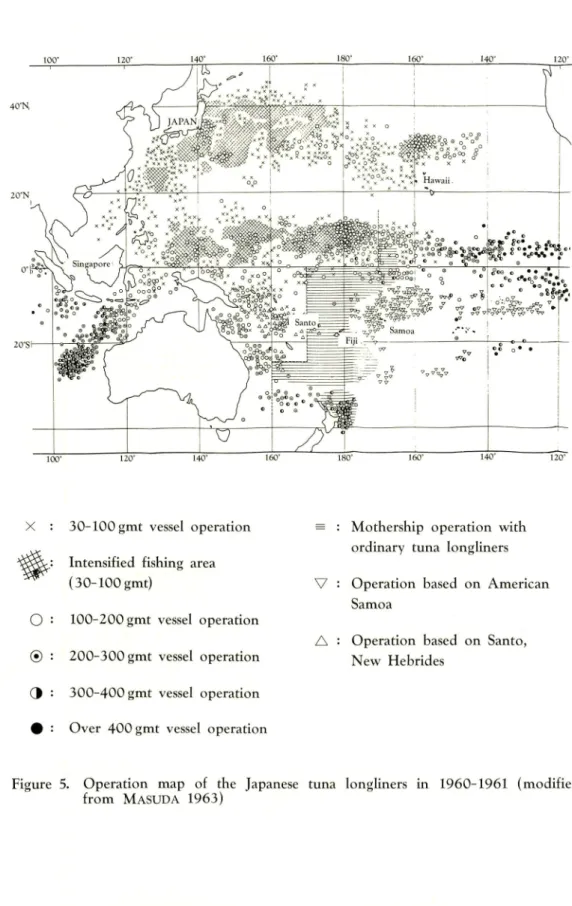
X : 30-100 gmt vessel operation
Intensified fishing area (30-100 gmt)
O : 100-200 gmt vessel operation
® : 200-300 gmt vessel operation
3 : 300-400 gmt vessel operation
# : Over 400 gmt vessel operation
= : Mothership operation with
ordinary tuna longliners V : Operation based on American
Samoa
A : Operation based on Santo,
New Hebrides
169
Figure 5. Operation map of the Japanese tuna longliners in 1960-1961 (modified
170 MATSUDA: Legal, Political, and Economic Constraints 10 t 1— 1 1 •I 1 — 1 JI 1 * 1 b •I o 1 6 o ' 1 o 1 V o 0 1, o 0' 0 0 o i o i - w \bL •* 1962 c~1)c S
jj'
o 0 o • 0 0\
r 0 o • o o 0 o 0 o I ° • • • • • • * • 0 o 0 • • 0 • o o 0 o o 0 r o o 0 o o o 0 o 0 o o o o o °lfl\ / o 0 /ff O o o o o o o o o o o o o ° o o o 0 o o s4j O • • o 0 • o • o • • • • • • • o o o o oV\ o o;|<jS0
o o o 0 • o o o o 0 o 0 al o JL • • • o • • • • 0 • o 0 o o 0 0 o o o o o o o/§
• tjj o o • o 0 o 0 o • o o o o o •"oJfh
• <?' • 'v«f o • • o o • • 0 o o o o • 0 0 o 0 0 0 • 1° o 0 • • * 0 • 0 o 0 0 0 0 0 o o o • • o 0 o 0 o *\y o 0 0 0 o o 0 o o o o o o o • of • o*b o o 0 0 0 0 0 0 o o o 0 o • • •\
)
• • o • o • • • • • 0 o o o o 0 o o %\ o o o . o o Unit 104 O - 99 • 100-199 • 200-1967 C r -A £ o o o 0 o o" • o ! Is rf* ° " • • 0 0 0 0 0 \ « » " o " o • • • o o A3 o • ' 0 'J " " • • 0 0 " Ai o 0 0 o o • • o 0 " f " '•• o o p,a o 0 • • 0 > !b o o o o o 0 a o w 0 11 " o o .5 p o °i/s '•>)• *J% • 0 o o • • o • • • • o o o 0 o a - 0 0 • o o 1 • • • • o • • o .: ^v4r:771&& o • • • • • • • ••• • o 0 _ \ >s
LtrU,o f o o a " • 0 • o 0 Q o • o o ~ * r& u o n 0 a 0 o 0 o D o 0 0 o • 0 " a • #J^V IjV V JL9, ~o*? ° 7T ,',°_° o o o o o o 0 o o • u O I! • o o 0 0 o "[ \, •> •' <l o o '••' o (j 0 o 0 0 o 0 • • • o\krfTX
4 o 0 " o cr 0 o a o 0 o o o o 0 • t z.'•'I
jL'"' - * " u 0 ° " ° 0 0 0 a 0 ° 0 1972 < o o 0 0 0 0 1 o o • • • 0 0 0 o a o o o 0 o \ • • o • • • • • • • • • • q o 0 0 • 0 • b • o • • • • o 0 0 0 Ifi0 0 0 o 0 0 0 0 • o o o %lo 0 <J••"! o • • o o 00 o 0 0 o ®lo • • • o o 0 0 s 0 0 • o 0 0 o o 0 o 0 0 o 0 o o 0 o 0 o Vv'•)0 0 \ 0 0 0 o o o o 0 0 o 0 o o • • q_ q o OOo • q. • 0 • G^b0 0 0 0 0 o 0 • r?y s 'n u 0 0 0 0 0" wTt o" Q• 0 o • • (J o 0 0 0 o o o 0 0 o 0 o o 0 0 0 o 0 o o 0 V>>» p 0 o 0 o 0 o 0 0 0 0 0 • • • o\&j 7 fijo0 o 0 o f)o 0 o o 0 o 0 o 0 0 0 0 6 0 ST0 0 o o 0 '[]
o • 0 &0 0 o o 0 o o o o o o 0 1 o 0 o 3 o o o o o 0 o o °L<T\/ • • 0 o ••:• '•' 0 • ~ • • • o o 1977 f o • • • . o 0 0 o 0 0 o 0 o 0 0 o 0 • 6 o o 0 \>-
0 • o • 0 o o o 0 0 o o 0 0 nr^0rr%
0 o o o • o o o_ o • b • o o • • • o b • • • o o • • • • 6 • • • • o o • • 0 o 0 o o o 0 0 o • • o o o • 0 o o • 0 o • o o 0 0 Q,o 0 o o -o 0 0 0 0 0 0 • • o o o c o o o • o • • • 0 • o • 0 6 ojo s 4 9 • o • • o o o o • • • • • o o 0* 0 0 0 o f o cT • • • • • • qo o 0 o 0 o o q^o • • • o 0 6 0 O V p fi o 0 o 0 o o • • • r ^ ^ o *>' o o 0 a LP0 0 o o o o 0 o 0 0 O O o 0 o o o o o °fed35U r o o 0 0 0 • r\A^1 oo • • 0 0 -0 oI
1980 'f
^ f £• • •• o o o 0 0 ) % • • • • • • • • o 00 • • • • o 0 o 0o r o o o • • •• • • • • o oo o o o 0 0 o oJDo / T o o 0 • o •• • 0 0 o oo o Q 0 o 0 o o o o b o 0 0 0 0 o jp q • o o ~6 a o o o • o o 0 • o o • • 0 • • • 0 • • • q. • 0 • 0 o • • q • 0 • 0 • • • q • • * q • • • o • 0 • o • 6 o 0 • 0 0 0 o o o o n o o • o o 0 • i • • 0 • 0 0 0' q o q_ 0 o 0:
• 0p • 0 • 0 • 6 0 o o o '"b 0 0 0 o • • • • • • • • • • • • • • o qU o • • 0 o ~j o o o o 0 o • • • 0 7 ^ c 0 o !It • o o 0 o o o 0 0 4 0 • 0 o 0 0 o U^rrL^u &o o o o o oFigure 6. Distribution of estimated Japanese total tuna longline fishing effort in hook
number in Southeast Asian seas and the western central Pacific (1962-1980) Sources: JAPAN FISHERY AGENCY 1965-1982 (16).
Mem. Kagoshima Univ. Res. Center S. Pac, Vol. 5, No. 2, 1984 171 , „ , ,, . 5 I ,•, - . . » i . ,7. ,0- IT.- » , , , ,•> M- . 4IJ- ^j y Jan.. < -Mar. 1967. fc' ,* Jjw an • a .a. \ ^Olaiaonooono I tan 1111aon tot • 1 » M 111SI01i ,a tas01HI 01ai0 ,o .01a. i i t « « HI0707w o iaia t i i oSl .J
"5" Mil"uTat a tTo"09,-. 01 « 0 !
ll J i r =rM u ,",-Li01n*" a t a .i . M . . 0 , «-• : •, .B . 1
i
<±5T1
y»
1 — |1
£s 0 .^ = 1?gITifl
:I
» 01 *Fa t77 u 7 H^V.Ti r ri in .ITu 111u 11 i t . i" U •<u aB M OTSIJ V"ii "•7*• iiI t13 SIM 14 i ni n , ,i tQls 5 S . ,. , • i• i m m|QI_ t?
M .10 L Apr. -Jun. 1962 r-~ ? ) X> • 1 ,o^
m"«.i iU • " SO 0 1111i ii i11i i 11SI 00 oiSt« 111u u ti i 'J1t^1 10 !. ..• 11•1 i i10 010 .04" u ti o, ao i> " if. 1 0 ik » , - r f . .. .1 .i i77"o7M 0 >«II01 0111ai TTld" IT " 1 n .Ql_LLi i !•!.-.•._JJJJ:« i t?i,»•«_y. ii lT m mii u 7X iiQ
\" Sp'~ P ^JM - _ ^A^sa«i tm a-a , ,irhij ? f1SI !£ " J i ;TjZ"90 .tr Ji ngniL l il-S "\y "* \ M Ll LT 01 11Bl 4 07 k.011 1) u 11 u 3 SB StSI01 01DO II 01 01 ,4 H. „ I I _ Jc1f!#
. i ..j.. ,|. .i i -Sef 19622|J-. ft
JUj• i•ijiiiiilu n i l \ • H i l l | | i !• ii u • u • •• » i » u| a.oti iai oii t oo oo•i •<•1 nil,fir ot
J p
* IT 11flail
rwfra y t t trM^rk ##rrt i^^oTlr^S
Hj^f
a f
Wuz^m"^"•"""••
- tT "f." " !H" "•'1 i 1
^trT
T^ij^ij-
it:
:::
:
o " - ^'o 1 0 0 , • «
I
jill 0ai SI o« s«I 00 0 • -Dec. 1962 j ) 1BgUooaososoai StsoOB000 .00ooai oi a 1110 'oiImo t01ao0101 si • 0 !00a tSIooa! 00 4»|sb04 01o«SB0401 ST 00t 0 , 0 , I.l | 1.1 Oil 01SIOTm;01 OB11 OB11 » MM aJjarxiaM _LLi-2.iiJ*.J i OTSTu H 1501« « « uio l*|^J^^ii j11IT LILISI 01OB0009o r0111LISB0 t aso ia t a i ^ JmS.tipS"b;« ••1L TT siS!1L^ E~UU.'. Z 0, 0, 01 0.U °.l^Ni&runf'l"-ftfiSSSI"!" ~ t '" '.3.i »u M LT11,1,10 Ill 01 It1101 0 .01B»01OJ 01[^ JA. »• Jt 4.401OT OT01 0 .ii 16| ItU I U ? !a-l":> L l 04140401OJ OB 011101 t 01 0101 01 01 01 • ME£ L^y V•T04 H SIulM01 » MM 1• i toi aiot01 a t0401 s OT •I 0 !QlM 0401 I01I t0111 o t010 , ojsa u o< 010 !0< 0 .M 010. « 0101 0 ,£ i l0 . t^ „ tE -
1
Hooking rate(%) a -0.9 g 1.0-2.9 • 3.0-f 0..!
ii 600.00.00.0 0.0 0.0 0.0 OJ \ ) U0.0 0.1 0.0nn0.0 0.000 in0 1 on110 1 0 1 010 101 01 on0.0 1977 / n?0.2 b.i 00 no0.00.0on 0.1n t[1208 08 06O.fl0.2 0.2OJ 0.10.1 </1.1 0.0 Q.7 OJ 0.8 0.7 i t1.80.5080.9 2.41.7 060.10.10.2OJ OJ0BU 0.0 0.1OO 5:1.6 1 5] &IjBiS 1.7OJ013J50.5 0.4OJ 0.1 0.1 0.0 0.0 0.00.1 OJ 2 0a™. 0.222OS1.412i.20.8OJ0.8 090.S OJ 0.402 02OJ 0.10.4OJ 0.2OJ08 NtlU•, IJI i1.8\ t! 4!.4 1.710 1 1ti U lj0.80.0OS 08 0808 0.20.402 0.8 06 0.4= 06<t
fl.Sm*2.8 1.71.01.0 0507 OS 0.802 0 10.20.2 D.G 0.6 -0.7|0.7 0.7 |1.0~ « , ^4A]1,7^Kj6 -060.708 08 08 0.8 0.2 0.2 02 0.1 6.F 0 1 01 oi 0-0Sf K! 0.20.8* 0.2 O-i p _^r^P\» 0 10.10.8 -05 0.1 0.1010.1 r */•Cfcp
T i r-i.pi. ^ -Jun.$
yja0.010.0 0.0 000.0 0.0 OJ0.00.10.00.0 1977 / 0.8 000.0 0.0on nnonno 0.000 00 0.4 0?0.80.10.210.1no01no 0.8 0.1 0.1 0.0 U.B1
i.l n 182.6u 1.40.40.0 0 10.2 _ 010.1 0.0 0.0 0.00.0 M Ai 1.7IK1-8IX IJ0.8o.e 06 0.8 1.00.20.6010.202OJOB0.80.10.2o.e 0.6 --' ai ii^1.7212.62.1l.«2 02.< 0.90.8L2 0.40.10.8 0.408 020.10 1 0.1 0.2 0.8 0.8 fo l* OJ1 £^ 1.8 »2.84.88S2.42? 8.6i.e 0.7 08 08 n? 0? 0.10 1 OJ ^ xetio Kn<k ^ if 88 05OJ0.808 08OB0.8 08 04 18 0511 0.10.4 08 0.8 <* flf -00 0.1 0.10.1 ° 06 t— 0.1 0.2 0.1OJ Jul. r 0.0 0.0 0.00.0 \ t |io0.0 nono0.0 0000 0.0 00 \ -Sep. Sio 0.0 0.0 00000.10.0 0.0 1977 0.1 0.40.0 OJ00 0.0 0.00.00.0 0.00.00.20.10.0OJ000.00.0 0.1 tSA0 10.1 OJ18 0.7 04 OJ0.8 0 1 00 1.708 0,11.71.710 o.e08 0 1 00 0.0 08 0.704 Uj1.8ll-81.72.82.1 ' *0.51.1IJOJ040.704 00 020.00.1 0.2OsJo.B1.72.1221 i< L',2i.l1.4j8J|0.82.0180.6 0.2 0.6 08 OH0?OB 08 080?fl? j^T§ 'ii};. ilS '*,! 1 2| IJ.8 18IS npj|TT 07 08 05 05 0.2OJ0.10208 OS 0.* 0.8
I
EJjU2.527 2.62.829 2.4ii12 1.206 08 02 08 0.8 08 02 0.2 0.0 £A-05 06 040802 7 ^ 0.1 a" 0.20.2 0.0 0.0 OJ 0.000 °f y 0.2 0.2 0.1 0.6\ o.iki^_^--p\ . OJ 00 -*. OJ 0 00.0:0.000 '-Dec. \
0.2 Pn0.0 0.000on on0.0 00 OJ0.0OO \ 0.0 0.1 0.0 0.1 0.010.00.0 0.0 0.0 0.0 0.0 o.e 0 0 0 00.1 0.2 OJ 02 0.1 0.1 OJ o.t 0.1 0.1 0.0 0.1 0.0 0.1 0.0 00 OJ00 0.1 1977 0.001 0.0 0.0 O.Oi0.1 -OJ 0.7 OJ OJ 04 04 OJ 00 0.2 OJ 0.1 OJ 0.1 0.7fr 0.0 06 OT 02 0 4 TT 080.108080.1O.I1!0.1 0.1 0.1020.1 OS 08 08 020.2 0.10.0 OR 0.2 0 2 0.10.1 0.2~ -L.l12 i.e 06 OB 0.9 IJ 1,711 1.2 1.62J 0.7 080.70918 0.71 61 51.11 018 02060 1 nn 08 202.628 288 0 2;;212 1I ;Ztj; 7l.C1.012 09 08 on050 1 ni0 2 it To" rf -,- 47T-4J1J4.4 ;8*822.2 2.113 2.0;•: ?. 26 »2 0.6OSor, M OS0? 0?0? 06 1418 i.^11•to. ;•*880.7 1.71.820 _ _ 1 0 04 06 0.7 OJ 0.7 OS04OJ OJ 0 2 0.2 0.1 OJ 0.4 OJ ojJ %" 0.2 0.8 7 ^ 08 02 0.00.0 -~\Y V0.1 00 0.10.10.1 OA 180.80.1 0.1 01 0.10.0 mj 0.0 - V , . . . .Figure 7. Yellowfin catch per unit effort (CPUE by hooking rate in %) by Japanese
tuna longliners in Southeast Asian seas and the western central Pacific in 1962 and 1977
172 MATSUDA : Legal, Political, and Economic Constraints
of tuna decreased due to lower productivity, and skipjack production increased due
to improvement in live-bait transportation and overseas base development. In 1980, production of tuna and skipjack were almost the same (as about 380,000 mt). The rapid growth in production corresponded to the rapid expansion of tuna longline
fishing activities during the 1950s and of skipjack pole-and-line fishing activities
during the early 1970s (Table 2, Figures 2, 6 and 8).
However, fishing grounds for skipjack were limited to the western North Pacific
before 1970 and are limited to the western central Pacific today because of the live-bait requirement for skipjack pole-and-line fishing.
Table 3 summarizes Japanese tuna and skipjack production in Southeast Asia and
the Pacific from 1951-1981 except for that Japan-based tuna longline fishing
includes production from the Indian Ocean. Production from foreign-based skipjack fishing and purse-seine fishing activities have been increasing since the late 1970s. Mothership operations ceased in 1965 while foreign based fishing shifted from tuna to
skipjack activities in the early 1970s.
vi) Tuna and skipjack fishing activities in Southeast Asian seas
Statistics are not available for tuna longline operations before 1962 and for skipjack
pole-and-line operation before 1968.
However, Japanese tuna and skipjack fishing
activities in Southeast Asian seas were present before 1962. After the removal of
McArthur's line in 1952, Kaiko-maru (Nihon Suisan 2,940.61 gmt) with 10 longliners
fished in Celebes, Moluccas, and Banda Seas in 1952. Ginyo-maru (Hokkaido Kosha,
3,840 gmt) with 10 small catcher boats (less than 20 gmt) and Saipan-maru (Taiyo Reito, 3,737.89 gmt) with 5 longliners fished south of Java while Tenyo-maru (Taiyo
Gyogyo, 3,689.31 gmt) with 16 catcher boats fished in the Andaman Sea and in waters
off the Nicobar islands in 1954. In addition to those mothership operations, Kushikino
tuna longliners and Makurazaki pole-and-line vessels were active. The South China
Sea was also regarded as good fishing grounds for large tuna, especially from September to May. The average catch per unit effort of tuna longline fishing operations in the
South China Sea varied from 1.5 to 4-5% (catching rates of fish caught per 100 hooks)
by month except for June to August during the period 1930-1956, excluding the
period 1942-50 (36). Figures 6 and 8 show Japanese tuna longline fishing operation
in Southeast Asian seas from 1962 to 1980 and skipjack pole-and-line fishing operations
in the South China, Sulu and Celebes seas in 1970.Available statistics show there were continuous tuna longline fishing operations in Southeast Asian seas from 1962 and skipjack pole-and-line operations from 1968 (Table 4). These fishing grounds have been considered by the Japanese, however, to be nearshore, not distant-water, fishing grounds, (see Figure 4), for the Japanese tuna
and skipjack fishery, as the fishing was seasonal and vessels used less than 80 gross
metric tons. The major species caught by longline were yellowfin and bigeye tuna, with annual production fluctuating between 17,000 and 21,000 metric tons for large tuna, and 1,000 to 6,000 metric tons for skipjack.
20° N
20° S
100° E
Mem. Kagoshima Univ. Res. Center S. Pac, Vol. 5, No. 2, 1984
2 3
140° E 180°
Reported fishing grounds in 1970 Reported fishing grounds in 1977
The Japanese purse-seine fishing
grounds in 1980
The South Pacific Commission Area in
1982
173
Figure 8. Fishing grounds for the Japanese skipjack pole-and-line fisherv in 1970 and 1977 (modified from JAPAN FISHERY AGENCY 1970-1979)
Table 3. Japanese tuna skipjack production in Southeast Asian seas and the Pacific by type 1951-81 Unit : metric ton (mt)
Ny
Type
Japan-based tuna Japan-based skipjack Tuna lonj *line fishing Foreign -based Purse -seine Longline fishi nK1 pole-and-line fishing with motherships fishing2 fis hing Year ^\ Tuna' Skipjack Tuna Skipjack Tuna3 Skipjack Tuna' Skipjack Tuna3 Skipjack 1951 90,199 203 27,135 96,214 9,915 18 — -375 289 52 109,375 642 48,705 78,518 5,641 28 7 — 675 394 53 128,366 244 43,625 65,546 7*,006 1 1 7 — 927 907 54 148,208 450 37,647 88,073 15,000 15 7 — 7,977 4,230 55 175,842 536 35,207 92,524 11,699 28 7,245 — 13,163 2,363 56 212,813 416 55,737 91,950 9,550 — 7,095 — 17,338 1,942 57 237,882 791 61,861 92,156 12,542 — 8,816 — 16,876 2,757 Sf 58 257,756 1,054 37,113 131,441 12,872 — 15,849 — 11,048 10,318 — > 59 290,827 1,210 25,355 145,447 18,473 — 15,943 — 14,720 16,641 H 60 321,507 1,267 32,193 70,428 21,716 — 14,909 — 11,152 3,620 C a 61 350,034 1,004 28,790 127,011 26,050 — 14,748 — 11,414 11,169 > 62 384,968 1,175 21,057 152,387 21,736 — 77,851 — 16,554 11,267 r1 63 369,311 1,082 37,715 94,757 12,351 — 20,989 — 10,314 9,149 era 64 319,156 1,441 36,298 136,081 13,025 — 34,878" 17'1 12,175 24,950 ~ 65 309,463 1,092 51,698 127,436 4,251 — 31,473J 35" 14,208 4,637 -66 345,230 1,236 33,646 212,986 — — 32,2264 304 14,804 10,844 Bt 67 339,930 898 43,735 165,492 — — 23,236"* 7 3.1 9,608 10,835 n* 68 324,409 948 27,776 157,340 — — 20,250'' 15" 16,390 7,415 r~ 69 325,207 1,202 43,059 163,45 5 — — 13,6234 16' 7,757 10,628 i 70 302,608 1,544 34,390 187,438 — — 8.744'1 27'' 8,582 7,081 [-T-71 279,458 392 62,927 157,380 — — 4,975J 4,718s 8,302 11,429 n 72 27 1,848 504 76,425 199,836 — — 2,505J 12,867s 9,530 16,105 g 73 272,015 538 89,958 291,856 — — 574' 22,978s 11,595 18,616 I 74 265,445 283 95,423 333,281 — — 355'1 33,185s 16,493 6,942 n 75 260,484 224 67,264 244,348 — — — 15,379s 13,490 8,504 0 76 265,143 284 112,877 302,632 — — — 40,952s 14,399 21,028 | 77 286,123 223 56,267 277,435 — — — 15,046s 16,177 24,510 •t 78 294,287 192 80,159 326,915 — — — 50,531s 24,830 32,097 3' 79 289,919 99 58,927 292,167 — — — 43,992s 31,977 29,443 80 301,904 82 65,209 295,568 — — — 46,531s 32,976 49,982 81 281,555 66 44,778 237,685 — — — 14,098s 52,051 43,904 1) Including Indian Ocean operations 2) American Samoa, Santo islands, and Noumea bases, not including all foreign-based fishing in the Pacific 3) Including billfish 4) Including bases along Indian Ocean coasts 5) Including only Irabu-mura Okinawa fishermen's landings 6) Including only Okinawa fishermen's landings to Solomon Taiyo Co. Ltd., alone. Sources: Compiled from IRABU MURA 1981 (13), JAPAN MINISTRY OF AGRICLTURE, FORESTRY, AND FISHERIES 1977-1984 (22), and KATAOKA AND MATSUDA 1983 (25).Table 4. Japanese tuna and skipjack catch 1965-1982 and 1970-1978) in Southeast Asian seas: 1962-1978 (modified from JAPAN FISHERY AGENCY Unit: metric ton (mt) Tuna Ion *line operation Skipj ick pole-and-line operation South South Year China Near the Banda Total5 China N ear the Banda Total5 Sea2 Philippines' Sea4 Sea2 PI lilippines3 Sea4 1962 875 7 7 7 7 7 7 7 s 63 783 1,3046 6,6236 7 7 7 7 h il 64 776 1.6527 5,3637 7 7 7 7 65 1,833 2.3037 6,5367 7 7 7 7 ijr 66 1,618 4,481 7,810 11,909 7 7 7 3 67 7,134 2,891 3,273 13,298 7 7 7 c 68 3,744 2,947 7,226 13,917 1,273 0 7 <' 69 4,830 4,049 6,459 15,338 4,092 0 7 -70 2,397 1,587 3,556 7,540 345 3,537 0 3,537 p 71 3,299 1,193 3,672 8,164 225 4,884 0 4,884 3 72 3,803 1,965 1,142 6,910 1,654 5,540 246 5,786 C/3 7 3 5,104 4,362 3,814 13,380 503 2,280 157 2,437 T3 74 3,351 7,691 4,759 15,791 472 6,018 63 6,081 £ 75 4,819 7,580 9,055 21,454 891 1,814 69 1,883 76 5,222 3,702 2,035s 10,959 1,581 1,331 0 1,331 Jl 2 77 2,323 3,240 5,087s 10,650 1,318 2,804 0 2,804 78 ? 7 2,022s 7 7 7 7 7 1° Unless specified, tuna longline catch includes the following eleven species : Bluefin, Southern Bluefin, Albacore, Bigeye, Yellowfin, Broadbill Swordfish, Striped Marlin, Blue Marlin, Black Marlin, Sailfish, and Skipjack. Conersion ratios were adapted from Kume 1973 (33) and ZlNGU 1978 (127) unless specified: 53 kg./fish for Bluefin, 62 kg. for Southern Bluefin, 22 kg. for Albacore, 39 kg. for Bigeye, 34 kg. for Yellowfin, 47 kg. for Broardbill Swordfish, 48 kg. for Striped Marlin, 101 kg. for Blue Marlin, 78 kg. for Black Marlin, 26 kg. for Sailfish and 2 kg. for Skipjack. Including an area surrounded by 5°N 105aE, 5°N 120°E, 25°N 12CTE, and 25°N 105°E. Including an area surrounded by 5°N 1 15°E, 5CN 130°E, 20"N 130°E, and 20°N 115°E. Including an area surrounded by 10°S 120°E, 10°S 135°E, 0°S 135°E, and 0°S 120°E. Donlile accounting of tuna longline catch from an area surrounded by 5°N 115°E, 5°N 120°E, 20DN 120°E, and 20°N 115°E is assumed to be offset by catch from other parts of Southeast Asian seas. For skipjack pole-and line operations, catch from South China Sea is included in catch from near the Philippines. Figures include all species caught by pole-line operation. Skipjack comprises approximately 90°^ of total catch. Catch estimates concern only four species : Bluefin, Albacore, Bigeye, and Yellowfin tuna. Excludes Southern Bluefin. Data from Zimbo (126).