
2013(Heisei 25)
Doctoral Thesis
Studies on Controlled Coupling Cyclization of
Unsymmetric Quinones
Doctoral Program in
Integrated Science and Engineering
Graduate School of Science and Engineering
Ritsumeikan University
Table of contents
Overview ... 1
Results and Discussion ... 7
Chapter I. Studies on Controlled Coupling at Allylacetal Moiety of QMAs... 9
1.1Brønsted Acid-Controlled [3 + 2] Coupling of QMAs toward Alkene Nucleophiles ... 9
1.2 Synthesis of Various Dihydrobenzofuran Derivatives ... 11
1.3 Mechanistic Considerations ... 15
1.3.1 A Plausible Reaction Mechanism ... 15
1.3.2 Comparison with Other Methods ... 18
Chapter II. Controlled [3 + 2] Coupling of QMAs in a Catalytic System ... 21
Chapter III. Controlled Couplings of QMAs Using Reusable Polystyrene-Anchored Specific Proton Catalyst ... 26
3.1 Preparation of Polystyrene-Supported Perfluorobenzoic Acid ... 27
3.2 Polystyrene-Supported Perfluorobenzoic Acid as the Specific Promoter for Controlled Couplings of QMAs ... 28
Chapter IV. Reaction Using Other Extended Nucleophiles ... 31
Chapter V. Applications... 34
5.1 Concise Synthesis of Several Naturally Occurring Compounds ... 34
5.2 Preparation of Benzofuran Oligomers ... 36
Conclusion ... 38
Acknowledgment ... 40
Experimental Section ... 41
1
Overview
Phenolic compounds commonly referred as polyphenols or phenols are secondary metabolites occurring widely in food plants, and indispensible quantity is consumed in our daily dietary. Structurally, phenolics can be defined as bioactive substances which include an aromatic ring, bearing one or more hydroxyl substituents, possessing functional derivatives such as esters, methyl ethers, and glycosides, etc.1) Over the past few decades, our lab has been looking into the development of the synthesis and utilization of dearomatized phenols as well as their applications toward natural products synthesis from phenols,2) whereby, a wide array of quinone-type compounds have been reported via chemical oxidations by treatment with organic oxidants, specifically phenyliodine(III) diacetate (PhI(OAc)2, PIDA) and phenyliodine(III) bis(trifluoroacetate) (PhI(OCOCF3)2, PIFA) in suitable alcohol solvents from corresponding phenols, which have emerged as a straightforward and attractive strategy in recent years (Scheme 1).3)
Scheme 1
Quinone-type compounds ubiquitously exist in nature and are frequently included in commercial and industrial chemicals of many broad and attractive applications. As a result, these quinone-type compounds are of importance in organic chemistry as synthetic intermediates and building blocks.4,5) Regarding the reactivity, many types of reactions based on the unsaturated enone structure as versatile electrophiles, especially, for various nucleophiles and dienophiles in cycloadditions, have been developed. At the same time, some chemo- and regio-selective issues toward all the ring carbon arise due to the presence of the two carbonyl functionalities and enone units, sometimes limiting the utility of quinones themselves in organic synthesis.
2
Issues for realization toward high levels of chemo- and regio-selectivity have always been the Achilles’ heel of synthetic organic chemistry.6)
The achievements of regio-specific strategy for partitioning between the accessible reaction pathways mainly involve the controlling strategies via efficient reagents or modification of the substrates. Therefore, as one of the promising solutions to the selectivity issues, quinone
monoacetals (Figure 1, QMAs 1), the mono-protected quinone compounds, bearing not
only-unsaturated carbonyl but also allylacetal moieties in one skeleton, have already appeared for differentiating the reactivity of the two same carbonyl functional groups.7) The desymmetrized quinones would serve as a useful alternative for selective chemical transformations in controlling the reactivity of quinones, and thus are frequently called ‘‘masked’’ quinones whereonly one carbonyl moiety of the enone unit is protected from the additions by nucleophiles and dienophiles, which could be severed as a potentially regio-specific quinone equivalents in synthetic utilities and naturally occurring compounds, for instance, pterocarpan type compound, such as maackiain, physostigmine, defucogilvocarcin M, and aranorosin (Figure 1).8)
Figure 1
Owing to the uniqueness of the privileged bifunctional structure of QMAs based on the ,-unsaturated carbonyl and allylacetal moieties in one skeleton as well as their easy and efficient preparations, the rising interest in the development of utilization of QMAs 1 in chemical reactions has been fuelled since the 1970s. For nucleophiles, a
3
wide array of reactivities toward the enone moieties of QMAs 1 was already revealed to produce the addition reactions, the fundamental theories of which had been extensively studied from 1970 to the 1990s, concluding that the nature of the used hard and soft nucleophiles is the dominant factor that alters the reactivities toward enone group.9, 10) For instance, additions to the carbonyl carbon (i.e., 1,2-addition) with the treatment of alkyllithium as a hard nucleophile (eq 1, Scheme 2),9a) or the conjugated additions to an enone moiety (1,4-addition) using dialkylzinc reagent as a soft nucleophile (eq 2, Scheme 2),10a) as well as other extended cyclizations involving these processes.11
Scheme 2
Besides these addition reactions, it seems that QMAs 1, in principle, can enjoy the reactivity of the allylacetal functionalities. However, in sharp contrast to the established addition chemistry of QMAs regarding the reactivity at the enone moieties, strategies for utilizing the allylacetals as an electrophilic unit for substitution reactions were rarely reported,12-16) except for the intramolecular reactions17) and well-known acetal deprotection by hydrolysis (Scheme 3).
4
One of the typical reports of the substitution for QMAs under basic conditions was demonstrated for introducing the nucleophile to some extent to the allylic position of QMAs 1 with the treatment of the allylindium reagents (In/allyl bromide) only via the 1,2-addition of the organometallic species to the carbonyl group followed by rearrangement (eq 1, Scheme 4).13b) However, the attractive reactivity of QMA 1a for allylic substitution promoted by the acidic activator of diethylaluminum chloride (EtAlCl2) was demonstrated for few substrates by Sartori’s group, who proposed the
pseudo-intramolecular SN2’ process via coordination of the aluminum Lewis acid to
both the acetal and the phenol nucleophile as a rare example (eq 2, Scheme 4).14a)
Scheme 4
In contrast to these partial successes, this thesis principally deals with the achievements of novel strategies for developing the chemo- and regio-selective substitution reactions of QMAs 1 with soft and neutral nucleophiles based on the screening of more suitable catalysts under the acidic conditions. To summarize, the following results are newly obtained in this research field.
(1) An efficient Brønsted acid-controlled strategy for the [3 + 2] coupling approach of QMAs 1 with a series of alkene nucleophiles 2 has been successfully developed (Scheme 5). The strategy is triggered by the particular use of a specific acid promoter, perfluorobenzoic acid (PFBA), in situ generation by the coordination of the hydrogen bond donor solvent, that is 1,1,1,3,3,3-hexafluoro-isopropanol (HFIP). With the
5
stoichiometric amount of PFBA, the reaction could smoothly proceed with high regio-specificity regarding QMAs 1 for introducing the-nucleophiles 2 toward only the allylic positions, providing diverse dihydrobenzofuran products and other derivatives 3 with high to quantitative yields under mild conditions in short reaction times (Chapter I).18a)
Scheme 5
(2) Aiming at realizing this [3 + 2] coupling reaction in a catalytic way, a further part of our ongoing investigation with regard to the acid tuning has led to finding of an excellent catalytic perfluorinated acid catalyst, which advances our original stoichiometrically controlled couplings to render catalysis of the acid at lower than 5 mol% loading together with the significantly improved stoichiometry of the alkenes 2 lowering to 1.2 equiv. (Scheme 6). The minimal loading of the acid alternative and the save of the amounts of substrates have made this coupling very fascinating from a practical view (Chapter II).18b)
6
(3) Despite the high performances of the perfluorinated acid for this [3 + 2] coupling reaction, the used acid catalyst is usually considered to be a waste material after the reactions. To overwhelm this backdrop, a unique solid proton catalyst, so we called PS-PFBA, immobilizing PFBA sites on the polystyrene backbones was successfully prepared and applied as an efficient and reusable solid acid for our controlled activations of QMAs 1 for giving the desired [3 + 2] coupling cycloadducts and other coupling products with a similar efficiency to the homogeneous counterpart, PFBA (Scheme 7). The prepared catalyst is highly stable for additional multiple runs without any loss of activity (Chapter III and IV).18c)
Scheme 7
(4) Finally, this novel [3 + 2] coupling approach also shows potency of the extensive applications for the concise synthesis of key modules of phenol and indole-derived natural products, as well as the regio-controlled benzofuran functionalized oligomers (Scheme 8) (Chapter V).
7
Results and Discussion
Chapter I. Studies on Controlled Coupling at Allylacetal Moiety of QMAs
Despite the partial success mentioned early works, the limited range of usable nucleophiles under acidic conditions, which typically have lower nucleophilicities than the basic reagents, significantly restricted the scope of the attractive substitution strategy to the allylacetal moiety of QMAs. For expanding the utility, new challenges for developing the substitution reactions of QMAs have thus appeared in recent years by several research groups including us based on the screening of more suitable activators.12-16)
At this stage, we first hypothesized the strategy of this regio-specific allylic coupling reaction particularly for the introduction of several soft nucleophiles to QMAs 1 on the behave of the in situ controlled reagent of specifically bulky acid promoters by the coordination of the methoxy group of the acetal unit via the shielding effect, whereby the nucleophiles would reasonably attack to the less hindered carbon site (which refers to the -position of the allylacetal moiety) remote from the sterically congested
-position of allylacetal unit and acetal carbon itself (via pseudo-SN2’ pathway)
(Scheme 9), which is remarkably different to the known phenoxenium ion intermediates by an SN1 leaving manner (Scheme 10).
Scheme 9
8
In this course, we recently reported a new method of QMAs 1 with aromatic nucleophiles to obtain oxygenated biaryls which is catalyzed by a solid acid catalyst, montmorillonite K-10 (MT K-10) clay, in a specific solvent, that is 1,1,1,3,3,3-hexafluoroisopropanol (HFIP) as a rare example for enabling the substitution under acidic conditions (Scheme 11). The montmorillonites are known to consist of higher order 2D and 3D clusters of silicate anions with nanospaces between their layers, in which a number of protons (H+) are absorbed along with the sheet-like polyanions.footnote 2 The unusual protons captured in the interlayers of the solid acids could possibly be considered as a special Brønsted acid activator to generate charged species that are effectively stabilized by the soft poly-anion counterparts. It is thus assumed that the charged intermediate can react with an aromatic nucleophile in the allylic manner at the less hindered carbon opposite to the acetal, rather than the sterically blocked tertiary acetal carbon under such reagent control. It should also be noted that the polar medium fluoroalcohol,footnote 3 HFIP, with high hydrogen bond donor ability,20,21) matches the proposed activation mode of the MT clay toward the QMA, probably as a charge-stabilizing polar medium, which thus give the biaryl products in up to 90% yield with high efficiency and broad applicability.
footnote 2
Montmorillonite with the chemical structure (Na, Ca)0.33(Al, Mg)2Si4O10(OH)2・nH2O, is a very soft
phyllosilicate group of minerals that typically form in microscopic crystal, forming a clay. It is a member of the smectite family, a 2:1 clay, which means that it has two tetrahedral sheets sandwiching a central octahedral
sheet, in which the cationic species can be easily replaced by other metal cations and these ion-exchanged montmorillonites have great potential as solid acid catalysts for many environmental friendly reactions because the selection of different cations enables tuning of their acidity, among which the sulfuric acid-treated montmorillonite, K10 has been widely used as a suitable solid acid catalyst in some carbon-carbon bond-forming reactions from a viewpoint of synthetic organic chemistry.19)
footnote 3
The fluoroalcohol, i.e., 1,1,1,3,3,3-hexafluoroisopropanol (HFIP) with highly polar [ET(30) = 69.3], but low nucleophility [N = -4.23], are the unique solvent that exhibit a high
ionizing power with a pKa [9.3 (HFIP)] higher than that of acetic acid [pKa = 5.2]. In addition, HFIP also has quite excellent hydrogen bond donor abilities [= 1.96].20,21)
9
Scheme 11
Section I. Brønsted Acid-Controlled [3 + 2] Coupling of QMAs with Alkene Nucleophiles
Encouraged by the remarkable activation behaviour of the controlled reagent of montomorillonite K-10 with hydrogen bond donor, HFIP, in the oxygenated biaryls coupling reaction of QMAs 1 with aromatic nucleophiles (vide supra),19i, 19j) extensive investigation of this attractive strategy was anticipated. We have now envisioned that the use of the bifunctional molecules of QMAs 1 for other carbon-carbon bond transformation with other potential soft nucelophiles, in particular among which the unactivated alkene nucleophiles for the formal [3 + 2] coupling via substitution with the resulting formation of dihydrobenzofurans 3 would probably be possible by further probing the appropriate acid activator and condition. Herein, the investigations for the [3 + 2] coupling of QMAs 1 with a series of alkene nucleophiles 2 by screening of the stoichiometric acid activator by the aid of the the polar medium solvent, fluoroalcohol, was first carried out (Table 1).
We initially examined the [3 + 2] coupling of the QMA 1a with allyltrimethylsilane
2a22) in our reported system along with montmorillonite (MT) or a stoichiometric amount of acetic acid in a mixed solvent with HFIP (Table 1, entries 1 and 9). These reactions indeed produced the coupling adduct, dihydrobenzofuran 3aa, to some extent (61% and 19%, respectively) at room temperature, but the reactions were very slow and required long times to consume all the starting QMA 1a.footnote 4 Considering the pKa values, several types of Brønsted acids involving a series of carboxylic acids were
footnote 4 The [3 + 2] coupling utilizing MT clay16a)
and acetic acid16b) in ordinary solvents were reported as reaction initiators, but these seem to be usable only for a limited number of extremely activated alkenes, i.e., vinyl sulfide and electron-rich chromenes.
10
systematically evaluated. The results indicated that only the carboxylic acids with suitable acidic proton strength23) showed good performance in order to develop the
Table 1. Effects of the Stoichiometric Acid Activators for [3 + 2] Coupling Reaction
coupling, among which pentafluorobenzoic acid (PFBA; pKa: ca. 1.5-1.6)footnote 5 especially gave the most promising results regarding not only the product yield (90%) but also the observed production rate and reaction purity, while lowering the temperature to 0 oC (entry 5). Otherwise, incomplete conversions of the QMA 1a were usually observed for the less acidic activators (entries 7-9), while the stronger acids, such as trichlorobenzoic and phthalic acids (entries 4 and 6), would considerably decompose QMA 1a, resulting in poorer yields of the product 3aa. In particular, trifluoroacetic acid produced the dihydrobenzofuran 3aa in an acceptable yield (entry 3), but formation of quinone as well as some byproducts derived from the background polymerization of the used alkene 2a was accompanied by the acid and much stronger
footnote 5The pKa order of the tested acids is as follows: AcOH, C
6H5CO2H > 4-NO2C6H4CO2H >
11
methanesulfonic acid (entry 2), which is recognized as a serious problem for future expansion of the scope of the QMAs 1 and alkenes 2.24) footnote 6 Some Lewis acids, such as boron trifluoride and trimethylsilyl triflate, are known instead to induce the conjugated addition10h) and [5 + 2]-type cyclization15) for QMAs 1a and thus did not produce the desired [3 + 2] coupling as expected.
Due to the good results provided by the perfluorobenzoic acid, we conducted further optimizations of the [3 + 2] coupling. Notably, HFIP has an indispensable role in this new coupling system because the consumption of the QMA 1a by pentafluorobenzoic acid in other solvents was very slow (entries 10-12), and product 3aa would not smoothly form, even in the parent but less polar and weaker hydrogen bond donor, 2,2,2-trifluoroethanol (TFE, entry 10). Therefore, the combined use of the perfluorobenzoic acid in HFIP is highly important to achieve an effective reaction.
To sum up, from these observations, we determined the standard conditions for the [3 + 2] coupling of QMAs 1 to be optimized as the use of 2 equiv. of alkene nucleophiles 2 in the presence of 1 equiv. of the acid promoter, PFBA, in a mixed solvent system of HFIP and DCM (Scheme 12).
Scheme 12
Section II. Synthesis of Various Dihydrobenzofuran Derivatives via Controlled [3 + 2] Coupling toward Alkene Nucleophiles
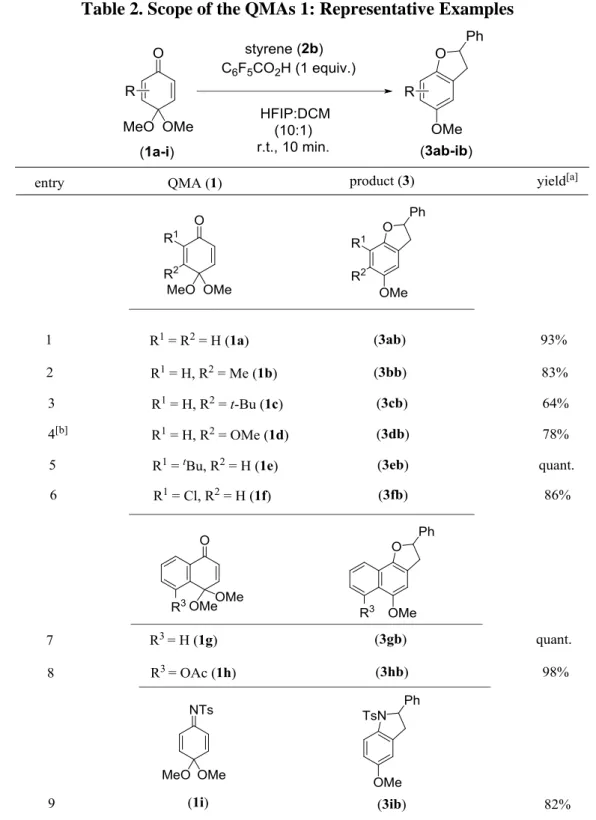
With the established conditions in hand, the scopes of both extensive QMAs 1a-i for the formation of various dihydrobenzoruan derivatives toward 2b as the counterpart was then evaulated. Many types of the QMAs 1a-i were applicable in our coupling and afforded the corresponding dihydrobenzofurans 3 in up to quantitative yield (Table 2).
12
Table 2. Scope of the QMAs 1: Representative Examples
[a] Isolated yields of the products 3 after purification by column chromatography. [b] 2 equiv. of the acid activator and 3 equiv. of styrene 2a were used.
13
The reactions occurred quite regio-selectively at the less hindered position of the carbonyl in the QMAs. The tert-butyl substituent at the neighboring position of the acetal in the QMA 1c somewhat hampered the substrate reactivity due to its steric demand (entry 3). The QMAs possessing the substituents of halogen 1e and a tert-butyl moiety 1f could afford the cyclized coupling products 3eb and 3fb with high conversions (entries 5 and 6). The formations of the desired cycloadducts 3gb and 3ib were achieved in excellent yields from naphthalene QMAs 1g and 1h (entries 7 and 8). Gratefully, the valuable indoline compound 3ib could also be obtained from iminoquinone acetals 1i without optimization (entry 9). Such oxygenated indoline structures are found in the natural products showing several interesting biological activities, such as physostigmine and esermethole.25)
Subsequently, the scope of the reactions regarding the various alkene coupling partners 2 was investigated by employing QMA 1a as a unified reaction substrate (Table 3). Fortunately, alkenes 2a-i, having either electron–donating or withdrawing substituents (entries 1-8), could smoothly react with the QMA 1a without significant alteration of the reaction efficiencies. Especially, the trans-isomer of the dihydrobenzofuran was solely obtained from the trans-styrene 2g. The cyclic styrene 2h was also applicable to the construction of the fused dihydrobenzofuran structure in the product 3ah found in the pterocarpan-type natural products (entry 7).26) footnote 7 The use of these alkenes 2 as nucleophiles could afford the corresponding dihydrobenzofurans 3 only in this strategy, while the reported oxidative cyclization methods starting from phenols were somewhat troublesome in terms of the yields to obtain the same products
3.27) Additionally, the vinyl sulfide 2i was also the appropriate nucleophile, giving the cyclized O,S-acetal 3ai in good yield (entry 8).footnote 8
footnote 7 The member of widely distributed isoflavanoid families showing a broad spectrum of biological properties including sharp responses to fungal infections, COX-2 inhibition, antitumor, LDL-antioxidant, anti-HIV, and anti–snake venom activities.26), 8a)
footnote 8The cyclized O,S-acetal 3ai could also be utilized for production of the benzofuran 4 as a synthetic module.
14
Table 3. [3 + 2] Coupling of Various Alkenes 2a-i Toward QMA 1a
[a] See the footnote in Table 2 for the reaction conditions. 2 equiv. of alkenes 2a-i were used for the reactions. [b] Performed at 0 oC. [c] Only trans isomer produced.
15
On the other hand, while treating the five- and six-membered exo-methylene compounds 2j and 2k in excess amounts under the optimized conditions, the two types of ring-sized spirocyclic dihydrobenzofurans 3aj and 3ak could be successfully afforded with comparable results, respectively (Scheme 13).28) footnote 9
Scheme 13
In first conclusion, we have successfully achieved the [3 + 2] coupling of the QMAs
1 with various alkenes 2 on the basis of a new allylic substitution strategy promoted by
the stoichiometric amount of perfluorobenzoic acid activator (PFBA) and the hydrogen bond donor, HFIP, affording the final dihydrobenzofuran and other derivatives in good to quantitative yields.
Section III. Mechanistic Considerations 1.3.1 A Plausible Reaction Mechanism
It has been reported that some QMAs 1 would induce [5 + 2] cyclizations with alkenes upon acid treatment.15) For the QMA 1d, the generation of the phenoxenium ion29) was reported during the mechanism to exclusively lead to the [5 + 2] cyclization by the trapping with styrene 2b, giving rise to the product 5 (Scheme 14).15c) However, in our reaction system the [5 + 2] adduct 5 would not be produced at all in the presence of the same substrate 1d, which indicated that our conditions cannot apparently produce the phenoxium ions. Herein, as illustrated in Scheme 14, we hypothesize that our [3 + 2] coupling of the QMA 1a would instead involve the charged QMA species A associated
footnote 9 These ring-sized spirocyclic compounds are known to be potentially useful in consideration of the ubiquitous nature of the spirocyclic structures in natural products showing interesting biological activities and of unique physical properties, such as for optoelectronics and asymmetric ligands for catalytic synthesis.28)
16
with the acid species in situ generation of the combined acid in equilibrium by the coordination of the hydrogen bond donor solvent, HFIP, as the more stable charged intermediacy A.
Scheme 14
To further prove the existence of our proposed charged QMA species A, the following control experiments with an extra addition of 1 equiv. as well as even 5 equiv. of water were conducted under our optimized reaction conditions, against the reactive and unstable phenoxenium ions having low moisture tolerability. As expected, our [3 + 2] coupling of the QMAs 1a with addition of water did not cause a remarkable decrease in the product yields probably due to the intermediacy of the more stable charged QMA species A (Scheme 15), while phenoxenium ions generated under the known conditions15d) underwent competitive quinone formation by hydrolysis of the acetals in the presence of water (SN1 pathway).
Scheme 15
After confirmation of the QMA charged species A, we subsequently proposed the plausible mechanism for the [3 + 2] coupling reaction using QMAs 1a and alkene
17
nucleophile 2a as the representative coupling substrates (Scheme 16).
Scheme 16
The initiation step concerns the charged QMA A associated with the combined acid species of perfluorobenzoic acid and hydrogen bond donor, HFIP. Pre-activation of the Brønsted acid might first occur by the coordination of HFIP to the Lewis basic functionality of the carbonyl group of the acid (Brønsted acid activation by HFIP).21) The charged QMA A could then react with -nucleophile 2a at the allylic carbon of the ring structure, rather than the sterically encumbered tertiary acetal carbon atom. The
pseudo-SN2’-like introduction of the nucleophile 2a by the reagent control could afford
the keto-type intermediate B, which simultaneously cyclized at the carbonyl moiety of the QMA with accompanying aromatization as a driving force. The stepwise constructions of the carbon-carbon and carbon-oxygen bonds between the QMA 1a and-nucleophile 2a would lead to the formation of the formal [3 + 2] coupling product, dihydrobenzofuran 3aa. Apparently, the high polar fluoroalcohol is a good match for the solvation of all the charged reaction intermediates.
Finally, to prove the intermediary of the pre-cyclized keto-type tautomer B, we presented the following experiment using the Z-type styrene 2l for the coupling (Scheme 17). In fact, the reaction of the QMA 1a and cis-methyl styrene 2l produced the corresponding cyclized products 3al as a regio-mixture with an about 30:70 ratio of
18
supports the involvement of the pre-cyclized cationic intermediate B, in which the free rotation of the C-C bonds competitively occurred to the cyclizations to form the more thermodynamically-favored latter trans-isomer rather than the cis-3al.
Scheme 17
1.3.2 Comparison with Other Methods
In comparison, we summarize the differences of the reaction pathways between our proposed reaction mechanism under acidic conditions and other representative allylic substitutions of QMAs 1 under basic or neutral conditions, in order to clarify the uniqueness of our pseudo-SN2’ reaction mechanism more concrete.
So far, with regard to the other limited strategies promoted under basic and neutral conditions, the first report of an allylic substitution reaction for QMAs 1 with the methyl Grignard reagent (MeMgI) was presented by Coutts and Hamblin over 30 years ago to give the rearomatized diphenyl phenol ether in some extent, where the reaction favored the unusual substitution course due to the formation of the stable magnesium phenoxide consisting of the organometallic reagent and the specific acetal leaving group (Scheme 18, eq 1).12) Indeed, the introduction of an excellent leaving group, such as the carboxyl group, at the acetal part in some stable and/or electron-deficient QMAs could be promising to bias the reactivity of QMAs for substitution versus the above-mentioned addition preference (eq 2).30) However, some of the reactive QMAs are too unstable to smoothly handle and 1,3-rearrangement of the acetal methoxy group in a methanol solution might occur via the allylic substitution pathway (eq 3).31)
Although these strategies are useful for directing the reaction to the substitution course under basic and neutral conditions, they might not perfectly eliminate the competitive addition processes and not be applicable to simple and readily accessible QMAs as well as extended nucleophiles.
19
Scheme 18
Very recently, a SN2’ displacement and cyclizing substitution for the introduction of
electron-rich arenes to QMAs similar to that of us has recently been nicely described by Porco et al., who investigated the ABCD ring construction of kibdelones using a novel arylation to produce a complex biphenyl adduct in moderate yield.14b) footnote10
footnote10This unique arylative substitution could proceed by the action of inorganic platinum(IV) catalysts in the presence of an appropriate amount of water, whereas a number of other screened metal salts as well as Brønsted and Lewis acids did not similarly work so well for the reaction.
20
In summary, after the extensive mechanistic considerations and investigation of this [3 + 2] coupling reaction including the comparison with other methods, the mechanism of which has been rationalized to principally involve the concerted pseudo-SN2’
interaction reacted on the tertiary acetal moiety of QMAs 1 with nucleophilic alkenes 2
in situ generation of the acitivated acid species of specific acid (PFBA) in equilibrium
by the undesired involvement of coordination of the hydrogen bond donor solvent, fluoroalcohol, at first rather than the 1,2-addition to the carbonyl group followed by rearrangement (aforementioned as an example in eq 1, Scheme 4,)13b) or through the known phenoxenium ions by an SN1 leaving manner (mentioned above, Scheme 14)15d),
and then to stepwisely construct the carbon-carbon and carbon-oxygen bonds for cyclizing, leading to the diverse thermo dynamically-favored dihydrobenzofurans 3 and other derivatives.
21
Chapter II. Controlled [3 + 2] Coupling Reaction of QMAs in a Catalytic System
Despite the general success of the results in this [3 + 2] coupling reaction (vide supra), there still exists several critical limitations from the practical view regarding our reported chemical coupling reaction of the QMAs 1 and nucleophilic alkenes 2 with the treatment of PFBA. The reactions usually required a stoichiometric amount of PFBA, which is considered to be a waste material after the reaction process.32) Additionally, the acid-induced background polymerization of the used alkenes 2 as a problem24) forced their excess use, typically over 2 equiv., for the couplings, which also refers to the all consumption of the QMAs 1.
Aiming at realizing a more practical catalytic reaction, several significant advances are expected to be improved, which mainly involves: 1) enhancing the reactivity of our specific perfluorinated acid in order to address the reaction problems needs for its catalytic use, and emerging the reaction more applicability needs improved stoichiometry of the alkenes 2 without any redundant formation of the alkene-derived byproducts.
Herein, we accordingly further attenuate the reactivity of the acid promoter working at a possible minimal loading. Considering that only the acids with the suitable pKa values could serve as the efficient promoters for the [3 + 2] coupling, we screened a series of perfluorobenzoic acid derivatives a-h with the varied pKa (Figure 2).
Figure 2
It is thus possible to systematically attenuate the acidity of the perfluorobenzoic acids by modifying the functionality at the ring positions. For the catalytic reaction at 2 mol% loading, all the partially fluorinated benzoic acids a-e showed lower efficiencies and slow reaction rates (Table 4, entries 2-6), probably due to their weaker acidities
22
compared to PFBA itself. Meanwhile, a set of more acidic phthalic acids f-h were examined with promising results under the catalytic conditions (entries 7-9), among the three isomers of which fluorinated terephthalic acid h showed a best catalytic performance and was capable of providing the coupling product 3aa in 72% yield even at 1 mol% loading (entry 9). Encouraged by the results with the catalyst h, general effects regarding the catalyst loading, reactant ratio, concentration, and temperature were further investigated (entries 11-14). By employing the catalyst h at 5 mol%, more promising results were obtained (entry 10). At last, the catalytic reaction at the temperature of 0 oChas become comparable to the original stoichiometric one (PFBA) for the dihydrobenzofuran 3aa production when using the fined catalyst h at 5 mol% (entry 14).
Table 4. Screening for the Catalytic [3 + 2] Coupling Reaction of 1a and 2a[a]
[a] Unless otherwise noted, reactions were examined in HFIP/DCM (1/1 v/v, 0.2 M) at room temperature for 1 hr. [b] Relative to QMA 1a. [c] Isolated yields after purification. [d] HFIP/DCM (2/1 v/v, 0.2 M). [e] HFIP/DCM (2/1 v/v, 0.2 M). [f] Performed at 0 oC for 3 hrs.
entry catalyst x nucleophile
2a (equiv.)[b] yield[c] 1 Pentafluorobenzoic acid 2 1.2 48% 2 2,3,5,6-tetrafluorobenzoic acid a 2 1.2 45% 3 2,3,4,5-tetrafluorobenzoic acid b 2 1.2 24% 4 3,4,5-trifluorobenzoic acid c 2 1.2 15% 5 2,6-difluorobenzoic acid d 2 1.2 27% 6 2,5-difluorobenzoic acid e 2 1.2 18% 7 perfluorophthalic acid f 1 1.2 41% 8 perfluoroisophthalic acid g 1 1.2 61% 9 perfluoroterephthalic acid h 1 1.2 72% 10 perfluoroterephthalic acid h 5 1.2 78% 11 perfluoroterephthalic acid h 5 1.0 72% 12d perfluoroterephthalic acid h 5 1.2 69% 13e perfluoroterephthalic acid h 5 1.2 65% 14f perfluoroterephthalic acid h 5 1.2 84%
23
With the optimal catalyst h and conditions, we confirmed the versatility of the catalytic system for the described QMAs 1 and nucleophilic alkenes 2 (Table 5). In comparison, it was found that a series of the dihydrobenzofuran products 3 were successfully produced by employing the 5 mol% catalyst h with the improved stoichiometry of the alkenes 2 (lowering to 1.2 equiv. from 2 equiv.). The selected examples are summarized. The good-to-excellent yields (up to 98% for the dihydrobenzofuran 3eb) have promised the generality of the catalytic method for the practical [3 + 2] couplings of the QMAs 1.
Table 5. [3 + 2] Coupling by Perfluoroterephthalic Acid Catalyst h[a]
[a] Reactions were performed using 1.2 equiv. of alkenes 2 in the presence of 5 mol% of the acid catalyst h in HFIP/DCM = 1/1 (0.2 M) at room temperature.[b] Isolated yields after purification. [c] Only trans isomer was obtained. [d] 3 equiv. of alkene 2j and 2k were used.
entry QMA (1) alkene (2) product (3) time yield[b]
1 1a 2b 3ab 4h 82% 2 1b 2b 3bb 5h 76% 3 1c 2b 3cb 5h 67% 4 1e 2b 3eb 5h 98% 5 1f 2b 3fb 4h 85% 6 1h 2b 3hb 5h 90% 7 1i 2b 3ib 8h 94% 8 1a 2c 3ac 3h 78% 9 1a 2d 3ad 4h 80% 10 1a 2e 3ae 5h 88% 11 1a 2f 3af 5h 79% 12 1a 2g 3ag[c] 4h 84% 13 1a 2h 3ah 5h 90% 14 1a 2i 3ai 4h 88% 15 1a 2j[d] 3aj 4h 74% 16 1a 2k[d] 3ak 7h 81%
24
Nonetheless, the much stronger acids, e.g., toluenesulfonic acid, trifluoroacetic, and methane sulfonic acids, on behalf of the catalyst h would provide quite sluggish reaction outcomes, showing much poorer yields of the desired product 3aa; as already described, such acids were harmful to the QMA 1a and the alkene 2a (vide supra). Therefore, appropriate acidity is an important factor required for the catalyst.footnote11
Although the origin of the higher catalytic activity of the catalyst h is yet unclear, one significant difference in the perfluorobenzoic acids relative to others is the presence of the intramolecular H-bonding in the ortho-fluorobenzoic acid structure,33) which makes the acidic site of the molecule quite bulky. Compared with the less effective catalysts f and g, the best catalyst h has much opportunity for the H-F bondings. It seems that this conformation favorably affected the desired protection of the acetal carbon in the assumed transition state A (see the reaction mechanism in Scheme 16) from the nucleophilic attack and thus might exclude the quinone formation by addition of concomitant water as well as other side reactions. In our previous studies, steric blocking of the electrophilic acetal carbon by bulky activator was very important for suppressing the quinone formation.19i, 19j) Hence, the perfluorinated benzoic acids would have a superior effect on controlling the coupling reactions in the catalytic cycle because of the bulky shapes compared to the acids having similar pKas(Scheme 19).
Scheme 19
footnote11Aliphatic carboxylic acids having pK
a values similar to that of the catalyst h, that is,
trichloro- and dichloro-acetic acids, showed somewhat lower efficiencies as the catalysts (below 65% yields of the product 3aa at 2 mol% loading).
25
In summary, further investigations in our [3 + 2] coupling strategy with regard to the modification of perfluorinated acid catalyst on their ring structures have been sufficiently conducted, which led to the findings of an excellent catalytic alternative, that is the fluorophthalic acid catalyst h, advancing original stoichiometrically controlled couplings to render catalysis of the acid at lower than 5 mol% loading together with the significantly improved stoichiometry of the alkenes (lowering to 1.2 equiv.) for making this controlled coupling reaction more practical.
26
Chapter III. Controlled Couplings of QMAs Using Reusable Polystyrene-Anchored Specific Proton Catalyst
As we mentioned in the previous chapters, we have succeeded in performing this reagent controlled couplings of QMAs 1 with a series of carbon -nucleophiles 2 by successfully controlling the formation of carbon-carbon bonds to the quinone architecture. However, with regard to the reaction activator of alkene nucleophiles, the used specific fluorinated acid, that is perfluorobenzoic acid (PFBA) or perfluoroterephthalic acid h, is still considered to be a waste material after the reactions.
Encouraged by many positive outcomes in the polymer-supported reagent chemistry34-36) footnote12, we have become interested in designing a new heterogeneous catalyst carrying the specific PFBA functions as our continuation of effort in developing greener and more attractive strategies in applying the QMAs. We now report the preparation and reactivity of a reusable solid-type PFBA alternative that is extremely valuable for the coupling of QMAs 1 with carbon -nucleophiles, in which the former electrophiles 1 can be exclusively activated by the solid acid to minimize the formation of alkene-derived byproducts and deactivation of the acid catalyst (Scheme 20).
Scheme 20
footnote12 Polymer-supported reagents and catalysts, which have emerged from solid-phase organic synthesis (SPOS),34) have been emerging as a promising tool in modern synthetic research in developing greener methodologies that can meet recent growing demands for establishing ecological and environmentally friendly chemical processes.35) Generally, the advantages of reagents and catalysts that are immobilized on polymer backbones include enhanced stabilities such as robustness, high tolerance to air and moisture, as well as their convenient handling and recovery, the benefits of which have made them environmentally benign alternatives to conventional reagents and catalysts.36) Many research studies have revealed that the immobilization of conventional reagents and catalysts is one of the promising ways not only to control their stability, but also to maintain their reactivity for reuse and recycling.
27
Section I. Preparation of Polystyrene-Supported Perfluorobenzoic Acid
For easy access to the preparative polystyrene-supported perfluorobenzoic acid (PS-PFBA), we first envisioned the following one-pot protocol starting from the commercial perfluoroterephthalic acid (Scheme 21). Relying on well-established procedures in Merrifield’s solid-phase peptide synthesis (SPPS),37) the activated ester A was first generated in situ in a flask by treatment of the PFBA with diisopropyl carbodiimide (DIC) and hydroxybenzotriazole (HOBt) via the amide bond formation,38) by which the desired polystyrene-anchored PFBA (PS-PFBA) could be finally produced in good efficiency (75%) as white microbeads by rinsing the resins with several solvents. The prepared PS-PFBA is stable under ambient conditions at least for several months without special storage conditions. Characterization for ascertaining the introduction and loading of the PFBA in the polymer backbones was determined by IR and elemental analyses.footnote13
Scheme 21
footnote13IR spectrum exhibited strong band absorptions at 1698 and 1723 cm-1
corresponding to the vibration peaks of the amide linkage and carboxylic acid functionality of the PFBA along with a broad but weak absorption band ranging from 2914 and 3290 cm-1 for the NH and COOH groups. Theoretical loading of the PFBA based on the elemental analysis of the nitrogen contents (Found: N, 2.20) averaged 1.06 mmol/g in comparison to the starting aminomethyl polystyrenes (N, 2.88 for 2.0 mmol/g of the free amine sites). The degree of unreacted free NH2
sites in the polymers (ca. 25%) was also checked by elemental analyses as the corresponding ammonium salt after titration of the prepared PS-PFBA using hydrogen chloride.
28
Section II. Polystyrene-Supported Perfluorobenzoic Acid as the Specific Promoter for Controlled Couplings of QMAs
The newly prepared polystyrene-supported perfluorobenzoic acid (PS-PFBA) was evaluated with further optimization. It should be noted that, although the reaction of the QMA 1a and allyltrimethylsilane 2a at room temperature successfully afforded the coupling product 3aa in good yield (81%) under the optimized condition, a further approximate 10% increase in the yield was obtained at 0 oC (90%) probably because the formation of the cationic charged quinone species A that occurred in situ during the transition states should plausibly occur at that lower temperature. Nonetheless, the used PS-PFBA beads could be quantitatively recovered by filtration of the reaction mixture, and were then repeatedly used for at least several times (vide infra).
Encouraged by the remarkable activation behaviour of the PS-PFBA in this [3 + 2] coupling reaction, we subsequently expanded the reaction scopes of various QMAs 1 having different ring substituent patterns and a wide array of carbon -nucleophiles 2 under the optimized conditions in order to ascertain the versatility of the PS-PFBA as a heterogeneous catalyst (See selected results in Scheme 22). As a result, the PS-PFBA also served as an efficient reusable acid promoter for the reactions to succinctly provide a series of dihydrobenzofuran products 3footnote14 in good to excellent yields. The yields
in most cases were comparable and sometimes even higher than those for the PFBA and perfluorinated acid h. The new polymer acid, PS-PFBA, thus behaved as a powerful and clean promoter with a broad generality.
footnote14The increased yields of the products 3 from the alkene nucelophiles 2 is probably due to the excellent chemo-selectivity of the PS-PFBA toward the QMAs 1 over the alkenes 2 as a milder acid. Since some byproducts derived from the background polymerization of the used alkenes2 has been confirmed by us as a serious problem of previous homogeneous conditions caused by the acid in chapter I. On the other hand, such byproduct formation was not detected at all based on the NMR detection level when using this newly developed PS-PFBA. The attenuated activity of the PS-PFBA compared with its soluble alternative is mainly due to the heterogeneity of the polymer catalyst.
29
[a] Recycling yield of the polystyrene anchored acid (PS-PFBA) was nearly quantitative. [b] 5.0 equiv. of alkene and 2.0 equiv. of PS-PFBA.
Scheme 22
Since the recyclability is regarded as one of the important criterion for evaluating the applicability of the heterogeneous catalysts, we then attempted to investigate the recovery and recyclability of PS-PFBA in this [3 + 2] coupling reaction. As depicted in Table 6, the recycled catalyst of PS-PFBA was also capable of being reused smoothly for at least four consecutive reuses without any loss of the catalytic activity.
30
Table 6. [3 + 2] Coupling Product 3aa Using Reused PS-PFBA
To sum up, we have also succeeded in developing a unique solid acid catalyst (PS-PFBA) including immobilized perfluorobenzoic acid sites in the polystyrene backbones, which are capable of behaving as specific promoters for this controlled carbon-carbon bond-forming transformation of QMAs 1. The polystyrene-anchored protons in the PS-PFBA could successfully induce the [3 + 2] coupling reactions from the diverse carbon nucleophiles 2 with a similar efficiency to its homogeneous counterpart PFBA and even catalyst h.
31
Chapter IV. Reactions Using Other Extended Nucleophiles
We finally attempted to broaden the scope of nucleophiles in a brief extension of this study. In evaluating mild conditions of the polymer acid catalyst, other two potential nucleophiles were tested for the reactions to the QMA 1a using the PS-PFBA. Toward this objective, the furanyl silylether 5a, and sulfur nucleophile 5b could behave as good nucleophiles to produce the desired coupling products 5aa and 5ab under mild conditions (Scheme 23).
[a] PS-PFBA (0.1 equiv.), nucleophile 5a (3 equiv.) in HFIP/DCM = 10:1 (0.1 M) at 0 oC-r.t. [b] PS-PFBA (1 equiv.), nucleophile 5b (2 equiv.) in HFIP/DCM = 1:1 (0.2 M) at 0 oC.
Scheme 23
Since enol silylethers and silyl ketene acetals39) have become one of the most popular carbon nucleophiles in organic synthesis and are also employed even easily as a relatively weak and soft carbon nucleophiles to form the carbon-carbon bond in other reactions such as Mukaiyama aldol reactions40),1,4-additions41), and others42). Therefore, we envisioned that the soft nucleophiles of silyl enolates, which are superior to other metal enolates in terms of their isolation might also be the favorable candidate for our coupling reactions of QMA 1a.
Finally, investigations in our coupling reactions by utilizing the unique reactivities of the enol silylethers 5c and silyl ketene acetals 5d as potential carbon -nucleophiles was conducted by the aid of our newly developed reusable PS-PFBA for the formation of new carbon-carbon bond for QMA 1a as the electrophile (Scheme 24). As expected, the reactions were successful for introducing the nucleophiles of enol enolates 5c and 5d toward only the allylic position of allylacetal unit of QMA 1a to provide two types of coupling products 5ac and 5ad in moderate to good yields under mild conditions.
32
[a] PS-PFBA (1 equiv.), nucleophiles 5c or 5d (2 equiv.) in HFIP/DCM = 1:1 (0.2 M) at 0 oC.
Scheme 24
Notably, these two examples of coupling reactions with silyl enolates 5c and 5d are the very rare examples of their use in substitution chemistry, showing impressive chemo- and regio-selectivity by using the uniqueness of the privileged bifunctionalities of QMA 1a (where substitutions toward only the allylic position of allylacetal unit), in comparison with the unique reactivities of silyl enolates and silyl ketene acetals which have been widely applied into the classical Lewis acid catalyzed Mukaiyama-aldol reaction40d) footnote15 and 1,4-addition reaction41), where the -unsaturated enones and ketones are also able to react selectively with different kinds of silyl nucleophiles respectively.
footnote15 To the best of my knowledge, this is a first example for the Mukaiyama-type
SN2’-substitution in the presence of the functionalization for the addition reactions shown below.40d)
33
Indeed, in our previous work, we found that the favorable 1,4-addition of -enone unit could be successfully performed only by utilization of acetonitrile as a solvent without any catalyst to give almost quantitative yields of the corresponding O-silylated Michael adducts, in which way the nucleophilic attack would occur toward only position of the enone moiety with the enol silyl ether nucleophile (eq 1, Scheme 25).41 However, our [3 + 2] coupling system using the quinone monoacetal as the electrophile could afford the O-silylated substitution product in excellent yield with unique regioselectivity, where the enol silyl ether nucleophile would attack to only the position of enone group (eq 2, Scheme 25).
Scheme 25
I conclude that, the other diverse carbon and heteroatom nucleophiles such as furanyl silylether 5a, sulfur nucleophile 5b, as well as the enol enolates 5a and 5b, are all able to react with the QMA 1a to produce different types of coupling products
5aa-ad in moderate to good yields promoted by our newly developed PS-PFBA under
mild conditions without any optimization. In particular, two types of coupling products
5ac and 5ad from silyl enolates 5c and 5d are obtained with impressive regio-selectivity
toward the allylic position of allylacetal unit by using the uniqueness of QMA 1a on contrary to the reaction positions between silyl enolate and enones in 1,4-addition reactions and Mukaiyama-type reaction.
34
Chapter V. Applications
Section I. Concise Synthesis of Several Naturally Occurring Compounds
Up to date, a great number of naturally occurring biologically active compounds has been described in the literature. In particular, the subset of modules with impressive structures such as the flavonoids derived pterocarpan26) footnote16 and the ring fused indoline-containing pyrrolidinoindoline25) footnote17 (Figure 4) have received substantial interests due to their high biological and medicinal properties in vitro and in vivo (e.g. antifungal, antimicrobial, antitumoral, and anti-HIV), especially in the area of anticancer drug discovery.
Figure 4
Encouraged by the rare success of the substitution-type chemistry of QMAs 1 to diverse dihydrobenzofuran products 3 as well as the indoline derivatives 3ib via our newly developed appealing reagent-controlled strategy with the involvement of the combined system of the perfluorobenzoic acid promoter and fluoroalcohol solvent, the discovery of more concise and promising route toward these two complex bioactive modules continues to be a vital research for us.
footnote16 Pterocarpans, the second largest group of natural isoflavonoids produced in plants possessing a 6a,11a-dihydro-6H-benzofuro[3,2-c]chromene skeleton (Figure 4) with unusal
cis-fused dihydrobenzofuran-benzopyran ring juncture, have received considerable attention due
to their spectrum of range of biological properties in response to fungal infections, COX-2 inhibition, LDL-antioxidant, anti-HIV, and anti-snake venom activities. Although lots of synthetic methods have been reported recently, many of which are multistep, proceed in poor overall yields, and relying on the uses of specific metal-catalysts.26)
footnote17 Pyrrolidinoindolines, a subset of compounds with a fused indoline motif (Figure 4), mainly exist in the naturally occurring compounds of physovenine showing the acetylcholinesterase inhibitors, such as physostigmine. In most cases, the fused indoline ring system of pyrrolidinoindoline could be obtained in a stepwise fashion by the initial synthesis of a substituted indole or oxindole intermediate, and then further elaborated to the target product of pyrrolidinoindolines.25)
35
To our delight, the further applications of our methodology for the concise synthesis of these naturally occurring pterocarpan and pyrrolidinoindoline has been successfully achieved by the regio-specific [3 + 2] couplings with the involvement of the sequential oxidation/cyclization from phenol or benzenesulfonamide. The corresponding oxidants for the QMAs 1l and iminoquinone acetals 1i as key intermediates as well as the designed nucleophiles of 2H-chromen 6afootnote18, tosyl dihydropyrrole 6b, and 6c can thus be utilized for allowing control of the carbon position for accessing the concise formation of these two valuable naturally occurring skeletons 6la, 6ib, and 6ic in acceptable yields (53%, 75% and 84%), respectively (Scheme 26). Notably, the desired natural product of maackiain 7 could be very concisely synthesized in a good yield (76%), after the deprotection of the pterocarpan 6la.
Scheme 26
footnote18 2H-chromen 6a was prepared via the following methods. Tosyl dihydropyrrole 6b and 6c could also be obtained via the similar approach from tosyl pyrrolidinone.
The [3 + 2] coupling could not be succeeded when 2H-chromen (R = Me or H) was used probably due to its polymerization under the acidic conditions.
36
Section II. Preparation of Benzofuran Oligomers
In recent years, benzofuran oligomers are reported as a promising highly fluorescent compounds with the property of organic electroluminescence (OEL) which is an emerging display technology allowing the manufacture of efficient, low-voltage multicolor displays, owning to their highly photoluminescence (PL) quantum efficiency, thermal stability, and also their facile color tenability.43) However, we noticed that the reports on the series of non-linear ortho-benzofuran oligomers are quite limited in contrast to many of the linear ones, described as the good candidate as the promosing highly fluorescent compounds.44) Therefore, a more concise and iterative route to the non-linear benzofuran oligomers is still in demand, especially a new route that allows regio-control of the reaction.
As a successive effort by utilization of our newly reported [3 + 2] coupling reaction of QMAs 1 with alkene nucleophiles 2, the further application toward the synthesis of more elongated and structurally defined ortho-benzofuran oligomers was thus investigated based on the concept of the iterative oxidation/cyclization strategy involving the following two important steps: 1) the oxidation of phenols to the QMAs by PIDA and 2) a bond-forming cyclization reaction of the QMAs with the designed functionalized alkene nucleophiles (Scheme 27).
Scheme 27
Indeed, the use of this sequential synthetic approach could allow the convergent access to the regio-defined ortho-dihydrobenzofuran dimer 10a and trimer 11a in acceptable yields, which was also capable of converting into the benzofuran regio-defined ortho-benzofuran trimer 12a in a single step in 41% yield (Scheme 28). In details, the acyl protected dihydrobenzofuranyl phenol 8a was first obtained through
37
sequential oxidation/cyclization strategy from para-methoxy phenol using acyl protected oxygenated benzoyl alkene 8 as nucleophile.footnote19 QMA 9a was then produced by treatment of a solution of dihydrobenzofuranyl phenol in methanol via second oxidation after the chemo-selective removal of the acyl group using K2CO3 in methanol. Notably, this repetitive oxidation/cyclization strategy should occur before the regeneration of the initial phenol functionality by chemo-selective removal of protected acyl group. Therefore, repetition of the iterative oxidation/cyclization/deprotection process enabled expeditious access to the desired dihydrobenzofuran trimer 11a, which can be further used for preparing the final promising benzofuran trimer 12a by treatment of DDQ (2,3-dichloro-5,6-dicyanobenzoquinone) as an oxidant (Scheme 28). Therefore, this is conceptionally applicable for further elongated benzofuran oligomers by further repetitions, potentially becoming a new strategy for the controlled oligo-aromatics.
Scheme 28
footnote19 Our [3 + 2] coupling reaction of QMA 1a could not be successfully performed when the other benzoyloxy alkene (R = Me or H) was used as the coupling partner, probably because these two substituents of the corresponding monomer 8a are less stable than the acyl protected one under the acidic condition.
38
Conclusion
In summary, we have succeeded in developing the efficient controlled coupling reactions of the useful unsymmetrized quinone alternatives, quinone monoacetals (QMAs), under specific acidic conditions. The general successes are listed below.
1) At first, the rare success of the substitution-type chemistry of QMAs was achieved based on the development of the appealing reagent-controlled strategy consisting of the combined system of the perfluorobenzoic acid promoter and fluoroalcohol as solvent, which could smoothly proceed with high regio-specificity for introducing the
-nucleophiles toward only at the allylic position of QMAs, providing diverse dihydrobenzofuran products and their derivatives (Chapter I, Sections I, II). The mechanism was also detailed with experimental evidences (Chapter I, Section III).
2) The further investigations with regard to the acid tuning in this controlled [3 + 2] couplings have led to findings of an excellent catalytic alternative (perfluorinated acid catalyst h), advancing the original stoichiometrically reactions to render catalysis of the acid at lower than 5 mol% loading along with the significantly improved stoichiometry of the alkenes (lowering to 1.2 equiv.) (Chapter II).
3) A unique solid acid catalyst (PS-PFBA) including immobilized perfluorobenzoic acid sites in the polystyrene backbones has been successfully prepared, which acts as the specific promoters for this controlled coupling reactions of QMAs 1 with diverse
carbon nucleophiles in high performances with a similar efficiency to its homogeneous counterpart, PFBA (Chapter III, Sections I, II).
4) Other extended nucleophiles could also be utilized for this coupling reaction by the aid of the reusable solid acid catalyst (PS-PFBA) in hexafluoroisopropanol (HFIP) to give the coupling products at the desired positions with excellent regio-selectivities in high performances (Chapter IV).
5) We finally challenged the concise approaches to synthetic modules for natural products (e.g. maackiain and pyrrolidinoindoline) as well as the iterative elongation of regio-controlled benzofuran oligomers (e.g. dimer and trimer) by utilizing our newly developed controlled [3 + 2] coupling strategy as further applications (Chapter V, Sections I, II).
39
Main Papers
1) [3 + 2] Coupling of Quinone Monoacetals by Combined Acid–Hydrogen Bond Donor;
Toshifumi Dohi, Yinjun Hu, Tohru Kamitanaka, Naohiko Washimi, and Yasuyuki Kita, Org. Lett., 2011, 13, 4814–4817.
2) Controlled Couplings of Quinone Monoacetals Using Reusable Polystyrene-Anchored Specific Proton Catalyst;
Toshifumi Dohi, Yinjun Hu, Tohru Kamitanaka, and Yasuyuki Kita,
Tetrahedron, 2012, 68, 8424-8430.
3) Brønsted Acid-Controlled [3 + 2] Coupling Reaction of Quinone Monoacetals with Alkene Nucleophiles: A Catalytic System of Perfluorinated Acids and Hydrogen Bond Donor for the Construction of Benzofurans;
Yinjun Hu, Toshifumi Dohi, Tohru Kamitanaka, Yusuke Mishima, and
Yasuyuki Kita, J. Org. Chem., 2013, 78, 5530-5543.
Related Publications
1) Efficient Synthesis of Oxygenated Terphenyls and Other Oligomers: Sequential Arylation Reactions through Phenol Oxidation-Rearomatization;
Toshifumi Dohi, Tohru Kamitanaka, Shohei Watanabe, Yinjun Hu, Naohiko Washimi, and Yasuyuki Kita, Chem.-Eur. J., 2012, 18, 13164-13168.
2) Parallel and Modular Synthesis of P-Chirogenic P,O-Ligands;
Magnus J. Johansson, Susanne Berglund, Yinjun Hu, Kristian H. O. Andersson, and Nina Kann, ACS Comb. Sci., 2012, 14, 304-308.
3) Enantioselective Intramolecular Morita–Baylis–Hillman Reaction Using Chiral Bifunctional Phosphinothiourea as an Organocatalyst;
Kui Yuan, Hong-Liang Song, Yinjun Hu, Jian-Fei Fang, and Xin-Yan Wu,
Tetrahedron: Asymmetry, 2010, 21, 903-908.
4) Chiral Phosphinothiourea catalyzed Asymmetric Morita–Baylis–Hillman Reactions of Acrylates with Aromatic Aldehydes;
Kui Yuan, Hong-Liang Song, Yinjun Hu, and Xin-Yan Wu, Tetrahedron, 2009, 65, 8185-8190.
5) Chiral Phosphinothiourea Organocatalyst in the Enantio-Selective Morita-Baylis- Hillman Reactions of Aromatic Aldehydes with Methyl Vinyl Ketone;
Kui Yuan, Lei Zhang, Hong-Liang Song, Yinjun Hu, and Xin-Yan Wu, Tetrahedron
40
Acknowledgement
I sincerely wish to express my special gratitude to my supervisor Prof. Yasuyuki Kita whose expertise, understanding, and patience, added considerably during my doctoral courses. It’s my great honor to pursue my doctoral courses in your research group. I appreciate your specialized knowledge and skill in organic chemistry and your always assistance and expert advice at all times during my three years’ doctoral studies.
I also would like to thank my advisor Assistant Prof. Toshifumi Dohi, who always gave me many of assistance and suggestions at all levels of my studying and living. Thanks for your patient guidance, expert advice and always answering my questions no matter how busy you are.
I must also acknowledge Mr. Tohru Kamitanaka, Mr. Naohiko Washimi, thanks for your lots of helpings and always constructive suggestions in this thesis project.
Appreciation also goes out to Dr. Koji Morimoto, Dr. Motoki Ito, Dr. Akira Nakamura, Mr. Yusuke Mishima, Mr. Shohei Watanabe, Mr. Yudai Aramaki, Mr. Kazuyuki Shimizu, Mr. Nobutaka Yamaoka, Mr. Tomofumi Nakae, the other teachers and students in fine synthetic chemistry lab, and other professors in the department of pharmaceutical sciences.
Thank all of you in Experimental Lab 2 who never hesitate to help me!
I also express my gratitude to the agency of China Scholarship Council for their three years’ financial supporting during my doctoral courses in Ritsumeikan University.
Finally, a very special thank goes out to my family in particular my dear parents for the love and support they provided me all through my life. I am also grateful to all my friends in Japan, Sweden and China, for your care, encouragement and assistance.
41
Experimental Section
General Information
Melting point (mp) was measured by melting point apparatus. 1H NMR and 13C NMR spectra were recorded by spectrometers operating at 400 MHz for 1H NMR and 100 MHz for 13C NMR at 25 oC using CDCl3 as a solvent. Infrared spectra (IR) are reported in reciprocal centimeters (cm-1). High resolution mass spectra (HRMS-EI) were performed by the Elemental Analysis Section of Osaka University Pharmaceutical Sciences. Column chromatography was carried out on silica-gel (230-400 mesh) eluting with hexane and EtOAc for isolation of the QMAs 1 and cycloadducts 3. The spots and bands were detected by UV light of irradiation (254 and 365 nm) and/or by staining with 5% phosphomolybdic acid followed by heating. Unless otherwise noted, all the experiments were carried out at room temperature in open flask. A series of the perfluorinated acids (PFBA and a-h) (purchased from TCI), polystyrene, and silica-supported amines (from Sigma-Aldrich) were used as they stand. Other commercial acids for the screening of the reaction promoter were purchased from Aldrich, and TCI and used as they stand. All other chemicals including the commercial alkene nucleophiles 2 and solvents, such as hexafluoroisopropanol (HFIP), were obtained from commercial suppliers and used without further purification.
List of Abbreviations
![Table 1. Effects of the Stoichiometric Acid Activators for [3 + 2] Coupling Reaction](https://thumb-ap.123doks.com/thumbv2/123deta/6576694.1133434/17.892.128.754.270.686/table-effects-stoichiometric-acid-activators-coupling-reaction.webp)
![Table 3. [3 + 2] Coupling of Various Alkenes 2a-i Toward QMA 1a](https://thumb-ap.123doks.com/thumbv2/123deta/6576694.1133434/21.892.166.719.174.1037/table-coupling-of-various-alkenes-a-toward-qma.webp)
![Table 4. Screening for the Catalytic [3 + 2] Coupling Reaction of 1a and 2a [a]](https://thumb-ap.123doks.com/thumbv2/123deta/6576694.1133434/29.892.92.798.490.1051/table-screening-catalytic-coupling-reaction-a-a.webp)
![Table 6. [3 + 2] Coupling Product 3aa Using Reused PS-PFBA](https://thumb-ap.123doks.com/thumbv2/123deta/6576694.1133434/37.892.183.713.223.510/table-coupling-product-aa-using-reused-ps-pfba.webp)
