An Asian Triangle of Growth and
Cluster-to-Cluster Linkages
著者
Kuchiki Akifumi
権利
Copyrights 日本貿易振興機構(ジェトロ)アジア
経済研究所 / Institute of Developing
Economies, Japan External Trade Organization
(IDE-JETRO) http://www.ide.go.jp
journal or
publication title
IDE Discussion Paper
volume
71
year
2006-08-01
INSTITUTE OF DEVELOPING ECONOMIES
Discussion Papers are preliminary materials circulated to stimulate discussions and critical comments
Keywords: Asian Triangle of growth, regional integration, cluster-to-cluster linkages
JEL classification: F23, F59, R12, R58.
Executive Vice President, Japan External Trade Organization (JETRO) E-mail: [email protected]
DISCUSSION PAPER No. 71
An Asian Triangle of Growth and
Cluster-to-Cluster Linkages
Akifumi KUCHIKI*
August 2006
Abstract
It is expected that an Asian triangle of growth will be formed in the coming few decades. China, India and ASEAN surround the Asian triangle, which is home to many industrial clusters. Multinational corporations will link these clusters together. Regional integration will help them in this task by lowering the barriers of national borders. This paper explains the necessity of regional integration for cluster-to-cluster linkages in the Asian triangle of growth.
The Institute of Developing Economies (IDE) is a semigovernmental, nonpartisan, nonprofit research institute, founded in 1958. The Institute merged with the Japan External Trade Organization (JETRO) on July 1, 1998.
The Institute conducts basic and comprehensive studies on economic and related affairs in all developing countries and regions, including Asia, Middle East, Africa, Latin America, Oceania, and East Europe.
The views expressed in this publication are those of the author(s). Publication does not imply endorsement by the Institute of Developing Economies of any of the views expressed.
INSTITUTE OF DEVELOPING ECONOMIES (IDE), JETRO 3-2-2, WAKABA,MIHAMA-KU,CHIBA-SHI
CHIBA 261-8545, JAPAN
1. Introduction
Multinational corporations have increasingly created networks for value chain management in Asia as part of their efforts to maximize customer satisfaction. We can call the networks they have formed Asia’s regional network. We must take into account the management of multinational corporations in order to fully understand regional integration in Asia. This paper forecasts the growth of the Asian economies, attempts to provide an understanding of the management mechanisms of multinational corporations, and examines how Asia is being regionally integrated.
It is expected that an Asian triangle of growth will be formed in the coming few decades, with boundaries formed by China, India and ASEAN, as shown in Figure 1. There are many industrial clusters in this triangle, including the automobile industry cluster in Guangzhou, China, which is home to factories of Honda, Nissan and Toyota. This automobile industry cluster will expand over ASEAN as the Yuan economy grows. Because Japan is located outside of the triangle, it is necessary for Japanese clusters to link to clusters within it. We call these cluster-to-cluster linkages. Multinational corporations use value chain management to decide locations for their research and development, procurement, assembly, and marketing facilities, and these locations will link clusters together.
The Asian triangle of growth is emerging, and industrial clusters are expanding within the triangle as multinational corporations link a part of their value chain in one cluster with another part in another cluster. Regional integration refers to economic partnership in Asia, which will promote the linking of clusters with other clusters by lowering the barriers created by national borders. This paper explains the relationship between the Asian triangle of growth, industrial clusters, cluster-to-cluster linkages, and economic partnership in Asia.
Section 2 explains industrial clusters in the Asian triangle. Section 3 looks at the expansion of the region with the growth of the Yuan economy. Section 4 elucidates the formation of an Asian network formed by the value chain management of multinational corporations. Section 5 explains the linkages between clusters in Asia from the point of view of the value chain management of multinational corporations. Section 6 shows how Asian regional integration promotes linkages between the clusters of multinational corporations in the Asian triangle. The last section concludes.
2. Industrial Clusters in the Asian Triangle
China introduced an open door policy in 1979. By 2005, two decades later, it had become an economic power and was said to be a threat to its neighbors. In 2030, it is projected that the Asian economy will be heavily dependent on the Indian economy. In other words, the size of the economy of the Asian triangle seems certain to increase in the future. In the section below, we will explain the Asian triangle and its future.
First, in 2005 Global Strategy Research Institute, Matsuhsita Electric Industrial Co., Ltd. projected that China, India and ASEAN will form an Asian triangle, and that this triangle will be the core of growth in the manufacturing sector in Asia. As shown in Table 1, the per capita GNPs of India, China and Vietnam, all in the triangle, were 530 dollars, 1100 dollars and 480 dollars in 2004. The average growth rate of the countries of the region, as shown in Table 1 is a high 6.1 %. Figure 1 clearly shows that the island nations of Japan, the Philippines and Indonesia are located outside of the triangle.
Second, we will discuss industrial clusters in Asia from the point of view of competition and cooperation. We can illustrate the competition and cooperation between industrial clusters in Asia by examining the automobile industry cluster centered around Bangkok, Thailand and the electronics industry cluster in Penang, Malaysia.
In 2005, China was the world’s fourth largest car producer. In that same year, Toyota laid the cornerstone for a third factory in Tianjin, China. Nissan planned to produce the newest version of the Bluebird in China beginning in 2006. Also, Mazda, Suzuki and Mitsubishi were scheduled to make additional investments in China in the year. The Chinese government intends to promote sales of small cars such as the Honda Fit in order to promote energy conservation. Three large automobile industry clusters are forming in the Bohai Economic Circle, Changjiang Delta Economic Area and Pearl River Delta Economic Zone. Hyundai, a Korean company, has established a plant in Beijing, and Toyota, a Japanese firm, has constructed a plant in Tianjin in the Bohai Economic Circle. General Motors, Ford and Volkswagen have established plants in Shanghai.
The East Asian countries have industrial zones, and each zone has the characteristics of an industrial cluster. There are clusters in hi-tech industries, the die-casting industry, the automobile industry, and labor-intensive industries. We will describe them in the following section.
(1) The Pearl River Delta economy
The east side of the Pearl River Delta began its economic development starting from Shenzhen and Tongguang in the 1980s and 1990s. Foreign companies in the textile and electronics industry outsourced the manufacturing and assembly of their products to factories on the east side of the Delta.
In the 2000s, the west side of the Delta began to develop as Honda, Nissan and Toyota responded to the industrial cluster policy of Guangzhou municipality, creating an automobile industry cluster based around plants constructed by the three Japanese firms in Guangzhou, Guangdong Province, which neighbors Hong Kong. Guangzhou City, in the Pearl River Delta, is the only city in the world with plants operated by all three of
Japan’s major automobile firms. Hyundai, a Korean firm, and Isuzu, a Japanese firm, also constructed plants. A staff member from Honda told us that Honda can procure parts and components from its suppliers tier 1, tier 2, tier 3, and tier 4. Nissan can procure many of the parts and components it needs in China. Tier 1, tier 2 and tier 3 suppliers of Toyota were still constructing plants in 2006. The annual production capacity of automobiles in Guangzhou in 2010 is expected to be about 1.3 million vehicles. The automobile industry cluster as the center of Guangzhou is expanding.
Recently, a joint venture between Nippon Yusen and Mitsui O.S.K.Lines, Ltd. announced that it would construct the largest port facilities in China, to ship cars. Firms in the electric and electronics industry have constructed plants in Dongguan city on the east side of the Pearl River Delta, and firms that produce parts and components for the automobile industry are moving into Dongguang in Guangdong Province.
(2) The Yangtze River Delta economy
The Yangtze River Delta is centered around Shanghai city, and incorporates Jiangsu and Zhejian Provinces. The GDP growth rate of Jiangsu Province in 2003 was 13.8%, a figure greater than the national average of 9.1%. Jiangsu Province was ranked first in the amount of foreign direst investment implemented. The Shanghai area is expanding as an agglomeration of the automobile component industry, diecast industry, electric and electronics industry, and so on.
In 2001, the Shanghai municipality established Shanghai International Automobile City in 2001 as a base for auto production, based on the model of Detroit in America. It has a total area is 680 thousand square kilometers , divided into six districts for trade, research and development, education, etc. A College of Automotive Engineering was established at Tongji University, to develop human resources for the automobile industry. The city is well equipped in terms of physical infrastructure,
human resources, institutions, and living conditions. The Shanghai Automobile Group and Volkswagen launched a joint venture in 1984, and under it constructed three factories in the city. About 200 companies had moved in as of August 2004, with approximately half of them or about 100 companies, being in the automobile component industry.
Shanghai's industrial zones are characterized by the intention to form clusters of companies from specified countries or in specific industries. In April 2000, Shanghai City announced that it would develop an industrial zone targeting Japanese companies, not only in hi-tech industries but also including various industries in the manufacturing and service sectors. Shanghai Taiwan Commerce and Industrial Park in Shanghai was established to invite Taiwanese companies. In 2002, the Shanghai government announced that it would establish an industrial park for Taiwanese companies, which would target companies in the IT industry. In the above cases, local governments have taken the lead in creating clusters of Japanese and Taiwanese companies.
Another case is the Wuxi-Singapore Industrial Zone, which was established by SembCorp Industries, a Singaporean conglomerate, in cooperation with the Wuxi City government. The zone has good infrastructure and has an abundance of capable human resources from unskilled labor to engineers.
(3) The Bohai Rim economy
The National People’s Congress (NPC), China’s parliament, endorsed the development of the Tianjin Bohai New Area for Social and Economic Development from 2006 to 2010. Its development follows that of the Shenzhen Special Economic Zone in the Pearl River Delta in the 1980s and Shanghai’s Pudong New Area in the Yangtze River Delta in the 1990s. Within the Tianjin Bohai New Area, the Tianjin Economic Development Area is crucial to attracting foreign investors to Tianjin. Toyota
started to manufacture a Vios-type automobile in Tianjin in 2002, and related firms began to agglomerate in Tianjin before and after the investment. Kuchiki (2005) calls this agglomeration the Toyota effect.
There were approximately 6,000 industrial zones in China in 2004. Some are sites of industrial agglomeration. Here, we will illustrate this, looking at the industrial cluster in Dalian.
(4) Japan-China Joint Venture Dalian Industrial Zone: Bohai
China has various kinds of industrial zones that target companies of a specific country, such as Japan and Singapore, or a specific industry, such as the hi-tech industry. As a commemoration of the twentieth anniversary of the normalization of diplomatic relations between Japan and China, the two countries cooperated on a project to establish the Japan-China Joint Venture Dalian Industrial Zone, and started to sell it in lots. At first they expected it to become a cluster of labor-intensive industries, but in consideration of a rise in wage levels, the mayor of Dalian changed its target industry from labor-intensive to high value-added industry. The zone has contributed to investments by Japanese companies. In 2001, Tostem Construction Materials, Yoshida Fastner, and Fuji Plastic decided to invest, and by 2002, 2,054 Japanese companies had made investments, for a total figure of 5.4 billion dollars in contract terms. Of these companies, 77% were in the manufacturing industry.
(5) Hong Kong’s information technology industry: The Free Trade Zone Scheme The Hong Kong government is proposing that the Chinese government establish a free trade zone in the area between Macao and China. In principle, the Chinese government agreed to establish a free trade zone in December 2001.
aim to have bases in the information technology industry. The Cyber Port is part of Hong Kong’s policies to establish an information technology (IT) hub and to make it into an IT industry cluster. It is located on the western part of Hong Kong Island, on a plot of land owned by the government. The businesses located in the port are in information services, multimedia, and contents manufacturing. The Science Park, for its part, attaches importance to the fields of IT, electronics, biotechnology, precision instruments, and hi-tech manufacturing. These projects show that Hong Kong, which has placed priority on economic liberalization, is aiming at creating a cluster in the IT industry by establishing government-led industrial zones.
However, the following facts show that it will not be easy for Hong Kong to cluster the IT industry, since the main role of Hong Kong is as a gateway to the Chinese economy. The number of bases of foreign companies in Hong Kong hit a historical high in June 2001. It hosts 3,237 regional head offices, with 40% in services related to wholesale, retail and trade businesses. Its shares of financial services, commercial and professional services, and manufacturing of electronics products are 10%, 9%, and 7%, respectively. Hong Kong is a financial center for China.
(6) China’s die-casting industry
There are clusters in die-casting industries, which are crucial to the development of parts and components industries, in coastal areas in China. In particular Zhejiang Province is famous for its die-casting industry. The skilled labor in that province is also contributing to the development of clusters in the die-casting industry in Guangdong Province and Shandong Province. The die-casting industry in China has developed through three major routes. First, it has been developed by the many small and medium private companies that have long existed in Shandong Province. Second, it has been developed by foreign companies in Guangdong Province. And finally, state-owned
enterprises such Hiaer and Hisense, two electronics companies, have led the die-casting industry in Qingdao, Shandong Province.
These different regions are planning to form clusters in the die-casting industry by making use of industrial zones. The Ninhai Prefecture government plans to establish the Ninhai die-casting zone along a highway near Taizhou city. Ninhai city, which is in the same province, is home to a light-industry die-casting zone, where there are more than 150 enterprises involved in plastic die-casting. The Taizhou city government, with the intention to establish a hi-tech industrial cluster, started to produce press die-casting for the machine industry in the 1950s. At that time, there were more than 20 township and village enterprises involved in die-casting. One of the state-owned enterprises mentioned above spun off its department involved in die-casting, and relocated it to the Qingdao economic technology development zone.
(7) The Hi-tech Industrial Development Zone
The Hi-tech Industrial Development Zone is a cluster of Japanese hi-tech companies, including Sharp Electronics Components, Panasonic, and Toshiba. It is located in Suzhou and Wuxi, which are linked to Shanghai via a highway, and have wage levels that are 30% to 50% lower than those in Shanghai. The Shanghai government adopted a policy of shifting labor-intensive industry from the coastal areas to inland areas. The purpose of the policy is to concentrate the high value added industry in Shanghai and to foster service industries such as finance. This will make it easy for foreign companies to move into the zone taking advantage of one-stop services to complete their contracts. Preferential tax rates are also given to foreign companies. In concrete terms, hi-tech companies are exempted from corporate tax for two years after they make their first profits, and taxes are reduced by 50% from the third to eighth year. The zone is characterized by the presence of many Japanese companies and in various
kinds of industries such as the electronics industry, pharmaceutical industry, and package materials industry.
(8)The Automobile Industry Clusters in Chennai and Delhi, India
The development of industrial zones in India has proceeded as follows. KIADB, the Tata group and the Singaporean government established International Technology Park Ltd. (ITPL) in Bangalore in 1994. Then, the Infrastructure Development Authority of the state government and Hyundai, a Korean corporate group, established an industrial zone in Chennai, Tamil Nadu State. In 2004, India began to establish special economic zones of the same type as those in China. It is now trying to increase industrial zones for the information technology industry and promote investment by foreign firms into the zones. State governments have been the main players implementing the policy, together with private companies.
(9) Software Technology Park of India (STPI)
The STPI plan was established in 1991 by the Ministry of Information Industry to promote the export of software and information services. There were 164 STPIs in March 1992, and the number increased to about 6,500 in March 2000. Foreign investors in the parks have the right to be 100% foreign owned, are exempted from import tariffs on capital goods, have access to one-stop services, and are exempted from corporate taxes until March 2010.
India’s Software Export Promotion Organization is inviting Japanese companies to enter into joint projects in the software industry. India's export of software has increased by 31% thanks to the expansion of new markets such as China, Japan, and the EU. Indian software companies have established branches in Shanghai, China, and are developing and selling software for financial institutions and manufacturing companies.
(10) Malaysia’s automobile industry: the Proton City Scheme
The Proton, which was the first national car produced in Malaysia, is planning to build an industrial city in Tanjung Malim, Perak State in the northern part of Peninsula Malaysia. Former Prime Minister Mahatir promoted the development of the Proton in the 1980s as part of the “Look East policy.” At first the policy was not successful, but it began to produce profits during the high economic growth period in the late 1980s.
A second national automobile company, Perodua, began to produce automobiles in 1994. However, the Malaysian government gave approval for foreign investors to own more than 50% of capital in Malaysian firms, as a means to be competitive with companies of ASEAN and China. As a result, Mitsui Corporation and Daihatsu, a Japanese car company, purchased 51% of its capital, with Perodua retaining 49%.
Malaysia was well known as an electronics industry cluster, but lagged behind Thailand in the automobile industry. In response to this, former Prime Minister Mahatir launched a plan to make his country’s automobile industry competitive with those of other Asian countries by developing national automobile manufacturers Proton and Perodua. For that purpose the government implemented tax reform to attract foreign investors. For example, the rate of the domestic value added tax on the machine industry and capital equipment industry was lowered from more than 30% to more than 20%. In addition, target companies were exempted from income and investment tax.
(11) Thailand’s automobile industry: Law for the encouragement of investment Thailand enacted the Investment Encouragement Law in 1977 and revised it in 1992. Later, a second revision enlarged the decision-making power of the Board of Investment of Thailand (BOI) to reduce the corporate income tax for foreign investors, making it possible for the BOI itself to decide how much it would reduce the income tax.
The reduction period was extended from "between three and eight years" to "up to eight years." The zone system for giving preferential tax incentives was also changed. Each zone under system could have its own reduction rate for corporate tax. It is noted that the revision placed an upper limit on the reduction of corporate tax. The total amount of its reduction had to be less than 100% of the total investment of a foreign investor, excluding investment into land and operating costs.
In 2001, foreign investment into Thailand recorded nearly the same level as the previous year, though many economists had expected it to be lower due to the terrorist attacks in the U.S. However, Taiwanese investment in 2001 was more into China and not into Thailand. Although former President Li Denghui had called on Taiwanese companies to invest into ASEAN as a policy of developing the South in Asia by controlling their investment in China, most invested in China in 2001. Japan became the largest investor into Thailand in both the first in amount of investment and number of projects, with most of the new investment coming from small and medium sized enterprises in automobile parts and components, and the share of the electric and electronics industry dropped drastically.
Bangkok New International Airport opened in 2006, with three times the capacity of Tokyo’s Narita International Airport. The Thai government has launched a new project to develop human resources for the automobile industry in order to strengthen the economic relationship between Japan and Thailand. Honda established an automobile research center in Thailand after the entry of Toyota and Isuzu. The Thai government aims to make Thailand become the “Detroit of Asia“ as an automobile industry cluster. Thailand has a dual policy of stimulating domestic demand and introducing foreign investment. By 2001, Thailand Toyota had a target to assemble a car using 100% local parts following a request by the Thai government to use locally produced parts. Some economists insist that Thailand is on par with China in terms of
its competitiveness in commercial vehicles.
(12) Vietnam’s hi-tech and software industries: Task force for attracting foreign investment
Vietnam’s Ministry of Planning and Investment established a task force to promote to attract foreign investment, and gave responsibility to the industrial zone bureau, permission bureau and statistics bureau to cooperate efficiently in administrating foreign investment. Under a treaty of commerce that it entered with the U.S. in 2001, Vietnam faces the task of abolishing non-tariff barriers and opening the service markets. It is also opening its domestic markets as part of its preparations to become a member of the WTO and the ASEAN Free Trade Agreement. In 2001, it gave approval to foreign investors to own 100% of capital as a measure to attract them. Hasegawa was the first Japanese company to receive approval.
The Vietnamese government hopes to develop clusters in the software industry and motorcycle industry. It will nurture supporting industries, which are not well developed at present. The import tariffs on motorcycle parts were raised, largely to foster domestic industries by preventing them from importing Chinese parts.
Hoa Lac Hitech Park in Hanoi and Saigon Software Park in Hochiminh were established to become clusters of the software industry. The government expects that American companies will invest in these parks, outsourcing components or product assembly. Some of the American companies may be run by ethnic Vietnamese in the U.S. The Vietnamese way of inviting foreign investors into industrial zones and creating industrial clusters is very typical of how things are done in Asia, as we explain in the next section.
3. Expansion of the Region of the Yuan Economy
Figure 2-1 shows our flowchart approach to industrial cluster policy. A sufficient condition for the success of an industrial cluster policy is that it satisfies the following conditions, in the proper order: (1) industrial zones, (2) capacity building, and (3) anchor firms.
Many industrial clusters in East Asia satisfy these conditions. First, a local government constructs an industrial zone to attract foreign investors. Next, it builds capacity in order to improve business and living conditions for foreign investors. The elements of capacity building include: (i) constructing physical infrastructure, (ii) institution building, (iii) developing human resources, and (iv) creating living conditions amenable to foreign investors. Physical infrastructure refers to roads, ports, communications, and so on. Institutional building, which is also crucial to success in luring foreign investors, includes streamlining investment procedures through one-stop services, deregulation, and the introduction of preferential tax systems. Human resources include unskilled labor, skilled labor, managers, researchers, and professionals. The living environment includes the provision of hospitals and international schools in order to attract foreign firms. Finally, an anchor firm initiates plans to invest after the capacity building is carried out.
The typical situation in Asia was for central governments to establish industrial zones in the early stages of industrialization. At an early stage of development of Thailand and Malaysia in the 1980s, actors in the semi-public sector were responsible for establishing export processing zones and free trade zones, two types of industrial zones. Japanese trading corporations such as Sumitomo Corporation and Mitsubishi Corporation also established many industrial zones in the ASEAN countries particularly in the 1990s.
As shown in Figure 2-2, an electric and electronics industry cluster was formed in northern Vietnam based on Canon’s response to the industrial cluster policy of the Vietnamese government. Canon moved into an industrial zone in Hanoi, Vietnam, in 2002. It is a manufacturer of printers, which are composed of more than 600 parts and components. Its suppliers then moved into industrial zones in Hanoi and Haiphong. Consequently Canon and these related firms agglomerated in northern Vietnam. Thus an industrial cluster in northern Vietnam was born (Kuchiki (forthcoming)).
By 2006, a highway will be completed between Guangzhou in China and Hanoi in Vietnam, making it possible for a car to travel between the two cities in 14.5 hours. Sumitomo Corporation, located in Thanglong Industrial Park in Hanoi, is planning to form a distribution network of logistics to link Hanoi and Haiphong, and Guangzhou’s automobile industry cluster will expand to northern Vietnam through this distribution network. As we will explain below, the network will expand through the Asian triangle with the facilitation of the highway traffic network.
The Greater Mekong Subregion (GMS) Program of the Asian Development Bank (ADB) incorporates an international framework that covers the countries of Vietnam, Lao, Cambodia, Thailand, China, and Myanmar along the Mekong River. ADB has launched an economic scheme to promote trade and investment by means of a network of roads in Asia. There are eleven projects, including the East West Corridor, the second East West Corridor and the North South Corridor. The East West Corridor is a road across Indochina linking Danang in Vietnam, Savannakhet in Lao, Khon Kaen in Thailand, and Mawla Miene in Myanmar. The second East West Corridor is a route linking Hochiminh, Phnompenh, and Bangkok. The North South Corridor is a route linking Bangkok and Kunming. China, and ASEAN is taking the lead in developing this corridor.
nations through cooperation in infrastructure, commerce, sightseeing, and human development of the Greater Mekong Subregion Cooperation Program. For example, the Asian Highway Project of ESCAP (Economic and Social Commission for Asia and Pacific) is a project involving 15 countries, to link Singapore to Europe. In addition, a scheme for a railway passing through South East Asia from north to south, linking Singapore to Kunming in China, was proposed by former Prime Minister Mahatir. In addition, the China ASEAN Business Port was constructed in Kunming as a trading town in 2005, with commodity exhibition halls.
The Yuan economic region is expanding over southern China, and the development of the Greater Mekong Subregion will contribute to its expansion. Thus, Guangzhou’s automobile industry cluster is expanding within the Asian triangle.
4. Formation of a Network of Value Chain Management of Multinationals
Under free competition and globalization, private companies cannot survive without competitive advantages. Value chain management and the establishment of core competence are ways to attain a competitive advantage. We will explain the mechanism in Appendix Figures 1-6.
As shown in Appendix Figure 1, a value chain is a whole process of research and development, design, procurement of parts and components, assembly, and marketing, including aftercare services, which generate value for customers.
Production functions in economics focus on assembly and production. The objective of private companies is to maximize profit based on production functions. However, Appendix Figure 1 shows that their maximization is based on the value chain of the whole process from design, procurement, and assembly, to marketing. The solution is thus different from that involving production alone in economic textbooks, as
shown in Appendix Figure 2.
Appendix Figure 3 clarifies the fact that the optimization of a value chain is done to maximize customer satisfaction. This is different from the Japanese concept of “product-out” in the past. “Product-out” means that producers are satisfied when products with particular characteristics are of the highest quality. The aim of value chain management, by contrast, is to optimize a value chain to maximize customer satisfaction. As shown in Appendix Figure 4, it is not always optimal for a single company to carry out the whole process. U.S. multinational corporations often adopt strategies such as mergers and acquisitions, alliances, and outsourcing. That is why they have advantages in cost performance over Japanese companies.
A company that has a competitive advantage in the long run must have a core competence as a part of its value chain. No company can have competitive advantages in the entire value chain, so each must select a core competence and focus on it.
Here we summarize the definition of a value chain as follows:
Design & Plan Æ Procurements of Parts & Components Æ Assembly Æ Marketing (Logistics & Aftercare Services).
The strategies for value chain management are as mentioned above: (1) Outsourcing, (2) M&A (mergers & acquisitions), and (3) alliances. IBM places the emphasis on marketing and R&D in its value chain, and outsources the assembly process. Ford and GM began an Internet business for marketing, starting from the main process of assembly and production (See Appendix Figure 5).
The development of information technology has encouraged the formation of networks in three regions in the world: America, Europe and Asia. Asian multinational corporations must network their activities by introducing value chain management in order to remain competitive internationally (see Appendix Figure 6).
India and ASEAN. Regional integration will help link clusters by reducing tariff and non-tariff barriers between countries.
It may seem paradoxical, but under globalization, it is becoming more and more important for the distance between two places in a value chain to be short. There are three ways to think about Asia: an Asia linked by land, linked by sky, and linked by sea. Highways are crucial for linking clusters in Asia, since the Asia linked by land is the most important for manufacturing. A region cannot grow without industrial agglomeration and innovations. Multinational corporations are networking their activities in Asia from the point of view of value chain management.
5. Necessity of an Asian Economic Partnership
When they first began to invest in China, many Korean firms selected Qingdao and Yantai in Shandong Province near Korea, as well as Liaoning Province, which is also near Korea. LG, a Korean firm, invested in Shenyang, the capital city of Liaoning Province. Recently Korean firms have changed their strategy, choosing to invest in the main cities of China. Hyundai invested in Beijing and has increased its sales in China. Many Korean large firms have invested in the Shanghai region. Hyundai decided to invest in Huadu, Guangzhou, Guangdong Province.
Korea is now planning to open the new Pusan port as a national project, at a cost of about ten billion dollars. The aim is to make the port a hub for cargo in Northeast Asia. The Korean government has adopted a policy to create a cluster in the LCD industry by deregulating a law to allow the location of LCD plants in Seoul. Korean firms are now trying to create networks between Korea’s and China’s industrial clusters.
Next, we will describe the linkage between Japan’s industrial clusters and the Asian triangle, which involves cluster-to-cluster linkages. Most multinational
corporations have adopted value chain management, as explained in the last section. In the past, Japanese firms focused on the processes of procurement and assembly, but are now adopting the goal of maximizing their profits by maximizing consumer satisfaction.
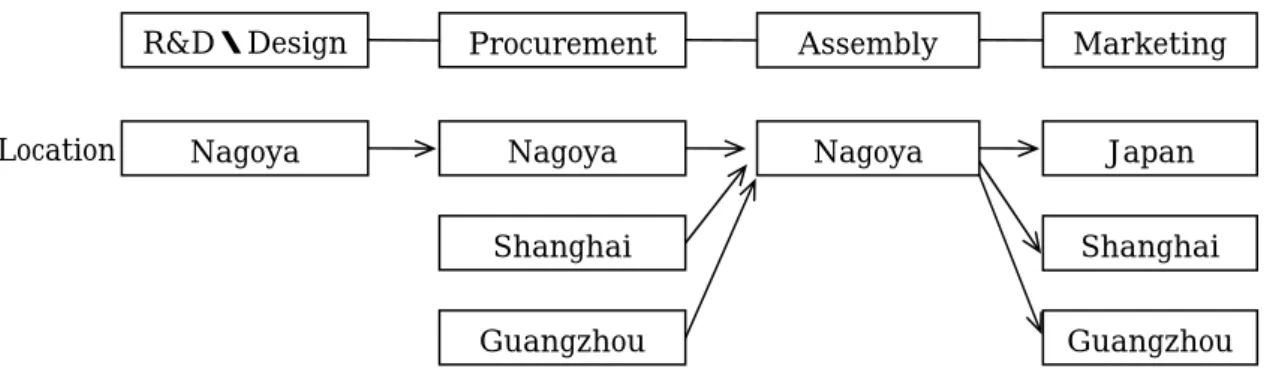
We will illustrate a case involving cluster-to-cluster linkages, using Figures 3-1, 3-2 and 3-3. Suppose that there are automobile clusters in Guangzhou and Nagoya, and that Toyota is operating in both clusters. Here Nagoya means “the zone Aichi centered in Nagoya”, or Aichi. Figure 3-1 shows that it assembles Camry-type cars in Guangzhou. When doing so, R&D activities are carried out in Nagoya and the results are sent to Guangzhou. The plant in Guangzhou procures some of its parts and components from Nagoya, and the final product is marketed in both China and Japan. This is the value chain for Camry-type cars in Guangzhou.
Similarly we can describe the value chain for the Prius in Nagoya. Figure 3-2 shows that Toyota assembles Prius-type cars in Nagoya, which is the center of R&D for Camry, Prius and Toyota’s other cars. Each of Toyota’s companies throughout the world procures parts and components from all over the world, including Guangzhou.
Next, we will explain the linkages within Toyota between the cluster in Guangzhou and the cluster in Nagoya. Figure 3-3 shows that linkages take place in a borderless fashion, between clusters in different countries. The results of R&D carried out in Nagoya are applied at Toyota’s Guangzhou factory. Key parts such as engines are exported from Nagoya to Guangzhou and used for the cars assembled there. Some parts, by contrast, are produced in Guangzhou and used in Nagoya.
The Nagoya factory plays the role of mother factory, by manufacturing prototypes for new types of cars. If these cars are successful in Japan, the Guangzhou factory begins to manufacture them as well. Thus, Japan is the place for manufacturing new types of cars, while the factories in foreign countries manufacture standardized types of
cars.
Under this system, the factories in Japan have a relationship with Asia. The company allocates different types of cars to different production places in an industrial cluster. The Guangzhou factory assembles Camry-type cars and sells them in Japan. The Nagoya factory assembles Prius-type cars and sells them in China. Figure 3-3 shows the linkages between clusters through the exchange of value chains. In order to be competitive in the world market, Japanese firms should have as many linkages as possible.
In Asia today, national borders must be lowered in order to strengthen cluster-to-cluster linkages. The major obstacles in the Asian triangle are tariffs, non-tariff barriers and customs clearance. Table 2 shows how long it takes to clear customs in Thailand, Cambodia, Lao, Myanmar, and Vietnam. Their borders are very high, as it takes from one to three days to clear customs. These walls can be lowered if these countries enter into free trade agreements with each other.
Concretely, customs clearance is done at the borders in Thailand, Laos, Myanmar, and Vietnam, as shown in Table 2. All cargo is inspected at the borders in Cambodia, Laos, Myanmar, and Vietnam, while only specified cargo is inspected in Thailand. The process takes from a few hours to a day in Thailand, from a half day to a day in Laos, from a day to two days in Vietnam, from a day and a half to three days in Cambodia, and from two days to three days in Myanmar. The time required for customs clearance should be shortened to expand trade between the countries of Asia.
Free trade agreements (FTAs) can be effective for strengthening cluster-to-cluster in the Asian triangle by lowering tariff rates, abolishing non-tariff barriers and shortening the time required for customs clearance.
6. Clusters in Asia and Asian Economic Integration
In Kita-kyushu, Japan, an automobile industry cluster is being formed composed of Toyota, Nissan and Daihatsu. The linkage between Japan and the Asian triangle is related to economic integration in Asia. Highways are crucial to linking countries in Asia. We must realize that a region can survive by forming an industrial cluster.
For example, a city in Japan can survive if it forms an industrial cluster and links it to other industrial clusters in the Asian triangle, surrounded by China, India and ASEAN (See Figure 1). Industrial clusters in East Asia compete with and complement each other, and FTAs in East Asia support the complementary roles of the industrial clusters.
7. Conclusions of Our Flowchart Approach to Industrial Cluster Policy in Asia
It is expected that an Asian triangle of growth will be formed in the coming few decades, bordered by China, India and ASEAN. There are many industrial clusters within the triangle. One of the industrial clusters is the automobile industry cluster in Guangzhou, China, where Honda, Nissan and Toyota are located. The automobile industry cluster will expand over ASEAN along with the growth of the Yuan economy. Multinational corporations use value chain management to decide their locations for research and development, procurement, assembly, and marketing. These locations will link clusters with clusters.
The Asian triangle of growth is rising, and industrial clusters in the triangle are expanding. Multinational corporations link the chains in their value chains in one cluster with those in another cluster. Regional integration means Asian economic partnership, and will promote links between clusters by lowering the barriers of national borders. This paper explained the necessity of regional integration for cluster-to-cluster linkages
in the Asian triangle of growth.
Japan is located outside of the triangle. Therefore, Japanese companies must link their clusters with clusters in the Asian triangle.
<References>
Kuchiki, A. “A Flowchart Approach to Asia’s Industrial Cluster Policy.” Industrial
Clusters in Asia Eds. Kuchiki, A and M. Tsuji. Macmillan, London, 2005.
Kuchiki, A. “Agglomeration of Exporting Firms in Industrial Zones in Northern Vietnam.” Industrial Agglomeration Eds M. Kagami and M. Tsuji. Edward Elgar, forthcoming.
Table1. Growth Rate of GDP and Per Capita GNP (% per year)
2000 2001 2002 2003 2004 Average Per Capita
GNP 2004, $ Japan 2.9 0.4 0.1 1.8 2.3 1.5 37,180 China 8.0 7.5 8.3 9.3 9.5 8.5 1,100 Malaysia 8.9 0.3 4.1 5.3 7.1 5.1 3,780 Myanmar 13.7 11.3 12.0 13.8 12.6 12.7 -Thailand 4.8 2.2 5.3 6.9 6.1 5.1 2,190 Vietnam 6.1 5.8 6.4 7.1 7.5 6.6 480 Bangladesh 5.9 5.3 4.4 5.3 5.5 5.3 400 India 4.4 5.8 4.0 8.5 6.5 5.8 530 Pakistan 3.9 1.8 3.1 5.1 6.4 4.1 470 6.1
Source: Asian Development Outlook 2005. World Development Indicators 2005, Economic Affairs Bureau Research Division Major Economic Indicators 2006
Table 2 Customs Clearance at Borders of Indochina Countries Country Place of entry Time
required*
Customs inspection
Ingress of other countries’ vehicles
Thailand Border A few hours ~ 1 day
Only specified cargo
Vehicles from Laos can enter(Prior registration required).
Cambodia Phnom Penh Customs (Imports whose import tariff is more than $300 and all exports)
1.5~3 days All By cargo transship area
Laos Border 0.5~1 day All ・ Vehicles from Thailand can enter (Prior registration required). ・ Vehicles from Vietnam
can enter Destinations are limited, Prior acceptance required). Myanmar Border (Export records
from competent border customs is required.)
2~3 days All By cargo transship area
Vietnam Border 1~2 days all By cargo transship area *Note: If importers/exporters declare in advance, time for customs clearance can be curtailed (only cargo inspection, a few hours).
Figure1. The Asian Triangle and Cluster-Link China Japan India ASEAN 〇Fukuoka 〇Nagoya 〇Dalian 〇Shanghai 〇Guangzhou 〇Leamchabang(Thailand) 〇Penang(Malaysia) 〇Mumbai[Bombay] 〇Bangalore 〇Bangkok 〇Delhi 〇Beijing Cluster Cluster C2C
Figure2-1 Flowchart Approach to Industrial Cluster Policy Step Ⅰ: (a) Agglomeration (b) (c) (d) Step Ⅱ: (a) Innovation (b) (c) (d) 1. Infrastructure 2. Institutions Capacity building(Ⅱ)
Universities / Research institutes
Anchor persons Cluster 3. Human resources 4. Living conditions Anchor firm 1. Infrastructure 2. Institutions Related firms Industrial zone Capacity building(Ⅰ) 3. Human resources 4. Living conditions
Figure 2-2. Industrial Clusters in Northern Vietnam
Hanoi (TLIP) Haiphong
Northern Vietnam
Highway No. 5
Haiphong Port Nomura Haiphong IZ
A Model of Forming Industrial Clusters
Thang Long IP (TLIP)
Nomura Haiphong IZ (NHIZ) Capacity building
【ODA】Highway No. 5, Haiphong Port Institutional Reform (One stop service, tax)
Anchor Companies
Related and Other Companies
Industrial Clusters Development of Northern Vietnam
+
Canon, Honda, Panasonic
Japanese companies, other foreign and local companies
Canon’s Effect
Figure 3-1 Guangzhou Camry Value Chain
R&D・Design Procurement Assembly
Guangzhou Guangzhou Guangzhou Shanghai China Nagoya Japan Guangzhou Location Marketing Nagoya
Figure3-2 Nagoya Prius Value Chain
Figure 3-3 Links between Japan and the Asian Triangle Based on “Cluster to Cluster”
C2C: Transborder links based on “Cluster to Cluster” R&D・Design Procurement Assembly
Guangzhou Guangzhou
Guangzhou
Nagoya
Nagoya Nagoya Japan
The Asian Triangle Guangzhou Cluster Value Chain Nagoya Cluster Marketing
Crucial components Mother factory
〈China・India・ASEAN〉
C2C C2C C2C
C2C R&D・Design Procurement Assembly
Nagoya Nagoya Nagoya Shanghai Shanghai Guangzhou Guangzhou Japan Location Marketing
Appendix Value Chain Management
Figure 1. Value Chain from Design Planning to Marketing
Figure 2. Efficiency in Production only
Figure 3. Optimization for Customers’ Satisfaction
Figure 4. Measures of Value Chain Management : an example
Figure 5. Core-Competence (selection & concentration)
Internet Business Ford, GM Design & Planning
D Procurement P Assembly A Marketing M A Customers’ Satisfaction D P A M Alliance D P A M
Outsource Mergers & acquisitions
D P A M
Figure 6. Toyota’s Value Chain Network in China
Automotive company --> consumer company (e-business, finance company)
① Japan ① Japan ① − ① -
② − ② Tianjin ② Tianjin ② − ③ − ③ - ③ − ③ China ④ − ④ Shanghai ④ - ④ −
①=domestic, ②=M&A, ③=alliance, ④=outsourcing (Cross dock logistics)
Value Chain Network of Pacific Basin countries Core competence = D
Source: Akifumi Kuchiki.