Manhattan
Product
of
Digraphs
Nobuaki Obata(尾畑伸明)
obata@math.
is.tohoku.ac.jphttp://www.math.is.tohoku. ac.jp/
obata
Graduate School of Infonnation Sciences TohokuUniversity, Sendai, 980-8579 Japan
Abstract We review the Manhattan product of digraphs from the
viewpoint of spectral analysis and obtain
some
preliminaryformu-lae. As
an
example, the spectmm ofthe Manhattan product of the directedpath $P_{n}$ and the directed cycle $C_{2}$ is obtained as well as its asymptotic spectral distribution.1
Introduction
Quantum probabilistic techniques have been developed for (asymptotic) spectral
analysis of graphs,
see
e.g., [10]. One of the main techniques is based on therelation between notions ofindependence and product structures ofgraphs. In
this note
we
initiatean
attempt to generalize the quantum probabilistic approachto,digraphs (directed graphs).
Figure 1.1: Manhattanstreetnetwork
There is
a
long history of spectral analysis ofdigraphs with many relevant topics. From the viewpoint of product structure of digraphs the first non-trivialexample
we
consider would be the Manhattan street network. The spectra oftherelies
on
directcalculation anda
more
conceptual derivation is desirable. In thisline it is natural to formulate the Manhattan street network
as
a kind ofproductof digraphs. In fact, in their
more
recentpapers
[7, 8] Comellas, Dalf\’o and Fiolintroduce the notion of Manhattan product of digraphs and obtain
some
basic properties. The mainpurpose
ofthisnote isto reformulate the Manhattan productin
a
slightlymore
general contextandto discuss the spectral properties ofsimpleexamples.
Independently of spectral analysis, the Manhattan street network
was
intro-duced beforehand by Maxemchuk [12] and Morillo et al. [13] for simple andeffective stmcture
ofcommunication
networks,see
also [3, 11, 14]. Insome
liter-atures, e.g., [2],the notion ofManhattan network
appears,
however,itis different from the Manhattan street network.2
Spectrum
of
a
Digraph
A digraph (directed graph) is a pair $G=(V,E)$, where $V$ is a non-empty set
and $E$ is
a
subset of $V\cross V$.
We say that $x\in V$ is a vertex and $e=(x,y)\in E$is
an
arc (arrow) from $i$ to$j$. In thatcase we
also write $xarrow y$.
By definitiona
digraphmayhave
a
loop, i.e.,an
arc
froma
vertex toitself. Throughout thispaper,
unless otherwise stated,
a
digraphmeans
a
finite digraph, i.e., adigraph with finite number ofvertices.The adjacency matrix of a digraph $G=(V,E)$ is a matrix $A$ with index set
$V\cross V$ definedby
$(A)_{xy}=\{\begin{array}{ll}1, if xarrow y,0, otherwise.\end{array}$
Then $A$ becomes a $\{0,1\}$-matrix. Conversely, every $\{0,1\}$-matrix with index set
$V\cross V$ defines
a
digraph with vertex set $V.$ $A$ digraph is called symmetric if itsadjacency matnix is symmetric. $A$ symmetric digraph with
no
loops is naturallyidentified with
a
graph in the usualsense.
In fact, their adjacency matricesare
characterizedby
common
conditions.The set of eigenvalues ofadigraph $G$is denotedby
ev
$G=\{\lambda_{1}, \lambda_{2}, \ldots, \lambda_{s}\},$where $\lambda_{1},$$\lambda_{2},$
$\ldots,$
$\lambda_{s}$
are
distinct eigenvalues ofthe adjacencymatrix$A$ of$G$. Thecharacteristic polynomial of$A$, often referred to
as
the characteristicpolynomialof$G$,is factorized
as
follows:Then is called the algebmic multiplicity of . While, the dimension ofthe eigenspace associated with $\lambda_{i}$ is called the geometric multiplicity. It is obvious
that $1\leq l_{i}\leq m_{i}$. Note that $l_{i}<m_{i}$ may happen for a general digraph and that $l_{i}=m_{i}$ fora symmetric digraph.
The
converse
or
opposite ofa
digraph $G=(VE)$ isa
digraph $G^{\vee}=(VE^{\vee})$,where
$E^{\vee}=\{(x,y)\in V\cross V;(y,x)\in E\}.$
The adjacency matrix of $G^{\vee}$ is obtained by transposing
that of $G$. Hence the
characteristicpolynomials of$G^{\vee}$ and $G$coincide,
so
do theireigenvalues.Thealgebraic(resp. geometric)spectmm ofadigraph $G$is the list ofits
eigen-values with algebraic(resp. geometric) multiplicities. The spectra of digraphs
are
characteristic quantities and havemanyapplications. For basicresults, in
particu-lar onthe spectral radius, seethe recent surveyby Bmaldi [1].
Example 2.1 (Cycle) Let$n\geq 2$. Weput
$V=\{0,1,2, \ldots, n-1\},$
$E=\{(0,1), (1,2), \ldots , (n-2, n-1), (n-1,0)\}.$
The digraph $(V, E)$ is called a cycle (ormoreprecisely, adirectedcycle) ofdegree
$n$ and is denoted by $C_{n}$. Note that the cycle $C_{2}$ is symmetric. From elementary knowledge oflinearalgebraweknowthat
$\varphi_{C_{n}}(x)=x^{n}-1,$
ev
$C_{n}=\{1=\omega^{0}, \omega, \omega^{2}, \ldots, \omega^{n-1}\},$ $\omega=e^{2\pi i\int n}.$Moreover, the algebraic multiplicity ofeach eigenvalueis one,
so
coincides withthe geometricmultiplicity.
Example 2.2 (Colliding cycle) Let $n\geq 3$ and $0\leq k\leq n.$ $A$ colliding cycle is a
digraph $C_{n,k}=(VE)$, where
$V=\{0,1,2, \ldots,n-1\},$
$E=\{(0,1), (1,2), \ldots, (k-1,k)\}\cup\{(k+1, k), \ldots, (n-1, n-2), (0, n-1)\}.$
(Addition is taken bymodulo $n.$) Apparently, $C_{n}=C_{n,n}=C_{n,0}^{\vee}$. For
a
non-trivialcollidingcycle $C_{n,k}$with $k\neq 0,$$n$,
we
have$\varphi(x)=x^{n}$,
ev
$C_{n,k}=\{0\}.$$0$ 1
Figure 2.2: Colliding cycle
3
Bipartite
Digraphs
A digraph $G=(V,E)$ is calledbipartite ifthevertex setadmits
a
partition$V=V^{(0)}\cup V^{(1)} V^{(0)}\neq\emptyset, V^{(1)}\neq\emptyset, V^{(0)}\cap V^{(1)}=\emptyset$
such that every
arc
has its initial vertex in $V^{(0)}$ and final vertex in $V^{(1)}$,or
initialvertexin $V_{1}$ and final vertex in $V^{(0)}$
.
Bydefinitiona
bipartite digraph hasno
loops.The adjacency matrix ofabipartite digraph is ofthe form:
$A=\{\begin{array}{ll}O CD O\end{array}\}$, (3.1) where $C$ is
a
$\{0,1\}$-matrix with index set $V^{(0)}\cross V^{(1)}$ and$D$ isa
$\{0,1\}$-matrix withindex set $V^{(1)}\cross V^{(0)}$. From elementaryknowledge of linear algebra
we
have thefollowing
Proposition3.1 Let $G$ be a bipartite digraph with adjacency matrix (3.1). Then
the characteristic polynomialisgiven by
$\varphi_{G}(x)=\det(x-A)=x^{m-n}\det(x^{2}-DC)$,
where $m=|V^{(0)}|$ and$n=|V^{(1)}|$ withm $\geq n.$
Given a bipartite digraph $G=(V,E)$
we
define the parity fimction $\pi=\pi_{G}$:
$Varrow\{0,1\}$ by
Note that theparity function depends on the partition
.
Foran arc$(x,y)\in E$
we
have$\pi(x)+\pi(y)=1$.
Wementionsome
basicproperties. Theproofsare
straightforwardso
omitted.Proposition3.2 Let $G=(VE)$ be a bipartite digraph. For anypair
of
vertices$x,y\in V$, ithe$p$
,arity
of
the lengthof
a pathfrom
$x$ to $y$ (whenever exists) isinde-pendent
of
the choiceof
such apath.Proposition3.3 $A$ bipartitedigraph doesnotcontainacycle
ofodd
degree. Moregenerally, abipartite digraph does notcontain acolliding cycle
of
odddegree.Proposition3.4 $A$ cycle
of
even degree is bipartite. More generally, so is acol-lidingcycle
of
even degree.4
Manhattan Product
For $i=1,$21et $G_{i}=(V_{i}, E_{i})$ be a bipartite digraph with parity fimction$\pi=\pi_{i}.$
Consider the directproduct
$V=V_{1}\cross V_{2}=\{(x,y);x\in V_{1}, y\in V_{2}\}$
and let$E$ consistofpairs ofvertices $((x,y), (x’,y’))$ satisfyingone ofthe following
two conditions:
(i) $y=y’$, and$(x,x’)\in E_{1}$
or
$(x’,x)\in E_{1}$ accordingas
$\pi_{2}(y)=0$or
$\pi_{2}(\gamma)=1$;(ii) $x=x’$, and$(y,y’)\in E_{2}$ or$(\gamma’,y)\in E_{2}$ according
as
$\pi_{1}(x)=0$or
$\pi_{1}(x)=1.$The digraph$(V, E)$ is calledtheManhattanproductandis denotedby
$G=G_{1}\# G_{2}.$
Althoughnot explicitlyindicated,theManhattanproductdepends
on
thechoiceof the partitions $V_{i}=V_{i}^{(0)}\cup V_{i}^{(1)}$, orequivalently the choice of theparityfunctions$\pi_{i}.$
The (2-dimensional) Manhattan street network [8] is nothing but the Manhattan
product$C_{m}\# C_{n}$with
even
$m,$$n.$We
now
observea
simple property ofthe Manhattan product $G=G_{1}\# G_{2}=$$(V, E)$
.
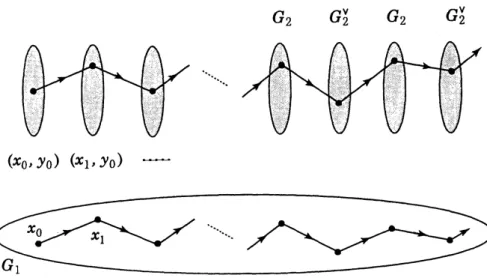
Take $(x_{0},y_{0})\in V$.
Thesection $\Sigma=\{(x,y_{0});x\in V_{1}\}$hasa
digraph stmctureisomorphic to $G_{1}$
or
$G_{1}^{\vee}$ accordingas
$\pi_{2}(\gamma_{0})=0$or
$\pi_{2}(\gamma_{0})=1$.
Let$(x_{0},y_{0})arrow(x_{1},y_{0})arrow\cdotsarrow(x_{i},y_{0})arrow\cdots$ (4.1)
be
a
path in $G$ and consider the sections $\Sigma[x_{i}]=\{(x_{i},y);y\in V_{2}\}$.
Then $\Sigma[x_{i}]$ isisomorphic to $G_{2}$
or
$G_{2}^{\vee}$, andthey occur altemately alongthepath(4.1). This is atypicalproperty oftheManhattan streetnetworks. In orderto maintainthis
$G_{2}$ $G_{2}^{v}$ $G_{2}$ $G_{2}^{v}$
$(x_{0J}y_{0})(x_{1},y_{0})$
Figure
4.3:
Manhattan productProposition 4.1 The Manhattan product
of
two bipartite digraphs is bipartite.PROOF. Consider twobipartite digraphs $G_{i}=(V_{i},E_{i}),$ $i=1,2$, withpartitions
of thevertex sets $V_{i}=V_{i}^{(0)}\cup V_{i}^{(1)}$
.
Set$V^{(0)}=V_{1}^{(0)}\cross V_{2}^{(0)}\cup V_{1}^{(1)}\cross V_{2}^{(1)}, V^{(1)}=V_{1}^{(0)}\cross V_{2}^{(1)}\cup V_{1}^{(1)}\cross V_{2}^{(0)}.$
Then $V=V^{(0)}\cup V^{(1)}$ is
a
partition ofthe vertex set $V$ of the Manhattan product $G_{1}\# G_{2}$, wherethereare
no
arcs
lying in $V^{(0)}$or
$V^{(1)}$.
1Proposition4.2 Let $G_{i}$ be a bipartite digraph with the adjacency matrix $A_{i},$ $i=$
$1,2$. Then the adjacency matrix$A$
of
theManhattan product $G=G_{1}\# G_{2}$satisfies
$(A)_{(xy)(x’f)}=\delta_{xx’}(t^{\pi\downarrow(x)}(A_{2}))_{y/}+(t^{\pi_{2}(\gamma)}(A_{1}))_{xx’}\delta_{y^{f}},,$ $x,x’\in V_{1},$ $y,y’\in V_{2},$
where$t(A)=A^{T}$ stands
for
the transposition and$\pi_{i}$ istheparityfunction of
$G_{i}.$We consider
a
simple example. Let $G=(V,E)$ bea
bipartite digraph and consider the Manhattan product$G\# C_{2}$ . Let$B$be the adjacencymatrixof$G$.
Thenthe adjacencymatrix$A$ is givenby
$A=\{\begin{array}{ll}B II B^{T}\end{array}\}$, (4.2)
$G^{\vee}$
$G$
Figure
4.4:
$G\# C_{2}$ ($G$ isnot necessarilybipartite.)Theorem
4.3
Let $G=(VE)$ be a bipartite digraph with adjacency matrix $B.$Then thecharacteristicpolynomial
of
the Manhattanproduct$G\# C_{2}$ isgiven by$\varphi(x)=\det((x-B)(x-B^{T})-I)$
.
(4.3)Moreover,
if
$B=\{\begin{array}{ll}O CD O\end{array}\},$
wehave
$\varphi(x)=\det[^{(x^{2}-1)I}-x(C^{T}I_{D)}^{CC^{T}} (x^{2}-1)I+DD^{T]}-x(C+D^{T})$
.
(4.4)PROOR Let$A$ be the adjacencymatrix ofthe Manhattanproduct $G\# C_{2}$
.
Thenthe characteristicpolynomial is given by
$\varphi(x)=\det(x-A)=\det\{\begin{array}{ll}x-B -I-I x-B^{T}\end{array}\}.$
Applyingthe formula:
$\det\{\begin{array}{ll}X II Y\end{array}\}=\det(XY-I)=\det(YX-I)$, (4.5)
where$X,$ $Y$
are
$n\cross n$ matrices and$I$is the identitymatrix,we
obtain (4.3). Then(4.4) follows bydirect computation. 1
Infact, $G\# C_{2}$ may be definedwithoutassuming that $G$isbipartite,
see
Fig. 4.4.Inthatcasetoo, $G\# C_{2}$keeps thetypical propertyofthe Manhattan street networks
Example
4.4
Let$P_{n}$ be thedirected
path with $n$vertices, i.e., $P_{n}=(V,E)$ with$V=\{1,2, \ldots,n\},$
$E=\{(1,2), (2,3), \ldots, (n-1,n)\}.$
The adjacencymatnix of$P_{n}$ is givenby
$B=\{\begin{array}{lllll}0 1 0 \cdots \cdots 0 0 1 \cdots \cdots \ddots \ddots 0 1 0\end{array}\}$
We
see
from Theorem4.3 that thecharacteristicpolynomial of$P_{n}\# C_{2}$ is givenby$\varphi_{n}(x)=\det((x-B)(x-B^{T})-D\cdot$
By elementarycalculationwe obtain
$\varphi_{n}(x)=x^{2}\varphi_{n-1}(x)-\varphi_{n-2}(x)$
.
Then,recalling the
recurrence
relation ofthe Chebyshevpolynomialofthe secondkind,
we
come
to $\varphi_{n}(x)=x^{n-1}\tilde{U}_{n+1}(x)$, where $\tilde{U}_{n}(2\cos\theta)=\frac{\sin(n+1)\theta}{\sin\theta}.$ Consequently, ev$(P_{n} \# C_{2})=\{2\cos\frac{k\pi}{n+2};k=1,2,$ $\ldots,n+1\}\cup\{0\},$whereevery
non-zero
eigenvalue has algebraic multiplicity one.Theasymptotic spectral distribution
as
$narrow\infty$ is also interesting.Theorem4.5 The asymptotic (algebraic) spectraldistribution
of
$P_{n}\# C_{2}$ isgiven$by$
$\frac{1}{2}\delta_{0}+\frac{1}{2}\rho(x)dx,$
where
PROOR Itis sufficientto showthat
$\mu_{n}=\frac{1}{n}\sum_{k=1}^{n}\delta_{2\cos\frac{k\pi}{n+1}}$
tends to$\rho(x)dx$ as $narrow\infty$
.
Let$f(x)$ be abounded continuous function. Thenwehave
$\int_{-\infty}^{+\infty}f(x)\mu_{n}(dx)=\frac{1}{n}\sum_{k=1}^{n}f(2\cos\frac{k\pi}{n+1})arrow\int^{1}f(2\cos\pi t)dt$,
as
$narrow\infty,$which follows by the definition ofRiemann integral. By change ofvariable, one
gets
$\int_{0}^{1}f(2\cos\pi t)dt=\int_{2}^{2}f(x)\frac{dx}{\pi\sqrt{4-x^{2}}}.$
Consequently,
$\lim_{narrow\infty}\int_{\infty}^{+\infty}f(x)\mu_{n}(dx)=\int_{2}^{2}f(x)\frac{dx}{\pi\sqrt{4-x^{2}}}=\int_{\infty}^{+\infty}f(x)\rho(x)dx,$
whichcompletes theproof. $I$
Remark4.6 Theprobability distribution$\rho(x)dx$in Theorem 4.5is called the
arc-sinelaw (with
mean
$0$ andvariance2).Remark4.7 As another generalization of(4.2) itis interestingto consider
$A=\{\begin{array}{llllll}B I B^{T} I B I \ddots \ddots B II B^{T}\end{array}\}$
.
(4.6)Thisis
a
kindofproduct of$G$and$C_{n}$ (witheven
$n$),whichis consideredsomethingbetweentheManhattanproduct andthe direct product.
References
[1] R.A. Brualdi: Spectra
of
digraphs, Linear Algebra Appl. 432 (2010),[2] M.Benkert,A. Wolff,F. Widmann and T. Shirabe: The minimum Manhattan networkproblem: Approximations andexactsolutions, Comput. Geom. 35
(2006),
188-208.
[3] F. Comellas and C. Dalf\’o: Optimalbroadcasting in 2-dimensional
Manhat-tan street networks, Parallel and Distributed Computing and Networks 246
(2005),
135-140.
[4] F. Comellas, C. Dalf\’o and M. A. Fiol: MultidimensionalManhattan street
networks, SIAM J. Discrete Math. 22 (2008),
1428-1447.
[5] F. Comellas, C. Dalf\’o, M. A. Fiol and M. Mitjana: A spectral study
of
theManhattan networks, Electronic Notes in Discrete Mathematics 29 (2007)
267-271.
[6] F. Comellas,C. Dalf\’o, M.A. Fiol andM.Mitjana: Thespectra
ofManhattan
street networks, LinearAlgebra Appl. 429 (2008), 1823-1839.
[7] F. Comellas, C. Dalf\’o, M. A. Fiol: A newoperation on digraphs: the
Man-hattanproduct,
[8] F. Comellas, C. Dalf\’o and M. A. Fiol: The Manhattan product
of
digraphs,prepnnt, 2009.
[9] D. M. Cvetkovi\v{c}, M. Doob and H. Sachs, Spectm
of
Graphs, AcademicPress, 1979.
[10] A. Hora and N. Obata, Quantum Probability and Spectral Analysis
of
Graphs, Springer, 2007.
[11] B. Khasnabish: Topologicalproperties
of
Manhattan Streetnetworks,Elec-tron. Lett. 25 (1989),
1388-1389.
[12] N. F. Maxemchuk: Routing in the Manhattan Street Network, IEEE Trans. Comm. 35(1987), 503-512.
[13] P. Morillo, M. A. Fiol, J. F\‘abrega: The diameter
of
directed graphsassoci-atedtoplane tessellations,Ars Comb. 20A (1985) 17-27.
[14] E. A. Varvarigos: Optimal communication algorithms
for
Manhattan streetnetworks, Network communications broadcasting and gossiping. Discrete