90
Note
on
dynamically stable
perturbations of
parabolics
Tomoki Kawahira
*Nagoya University
Abstract
Inthisnote,we sketchsome results onalmost-dynamics-preserving
per-turbationsofrational maps with parabolic cycles.
1
Introduction with rabbits
Well known “
$\mathrm{D}\mathrm{o}\mathrm{u}\mathrm{a}\mathrm{d}\mathrm{y}^{)}\mathrm{s}$ rabbit” has a friend called (“fat rabbit” at the root of
1/3-limbof the Mandelbrot set. Howeverthe term “fat” does not sound good,
so
we
tentatively call him “chubby rabbit”.$|$
Figure 1: “plump”, “chubby” , and “overweight”.
“Chubby rabbit” has a parabolic fixed point with
3
petals and multiplier$e^{2\pi \mathrm{z}/}?.$. Actually there is anoverweight rabbit in the main cardioid, which has an
attractingfixedpointwithmultiplierof theform$rc^{2\pi i/3}(0<r<1)$. Onthe other
hand, there is a little bit thinner rabbit than $” \mathrm{c}\mathrm{h}\mathrm{u}\mathrm{b}\mathrm{b}\mathrm{y}^{\grave{\prime}}$’
near
“Douady’s , which’The author gave a talk on 20 February 2003 at RIMS, Kyoto this note is written for
RIMS Kokyuroku
$\theta$$1$
has a repelling fixed point with multiplier $Re^{2\pi i/3}$ $(R >1)$. So
we
tentativelycall them “overweight rabbit” and “plump rabbit”. (Idon’t know whether these
terms
are
properor
not, though...)The change from “chubby” to “overweight”
or
“plump” is parameterized by the multiplier of $(\alpha-)\mathrm{f}\mathrm{i}\mathrm{x}\mathrm{e}\mathrm{d}$ point. They look similar when $r$ and$R$are
very closeto 1 (Figure 1). Actually “overweight” and “plump” converge to “chubby”
as
$r$,$Rarrow 1$ in the HausdorfTtopology. Moreover, the dynamicsonthe Juliasetsare
almost the
same
as
we cansee
byobservingthe combinatorics oflanding external rays. (By theoremsin52,
wecan
alsosee
that the dynamicsinside the Juliasetsare
almost the same.)In thle general case, changes from “parabolic” to “hyperbolic” ($=$ attracting
orrepelling ), or oppositedirections,
are
noteasyas
above. Thedifficultycom es
from well-known parabolic implosion, but herewe omitto deal with it. Our main question is:
For a rational $\tau nap$ with a parabolic cycle,
can we
give a $wa?/$ toperturb itsparabolic cycle into another kind
of
cycle without changingmost part
of
the dynamics$p$In this note,
we
willgive a quick surveyon
this proble $\mathrm{m}$.1.1
Preliminary
Here we list
some
definitions and notation.Classes of rational maps, Let $f$ : $\hat{\mathbb{C}}arrow \mathbb{C}\mathrm{A}$
be a rationalmap of degree $d\geq 2$.
Here we recall
some
famous classes:.
$f$ isgeometricallyfinite
if every critical point in the Julia set$J(f)$ isPrePe-riodic. If$f$ isgeometrically finite, theFatou set $F(f)$ consists of attracting
or parabolic basins.
.
$f$is called subhyperbolic if$f$ is geometricallyfinite without parabolic cycles.$\bullet$ $f$ is called subhyperbolic if$f$ has
no
recurrent criticalpointsnor
paraboliccycles in its Julia set.
In
\S 3, we
will deal withone
more class ofrational maps, called weakly hyper-bolic.Perturbation. A perturbation of a rational map (resp. polynomial) $f$ is
a
family of rational maps (resp. polynomials) $\{f_{\epsilon} :\epsilon\in[0, c_{0}]\}$ with
some
$\epsilon_{0}>0$satisfying $f_{0}=f$ ). $\deg f_{\epsilon}=d,\cdot$ and $d_{\hat{\mathbb{C}}}(f_{\epsilon}, f)arrow \mathrm{O}$
as
$\epsilonarrow 0$. For simplicity, we82
Notation.
.
For aparabolic or attracting periodic point $\alpha$, $A(\alpha)$ denotes its immediatebasin.
.
$P(f)$ denotes the postcritical set of$f$..
$C(f)$ denotes the criticalset of$f$.2
Polynomial
case:
Theorems
of
P.
$\mathrm{H}\dot{\mathrm{a}}\mathrm{i}\mathrm{s}\mathrm{s}\mathrm{i}\mathrm{n}\mathrm{s}\mathrm{k}\mathrm{y}$In the case ofpolynomial, there
are some
results by Peter Haissinsky. Here wesketch his sequential workrelatedtoour question. In thissection we
assume
that $f$ is a polynomial of degree $d\geq 2$.
2,1
Parabolic
to
repelling
The first theorem is on a perturbation of direction $” \mathrm{p}$ arabolic$arrow$ repelling”.
Theorem 2.1 (Haissinsky, [5])
If
$f$ isgeometricallyfinite
with connected Juliaset, then there exists apolynomial perturbation $f_{\epsilon}arrow f$ accompanied by
conjuga-cies between the actions
of
the Julia sets. Moreover, $f_{\epsilon}$ are all subhype rbolic.This theorem is extended later in
\S 3.
Sketch of the proof. The last sentence implies that every parabolic cycle in $J(f)$ is perturbed into
a
repelling cycle. We explicitly construct a rationalperturbation $F_{\epsilon}=f+\epsilon R$, where $R$ is a rational function which takes value
zero
at all parabolic cycles and at finite critical orbits on $J(f)$. (Herewe
allow$\deg F_{\epsilon}\geq\deg f.)$ Then $F_{\epsilon}$ has cycles exactly the
same
placesas
the originalparabolic cycles, buttheir multipliers are changed slightly by $R$. Here
we
take aproper$R$to make them repelling. Moreover, topreservethe local degree of critical
orbits
on
the Julia sets,we
take $R$ to have enough tangency at those points. If$\epsilon$ $\ll 1$, we can take a nice topological-disk neighborhood $U$ of $J(f)$ such that $\{U, F_{\epsilon}^{-1}(U), F_{\epsilon}\}$ is an analytic family ofpotynomia1-4ii$\mathrm{e}$map. By straightening,
we
obtain a subhyperbolic perturbation $f_{\epsilon}arrow f$. Now it is known that theconnected Julia sets of geometrically finite polynomials
are
locally connected.Thus every externalrayland on thhe Juliasets. To check thedynamical stability
on
the Julia sets,we
check the stability of the ray equivalence, which is defined83
Goldberg-Milnor conjecture. Theorem 2.1 gives
an
affirmative answer to the following Goldberg-M ilnor conjecture in thecase
ofgeometrically finite poly-nolnials: For a polynomial $f$ which has a parabolic cycle, there exists a small perturbationof
$f$ such that.
the immediate basinof
the parabolic cycle is converted to basinsof
someattracting cycles; and
.
the perturbed polynomial on its Julia set $\iota s$ topologically conjugate to theoriginal polynomial$f$ on$J(f)$.
Conversely,is it possible to create parabolics from hyperbolics(attractingor
repelling)? The following results give us
some
partialanswers.
2.2
Repelling to parabolic
Next we consider the opposite direction: “repelling $arrow$ parabolic”. The second
theorem is:
Theorem 2.2 $(\mathrm{H}\dot{\mathrm{a}}\mathrm{i}\mathrm{s}\mathrm{s}\mathrm{i}\mathrm{n}\mathrm{s}\mathrm{k}\mathrm{y}, [4])$ Suppose $f$ has an attracting
fixed
point a anda repelling
fixed
point$\beta$ on $\partial A(\alpha)$. Vie also add the following condition:(B) $\beta$ is accessible
from
$A(\alpha)$ and$\beta\not\in P(f)$Then there exists a polynomial $g$
of
degree $d$ and a homeomorphism $h$ :$\mathbb{C}$ $arrow \mathbb{C}$
such that
.
$h\circ \mathrm{f}(\mathrm{z})=g\circ h(z)$for
any $z\in\hat{\mathbb{C}}-A(\alpha)$;.
$h(\beta)$ isa
parabolicfixed
point and $h(A(\alpha))=A(h(\beta))$; and@ $h|_{J(f)}$ gives a topological conjugacy between the actions on the Julia sets.
We can
remove
condition (B) when $f$ is geometrically finite. Moreover, wecan modify the statem ent by replacing the term “fixed point” with “$\mathrm{c}\mathrm{y}\mathrm{c}1\mathrm{e}^{)}’$.
This theoremsaysthat
we can
convert anattracting basin intothe parabolic basin inour
particular situation. The conjugacy breaks only on the immediatebasin $A(\alpha)$, where
we
operate tricky surgery bymeans
$\mathrm{n}\mathrm{s}$of$\mu$
-conformal
map. $\mu-$conforrnal map is not a quasiconformal map, though it is exponentially close to
quasiconformal insome
sense.
Let $\mu$ :
$\mathbb{C}arrow \mathrm{D}$be a measurable function which satisfies
Area{z
$\in \mathbb{C}$ : $|\mu(z)|>1-\in$}
$\leq Ce^{-\eta/\epsilon}$for
some
$C\geq 0$ and$\eta>0$. Such a$\mu$iscalledto be in the David class offunctionson C. Note that $||\mu||_{\infty}$ can be 1 but it is quite close to the situation $||\mu||_{\infty}<1$
(that is,
84
for a1J $\epsilon<<1$), which will give us a
quasiconformal
map by solving the Beltram$\mathrm{i}$
equation $\partial_{\overline{z}}\phi=\mu(z)\partial_{z}\phi$
.
Now the maintool is:
Theorem
2.3
(David, [3]) For $\mu$ in the David class, the Beitrami equation$\partial_{\overline{z}}\phi=\mu(z)\partial_{z}\phi$ has a unique solution fixing
01
and $\infty$.We call this solution a $\mu$-conformal map. In the proof, we will partially replace
the M\"obius-hyperbolic-like dynamics
near a
and $\beta$by M\"obius-parabolic-like oneand will obtain
a
new topological dynamics $F$ : $\mathbb{C}arrow$ C. Then $\Gamma^{t}$ admits aninvariant $\mu$ which is in the Davidclass, andby solving the Beitrami equation we
will get the desired polynomial $g$.
Sketch of the proof. For simplicity
we
assume
that $A(\alpha)$ containsa
singlecritical point only. Then the dynamics in $\Lambda(\alpha)$ is quasiconformally conjugate to
that of a Blaschke product $B$ : $\mathrm{D}$ $arrow \mathit{1}\mathrm{D}$ of the form $B(z)=(z^{2}+b)/(1+bz^{2})$
with $0<b<1/3$
.
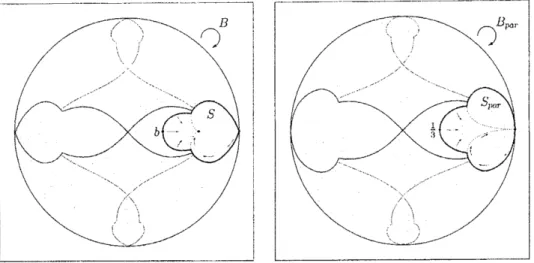
Let $\Psi$ : $\mathrm{A}(\mathrm{a})arrow \mathrm{D}$be the conjugacy. By comparing with thedynamics of $B_{par}(z)=(z^{2}+1/3)/(1+z^{2}/3)$, we will find invariant “sectors” $S$
and $S_{par}$ which have similar dynamical behavior
on
their boundaries (Figure 2).Indeed, there is a piecewise quasiconformal homeomorphism $\psi$ : $\mathrm{D}$ $arrow \mathrm{D}$ which
satisfies$\psi(S)=S_{par}$ and $\psi$$\circ B=B_{par}\circ\psi$ on $\mathrm{D}$$-S$
.
Figure
2:
Dynamics of$B$ and $B_{\mu \mathrm{z}r}$on
D.$\Gamma 1^{\urcorner}\mathrm{h}\mathrm{e}$ thickest
curves
show the boundaryof invariant “sectors” $S$ and $S_{par}$. Thinner
curves
show their first and secondpreimages.
Now
we
define the topological endomorphism $F\cdot$ $\mathbb{C}arrow \mathbb{C}$ by $F:=P$ on $\mathbb{C}-\mathrm{A}(\mathrm{a})$; and by $F$ $;=(\psi\circ\Psi)^{-1}\circ B_{par}\mathrm{o}(\psi\circ\Psi)$on
$\mathrm{A}(\mathrm{a})$. (Herewe
replace thehyperbolic dynamics by parabolic one.) Let$\sigma_{0}$be thestandard complexstructure
of$\mathbb{C}$, and let
\S 5
a by $\sigma:=(\Gamma’)^{*}n(\sigma_{1})$
on
$P^{-n}(A(\alpha))$; and by $\sigma:=\sigma_{0}$ elsewhere. Then we have$\Gamma^{*}\prec\sigma---\sigma$.
We have to
use
the property $\beta\not\in P(f)$ in (B). Actually,even
ifsome
criticalorbits land
on
$\beta$ but the other critical points do not accumulateon
$\beta$,we can
show tlat the Beltram $\mathrm{i}$ differential
$\mu_{\sigma}$ induced by a belongs to the David class
(bytakingsuitable$\psi$ above). ByTheorem2.3, thereexists a$\mu_{\sigma}$-conformal$\phi$with
$\phi^{*}\sigma_{0}=\sigma \mathrm{a}.\mathrm{e}.$, and the polynomial$g$ $:=\phi\circ\Gamma^{r}\circ\phi^{-1}$ has the desired properties. $\blacksquare$
2.3
Attracting
to parabolic
Next direction is “attracting $arrow$ parabolic” Before stating the thirdtheorem, let
us
start with an easyexample.Pinching to be “Chubby”, We
assume
fromnow on
that $p$ and $q$axe
rela-tively prime positive integers. (That is, $(p,$$q)=1$ where
we
allow$p=q=1.$)Set$\omega$ $:=e^{2\pi i\rho/q}$, andconsider a family ofquadratic polynomial
$\{f_{\epsilon}(z)=(1-\epsilon)\omega z+z^{2} : 0\leq\epsilon<1\}$.
For fixed $0<\epsilon_{0}<1$, the dynamics of $f=f_{\epsilon_{0}}$
near
the origin is conform allyconjugate to $T$ : $w\mapsto(1-\epsilon_{0})\omega w$. Let 4 denote this local conjugacy. We extend it analytically to $\Phi$ : $A(0)arrow \mathbb{C}$by using the relation$w=\Phi(z)=T^{-n}\circ\Phi$$\mathrm{o}f^{n}(z)$.
Now there
are
$q$ symmetrically arrayed raysjoining 0 and oo whose union isT-in variant
on
$vJ$-plane. By pulling them back by (I)$)$
we
can find $q$ arcs $I_{1}$,$\ldots\backslash$,$I_{q}$
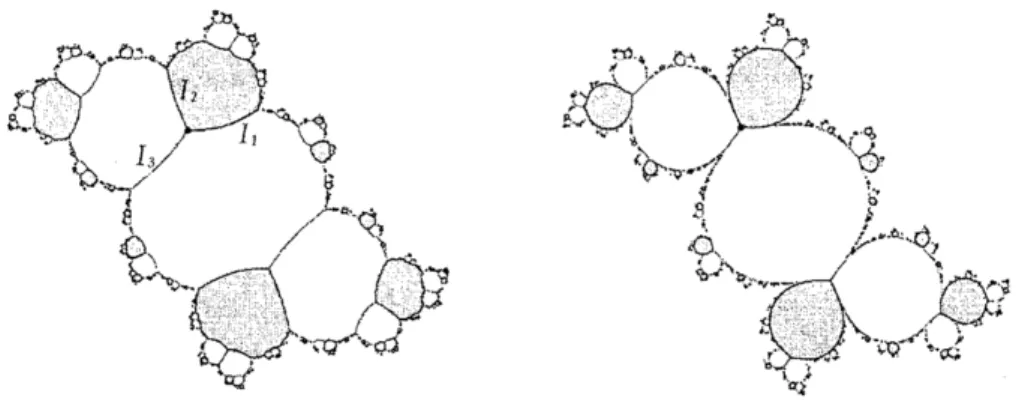
joining 0 and a repelling cycle $\gamma_{1}$,$\ldots$ ,$\gamma_{q}$, which are permuted by $f$ (That is,
Julia– $J_{j}$ iff$j\equiv \mathrm{i}\dashv- p$modulo $q$) and disjoint from $I^{J}(f)$ (Figure 3).
Figure 3: Left, the Julia set for
an
$f_{\epsilon}$ with $p/q=1/3$.
Right, the Julia set for $f_{0}$. Shadows distinguish the regions whichnever
intersect by the iteration of$f_{\epsilon}^{3}$
S6
Set $I:=\overline{\bigcup_{j}I_{j}}$. Bycomparing with the parabolic dynamics of$g=f_{0}$,
one
caneasilyseethat Iof$f$plays the role ofthe parabolic fixed point of$g$, topologically.
Apriori, we can getthe dynam ics of$g$bypinching the grand orbit of$I$. Whatthe
third theorem states is that we canfinda family ofquasiconformaldeformations
$\{f_{\epsilon}\}$ of$f$ which realizes the pinching as above, and
we
can get $g$ as its limit.Theorem 2.4 $(\mathrm{H}\dot{\mathrm{a}}\mathrm{i}\mathrm{s}\mathrm{s}\mathrm{l}\mathrm{n}\mathrm{s}\mathrm{k}\mathrm{y}, [6])$ Suppose
f
issemihyperbolic withconnectedJu-lia set and an attractzng
fixed
point $\alpha$. Then the following holds:1. For any $p$ and $q$
as
above, there exist $q$ arcs $I_{1},$. .)$I_{q}$ joining
a
and $a$repelling cycle
of
period$q$ permuted by$f$ as the example above.2. There exists apolynomial$g$ with
a
parabolicfixed
point$\beta$of
multiplier$e^{2\pi ip/q}$which
satisfies
the following;.
There exist quasiconformaldeformations
$\{f_{\epsilon} :0<\epsilon\leq 1\}$of
$f(=f_{1})$such that$f_{\epsilon}arrow g$ is aperturbation.
.
Let $H_{\epsilon}$ denote the quasiconformal conjugacyfrom
$f$ to $f_{\epsilon}$. Then $H_{\epsilon}$converges uniformly as$\epsilon$ $arrow 0$ to the limit$h$ which semiconjugates $f$ to
$g$
.
.
For$y\in\hat{\mathbb{C}}_{f}$ card$(h^{-1}(y))\geq 2$ iffy eventually lands on$\beta$. Inparticular,such an $h^{-1}(y)$ is either $I=\overline{\cup I_{J}}$
or
a connected componentof
itspreimages.
We willsee
some
similar results later in\S 3.
Idea of the proof. Let us start with a model of pinching and a caricature of quasiconformal deformation. By quasiconformal deformation, we may assume
that the multiplier of$\alpha$ is $\omega/2$. By taking
a
linearizingcoordinate $z\mapsto w$ plus acovering$w\mapsto(=w^{q}$, the action of $f$ on $\mathrm{A}(\mathrm{a})$ is semiconjugated to $\zeta\mapsto\lambda\zeta$ on $\mathbb{C}$, where A $=(\omega/2)^{q}>0$.
Now we put
an
almost complex structure ($=\mathrm{a}$ field of infinitesimal ellipses)on
$\mathbb{C}$as
in Figure 4 By taking the angle $\epsilon$ closer to 0 and making the constant $C_{\epsilon}\nearrow 1$,we
will have a family of almost complex structures $\sigma_{\epsilon}$ and associatingBeltrami differentials $\mu_{\epsilon}$ which
are
invariant under the action of ( $\vdash*\lambda\zeta$. Bysolving the Beltrami equation $\partial_{\overline{\zeta}}\phi=\mu_{\epsilon}(\zeta)\partial_{\zeta}\phi$ for each $\epsilon$, the solution $\phi_{\epsilon}$ fixing
1, $\lambda$, and oo gives a deformation of the quotient torus $\mathbb{C}^{*}/\lambda^{\mathrm{Z}}$ to another torus
with lower modulus. Then quasiconformal map $\phi_{\epsilon}$ converges compact uniformly
to$\phi_{0}$ : $\mathbb{C}^{*}-\mathbb{R}_{-}arrow \mathbb{C}$as$\epsilonarrow 0$, and conjugate theactionof$\langle$ $arrow\lambda\zeta$to$\zeta\mapsto\zeta+1-\lambda$.
Wecanpull-back$\sigma_{\epsilon}$to$A(\alpha)$ by$(z\mapsto w\mapsto\zeta)^{*}$ anddenoteitby
$\sigma_{\epsilon}’$. By putting
$(f^{n})^{*}\sigma_{\epsilon}’$
on
$f^{-n}(A(\alpha))$, and the standard complex structure elsewhere, we havean
/-invariant almost complex structure andwe
will get afamily of polynomials$f_{\epsilon}$in the
same
way asthe previous theorem. This mayrealize the pinching $‘(\mathrm{h}\cdot \mathrm{o}\mathrm{m}$87
$|_{\mathit{1}’\subseteq}|\nearrow$ $\backslash \backslash _{\backslash \backslash }\backslash$
$\backslash _{\backslash }\backslash$
$|/x_{F}|=c_{\epsilon}^{\backslash _{\backslash }}\backslash \mathrm{E}^{\mathrm{o}}\backslash \acute{\mathrm{C}}\circ\backslash \backslash \dot{\mathrm{o}}_{\mathrm{O}}\backslash \epsilon[_{\Leftrightarrow}\Leftrightarrow\Leftrightarrow\Leftrightarrow\backslash \equiv\backslash \subset=\Leftrightarrow\Leftrightarrow\backslash \backslash \Leftrightarrow\Leftrightarrow \mathrm{a}\Leftrightarrow\fallingdotseq\vee$
$|/4\epsilon|=0$
$\circ 0_{\mathrm{o}\circ \mathrm{s}_{\mathrm{o}\mathrm{o}_{\mathrm{o}_{\mathrm{O}}}^{\mathrm{O}}}^{\mathrm{o}\mathrm{c}}}[mathring]_{\circ}[mathring]_{\mathrm{o}\mathrm{o}^{0\mathrm{O}}}_{\mathrm{o}}^{\mathrm{o}\mathrm{o}^{\circ}}\mathrm{o}\mathrm{o}\circ 6\mathrm{o}_{\mathrm{o}^{\mathrm{o}\mathrm{o}},\circ \mathrm{o}\mathrm{o}\circ\circ}\mathrm{o}\mathrm{c}\mathrm{o}\mathrm{o}$
$\prime\prime/’/$
$|\mu_{\epsilon}|=C_{\acute{\epsilon}}/’/$
$’/^{\prime’}$ $|/x_{\epsilon}|\nearrow$
0 $\lambda$ 1
$|\mu_{\epsilon}|=0$
Figure 4: A caricature of the pinching. On the right half plane $\mu_{\epsilon}(z)=0$. For
$\frac{\pi}{2}<|\arg z|<\pi-\epsilon$, $|\mu_{\epsilon}(z)|$ increases with dilatation $\frac{1+|\mu_{\epsilon}|}{1-|\mu_{\epsilon}|}=1$$+ \tan^{2}(|\arg z|-\frac{\pi}{2})$.
Finally $|\mu_{\epsilon}(z)|$becomesaconstant$0<C_{\epsilon}<1$elsewhere, with$\frac{1+C}{1-C_{\epsilon}}=1+\tan^{2}(.\frac{\pi}{arrow)}-$ $\epsilon)$. Moreover, we take $\arg\mu_{\epsilon}=0$ and $\mu_{\epsilon}$ is constant along any radial lines from
the origin. Hence $\mu_{\epsilon}$ is invariant under
$\langle$$\mapsto\lambda\zeta$.
that the limit of$f_{\epsilon}$as$\epsilonarrow 0$existsandis$g$as wedesired. To check them,wemake
someeffort to show that the integrating map $\phi_{\epsilon}’$ of$\sigma_{\epsilon}’$ is equicontinuous and any
subsequential limits coincide. Inthis technicalpart we
use
the semihyperbolicity of$f$. (We alsouse
the weak hyperbolicity of$f$. See\S 3.)
2.4
Explicit
construction
of pinching: Tessellation
Here we present
an
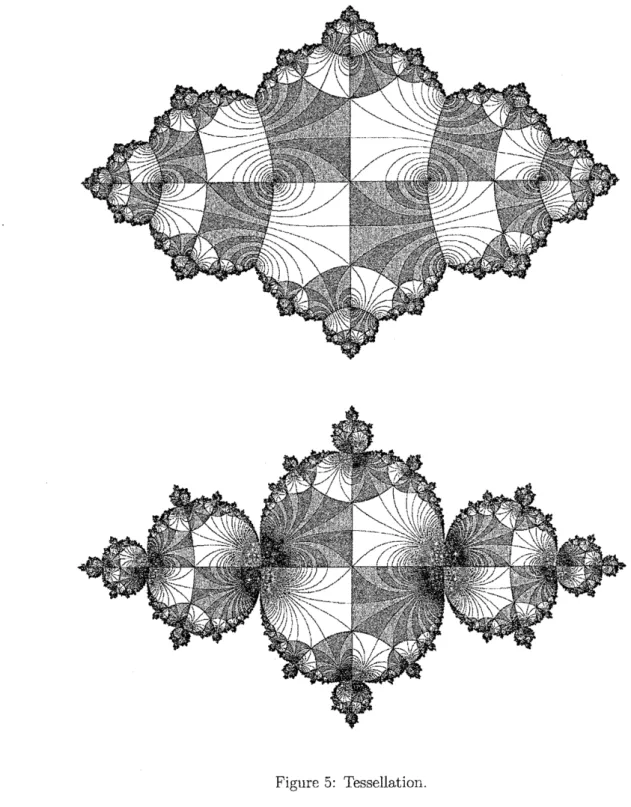
explicit way of constructing pinching semiconjugacy. The idea is tessellation of filled Julia sets [11]. For simplicitywe explainan example$\mathrm{j}$ust by figures.
Let
us
considera family of quadratic polynomials,$\mathcal{F}=\{f_{\mathrm{c}}(z)=z^{2}+c : -3/4<c<0\}$.
Figure 5 is the pictures of tessellation fortwoquadratics, oneis taken from$F$and
the other is $f_{-3/4}$. The construction oftiles are obviously based on linearizing
coordinates.
Each tile has an “address”,, consists of angle $\theta\in \mathbb{Q}/\mathbb{Z}$, level $n\in \mathbb{Z}$, and
signature $+$ or -. Addresses are organized so that the tile ofaddress $(\theta,n, +)$ is
mapped to the tileof$(2\theta, n+1, +)$ for example. It matchesto the combinatorics
of external rays, and we
can
preciselydescribe the dynamics inside the Julia set.Now it is not difficult to
construct
a pinching by pasting tile-to-tile homeo-morphisms which preserve addresses. Thensome
ofarcs
(as $\{I_{j}\}$ inthe previousexample $f_{\epsilon}(z)=(1-\epsilon)\omega z+z^{2})$
are
naturally pinched by continuous extentions of the tile-to-tilehomeomorphisms88
$\theta 9$ 7/3 7/24 5/24 7/6 5/72 $f/7\mathit{2}$ 7,24 $\mathfrak{X}4$ $t7/2\mathit{4}$ 79/24 $f$$7/24t9/24$ 7/12 77/72 2/3 $\gamma$$\gamma/\mathit{2}\mathit{4}$ 79/24 5/6
Figure 6: “Checkerboard” and ((
$\mathrm{Z}\mathrm{e}\mathrm{b}\mathrm{r}\mathrm{a}"$, showing the structure of the addresses
of tiles. “Checkerboard”’, with
some
external rays drawn in, shows the relationbetweentheexternalangles and the angles of tiles. The invariantregions colored
in white and graycorrespond to tiles of signature $+$ and – respectively. $‘\iota \mathrm{Z}\mathrm{e}\mathrm{b}\mathrm{r}\mathrm{a}^{7}$’
shows the levels of tiles. Levels get higher
near
the preimages of the attracting100
3
Rational
case:
Geometrically
finite
maps, etc.
Here we deal with the
case
ofrational maps. Some results are natural general-ization of theorems in52.
3.1
G.
Cui’s plumping
deformation.
G. Cui made intriguing applications ofwell-known Thurston rigidity to geom
et-ricaJly finite branched coverings. Here
we
roughly sketch some part of his work relating “parabolic $arrow$ hyperbolic” perturbations. See [1] for his original, or [14]for a survey of his entire works.
Periodic star-like graphs. Before the main statement, let
us
consider ara-tional map $f$ with an attracting cycle$\alpha$of period $l$. For someintegers $n$, $m$with
$nm=l$, suppose there axe a repelling cycle $\beta$ of period $n$ and star-like graphs
$I^{1}$,$\ldots\}I^{n}$ such that: each $I^{k}$ is centered at arepelling point in$\beta$). each$I^{k}$ has $\tau n$
feet with their toes at $\alpha,\cdot$ and $f(I^{k})=I^{k+1}$ with superscripts modulo $n$. We call
such an $I^{k}$ a repelling perioiic star-like graph associatedwith $\alpha$.
For example, readers mayimagine the case of “plumprabbit”, withan invari-ant star-like graph connecting the central repellingfixedpoint and the attracting cycle, or the cases of its tuned quadratic polynom ials (i.e. “plump rabbits” in copies of $M$ in $M$). One may call the graph $I=\overline{\cup I_{j}}$in Figure 3 an invariant
attracting stcvr-like graph centered at 0.
Plumping to be “plump”. The theorem here deals with simple plumping,
which replaces parabolic cycles by repelling periodic star-like graphs without
breaking thesymmnletryofpetals, likethe changeof “chubbyrabbit” into‘pplulYlP”.
Now the statement is:
Theorem 3.1 (Cui, [1]) Let g beageometrically
finite
rationalmapwith parabolic cycles. Then there exists a hyperbolic rational mapf
satisfying the following:.
There exist quasiconformaldeformations
$\{f_{\epsilon} : 0<\epsilon\leq 1\}$of
$f(=f_{1})$ suchthat $f_{\epsilon}arrow g$ is aperturbation.
.
Let $H_{\epsilon}$ denote the quasiconfo rmal conjugacyfrom
$f$ to $f_{\epsilon}$. Then $fI_{\epsilon}$con-verges uniformly as $\epsilonarrow 0$ to the limit $h$ which semiconjugaies$f$ to$g$.
.
For$y\in\hat{\mathbb{C}}$, card(h-1$(y)$) $\geq 2$
iff
$y$ eventually landson
a parabolic cycle. Inparticular, such an$h^{-1}(y)$ is either a repellingper iodic star-likegraph or $a$
connected component
of
itspreimages.Compare this with Theorem 2.4. (It
was
“overweight” to “chubby”.)Thistheoremis strongerthanTheorem 2.1 howevertheproof is quitedifferent
101
branched covering $F$ by replacing all parabolics with proper repelling star-like
graphs. This operation creates
no
Thurston obstruction. Step 2, by a resulton
convergence
of Thurston algorithm in [2],we can
finda
subhyperbolic rationallnap $f$whichis conjugate to$F$. Step
3 we
construct pinching deformations $\{f_{\epsilon}\}$as
in Theorem 2.4 which has the limit rational map $\hat{g}$ with recreated parabolics.Step 4, undersuitable normalization of$f$ and $f_{\epsilon}$, we
can
show $g=\hat{g}$by arigidityresult also due to [2].
Actually there is a much stronger theorem which makes Theorem 3.1 just
a corollary. See Theorem $\mathrm{D}+\mathrm{F}’+\mathrm{G}$’ in [14]. Instead of stating it in detail, we
consider anexample.
Example (Example 3 of [14]). Set $g(z):=z(1-z^{2})$, with a parabolic at
$z=0$. The attracting (resp. repelling) directions lie
on
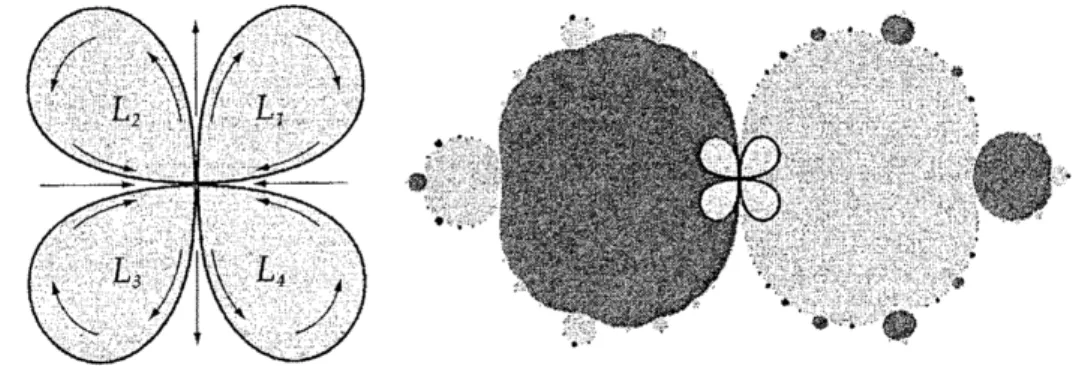
$\mathbb{R}$ (resp. $\mathrm{i}\mathbb{R}$). Let $\ell_{1}$ bean invariant curve in the first quadrant and $L_{1}$ the region enclosed by $\ell_{1}\cup\{0\})$
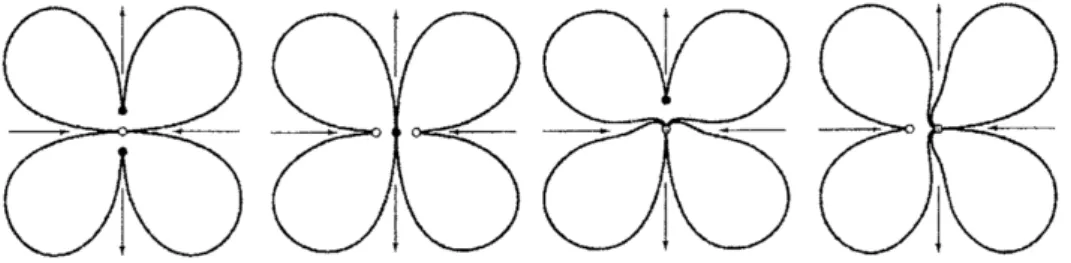
called asepal. For$\mathrm{i}=2,3$, and 4, let$\ell_{i}$ and $L_{i}$ be the symmetricimage of$l_{1}$ and $L_{1}$ in the 2-th quadrant. (See Figure 7.) In particular, $L_{1}$ and $L_{3}$ (resp. $L_{2}$ and $L_{4})$ are called right sepals (resp.
left
sepals).Figure 7: Sepals and the filled Julia set of $g$.
General plumping is, roughly speaking, replacing
a
pair of right and leftsepalsby
an
invariantarc
joiningtwo fixed points. To describe possibleways ofPlumP-$\mathrm{i}\mathrm{n}\mathrm{g}$, we consider plumping combinatorics $\tau$
as
following:$\tau$ is an injective 1nap
defined on $L_{2},$ $L_{4}$, or $L_{2}\mathrm{u}$ $L_{4}$; and $\tau|_{L_{i}}$ $(\mathrm{i}=2, 4)$ is just
a
symmetric reflectionwhich sends $L_{i}$ to $L_{1}$
or
$I_{3}$, Here is all the possible $\tau$:(t) $\tau$ : $(L_{2}, L_{4})arrow(L_{3}, L_{3})$
(ii) $\tau$ : $(L_{2}, L_{4})arrow(L_{3}, L_{2})$
(iii) $\tau$ : $L_{2}arrow L_{1}$, $\tau$ : $L_{4}arrow L_{3}$
102
There are corresponding plunapings of $\tau$ in Figure 8. Two $\tau’ \mathrm{s}$ in (iii) or (iv)
give topologically the
same
plumpings. For example, letus
pick up a plum PingFigure 8: Plumpings of type $(\mathrm{i})-(\mathrm{i}\mathrm{v})$, from left to right. Black, white, and gray
dots show repelling, attracting, and parabolic fixed points respectively
combinatorics $\tau$ : $L_{2}arrow$ U3, that is, $\tau(L_{2})=L_{3}$. Consider
a
Riemann map $\phi$ : $\hat{\mathbb{C}}-\overline{L_{2}\mathrm{U}\tau(L_{2})}arrow\hat{\mathbb{C}}-\overline{\mathrm{D}}$which sends two prime ends at 0 to those of $\pm 1$.Then there exists a gluing map $T$:C-D $arrow \mathbb{C}$ which identifies the components
of $\partial \mathrm{D}-\{1, -1\}$ such that $T$ respects the holomorphic dynamics
near
$P_{2}$ and$\tau(P_{2})=\ell_{3}$.
A new plumped map $F$ : $\hat{\mathbb{C}}arrow\hat{\mathbb{C}}$
will be defined basically by $(: \mathrm{o}T)$ $0$
$g\circ(\phi\circ T)^{-1}$. Indeed, it is naturally defined as
an
analytic map except 1ear$g^{-1}(0)$ $-\{0\}=\{1, -1\}$. T\^a $\mathrm{e}$a small neighborhood$U$ of$\overline{L_{2}\cup\tau(L_{2})}$. Let $U_{1}$ and
$U_{-1}$ be the component of$g^{-1}(U)$ around 1 and -1. Define $F$ on $\phi(U_{\pm \mathit{1}})$ by a
suitable topological map which sends $\partial\phi(U_{\pm 1})$ to $\phi(\partial U)$. Tlen $F$ is a partially analytic $\mathrm{b}1$anched covering.
Cui showed that there exists
a
polynomial $f$ which is conjugate to $F$. Moregcneially,
Theorem 3.2 (Cui) For any plumping combinatorics$\tau$
of
$g$ above, there existsapolynomial$f$ which is conjugate to apartially analytic map
defined
in asimilarway as $F$ above. Moreover, there exists
a
quasiconformaldeformation
$f_{\mathrm{c}}(0$ $<$$\epsilon\leq 1)$
of
$f=f_{1}$ which gives a per rurbation $f_{\epsilon}arrow g_{2}$ and is accompanied by(semi)conjugacies$f\mathrm{f}_{\epsilon}arrow h$ as in Theorem 3.1.
See [14] for
more
precise statement and the proof, which deals with general geometrically finite rational maps with parabolics.3.2
Weakly
hyperbolic
maps
In the case of simple plumping, Tan Lei and Hai’ssinsky generalized Step
3
of the proof of Theorem3.1
to more bigger class ofrational mapsas
following. Arational map $f$ is weakly hyperbolic if there exist $\delta$ $\geq 1$ and $r>0$ with the
following: For any $z\in J(f)$ –
{parabolics},
there existsa
subsequence $\{n_{l}\iota_{}\}$ of$\{n\}$ such that
103
where $B(x_{7}r)$ is a spherical ball of radius $r$ centered at $x_{\backslash }$ and $W_{n}$ is the
com-ponent of $f^{-n}(B(J^{n}(z), r))$ containing $.\sim^{\gamma}$. It is known that semihyperbolic
or
geometricallyfinitemaps
are
weakly hyperbolic.The statement is:
Theorem 3.3 ($\mathrm{H}\dot{\mathrm{a}}\mathrm{i}\mathrm{s}\mathrm{s}\mathrm{i}\mathrm{n}\mathrm{s}\mathrm{k}\mathrm{y}$and Tan, [8]) Let $f$ be a weakly hyperbolic
ratio-nal map with attracting cycles. Let I be
an
$f$-invanant collectionof
periodic repelling star-like graphs associated with the attracting cycles. Then there existsa rational map$g$ with parabolic cycles which
satisfies
the following:.
There exist quasiconformaldefo
relations $\{f_{\epsilon} : 0<\epsilon\leq 1\}$of
$f(=fi)$ suchthat $f_{\epsilon}arrow g$ is
a
perturbation..
Let $H_{\epsilon}$ denote the quasiconformal conjugacyfrom
$f$ to $f_{\epsilon}$. Then $H_{\epsilon}$con-verges
unifo
rmly as $\epsilonarrow 0$ to the limit$h$ which semiconjugates $f$ to$\mathrm{g}$..
For$y\in\hat{\mathbb{C}}$, card(h-1$(y)$) $\geq 2$iff
$y$ eventually lands on a
new
parabolic cyclecreated in $g$. In particular, such an $h^{-1}(y)$ is either a repelling
star-t
$ike$graph inI or a connected component
of
its preimages.The proof goes in the
same
way as Theorem $2_{-}4$. The difficulty is also thesam $\mathrm{e}$, that is, we have to show the equicontinuity of
$H_{\epsilon}$ and the uniqueness of
everysubsequential limit. Fortheequicontinuity, they usedamodulus-controlling
inequalitywhich is dueto Cui. Theuniqueness isfollowed byarigidityresult on
weaklyhyperbolic maps whichis due to Haissinsky[7].
3.3
Horocyclic
perturbation of geometrically finite maps
What kind of perturbations giveus dynamically stable perturbations? With the assumption ofgeometric finiteness, herewe give
a
sufficient condition for this: Theorem 3.4 $(\mathrm{K}, [9])$ Let $f$ be a geometricallyfinite
rational map.if
a per-trvrbation$f_{\epsilon}arrow f$ is horocyclic and preserving$J$-criticc$l$relationsof
$J(f)$ (definedbelow), then
for
$\epsilon\ll 1$, there exists a unique semiconjugacy $h_{\epsilon}$ : $J(f_{\epsilon})arrow J(f)$with the folloviing properties:
(1) $h_{\mathrm{c}}$ tends to the identity. Thatis, $\sup\{d_{\hat{\mathrm{C}}}(h_{\epsilon}(x),x) : x\in J(f_{\epsilon})\}arrow 0(\epsilonarrow 0)$;
(2)
If
$\mathrm{c}\mathrm{a}\mathrm{r}\mathrm{d}(h_{\epsilon}^{-1}(y))\geq 2$for
sorne
$y\in J(f)$, then$y$ eventudly landson
aparaboliccycle; and
(3) $h_{\epsilon}$ is
a
homeomorphism (thus is a conjugacy) be tween the Julia setsif
andonly
if
none
of
parabolic cyclesof
$f$ is perturbed intoan
attracting cycle.To get a dyn amically stable perturbation,
we
have to control two kinds ofbifurcation: One is the parabolic bifurcation of course, and the other is the
104
Horocyclic perturbation. Suppose that $f$ is a rational map with parabolic cycles. We say
a
perturbation $f_{\epsilon}arrow f$is horocyclic if each parabolic point $a$ of$f$, with $m$ petals and period 1, satisfies the following:(a) There is a neighborhood $D$ of$a$ with local coordinates $\phi_{\epsilon}$, $\phi$ : $Darrow \mathbb{C}$ (not
necessarily conformal) such that: $\phi(a)=0|$. $\phi_{\epsilon}\neg\phi$ uniformly
on
$D$; andthe perturbation is locally viewed
as
$\phi_{\epsilon}\mathrm{o}f_{\epsilon}^{ln\iota}\mathrm{o}\phi_{\epsilon}^{-1}(z)=\lambda_{\epsilon}z+z^{m+1}+O(z^{\tau\prime\iota+2})$
$arrow$ $\phi \mathrm{o}f^{\ell m}\mathrm{o}\phi^{-1}(z)=z+z^{m+1}+O(z^{m+2})$,
where $\lambda_{\epsilon}arrow 1$.
(b) If we set $\exp(L_{\epsilon}+\mathrm{i}\theta_{\epsilon}):=\lambda_{\epsilon}$, which tends to 1
as
$\epsilonarrow 0$, then $\theta_{\epsilon}^{2}=o(|L_{\epsilon}|)$as
$L_{\epsilon}$, $\theta_{e}arrow 0$.Condition (a) means thatthe perturbation preserves thesymm etryof
dynam-ics
near
parabolics. This is notso
muchan
essentialcondition but it makes the argument simpler. Condition (b)is amore
crucial condition: If$f$ hasnorotation domains, then the Julia set varies continuously along horocyclic perturbations.However, it is knownthat this continuitybreaks when property (b) breaks.
Horocyclic perturbation was originally defined
as
horocyclic convergence of rational mapsbyC. McMullen[12,\S 7-9|,
toinvestigatethecontinuity ofHausdorffdimension of the Julia set.
$J$-critical relations. Let$\mathrm{c}_{1}$,
.
..,$c_{N}$be allcriticalpoints of$f$ containedin$\mathrm{t}/(J)$,where $N$ is counted without multiplicity. A $J$-critical relation
of
$f$isasetof non-negative integers $(\mathrm{i},j, m, r\iota)$ suchthat $f^{\gamma\prime\iota}(c_{i})=f^{n}(c_{j})$.We say
a
perturbation$f_{\epsilon}arrow f$ preserves the $J$-cntical relationsof
$f$ if:.
For ail $\mathrm{i}=1_{;}\ldots$.’$N$, the maps $f_{c}$ have critical points Cf(e) (may be in the
Fatouset) satisfying$c_{i}(c)$ $arrow c_{i}$ and $\deg(f_{\epsilon}, c_{i}(\epsilon)\rangle=$ $\deg(f, c_{i},)$
as
$\epsilonarrow \mathit{0}$; and.
Foreach$J$-critical relation $(i,j, \tau r\iota, n)$of$f$, $f_{\epsilon}$satisfies$f_{\epsilon}^{m}(c_{l}(\epsilon))=f_{\epsilon}^{n}(c_{j}(\epsilon))$.If $f$ isgeometrically finite, then each $f_{\epsilon}$ is also geometrically finite.
Idea of the proof. To explain the idea, consider a perturbation of$f(z)=z^{2}$
into $f_{\epsilon}(z)=z^{2}+\epsilon$ with small $\xi$ $>0$. We
can
make aconjugation on the Juliasetin the following way: First take two attracting disks
near 0
andoo
of $f$. Then theyare
also attracting disks for $f_{\epsilon}$ for $\epsilon<<1_{7}$ because of uniform convergence$f_{c}arrow f$. Let $\Omega$ be the compliment ofthese twodisks, which is
a
closed annu$\mathrm{l}\mathrm{u}\mathrm{s}$.Set $\Omega^{n}:=f^{-n}(\Omega)$ and $\Omega_{\epsilon}^{n}:=f_{\epsilon}^{-n}(\Omega)$. $\ulcorner 1^{\gamma}\mathrm{h}\mathrm{e}\mathrm{n}\Omega^{n+1}$
105
$\Omega^{n})$ and the
same
is true for $\{\Omega_{\epsilon}^{n}\}$. Set $h_{0}=\mathrm{i}\mathrm{d}|_{\Omega}$. By lifting $h_{n}$ to $h_{n+1}$ by the relation $h_{n}\mathrm{o}f_{\epsilon}=f\circ h_{n+1}$for $n\geq 0$, we obtain the following diagrams:.
$\cdot$ ..
$\cdot$ . . $\cdot$ . . $\cdot$ . $f_{\epsilon\downarrow}\Omega_{\epsilon}^{2}arrow h_{2}\Omega^{2}\downarrow f$ $\Omega_{\epsilon}^{n+1}f_{\epsilon\downarrow}arrow h_{n+1}\Omega^{n+1}\downarrow f$ $f_{\epsilon\downarrow}\Omega_{\epsilon}^{1}arrow h_{1}\Omega^{1}\downarrow f$ $\Omega_{\epsilon}^{n}..$ . $arrow h_{n}$ $\Omega^{n}.\cdot$.
$\Omega_{\epsilon}^{0}arrow h_{0}\Omega^{0}$Now one can showthat $h_{n}$ converges to a unique limit $h_{\epsilon}$ onthe Julia set $J(f_{\epsilon})$,
by using the uniform expanding propertyof$f$
near
$J(f)$.Even in the
case
ofgeometrically finite $f$) we can take such a nice compactset $\Omega$ with $J(f)\subseteq\Omega^{n+1}\subset\Omega^{n}$. Indeed, we
can
find such an $\Omega$ of the form $\hat{\mathbb{C}}-${attracting disks and
petals}U{some
finitedisksnear
critical orbits in $F(f)$}.
We can find a similar set $\Omega_{\epsilon}$ with $J(f_{\epsilon})\subset\Omega_{\epsilon}^{n+1}\subseteq\Omega_{\epsilon}^{n}$ by modifying $\Omega$near
the parabolics- Then we
can
start lifting $h_{0}$ : $\Omega_{\epsilon}arrow\Omega$, which is not $\mathrm{i}\mathrm{d}|_{\zeta?_{\mathrm{t}})}$ butarbitrarilycloseto $\mathrm{i}\mathrm{d}|_{\Omega_{\epsilon}}$ by horocyclicity of$f_{\epsilon}arrow f$. Since the $J$-criticalrelations
are preserved, the lifting is not so complicated. The convergence of$h_{n}$ is shown
by
means
ofa weakly expanding metricnear
$J(f)$, which is compatible withthespherical metric. For the construction of this metric we again
use
the geom etricfinitenessof $f$.
Remark. If $J(f)=\hat{\mathbb{C}}$, then $f$ is postcritically finite and thus has Thurston
rigidity. This implies that any perturbation$f_{\epsilon}arrow J$ preserving the $J$ critical
rela-tionsmust be either afamilyofMobius conjugation
or
afamilyof quasiconform al deformation. The former happens whenthe associating orbifolds doesnot have type (2, 2,2, 2).Existence of perturbation. For any geometrically finite rational map, there
exists such aperturbation as in Theorem
3.4.
Theorem 3.5 $(\mathrm{K}, [10])$ Let$f$ bea geometrically
finite
rationalmapwith$J(f)\neq$C. Then there exists
a
horocyclic perturbation $f_{\epsilon}arrow f$ which preserves $J$ criticalrelations. Thus there exists
a
semiconjugacy as in Theorem3.4.
Moreover,one
can
choose the directionof
the perturbation such that the parabolic cyclesof
$f$are
perturbedinto repelling, parabolic and attracting cycles
of
$f_{\epsilon}$ in any combination.Sketch ofthe proof. The proof
uses
quasiconformal perturbation developed$10\theta$
cycles, parabolic cycles, and at the finite set $(C(f)\cup P(f\cdot))\cap J(f)$. (We may
assume
that $\infty$ is not periodic.) In particular,we can
take$p$ with an expansionofthe form
$p(z)=s(z-a)+(z-a)^{M+2}+\cdot$ ..$+(z-a)^{k}$
about everyparab olic point $a$, where $s=1$, 0, or -1 depending on what kind of
cycle we want, $k=\deg p>>0$, and $M$ is the largestpetal number of parabolics.
Let$\rho$ : $[0, \infty)arrow[0,1]$ bea smoothnon-decreasingfunctionsuchthat$\rho(t)=1$
at $t\in[0, 1]$ and $\rho(t)=0$ at $t\in[2, \infty)$
.
In particular, wecan
take sucha
$\rho$ withbounded derivative. Set $H_{\epsilon}(z)=z+\epsilon h(z)\rho(\epsilon^{1/k}|z|)$. Then $H_{\epsilon}$ :
$\hat{\mathbb{C}}arrow\hat{\mathbb{C}}$
is a
quasiconformal map if$\epsilon<<1$, and satisfies $H_{\epsilon}arrow$id and its maximum dilatation
tends to 0 as $\epsilonarrow$Q.
Set $g_{\epsilon}:=f\circ H_{\epsilon}$. Note that the quasiregular map $g_{\epsilon}$ is holomorphic except
$V_{\epsilon}:=\{z:|z|>\epsilon^{-1/k}\}$. Inparticular, if$a$ is as abovewith period$l$ and multiplier
$\lambda$, then
$a$ is aperiodic point of$g_{\epsilon}$ with period
1
and multiplier$(1+s\epsilon)^{l}$A. Thus it
can
berepelling, parabolic, orattracting dependingon$s=1$, 0 or -1. Moreover,$g_{\epsilon}arrow f$ preservesthe $J$-critical relations of$f$.
By taking
a
$g_{\epsilon}$-invariant region$E_{\epsilon}$ and taking a Mobius conjugacy, we may
assume
that $g_{\epsilon}(V_{\epsilon})\subset E_{\epsilon}$ if$\epsilon<<1$. Indeed, we canconstruct such a family ofsets$\{E_{\epsilon}\}$ by modifying aunion ofattracting disks and petals of$f$
Let $\sigma_{0}$ denote the standard complex structure
on
$\hat{\mathbb{C}}$
. For $\mathrm{c}$ $<<1$, we put an
almost$\mathrm{c}\mathrm{o}$mplex structure
$\sigma_{\zeta}$defined by $(g_{\epsilon}^{n})^{*}(\sigma_{0})$
on
$g_{\epsilon}^{-n}(E_{\epsilon})$ andby$\sigma_{0}$elsewhere.
Then$\sigma_{\epsilon}$is$g_{\epsilon}$-invariant and
we can
findaquasiconform almap(I) suchthat (I);$\sigma_{0}=$ $\sigma_{\epsilon}\mathrm{a}.\mathrm{e}.$, andthus $f_{\epsilon}:=\Phi_{\epsilon}\circ g_{\mathrm{c}}\circ\Phi_{\epsilon}^{-1}$is a rational mapofdegree$d$. Since $$\epsilonarrow$ id
by the definition of $g_{\epsilon}$ and the continuous dependence of
$\Phi_{\epsilon}$ on its Beltran$\mathrm{z}\mathrm{i}$
differential,
we
obtain a rational perturbation $f_{\epsilon}arrow f$ preserving tlte J-criticalrelations of$f$. By investigating local dynamicsneartheparabolics,
we can
checkthat $f_{\epsilon}arrow f$ ishorocyclic. Now we can applyTheorem 3.4. $\blacksquare$
Remarks. Onecanenjoymorevarious perturbations of parabolics by changing the polynomial $p(z)$ above. Note that this perturbation keeps superattractin$\mathrm{n}\mathrm{g}$
cycles, thus a polynomial is perturbed within the category ofpolynomials. In
particular, this gives a mild generalization of Theorem
2.1.
References
[1] G. Cui. Geometrically finite rational maps with given combinatorics.
Preprint,
1997.
[2] G. Cui, Y. Jiang and D. Sullivan. Combinatorics ofgeometrically finite
ra-tional maps. $Prep\dot{n}nt_{2}$ 1996.
[3] G David. Solutions de l’equation de Beltrami avec $||\mu||_{\infty}=1$. Ann. Acad.
107
[4] P. Haissinsky. Chirurgie parabolique. C. R. Acad. Sci. Sir. I. Math. 327(1998), 195-198.
[5] P. Haissinsky. Deformation $J$-equivalence de polyn\^omes geometriquement
finis. Fund. Math. 163(2000), no.2,
131-141.
[6] P. Haissinsky Pincement de polynomes. Comm. Math. Helv. 77(2002), 1-23.
[7] P Haissinsky. Rigidity and expansion for rational maps. J. London Math. Soc, 63(2001),
128-140.
[8] P. Haissinsky and Tan Lei. Mating of geometrically finite polynomials.
Prepublication Universite de Cergy-Pontoise, 12/2003.
[9] T. Kawahira. Semiconjugacies betweenthe Juliasets ofgeometrically finite
rational maps. Erg. Th.
&
Dyn. Sys. 23(2003), 1125-1152.[10] T. Kawahira. Semiconjugacies between the Julia sets ofgeometrically finite
rational maps II. Preprint, 2003.
[11] T. Kawahira. Semiconjugacies in complex dynamics with parabolic cycles. Thesis, University ofTokyo, 2003.
[12] C. McMullen. Hausdorff dimension and conform al dynamics II:
Geometri-cally finite rational maps. Comm. Math. Helv. 75(2000), no.4, 535-593
[13] M Shishikura. On the quasiconform al surgery of rational functions. Ann. Sci. $\text{\’{E}}_{c}.$
. Norm. Sup. 20(1987),
1-29.
[14] Tan Lei. Existence and deformations of semi-rational maps following Cui