Special classes
of
algebraic
integers
in
low-dimensional
topology
Eriko
Hironaka
April 15,
2005
Abstract
This note describes someopen problems concerning distributions ofspecial classes ofreal
algebraic integers such as algebraicunits, andSalem,P-V and Perron numbers. These special
algebraic integers appear naturally as geometric invariants in $\mathrm{l}\mathrm{o}\mathrm{w}rightarrow \mathrm{d}\mathrm{i}\mathrm{m}\mathrm{e}\mathrm{n}\mathrm{s}\mathrm{i}\mathrm{o}\mathrm{n}\mathrm{a}\mathrm{l}$topology, We
relate properties of Salem, P-V and Perron to minimization problems in various geometric settings.
1
Introduction
A complex number $\alpha\in \mathbb{C}$is an algebraic integer if it is
a
root of a monic integerpolynomial. Two algebraic integers a and $\beta$are
algebraically conjugat\^e vxritterr $\alpha\sim\beta$, it a and$\beta$ satisfy thesame
irreduciblemonicintegerpolynomial. An algebraic integer$\alpha$is an algebraic unit if
$\alpha\sim\alpha^{-1}$.
Let $\alpha$ beareal algebraic integer witha $>1$. Consider all
$\beta\sim$a such that $\beta\neq\alpha$:
(i) it $|\beta|<|\alpha|$,then
a
isa
Perron number’(ii) if $|\beta|<1$, then $\alpha$ is aP-$V$number, and
(iii) if $|\beta|\leq 1$ with atleast
one
$|\beta|=1$, then $\alpha$ is a Salem number.In this short note, we review definitions and known results concerning distributions of P-V, Salem and Perronnumbers (Section 2), and relatethem to geometric invariantsin
low-dimensional
topology, including lengths of geodesies, growth rates of automatic groups, and homological and geometric dilatations of surface homeomorphisms (Section 3).
2
Distributions of algebraic
integers
and
Lehmer’s problem
Let $P$ bethe set ofmonicinteger polynomials. Given $f\in P$, let $s_{f}$ be theset ofcomplexroots of
$f$ countedwithmultiplicity, and let $S^{+}(f)\subset s_{f}$ be the subsetof points outside the unit circle $C$
.
For $f\in P$ define
$N(f)$ $=$ $|\mathrm{S}^{+}(f)|$;
$\lambda(f)$ $=$ $\max\{|\alpha| : \alpha\in S(f)\}$; and
$M(f)$ $=$ $\prod$ $|\alpha|$
.
$\alpha\in \mathrm{S}^{+}(J)$Hereanempty product isdefined toequal 1. Thenumber $M(f)$, also
an
algebraicinteger, iscalledthe Mahler
measure
of$f$.The minimal polynomial for aroot ofunityis called a cyclotomicpolynomial. Thefollowingare
(i) $f$is aproduct of cyclotomicpolynomials;
(ii) $N(f)=0$ ; (iii) A(f) $=1$; and (iv) $M(f)=1$
.
Thus, $N(f)\mathrm{X}(\mathrm{f})$ and $M(f)$ can be considered as measures ofhow far$f$ isfrom beinga product
of cyclotomic polynomials. Let$\mathcal{T}\subset P$ hethe subset of products of cyclotomic polynomials. While $N(f)$ takes discrete values and $\lambda(f)$
can
get arbitrarilyclose to one from above it is not knownwhetherthereis alower bound for Mahlermeasuresgreater thanone. In 1933Lehmer [Leh]posedthefollowing problem.
Question 1 (Lehmer’s problem) Given$\delta>0$, does there exist a
f
$\in P$ such that $1<M(f)<$$1+\delta^{\varphi}$
It is not hard to see that for $f\in P$$\backslash \mathcal{T}$, ifwe fixthe degree $d$ of$f$
} then $\lambda(f)$ and $M(f)$ are
bounded from below by anumber greater than onedepending on $d$
.
Up to degree 40 there is no non-cyclotomic polynomial with Mahler
measure
less than that ofLehmer’s candidate polynomial
$f_{L}(x)=x^{10}+x^{9}$–$x^{7}-x^{6}-x^{5}-x^{4}-x^{3}+x+1$
(see, for example, [Boydl] [Mos]), TheMahler
measure
$M(f_{L})$ is approximately 1.7628.By aresult of Smyth in 1970, Lehmer’s problem reduces to the caseofreciprocal polynomials,
whichwe describe inSection 2.1. Section 2.2 givessome known results concerning distributions of Perron, Salem andP-Vnumbers.
2.1
Reciprocalpolynomials
Given $f\in P$of degree $d$, the reciprocal$f_{*}(x)$ of$f(x)$ is defined tobe
$f_{*}(x)=x^{d}f(1/x)$.
A polynomial is reciprocal if$f$ .
$=f_{*}$. Visually,
a
reciprocal polynom ial isone
for which thecoeffi-cients are palindromic, thatis, theyarethesamewritten from rightto left orlefttoright. Lehmer’s polynomial $f_{L}$ is areciprocal polynomial.
It$f$. satisfies $f=-f_{*}$, it is called anti-reciprocal A polynomial $f$ is anti-reciprocal if andonly
if $f(x)=(x-1)g(x)$ where $g(x)$ is reciprocal. All cyclotomic polynomials are reciprocal except
(x–1). A polynom ial is reciprocal or anti-reciprocal ifand only if it is a product of irreducible reciprocal polynomials and (x–1). A separable polynomial is reciprocal
or
anti-reciprocalif andonlyif $S(f)$ isclosed under inverses. Thus, an algebraic integer $\alpha$ is an algebraic unit if and only if its minimal polynomiai is reciprocal. An irreducible polynomial with aroot onthe unit circleis
automatically reciprocal. Thus, minimal polynomials ofSalem numbers are always reciprocal, and
theminimal polynomial ofa P-Vnumber is reciprocal only ifit is quadratic.
Smythshowed [Smy] that if$f\neq\pm f_{*}$, then the smallest Mahlermeasure is realized by
$f_{S}(x)=x^{3}-x-1$,
which hasMahler
measure
$M(fs)\approx$1.32472.
SinceLehmer’s polynomial $f_{L}$ satisfies$M(f_{L})<M(fs)$,
2.2
P-V
and Salem
polynomialsAn interestingspecial caseofLehmer’s problemis when $N(f)$ $=1$. Thefollowingare equivalent:
(i) $N(f)=1$;
(ii) $f$ has asingleroot outside $C$, whichis (up to sign) a Salem number or a P-Vnumber; and
(iii) $f=gh$where$g\in \mathcal{T}$and $h$ istheminimal polynomial ofaSalem number or a P-V number. For quadratic polynomials $N(f)=1$ implies that both roots are real. The reciprocalcase is
discussedinSection 3.1. Forirreduciblepolynomialsof degree$>2$,$N(f)=1$ im lies $f$hasaSalem
root (up tosign) if and onlyif $f$is reciprocal oranti-reciprocal.
Theset ofP-Vnumbers is closed [Sal], and thesmallestaccumulation pointis the goldenmean
$\alpha_{G}$ (cf. Section 3.1). A complete set ofP-V numbersless than 1.6 was catalogued by Dufresnoy
andPisot [DP].
The polynomial $fs(z)=x^{3}-$$x$–1 isthe minimalpolynomialfor the smallest P-V number $\theta 0$
[Sie], and $f_{L}$ is the minimalpolynomial for the smallest known Salem number $\alpha_{L}$
.
It is an openproblem whether thereis alower bound larger thanone for the set of Salemnumbers, orwhether
there is aSalem number less than $f_{L}$.
In their study of distributions of Salem numbers, Salem [Sal] and Boyd [Boyd2] investigated sequences polynomials of the form
$Q_{n}(t)=t^{n}P(t)\pm P_{*}(t)$, (1)
for $P\in$ V. The sequence ofpolynom ials ofthe form givenin (1) is called a Salem-Boyd sequence
for $P$. Salem [Sal] proved that the set ofP-V numbers liesin the set of upper and lower limits of
Salem numbers byprovingthe following result.
Theorem 1 Given any P-$V$polynomial$\mathrm{P}$, let$Q_{n}$ beaSalem-Boydsequence
for
P. Thenfor
some
$N>0$, $N\{Qn$) $=0$jar $n<N_{\}}$ and$N\{Qn$) $=1$
for
$n\geq N$. Fur thermore,for
$n>N$, the Salemnumbers$M(Q_{n})=\lambda(Q_{n})$ converge monotonicallyto $M(P)=\lambda(P)$
from
above or below dependingon the sign.
Inthe more general setting where P $\in P$ is anyelement, Boyd showed the following [Boyd2],
Theorem 2 Let$Q_{n}$ be a Salem-Boyd sequence
for
a
monicintegerpolynomial$P(t)$.
Then$\prime n$)$e$ have the following.(1) $N(Q_{n})\leq N(P)$
for
all $n$ $\geq 1$;(2) $\lim_{narrow\infty}\mathrm{N}\{\mathrm{Q}\mathrm{n}$) $=\lambda(P1j$ and
(3) $\lim_{narrow\infty}M(Q_{n})=M(P)$.
Anyreciprocal polynomial
can
be written inthe form of$Q_{n}$ forsome
$P$ and $n$. Thus, althoughTheorem 2doesn’t givea lower boundon$M(Qn)$or$\mathrm{X}(\mathrm{Q}\mathrm{n})$ in terms of$M(P)$ and $\lambda(P)$,itdoes
par-titionthe setof Mahler measures and radiiofreciprocalpolynomials into (non-disjoint) convergent
families.
A polynomial $f$ is a Perron polynomial if there is asimple realroot $\alpha>1$, such that for any
otherroot $\beta$of $f$, $|\beta|<\alpha$. Lehmer’s problemis unsolved for thisspecial subclass of monic integer
polynomials. By definition, the characteristic polynomial of a $\mathrm{P}\mathrm{e}\mathrm{r}\mathrm{r}\mathrm{o}\mathrm{n}rightarrow \mathrm{F}\mathrm{r}\mathrm{o}\mathrm{b}\mathrm{e}\mathrm{n}\mathrm{i}\mathrm{u}\mathrm{s}$
matrix is Perron
[Gan].
Theorem 3
If
P is a Perron polynomial and$Q_{n}$ is a Salem-Boyd sequencefor
P. Then$\lambda(Q_{n})$ isan eventuallymonotone sequence convergeng to $\lambda(P)$,
In general, $M(Q_{n})$ is not monotone, eventually monotone, or monotone for an arithmetic
sub-sequence
3
Examples
from low-dimensional topology and geometry
In this section, wclist some occurrencesofreciprocal, Salem, P-V and Perron polynomials in low
dimensional topology. These exam ples indicate a common underlying structure behind many of
the invariants of low dimensional topology, whichis yet to be fully explored.
3.1
Quadraticpolynomials
There is a bijective correspondence between $\Gamma=\mathrm{S}\mathrm{L}(2, \mathbb{Z})$ and reciprocal quadratic polynomials. This is defined by
$A\mapsto f_{A}$,
where $f_{A}$ is the characteristic polynomial for $A\in\Gamma$
.
The characteristic polynomial $f_{A}$ of any element $A\in\Gamma$ isreciprocal, since the twoeigenvaluesof $A$must multiply to 1.The inverse map is defined as follows. Let A be a quadratic such that $a=\lambda+1/\lambda\in \mathbb{Z}$, and
define
A $=($ $-1a$ $01$
).
ThenA and$\lambda^{-1}$are
the roots of$f_{A}$.
Thecorrespondence
$\mathrm{T}\mathrm{r}\mathrm{a}\mathrm{c}\mathrm{e}(A)\mapsto$A$(fA)$ (2)
is orderpreserving, and $\lambda(f_{A})=1$ ifand only if $|’\mathrm{b}\mathrm{a}\mathrm{c}\mathrm{e}(A)|\leq 2$. Thus, non-cyclotomic reciprocal
quadraticscorrespond to hyperbolic elements of$\Gamma$
.
Consider the action of$\Gamma$ as isometries on the hyperbolic disk $\mathbb{H}^{2}$. Then hyperbolic elements
$A\in\Gamma$ correspondto closed geodesies $\gamma_{A}$ on the quotient space
$\Gamma_{\backslash }^{\backslash }\mathbb{H}^{2}$, whoselength $\ell(\gamma A)$ is given
by
$\ell(\gamma_{A})=\log(’\mathrm{b}\mathrm{a}\mathrm{c}\mathrm{e}(A))$.
The correspondence givenin (2) also gives rise to anordering preserving correspondence between $\lambda(f_{A})$ andlengths of closedgeodesies
on
$\Gamma\backslash \mathbb{H}^{2}$.
Iffollows that for quadratic reciprocal polynomials $f$, the smallest Mahler
measure
greater thanone
thatoccurs
isrealized by$f_{0}(x)=x^{2}-3x+1$
and$M(fo)$ $=\lambda(J_{0}^{\cdot})=(3 +\sqrt{5})/2$.
Remark4 There $\mathrm{o}s$asimilar correspondence betweenSalem numbers andlengths
of
closedgeodesieson
more
general arithmetic quotientsof
$\mathbb{H}^{2}$ (see,for
example, [G-H]). Thus, the minimizationproblem
for
Salem numbers is related to the problemof
finding a minimum length geodesic on anThe smallest Mahler measure greater than one among all quadratics is realized by the non-reciprocal polynom ial
$f_{g}(x)=x^{2}-$$x-1$
.
Here, $M\langle f_{\mathit{9}}$) $=(1+\sqrt{5})/2$ is the golden mean. The smallest Mahler measures greater than one
for reciprocal polynomials ofdegrees 4and 6
are
approximately 1.72208 and 1.40127 respectively,and hence are also larger than the smallest non-reciprocal Mahlermeasure $M(fs)$. For degrees 8
and higher there always exists a reciprocal polynomial (not necessarily irreducible) with Mahler
measure
greater than one andlessthan$M(fs)$.3.2
Transformations preserving lattices
Let $B$ be anon-degenerate symmetric bilinear form
on
$\mathbb{R}^{n}$, and suppose $M\in \mathrm{S}\mathrm{L}(n, \mathbb{Z})$ preserves$B$
.
Equivalently, $M$preserves thelatticein$\mathbb{R}^{n}$definedby the innerproductassociatedto $B$.
Thenthe set of eigenvalues of $M$ is closed under inverses. Thus, iffor
exam
plc $M$ has no repeatedeigenvalues, orequivalently the characteristic polynomial$f_{M}$ is separable,then$f_{M}$ is reciprocal
or
anti-reciprocal (see,for example, [G-Mc], Theorem 2.1).
Consider the Coxeter element of
a
Coxeter system (see [Hum] for definitions). The Coxeterelement preserves
an
associatedsymmetric bilinear form definedby the Coxeter system. If $(W, S)$isanirreducibleCoxeter system, and$\mathrm{f}(\mathrm{w},\mathrm{s})$isthe characteristic polyonomial of the Coxeterelement
of $(W, S)$, then$\lambda(f_{(W,S)})=1$ifandonly if$(W, S)$issphericaloraffine $[\mathrm{A}’ \mathrm{C}]$
.
If$(W, S)$ isirreducibleandnot spherical or affine, then $\lambda(f_{(W,S)})$ is minimized by the $B_{10}$ Coxeter system $(W0, S_{\mathit{0}})$, and
$f_{(W_{0},S_{0})}=f_{L}$ is Lehm cr’s polynom ial ([Me] Theorem 6.1). It follows that forany Coxeter system $(W, S)$, either $f_{(W,S)}\in \mathcal{T}$or $M(f_{(W,S)})\geq M(f_{(W_{0},S_{0})}$, which solves Lehmer’s problemfor thisclass
ofexamples.
3.3
M-matrices
Let $T\in \mathrm{S}\mathrm{L}(n, \mathbb{Z})$ be amatrixsatisfying
$T=\pm M^{\mathrm{t}\mathrm{r}}M^{-1}$, (3)
where $M\in \mathrm{S}\mathrm{L}(\mathrm{n}, \mathbb{Z})$, and $M^{\mathrm{t}\mathrm{r}}$
isthe transposeof$M$. Then$T^{-1}$ is conjugateto $\pm T^{\mathrm{t}\mathrm{r}}$and hence $T$ has reciprocal
or
anti-reciprocal characteristic polynomial. Such matricesare
calledM-matrices.Howlett [How] showed that if$T$ isthejCoxeterelement of
a
simply-laced Coxeter systemasso-ciatedto
a
graph$\Gamma$, then the Coxeterelement can be writtenin terms of the adjacency matrix $A$for $\Gamma$
.
Let $A^{+}$ be its upper triangular part. Then
setting$M=I-A^{+}$ ,we
have $T=-M^{\mathrm{t}\mathrm{r}}M^{-1}$.This gives another proof that the characteristic polynomial of a Coxeter element isreciprocal in the simply-laced case.
Anotherwell-known case is the Alexander matrix ofaknot $(S^{3}, K)$ (see [Rolf] for definitions).
Let $V$ be the Seifert matrix for $(S^{3}, K)$. Then the Alexander polynomialfor $(S^{3}, K)$ is given by
$\Delta_{(S^{3},K)}(t)=|\det(tV-V^{\mathrm{t}\mathrm{r}})|$, up to multiplesof$t^{\pm 1}$
.
If$V$isinvertible, it follows that thecharacteris-ticpolynomial$\Delta(S^{3},K)$ is reciprocal andhas
a
monicrepresentative. Furtherm ore, $\Delta(S^{3},K)(1)=\pm 1$.Conversely, if $J^{\cdot}$is areciprocal polynomialwith$f\langle 1$) $=\pm 1$, thenthere is aknot $(S^{3}, K)_{\mathrm{t}}$ such that
3.4
Growth rates of
automatic
groups
Let $G$ be afinitely presented group, with generating set $S$, such that $S$ is closed under inverses.
The growth seriesof$G$ is the formal
sum
$\Psi_{(G,S)}(x)=\sum_{\mathrm{i}=0}^{\infty}a_{n}x^{n}$
where$a_{n}$isthenumber of words in$G$ofminimalword length$n$inthe generating set
$S$. The growth
rateof$G$ isgiven by
$\lambda(G, S)=\lim\sup|a_{n}|^{\frac{1}{n}}$
.
(See $[\mathrm{E}\mathrm{C}\mathrm{H}^{+}]$ for more details.) The growth series $\Phi(G,S)$ is rational, for example, when $G$ is
hyperbolic, automatic,
or
a Coxeter group (see forexample $[\mathrm{E}\mathrm{C}\mathrm{H}^{+}]$, [Can], for more details). Intheautomaticcase,
we can
realize$\lambda(G, S)$ as$\lambda(f(G,S))$where$\mathrm{f}(\mathrm{a},\mathrm{s})$is thecharacteristicpolynomialofan associated matrix.
Lehmer’s polynomial appears among these examples as follows. Let $(G , Sp1,\ldots,Pk\mathcal{P}1,. ,\mathrm{P}k)$ be
the Coxeter group of reflections through sides of a polygon in the hyperbolic plane with angles $\frac{\pi}{p_{1}}$,$\ldots$,$\frac{\pi}{p_{k}}$, where
$\frac{1}{p_{1}}+\cdots+\frac{1}{p_{k}}<k-2$,
Then Cannonand others [F-P], [C-W], [Floy] calculatethe denominators ofthegrowthseries, and show that $\lambda(G_{p1},.,\mathrm{P}k , S_{p1}, 1p\lambda )$ is aSalem number. In particular, Lehmer’s polynomal $f_{L}$
occurs
asthedenominatorfor $(G_{2,3,7}, \mathrm{S}_{2,3,7})$ and corresponds to the angle set givingriseto thesmallest area
hyperbolic polygon.
There is
a
close relation between theautomatic
group structure of $(G_{\mathcal{P}1}, .,Pk ,\mathrm{P}1,. .,pk S)$ and the Coxeter element of $(\mathcal{G}_{\rho_{1}},.,p_{k}’ S_{p_{1},..,pk}))$ where $(\mathcal{G}_{\mathrm{p}1{}_{\ddagger}Pk}..,, \mathrm{S}_{\mathcal{P}1,\ldots,\mathrm{P}\mathrm{L}}.)$ is the simply-laced Coxetersystem
associated
to the “star-like” graph with $\mathrm{f}\mathrm{c}$-branches emanating from a central vertex of lengths $p_{11}$.
.’$Pk$.
(See, for example, [Hir2]. Although the star-like graphs do not directly
de-fine theauotomatic structures of $(G_{p1},.,\rho_{k}’ S_{\rho 1,.,T^{J}k})$, calculationsin [Hirl] showthat the sequence
$a_{n}$ for the growth series
$\Psi(G_{p_{1}}, ,\mathrm{p}_{k)}^{S}\mathrm{p}_{1}.,p_{k})$
can
be computed directly from the Coxeter element $(\mathcal{G}_{p_{1,\}}\mathrm{p}k}., \mathrm{S}_{\mathcal{P}1\}}.,p_{k})$.3.5
Dilatations
of pseudo-Anosov
maps
Let $F$ be a compact
orientable
surface with negative Euler characteristic, and let$\phi$ : $Farrow F$
be ahomeomorphism. The
Thurston-Nielsen
theory [Thu] [FLP] [CB] states that for any surfacehomeomorphism $\phi$: $Farrow F$, $\phi$ is isotopic to
some
0 satisfying one ofthe following:(i) $\Phi$ isperiodic, i.e., $\Phi^{n}$ is theidentity;
(ii) (X) is irreducible, i.e.,there is a closed
curve
on $F$ invariant under 4 such that complementarycomponentshavenegative Euler characteristic;
or
(iii) (X) is pseudo-Anosov, i.e., there is
a
number $\lambda>1$ and a pair $F^{\pm}$ of transversemeasured
foliations such that
$\Phi(\mathcal{F}^{\pm}\}=\lambda^{\pm 1}F^{\pm}$.
Inthepseudo-Anosovcase, $\Phi$isthe uniqueelementintheisotopyclass of
$\phi$with smallest topological
Suppose $\Phi$ is pseudo-Anosov. Then there is anembedded graph
$\mathcal{G}$ in$F$ representing the spine
of$F$, such that the transitionmatrix $M_{\Phi}$for$\Phi$ restrictedto$\mathcal{G}$ is aPerron-Frobeniusmatrix. Thus,
the characteristic polynomial $f\phi$ of $M_{\Phi}$ is aPerron polynomial. Furthermore, the Perron number
associatedto $f_{\phi}$ equals thedilatation $\lambda(\phi)$
.
The transition matrix$M_{\Phi}$ has the property that $M_{\Phi}^{\mathrm{t}\mathrm{r}}$
1s conjugate to$M_{\Phi}^{-1}$ and hence its characteristic polynomial $f\emptyset$is reciprocal.
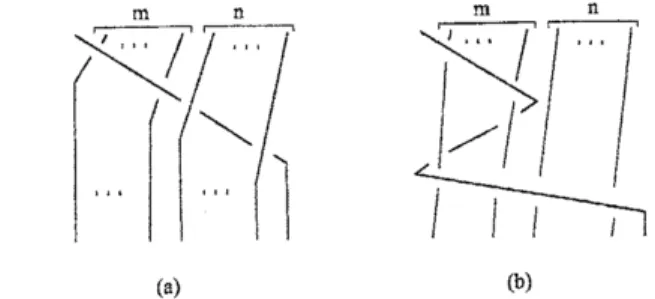
$\langle \mathrm{a})$ (b)
Figure1: Braids with smalldilatation.
In [HK] westudytwofamilies of pseudo-Anosov maps
on
a marked diskassociated
to thebraids $\beta_{m,n}(\mathrm{a})$ and $\sigma_{m,n}(\mathrm{b})$ drawninFigure 1, and showthat their dilatations satisfythe characteristic equations$x^{n+1}R_{m}(x)+(R_{m})_{*}(x)$
for $\beta_{m,n}$ and, when $n\geq m+2$,
$x^{n+1}R_{m}(x)-(R_{m})_{*}(x)$
for$\sigma_{m,n}$, when$\mathrm{e}$
$R_{m}(x)=x^{m}(x-1)-2$.
The polynomials $R_{m}$ have$\tau r\iota$ roots outside the unit circle. Thus, $R_{1}(x)$ isa P-V polynomial, and hence by Theorem 1 thedilatations of$\beta_{1,n}$ and$\sigma_{1,n}(n\geq 3)$ areSalemnumbers and
are
monotone(decreasingfor$\beta_{1,n}$ andincreasingfor$\sigma_{1,n}$). For all$m$,the polynomials$R_{m}$arePerronpolynomials, and hence by Theorem 3 the dilatations areeventually monotone (again, decreasing for5 $n\iota,r\iota$ and
increasing for$\sigma_{m,n}$). Since $\lambda(R_{m})$ approaches 1
as
$77\mathrm{L}$ goesto infinity, it follows that for any
$\epsilon>0$,
it is possibleto make$m$ and$n$ large enoughso that thedilatations are within$\epsilon$ of 1. The pseudo-Anosovmaps definedby$\beta_{m,n}$ and$\sigma_{m}$,
$n$lift to homeomorphisms ofgenus$g$ compact
surfaces with $b$ boundary
components
via double covering, where, if$m+n$ is even, $g= \frac{m+n}{2}$ and$b=1$, and if $\prime r\iota$$+n$ isodd, $g= \frac{r\mathrm{n}+n-1}{2}$ and $b=2$ . Let $\phi_{g}$ be the lift of$\sigma_{g-1,g+1\sim}$ Then
$\log(\lambda(\phi_{g}))=\log(\lambda(\sigma_{g-1,g+1}))-\cdot\frac{1}{g}$,
and we
recover
Penner’s resulton
least dilatations ofpseudo-Anosov mapson
orientabiegenus
$g$surfaces. The lifts of$\beta_{m,n}$ are themonodromyof fibered two-bridgelinks (seealso [Bri] and [Hir4]). Reflecting $\beta_{m,n}$
across
the axis containing the marked points, wesee
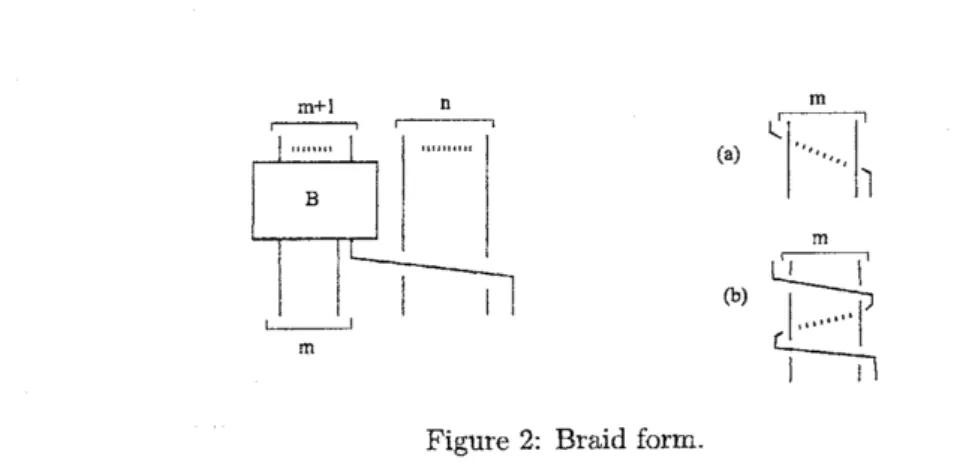
that the two braids arein the form given in Figure 2. A conjecture of de Carvalho and Hall $[\mathrm{d}\mathrm{C}\mathrm{H}]$, predicts that under
certain conditions
on
$B$ and for $n$ large enough, braids of the form given in Figure 2 (left) willdetermine pseudo-Anosov maps whoseinvariant fibrations will havenice limiting behavior. Thus,
it is natural to askthe following.
Question 2 Underwhat conditions on B will the braids in the
form
given in Figure 2 (left) have$\zeta \mathrm{a})$ ( $|\begin{array}{l}-|\prime\prime,r_{\prime}.\prime\end{array}|$
1
(b) $‘\ovalbox{\tt\small REJECT}_{1}|$ $\frac{\mathrm{m}}{\mapsto^{1}}||_{\tau}|\ldots..|$Figure 2: Braid form.
For$\beta_{m,n}$ and$\sigma_{m}$,$n$the limitingbehavioristhe same, andthis
occurance
explainstheappearanceof$R_{m}$ for the characteristic equationsof both braid families.
Problem 3 Characterize pairs
of
distinct braids whichif
plugged into B will give rise toSalem-Boydsequences associated to thesamepolynomial P anddiffering $\dot{\mathit{0}}$y the sign in
front of
P.3.6
Homological dilatation
Let$\phi$: $Farrow F$be a surface homeomorphlism, andlet
$\phi_{*}$be therestrictionof$\phi$tothe first homology
Hx$(\mathrm{F};\mathbb{R})$
.
If$\Phi$ isapseudo-Anosovrepresentativeof the isotopyclassof$\phi$,thensince$M_{\Phi}$ measures
thegrowth rate of word lengths of$\pi_{1}(F)$ under iterationsof$\Phi$ (see, for example, [FLP], [BH]) we
have in general
$\lambda(\phi_{*})\leq\lambda(\phi)$.
If, in addition, the invariant foliations $F^{\pm}$ are orientable, then the largest eigenvalue $\lambda(\phi_{*})$ of $\phi_{*}$,
calledthe homological dilatationof$\phi$, equals $\lambda(\phi)[\mathrm{R}\mathrm{y}\mathrm{k}]$.
A link $(S^{3}, K)$ is apair where $K$ is the disjoint unionof afinitenumber ofsmoothly embedded
circles in $S^{3}$. Alink $(S^{3}, K)$ is
fibered
if fora
regular neighborhood$U(K)$ of$K$ in$S^{3}$, $S^{3}\backslash U(K)$ isalocally trivial fiberbundle over$S^{1}$. This fiber bundle structure
over
$S^{1}$ isnot necessarily unique when $K$ hasmore
than one compoent.Given a
fibration let$\Sigma$ be a fiber. Then $s^{3}\backslash U(K)$ is
homeomorphicto the product of $\Sigma \mathrm{x}$ $[0,1]$ modulo
an
identification $(x, 1)=(\phi(x), 0)$, where $\phi$ isa
surface homeomorphism from$\Sigma$ to itself, i.e., it is the mapping torus for $\phi$. If$K$ is aknot, thenthe
characteristic
polynomial of $\phi_{*}$ equals $\Delta\langle S^{3},K$). In general, if$f$ isa
monicreciprocal integerpolynomial, then there isa fibered link suchthat $J$ equals thecharacteristic polynomial of
$\phi_{*}$ uP
to amultiple of $(x$ –1$)$ [Kan]. It thus follows that any question about algebraic integers canbe
translated to a question about homologicaldilatations offibered links.
Problem 4 Characterize
fibered
links with small Mahlermeasure greater
thanone.
Usingthesimilarforms ofAlexander matrices and Coxeter elements
described
inSection 3.3, itispossible to
construct
many examples offibered knots (andlinks) such that$f_{\phi}.(x)=f_{(W,S)}(-x)$,
One suchexample isthe (-2,3,7)-pretzel knot $K_{2,3,7}$,which is afiberedknot associated to the $E_{10}$ Coxeter system. Since $K_{2,3,7}$ has onlyone component,
$f_{\phi}.(x)=\Delta_{K_{2,3,7}}(x)$.
Thus, A$K_{2,3.7}$$(-x)$ $=f_{L}(x)$ is the Lehmer polynomial (cf. Section 3.2).
If $K_{n}$ is obtained from a fibered link $K_{0}$ by plumbing a $(2-n)$-torus link (see, for example, [Mur] and [Har] for definitions), we say that $K_{n}$ is obtained from $K_{0}$ by iterated Hopfplumbing. In [Hir4] , weshow that the characteristic polynomial ofthe homological monodromyof such a $K_{n}$ is a Salem-Boyd sequence. As an example, braids ofthe form given in Figure 2 define via double
covering homeomorphisms ofsurfaces, whichare obtainedby iterated Hopf plumbing.
Problem 5 Let$\phi$: $Farrow F$ beahomeomorphism
of
asurface
with boundary, and let$\phi_{n}$ : $F_{n}arrow F_{n}$
be obtained by iterated Hopfplumbing. Under what conditions on $\phi$ and$n$ is $\phi_{n}$ pseudo-Anosov,
andin this case do the dilatations satisfy a Salem-Boyd sequence?
References
[A’C] N. A’Campo. Surles valeurs propres de la transformation de Coxeter. Invent Math. 33
(1976), 61-67,
[BH] M. Bestivina and M. Handel. Traintracks and automorphism soffreegroups. Ann. Math. II. s. 135 (1992), 1-51.
[Boydl] D. W. Boyd. Speculations concerning the range ofMahler’s
measure.
Canad. Math. Bull.24 (1981), 453-469.
[Boyd2] D.W. Boyd. Small Salem numbers. Duke Math. J. 44 (1977), 315-328.
[Bri] P. Brinkmann. A Note
on
pseudo-Anosov maps with small growth rate. ExperimentalMath, 13 (2004), 49-53.
[C-W] J. Cannonand P. Wagreich. Growthfunctions ofsurface groups. Math. Ann. 293 (1992),
239-257.
[CB] A. Casson and S. Bleiler. Automorphisms
of
surfaces after
Nielsen and Thurston. Cam-bridge UniversityPress, 1988.[dCH] A. de Carvalho and T. Hall. The forcingrelation for horseshoe braid types. Experiment. Math. 11 (2002), 271-288.
[DP] $\mathrm{J}$ DufresnoyandCh,Pisot.
\’Etude
de certainesfonctionsmeromorphes borneesurlecercleunite, application \‘aun ensemblefermed’entiersalgebriques. $Ann$, Sci,
\’Ecole
Norm. Sup.72 (1955), 69-72.
$[\mathrm{E}\mathrm{C}\mathrm{H}^{+}]$ D. Epstein, J. Cannon, D. Holt, S.Levy, M. Paterson, andW. Thurston. Wordprocessing
in groups. Jones and BartlettPublishers, Boston, MA, 1992.
[FLP] A. Fathi, F.Laudenbach, and V. Poenaru. Travauxde Thurstonsttr les surfaces, volume
66-67. Societe MathematiquedeFrance, Paris, 1979.
[Floy] W. J. Floyd. Growth of planarCoxeter groups,$\mathrm{P}.\mathrm{V}$.numbers, andSalemnumbers. Math.
[F-P] W. J. Floyd and S. P. Plotnick. Symmetriesof planar growth functions ofCoxeter groups. Invent Math. 93 (1988), 501-543.
[Gan] F. Gantmacher. The Theory
of
Matrices vol. 1. ChelseaPublishing Co., NewYork, 1959. [G-H] E. Ghate and E. Hironaka. The Geometry of Salem numbers. Bulletinof
Arner. Math.Soc. 38 (2001), 293-314.
[G-Mc] D. Gross and C. McMullen. Automorphisms ofeven unimodular lattices. J. Algebra (to appear).
[Har] J. Harer. How toconstruct allfiberedknots andlinks. Topology 21 (1982), 263-280.
[Hirl] E. Hironaka. The LehrnerPolynom ialand Pretzel Knots. Bulletin
of
CanadianMath. Soc. 44 (2001), 440-451.[Hir2] E. Hironaka. Coxeterlinks, McKay’scorrespondence and 2,3,7. Contemp. Math. Proc 324
(2003), 123 – 138.
[Hir3] E. Hironaka. Chorddiagrams andCoxeterlinks. J. London Math. Soc.69 (2004),
243-257.
[Hir4] E. Hironaka. Salem-Boyd sequences and Hopf plumbing, preprint (2005).
[HK] E. Hironaka and E. Kin. A family ofpseud$0$-Anosovbraidswithsmalldilatation, preprint
(2005).
[How] R. Howlett. Coxeter groups and$M$-matrices. Bull London Math. Soc. 14 (1982),
137-141.
[Hum] J. Humphreys.
Reflection
groups and Coxeter groups. Cambridge University Press, Cam-bridge, 1990.[Can] J.W.Cannon. The combinatorial structureof cocompact discrte hyperbolicgroups. Geom. Dedicate 16 (1984).
[Kan] T. Kanenobu. Module d’Alexander des noeuds fibres et polynome deHosokawa des
lace-mentsfibr\’es. Math. $Sem$
.
Notes Kobe Univ. 9 (1981), 75-84.[Leh] D. H. Lehmer. Factorization ofcertain cyclotomic functions. Ann.
of
Math. 34 (1933),461-469.
[Mc] C. McMullen. Coxeter
groups,
Salemnumbers and the Hilbertmetric. Publ Math. Inst.Hautes
\’Etudes
Sci. 95 (2002),151-183.
[Mos] M. Mossinghoff. Lehmer’s problem, $http.\cdot//www$
.cecm.
$sfu$.$co/mJm/Lehmer$(2003),[Mur] K. Murasugi. On the genus of the alternatingknot. 1,11. J. Math.Soc. Japan104 (1958),
94-105,235-248.
[Rolf] D. Rolfsen. Knots and Links. Publish orPerish, Inc,Berkeley, 1976.
[Ryk] E. Rykken. Expanding factors for pseudo-Anosov homeomorphisms. Michigan Math. $J$
.
46 (1999),
281-296.
[Sal] R. Salem. A
remarkable
class ofalgebraicintegers.Proofof a conjectureofVijayaraghavan.[Seif] H. Seifert. $\ddot{\mathrm{U}}$
berdas Geschlecht von Knoten. Math. Ann. 110 (1934), 571-592,
[Sie,] C. L. Siegel. Algebraic integerswhose conjugateslie onthe unit circle. DukeMath. J. 11 (1944), 597-602.
[Smy] C. J. Smyth. On the product of the conjugates outside the unit circle of an algebraic
integer. Bull. London Math. Soc. 3 (1971), 169-175.
[Thu] W.Thurston. Onthegeometry anddynamicsofdiffeomorphisms ofsurfaces. Bull. Amer. Math. Soc. (N.$S.$) $19$ (1988), 417-431