A
Mathematical
Model of
Population
Dynamics
with Predator‘s Behavioral Change Induced
by Prey’s
Batesian Mimicry
*Hiromi SENO and **Takahiro KOHNO
’Department
of
MathematicalandLife
Sciences, Graduate Schoolof
Science,”Department
of
Mathematics, Facultyof
Science,Hiroshima University, Higashi-hiroshima739-8526$JA$PAN
[email protected]. hiroshima-u.ac.jp
被食者のベイツ型擬態に誘発される捕食者の行動変化を導入した個体群動態モデル
瀬野裕葵.*
河野孝弘
広島大学大学院理学研究科数理分子生命理学専攻,**
広島大学理学部数学科
Weanalyzeamathematicalmodelof the population dynamicsamongamimic, corresponding model,
andtheir predator populations. The predator changes itssearch-and-attack probability by forming
and losing its searchimage. Thepredatorcannotdistinguishthe mimic from themodel,sothateach
predator searches and attacks them with common probability. Once apredator predates a model
individual, it comes to omit both the model and the mimic species $hom$ its diet menu, and then
not to searchnorattack theminthesameday. Ifapredator predatesamimic individual,it comes
to increase the search-and-attack probability for both model and mimic. The predator may lose
the repulsive/attractive search image withaprobabilityper day. Analyzingourmodel, wecan find
theconditionfor the persistence of model and mimic populations, and then gettheresultthat the
condition for the persistence ofmodel population does not depend on the mimic population size,
whilethe conditionforthepersistenceofmimic populationdoesdependonthe thepredator’s ability
ofthe repulsive search imageformation.
本研究では,ベイツ型のmimic (擬態) 種とそれに対する model (被擬態) 種,それらに対する捕食者種 の間の個体群動態の数理モデルを解析した。 捕食者における探索像の記憶と忘却により捕食確率が変化す る。毎日の捕食活動時間における個体群動態を常微分方程式系で,$T$ 日間の捕食シーズンの後の生残個体 による繁殖をBeverton-Holt 差分方程式モデルで与えて,次の捕食シーズンの初期条件を定めるという 過程から成る数理モデルを構築し,解析した。model種と mimic 種は捕食者に同類の餌として認識され る。model 個体を捕食した後の捕食者の捕食確率は $0$に,mimic個体を捕食した後の捕食者の捕食確率は ある高レベルに遷移する。捕食者個体群サイズは餌個体群サイズに依存せず,一定であるとする。捕食活
動時間終了時の高捕食確率状態にある捕食者の頻度,捕食回避状態にある捕食者の頻度は,捕食履歴
(記 憶$)$ の忘却により,翌日までにある一定の割合で減少し,その減少した頻度分により,翌日の中庸な捕食 確率状態にある捕食者の初期頻度が定まる。構成された数理モデルの解析により,model個体群の存続条 件は,mimic 個体群サイズに依存しないが,mimic 個体群の存続は,捕食者の探索像記憶保持の程度に依 存することが示された。1
Introduction
In thiswork,weanalyzeamathematical model of thepopulationdynamicsamong amimic, corresponding
model, and their predator populations. The predator changes itssearch-and-attackprobability by forming
andlosing its search image. We analyzea mathematicalmodel consisting of the daily population dynamics
withordinary differentialequations,the seasonalpopulation dynamics withdifferenceequations, and the
annualpopulation dynamicswith differenceequations.
Thepredatorcannotdistinguish the mimic from themodel,sothat eachpredatorsearches and attacks
them withcommonprobability. Once apredator predates a model individual, itcomes to omit both the
model and the mimic species from its diet menu, and then not to search nor attack them in the
same
day. Ifapredator predates amimic individual, it comesto increase the search and attack probability for
the model and the mimic. Thepredator population size is assumed to be kept constant, independently
of the model and themimic population sizes. The frequency ofpredatorswith higher search-and-attack
probability and thatwithzerosearch-and-attack probability decreasesbyarate between thesubsequent
days,because ofthe predator$s$losingthesearch image. Analyzingourmodelsystem, wecangetthe result
suchthat the conditionforthepersistenceof modelpopulationdoes not depend on the mimicpopulation
size, while the conditionforthepersistence ofmimicpopulation doesdepend onthepredator$s$ability of
Figure1: Multi time-scalestructureofpopulationdynaniicsinourmodel.
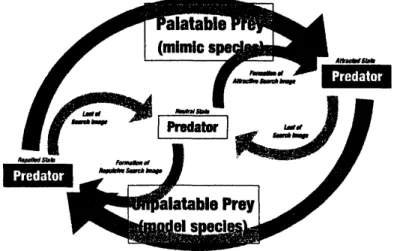
Figure 2: Pradator$s$state transition due to predating themodelorthe mimicprey.
2
Model
Weanalyzeamathematical model consisting of the daily populationdynamicswithordinarydifferential
equations, the seasonal population dynamics with difference equations, and the annual population
dy-namics withdifferenceequations (seeFig. 1). Eachpredationseason iscomposedwith the dailydynamics
repeatedday by day in$T$days.
Thepredator populationsizeisassumed to bekept constant, given by$P$, independently ofthe model
and themimicpopulationsizes. This
means
suchanassumptionthat thepredatorisageneralistandhassomeother preys tokeep the stationary population size, sothatitcansurvive andsustain itspopulation
evenif the model and the mimic population go extinct.
The reproductions of model,mimic, andpredator speciesis assumed to
occur
between the subsequentpredation
seasons.
In otherwords, thereisnoreproduction ofmodel, mimicor predatorwithin thepre-dation season,sothat the model and the mimicpopulationsmonotonicallydecrease due to thepredation
Daily dynamics
Thepredator cannot distinguish the mimic $hom$the model,so that each predatorsearches and attacks
themwith
common
probability. Oncea
predator predatesa
modelindividual, itcomes
toomitboth themodel and the mimic species from its diet menu, and then not to search nor attack them in the same
day. Ifapredator predatesamimic individual, it comesto increase the search-and-attack probability for
both the model and the mimic (see Fig. 2).
At the predation period in the $k$ th day ofpredation season, the predator subpopulation without
any search image for the model/mimic prey is now given by $P_{k}^{0}(t)(k=1,2, \ldots,T)$, at time $t$ after
the beginning of the predation period $(t=0)$
.
In thesame
way, the predator subpopulation withhigher search-and-attack probability after predating a mimic prey is given by $P_{k}^{+}(t)$, and that with
zero probability after predating amodel prey by $P_{k}^{-}(t)$
.
From the assumption ofa constant predatorpopulation size,
$P_{k}^{0}(t)+P_{k}^{+}(t)+P_{k}^{-}(t)=P$
for any $t\in[0, \tau]$, where $\tau$ is the length of predation period in which the daily dynamics undergoes
in
each day. The model and the mimic populationsizes at time$t\in[0, \tau]$ in thedaily dynamics
are
givenby$m_{k}(t)$ and$x_{k}(t)$.
In
our
model,thedaily dynamicsis governedby the following ordinary differential equations:$\frac{dm_{k}(t)}{dt}$ $=-F_{M}^{0}P_{k}^{0}(t)-F_{M}^{+}P_{k}^{+}(t)$; $\frac{dx_{k}(t)}{dt}$ $=-F_{X}^{0}P_{k}^{0}(t)-F_{X}^{+}P_{k}^{+}(t)$; $\frac{dP_{k}^{0}(t)}{dt}$ $=-F_{M}^{0}P_{k}^{0}(t)-F_{X}^{0}P_{k}^{0}(t))$ (1) $\frac{dP_{k}^{+}(t)}{dt}$ $=F_{X}^{0}P_{k}^{0}(t)-F_{M}^{+}P_{k}^{+}(t)$; $\frac{cfP_{k}^{-}(t)}{dt}$ $=F_{M}^{0}P_{k}^{0}(t)+F_{\#\backslash 1}^{+}P_{k}^{+}(t)$,
where $\Gamma_{M}^{0}\langle$ is the predationrate for the model perunit population
size of$P_{k}^{0}(t)$ at time$t$, and the others
aredefined
as
well, whichare
nowgiven by$F_{M}^{0}=\mu_{k}(t)\cdot b_{0}\{m_{k}(t)+xk(t)\}$; $F_{M}^{+}= \mu_{k}(t)\cdot\frac{b_{0}}{c+}\{m_{k}(t)+x_{k}(t)\}$; $F_{X}^{0}=\chi_{k}(t)\cdot b_{0}\{m_{k}(t)+x_{k}(t)\}$; $F_{X}^{+}= \chi_{k}(t)\cdot\frac{b_{0}}{c+}\{m_{k}(t)+x_{k}(t)\}$
with
$\mu_{k}(t)=\frac{m_{k}(t)}{m_{k}(t)+x_{k}(t)}$; $\chi_{k}(t)=\frac{x_{k}(t)}{mk(t)+x_{k}(t)}$.
Parameter $b_{0}$ isthe predation coefficient of the predator which doesnot experiencethepredation of the
model and the mimic preys. The contact rateofapredatorwith preys is assumed to be proportionalto
thesumofmodel and mimicpopulations, $m_{k}(t)+x_{k}(t)$. Parameter$c^{+}$ is positiveand less than 1, which
gives the increaseof predationrate bythe creation of search image due to the predationof the mimic
prey.
Makinguseofthe following non-dimensionalizing parametertransformation:
the system (1) becomes $\frac{dm_{k}(t)}{dt}$ $=-P \{p_{k}^{0}(t)+\frac{p_{k}^{+}(t)}{c+}\}m_{k}(t)$; $\frac{dx_{k}(t)}{dt}$ $=-P \{p_{k}^{0}(t)+\frac{p_{k}^{+}(t)}{c+}\}x_{k}(t)$; $\frac{dp_{k}^{0}(t)}{dt}$ $=-\{m_{k}(t)+x_{k}(t)\}p_{k}^{0}(t)$; (2) $\frac{dp_{k}^{+}(t)}{dt}$ $=p_{k}^{0}(t)x_{k}(t)- \frac{p_{k}^{+}(t)}{c^{+}}m_{k}(t)$; $\frac{dp_{k}^{-}(t)}{dt}$ $= \{p_{k}^{0}(t)+\frac{p_{k}^{+}(t)}{c+}\}m_{k}(t)$.
Now$p_{k}^{0},$$p_{k}^{+}$ and$p_{k}^{-}$ respectivelymeanthe frequency of predatorsaccording to the state characterized by
thesearch-and-attack probability, satisfyingthat
$p_{k}^{0}(t)+p_{k}^{+}(t)+p_{k}^{-}(t)=1$
for any$t\in[0, \tau]$.
Seasonal
dynamics
The model and the rnimicpopulation sizes at the end of$k$th predation period inthepredation season
are
givenby$m_{k}(\tau)$ and$x_{k}(\tau)$.
They givethe initial populationsizes in the subsequent predation periodofthe next day: $(m_{k+1}(0), x_{k+1}(0))=(m_{k}(\tau), x_{k}(\tau))$. We ignore the death rate due to any other
reasons
except for the predationinevery day ofthe predation
season.
As for the frequencies in the predator population, we introduce the probabilityoflosing the search
image, say,theforgetting probability. Thepredator losesits searchimage with aprobabilitybetween the
end ofapredation period and the beginningofthe subsequent predation period. Thepredator withthe
highersearch-and-attack probabilityloses itwithprobability $1-\sigma^{+}$,where$\sigma^{+}$ meansthe probabilityto
keepthe attractive searchimage$(0\leq\sigma^{+}\leq 1)$
.
$\ulcorner\Gamma he$predatorwith thelower search-and-attackprobabilityloses it with probability $1-\sigma^{-}(0\leq\sigma^{-}\leq 1)$. So the parameter $\sigma^{-}$
means
the probability tokeep therepulsivesearch im\‘age. Therefore, we
assume
the relation between the predatorfrequencies at the endof$k$thpredation period and those at thebeginning of$k+1$ thone asfollows:
$p_{k+1}^{0}(0)$ $=p_{k}^{0}(\tau)+(1-\sigma^{+})p_{k}^{+}(\tau)+(1-\sigma^{-})p_{k}^{-}(\tau)$;
$p_{k+1}^{+}(0)$ $=\sigma^{+}p_{k}^{+}(\tau)$; (3)
$p_{k+1}^{-}(0)$ $=\sigma^{-}p_{k}^{-}(\tau)$.
Hence, ifthe model and the mimicpopulations donotexistor goesextinct, the frequency$p^{0}$
asymptoti-cally approaches 1 day by day in ageometric manner. Theseboundary conditionsfor the model/mimic
populations andthe predator frequenciesgovem theirseasonal dynamics througheach predationseason
of$T$days.
Annual
dynamics
Letus consider the$n$th predation
season.
The initial population sizes of model and mimicare
given by$m_{1}(0)$and$x_{1}(0)$from thedefinitions for thedailydynamics. These initialpopulationsizessimultaneously
define the initial population sizes for the$n$ th predation season, now rewritten by$M_{n,0}(=m_{1}(0))$ and
$X_{n,0}(=x_{1}(0))$
.
In our model, the reproduction of the model and the mimic populations is given by what is called
Beverton-Holt model. Since the reproduction season is now assumed to be between subsequent pre
$(M_{n+1,0}, X_{n+1,0})=(m_{1}(0),x_{1}(0))$ at the beginning of$n+1$th predation
season:
$M_{n+1,0}$ $= \frac{r_{M}m_{T}(\tau)}{1+\beta_{M}m_{T}(\tau)}$
.
(4)
$X_{n+1,0}$ $= \frac{r_{X}x_{T}(\tau)}{1+\beta_{X}x_{T}(\tau)}$,
where $r_{M}$ and $r_{X}$
are
respectivelythe intrinsic growthrate,$\beta_{M}$ and$\beta_{X}$ the density effect coefficient.In
our
model,weassume
that the predator completely loses the search image in the period betweensubsequent predationseasons. Thus the initial condition forthe predator$s$ frequencies accordingto the
stateofsearch-and-attackprobability is given by
$(p_{1}^{0}(0),p_{1}^{+}(0),p_{1}^{-}(0))=(1,0,0)$,
onthe first day ofany predationseason,independently of theirvalues at the end of previousseason.
3
Analysis
Daily dynamics
From(2), we caneasilyfind that $d(\log m_{k})/dt=d(\log x_{k})/dt$for any$t\in[0, \tau]$. This
means
that theratio$Xk(t)/mk(t)$isconstant independently of$t$, sothat $x_{k}(t)/m_{k}(t)=Xk(0)/m_{k}(0)$for any$t\in[0, \tau]$ and any
$k=1,2,$$\ldots,$$T$. Moreover, from the boundary condition $(m_{k+1}(0),x_{k+1}(0))=(m_{k}(\tau)_{)}x_{k}(\tau))$, we lastly
have
$\frac{x_{k}(t)}{m_{k}(t)}=\frac{x_{k}(0)}{m_{k}(0)}=u_{n}:=\frac{ir_{1},(0)}{m_{1}(0)}$ (5)
for any $t\in[0, \tau]$ and any $k=1,2,$$\ldots,$$T$ in the $n$ th predation season. We remark that, from the
definition,$x_{1}(0)/m_{1}(0)=M_{n,0}/X_{n,0}$, the ratio atthe beginningof the first predation period in the$n$th
predationseason. Furthermore, from (2),we can find that $d(m_{k}+p_{k}^{-}P)/dt=0$ for any $t\in[0, \tau])$ too.
Thus, we have
$m_{k}(t)=m_{k}(0)-\{p_{k}^{-}(t)-p_{k}^{-}(0)\}P$ (6)
for any $t\in[0, \tau]$.
Now, from (2),since$dm_{k}/dt<0$forany$p_{k}^{0}>0,$$p_{k}^{+}>0$and$m_{k}>0,$$m_{k}(t)$ismonotonically decreasing
in terrnsof$t\geq 0$. On the otherhand, $\prime n_{k}(t)\equiv 0$is aspecificsolution for the first differential equation
of (2). Thus, becauseofthe uniqueness of solution, $m_{k}(t)$ with any positive initial value $m_{k}(0)>0$ is
bounded from below. Therefore, $\lim_{tarrow\infty}m_{k}(t)=m_{k}^{*}\geq 0$ exists. Fkom (2) with the trivial boundedness
such that$p^{-}\leq 1$, makinguseofthe analogous arguments,wefind that
$\lim_{tarrow\infty}p_{k}^{-}(t)=p_{k}^{-}"$ $\geq 0$exists, too.
Lastly, thismeansthat $\lim_{tarrow\infty}p_{k}^{+}(t)=p_{k}^{+*}\geq 0$ and $\lim_{\dagger.arrow\infty}p_{k}^{0}(t)=p_{k}^{0*}\geq 0$exist at thesame time.
If$m_{k}^{*}>0$, then, from (2),it is necessary that$p_{k}^{0*}=p_{k}^{+*}=0$ sothat$p_{k}^{-}‘$ $=1$. In this case, from (6),
$m_{k}^{*}=m_{k}(0)-\{1-p_{k}^{-}(0)\}P$,which is validwhenandonlywhen$mk(0)>\{1-p_{\overline{k}}(0)\}P$
.
In contrast, from(6), if$m_{k}^{*}=0$, then$p_{k}^{-}"$ $=p_{k}^{-}(0)+m_{k}(0)/P$which is valid when and only when $p_{\overline{k}}(0)+m_{k}(0)/P\leq 1$,
that is, $mk(0)\leq\{1-p_{k}^{-}(0)\}P$. In this case, from (5), $\lim_{tarrow\infty}xk(t)=x_{k}^{*}=0$ as well.
With these arguments, nowwe have thefollowingresult:
In the daily dynamicsgiven by (2), thesystem asymptotically approachesthe equilibriumstate
given by
$(m_{k}(t), x_{k}(t),p_{k}^{0}(t),p_{k}^{+}(t),p_{k}^{-}(t))arrow$$tarrow\infty\{\begin{array}{l}E_{0}(0,0,p_{k}^{0*},p_{k}^{+*},p_{k}^{-*}) if m_{k}(0)\leq\{1-p_{k}^{-}(0)\}P;E_{+}(m_{k}^{*}, u_{n}m_{k}^{*}, 0,0,1) if m_{k}(0)>\{1-p_{k}^{-}(0)\}P\end{array}$ (7)
Equilibrium
state
approximation
Now,weintroduceanapproximation for thestate atthe end of predation period. Let
us
assume
thatthestate $(m_{k}(t),x_{k}(t),p_{k}^{0}(t),p_{k}^{+}(t),p_{k}^{-}(t))$approaches theequilibrium stategiven by (7) sufficiently fast. In
otherwords,
we
assume
that thestate at the end ofpredation period $(m_{k}(\tau),x_{k}(\tau),p_{k}^{0}(\tau),p_{k}^{+}(\tau),p_{k}^{-}(\tau))$is sufficientlynear the equilibrium state givenby (7). Thus,
as an
approximation, wehereafteruse
theequilibriumstategiven by (7) asthestate atthe end of predation period.
With this approximation, we reset up the relation between the predator frequenciesat the end of $k$
th predation period and those at the beginning of$k+1$ thone
as
follows $(k\geq 1)$:$p_{k+1}^{0}(0)$ $= \lim_{tarrow\infty}\{p_{k}^{0}(t)+(1-\sigma^{+})p_{k}^{+}(t)+(1-\sigma^{-})p_{k}^{-}(t)\}$;
$p_{k+1}^{+}(0)$ $= \lim_{tarrow\infty}\{\sigma^{+}p_{k}^{+}(t)\}$; (8)
$p_{k+1}^{-}(0)$ $= \lim_{tarrow\infty}\{\sigma^{-}p_{k}^{-}(t)\}$,
insteadof (3).
From (7) and (8),
as
faras
the mimic populationpersists and the system asymptotically approachesthe equilibrium state $E+$ in the$k$ th predation period,
we
have$(p_{k+1}^{0}(0),p_{k+1}^{+}(0),p_{k+1}^{-}(0))=(1-\sigma^{-}, 0, \sigma^{-})$
.
In contrast,
once
the mimicpopulation goes extinct in the$k$ th predation periodwith the equilibriumstate$E_{0}$ in (7),which could be regarded
as
theconsequenceof predator‘sovergrazing,we
have$p_{k+1}^{0}(0)$ $=p_{k}^{0*}+(1-\sigma^{+})p_{k}^{+\prime}+(1-\sigma^{-})p_{k}^{-}.$;
$p_{k+1}^{+}(0)$ $=\sigma^{+}\rho_{k)}^{+}$
$p_{k+1}^{-}(0)$ $=\sigma^{-}p_{k}^{-}.$.
Subsequently, since the mimic and the model populations have gone extinct, the system (2) gives no
changeofthepredator frequencies in the subsequentpredation period. Thus, wehave
$p_{k+1}^{0}$ $=p_{k}^{0*}+(1-\sigma^{+})p_{k}^{+*}+(1-\sigma^{-})p_{k}^{-*}$;
$p_{k+1}^{+*}$ $=\sigma^{+}p_{k}^{+*}$;
$p_{k+1}^{-*}$ $=\sigma^{-}p_{k}^{-*}$.
Therefore,thepredator frequenciesgeometricallyapproach $(1, 0,0)$day by day after the extinction of the
mimic and the model populations, because ofthepredator$s$losing thesearch image.
Now,suppose that the mimicpopulation persiststill the$k$thpredation period. Then, fromthe above
arguments,
we
have $(p_{k}^{0}(0),p_{k}^{+}(0), p_{k}^{-}(0))=(1-\sigma^{-}, 0, \sigma^{-})$ for$k>1$.
Further, from (2) and (5),we
find that$\frac{d}{dp_{k}^{0}(t)}[\frac{p_{k}^{+}(t)}{\{p_{k}^{0}(t)\}^{\alpha}}]=-\frac{u_{n}}{1+u_{n}}\frac{1}{\{p_{k}^{0}(t)\}^{\alpha}}$,
where$\alpha_{\mathfrak{n}}$$:=1/\{c^{+}(1+u_{n})\}$. Hence,we canobtainthefollowingrelation between$p_{k}^{0}(t)$ and $p_{k}^{+}(t)$ inthe
$k$thpredation period:
$p_{k}^{+}(t)=\{\begin{array}{ll}-(1-c^{+})p_{k}^{0}(t)\log\frac{p_{k}^{0}(t)}{p_{k}^{0}(0)} if \alpha_{n}=1;\frac{1}{\alpha_{n}-1}\frac{u_{n}}{1+u_{n}}p_{k}^{0}(t)[1-\{\frac{p_{k}^{0}(t)}{p_{k}^{0}(0)}\}^{\alpha_{\mathfrak{n}}-1}] if \alpha_{n}\neq 1.\end{array}$
Making
use
ofthisequationwith$p_{k}^{+}(t)=1-p_{k}^{-}(t)-p_{k}^{0}(t)$and$p_{k}^{+}=1-p_{k}^{-}"$ $-p_{k}^{0*}$,wecaneasilyprovethat theequilibrium state$E_{0}$ in (7) uniquelyexists with$0<p_{k}^{0}<1,0<p_{k}^{+*}<1$and $0<p_{k}^{-*}<1$
.
(a)
(b)
Figure3: A numerical example of the seasonal dynamics governed by (2) with the equilibriumstateapproximation
(8). Solid curves show the daily dynamics, and dashed curves do the interval between subsequent predation
periods. (a) $(m_{1}(0), x_{1}(0))=$ (52.4469, 26.2234); (b) $(m_{1}(0), x_{1}(0))=$ (26.2234, 13.1117). Commonly, $T=50$,
$\tau=2.0,$ $c^{+}=0.1,$ $\sigma^{+}=0.5,$ $\sigma^{-}=0.1,$ $P=1.0,$ $rr\iota_{c}=45.i$. The mimic and the model populations persist
throughthepredation sea.sonin (a),whilethey goextincton aday ofitin (b).
Themimi$c$ and themodelpopulations persist inthe$k$ th predation penod
if
andonlyif
$m_{k}(0)>$$(1 -\sigma^{-})P$
for
$k>1$ and$m_{1}(0)>P.$ Then, $(p_{k}^{0*},p_{k}^{+*},p_{k}^{-*})=(0,0,1)$ and$m_{k}^{*}=m_{k}(0)-$$(1 -\sigma^{-})P$.
for
$k>1$ and$mi=m_{1}(0)$ –P.If
and onlyif
$m_{k}(0)\leq(1-\sigma^{-})P$for
some$k>1$ or$m_{1}(0)\leq P$, the mimic and the modelpopulations go extinct in the $k$ th or the
first
predationperiod, and then the system approaches the equilibrium state $E_{0}$ with$0<p_{k}^{0*}<1$,
$0<p_{k}^{+*}<1$ and$0<p_{k}^{-*}<1$.
As for aspecial case without the model population, when the system contains the mimic and the
predator,wecaneasilyshown that the mimicpopulationgoes extincton the
first
dayof
predationseason
with the equilibnum state approximation without the modelpopulation.
Seasonal
dynamics
Letusconsider thecasethat the mimic and themodel populations persist tillthe $k$ th predation period
$(k>1)$. Then, fromtheabovearguments withtheequilibriumstate approximation,wehave thefollowing
dailyrecurrence relation about theinitial model population size:
for $j=1,2,$$\ldots,$$k-1$. Since$p_{1}^{-}(0)=0$ and $p_{j}^{-}(0)=\sigma^{-}$ for $j>1$ , this
recurrence
relation gives thefollowing general form of$m_{j}(0)$:
$m_{j}(0)$ $=$ $m_{1}(0)-\{1+C-2)(1-\sigma^{-})\}P$ for$j=2,3,$$\ldots,$$k$
.
(10)As
a
consequence,since thenecessaryandsufficientcondition that the mimic and the model populationspersist in the $T$ th predation period ($=$ thelast predation period in the predation season) is given by
$m_{T}(0)>(1-\sigma^{-})P$from theresult in the previoussection,wehave thefollowingresult about the seasonal
dynamics:
The mimic and themodelpopulations persest through the$n$ th predatior}
season
if
and onlyif
$m_{1}(0)=M_{n,0}>m_{c}:=\{1+(T-1)(1-\sigma^{-})\}P$. (11)
Othemrise, the mimic and the model populationssimultaneouslygo extinct in the$k_{c}$ th day$0\int$
the$n$ th predation season, where the day $k_{\epsilon}$ the extinction occurs is determinedby
$k_{e}= \min\{j|j\geq\frac{M_{n,0}/P-1}{1-\sigma^{-}}+1,1\leq j\leq T\}$
.
(12)In the
case
that the mimic and the model populations persist through the$n$ th predation season, themimic populationsize$m_{T}$ attheend of thepredation
season
is given by$m_{\dot{T}}$ $=$ $m_{T}(0)-(1-\sigma^{-})P=m_{1}(0)-\{1+(T-1)(1-\sigma^{-})\}P$
$=$ $M_{\mathfrak{n},0}-m_{c}$. (13)
Asaconsequence, the extinction of onlyoneof mimic and modelnever
occurs
in theseasonaldynamicsof
our
model with the equilibriumstateapproximation, while it is likely that both of themgoextinct in it.A numericalexampleoftheseasonaldynamicsgoverned by (2)with theequilibriumstateapproximation
(8) is given in Fig. 3.
Annual dynamics
From (4) with the equilibrium state approximation (8), the model and the mimic populations at the
beginning of$n+1$ th predation season,$M_{n+1,0}$ and$X_{n+1,0}$, are nowgiven by the following reproduction
functions: $M_{n+1,0}$ $= \frac{r_{M}m_{\dot{T}}}{1+\beta_{M}m_{T}}$; (14) $X_{n+1,0}$ $= \frac{r_{X}x_{T}^{*}}{1+\beta_{X}x_{T}^{*}}$, where $x_{T}^{*}=u_{n}m_{T}^{*}= \frac{x_{1}(0)}{m_{1}(0)}m_{T}^{*}=\frac{X_{n,0}}{M_{n,0}}m_{J’}^{*}$,
from (5). Then, from (7), (11), (13) and (14), we have the following difference equations todetermine
the annualdynamics in termsofthe model and the mimicpopulationsizes at thebeginningofpredation
season:
$M_{n+1.0}$ $= \frac{r_{M}[M_{\mathfrak{n},0}-m_{c}]_{+}}{1+\beta_{M}[M_{n,0}-m_{c}]_{+}}$;
(15)
$X_{n+1,0}$ $= \frac{r_{X}[M_{n,0}-m_{c}]_{+}X_{n,0}}{M_{\iota,0}+\beta_{X}[M_{\iota,0}-m_{c}]_{+}X,,0}$,
where the symbol $[$ $]_{+}$ is definedby
Wenotethat the annual dynamics of model population is independent ofthatofmimic population, while
thelatterdepends
on
the former.Analyzing the first equationof(15),
we
can
obtain thefollowing resultaboutthepersistenceofmodelpopulation:
If
and onlyif
the following conditions are satisfied, the model population persists in anypredation season, and$M_{n,0}arrow M^{*}=m_{c}+\lambda+=(r_{M}-1-m_{c}/\lambda_{+})/\beta_{M}$ as$narrow\infty$:
$r_{M}$ $\geq$ $(1+\sqrt{\beta_{M}m_{c}})$
.
; (16) $M_{1,0}$ $\geq$ $m_{c}+\lambda_{-}=(r_{M}-1-m_{c}/\lambda_{-})/\beta_{M}$, (17) where $\lambda\pm=\frac{1}{2\beta_{M}}[r_{M}-(1+\beta_{M}m_{c})\pm\sqrt{\{r_{M}-(1+\sqrt{\beta_{M}m_{c}})^{2}\}\{r_{M}-(1-\sqrt{\beta_{M}m_{c}})^{2}\}}]$.
(18)Othemrise, the modelpopulationgoes extinct in the$n_{e}$ th predation
season
with$M_{n_{*},0}\leq m_{c}$,where
$n_{\epsilon}$. $=1+[ \frac{\log(\frac{1-[M_{n,O}-m_{c}]_{+}/\lambda+}{1-[M_{n,O}-m1+/\lambda-})}{\log(\frac{1+\beta_{M}\lambda_{+}}{1+\beta_{M}\lambda_{-}})}I\cdot$ (19)
The symbol$[x$
I
means
the smallestintegernot less than$x$.As for themimicpopulationgovernedbythe second differenceequationof(15), here letusconsider it
with$M_{n,0}\equiv M^{*}=m_{c}+\lambda+$ for any$n$
.
This is because the model population dynamics is independent ofthemimic one. Besides, as wehave already seen, if the model population goesextinct, thenso does the
mimicpopulation. Further, we canprovethat,even ifthemimicryis absent, theseasonalandtheannual
dynamics for the model populationisthesame as shown above. Sowenow focus the mimic population
dynamicswhen themodel populat,ionhas reachedit,$s$equilibriumstateaccordingtothe annual dynamics
governedby thefirst differenceequation of (15). Hence, instead ofthe second differenceequationof(15),
let usconsider here the following annual dynamics of mimicpopulation:
$X_{n+1,0}= \frac{r_{X}X_{n,0}}{1+m_{c}/\lambda_{+}+\beta_{X}X_{n,0}}$. (20)
$\mathbb{R}om$this differenceequation,we obtain the followingresult about thepersistence
of mimic population:
If
and onlyif
the following condition issatisfied
when the model population persists at itsequilibnum state, the mimic populationpersists in anypredation
season:
$r_{X}>1+ \frac{m_{c}}{\lambda_{+}}=r_{M}-\beta_{M}M^{*}$, (21)
and then
$X_{n,0} arrow X^{*}=\frac{1}{\beta_{X}}\{r_{X}-(1+\frac{m_{c}}{\lambda+})\}=\frac{\beta_{M}}{\beta_{X}}M^{*}+\frac{?^{\backslash }x-r_{M}}{\beta_{X}}$ (22)
as$narrow\infty$. Otherwise, the mimic populationgoes extinct, that is, $X_{n,0}arrow 0$ as$narrow\infty$
for
any$X_{1,0}>0$.
Differently from the case ofmodel population, thereis nocondition for the initial value$X_{1,0}$ about the
mimic population persistence.
We note that, in thisresult, unless the condition (21) issatisfied, the mimic populationtends to go
extinct, though its extinction never
occurs
at any finite time as longas
the model population persists.Asalreadyseenin the seasonal dynamics, the mimicpopulation goes extinct inapredation
season
onlywhensodoes themodel population. Thus, the mimic’sextinctioninthe above resultmeansthe tendency
for the mimicpopulationto goextinct. In suchcase, the mimic populationsize decreases not onlyday
by day in the predationseason but also yearby year, independently ofthe temporal variation ofmodel
(a) (b) (c)
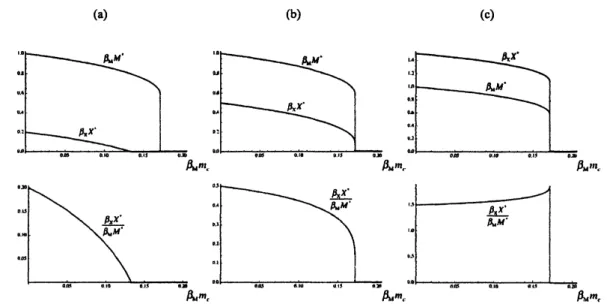
Figure 4: m.-dependenceofequilibrium population sizes atthe beginningof predationseason, that is, forthe
annual dynamics of (2) and (14) with the equilibriumstate approximation (8). (a) $rx=1.2;(b)rx=1.5;(c)$
$r_{X}=2.5$
.
Commonly, $r_{M}=2.0$. In caeeof (a), themimic population is extinct fora range of$m_{c}$ inwhich themodel population is persistent. Incasesof(b) and(c), themimicpopulationis persistent as longasthe model
population is.
Equilibrium
population
size ratio
Inthecasewhen the modelpopulationispersistentunderthose conditions(16)and (17), then, from (5),
we can show that the ratio of theirpopulation sizes approaches aconstant at any moment in the daily
dynamics ofany predationseason:
$\frac{X_{n,0}}{M_{n,0}}=\frac{x_{k}(t)}{m_{k}(t)}=u_{n}arrow\frac{X}{M^{*}}=\frac{\beta_{M}}{\beta_{X}}\cdot\frac{[r_{X}-1-m_{c}/\lambda_{+}]_{+}}{r_{M}-1-m_{c}/\lambda_{+}}$ (23)
as $narrow\infty$, where $[$ $]_{+}$ is defined as before. Numerical examples of$m_{c}$-dependence ofthe equilibrium
populationsizeratio aregiven in Fig. 4.
Wecaneasily find that $m_{c}/\lambda_{+}$ is monotonically increasing and$m_{c}+\lambda_{+}$ is monotonically decreasing
in terms of $m_{c}$. Since $m_{r}$, defined in (11) is monotonically decreasing between its minimum $P$ and
maximum $TP$ in terms of $\sigma^{-}$, the results ofour analysis indicate that the persistence of model and
mimicpopulation depends on thepredator$s$ ability of repulsivesearchimageformation. Moreover, it is
likely that thepredator‘sabilityofrepulsivesearchimageformation could determine thepopulation size
ratiobetween themimic and the model populations.
4
Concluding Remarks
As the predator‘s ability ofrepulsive search image formation is better, it is more likely for the model
population to persist, andthe
equilibri.um
model population size gets larger. This isbecause the betterability ofrepulsive search image formation indicates to repel the predator from the model population
so
as
to make the predation praesure weaker for it. This feature according to the predator‘s ability ofrepulsive search image formation can be adopted to the persistence and the equilibrium size of mimic
population,too. At thesametime, this result impliesthat theequilibrium populationsize ratiobetween
themodel and the mimic is affected bythepredator’s ability of repulsivesearch imageformation.
Beyondtheseresultsin thepopulation dynamical nature, wecould extendour resultto some
discus-sionsonthe evolution or the invasion ofmimicry from theviewpointof coexistenceofthemimicand the
model populations. Iiurther, wecould discuss the possiblecoevolutionary relation between the predator