Explicit
and
implicit
error
correction
methods
の基礎概念
Basic
concept
of
explicit
and
implicit
error
correction
methods
岩下武史 (京都大学), 美舩健 (京都大学), 島崎眞昭 (福井工業大学)
Takeshi Iwashita (Kyoto University), Takeshi Mifune (Kyoto University), and Masaaki
Shi-masaki (Fukui University ofTechnology)
1
Introduction
This
paper
introduces the explicit and impliciterror
correction methods recently proposed bythe
authors [1]. First,we
focuson a
similaritybetween
Hiptmair’s hybrid smoother [2] anda
(2-level) multigrid method [3]. Both methods use a coefficient matrix that is different to the
originalonein theerrorcorrection process. While thehybridsmootherusesthediscrete gradient
operator matrix, the multigrid method introduces coefficient matrices constructed
on
thecoarse
grids. We define a
new
class of sucherror
correction techniques in iterative solvers, whichwe
call the Explicit $emr$ correction $(EEC)$ method. Moreover, corresponding to this explicit
error
correction method,
we
have proposed the Implicit $emr$ correction $(IEC)$ method [1]. InSection
2,
we
introduce the detail of both these methods.Next,
we
showanexampleof the EEC andIECmethods inacontext ofan
electromagnetic fieldanalysis. In
a
finite element electromagnetic field analysis, it is necessary to solve a large linearsystem ofequations. Generally,
a
linear iterativesolver suchas
theICCG (Incomplete CholeskyConjugate Gradient) method is used for this purpose [4]. It is well-known that the A-phi
formulation
givesa
superiorconvergence
rate to theA-formulation
in theiterative
solver [5, 6].While several research papers have investigated the advantage of the A-phi method [7, 8], we
here provide another interpretation of its effectiveness. It is shown that the A-phi method
(formulation)
can
beseen as
an IEC method corresponding to Hiptmair’s hybrid smoother.The authors have, therefore, suggested that the A-phi method has a similar effect to that of
the hybrid smoother for the
error
that corresponds to the kemel of the discrete curl operatorKer(curl) [1]. Whereasthe hybrid smoother corrects these
errors
explicitly, the A-phi methodintroduces unknown variables for the electric scalar potential. Numerical results show that
the A-phi method reduces the
error
belonging to Ker(curl) in the conductive region, which isexplicitly corrected in the hybrid smoother, more efficiently than the A-method.
Next, it is shown that the IEC method can improve the condition ofa coefficient matrix. We
introduce
our
new
multigrid type iterative method, namely the Implicit correction multigridmethod [9], which is
an
IEC method corresponding toa
conventional multigrid method.Nu-merical results of a 2-D finite difference analysis show that the implicit correction multigrid
method achieves
a
convergence rate independent of the grid-size, which is the mostimpor-tant function of the multigrid method. Thus, the IEC method
can
improve the condition ofa
2
Explicit and
Implicit
Error
Correction
Methods
In this paper,
we
deal witha
following linear sysytem ofequations:$Ax=b$, (1)
where $A$ is
an
$n\cross n$ matrix, and$x$ and $b$
are
n-dimensional vectors. Whena
linear system(1) is solved by
an
iterative solver, theerror
correction method is often used. Let the currentapproximation for$x$be$\overline{x}$
.
The expliciterror
correction (EEC)methodisdefinedbythefollowing
two steps. The first step is to determine
error
quantity $\overline{y}$ using the following linear system:$Cy=d(\tilde{x})$
.
(2)When the dimension of$y$ is denoted by $m$, the coefficient matrix $C$ is
an
$m\cross m$ matrix. Them-dimensional vector $d$ is given by a function of the current approximation $\tilde{x}$. In general, the
dimension $m$ is sufficiently smaller than $n$
.
Applyingan
iterative method suchas a
relaxationmethod
or
a
direct solver to (2),we
get an mdimensional vector $\tilde{y}$, which isan
approximationof$y$
or
exactly $y$.
The second step is, then, given by the update ofthe approximation $\tilde{x}$:$\tilde{x}^{new}arrow\tilde{x}+B\overline{y}$, (3)
where matrix $B$ is an $n\cross m$ matrix.
We here proposethe implicit
error
correction (IEC) method, inwhichthe original linear system(1) and the (reduced dimensional) linear system for error correction (2) are combined. The
implicit
error
correction method is derivedas
follows. First, whilewe
pay attention to (3),the solution vector $x$ in (1) is replaced by $\hat{x}+B\hat{y}$, where $\hat{x}$ and
$\hat{y}$
are
n-dimensional andm-dimensional vectors, respectively. This means that the solution vector is described by $\hat{x}+B\hat{y}$
.
Consequently,
we
obtain$A\hat{x}+AB\hat{y}=b$ (4)
insteadof(1). Next,
we
consider the linear system for determining theerror
correction quantity(2). In most explicit
error
correction type methods, the linear system (2) Is given by therestricted residual equation of (1). In this case, $d$ is written
as
a matrix-vector product $Dr$,where $D$ is
an
$m\cross n$ matrix and $r=b-A\tilde{x}$ is the residual vector. Then, inthe IEC method,
we
replace $d(\tilde{x})$ in (2) by $D(b-A\tilde{x})$. Accordingly, we get$DA\tilde{x}+Cy=Db$
.
(5)By rewriting vectors $\tilde{x}$ and
$y$ by $\hat{x}$ and
$\hat{y}$, respectively,
we
finally obtain the matrix form of theIEC method
as
follows:$(\begin{array}{ll}A ABDA C\end{array})(\begin{array}{l}\hat{x}\hat{y}\end{array})=(\begin{array}{l}bDb\end{array})$
.
(6)In the proposed method, the linear system ofequations (6) instead of (1) is solved by
a
(pre.conditioned) iterative method. The solutionofthe original linear system (1) is givenby $\hat{x}+B\hat{y}$
.
It is expected that the iterative solution process produces the effect of the error correction
implicitly. In other words, the linear system derived from the IEC method (6) is expected to
3
Relationship
Between
A-phi
Method and Hybrid
Smoother
In this paper, we deal with a quasi-static electromagnetic fieldproblem. It is assumed that the
analyzed domain $\Omega$ is a simply connected domain. For simplicity, we do
not describe the effect
of the boundary in the following. The basic equation based
on
theA-formulation
is given by$\nabla\cross(\nu\nabla\cross\vec{A}_{m})+\sigma\frac{\partial\vec{A}_{m}}{\partial t}=\vec{J_{0}}$,
(7) where $\vec{A}_{m},$
$\nu,$ $\sigma,$
$t,\vec{J_{0}}$
are
the magnetic vector potential, the magnetic reluctivity, the electricalconductivity, time, and the excitingcurrent, respectively. It is notedthat $\nabla\cdot\tilde{J_{0}}=0$ is satisfied.
The basic equation based
on
the A-phi formulation is given by$\nabla\cross(\nu\nabla\cross A_{m}^{\vec{/}})+\sigma\frac{\partial(A_{m}^{\vec{\prime}}+\nabla\phi)}{\partial t}=\vec{J_{0}}$,
(8)
$\nabla\cdot(\sigma\frac{\partial(A_{m}^{\vec{/}}+\nabla\phi)}{\partial t})=0$,
(9)
where $A_{m}^{\vec{\prime}}$ is also the magnetic vector potential and $\phi$ is the electric scalar potential.
When
a
finiteelement discretizationwith edge elements anda backward time differencemethodare
applied to (7), the resulting linear system of equations is given by$K_{A}x_{A}=(C_{u}^{T}M_{\nu}C_{u}+ \frac{M_{\sigma}}{\Delta t})x_{A}=b_{A}$, (10)
where $\Delta t$is the length ofthe timestep,
$x_{A}$ isthe unknown vector that represents the magnetic
vector potential tobecalculated, and the right-hand side$b_{A}$ isdetermined by thepreviousvalue
ofthe magnetic vector potentialand the exciting current. When the number of edges and faces
are
denoted by $e$ and $f$, respectively, the matrix $C_{u}$ isan
$f\cross e$ matrix, which is given by thediscrete curl operator. The $f\cross f$ matrix $M_{\nu}$ and the $e\cross e$ matrix $M_{\sigma}$
are
given by$[M_{\nu}]_{ij}= \int_{\Omega}\nu\vec{w}_{i}^{f}\cdot\vec{w}_{j}^{f}dV$, $[M_{\sigma}]_{ij}= \int_{\Omega}\sigma w_{i}^{\neg e}\cdot\vec{w}_{j}^{e}dV$, (11)
where $\vec{w}^{f}$ and $\vec{w}^{e}$
are a
face-element basis function andan
edge-element basis function,respec-tively.
In thispaper,
we
consider theuse
of Hiptmair’s hybrid smoother [2] in the A-method. Althoughthe hybrid smoother consists of a normal Gauss-Seidel sweep and
a
specialerror
correctionprocess, the latter correction process is key to the method. Thus, we discuss only the
error
correction process in the following. When Hiptmair’s hybrid smoother is applied to (10), the
error
correction procedure can be written in the form ofan EEC methodas
follows:$d(\overline{x}A)=G^{T}(b_{A}-K_{A}\tilde{x}_{A})$ (13)
in (2), and
$B=G$, (14)
where$\tilde{x}_{A}$ isthe current approximationfor
$x_{A}$ and $G$ is
a
discretegradient operatorthat satisfies $C_{u}G=0$.
The matrix$C$is also writtenas
$G^{T}K_{A}G$.
From (6), (10), (12), (13), and (14) andthe relationship between $C_{u}$ and $G$,we
obtain the linear system oftheIEC
method corresponding
to the hybrid smoother
as
follows:$(\begin{array}{ll}K_{A} K_{A}GG^{T}K_{A} G^{T}K_{A}G\end{array})(\begin{array}{l}\hat{x}_{A}\hat{y}_{A}\end{array})$
$=$ $(\Gamma^{1}\iota^{G^{T}M_{\sigma}}K_{A}$ $\tau_{t^{c^{M_{\sigma}G}}}^{1^{\Gamma^{1}t}\tau_{M_{\sigma}G}})(\begin{array}{l}x_{A}\hat{y}_{A}\end{array})=(\begin{array}{l}b_{A}G^{T}b_{A}\end{array})$
.
(15) The coefficientmatrix in (15) is identicalto the coefficient matrix arising from the finiteelement discretization of (8) and (9). Moreover, since the initial condition that $\hat{x}_{A}=x_{A}$ and $\hat{y}_{A}=0$ is
normally set at $t=0,$ $xA=\hat{x}_{A}+G\hat{y}_{A}$ is satisfied ineach time step. Consequently, the right-hand
side of (15) is the
same
as the right-hand side derived from (8) and (9). Therefore, the linearsystem of the IEC method that corresponds to the hybrid smoother (15) coincides with the
linear system of equations derived from the A-phi method. Thus, the A-phi method
can
beregarded
as
the implicit version of theerror
correction of Hiptmair’s hybrid smoother.4
Implicit
Correction
Multigrid
Method
In this section,
we
introduce the implicit correction multigrid method [1, 9], in which the linearsystems of equations
on
all levels ina
conventional multigrid methodare
combined and aresolved simultaneously using
a
(preconditioned) iterative method. We first introduce the 2-levelimplicit correction multigrid method. In a conventiona12-level multigrid method, the
coarse
grid correction for (1) is given in the form of the explicit
error
correction methodas
follows:$C=A^{H}$, (16)
$d(\overline{x})=I_{h}^{H}(b-A\tilde{x})$, (17)
and
$B=I_{H}^{h}$, (18)
where $A^{H}$ is the coefficient matrix
constructed
on
thecoarse
grid, and $I_{h}^{H}$ and $I_{H}^{h}$are
therestriction and prolongation operators, respectively. From (6), (16), (17), and (18), the linear
system of the (2-level) implicit correction multigrid method that corresponds to the
coarse
gridcorrection is given by
where $x^{H}$ is
an
unknown vector with the dimension of thecoarse
grid.The linear system for the multi-level implicit correction multigrid method is derived from the
recursive application of the 2-level implicit correction multigrid method to the original linear
system (1). Here,
we
denote the linear system arising from the proposed method, for $0$ to $k$levels, by
$T^{k}x_{t}^{k}=b_{t}^{k}$. (20)
When
we
solve (20) bymeans
of the 2-level implicit correction multigrid method, the resultinglinear system is given by
$(I_{k}^{k+1}T^{k}T^{k}$ $T^{k}I_{k+1}^{k}A^{k+1})(x^{k+1}x_{t}^{k})=(\begin{array}{l}b_{t}^{k}I_{k}^{k+l}b_{t}^{k}\end{array})$ , (21)
where $A^{k+1}$ and $x^{k+1}$ are the coefficient matrix and the unknown vector on the $k+$llevel,
respectively, and $I_{k}^{k+1}$ and $I_{k+1}^{k}$
are
the restriction and prolongationoperatorsbetween the k-thand $(k+1)$-th levels, respectively. Applying (21) to (1) recursively,
we
finally obtain the linearsystem for the l-level implicit correction multigrid method
as
follows:$(\begin{array}{lll}S^{0,0} \cdots S^{0,l}| \ddots |S^{l,0} \cdots S^{l,l}\end{array})(\begin{array}{l}x^{0}|x^{l}\end{array})=(\begin{array}{l}f^{0}|f^{l}\end{array})$ , (22)
where
$S^{\alpha,\alpha}=A^{\alpha}$, (23)
$S^{\alpha,\beta}=A^{\alpha}I_{\alpha+1}^{\alpha}I_{\alpha+2}^{\alpha+1}\cdots I_{\beta}^{\beta-1}(\alpha<\beta)$, (24)
$S^{\alpha,\beta}=I_{\alpha-1}^{\alpha}I_{\alpha-2}^{\alpha-1}\cdots I_{\beta}^{\beta+1}A^{\beta}(\alpha>\beta)$, (25)
$f^{\alpha}=I_{\alpha-1}^{\alpha}I_{\alpha-2}^{\alpha-1}\cdots I_{0}^{1}b$, (26)
$A^{0}=A$, and $f^{0}=b$
.
In the proposed method, the linear system (22) is solved usinga
preconditioned iterative method. The solution vector of the original linear system (1) is given
by $x=x^{0}+ \sum_{k=1}^{l}\{(\prod_{p=1}^{k}I_{p}^{p-1})x^{k}\}$
.
5
Numerical
Results
5.1 Effect of the A-phi
Method
In this subsection, we examine the effect of the
error
correction in the A-phi method. The testproblem is the TEAM (Testing Electromagnetic Analysis Method) workshop problem 10 [10].
The test model is discretized by using tetrahedrafinite elements (Whitney elements), with the
number of elements equal to 5968, and $\Delta t$ set to $10^{-3}(s)$
.
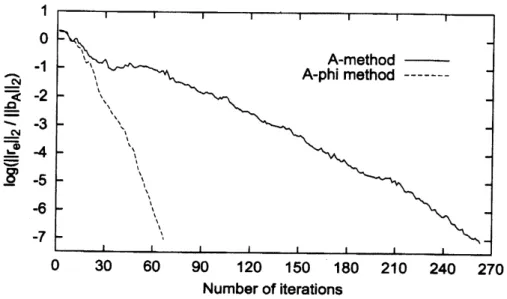
The linear system in the first timeNumber ofiterations
Figure 1: Comparison of
convergence
between
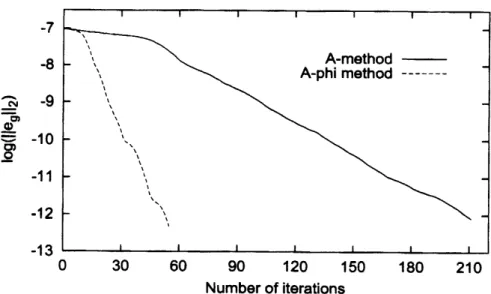
A-method and A-phi method$e_{g}$ of the kemel ofthe
discrete
curl operator $Ker(cur1)$ in the conductive region ofthe model.
WhereasHiptmair’s hybrid smoother corrects this
error
explicitly, Fig. 2indicates thattheerror
$e_{g}$ can be efficiently removed in the A-phi method. Moreover, while we
calculate the 2-norm
ratio of$e_{9}$ with respect to thetotal
error
inthe conductive region for the A-method, the ratio ishigher than
0.9
in mostof iterations. Thus, the$Ker(cur1)$error
causes
the slowconvergence ratein the A-method. Accordingly, the A-phi method has the effect of (implicit)
error
correction of$e_{g}$
as
in the hybrid smoother, and therefore achieves the advantage in convergence.5.2
Effect
of the ImplicitCorrection
MultigridMethod
In this subsection,
we
examine the effect ofthe implicit correction multigrid method. The testproblem isgiven
as
a linear systemof equationsderived froma
2-D Poissonequationdiscretizedby afive point difference method. Figures3 and 4 show acomparison ofconvergence behaviors,
where $iMG$”
implies the implicit correction multigrid method. When the CG (Conjugate
Gradient)
or
ICCGmethod isapplied to the originallinearsystem, theconvergenceratedeclinesrapidly
as
the problem sizeincreases. On the other hand, when the linear system basedon
theimplicit correction multigrid method is solved using the CG method, the number of iterations
necessary
forconvergenoe
does not really depend on theproblem size. Since the proceduredoesnot include
any
conventional multigrid process, thisresult indicates that the implicit correctionmultigrid method includes the
coarse
grid correction effect. Moreover, it is shown that thecondition number ofthe coefficient matrix of the implicit multigrid method is improved from
Number ofiterations
Figure 2: Convergence behavior of the
error
of the kemel of the discrete curl operator in theconductive region
5.3
Effectiveness
of
ImplicitError Correction Method
Numerical results indicate that the IEC method improves a condition ofthe coefficient matrix
and attains a similar effect
as
the corresponding EEC method. Wenow
consider the conditionunder which the IEC method works well. In general, an EEC type method is introduced for
correction of the
error
$e_{s}$ that satisfies $Ae_{s}\simeq 0$.
When $A$ is positiveor
semi-positive definite,these
errors
belong toa
space spanned by the eigenvectors having small eigenvalues, whichwe
denote by $V_{s}$
.
Accordingly, it is expected that the IEC methodcan
work well when the range
of $B$ gives
a
good approximation of$V_{s}$.
In thiscase, $D$ and $C$can
simply be setas
$D=B^{T}$ and$C=B^{T}AB$ (Galerkin approximation), respectively, and then the enlarged linear system (6) is
written
as
a
following singular linear systcm:$(\begin{array}{ll}A ABB^{T}A B^{T}AB\end{array})(\begin{array}{l}x\hat{y}\end{array})=(\begin{array}{l}bB^{T}b\end{array})$. (27)
In
our
numerical tests, the implicit correction multigrid method shows goodconvergence
per-formance under the above condition, even though the coefficient matrix on coarse levels can be
constmcted using other strategies. In [11],
we
have discussed the condition of the matrix$B$ formaking the IEC method work well.
6
Conclusion
This paper introduces proposed
an
impliciterror
correction method that corresponds to the$\mathring{=}E$ コ $\underline{\frac{\varpi}{q\Phi^{)}}}$ $\geq\Phi$ $o\tilde{\frac{\varpi}{e\Phi}}$
Number
ofiterations
Figure 3: Comparison of
convergence
behaviors (15 $\cross 15$ grid)correction in a multigrid method. It is shown that the A-phi method can be regarded as an
implicit
error
correction version of the hybridsmoother. Fhrthermore, numericaltestsshowthatthe A-phi methodhas a similar effect on the correction ofthe
error
ofthe kernelofthe discretecurl operator
as
that of the hybrid smoother, which results in an advantage in convergence.Next, we introduce the implicit correction multigrid method by applying the implicit
error
correctionconcept to the multigrid method. It is shown that the proposed method achieves the
convergence
rate independent of the problem size. This result confirms the strong relationshipbetween
theexpliciterror
correctionmethodand the impliciterror
correction methodandshowsthe effectiveness of the proposed method.
References
[1] T. Iwashita, T Mifune and M. Shimasaki,
“Similarities
between implicit correctionmulti-grid method and A-phi formulation in electromagnetic field analysis”, IEEE Thans. Magn.,
vol.44, pp. 946-949, June, 2008.
[2] R. Hiptmair, “Multigrid method for Maxwell’s equations,” SIAM J. Numer. Anal., vol.36,
pp. 204-225, Dec. 1998.
[3] P. Wesseling, An introduction to multigrid methods, JohnWiley&Sons Ltd.,
1992.
Corrected$CO\subseteq$ コ $\underline{\Phi\frac{\mathring}{\omega}}$ $\geq\omega$ $\check{\underline{\varpi}}$ $oe\omega$
Number
ofiterations
Figure 4: Comparison of
convergence
behaviors (127 $\cross 127$ grid)[4] Y. Saad, Iterative Methods
for
Sparse LinearSystems, Second ed., Philadelphia, PA: SIAM,2003.
[5] K. Fujiwara, T. Nakata, and H. Ohashi, “Improvement of convergence characteristic of
ICCG method for the $A-\phi$ method using edge elements”, IEEE Trans. Magn., vol.32,
pp. 804-807, May 1996.
[6] R.D. Edlinger and $0$
.
Biro, “A joint vector and scalar potential formulation for drivenhigh frequencyproblemsusing hybrid edge and nodal finite element,” IEEE Tmns. Microw.
Theory Tech., vol.44, pp. 15-23, Jan. 1996.
[7] H. Igarashi and T. Honma, “On convergence
ofICCG applied to finite element equation for
quasi-static fields,” IEEE Trons. Magn., vol.38, pp. 565-568, Mar. 2002.
[8] B. Weiss and O. Biro, “On the convergence of transient eddy-current problems,” IEEE
$\pi ans$
.
Magn., vol.40, pp. 957-960, Mar. 2004.[9] T.Iwashita, T. Mifune, and M. Shimasaki,“
New multigrid method: basicconceptofimplicit
correction multigrid method,” IPSJ $\pi_{ans}$
.
Advanced Computing Systems, vol.48 (ACS18),pp. 1-10, May 2007 (In Japanese).
[10] T. Nakata, N. Takahashi, and K. lfujiwara,“Summary
of the results for
benchmark
problem[11] T. Mifune, S. Moriguchi, T. Iwashita, and M. Shimasaki, “Convergence