The Efficacy of Reflection in Narrative
Production: Can a Reflective Session
Facilitate the Use of Mental State Talk in
Narrating a Story ?
著者名(英)
Hiromi TSUJI
journal or
publication title
大阪樟蔭女子大学研究紀要
volume
5
page range
27-33
year
2015-01-31
URL
http://id.nii.ac.jp/1072/00003898/
Reflective practices
A notion of a “reflective practitioner” was pro-posed by Schon (1983) and has been widely recog-nized in education and social care services (Kinsella, 2010). This trend is also occurring in the Japanese education system. The term “reflective practitioner” has been introduced in textbooks for childcare training courses, for example. This would suggest that students in education courses are expected to be aware of this concept. However, knowing this concept does not guarantee it’s use in practice. Teaching students how to become a “reflective practitioner” is a key question for train-ing institutions in education. To address this prob-lem, it might be important for learners to experi-ence “reflective processes”. Sch n maintains that a reflection practice, in which one’s own behaviours are assessed critically by oneself, includes reflec-tion-in-action and reflection-on-action. Reflection-in-action is reflecting about yourself or your behaviours during on-going practices, whereas re-flection-on-action is reflection after your action.
In this study, the term reflection refers to the lat-ter meaning. The present study aims to examine the efficacy of reflection-on-action, thereby intro-ducing deliberate reflective experiences in students’ learning.
Linguistic strategies in narratives
To evaluate ‘reflection’ on narratives, we investi-gated evaluative strategies, which are linguistic functions that narrators use in producing narra-tives. The evaluative function is one of the compo-nents of a narrative (Labov & Waletzky, 1967), and goes beyond the referential function in which events are described, and reflects the story teller’s interpretations of the consequence of events or in-ferences about a particular mental state (Bamberg & Damrad-Frye, 1991). The ability to use evalua-tive functions has been reported to vary both devel-opmentally and culturally (Kuntay & Nakamura, 2004). Given that the use of evaluative strategies re-lates in part to the development of metacognition (Flavell, 1979), it is possible that evaluative
大阪樟蔭女子大学研究紀要第5 巻(2015) 研究論文
The Efficacy of Reflection in Narrative Production:
Can a Reflective Session Facilitate the Use of Mental
State Talk in Narrating a Story?
Faculty of Psychology, Department of Psychology
Hiromi TSUJI
Abstract:The efficacy of reflection in narrative production was examined. The evaluative strategies used by fe-male university students (N=52) in the production of a narrative were assessed before and after a reflective ses-sion. In the reflection session, the participants were asked to compare and contrast their evaluative strategies used in narrative with the developmental data drawn from a previous study. The frequency of evaluative strate-gies increased significantly after the reflective session. The largest increase was in the frequency of use of frames of mind in which the narrator refers to the mental states of the protagonists. The students’ use of strate-gies, such as: frames of mind and causal connectors were correlated, suggesting that personal style may be rela-tively stable over time. The implications of introducing a reflection session are discussed.
strategies used in narratives may change if one’s metacognitive thinking is stimulated during a re-flective practice.
Although little attention was given to the indi-vidual differences in evaluative devices for adults, there is tentative evidence for group differences in evaluative strategy use between female university students studying different disciplines and also be-tween students and young mothers (Tsuji, 2013; Tsuji & Toi, 2011). It is worth noting that both mothers and students studying early years educa-tion tended to use more sound symbolic words such as onomatopoeia and mimetic, and less men-tal state references compared to female university students in other disciplines.
In the early development of social understand-ing, mental state references that children hear in conversations with adults are known to be impor-tant (Dunn, Brown, & Beardsall, 1991; Ensor, Devine, Marks, & Hughes, 2014). Thus, investigat-ing the evaluative aspect of narratives used by peo-ple who interact with young children could extend our understanding of individual differences. If a re-flective practice makes a difference in evaluative strategies used in narrative production, then this process could also contribute to a training programme for parents and early years teachers.
The present investigation involves two analyses to address the efficacy of a reflective practice in narrative production. The first is a comparison of the frequency of evaluative strategy use between Time 1 and Time 2, with an intermission that in-cluded a reflective session. The second examines the relationships between the use of these strate-gies both within and between Time 1 and Time 2. Method
Participants.
52 female university students (Mage=19.1, SDage
=.39) who were enrolled on an early years educa-tion course participated in this study and were awarded a course credit for their participation. Procedure.
Narrative production at Time 1
In an induction session for their course, the
participants were asked to view 24 scenes depicted in a picture book Frog, where are you. After view-ing these scenes, they were asked to narrate a story based on these pictures as if they were tell-ing the story to preschool children. Their narra-tives were then written up.
Reflection session for their narratives.
In a following session, they were instructed to ex-amine their narratives with reference to a previ-ous cross-linguistic developmental study on narra-tive strategies (K ntay & Nakamura, 2004). The de-velopmental data comprises of mean frequency of strategy use for children aged 4, 5, 7, and 9 years old and for adult Japanese-speakers. The students were asked to check if any of the 7 categories were used in their own narratives and their frequency of strategy use was also computed. They were then asked to write about how their narrative strategy differed from the developmental data pro-vided in the previous study. Also, they were asked to consider how they would be able to improve their narratives. Their reflective thoughts were re-corded in a written form.
Narrative production at Time 2
In the final session of the course, which oc-curred approximately 14 weeks after the induc-tion, the students were asked to narrate the same picture book story. They received a copy of their previous narratives and their reflective sheet, which was completed after the first narrative ses-sion. No instructions were given on how to use the reflection sheet. At the end of this narrative pro-duction, the students were asked to comment on their narrative in response to the question ‘what did you consider when you produced this narra-tive?’
Data analyses.
The narratives were coded for the following cate-gories based on K ntay and Nakamura (2004): 1) Frames of mind, which included expressions of the mental states of the characters; Hedges : linguistic devises used to signify a narrators epistemological state on the true value of the proposition ex-pressed; Character speech : direct statements made in a speech-like form on behalf of a character;
Causal Connector : use of a certain sentence struc-tures to inform a causal framework between the events in a narrative; and Onomatopoeia : a sound symbolic device to indicate the vividness of sound or movement. Full descriptions of each category can be found in (K ntay & Nakamura, 2004).
Two independent coders coded all the narrative data. Inter-rater agreements were assessed to com-pute reliability. Cohen’s kappa reached .91 for the Time 1 and .95 for Time 2 narratives. All discrepan-cies were resolved by discussion.
Results
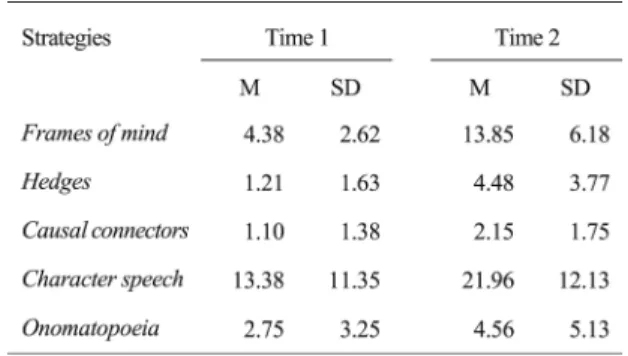
Descriptive statistics for the frequency of strat-egy use in narratives for Time 1 and Time 2 are summarised in Table 1.
Comparisons for the frequency of strategy use be-tween Time 1 and Time 2
The narratives were produced on two separate oc-casions, with a self-reflective analyses preceding the second narrative. They were compared in two
ways. One method used direct comparisons be-tween Time 1 and Time 2 for the frequency of strat-egy use to examine the changes before and after the reflection session; and the second method used correlational analyses to examine the stability of personal trends in the frequency of strategy use as well as inter- category relationships. Due to the deviation from a normal distribution for some fre-quency data, additional non-parametric tests were performed. If the results were the same, then the parametric tests were reported; otherwise the re-sults of non-parametric tests were reported.
The frequency of strategy use was compared be-tween Time 1 and Time 2. All strategies increased significantly from Time 1 to Time 2: t(51)=10.7, p<.001, d=1.48, for Frames of mind ; t(51)=5.79, p<.001, d=.80 for Hedges, t (51)=3.09, p<.001, d= .54 for Causal connectors, t (51)=4.02, p<.001, d= .55 for Character speech, t (51)=2.26, p=.28, d=.31 for Onomatopoeia (Figure 1). The frequency for all strategies used changed over time.
Correlational analyses between and within the nar-ratives.
A correlational analyses between strategy use at Time 1 and Time 2 were performed. Table 2 summarises the spearman correlation coefficients. As for the stability within the strategy use, a sig-nificant correlation between Time 1 and Time 2 was found for the use of Onomatopoeia, suggest-ing that the students who used more onomato-poeia in the Time 1 narrative also tended to use
Table 1. Means and standard deviations for strategy use
more onomatopoeia at Time 2. On the other hand, other categories did not show stability. This would suggest that with the exception of onomato-poeia, the students’ narrative strategies changed over time.
There were a few significant correlations be-tween the different strategies for Time 1 narrative and Time 2 narratives. For Time 1, Frames of mind correlated positively with Hedges and Causal connectors, whereas Character speech correlated positively with Hedges and Onomatopoeia. For Time 2, Frames of mind correlated positively with Causal connectors but Hedges was only approach-ing a significant level. Character speech correlated positively with Onomatopoeia but not with Hedges. In addition, Onomatopoeia correlated negatively with Causal connectors.
Correlation between strategies across Time1 and Time 2 indicated that Frames of mind and Causal connectors at Time 1 correlated negatively with Character speech at Time 2.
Students’ evaluation for Time 2 narratives
41 students out of 52 (79%) provided comments on their narrative at the end of the session for Time 2. A few students mentioned more than two strategies. The most mentioned strategies were Frames of mind and Character speech : 25 students commented on their awareness of Frames of mind ; 18 students commented on Character speech in which 13 students mentioned their intention to in-crease their use whereas 5 mentioned their inten-tion to decrease the use of the same strategy. Four students commented on Onomatopoeia. The
least mentioned strategies were Hedges and Causal connectors, which were only mentioned by one student, for each strategy. In addition they made comments such as: “trying to take a third person’s perspective”, “tried not to be very childish”, “tried to put myself into the protagonists’ shoes” and “tried to give concrete detailed accounts so that children can visualize without pictures”. Discussion
The present study examined the students’ narra-tives at two points in time with a reflective session in-between them. The frequency of use for all the strategies changed in the students’ narratives. A significant increase with a larger effect size was found for Frames of mind. When the individual changes for the frequency of use were examined closely, with the exception of two students, all stu-dents increased their use of this strategy.
The previous data of K ntay, & Nakamura (2004) indicated that Frames of mind was the most frequently used strategy, whereas for the students in the present study the frequency of use of this strategy was almost half of that reported in the previous study. In line with the students’ com-ments on Frames of mind reported above, the re-flection using objective data could have caused this change in the frequency of use.
The next largest change was found in Hedges, with 46 out of 52 students increasing their fre-quency of use. Causal connectors and Character speech showed moderate effect sizes. Character speech presented interesting changes in which 12
students actually decreased their use of this strat-egy, whereas all other students increased their use. These bi-directional changes are likely to be re-lated to the students’ reflection and a wider individ-ual variability. In the reflection session, those who had not used any Character speech at all in the first narrative might have felt that it is necessary to use this strategy, whereas those who had al-ready used this strategy might have felt the need to use other strategies such as Frames of mind.
With respect to the efficacy of a reflection ses-sion, the increase in the frequency of use for all strategies suggests that there were some positive outcomes in that the students became aware of their strategy use in comparison to the adults data drawn from the previous study (K ntay & Nakamura, 2004) and made some effort to change their use of strategies in their production of the sec-ond narrative. However, it is too na ve to draw a conclusion based on the increase in the frequency of strategy use, which only addresses the quantity but not quality of narrative production. Further, an increase may not necessarily be a positive out-come in the quality of the narrative for early years education.
The correlational analyses between different strategy uses may address the qualitative aspect of individual differences. At Time 1 and Time 2 Frames of mind was related to Causal connectors. This relation was held across time, suggesting that those who tended to use more mental state references in their narratives also used more Causal connectors. This result was in line with a previous study of Japanese narratives (K ntay & Nakamura, 2004). This tendency indicates that peo-ple who narrate a story using these strategies in-terpreted a relationship between the narrated events by filling implicit gaps with linguistic refer-ences to the mental states of the protagonists. How-ever, it is interesting to note that such tendencies were not found in the Turkish narrative in the aforementioned study (K ntay & Nakamura, 2004), suggesting that this trend may have cross-cultural differences.
Character speech correlated positively with
Onomatopoeia and this trend remained at Time 2. This result suggests that those who tended to use more Character speech also used more Onomato-poeia. These correlational results suggest that the way in which people use evaluative strategies var-ies individually, and this personal tendency seemed robust over time. However, there was a change in the relationship between Character speech and Hedges over time. At time 2, a positive relation-ship between Character speech and Hedges disap-peared, suggesting that there were some effects of reflection on the qualitative changes in the subse-quent narratives, though we do not yet know the exact mechanism for changes in quality.
Inter-strategy relationships over time suggest that those who initially used more Frames of mind and Causal connectors used less Character speech at Time 2. As Frames of mind and Causal connectors did not correlate with Character speech at Time 1, it is likely that people who tended to use Frames of mind and causal connectors initially used less Character speech after the reflection ses-sion. The relationship can also be regarded as a sign of qualitative change between the two time points.
So far the analyses have suggested some effect of reflection used in the present study for bring-ing changes in evaluative strategy in narratives. In terms of quantity of strategy use, given a refer-ential framework such as the numerical figures drawn from the previous study, observable changes are likely to occur. However, in terms of quality, how people produce narratives may not be so easily changed. It may be that one reflective ses-sion is not sufficient to produce significant changes. Nevertheless, this study indicated some aspects of the evaluative strategy could be changed as a consequence of reflection as seen in the students’ comments, if the direction of a reflec-tive process is systematically navigated.
One of our intentions in implementing the reflec-tive processes in narrareflec-tive production is to apply such a reflective session to facilitate parents and early years educators in their use of mental state references. Although there are personal styles for
narrating a story and no single style outperforms the rest, evidence from developmental psychology suggest a causal relationship between mental state references and child social understanding. For par-ents and early years educators such evidence can be borne in mind when they tell a story to young children.
The present study focused on reflection-on ac-tion and found that implementing a reflective ses-sion changed the students’ performance. The pre-sent study suggests that if there is a deliberate practice of introducing reflective sessions, then the students are able to reflect upon their outcomes, which brings about some changes. However, how reflection practice comes about spontaneously is another issue. As Sch n (1983) claimed, reflection-on-action is a retrospective practice we often use, especially when things go wrong. For educational practitioners, it is necessary to put such processes into practice spontaneously. Thus, reflection-in-action also needs to be considered as it is impor-tant to monitor on-going interaction with young children and make amendments when necessary.
Finally, the future direction of this line of study is addressed. The reflection session used in the pre-sent study was a one-off occasion for students’ learning. If the reflective processes are expected to bringing about extensive outcomes, it is important to locate such processes systematically and such processes need to be evaluated.
References
Bamberg, M., & Damrad-Frye, R. (1991). On the ability to provide evaluative comments: fur-ther explorations of children’s narrative competences. Journal of Child Language, 18, 689-710.
Dunn, J., Brown, J. R., & Beardsall, L. (1991). Fam-ily talk about feeling states and children’s later understanding of others’ emotions. Devel-opmental Psychology, 27 (3), 448-455.
Ensor, R., Devine, R. T., Marks, A., & Hughes, C. (2014). Mothers’ Cognitive References to 2-Year-Olds Predict Theory of Mind at Ages 6 and 10. Child Development, 85 (3), 1222-1235. doi: 10.1111/cdev.12186
Flavell, J. H. (1979). Metacognition and cognitive monitoring: A new area of cognitive-develop-mental inquiry. American Psychologist, 34 (10), 906-911. doi: 10.1037/0003-066X.34.10.906 Kinsella, E. A. (2010). Professional knowledge and
the epistemology of reflective practice. Nurs-ing Philosophy, 11 (1), 3-14. doi: 10.1111/j.1466-769X.2009.00428.x
K ntay, A. C., & Nakamura, K. (2004). Linguistic strategies serving evaluative functions: A com-parison between Japanese and Turkish Narra-tives. In S. Str mqvist & L. Verhoeven (Eds.), Relating events in narrative (Vol. 2: Typologi-cal and contextual perspectives, pp. 329-358). Mahwah: Lawrence Erlbaum Associates. Labov, W., & Waletzky, J. (1967). Narrative
analy-sis: Oral versions of personal experience. In J. Helm (Ed.), Essays on the verbal and visual arts (pp. 12-44). Seattle, WA: University of Washington Press.
Sch n, D. (1983). The reflective practitioner New York: Basic Books.
Tsuji, H. (2013). Differences in the narrative styles of female university students: implications for maternal use of linguistic strategies for storytelling to children. Research bulletin of Osaka Shoin Women’s University, 3, 55-62. Tsuji, H., & Toi, Y. (2011). Story telling to
chil-dren: what differences are related to child-rearing experiences? Paper presented at the Pa-cific Early Childhood Education Research As-sociation 12th Annual Conference, Kobe, Ja-pan.
Acknowledgement
This study was supported by JSPS grants: KAKENHI #2453805.