Promoting a Modified Early Essential Newborn
Care Program for Indonesian Midwives:
A Feasibility Study
Miyuki OKA1 ) Yasuko NAGAMATSU1 ) Yenita AGUS2 ) Kana SHIMODA1 )
Sachiko SAKURAI3 ) Shigeko HORIUCHI1 )
インドネシア助産師に向けた早期必須新生児ケアトレーニング
―実行可能性の検討―
岡 美雪1 ) 長松 康子1 ) Yenita AGUS2 ) 下田 佳奈1 ) 櫻井佐知子3 ) 堀内 成子1 )
〔Abstract〕
Objectives:Neonatal mortality remains high in Indonesia with 14 deaths per 1000 births in 2016. In the same year, the World Health Organization developed a neonatal resuscitation training program called Early Essential Newborn Care (EENC). We incorporated and adjusted components of this training pro-gram into our modified newborn care course propro-gram which includes first embrace, breastfeeding, and cord care. Here, we assessed the feasibility of our modified EENC program to fit the settings for Indo-nesian midwives.
Methods:We used a qualitative descriptive study design. We conducted our modified EENC program at a clinical simulation room in an Islamic university in Jakarta, Indonesia in October 2017. This was a 5-hour educational program consisting of lectures, demonstrations, questions and answers, and group discussions. The participants took part in focus group discussions (FGDs) after the program. These FGD questions were used to obtain qualitative data: 1)“How was the educational program?” and 2) “What are some difficulties in implementing this program at your work setting?”. Qualitative data were
analyzed using content analysis.
Results:A total of 16 female midwives (mean age: 46.6 years; range: 36-60) participated. Qualitative analysis of the FGDs yielded three categories of the program: 1)“Acceptability as practical program”, 2)“Demand for practical program”, and 3)“Barriers and countermeasures for implementation”.
Conclusion:Our modified EENC program fits the settings for Indonesian midwives. There is a high demand for learning new procedures of newborn care. However, there are some barriers to implement-ing new procedures in the settimplement-ings for Indonesian midwives.
〔Key words〕
feasibility study, midwifery, early essential newborn care, simulation training, Indonesia〔要 旨〕
目的:世界保健機関は新生児死亡率の改善のために,医療者に向けた早期必須新生児ケアプログラムを開 1 ) St. Luke’s International University, Graduate School of Nursing Science
2 ) Syarif Hidayatullah State Islamic University, Jakarta, Indonesia
3 ) St. Luke’s International University, Graduate School of Nursing Science, Master’s Program
受付 2019年9月22日 受理 2019年11月22日
Ⅰ.Introduction
Globally, 2.5 million newborns die in their first month every year, with the overwhelming majority coming from low- and middle-income countries1 ).The United Nations Sustainable Development Goals (SDGs)2 ) item number 3.2 specifies the aim to ‘end preventable deaths of newborns in all countries aiming to reduce neonatal mortality to as low as 12 deaths per 1000 live births by 2030’. However, despite making progress in reducing the global mortality of children aged < 5 years, improvements in the neonatal mortality and death rates remain delayed. In Indonesia, the neonatal mortality rate is relatively high at 14 deaths per 1000 births in 20163 ).
Neonatal mortality is usually high during the first 24 hours after birth, accounting for 25%-45% of all neonatal deaths. However, as neonatal deaths are unlikely to be recorded when a baby dies in the first hour or day, global analysis is based on estimates4 ).Approximately 5%-10% of all newborns require basic neonatal resusci-tation, and simple warming, drying, and stimulation may reduce neonatal mortality5 ).Thus, basic neonatal resuscitation is a well-established, highly effective, low-cost intervention in low- and middle-income countries. A neonatal resuscitation program has been developed earlier to educate health providers, and simula-tion-based training is recommended using a neonatal manikin simulator6 ).Simulation-based training involves the immersion of a learner in a realistic situation. In 2016, the World Health Organization (WHO)7 ) devel-oped a neonatal resuscitation training program called Early Essential Newborn Care (EENC). We incorpo-rated and adjusted components of this training program
into our modified newborn care course program which includes first embrace, breastfeeding, and cord care. A previous report has revealed that Indonesian mid-wives face difficulties in providing newborn care because of the lack of a continuing education system. They eagerly look for continuing education opportuni-ties to update their knowledge and skills as well as to fill the gap between theory and real practice8 ).Taking this previous report into account, we developed a three-hour pilot program and its contents based on reports in the literature and the EENC facilitator’s guide7 ).A total of 31 midwives and nurses participated our pilot program. The pilot program was conducted at a meet-ing room in a hospital and used two birthmeet-ing simulator manikins (MamaNataliesTM).The contents of our pilot program were lectures on basic EENC knowledge, demonstrations of the childbirth procedure for breath-ing babies usbreath-ing a simulator manikin, and role-plays of the childbirth procedure for breathing babies using a simulator manikin. The facilitators explained all the pro-gram contents in English. The Indonesian researchers translated all the contents into the Indonesian language throughout the program.
The initial implementation of the pilot program gen-erated lowing three suggestions for a better modified program as follows: 1) there should be some limitations in the number of participants for each role-play group, 2) an effective venue for birthing simulation should be provided, and 3) the local language should be used because of familiarity by the participants. Thereafter, we revised the program describing the detailed concept of EENC while reflecting on the suggestions made. Then we conducted our modified EENC program in a public hospital in Indonesia in January 2017.
発した。本研究の目的は,EENC メソッドをインドネシア助産師向けに再構成したプログラムの実行可能 性を評価することである。 方法:質的記述研究である。プログラムの内容は,講義,実技,フォーカスグループディスカッション (FGD)が含まれる。FGD の内容は,1 )本プログラムを実施してどうだったか,2 )臨床現場で適応す る場合,難しいと感じることは何か,である。質的データは内容分析を行った。 結果:16人の助産師が参加し,平均年齢は46.6歳だった。FGD の内容より,「プログラムの受容性」「プロ グラムの需要」「プログラム実装の障壁と対策」の 3 つのカテゴリーが抽出された。 結論:再構成した EENC プログラムはインドネシア助産師に受容性と,需要があるが,一方,臨床現場 での実装にはいくつかの障壁があると示唆された。
〔キーワーズ〕
実行可能性の検討,助産学,早期必須新生児ケア,シミュレーショントレーニング, インドネシアThe aim of this study was to examine the feasibility of our modified EENC program to fit the settings for Indonesian midwives who work in public hospitals. Ⅱ.Methods
1. Design
We used a qualitative descriptive study design. 2. Program participants
The participants were midwives or nurses working at an obstetric ward in public hospitals in Indonesia. Approval from the director of the selected hospitals was obtained to conduct the study and announce the program. We verbally explained the study as written in the request form to eligible midwives and nurses. If a midwife or nurse decides to participate, written informed consent was obtained and a description of the study was provided.
3. Program setting
The modified EENC program was conducted at a clinical simulation room in an Islamic university in Jakarta, Indonesia in October 2017. The simulation room had an examination bed and a bedside cabinet which mimicked a hospital room. Birthing simulator manikins (MamaNataliesTM),forceps, and newborn bag and mask were prepared.
4. Program contents
The modified EENC program was developed by mak-ing revisions to the pilot study conducted in January 2017. The main points revised were the 1) number of
participants in each group, 2) contents of the program, 3) environmental practice setting, and 4) language used in the program.
The number of participants for each group in our program was smaller than that in the previous pro-gram. This allows each participant to practice the child-birth procedure using a child-birth simulator manikin. The revised content included the situation of deliver-ing a non-breathdeliver-ing newborn followdeliver-ing more accurately the EENC guidelines of WHO (2016).
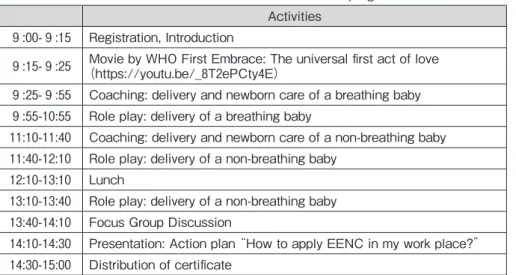
The modified EENC program was a 5-hour educa-tional program consisting of lectures, demonstrations, questions and answers, and a group discussion (Table 1).
Before conducting the modified EENC program, an interpreter who was not a medical professional took part in the birth demonstration practice and translated the simulation. The demonstrations were performed by two Japanese midwives in the two groups with a simul-taneous explanation of the procedure in Indonesian lan-guage by the interpreter. Also, two Indonesian midwives, a Japanese nurse, and 3 Japanese midwives supported the sessions throughout. They provided instructions regarding the birthing procedure in accor-dance with the skills checklist of EENC (breathing baby and non-breathing baby) (Tables 2 and 3). 5. Data collection
The participants attended the 5-hour program and took part in the focus group discussions (FGDs) at the end of the program.
Table 1. Contents of the modified EENC program Activities
9 :00- 9 :15 Registration, Introduction
9 :15- 9 :25 (https://youtu.be/_8T2ePCty4E)Movie by WHO First Embrace: The universal first act of love 9 :25- 9 :55 Coaching: delivery and newborn care of a breathing baby 9 :55-10:55 Role play: delivery of a breathing baby
11:10-11:40 Coaching: delivery and newborn care of a non-breathing baby 11:40-12:10 Role play: delivery of a non-breathing baby
12:10-13:10 Lunch
13:10-13:40 Role play: delivery of a non-breathing baby 13:40-14:10 Focus Group Discussion
14:10-14:30 Presentation: Action plan “How to apply EENC in my work place?” 14:30-15:00 Distribution of certificate
6. Demographics
The questionnaire contained items on demographic characteristics as follows: age, educational background, job experience, workplace, and training participation. 7. Feasibility of the modified EENC program
Bowen et al. previously indicated eight general areas of focus in feasibility studies9 ).In the present study, two of these eight general areas, namely, acceptability and demand, were focused on. The feasibility of the modified EENC program was assessed by conducting FGDs. The following questions were used as guide in the FGDs to obtain qualitative data: 1)“How was the educational program?” 2)“What are some difficulties in implementing this program at your work setting?”. The Indonesian researchers conducted FGDs in the Indone-sian language. The contents of their discussion were audio-recorded. The contents were then transcribed and translated by an experienced midwife who was a native speaker of Indonesia.
8. Data analysis
Qualitative data were analyzed using the content analysis method as follows. The discussions were tran-scribed into the Indonesian language and then carefully translated into English by one of the researchers (YA) who is fluent in both languages. Sentences were initially divided into subcategories. The subcategories with the same content were grouped into a particular category. 9. Ethical considerations
All the participants were informed of the purpose and contents of the research by providing them with a written document and a verbal explanation by the interpreter. It was explained that participation was purely voluntary and that they could decline or discon-tinue participating at their convenience. All the partici-pants consented to the use of the data from the discussions and questionnaires. This study was approved by the ethics committee of St. Luke’s Interna-tional University (17-A16).
Table 2. Skills checklist for the delivery of a breathing baby
Pre-birth preparations YES PARTIAL NO
1 Checked the room temperature
2 Washed my hands (first of two handwashings) 3 Placed a dry cloth on the mother’s abdomen 4 Prepared the newborn resuscitation area 5 Checked that the bag and mask are functional 6 Washed my hands (second of two handwashings) 7 Wore two pairs of clean gloves
8 Positioned the forceps and cord clamp/ties in an easy-to-use order Immediate postpartum/newborn care
9 Called out the time of birth: hour , minute , second . 10 Started drying the baby within 5 seconds of birth
11 Dried the baby thoroughly (wiped the eyes, face, head, front, back, arms, and legs) 12 Removed the wet cloth
13 Placed the baby in direct skin-to-skin contact with the mother 14 Covered the baby’s body with a cloth and the head with a hat 15 Checked for a second baby
16 Gave oxytocin to the mother within 1 minute of delivery 17 Removed the outer pair of gloves
18 Checked cord pulsations before clamping, clamped after the cord pulsations stopped (usually 1 - 3 minutes) 19 Placed a clamp/ties at 2 cm and forceps at 5 cm from the umbilical base
20 Delivered the placenta
Ⅲ.Results
1. Characteristics of participants (Table 4)
A total of 16 female midwives participated in the modified EENC program. Their mean age was 46.6 years (range, 36-60). Their mean years of clinical expe-rience as a midwife was 22.2 years (range, 10-36). The participants had a master’s or bachelor’s degree (n = 13), nursing diploma (n = 1), and a midwifery academy diploma (n = 2). Half of the participants were mainly working in the delivery and obstetrics ward, two in the baby room, and two in the gynecology ward where EENC was relevant. More than half of the participants (n = 11) had participated in some kind of job training
within the last three years (Figure 1).
2. Feasibility of the modified EENC program
Three categories characterizing the modified EENC program were identified by qualitative analysis of the FGDs as follows: 1)“Acceptability as a practical pro-gram”, 2)“Demand for a practical program”, and 3) “Barriers to and countermeasures for implementation”.
1 )Acceptability as a practical program
This category has four subcategories as follows: a) “Practice provision for each participant”, b)
“Impor-tance of continuing education”, c)“Understanding eased by native language”, and d)“Effective learning pro-cess”.
Table 3. Skills checklist for the delivery of a non-breathing baby
Pre-birth preparations YES PARTIAL NO
1 Checked the room temperature
2 Washed my hands (first of two handwashings) 3 Placed a dry cloth on the mother’s abdomen 4 Prepared the newborn resuscitation area 5 Checked that the bag and mask are functional 6 Washed my hands (second of two handwashings) 7 Wore two pairs of clean gloves
8 Positioned the forceps and cord clamp/ties in an easy-to-use order Immediate postpartum/newborn care
9 Called out the time of birth: hour , minute , second . 10 Started drying the baby within 5 seconds of birth
11 Dried the baby thoroughly (wiped the eyes, face, head, front, back, arms, and legs) 12 Removed the wet cloth
13 Placed the baby in direct skin-to-skin contact with the mother 14 Covered the baby’s body with a cloth and the head with a hat 15 Called for help
16 Removed the outer pair of gloves 17 Quickly clamped and cut the cord 18 Moved the baby to the resuscitation area
19 Coved the baby quickly during and after the transfer 20 Positioned the baby’s head correctly to open airways
21 Applied a face mask firmly over the baby’s chin, mouth, and nose 22 Gained chest rise within < 1 minute of birth: minutes , seconds . 23 Squeezed the bag to give 30-50 breaths per minute
24 Maintained a good chest rise throughout or took steps to improve ventilation 25 Stopped the mechanical ventilation when the baby’s breathing was stable 26 Returned the baby to the mother for skin-to-skin contact, covered the baby 27 Checked for another baby
28 Gave oxytocin to the mother
29 Checked that the placenta was delivered
a)“Practice provision for each participant”
One of the revisions for this modified EENC program was to provide ample opportunities to all participants to practice by themselves to enhance their skills. Each participating midwife could experience and follow the instructions for an EENC setting after demonstrations by the staff. This opportunity to practice provided each participant adequate understanding of the EENC proce-dure.
“We had a chance to practice it by ourselves”
b)“Importance of continuing education”
The modified EENC program not only provided an opportunity to practice, but also made the participants realize that the practical program facilitates continuing education to enhance their skills and knowledge. “Who has done it often will be more skilled...” c)“Understanding eased by native language” Another revision was the language used in the modi-fied EENC program. The Indonesian language was used for explanations instead of the English language by the Indonesian midwives who understand both English and Indonesian. The English lectures were also interpreted into Indonesian and the demonstrations were conducted in the Indonesian language as supported by our research members. The only English resource used was the WHO EENC DVD.
“It is better in Indonesian. It is easier, and can be bet-ter understood.”
d)“Effective learning process”
The learning process provided by this modified EENC program was holistic. It involved watching an EENC DVD initially, followed by self-practice, and
Table 4. Demographic characteristics of the participants (N=16) Intervention Age (years) M [SD] 46.6 [7.3] n (%) 36-39 4 (25.0) 40-49 6 (37.5) 50-59 5 (31.3) 60 1 (6.3) Educational background
Midwife Academy Diploma 2 (12.5)
Nursing Diploma 1 (6.3)
Bachelor of Nursing 1 (6.3)
Bachelor of Midwife 3 (18.8)
Master’s Degree 9 (56.3)
Job experience (years) M [SD]
22.2 [8.6] n (%) 10-19 5 (31.3) 20-29 8 (50.0) 30-36 3 (18.8) Main assignment Delivery 3 (18.8) Obstetrics ward 5 (31.3) Gynecology ward 2 (12.5) Baby room 2 (12.5) Others 5 (31.3)
Received training within three years
Yes 11 (68.8)
No 5 (31.2)
finally demonstrations which facilitated a better under-standing of the EENC procedure.
2 )Demand for a practical program
This category has two subcategories as follows: a) “Routine use of two pairs of gloves”, and b)
“Time-effi-cient implementation”.
a)“Routine use of two pairs of gloves”
The modified EENC program not only conducted the sessions in a different facility, but also carried out a pro-cedure that differed from the current practice. The par-ticipants usually followed a routine procedure of putting on only a pair of gloves during delivery instead of two pairs of gloves as performed in the modified EENC pro-gram. The participants soon realized and expressed the need to adopt the practice of wearing two pairs of gloves by themselves. This realization came after understanding that the two pairs of gloves can prevent infection of the umbilical cord.
“We need to develop the habit (of using two pairs of gloves)”
b)“Time-efficient implementation”
Although skin-to-skin contact was practiced in the current hospital, the participants were not consciously aware of the time that has elapsed after the baby was born to ensure proper resuscitation. Through this pro-gram, they have realized new measures in terms of being more efficient than what they have been used to do. They gained a clearer understanding of what must be done in a time-efficient manner to successfully imple-ment EENC.
“We have done skin-to-skin contact, but we have learned today that we are more efficient because we set the time”
“to be quicker, to be more agile”
3 ) Barriers to and countermeasures for implementa-tion
This category has two subcategories: a)“Lack of resuscitation place” and b)“Fixtures for temperature adjustment”.
a)“Lack of resuscitation place”
When considering the implementation of EENC in a practical setting, it was apparent that their present working environment had some differences from the working environment of this modified EENC program. In our modified program, babies who have difficulty in breathing would require immediate resuscitation in a prepared resuscitation area. The limitations of the facil-ity were pointed in the discussion, particularly the lack of a resuscitation place.
“The distance between the delivery room and the resuscitation room is quite far. Well, bringing the baby takes time. The facility should be there. The setting should properly identify the resuscitation place for a mother. We have a resuscitation place for some deliver-ies. Six beds with one infant warmer. Those are the facilities.”
b)“Fixtures for temperature adjustment”
The other limitation of the facility was fixtures for adjusting the temperature. In EENC, the temperature of the delivery area should be set between 25-28 ºC. The hospital uses only a central adjustment for the room temperature. Thus, warm clothes were used to keep the baby warm, which is one of the important aspects of EENC to prevent hyperthermia.
“But we can do a modification. When we help a mother to deliver her baby, if a small baby would be born, we will put a baby swaddle on the warmer. So it is warm. As soon as the baby is born, we put on the warm swaddle.”
“But for this region, the use of towels is suitable because a warmer is not available”.
Ⅳ.Discussion
1. Advantages of the modified EENC program
To examine the feasibility of this modified EENC pro-gram, we designed and developed it to focus on the ‘implementation’ of practice as Bowen et al. described whether an intervention could be performed in a target community9 ).The contents of the FGDs suggested the feasibility of this modified EENC program for the par-ticipants’ own working context to some extent.
program was feasible for the settings of the partici-pants. All the participants were provided an opportu-nity to experience the EENC procedure, and they also had a chance to review the procedure by observing the other participants. This is one of the strengths of a sim-ulation training as it builds skills from one’s own practi-cal experience. In a simulation training, the practice experience of an individual is important as this initiates a reflective process10).
The EENC coaching method7 ) has recommended a facilitator-to-participants ratio of 1:6. For this modified EENC program, two Indonesian facilitators, one Japa-nese nurse, and three JapaJapa-nese midwives supported the 16 participants who were divided into two groups, that is, a facilitator-to-participants ratio of 3:8. The ratio of facilitators to participants were considered appropriate in this setting because all of the participants had the chance to practice and were appropriately supervised by the facilitators.
Clapper11) showed that through simulation training, an adult learner engages in experimental and active learn-ing which will likely be an important element in his/her transformative learning process. A transformative learning theory focuses on “changing what we know”, and “the process of using a prior interpretation to con-strue a new or revised interpretation of one’s experi-ence in order to guide future action” (as cited in Clapper, 2010). Reflection is an important element in transformation learning as facilitators could challenge an adult learner’s assumption by providing answers as facilitators of reflection. This suggests the importance of having a sufficient number of facilitators for adult participants.
The participants also stated that the procedure was easy to comprehend because of the use of their own language. Interpreters who learn the contents of the program in advance might be more successful in simul-taneously explaining the demonstrations in their own language.
2. Issues regarding the implementation of the modified EENC program
In this modified EENC program, some of the EENC procedures, such as wearing of two pairs of gloves to prevent infection, and other concerns such as the length of the procedure time, were burdensome to the participants. This is because their usual childbirth pro-cedures involve the wearing of only one pair of gloves
during childbirth, and they are hardly concerned with the onset time of resuscitation in non-breathing babies immediately after childbirth. However, despite of some difficulties in certain procedures, the participants were satisfied overall with the program. During the program, they particularly recognized the importance of acquir-ing new practices such as wearacquir-ing of two pairs of gloves and of being aware of the time that has elapsed after childbirth.
Through this modified EENC program, the partici-pants also realized their shortage of the necessary sup-plies in their own settings. The EENC procedure involves checking the time, adjusting the room tem-perature, and making provisions for a resuscitation place on each side of a delivery bed. Notably, there were only a few clocks or room temperature indicators in the delivery room. Moreover, the resuscitation places are located far from the delivery beds and are shared with other babies in their setting hospital.
Xu et al.12) suggested the importance of explaining new evidence-based recommendations and the differ-ence of the new procedures from the previous proce-dures in a hospital setting. The content of the EENC program7 ) consists of providing new evidence-based procedures to change practice in the facility. New evi-dence of effectiveness should be disseminated to all staff members.
3. Repetitive in-service training
One of the essential competencies of a midwife prac-tice13) is to assume responsibility for self-development in terms of maintaining up-to-date skills and knowledge by participating in continuing professional education. The participants recognized the necessity of revising their practices and adopting new procedures in their settings. A previous study suggested that some of the effective methods of in-service training are the use of immediate feedback on performance, interaction between facilitators and learners, and a repetitive inter-vention14).Moreover, repeated training opportunities are preferable to one-time training, as these opportuni-ties lead to the use of new skills in the clinical setting. Gomez et al. conducted a cluster randomized trial to assess the effect of a low-dose, high-frequency training approach to improve the quality of maternal and new-born care among skilled birth attendants (SBAs) in Ghana15).The training approach was based on evidence from reports in the literature. The scores of the skills
and knowledge of SBAs increased one year after the intervention. The present modified EENC program also included these effective techniques, and highlighted the importance of a high frequency of intervention.
Ⅴ.Conclusion
The modified EENC program was found to be acceptable in the Indonesian settings. There is also a positive demand among Indonesian nurses to learn new procedures for newborn care. However, they also face the reality of overcoming certain barriers to the imple-mentation of new procedures in their own settings. ACKNOWLEDGEMENTS
We would like to express our gratitude to Dr. Edward Barroga, Professor of St. Luke’s International University, for his valuable editing and insightful com-ments on our manuscript. This study was founded by JSPS Asia Africa Platform Program and Grant-in-Aid for Exploratory Research (23660022).
REFERENCES
1 ) World Health Organization [Internet]. https:// www.who.int/news-room/fact-sheets/detail/newbor ns-reducing-mortality [cited 2019-09-02].
2 ) World Health Organization [Internet]. https:// www.who.int/sdg/targets/en/ [cited 2019-09-02]. 3 ) The state of the world’s children 2017: Children in a
Digital World. USA: UNICEF; 2017. [Internet]. https://www.unicef.org/publications/files/ SOWC_2017_ENG_WEB.pdf [cited 2019-09-02]. 4 ) Lawn JE, Cousens S, Zupan J, et al. 4 million
neona-tal deaths: When? Where? Why? The Lancet. 2005; 365(9462):891-900.
5 ) Wall SN, Lee AC, Niermeyer S, et al. Neonatal resuscitation in low - resource settings: What, who, and how to overcome challenges to scale up? Int J Gynaecol Obstet. 2009;107(Suppl 1):S47-64. 6 ) Gülmezoglu AM. Impact of training on emergency
resuscitation skills: Impact on millennium
develop-ment goals (MDGs) 4 and 5. Best Pract Res Clin Obstet Gynaecol. 2015;29(8):1119-25.
7 ) Coaching guide for the first embrace: facilitator’s guide (Early Essential Newborn Care). Switzerland: World Health Organization (WHO);2016. [Internet]. https://apps.who.int/iris/bitstream/handle/10665/ 208314/9789290617594_eng.pdf?sequence=1&isAll owed=y [cited 2019-09-02].
8 ) Nagamatsu Y, Tanaka R, Oka M, et al. Identifying clinical and educational difficulties of midwives in an Indonesian government hospital maternity ward: Towards improving childbirth care. Journal of Nurs-ing Education and Practice. 2017;7(11):7-13. 9 ) Bowen DJ, Kreuter M, Spring B, et al. How we
design feasibility studies. Am J Prev Med. 2009;36 (5):452-7.
10) Zigmont JJ, Kappus LJ, Sudikoff SN. Theoretical foundations of learning through simulation. Semin Perinatol. 2011;35(2):47-51.
11) Clapper TC. Beyond knowles: What those conduct-ing simulation need to know about adult learnconduct-ing the-ory. Clinical Simulation in Nursing. 2010;6(1):e7-e14. 12) Xu T, Yue Q, Wang Y, et al. Childbirth and early
newborn care practices in 4 provinces in China: A comparison with WHO recommendations. Glob Health Sci Pract. 2018;6(3):565-73.
13) Essential competencies of a midwife practice. Can-ada: International Confederation of Midwives (ICM); 2018. [Internet]. https://www.internationalmidwives. org/assets/files/general-files/2018/10/icm-competenc ies---english-document_final_oct-2018.pdf. [cited 2019-08-26].
14) Bluestone J, Johnson P, Fullerton J, et al. Effective in-service training design and delivery: Evidence from an integrative literature review. Hum Resour Health. 2013;11(1):51.
15) Gomez PP, Nelson AR, Asiedu A, et al. Accelerating newborn survival in Ghana through a low-dose, high-frequency health worker training approach: A cluster randomized trial. BMC Pregnancy and Child-birth. 2018;18(1):72.