__________________________________________
* Professor of Linguistics, Faculty of International Studies, Kindai University. E-mail: [email protected]
© 2018 Emma Tămâianu-Morita
Tămâianu-Morita, E. (2018). Suspending Logic: A Linguistic Exercise. Part I - Dimensions
Suspending Logic: A Linguistic Exercise.
Part I - Dimensions and Levels of Analysis,
with Some Contrastive Considerations
Emma Tămâianu-Morita*
ABSTRACT: Japanese is sometimes described as more ‘illogical’, or at least more ‘vague’, from the standpoint of the referential function, than English and other European languages. In counterpoise, fostering the students’ logical thinking abilities is often put forward as one of the educational goals of teaching English in Japan. This paper examines critically some of the ground tenets that underlie these two complementary views, adopting a contrastive perspective, with illustrations selected mainly from Japanese, English and Romanian texts. Starting from a distinction proposed by E. Coseriu (1957) between two radically different acceptations of «logic» in relation to language, the present paper explores the functional autonomy of the judgments of idiomatic correctness and textual adequacy (appropriateness) from the judgments of congruence and logical coherence, in light of a general principle of suspendability of non-conformity evaluations from more specific levels to more general levels of language organization and linguistic competence. Part I focuses on instances where the judgments of incongruence are suspended through the semantic organization of particular languages as historically-constituted traditions of speech.
KEYWORDS: Linguistic conceptualization, Textual meaning, Congruence, Correctness, Adequacy (Appropriateness)
Introduction
Let us consider the following four verbal sequences. The reader is invited to judge which case(s) contain(s) elements that call for suspending the requirements of logical reasoning in order to accept the respective sequence(s) as (a fragment of) text/discourse.
(1) On the 11th of May 2013 I took a day trip by bus from Almería to
Emma Tămâianu-Morita
(2) ネコのクロちゃんはネズミを見ると怖がる。1
(3) [Roshi:] – How is the koan coming? [Acolyte:] – There is no koan. [Roshi:] – How is that?
[Acolyte:] – There is no koan, and which one is unimportant. (4) Professor: […] Thus all words in all languages…
Pupil: Oh yes? … I’ve got toothache.
Professor: We go on… are always the same, as are all flexional endings, all prefixes, all suffixes, all roots…
Pupil: Are the roots of words square roots? Professor: Square or cubic. It depends. Pupil: I’ve got toothache.
Perhaps most readers will characterize (1) as demanding no suspension of logic whatsoever. In the case of (2), a minor note would be made that the facts described are somewhat surprising, in the sense that our previous (“encyclopaedic”) knowledge concerning the behaviour of cats leads us to expect that cats, as fierce hunters, should not be afraid of mice. On the other hand, (3) would be shown to contain a blatant logical contradiction in the last turn: the expression “which one” presupposes a set of (existing) kōans (公案) out of which one is picked up, but such a selection cannot be operated out of non-existing kōans. Finally, (4) would perhaps strike the reader as incoherent in its entirety: the thematic development is erratic (‘languages’ → ‘toothache’ → ‘languages’ (morphology) → ‘mathematics’ → ‘toothache’); the referential content is preposterous (all the words in all languages are the same); the context which should serve to disambiguate the lexical meaning of “root” shifts freely from grammar to mathematics and back to grammar, or, more precisely, constitutes a single undifferentiated context engulfing both without distinction.
Such an evaluation would seem to be supported by the typological nature of the texts. Sequences (1) and (2) are fragments of personal accounts: original formulations which stem from the author’s own experience. Sequence (3) is excerpted from a short story entitled The Koan by Donald Richie (1991: 27)2, which is part of a
collection of Zen-inspired “stories, fables, parables and sermons”3. Sequence (4) is
1 Neko no Kuro-chan wa nezumi wo miru to kowagaru (approx. “Kuro the cat is afraid of
mice.”)
2 The fragment is quoted with the original spelling, which does not mark the long vowels of
rōshi (Zen master) and kōan (the insoluble paradox used in Zen training in order to break down and ultimately annul the ordinary patterns of thought and experience).
3The same procedure can be found in the Preface to the volume: “[…] I know little about Zen.
My theoretical knowledge is scattered; my understanding, based upon emotional hankering, cannot be said to exist; and having had no real experience, I can have no real comprehension. […] Since, however, I am presenting my lack of credentials, I should add in all fairness that the training that I did not have was of the best. Though I cannot say that I studied with Daisetsu
Journal of International Studies, 3, November 2018
excerpted from Eugène Ionesco’s now classical piece of absurd theater “La leçon” (“The Lesson” [1954]/ 2000: 203).
Yet, the answer sketched above, for all its appearance of credibility, is wrong. Let us then disclose the correct answer from the very beginning: all four sequences call for a suspension of logical reasoning in order to function as (fragments of) text/discourse. The difference is not quantitative (as the scalar description above may suggest), but qualitative – one that concerns what kind of ‘logical’ component is suspended, and at what level of linguistic organization that hermeneutic process occurs. This contribution aims at justifying this claim and suggesting some conceptual distinctions that may prove useful not only in the domain of linguistic text analysis and interpretation as a goal in itself, but also in the practical field of teaching/learning a foreign language and its associated discourse.
Due to space limitations, the discussion will be organized in two parts. The present article (Part I) introduces the topic and justifies its significance, outlines the theoretical background, illustrates some fundamental distinctions that need to be operated (two radically different acceptations of ‘Logic’ in relation to language, and the principle of ‘suspendability’ of non-conformity evaluations) and then analyzes in detail the first two fragments proposed for reflection in the Introduction, which represent cases of suspension of ‘Logic’ on the level of the semantic organization of particular languages as historically-constituted traditions of speech. A future article, representing Part II of the contribution, will deal with the third and fourth textual examples, which constitute more complex cases, of suspension of ‘Logic’ on the level of discourse understood as a functionally autonomous level where the processes of sense-construction unfold4. On this level, the strategies of suspending ‘Logic’ are
motivated by each text’s unique overall signifying intention and typological orientation. Consequently, the analysis and interpretation will have a very different focus and domain of applicability than the analysis of the first two sample texts.
1. Rationale
1.1. Can a language be less ‘logical’ than another?
The idea of the present contribution arose from the author’s long-term preoccupation with the contrastive study of languages, English and Japanese among them. Japanese is often described as more ‘illogical’, or at least more ‘vague’, from the standpoint of the referential function, than English and other European languages. In counterpoise, “fostering the students’ logical thinking abilities (論理的思考力)” is often put forward as one of the educational goals of teaching English in Japan.
A well-known theoretical proposal attempts to clarify and, ultimately, substantiate the former intuitive judgement. Thus, Yoshihiko Ikegami (1981) proposes the typological dichotomy «DO-language vs. BECOME-language» with
Suzuki, I did meet and talk with him every week or so over the years 1947 and 1948 while he was living at Engaku-ji.” (1991: viii; emphasis mine – E.T.-M.)
Emma Tămâianu-Morita
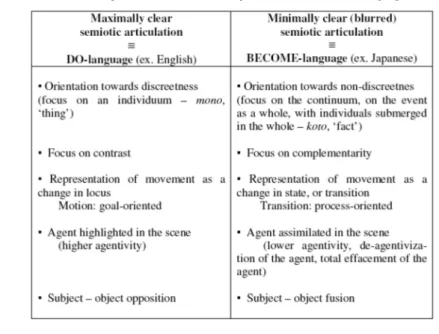
English and Japanese respectively as prototypical instantiations of the two poles, and then expands the opposing types of linguistic organization into a more encompassing model of contrasting semiotic orientations in language and culture, where the cultures associated with the two languages are also held to illustrate orientations towards a “maximally clear semiotic articulation” vs. a “blurred semiotic articulation” (1988-1989, 1989, 1998). In this model, Japanese appears as “relatively underdetermined in its referential function”, but “relatively specific in its interpersonal function” (Ikegami 1998: 1901, 1996), and these characteristics are also found in other manifestations of (traditional) Japanese culture, when examined in contrast to “Western” culture:
One can find certain features recurring across different areas of Japanese culture. Such features are the focus on complementarity (rather than a focus on contrast), subject-object fusion (rather than subject-object opposition) and the metonymic orientation either in terms of focus on the concrete (rather than focus on the abstract) or in terms of focus on the small (rather than focus on the large). One has the impression that all these features in culture are prototypically found in the way in which the Japanese language functions. (Ikegami 1998: 1909)
A summary of the contrasting features that delineate the two poles is given in Table 15.
Table 1. Ikegami’s model of contrasting semiotic orientations in language
Journal of International Studies, 3, November 2018
Ikegami’s model and the overall semantic and cognitive tendencies it intends to capture have a great deal of intuitive appeal to both specialists and non-specialists – speakers and learners of the two languages, especially to those who come from a Western background and are faced with the remarkable difficulties and intricacies of Japanese. It may be that the lay perception has been responsible for the emergence of the image of Japanese as less ‘logical’, by equating ‘vagueness’ in linguistic Gestaltung and the higher context-dependency of Japanese with a lack of ‘clarity’, in turn equated with a lack of ‘logic’, or in any case a looser application of ‘logic’.
To take a well-known and much discussed example, in Japanese it is possible to combine expressions of approximation with the smallest quantum of plurality, and declarethatyou need not two objects, but about/around two, as in “ふ たつほどください” (“futatsu hodo kudasai”), whereas in English the contradiction between the absolute precision of a number as small as 2 and the notion of approximation makes a corresponding formulation very unnatural: “?I’ll have about
two”. Naturally (i.e. as is to be expected from a ‘logical’ point of view), the higher the number, the easier it becomes to form acceptable combinations. Some English speakers may already feel that “I’ll have about three” sounds ‘natural’; from four to ten the judgments of acceptability would probably be unanimous, as they would be from ten upwards as well, provided that the numbers themselves are not ‘too’ exact. For example, “about 150” presents no problem, but an impression of contradiction may arise again in the case of, say, “about 153”). In the light of such an example, one feels indeed inclined to accept that the Japanese semantic organization is ‘vague’ or in any case allows for more ‘vagueness’ than its English counterpart. To this, a speaker of Romanian may counterargue: Romanian evidences a “maximally clear” semiotic articulation in its lexical and grammatical organization, inherited from Latin, and yet it is perfectly possible and natural to ask for “about two” objects, as in “Dați-mi vreo două”, where vreo is an indeterminate adverb of approximation quite similar in many contexts of usage with the Japanese hodo (ほど). Does this suggest that in lexis and grammar Romanian is closer to the pole of English, but in usage, discourse, and possibly also as regards the associated cultural tendencies it is closer to the pole of Japanese? Attractive as this may sound as a would-be illustration of mental and cultural sistership beyond spatial and linguistic frontiers, obviously a claim formulated in these terms has no objective basis at all.
In reality, what examples such as this one show is simply that the model of contrasting semiotic orientations does not apply uniformly to a language, the discourse constructed in that language, and the culture in which the language is embedded, and neither do the judgments of ‘vagueness’ vs. ‘clarity’ or ‘logical’ vs. ‘illogical’.
In the system of the language, each key unit from the examples above (futatsu, hodo, two, about, două, vreo) is perfectly clear and displays the maximally tight type of articulation that exists in the domain of verbal expression: each has a significatum defined oppositively within paradigmatic structures and possesses well-established combinatorial valencies in syntagmatic structures, and as linguistic concepts they are not – indeed cannot – be ‘vague’ at all. As significata-in-use, i.e. as acceptations actualized in the given combinations, they are also perfectly clear, and
Emma Tămâianu-Morita
still defined rather tightly (perhaps not always oppositively, but by clearly recognizable differences in meaning). Adding the unit of approximation hodo, about or vreo signals that the speaker does not attach importance to the number itself, but to getting some objects as opposed to no objects at all: « Even one might do, but I’ll have two (or three) just in case », « I may need two after all » − which is what a speaker of English could naturally say, if he/she actually wanted to convey the same communicative intention as through the Japanese “futatsu hodo kudasai”. The issue of ‘vagueness’ vs. ‘clarity’, with all the degrees in between, does not relate to the system of the (three) languages and the significata of the respective expressions, but to the ulterior operation of designating a certain state of things in a concrete discourse act. It is this designation that can be presented as ‘clear’ or ‘unclear’, ‘precise’ or ‘imprecise’, ‘vague’ or ‘exactly delimitated’ etc. In principle, any such type of designation is possible through any language, by choosing different means of expression from different functional levels of linguistic organization. In other words, the semantic and typological characteristics (or, to use Ikegami’s term, the “semiotic orientation”) of a text are functionally autonomous from the nature and typological characteristics of the system and norm(s) of the language(s) in which the text is constructed6.
1.2. Discussion
Aconfusion of levels seems to motivate the use of this example for substantiating the “vague” character of Japanese. For instance, Ikegami (1995: 11) indicates that “the Japanese speaker prefers to avoid an exact delimitation either of quantity or of quality, saying something like «approximately two» (instead of simply and clearly
6 In Tămâianu-Morita (2006), a detailed textual analysis shows how the units of a very
precisely articulated language (Romanian) can be used to create referential vagueness (indeterminacy) in the construction of the textual world and the construal of textual meaning. Ikegami (1995: 12) also admits the lack of a deterministic correlation between “the overall characteristic of the grammar of a language” and what he calls “the general characteristic of the linguistic performance of the speakers of the same language”, attributing this lack to contingent factors, such as the unpredictability of the speakers’ choices in concrete situations or “competing motivations” which lead to different choices by speakers of languages with the same characteristics. His conclusion is formulated in rather noncommittal terms: “there is nothing which prevents the speakers of a «vague» language from trying to speak in an unvague way” (emphasis mine – E.T.-M.). The stance advocated by us differs in essence from Ikegami’s position: we hold that the non-correlation is one of principle, arising from the double semiotic relation in discourse, i.e. from the fact that the units of a language, with their content and expression and all their characteristics and relations within the language, function as semiotic expression for a higher-degree content, which is textual sense, created according to specific strategies and mechanisms. Secondly, though no less importantly, it is doubtful that one and the same “overall characteristic”, as far as “vagueness” is concerned, can be found to reign over the whole system of a language. Finally, it is clearly false that there is any such thing as a “general characteristic of the linguistic performance of the speakers” of a language: in the domain of discourse, general orientations of the sense-construction processes vary significantly according to text-typological and contextual factors that can and often do apply cross-linguistically and cross-culturally.
Journal of International Studies, 3, November 2018
saying «two») or saying the equivalent of «such» where one could very well say «this» or «that»”. The motivation offered for “preferring to behave ambiguously” is politeness. In other words, in the respective context there would be no semantic difference between saying “approximately two” as opposed to simply “two”, the only difference being that of politeness register.
Even more directly, a source widely used by foreign learners of Japanese (Makino & Tsutsui 1986: 138) states that when saying “Sono ringo o futatsu hodo kudasai” the speaker “does not want about two apples but exactly two apples […]” (emphasis in the original). The authors continue:
It is a very common practice in Japanese to avoid asking for exact numbers or amounts, and the practice comes from the idea that being straightforward or direct is impolite. This can be observed in many verbal and nonverbal expressions in Japanese and also in the manners of the Japanese people. (Makino & Tsutsui 1986: 138)
Such stances are entirely speculative, because one can never attest in linguistic analysis what an individual speaker actually “wants” in a concrete situation. Linguistic analysis deals with language as a virtual system of significata and with the strategies of sense-construction in discourse as general possibilities, aiming at the maximal interpretation possible in the given context. Moreover, these stances flatten the level of the semantic organization of the language itself with the level of discourse/texts. On the one hand, the expression “futatsu hodo” is not functionally coincident with “futatsu” at the level of the Japanese language
Gestaltung; on the other hand, while avoiding precise and straightforward
expressions is in fact a discourse strategy used for politeness, this strategy is a general (cross-linguistic) device, applicable in any language the speaker might be using at that moment. One might even counter-speculate that such a strategy could be more frequent in situations that require a higher level of politeness when the speaker uses a language that does not have a clear, lexicalized and grammaticalized, polite language style, as Japanese does.
To clarify this point, let us consider one more example. If one adopts the perspective upheld by the above-mentioned sources, one might say, as some teachers of Japanese as a foreign language do, that in expressions like “ご協力のほど、よろし
くお願いいたします” or “ご理解のほど、よろしくお願いいたします”7, hodo has ‘no
meaning’, and is merely used to make the speech more polite. In other words, the expressions with hodo are semantically identical with “ご協力を、よろしくお願いい たします” and “ご理解を、よろしくお願いいたします”8, but more polite. A clever
student might then ask, like the linguist who adopts a genuinely functional perspective: Why is it that the presence of hodo and not some other word makes the expressions more polite? The answer, of course, is that hodo (程) fully maintains and brings into the utterance its systemic significatum, of «extent», «measure» or
7 Go-kyōryoku / Go-rikai no hodo, yoroshiku onegai-itashimasu, corresponding to “We kindly
ask for your cooperation / understanding”.
8 Go-kyōryoku / Go-rikai wo, yoroshiku onegai-itashimasu (the same expressions, but without
Emma Tămâianu-Morita
«degree» of an action or state. Thus, the expressions “ご協力/ご理解のほど、よろし くお願いいたします” literally signify «What we ask of you only goes to the extent of your cooperation/understanding», or «What we ask of you is only your cooperation/understanding and nothing more», «Please grant us your cooperation/understanding and we will not impose on you any more than that ». It is precisely this act of specifying the limit (= the extent or degree) of the request, with the implicit promise of not asking for more, that justifies the possibility of using those expressions to signal (not signify!) higher politeness onthe level of discourse acts. Far from being a semantically etiolated or marginal use of hodo, such expressions instantiate the very core of the word’s (systemic) significatum, and can safely be ranged among the ‘prototypical’ uses of this linguistic unit.
The aspects discussed above converge towards the need for a theoretical model with immediate analytical applicability that explains such phenomena coherently, from the broader angle of the relationship between language (linguistic conceptualization), discourse (construction of textual meaning) and logic, a model also apt to clarify, for instance, why and in what (different) ways all the four sequences exemplified in the Introduction do in fact require a suspension of ‘logic’9.
No less important is that the model in question should reflect and therefore correspond to the speakers’ own knowledge at work in the production and interpretation of texts, as opposed to an artificial theoretical construct retroactively and speculatively projected onto the speakers’ competence.
2. Theoretical background
2.1. Two types of « logic » and their relation with language
In order to devise a clarifying framework of analysis, the diverse acceptations and uses of the term « logic » itself need to be addressed first. What concerns us here are only those acceptations that relate directly to the structure and functioning of language(s) and/or are used as instruments for describing and explaining the structure and functioning of language(s). As early as the 1950s, Eugenio Coseriu advocated for a clear-cut distinction between two acceptations of « logic » which constitute the principal source of confusion in the matter under discussion – a confusion that had already become apparent at that time, both in the philosophy of language and in linguistics, in the latter domain more pregnantly so with the advent of generativism. Two Coserian studies are of particular interest in this respect: “Logicismo y antilogicismo en la gramática” (1957), and, two decades later, “Lógica del lenguaje y lógica de la gramática” (1976), where the issue is confronted again, since the confusions seemed to have grown deeper, this time due to the rising popularity of pragmatic approaches to language use.
9 It is evident that an oversimplified evaluation in terms of grammaticality (idiomatic
‘correctness’) vs. acceptability is insufficient for covering the actual structure, meaning construction strategies and effect produced by our four initial examples, and, in general, the ample variety of cases that can be found in genuine texts.
Journal of International Studies, 3, November 2018
Coseriu’s claim is that linguistics is held to explain and justify the authentic linguistic knowledge of the speaking subject. One must therefore operate a clear conceptual separation between the following two kinds of logic (“Logic1” and
“Logic2”), which differ in terms of content, status, role and epistemic level.
(1) “Logic1” = the universal principles of thought which ensure the coherence
and consistency of speech, associated with the norms of congruence (i.e. compatibility with our experience of the empirical world) which manifest themselves in speaking as a generally-human activity, rationally prior to language-specific semantic organization.
This type of « logic » is closer to what is often called ‘common sense’: the principles of rational thought rooted in the normality of our ordinary, everyday experience in the world. For example, in the absence of a belief in the constancy of an object’s identity, the use of substitutes and pronominal reference would be impossible. One can only meaningfully say “Please go outside and wait for me there” if one believes that the spatial order of the immediate environment and the world at large will not collapse or radically change from one moment to the next. Other examples are: an intuitive principle of non-contradiction (an entity cannot be at the same time and from the same point of view itself and its opposite), the realization that a causal relation implies temporal succession (the cause must precede its effect), the understanding of quantitative progression (2 comes after = is more than 1; 3 comes after = is more than 2 and not the other way round) etc. These principles and norms are not self-evident or biologically given, but are developed experientially and reinforced culturally, as part of the cognitive formation of the speaking subject. Thus, “Logic1” is the speaking subject’s constant companion, an inherent part of his/her
intuitive knowledge, inseparable from every instance of speech activity.
(2) “Logic2” = the science of logic, which comprises principles and rules for
establishing the validity of judgments; by extension, the science/technique of of argumentative reasoning.
“Logic2” is an artificial construct pertaining to the level of reflexive-theoretical
(epistemic) knowledge in a particular field of scientific endeavor, which is obtained by (i) the reduction of language to one of its aspects of manifestation (the “apophantic”, governed by the values of truth vs. falsehood10) and (ii) progressive
abstractization – in other words a post-linguistic epistemic construct.
For the knowledge of language(s), only “Logic1” is relevant. However, as
will be illustrated in the following sections, in the domain of speech, the norms of “Logic1” are twice suspendable: through the peculiar semantic organization of each
language as a historically and culturally constituted tradition of speech, and through
10 For the characteristics of the “apophantic” orientation of discourse and its relation to other
types of orientations defined on the basis of Aristotelian concepts, see Coseriu 1969: 77 and 2003: 87-88.
Emma Tămâianu-Morita
the situationally-bound adequacy judgments pertaining to the level of discourse. As for “Logic2”, the use of a limited and not too technical part of it may prove relevant in
the study of discourse, but only in one type of discourse, the “apophantic” or scientific (informative) – i.e. the type it was originally abstracted from. When applied at this level, the respective strategies do not bear any direct correlation with language-specific semantic Gestaltung.
Thus, the proper domain of relevance of “Logic2” is not that of language(s),
but that of the science of language(s), i.e. linguistics11, with its various branches and
inclusive of the task of explaining the speakers’ own metalinguistic knowledge. The idea of “fostering logical thinking through the study of English” invoked in Section 1 obviously refers to a certain system of reasoning pertaining to Logic2. However, as noted before, Logic2 has no direct bearing on the structure of the
English language as such, and cannot be derived from discourse in English as such. To put it more directly, when we teach English as a foreign language, we do not teach students how to seek for the truth or how to distinguish truth from falsehood, but only the linguistic means for positing something as true in the tradition of speaking called “the English language”; we do not teach students how to interact with the interlocutor in order to persuade him/her, but only the means of expression in English for textual
functions or discourse acts such as affirmation, negation, refutation, refusal,
acceptance etc.
If teachers and students had unlimited time and resources at their disposal, it would certainly be possible to help students develop their “logical thinking abilities” through the study of a (= any) foreign language. To be sure, the only immediate way to develop the students’ abilities of logical thinking (Logic2) in the process of
learning a foreign language is to practice… applied Logic2 – in this case the analysis
of language structure with the help of a (= any) conceptual framework. This process is the key for enhancing the students’ capacity of generalization and scientific conceptualization. One could certainly point out that such practice is more efficient if performed first by using the students’ native language, and only afterwards in a foreign language, when the focus needs to be placed on learning different means of expression for the same ‘logical2’ operations. If such intellectual practice starts early
enough, around the age of 8 or 9, its benefits will not fail to appear12.
In utter contrast to developing the (post-lingusitic) abilities of logical reasoning, learning a foreign language in a proper way requires dealing with Logic1.
In this process, the speaker needs to suspend both the reliance on previous empirical experience, and the reliance on the previous linguistic-conceptual distinctions given by the native tongue.
11 It is in this sense that Coseriu emphasizes, in a critical observation to extreme antilogicism,
that all science is ‘logical’, including the science of an object such as language, which is not, in itself, of a logical nature: “Toda ciencia es lógica por ser ciencia, y no por ser ciencia de un objeto lógico. […] Hasta el estudio de un objeto «irracional» – si es estudio y no contemplación – es necesariamente racional.” (Coseriu 1957: 252-253; emphasis in the original)
12 Unfortunately, this is neither done in Japan at present, nor something the educational
Journal of International Studies, 3, November 2018
For the analysis and explanation of genuine speech (genuine texts) from the internal perspective of the speaking subject’s own knowledge and activity, only Logic1 is relevant, and it is this acceptation that will concern us in the present
contribution.
2.2. Levels and forms of « language »
The second aspect that needs to be clarified is precisely what we mean by « language » in the discussion about the relation between language and logic. The framework I propose to use here is Eugenio Coseriu’s « integral » map for the study of language as a creative cultural activity, with a detailed account of its levels and forms of manifestation13. Language, or, rather, speaking (Sp. “el hablar”, Germ. “das
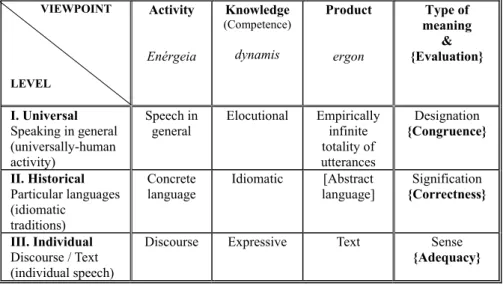
Sprechen”) is a generally-human activity (Level I), carried out according to historically established communitary traditions of speech (Level II) in concrete situations as an expression of individual signifying intentions (Level III). Each level
of manifestation (universal, historical, individual) is functionally autonomous, with
its own specific type of linguistic competence (elocutional, idiomatic, expressive) and specific products, subjected to specific judgments of conformity (congruence, correctness, adequacy) (see Table 2). The principles and norms of Logic1 are part of
the speaker’s “elocutional” competence, being thus situated on Level I in the general map. In the present analysis we will focus on the last column, of the types of meaning and the evaluations of speech according to the norms of each level, also taking into account further sub-categorizations of the levels, where necessary.
Table 2. Eugenio Coseriu’s triadic model: Levels and forms of language, with their associated evaluations VIEWPOINT LEVEL Activity Enérgeia Knowledge (Competence) dynamis Product ergon Type of meaning & {Evaluation} I. Universal Speaking in general (universally-human activity) Speech in
general Elocutional Empirically infinite totality of utterances Designation {Congruence} II. Historical Particular languages (idiomatic traditions) Concrete
language Idiomatic language] [Abstract {Correctness} Signification
III. Individual
Discourse / Text (individual speech)
Discourse Expressive Text Sense
{Adequacy}
13 Coseriu 1955-56: 285-287, 1973/1981, Ch.10, and 1988: 59, 70-75 (with the table at p. 75 –
translation mine, E.T.-M.). An extended presentation and discussion can be found in Tămâianu(-Morita) 2001: 15-60, 2012a, 2015 and 2016.
Emma Tămâianu-Morita
2.3. The evaluations of speech on each level
Numerous Coserian studies starting from the 1950s discuss at length, substantiate and amply illustrate the autonomy of the evaluations of speech according to the conformity or non-conformity with the principles, rules or norms attestable in the knowledge (competence) of speakers on each level. The fundamental notions, with examples from many different languages, can be found in concise systematizations in the volume dedicated to text linguistics (1981: 41-43) and in the monographic volume on the nature and components of linguistic competence (1988: 76-127). A synopsis of the subcategorization of the judgments of textual adequacy (Angemessenheit) can also be found in the latter source (1988: 174-181). Here we will briefly highlight the most important points to be taken into account in the present discussion.
On Level I, the evaluation of speech is manifested in judgments of congruence with the general principles of rational thought and with our normal experience in the empirical world (“the knowledge of things”, including the knowledge of the contexts and the universe of discourse). When necessary to separate the two broad cases and operate subclassifications, the first is also termed “coherence” in Coseriu’s model. The principles and norms of Level I are supra-idiomatic: they represent the background of any act of speech, their knowledge is activated spontaneously and most often they need not be verbalized. Furthermore, being intuitive in nature and taken for granted, an inventory is neither feasible, nor necessary. One can easily recognize when such a principle or norm has not been observed, and assess the utterance as incongruent. Thus, a sentence like “The five continents are four: Europe, Asia and Africa.” is incongruent because the quantities denominated by the numbers 5, 4 and 3 cannot be equal. In the case of the sentence “The scene of the crime was a small apartment, and it occurred three months ago.” the incongruence arises from breaking a principle of identity of relation required by the coordination (“the scene” designates a place, but “it” shifts to the designation of the event)14.
Tautologies are also typical examples of incongruence, as they verbalize overlapping information in constructions where new information should appear. For example, in answer to the reporter’s question about the reasons of customer dissatisfaction in a TV street interview, one interviewee answered “不満の理由は、 やっぱり、満足できないことですね。”15, with a structure topic−comment where the
comment is expected to provide new information about the topic. In another TV
broadcast, the comment “この文化をなくしてはいけないので、残さないといけない
と思います。”16 violates the principle that the (explanatory) cause and effect cannot be
identical.
On the other hand, in a sentence like “I went to the dentist to extract the square root of a tooth” the incongruence is caused by the sudden shift from the
14 These examples are discussed in Coseriu (1988: 89-90, 93).
15 Fuman no riyū wa, yappari manzoku dekinai koto desu ne. (lit. “The reason for my
dissatisfaction is, well, that I can’t be satisfied [with the product]”)
16 Kono bunka wo nakushite wa ikenai node, nokosanai to ikenai to omoimasu. (lit. “Because
Journal of International Studies, 3, November 2018
universe of discourse of everyday life (where dentists extract the patients’ teeth in the course of treatment) to the universe of discourse of mathematics (where extracting the “square root” is a numerical operation). This is a case of non-conformity with the “knowledge of the world” organized in the “circumstances” (entornos) of speech17.
On Level II, the judgments of correctness include not only grammatical correctness, but the conformity with all the rules and norms of a language as a historically-constituted tradition of speech, comprising all its structural layers, including the layers of lexical structuring, and all the varieties attested as part of that tradition. Thus, in English the sentence “There isn’t no time.” will be evaluated as incorrect if the double negation is not allowed by the grammatical rules in the neutral register to which isn’t belongs. However, the sentence “There ain’t no time.” has to be recognized as correct in certain dialects, sociolects or language styles (e.g. the colloquial register), even though it is not in conformity with the rules of the current standard norm of English. In other words, on Level II it is important to recognize as “correct” not only what is “exemplary”, i.e. in accordance with the (/a) standard variant, but everything that applies the rules and norms of the ‘real’ language, with its variety dimensions and its historical dynamicity.
Naturally, the judgements of correctness even for similar linguistic facts will differ in each language. For instance, double negation may be incorrect or non-exemplary in English, but correct and exemplary in other languages (Romanian among them).
Finally, the evaluations of textual adequacy are the most complex, comprising criteria of conformity with respect to the interlocutor (the relation between speaking subject and interlocutor), to the object or referential content of the discourse, and to the situation of speech. For example, “I need your recommendation letter ASAP.” in a mail from a student to a teacher is both congruent and correct, but inadequate with respect to the interlocutor. Conversely, the ‘broken’-style utterances used when addressing a baby or a foreigner who barely knows the language in question are incorrect (in the case of “baby talk”, possibly also incongruent), but adequate with respect to the interlocutor18.
2.4. The principle of “suspendability from bottom to top”
A general principle of suspendability “from bottom to top” articulates the three levels (see Figure 1). The evaluations of non-conformity can be suspended “from bottom to top”, i.e. the norms of the more general level can be suspended by the norms of the more determined (specific) level. Thus, if a verbal sequence is adequate as a text at least from one point of view, it no longer matters that it may be incorrect or incongruent. Similarly, if a verbal sequence becomes part of a linguistic tradition (a particular language), it no longer matters that it may be incongruent. Coseriu insists
17 A very detailed classification, along with a multidimensional explanation of the function of
the entornos in speech, within the ground plan for a “universal” linguistics, i.e. a linguistics of Level I, are put forward in Coseriu (1955-1956).
18 Coseriu notes that a text can be adequate and inadequate at the same time, from different
points of view, and that complete adequacy from all points of view may be hard to encounter in genuine texts (1988: 180).
Emma Tămâianu-Morita
that suspending a judgment of non-conformity should be understood in the phenomenological sense (Aufhebung) of “putting out of force / out of effect”, or “overriding” (“ausser Kraft [setzen]”, 1981: 43): the suspended principle, rule or norm is never annulled or eliminated, and its non-observance remains recognizable within the judgment of adequacy.
Figure 1. Suspending the judgments of non-conformity
Thus, Engl. “I saw it with my own eyes.”, Ro. “am văzut cu ochii mei” (lit. «I saw it with my eyes»), Jp. “自分の目で見た” represent instances where correctness suspends incongruence (from Level II → I): the expressions are fixed in the respective languages as idiomatic phrases and on this level the tautology is accepted and receives a new function, that of emphasis. Incidentally, in Japanese the variant “この目で見た” (lit. ) «I saw it with these eyes») is also possible, whereas in Romanian it is not (the idiomatic phrase “am văzut cu ochii ăștia” does not exist). Other typical examples can be found in the domain of grammatical agreement. In languages where adjectives have the category of number, the plural form has to be used when the superordinate term designates more than one entity, but this principle can be suspended in certain constructions. For instance, in Romanian the correct expression for “Japanese language and culture” is “limba și cultura japoneză”, with the adjective in the singular, and not “limba și cultura japoneze”, with the adjective in the plural. Suspending incongruence through the specific semantic organization of particular languages will be examined in Section 3.
In discourse/texts (from Level III → I), we can encounter three basic types of suspension of incongruence: the metaphorical, the metalingual, and what Coseriu terms “the extravagant”.
(a) The diverse mechanisms of the metaphorical suspension are presented in detail in Coseriu (1952: 81-82). Metaphor should not be reduced to a simple linguistic transposition or “abridged comparison”. To the contrary, metaphor is a central mechanism of meaning construction, as “a unitary, spontaneous and immediate expression of a vision”, without any intermediate element. Broadly speaking, this can imply (i) a momentary identity of distinct objects, (ii) the hyperbolization of a particular aspect of the object, and (iii) can reach up to an identification of opposites, logically ʻabsurd’ but meaningful and conducive to ironic effects in certain situations of speech.
(b) The metalingual suspension presents the incongruence as the content of another speech by quoting it.
Journal of International Studies, 3, November 2018
(c) The “extravagant” suspension intentionally constructs the text in a contradictory fashion; the signifying intent itself is that of expressing the absurd, as in textual fragments (3) and (4) from the Introduction.
Phenomena of suspending incongruence through adequacy will be examined in Part II of our study.
2.5. Discussion
Whether a judgment of incongruence is actually suspended or not in concrete acts of discourse depends on many individual factors, and does not fall within the range of the tasks which can be assumed by linguistic analysis. What can be done with the analytic tools of linguistics is to assess and explain the suspendability or lack of suspendability of incongruence, and the ensuing effects on the sense of the text/utterance. Let us examine two genuine Japanese examples.
(1) The first comes from a popular TV show19 that presents less known
information on various topics and asks the host Osamu Hayashi, a charismatic preparatoryschool teacher turned TV personality, to either explain the topic if he had advance knowledge of it, or admit his defeat if the information is new even to him. Confronted with a topic he was completely unable to explain, the host declared “完 全にぼくの完敗です。” (kanzen ni boku no kanpai desu, lit. approx. «It is completely my total defeat.»). If this expression were fixed as an idiomatic phrase in the Japanese language, the incongruence (tautology) would be suspended on Level II and the formulation would be interpreted as emphatic. However, if this is not the case, then the incongruence remains in effect on Level II, and we can proceed towards examining if the incongruence can be suspended through adequacy, at the level of sense-construction in the given text, in other words if the logical error was produced with a recognizable signifying intention. One candidate for such an interpretation would be an intended ironic effect – self-irony, to be more precise. Having to admit his lack of knowledge on the given topic, the speaker exaggerates his failure by breaking a rule of Logic1, thus feigning ignorance in this respect too. As this was an
oral discourse in front of the TV cameras, paralinguistic elements such as intonation and voice inflection, combined with nonverbal elements such as eye movement, facial expression, posture etc. could be used by the viewer in order to assess if an ironic effect was intended or not. If such intentionality cannot be detected, then the incongruence would remain in effect, and the expression would be qualified as nothing more than a mistake.
(2) Interviewed for a news program20, the victim of a natural disaster that
had recently hit his region commented on how important it was to make advance preparations for emergency situations, declaring: “そういうことを改めて再確認でき ま し た 。” (sō iu koto wo aratamete saikakunin dekimashita, lit. approx. «I reconfirmed this fact to myself once again»). The formulation can often be heard nowadays, probably with the intention of emphasis. However, the effect of emphasis can only be achieved if an incongruence is suspended: according to the norms of
19 “林先生が驚く初耳学!”, 12 April 2016. 20 “報道ステーション”, 2 April 2016.
Emma Tămâianu-Morita
Logic1, if you reconfirm something once again you actually (re)confirm it twice: “確
認” presupposes that the information was already known; “再確認” signifies that you became aware of it again, i.e. that the information resurfaced to your attention; “改め て” indicates that the process was repeated. If this usage is adopted on a wide scale and enters the norm of Japanese as an idiomatic phrase, it might become correct for the function of emphasizing the (one-time) reconfirmation, with the incongruence suspended on Level II. As this is not yet the case, and clearly no ironic or humorous effect was intended in the given situation, the incongruence remains in effect and the formulation is qualified as an error.
3. Suspending Logic1 on the level of particular languages (Level II → I)
3.1. Language-specific signification vs. designational variants
At this point let me invite the reader to perform a mental experiment. Imagine a language that expresses all of the following relations between two entities by one and the same grammatical meaning (/structure) :
• [I] – [book] my book
• [movies] – [magazine] magazine about movies • [wood] – [chair] wooden chair
• [Romania] – [wine] Romanian wine • [(last) week] – [party] last week’s party • [president] – [visit] the president’s visit
• [cat] – [Kuro (proper name)] Kuro the cat
In other words, you have a language where the possessor of an object, the content of an object, the material of an object, the object’s place of provenance, the time of an event, the agent of an action, and even the appositive relation (in this case the class or species of an individual entity identified by its proper name) are all expressed by one and the same grammatical unit. Surely a language that puts all these different ‘meanings’ into one category must be more vague, more indeterminate, less logical than English (?). Surely this must be a language where ample areas of designation are organized in categories with blurred semantic borderlines (?).
This language, of course, is real: it the prototype of the «blurred semiotic articulation» pole in Ikegami‘s model, Japanese, and the expressions in question are:
• 私の本 • 映画の雑誌 • 木のいす • ルーマニアのワイン • 先週のパーティー • 大統領の訪問 • ネコのクロちゃん
I have often asked Romanian students just beginning to study Japanese as a foreign language to perform the same experiment and try to imagine the nature of the
Journal of International Studies, 3, November 2018
grammatical structure that can unify all these ‘meanings’ (or uses)21, a riddle they
have always found impossible to solve. Conversely, I have asked Japanese students to find the English correspondents of the Japanese sequences, with the result of all-too-familiar errors (overgeneralizing the uses of the genitive case or of the preposition of ), accompanied by a sense of wonder at the confusion that seems to reign in English, where so many different structures have to be used in order to obtain natural expressions.
In the didactic setting, this experiment was meant to make students aware of the risks of looking at isolated linguistic units (both lexical and grammatical) from the outside, and passing judgment on the degree of vagueness or clarity, logic or lack of it in the respective language. The task was deliberately formulated in terms that mix up the levels of semantic organization, exactly as the situation would appear for the lay person learning that language at beginner level.
In fact, in a well-founded linguistic analysis, in this case Japanese appears as much more ‘logical’ and precisely articulated than English. The adnominal particle “no” (N1の N2), always connecting nouns, is an elegant, extremely logical and very
economical structure, because the idiomatic (language-specific) function is clearly separated from extra-linguistic knowledge brought to bear in the interpretation of the combinations, whereas in English or in Romanian these two levels of meaning interact in a more complicated way and sometimes overlap. Thus, in the system of the Japanese language the significatum of no is merely that of «association between two entities» (N1 has something to do with N2); everything else (‘possessor’, ‘material’,
‘provenance’ etc.) is a variant of designation arising from the lexical significata of the nouns placed in the associative relation, interpreted on the basis of our knowledge of the world. Ambiguities in interpretation also appear in the designative process, and not at the level of the grammatical structure as such22.
What the example discussed above indicates is that judgments of “vague” or “blurred” vs. “clear” semiotic articulation are only made as such from an external
21 The examples are taken from a textbook used for 1st year students in some Romanian
universities (Tămâianu-Morita & Morita 2005: 34-47).
22 For example, in the sequence “コセリウの本”, the possibility of interpreting the relation as
one of possession (the book belongs to Coseriu) or one of agentivity (the book was written by Coseriu) does not arise from the grammatical structure itself, or even from the mere combination of the grammatical meaning with the lexical meaning of the two nouns, but from the “knowledge of the world”, which allows us to find most probable (most ‘logical’) designative relations. If we know that “Coseriu” is a human being, then we also accept that he can own things, produce things and so on. Consequently, when teaching the N1 の N2 structure,
is is both confusing for the students and linguistically inaccurate to say that « no » has “different / diverse meanings”, as some sources do (e.g. Iori et. al. 2000: 31), and somehow suggest that students should make an effort to memorize them. On the contrary, the emphasis should be placed on the unitary significatum of « no », defined in functional terms, because the “knowledge of the world” (from Level I, supra-idomatic) will easily be applied in order to identify the most probable designational variant in each context. Although the most frequent and ‘normal’ interpretations may also be perceived by the speaker as ‘codified’, in reality they are not codified in the system of that language, but merely transmitted traditionally in the norm(s) of the language, as significata-in-use (Sprechbedeutungen), or designational variants of the significatum.
Emma Tămâianu-Morita
perspective, not from an internal standpoint of the language in question23. It therefore
appears to me that they are categories of linguistic analysis (meta-categories) rather than categories of the languages themselves. For this external perspective to be justified as a genuine contrastive analysis of languages, it is necessary to distinguish what is organized at Level II, the level of the language itself (with its system and norm) from what is given by the knowledge of the world (Level I), as well as from what is subsequently added at the level of discourse (Level III).
That is why no language is, in and by itself, more vague or more precise, more clearly articulated or more blurred in its semantic organization than any other language. A proper understanding of Humboldt’s notion of linguistic relativity can help to avoid the confusion of levels in this matter:
[…] every language draws about the people that possesses it a circle whence it is possible to exit only by stepping over into the circle of another one. To learn a foreign language should therefore be to acquire a new standpoint in
the world-view hitherto possessed, and in fact to a certain extent is so, since every language contains the whole conceptual fabric and mode of presentation of a portion of mankind. (Humboldt 1836/1988: 60; emphasis
mine – E.T.-M.)
In this sense, Coseriu (1976: 28-29) notes that languages are not “mosaics” of significata covering the same objective delimitations given in the empirical world, and therefore one should not expect to find the same or all possible distinctions in different languages. Each language puts forward a different conceptualization of the world through its own networks of significata, diverse and multi-dimensional, but functionally justified and unitary as significata. The appearance of logical heterogeneity or incompleteness arises only when these are regarded from the point of view of designation, or through the distorting lens of distinctions operated by another language and artificially projected onto the language under consideration.
The second micro-text proposed for reflection in the introductory section, “ネコのクロちゃんはネズミを見ると怖がる。”(approx. “Kuro the cat is afraid of mice.”) contains a determinative apposition, ネコ (neko, “the cat”), which in Japanese needs to be connected to its superordinate noun, the cat’s name Kuro, by the adnominal postposition no. In Romanian, the same structure is formed by juxtaposition (pisica Kuro)24, and thus appears clearly separated, functionally, from
other nominal attributes, where the relation is expressed by case inflection morphemes or prepositions. Without exception, this is a case which Romanian learners of Japanese find extremely difficult to master, and where errors (“ネコクロ ちゃん”, “クロちゃんネコ”) keep reappearing even after many hours of practice. Simple as this basic grammatical structure may seem, the «no» syntagm is actually a
23 Similarly, the so-called ‘lexical gaps’ are no gaps at all from an internal standpoint; they
simply appear so when a 1:1 correspondence in designation is sought for, mistakenly, in the same structural stratum of different languages.
24 Technically, this is what in Romanian traditional grammar is called a “false apposition”: a
Journal of International Studies, 3, November 2018
typical instance of the radical shift of “standpoint in the world-view hitherto possessed”, where the learner has to abandon the mix of significational and designational criteria which motivate the organization of the attributive structures in Romanian and adopt a purely significational definition, in this case of a connective defined only by its formal (instrumental) function25. Strictly speaking, this shift
presupposes not so much the suspension of ‘Logic1’ per se, as abandoning the
reliance on the primary semantic organization of the world provided by the native tongue, which is often mistaken by the naïve speaker as the ‘natural’ way of things, or ‘the’ logic of things.
3.2. Suspending Logic1 through the organization of lexical significata
Let us now turn our attention to the first micro-text proposed for reflection in the Introduction: “On the 11th of May 2013 I took a day trip by bus from Almería to
Córdoba, in order to see the spectacular Festival of the Patios.” At first sight, this utterance seems to involve no suspension of logic whatsoever, and appears to be in complete agreement both with the universal principles of rational thought, and with our ordinary experience in the empirical world. Let us focus, however, on the phrase “day trip”, and analyze its language-specific signification and its designation in this particular instance of speech.
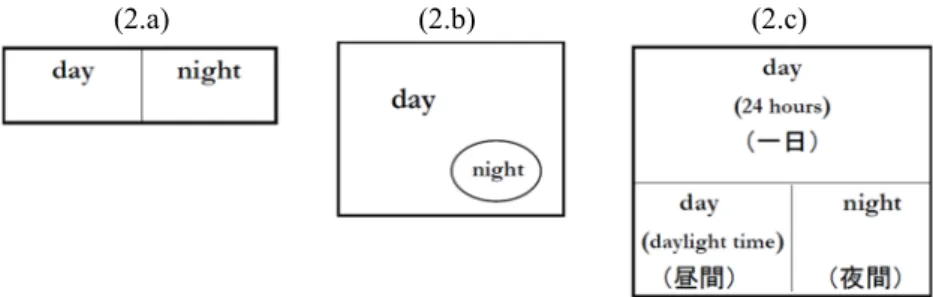
In English the lexeme day is defined primarily by opposition with the lexeme night, as in Figure (2.a.), with their significatum distinguished by the feature <+/− sunlight >, the presence vs. the absence of daylight. The designation may vary according to diverse factors, from equal intervals (at the equinoxes), to one being longer and the other shorter, but neither of them disappearing completely. Thus, in the extreme we may have “white nights” (“白夜”), which are still categorized as nights and not as days. However, the lexeme day can also signify the whole duration
of 24 hours26, which includes both the interval of daylight and the interval of
darkness (absence of daylight). Thus, one term of the lexical opposition (called the “neutral” term) denominates both ‘itself’ and its opposite (the “marked” term of the opposition): the neutral term includes the semantic area of its opposite. This is a prototypical instance of the well-known and wide-spread phenomenon of “neutralization of lexical oppositions” (Figure 2.b.), which is in itself a typical example of suspending the intuitive principle of non-contradiction from Logic1
25 In this sense, it can be noted that among the so-called “interference errors” there is a
category which is relatively easy to correct, if the learner simply projects into the target language ad litteram isolated lexical contents or grammatical structures from another language. There exists, however, a category more radical and difficult to deal with, like the example discussed here, where the learner projects principles and dimensions of semantic organization alien to the target language (with Humboldt’s metaphor, the very “conceptual fabric” of another language). Unless addressed systematically, with rigor and an amount of effort well beyond those required by the first category of interference errors, the latter type of projection risks to become a permanent obstacle to the learner’s progress beyond a rudimentary use of the target language.
26 This can designate either the calendar day, according to the conventions of modern life, or
the interval from one morning to the next morning, according to the more general experience of man’s diurnal activity cycle.
Emma Tămâianu-Morita
(Level 1) through the specific semantic organization of a particular language as a traditionally constituted technique of speech (Level II). Since this is a phenomenon pertaining to Level II, it may occur in some languages, but not in others. For comparison, we can note that in Japanese the lexical organization of the same empirical domain of time intervals is completely different (Figure 2.c.), with the lexeme signifying the interval of 24 hours of a calendar day (24 h within the same calendar date) distinct from those roughly correspondent to the opposition by the feature <+/- sunlight >, and without a phenomenon of neutralization. The domain conceptualized in English through one lexeme is conceptualized in Japanese by several different primary or compound lexemes. In this respect English can thus be characterized as more ‘vague’ than Japanese.
(2.a) (2.b) (2.c)
Figure 2: Functional organization of the lexical meaning of day
Thus, when learning and when using the significatum of the English lexeme
day, the speaker necessarily suspends an incongruence, accepting that one entity can
be at the same time itself and its opposite, and this is no longer felt as a contradiction precisely because this is the peculiar means of expression handed down from generation to generation in the tradition of speech called “the English language”. Nevertheless, in a genuine utterance, when the virtual signification of the lexeme is actualized and contextually orientated in order to designate a certain interval of time whose concrete length will differ in each case, situations may appear that bring the phenomenon of neutralization into the speaker’s awareness.
Such was the author’s experience in May 2013 in Spain. Having booked what was advertised as a “day trip” from a local travel agency in the city of Almería, situated on the coast of the Mediterranean, I joined the group at the designated pick-up spot at 6 a.m. on May 11, 2013, when the bus departed towards Córdoba and duly covered the 360 km distance in about 4 hours, after which the sightseeing program began. In the specific terminology of tourist packages, the word day is normally used in the narrower acceptation, based on the feature <+ daylight>. Thus, a day trip would last for a maximum of 12 hours, for example between 7 a.m. and 7 p.m. This is also termed a full-day trip/tour, as opposed to a half-day trip, the latter covering either the first half of a day (e.g. 7:00 to 13:00) or the second half of the day (e.g. 14:00 to 20:00) – with the lexeme day used with the same acceptation in all of these cases. Having left Almería at 06:00h for the “day trip”, I naturally expected to be back in the city on the same … day, later in the evening. Taking into account the
Journal of International Studies, 3, November 2018
distance to be covered by bus, perhaps a late hour such as 9 or 10 p.m was within predictable limits. After having finished the guided part of the tour, which included the most beautifully decorated patios in the old city center, as well as the world-famous Mosque-Cathedral (La Mezquita), from around 2 p.m. we were offered free time to visit the sights on our own. To my utmost surprise, the pick-up time for return was announced to be 23:30h (!), with the arrival back in Almería scheduled for around 04:00h on the next day, May 12 – which was indeed faithfully observed by our trustworthy bus driver. It then became evident to me that we had just finished a day trip in the sense of the neutral term: a trip that extended over almost 24 hours, so as to give us ample time to enjoy the city of Córdoba, with its splendid architecture, rich history and wonderful festival, when countless houses and gardens are each decorated in a unique way, so that time never seems enough for discovering all of them. Crossing the borderline of the midnight hour, which marks the beginning of the next calendar day was not an obstacle in a country where, as I could see on numerous other occasions, people will not let formal or material factors deter them from the fullest enjoyment of cultural experiences. Technically, in Japan, this tour could not have been classified as a day trip (1 日ツアー), but very precisely as a two-day trip without hotel accommodation (0 泊 2 日ツアー), with the lexeme “日” designating not just any 24-hour interval, but the calendar day, and no suspension of Logic1 required for the meaningful interpretation of the linguistic expression in
question.
4. Final considerations
4.1. Closing remarks for Part I
In the present article I have argued that all languages, as primary systems of signification, can and do suspend judgments of incongruence with the universal principles of rational thought and with the ordinary experience in the empirical world (“Logic1”). Consequently, no language is inherently any more or any less ‘logical’
than any other language. As far as ‘vagueness’ is concerned, it only appears as such from an external point of view, when units and structures are extracted from their holistic relations within one language and placed in a direct comparison from the point of view of their designations, again taken in isolation. Thus, ‘vagueness’, if/when attestable, should be treated as a category of linguistic analysis rather than a category of the languages themselves.
On the other hand, “Logic2”, the science of logic and argumentation, may
concern discourse organization in certain types of texts but not in all texts, and can
never apply to the structure of a language in and by itself, as a virtual system of
signification.
Finally, with respect to its treatment of “Logic1”, the Japanese language is
neither more ‘illogical’ nor necessarily more ‘vague’ than the other languages taken for comparison (here, English and Romanian). With respect to the use of “Logic2”,
should it be true that fallacies or failures seem to be more frequent on the Japanese social scene than elsewhere, the culprit is not the Japanese language itself, but the combined effect of other hindering factors, such as failures in the language education
Emma Tămâianu-Morita
process, erroneous models propagated by the media, individual ignorance and/or indifference and so on.
4.2. Outline of Part II
The second part of the present exploration27 will focus on the suspension of Logic 1 on
the level of texts (Level III → I), as in the last two cases announced in the Introduction. Text (3) suspends the universal norms of Level I by exploiting the specific organization of grammatical significata in English. On the other hand, Text (4) suspends the norms of Level I with minimal use of the specific lexical and grammatical organization of French, in its aspiration towards becoming the absolute model of incongruent discourse, easily adaptable and recognizable as such even when translated into – in principle – any other language. Thus, in each case the overall signifying intention and sense of the text justifies the way in which the norms of Logic1 are suspended, and these mechanisms function as a means of expression for
a meaning of a higher rank than significata and designata, which is textual sense28.
Finally, the triadic model of analysis proposed here in the framework of Coseriu’s theoretical outlook on language will be compared with two other theoretical orientations relevant for the issue under discussion:
(i) Beaugrande and Dressler’s (1981) “principles of textuality”: seven “constitutive” principles (cohesion, coherence, intentionality, acceptability, informativity, situationality and intertextuality) and three “regulative” principles (efficiency, effectiveness, appropriateness);
(ii) pragmatic accounts based on Grice’s (1975, 1989) Cooperative Principle and conversational maxims, implicatures and presuppositions, with the phenomena of intentional non-observance (opting out, flouting, suspension).
References
Beaugrande (de), Robert-Alain and Dressler, Wolfgang (1981). Introduction to text linguistics. London & New York: Longman.
Coseriu, Eugenio (1952). La creación metafórica en el lenguaje. Reprinted in E. Coseriu (1977), 65-102.
― (1955-1956). Determinación y entorno. Dos problemas de una lingüistica del hablar. Reprinted in E. Coseriu (1962), 282-323.
― (1957). Logicismo y antilogicismo en la gramática. Reprinted in E. Coseriu (1962), 235-260.
― (1962). Teoria del lenguaje y lingüistica general. Cinco estudios. Madrid: Gredos. ― (1969). Geschichte der Sprachphilosophie von der Antike bis zur Gegenwart. Eine Übersicht. Teil I: Von der Antike bis Leibniz. (Winter semester 1968-1969). Ed. by G. Narr & R. Windisch. Tübingen: Narr.
27 Part II will be prepared for publication in a future issue of the Journal of International
Studies, Kindai University.
28 The relation between significata and designata on the one hand, and textual sense on the
other hand, as elements in the double semiotic articulation of discourse, is analyzed in Tămâianu-Morita (2012a, 2012b, 2014, 2016).