A Comparison of JSL and JFL Environments
Yumi Takamiya異なる学習環境におけるプラグマティックスと文法に関する意識
髙 宮 優 実
Bardovi-Harlig & Dörnyei(1998)、Niezgoda & Röver(2011)、 Schauer(2006)、Xu, Case & Wang(2009)らの研究によって、プラグ マティックスと文法に関する意識は、それぞれ独立していることが明ら かにされている。しかし、意識がどのようにプラグマティックスや文法 の能力と関連しているかや、学習環境との関連性については、検証が行 われていない。そのため、本研究では以下の点を検証することにする。 1)学習環境の違いによって、意識に差はあるか。 2)学習者の言語能力はプラグマティックスの不適切さ、文法の誤りに 関する意識に差を生み出すか。 3)プラグマティックスの不適切さや文法の誤りを意識できる学習者は、 より適切で正しい産出をすることができるか。また、第二言語か、 外国語かという環境による差はあるか。 4)プラグマティックスの転移は、高い言語能力をもつ学習者に多くみ られるか。 談話完成テストを用いて調査した結果、JSL グループは、プラグマ ティックスと文法の間違いを同等に捉えていることがわかった。間違い の深刻さは、JFL グループのほうが JSL グループよりも、より深刻だと 認識していたものの、間違いを特定できる率は JFL グループのほうが、 JSL グループよりも低かった。質問紙を分析した結果、学習環境は学習 者の意識には常に影響を及ぼすということはないものの、学習者の言語 能力は意識に影響を及ぼすことが明らかになった。
1. Introduction
This paper reviews research discussing the relationship between interlanguage pragmatics and grammatical development and especially the differential effects of SL and FL settings on the development of pragmatic and grammatical awareness. In order to examine the developmental stages of grammatical and pragmatic competence, this study explores the extent to which instructed L2 learners of Japanese are aware of differences in target-language grammar and pragmatics. In particular, the study examined how learner awareness is related to production.
1.2 Literature review
Even though many researchers are interested in investigating the connection between pragmatics and grammar, most of the research has focused on pragmatics only and has not examined the correlation between pragmatic development and grammatical development. However, researchers are finally channeling their interest into serious studies focusing on the connection between pragmatics and grammar.
In Bardovi-Harlig and Dörnyei's (1998) study of ESL and EFL learners' pragmatic and grammatical awareness, the researchers tested 543 learners and their teachers in the United States and Hungary as well as a secondary sample of 113 EFL speakers in Italy. The method centered on the use of 20 videotaped scenarios of brief conversations in English, each containing either a pragmatic error, a grammatical error, or no error in the last utterance in the conversation. After each scene, participants indicated whether the
utterance was "appropriate/accurate," and if it was not, they rated the gravity of the problem on a six-point scale from not bad at all to very bad. The results showed that ESL learners identified more pragmatic errors and rated them as more severe than they did grammatical errors, whereas EFL learners showed the opposite pattern, ranking grammatical errors as more serious than pragmatic errors. The results also showed that learners' proficiency influenced their degree of awareness of errors. The low-proficiency EFL students gave lower ratings to both grammatical and pragmatic errors than did the high-proficiency EFL group. High-proficiency EFL students rated the grammatical errors as more severe than the pragmatically inappropriate forms. Meanwhile, the high-proficiency ESL group assessed pragmatic inappropriateness as more serious, whereas the high-proficiency students rated grammatical accuracy lower than did the low-proficiency students. Thus, language development was associated with an increase in pragmatic/grammatical awareness but in opposite directions, depending on the instructional environment. However, this study does not provide conclusive evidence that pragmatic/grammatical awareness is linked to the instructional environment because FL and SL classes are not equal, nor are students' ability or motivation.
In a replication of Bardovi-Harlig and Dörnyei's study (1998), Niezgoda and Röver (2001) investigated whether the environmental effect found by Bardovi-Harlig and Dörnyei is inevitable or whether learners can develop high pragmatic awareness in an FL setting while learners in SL settings cannot. They tested 48 ESL students in
Hawai'i and 124 Czech students learning English in the EFL context of the Czech Republic. They found that the ESL students in Hawai'i rated pragmatic errors as substantially more severe than grammatical errors, which confirmed Bardovi-Harlig and Dörnyei's findings. However, unlike Bardovi-Harlig and Dörnyei's Hungarian EFL group, the Czech students noticed a much higher number of pragmatic and grammatical errors and judged both error types to be more serious than did the ESL students. Low-proficiency learners in both the EFL and ESL groups recognized more pragmatic errors than grammatical errors and rated pragmatic errors as more severe than grammatical errors, whereas high-proficiency learners showed the opposite tendency.
Both of their findings suggest that students' awareness of grammar and pragmatics are independent. Later, Schauer (2006) and Xu, Case, and Wang (2009) conducted similar studies. However, neither study showed how the learners' awareness of grammar and pragmatics is related to their ability to use that awareness in production. Accurate production is very important to students. If students are able to recognize accurate grammar and appropriate pragmatics but cannot produce accurate or appropriate utterances, their ability to communicate is compromised. It is not always the case that students who perceive accurately and/or appropriately can produce accurate and/or appropriate utterances. Both of these aspects are considered in this study to examine the relationship between perception and production. If there is a gap between the two, language teachers could be made aware of it and could then work with their students to bring
perception and production to the same level.
This relationship between awareness and ability is best addressed using discourse-completion tests (DCTs). These consist of descriptions of situations designed to elicit specific speech acts. Participants write in the blanks in a short conversation what they would say in that situation. DCTs are very effective at eliciting speech production data in written format. However, a methodological issue in using DCTs is whether to give the participants the opportunity to "opt out," that is, not to respond to the questions. Rose and Ono (1995) state that opting out is the choice of not performing the speech act under investigation and is particularly difficult to investigate in written questionnaires. Rose and Ono (1995) administered DCTs and multiple-choice questionnaires (MCQs) designed to elicit request forms from two groups of 36 female Japanese undergraduates. There were significant differences in most situations, with those completing the MCQs choosing to opt out or to indicate their response indirectly more frequently than those completing the DCTs. These results seem to indicate serious problems with DCTs that need to be addressed if DCTs are to be used in speech act studies. Because participants using DCTs preferred to opt out substantially less frequently than those using MCQs, I included in my own DCTs explicit instructions for opting out. However, most studies, including Takahashi and Beebe (1987), did not include this option. Clearly, it is easier to elicit the desired data without the opting out option. However, when this option is not offered, participants are forced to provide responses that are not representative of actual productive communication. This makes the
data unreliable. While DCTs are useful for generating large amounts of data quickly, we should try to understand the underlying causes of the variation produced by our research methods so that we can determine the most appropriate uses of data collection procedures. The DCTs used in this study therefore included the option to opt out in order to make the participants' answers as natural as possible, given that DCTs do not demonstrate natural spoken production since they are in a written format.
If we are to understand the relationship between awareness and production, we will be able to see how students' perceptions are reflected in their production. Moreover, although previous studies examined ESL learners' average of length of stay in the target language country, whether EFL learners may have had experience of staying in the target language country was not addressed. This study therefore addresses this issue, as EFL learners who have stayed in the target language country should have a higher level of pragmatic competence than their EFL peers who have never had that experience.
This study applies earlier research by Bardovi-Harlig and Dörnyei (1998) and Niezgoda and Röver (2001) to students of Japanese. It focuses on learners' grammatical and pragmatic abilities to examine differences between students studying in different environments, namely Japan and the United States. I used DCTs with the option of opting out, that is, giving no response in some situations. I also measured the learners' proficiency levels using a number of tools, taking into consideration class level, average grades in Japanese
courses, and standardized tests. Moreover, because I hypothesized that first languages and cultures influence speech act realizations, I separated the learners into two groups: JSL and JFL. I first selected learners who had the same language and cultural background (English speakers), but as their numbers were small, I added speakers of Chinese, Korean, Spanish, Thai, Turkish, Indonesian, Arabic, and Russian.
1.3 Research questions
The research questions were as follows:
RQ1: Does an environmental experience in the L2 culture influence awareness? Do JSL and JFL learners show the same degree of awareness?
RQ2: Does the learners' level of proficiency influence the degree of awareness of pragmatic and grammatical errors?
RQ3: Do learners who perceive more pragmatic and grammatical errors have more grammatically and pragmatically accurate/ appropriate production? Are there any differences between SL and FL settings?
RQ4: Is there more pragmatic transfer in the production of higher proficiency learners than in the production of lower proficiency learners?
The first two research questions, which examine learners' perceptions, parallel those in the Bardovi-Harlig and Dörnyei (1998) and Niezgoda and Röver (2001) studies. The last two questions are different in that they examine learners' production.
1.4 Hypotheses
Two hypotheses were identified as being useful in investigating the first research question:
H1: JSL learners (learners who have stayed in Japan for more than 10 months) will consider pragmatic errors to be more serious than grammatical errors;
H2: JFL learners (learners who have never stayed in Japan) will consider grammatical errors to be more serious than pragmatic errors.
Recall that in Bardovi-Harlig and Dörnyei's (1998) research, the low-proficiency EFL students gave lower ratings to both grammatical and pragmatic errors than did the high-proficiency EFL group, while the high-proficiency EFL students rated the grammatical errors as more severe than the pragmatic errors. By contrast, the high-proficiency ESL group assessed pragmatic inappropriateness as more serious, whereas the high-proficiency students rated grammatical errors lower than did the low-proficiency students. Meanwhile, in Niezgoda and Röver's (2001) replication research, low-proficiency learners in both the EFL and ESL groups recognized more pragmatic errors than grammatical errors and rated pragmatic errors as more severe than grammatical errors, while high-proficiency learners showed the opposite tendency.
Therefore, my third hypothesis (H3), which is related to RQ2, was as follows: High-proficiency learners who have never lived in Japan will rate grammatical errors as more severe than pragmatically inappropriate speech, while learners who have lived in Japan will rate
pragmatic inappropriateness as more serious. Low-proficiency learners will rate both grammatical and pragmatic errors lower than will high-proficiency learners, while low-high-proficiency learners will find pragmatic errors very difficult to rate, especially for learners who studied in an FL setting only.
My fourth hypothesis (H4), which is related to RQ3, was as follows: The DCTs will show a relationship between perception and production. High-proficiency learners will tend to produce pragmatically appropriate and grammatically accurate sentences. Low-proficiency level learners will tend to produce grammatically inaccurate and pragmatically inappropriate utterances.
Finally, and related to RQ4, my fifth hypothesis (H5) stated: High-proficiency learners will show more pragmatic transfer in their answers.
2. Methodology
I compared Japanese as a Foreign Language (JFL) learners in the United States and Japanese as Second Language (JSL) learners in Japan.
2.1 Participants
For administrative reasons, I could not administer standardized proficiency measures to my learners. Therefore, I had to rely on proficiency assessments provided by the Japanese and the US institutions, and I had no outside standard for comparing the JSL and JFL groups with each other (see Table 1).
I recruited a total of 90 learners for this study. A total of 49 learners in the JFL sample were students enrolled in fifth- and seventh-semester Japanese classes Japanese Language Programs at two large mid-western universities in the US. The JSL learners were enrolled in Japanese language programs at three universities in Tokyo, Japan. A total of 41 learners participated in the JSL sample.
Table 1. Background of Participants Gender
Group Number Male Female Age JFL 49 28 21 22.5 JSL 41 19 22 23 Total 90 47 43
Participants represented a diverse population that included native speakers of English, Chinese, Korean, Spanish, Thai, Turkish, Indonesian, Arabic, and Russian. I conducted analyses to investigate the influence of ethnolinguistic background by collecting information sheets and sample questionnaires. The information sheet elicited information regarding the participants' gender, age, learning history, length of residency in Japan, and living style in Japan. Living style was included in order to determine the participants' current learning environment. The questionnaire included 15 questions including grammatical and pragmatics errors and one DCT similar to the instrument used in this study. As no substantial differences were found in the sample after examining the answers, I decided to include all of the respondents. There were slightly more students in the JFL group than in the JSL group. The average age in the JFL and JSL
groups was about the same. Male participants numbered slightly more than the female participants.
Bardovi-Harlig and Dörnyei (1998) used two items to produce a proficiency measure. The first concerned the proficiency level of the English course the participants attended, and this variable was combined with a self-report proficiency measure. However, unlike the samples in the Bardovi-Harlig and Dörnyei (1998) study, the samples in this study were not preselected on the basis of scores on standardized tests. Instead, I divided the EFL participants into two groups, low proficiency and high proficiency, on the basis of semester of study: fifth-semester students were placed in the low proficiency group and students in the seventh semester and above were placed in the high proficiency group. For JSL, students in intermediate courses were placed in the low proficiency group and students in advanced courses were placed in the high proficiency group. Moreover, because self-rating is not reliable, I asked students to record their average grades so far in college level courses as supplemental information. Additionally, I asked students whether they had passed a Japanese standardized test and, if so, to report that grade. However, because most of the JFL students had never taken the test, I decided not to use this information in this study.
2.2 Instrument
To test for differences in the learners' awareness in the grammatical and pragmatic domains, I developed a contextualized pragmatic and grammatical judgment task presented in a written format. I
used Bardovi-Harlig and Dörnyei's (1998) original questionnaire as a reference. I created tasks such as requests, apologies, suggestions, refusals, advice, complaints, and compliments. In addition, I added the following speech acts: offering a greeting, asking a question, and giving a reason. The written questionnaire consisted of 23 situations: ten containing pragmatic errors, ten containing grammatical errors, and three consisting of accurate utterances. To ensure that each grammatical/pragmatic error would be unambiguously identifiable, I asked 12 Japanese native speakers to evaluate each question. These raters were all Japanese teaching assistants majoring in Japanese linguistics at a US university. Situations in the written questionnaire involved "I" and classmates, teachers, boss, and host mother. The participants answered this questionnaire outside of class. As a result, I could not tell how long it took for them to answer each question or whether they had help from others. Participants then read dialogues and answered questions, such as the following:
友だちと話しています。 Tomodachi to hanashite imasu.
You are talking to your friend.
友だち:一緒に映画を見に行きませんか。
Tomodachi:Issho ni eiga o mini iki masenka.
Friend:Won't you go to see the movie together? 私:いいえ、行きません。
Watashi:Iie, ikimasen.
I:No, I won't.
a) Was the underlined part grammatically correct? ( )Yes ( )No If there was a problem, how bad do you think it was?
Not bad at all : : : : : : Very bad
b) If there were no grammatical errors, or if the grammatically incorrect parts were fixed, would the underlined part be
target-like/appropriate? ( )Yes ( )No If there was a problem, how bad do you think it was?
Not bad at all : : : : : : Very bad
In completing the task, learners first had to judge the accuracy of the utterance and then its appropriateness. Learners then rated the severity of the problem. Finally, after the participants completed the questionnaire, they were asked to answer a Discourse-Completion Test (DCT) so that the relationship between learners' perception and production could be examined.
3. Results
In this section, I address each of the research questions individually in four sections: environment, proficiency level, grammatical and pragmatic elements in production, and pragmatic transfer in production.
3.1. RQ1: Does environment influence awareness?
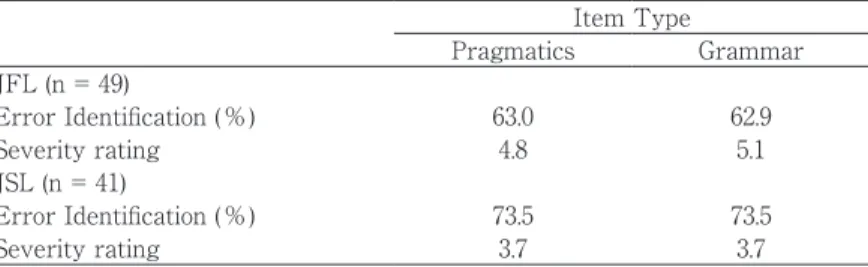
The first subquestion asked whether JSL and JFL learners showed the same degree of awareness. Table 2 presents the respondents' error identification and error salience ratings broken down by subsample.
Table 2. Comparison of JFL and JSL Error Identification and Severity Ratings Item Type Pragmatics Grammar JFL (n = 49) Error Identification ( % ) 63.0 62.9 Severity rating 4.8 5.1 JSL (n = 41) Error Identification ( % ) 73.5 73.5 Severity rating 3.7 3.7 3.1.1. Between-group comparisons
The JFL group noticed a lower number of both error types. However, they perceived both error types as much more serious than did the JSL group. The grammatical ratings of the JFL group were substantially higher than those of the JSL group.
First, I would like to consider grammatical error identification (see Table 2). In the JSL setting, because there was a lot of Japanese input in the students' daily life, they could identify the errors relatively
easily. However, in the JFL setting, because the quantity of input is much smaller because the environment outside of the classroom was English-speaking, the students were not skillful enough to identify the grammatical errors reliably. However, once the JFL students found grammatical errors, they took them very seriously. Grammar was very important to them because as students, they focus on learning grammar in the classroom. Also, their grammatical errors are clearly visible on their own quizzes. Teachers count off grammatical errors on tests and test results are often the only feedback JFL students receive. In contrast, for JSL students, Japanese people generally do not point out a foreigner's grammatical errors if that person can communicate well enough. This could be one reason why the JSL students did not take grammatical errors quite so seriously. As regards severity ratings for grammar, JSL students tend to skim and catch the most important content in utterances in daily life. This is a necessary skill for living in the target language environment. If they over-focus on each error, especially grammatical errors, they will miss important information because conversation flows so quickly. This is why the severity ratings of the JSL students on grammar was low. By contrast, because the quantity of input is much smaller in the FL setting, learners have more time to examine each error once they become aware of it. This is most likely why the JFL students gave grammatical errors a high severity rating. For JFL students, grammatical errors are something they cannot ignore once they are aware of them.
As regards error identification and severity ratings for pragmatics, the results showed that both JFL and JSL learners identified errors
and rated severity at similar levels. This went against my hypotheses H1 and H2. Given Bardovi-Harlig and Dörnyei's (1998) and Niezgoda and Röver's (2001) findings, I predicted that the JSL learners would identify the pragmatic errors and rate them as more severe than would the JFL learners. The reason why JFL and JSL learners perceive pragmatic errors similarly is that it is difficult to become aware of and to acquire Japanese pragmatics compared to English pragmatics. In Japanese, "there exists a much stronger link between the relative social status of interlocutors and appropriateness of linguistic forms than in English because the choice of linguistic forms in Japanese inherently carries social information" (Jung, 2002, p. 5). According to Jung, the Japanese use of polite expressions is more normative and prescriptive than in English. Since Japanese pragmatics are complex, it is likely that learners will find them difficult to acquire even when they receive a lot of input from various sources or live in the SL setting.
3.1.2. In-group comparisons
JSL and JFL learners identified pragmatic and grammatical errors at the same rate (see Table 2). This result is similar to Bardovi-Harlig and Dörnyei's (1998) and Niezgoda and Röver's (2001) findings on this question.
The JSL sample rated pragmatic errors as more severe than grammatical errors. By contrast, the JFL sample rated grammatical errors as more severe than pragmatic errors, which replicated Bardovi-Harlig and Dörnyei's (1998) results but not Niezgoda and
Röver's (2001), who found that EFL learners did not rate pragmatic and grammatical errors substantially differently.
As with the between-group comparison, the reason why the JSL sample rated pragmatic errors as more severe than grammatical errors is that for learners living in the target language community, grammatical errors do not normally cause severe communication problems compared to pragmatic errors. No one wants to be misunderstood by those around them, and since pragmatic errors cause misunderstandings, the JSL group rated this type of error as very serious. However, the identification rate for pragmatic and grammatical errors was identical. Most likely, the reason is that because JSL learners receive a lot of input in daily life, they can identify pragmatic and grammatical errors equally well.
Again as in the between-group comparison, the reason why the JFL sample rated grammatical errors as more severe than pragmatic errors is most likely that pragmatic errors are not assessed on quizzes whereas grammatical errors are. Students are thus forced to take grammatical errors seriously. However, they could not identify grammatical errors as reliably as pragmatic errors. This was a surprising result. Since the students take grammatical errors seriously, they should be able to identify them. However, since the quantity of the input they receive is small, they are not skillful enough to easily catch small grammatical errors. On the other hand, if the sentence is grammatically accurate but sounds unnatural, they can identify pragmatic mistakes. In FL settings, pragmatic elements are sometimes taught implicitly. That is probably why the JFL group could identify
grammatically accurate but pragmatically inappropriate sentences. 3.2. RQ2: Does the learners' proficiency level influence their degree of awareness?
Recall that the JSL and JFL participants were divided into high-proficiency and low-high-proficiency groups based on the level to which they had progressed in their university Japanese program.
3.2.1. JSL Sample: Error Recognition Scores
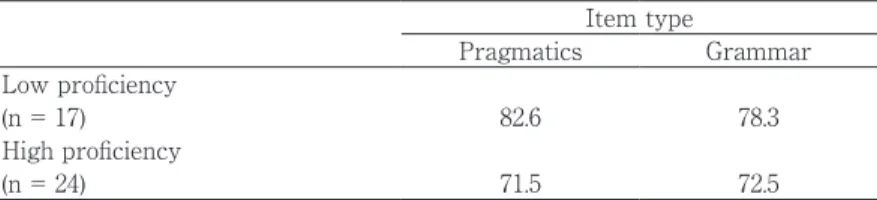
In a comparison of error identification within the same proficiency groups (Table 3), I found that low-proficiency learners recognized more pragmatic errors than grammatical errors. However, the number of participants in the low-proficiency group was small, and as one of the students had lived in Japan for ten years previously, this result was not reliable.
Table 3. Effects of Proficiency on JSL Learners' Accuracy Judgments Item type Pragmatics Grammar Low proficiency (n = 17) 82.6 78.3 High proficiency (n = 24) 71.5 72.5
On the other hand, high-proficiency learners recognized more grammatical errors than pragmatic errors, though the difference was not substantial, possibly because of the small subsample size. An analysis comparing proficiency groups showed that low-proficiency
learners recognized more grammatical and pragmatic errors than did high-proficiency learners. When the students' proficiency level is high, it should be easier for them to identify errors, especially grammatical errors. It is difficult to explain why low-proficiency level students could identify grammatical errors better than did the high-proficiency level students. However, the one person who lived in Japan for a long time probably skewed the results.
3.2.2. JSL Sample: Error Severity Ratings
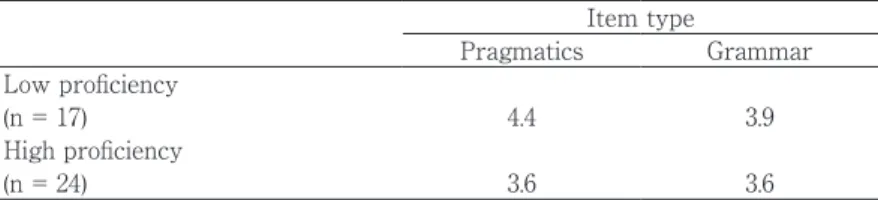
For severity ratings within proficiency groups (Table 4), low-proficiency learners rated pragmatic errors as more severe than grammatical errors.
Table 4. Effects of Proficiency on JSL Learners' Severity Judgments
Item type Pragmatics Grammar Low proficiency (n = 17) 4.4 3.9 High proficiency (n = 24) 3.6 3.6
High-proficiency learners did not differ in their severity ratings for the two error types. In a comparison between proficiency groups, I found that the low-proficiency learners' severity ratings for pragmatic errors were more severe than those of high-proficiency learners, whereas there was little difference in severity ratings for grammatical errors. Moreover, low-proficiency learners' pragmatic ratings were remarkable across the four sets of ratings. This was a puzzling finding,
which may be due to the one low-proficiency learner who spent a long time in Japan and who must have had more contact with Japanese-language speakers than any other student.
3.2.3. JFL Sample: Error Recognition Scores
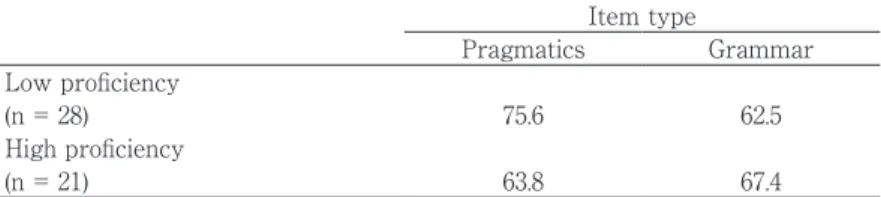
In an analysis of within proficiency groups (Table 5), I found that low-proficiency learners identified more pragmatic errors than grammatical errors while high-proficiency learners identified more grammatical errors than pragmatic errors.
Table 5. Effects of Proficiency on JFL Learners' Accuracy Judgments
Item type Pragmatics Grammar Low proficiency (n = 28) 75.6 62.5 High proficiency (n = 21) 63.8 67.4
This is most likely because in the FL setting, it is very important to recognize grammatical errors, especially in the classroom, whereas pragmatic errors are less important. Therefore, high-proficiency learners are accustomed to finding grammatical errors. It was interesting to see that low-proficiency learners identified more pragmatic errors than grammatical errors. Since low-proficiency learners lack in -depth knowledge of Japanese grammar, it is harder for them to find grammatical errors. In contrast, they can spot pragmatic errors more clearly because, although the sentences were grammatically accurate, they sounded unnatural. Low-proficiency
learners appear to be more sensitive to differences between natural and unnatural speech patterns because they are not distracted by grammatical structures of which they are unaware. It is interesting, even ironic, that their low grammatical awareness is of benefit to their pragmatic awareness.
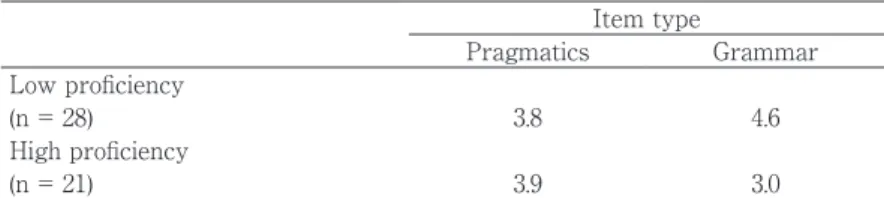
3.2.4. JFL Sample: Error Severity Ratings
As regards severity ratings within proficiency groups (Table 6), I found that low-proficiency learners rated grammatical errors as more severe than did high-proficiency learners.
Table 6. Effects of Proficiency on JFL Learners' Severity Judgments
Item type Pragmatics Grammar Low proficiency (n = 28) 3.8 4.6 High proficiency (n = 21) 3.9 3.0
This is most likely because, for low-proficiency learners, grammar is the only area in which they can show learning progress in FL settings. They cannot see grammatical errors as unimportant. On the other hand, high-proficiency learners did not rate grammatical errors severely. This maybe because for these learners, conveying meaning is as important as accurate speech. However grammatically accurate their utterances may be, if they convey the wrong meaning or no meaning at all, then these utterances are useless. High-proficiency learners see grammatical errors as a minor part of communication
whereas pragmatics plays an important role for them because they are the key to delivering the right meaning. By contrast, low-proficiency learners take grammatical errors more seriously because they believe that if the grammar is accurate, hearers will understand their meaning. Although this is not be the case in practice, high-level learners may know this but low-level learners may not.
3.3. RQ3: Do learners who perceive more pragmatic and grammatical errors have more grammatically and pragmatically accurate production? Are there any differences between SL and FL settings?
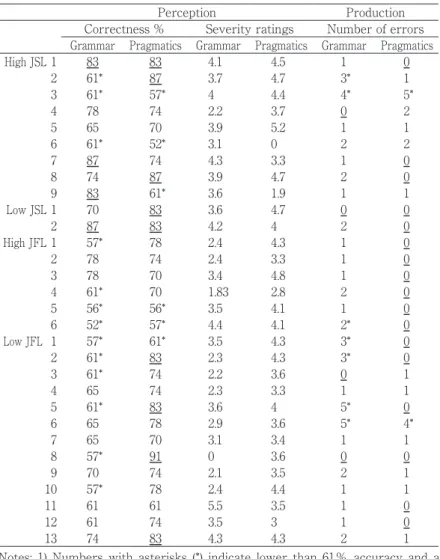
Relationships between perception and production are shown in Table 7.
The results showed that while some learners could reliably perceive grammatical and pragmatic errors, their written production was inaccurate. Further, learners who could not recognize grammatical errors could not produce accurate utterances either. Since their grammatical level was low, it follows that their production level was also low. With the exception of one learner who had a low perception of pragmatics and also produced many pragmatic errors, even students who could not recognize pragmatic errors did not produce pragmatic errors. Even though learners care about grammatical errors, they cannot necessarily produce accurate utterances. However, even if they cannot reliably perceive pragmatic errors, it is possible for them to avoid producing pragmatic errors.
Table 7. Relationship Between Perception and Production Perception Production Correctness % Severity ratings Number of errors Grammar Pragmatics Grammar Pragmatics Grammar Pragmatics High JSL 1 83 83 4.1 4.5 1 0 2 61* 87 3.7 4.7 3* 1 3 61* 57* 4 4.4 4* 5* 4 78 74 2.2 3.7 0 2 5 65 70 3.9 5.2 1 1 6 61* 52* 3.1 0 2 2 7 87 74 4.3 3.3 1 0 8 74 87 3.9 4.7 2 0 9 83 61* 3.6 1.9 1 1 Low JSL 1 70 83 3.6 4.7 0 0 2 87 83 4.2 4 2 0 High JFL 1 57* 78 2.4 4.3 1 0 2 78 74 2.4 3.3 1 0 3 78 70 3.4 4.8 1 0 4 61* 70 1.83 2.8 2 0 5 56* 56* 3.5 4.1 1 0 6 52* 57* 4.4 4.1 2* 0 Low JFL 1 57* 61* 3.5 4.3 3* 0 2 61* 83 2.3 4.3 3* 0 3 61* 74 2.2 3.6 0 1 4 65 74 2.3 3.3 1 1 5 61* 83 3.6 4 5* 0 6 65 78 2.9 3.6 5* 4* 7 65 70 3.1 3.4 1 1 8 57* 91 0 3.6 0 0 9 70 74 2.1 3.5 2 1 10 57* 78 2.4 4.4 1 1 11 61 61 5.5 3.5 1 0 12 61 74 3.5 3 1 0 13 74 83 4.3 4.3 2 1 Notes: 1) Numbers with asterisks (*) indicate lower than 61% accuracy and a
number of errors in production greater than three.
2) Underscored numbers ( ) indicate higher than 83 % accuracy and no errors in production.
Next, I will discuss salient responses to the DCTs, focusing primarily on pragmatically appropriate/inappropriate answers. Here, I offer a qualitative analysis.
High-proficiency JSL
High severity rating of pragmatics
Learner 1 – Error identification rate for pragmatics: 83% (3)またいつか誘ってね。
Mata itsuka sasotte ne
Again sometime invite FP Please invite me again sometime
(4)いや、たいしたものじゃないから気にしないで。
Iya, taishita mono jya nai kara ki ni shinai de
No, such a thing COP-NEG because
It is not important. Please do not take it seriously.
Here, the learner suggests a future invitation when she is invited to a concert for which it is natural to decline the invitation. When she declines her friend's offer to buy her a new umbrella, she says, "It is not important. Please do not take it seriously." When Japanese people hesitate to accept an offer, they normally give the reason. Most likely, the learner acquired this rule in the SL setting.
Learner 2 – Error identification rate for pragmatics: 87%
(5)本当に行きたいんだけど、日曜日はバイトなのでちょっと行けないです。
Hontoo ni ikitai nda kedo,
Really go-want NML-COP but,
nichiyoubi wa baito na node chotto ikenai desu
Sunday TOP part-time job COP NML-COP because little go-NEG cop I really want to go, but since I have a part time job on Sunday, I cannot go.
When the learner refuses an offer, she gives a positive answer: "I really wanted to go," and then adds, "Because of my job, I cannot go." She cares about the hearer's feelings and carefully avoids hurting him/her. This is a highly appropriate approach in Japanese.
Learner 4 – Error identification rate for pragmatics: 74% (6)また今度行きたいなあ。楽しんできてね。
Mata kondo ikitai naa. Tanoshinde kite ne
Again next time go-want FP. Fun-please FP I want to go next time. Please have fun.
(7)いいよ、いいよ、そんなの。わたし傘いっぱい持ってるから気にしな いで。本当に、大丈夫だよ。
Iiyo iiyo son na no. Watashi kasa ippai motteru kara ki ni shinai de.
OK OK such a thing. I umbrella a lot have because worry do-NEG
Hontoo ni daijyoobu dayo
Really OK COP FP
Oh, don't worry. Forget it. Please don't worry about it. I have lots of umbrellas.
The learner mentions future acceptance and adds, "Have fun." She expresses both gratitude and solicitude. Regarding the umbrellas, she says in essence that it is not a big deal. Her strategies make the hearer feel comfortable.
Learner 5 – Error identification rate of pragmatics: 75% (8)テレビつけるの遠慮してくれる?
Terebi tsukeru no enryo shite kure ru
TV turn on GEN hesitate do-receive Will you please not watch it now?
The word enryo (hesitate) is useful, but learners have difficulty using it appropriately. In this case, the student used it correctly. Sometimes, students use this word to refer to their own actions. However, it is difficult to apply to the actions of others.
High-proficiency JSL
Low severity rating for pragmatics
Learner 3 – Error identification rate for pragmatics: 57%
(9)実に俺傘がたくさんあるんだよ。だから気にしないでほかの買わない でくれ。(?)
Jitsu ni ore kasa ga takusan arun da yo
Really I umbrella NOM lot exist NML COP FP
Dakara kini shinaide hoka no kawanaide kure
Therefore mind do-NEG other one buy-NEG please
In fact, I have many umbrellas. So, don't worry, and don't buy me another one.
pragmatically inappropriate because he asks the listener not to buy another umbrella very strongly. In his case, the level of perception seems to correlate with production. I assume that the learner knows that using the plain form, which is the casual style used among people in close relationships, is the appropriate way to address a friend. However, he has not learned to use it appropriately. In fact, even students who have lived in Japan still have difficulty using the plain form.
Learner 6 – Error identification rate for pragmatics: 52% (10)もしよければ、つけないでください。(?)
Mosi yokere ba tsukenai de kudasai
If all right turn-NEG please
If possible, will you please not turn on the TV? (11)残念ですが、ハイトがあるから、いけない。(?)
Zannen desu ga, haito ga aru kara ikenai.
Unfortunately, COP but, part-time job NOM exist because go-cannot Unfortunately, because I have a part-time job, I cannot go.
This learner's perception of pragmatics is low. He uses the polite form, which should be used to people who of a socially higher rank, with his own roommate when he asks him not to turn on the TV. This is an unnatural utterance. Moreover, when he refuses his friend's offer to go to a concert, he does so impolitely by using the plain form.
Low-proficiency JSL
High severity rating for pragmatics
Learner 1 – Error identification rate of pragmatics: 83% (12)べつにいいよ。気にしないで。傘ならいっぱいあるから。
Betsu ni iiyo. Ki ni shinai de. Kasa nara ippai aru kara.
Particularly ok. Mind for do-NEG Umbrella as for many exist because
That's OK. Don't worry. As for umbrellas, I have a lot of them.
This learner's usage of nara (as for) is very natural here. Nara is difficult to use appropriately. However, in the SL setting, even low-proficiency learners can acquire the usage of nara.
Learner 2 – Error identification rate for pragmatics: 83%
(13) 実は、来年日本に留学したいんです。お忙しいところすみませんが、 推薦状を書いていただくわけにはいかないでしょうか。
Jitsu wa rainen nihon ni ryugaku shitai n desu.
Actually TOP next year Japan to study abroad want NML COP.
Oishogashii tokoro sumimasen ga,
Busy time sorry but
suisenjyou o kaite itadaku wake ni wa ikanai de shouka.
recommendation letter ACC write receive reason for COP Q
To tell the truth, I would like to study abroad in Japan next year. I am sorry to trouble you, but are you available to write a letter of recommendation for me?
(14) いいよ。そんなこと…。かさなんていくつでもあるよ。
Iiyo. Sonna koto. Kasa nante ikutsu demo aru yo.
OK. Such thing. Umbrella many even exist FP
This learner uses nodesu (nominalizer + copula) appropriately here. Yet this item is difficult to acquire because it often offends people's feelings. In addition, when she asks her professor to write a letter of recommendation, she tries to avoid forcing the professor to do this by mitigating her request. This is very natural in Japan. When she declines the hearer's offer, she says kasa nante (thing like) to show that losing the umbrella is not a big issue for her. This learner is able to consider the interlocutor's feelings and choose an appropriate wording.
High-proficiency JFL
High severity rating for pragmatics
Learner 1 – Error identification rate for pragmatics: 78%
(15)申し訳ありませんが、留学プログラムに申し込むために、教授の推薦 状が必要ですから、推薦状を書いていただけないでしょうか。
Mousiwake arimasen ga, ryuugaku puroguramu ni moushikomu tame ni
Sorry but study abroad program for apply for
Kyoujyu no suisenjyou ga hitsuyou desu kara
Professor GEN recommendation letter NOM need COP because
Suisenjyou o kaite itadake nai deshouka.
Recommendation letter ACC write receive COP Q
I am sorry, but in order to apply for the program to study abroad, I need to have a letter of recommendation. Will you please write it?
The learner first apologizes when requesting something of his superior, and he uses the honorific form. Even in the FL setting, low-proficiency learners are able to use this kind of expression.
Learner 2 – Error identification rate for pragmatics: 74%
(16)あのねえ、実は明日テストがあるんだけど、なにか大事な番組でもある?
Anonee, jitsu wa ashita tesuto ga aru n dakedo
Well actually TOP tomorrow test NOM exist NML COP but
Nanika daiji na bangumi demo aru
Something important program like exist
Well, in fact, I have an exam tomorrow. Do you have any particular program which you really want to watch?
(17)お気持ちはありがたいけど、でも残念なことに、その日はバイトをす るので、ちょっと行けないと思う。また、今度ねえ。
Okimochi wa arigatai kedo, demo zannen na koto ni
Offer TOP thank but but unfortunately thing
Sono hi wa baito o suru no de, chotto ikenai to omou.
That day TOP part-time job ACC do NML little go-NEG QT think
Mata kondo ne.
Again next time FP
That's so kind of you, but unfortunately, I have a part-time job on that day, so I don't think I can go. Well, maybe next time!
When this learner's roommate asks him whether he can turn on the TV, he does not explicitly refuse. Rather, he asks why the roommate wants to watch it. It is useful to be able to ask someone indirectly not to do something. It is interesting to see that learners can produce this kind of expression even in an FL setting. When the learner declines the offer, he first expresses his gratitude before declining, which mitigates and softens the utterance. This is a useful skill for learners.
Learner 6 – Error identification rate for pragmatics: 57% (18)それはちょっと。仕事があったから。次のいきましょう。
Sore wa chotto
It TOP little
Shigoto ga atta kara. Tsugi no iki masho.
Work NOM exist-PST because. Next one go-lets.
Well... it is a little inconvenient. I have to work. Maybe next time, I can go.
(19)いいだ。いいだ。しんぱいないよ。友達だから。
Iida. Iida. Shinpai nai yo. Tomodachi da kara.
OK OK worry NEG FP. Friends COP because OK, OK. Don't worry. Because we are friends.
The phrase sorewa chotto (it is a little inconvenient) is very unnatural in this context. Native Japanese speakers do not normally decline an offer in this way. Learner 6 also says, "Don't worry. Because we are friends." This type of statement is also unnatural in Japanese.
Low-proficiency JFL
High severity rating for pragmatics
Learner 7 – Error identification rate for pragmatics: 70% (20)いいえ、勉強しなきゃ。
Iie benkyoo shi nakya.
No study do must No, I need to study.
The learner says, "No," at the beginning of the sentence, which makes this refusal sound very strong.
Learner 8 – Error identification rate for pragmatics: 91% (21)いいけど、今勉強しているのに…。
Ii kedo, ima benkyoo shite iru noni
OK but, now study do Yes, but I am studying now...
When the learner asks his roommate not to turn on the TV, he doesn't say "No" but "Yes" first and then "but I am studying now..." In Japan, people do not normally say "no" explicitly, and sometimes "yes" can mean "no." Although this student has never been to Japan, he can produce this kind of natural utterance. I am curious to know how he acquired this strategy for saying "no" indirectly in Japanese.
Learner 13 – Error identification rate for pragmatics: 83% (22)いいえ、つけないでください。
Iie tsukenai de kudasai.
No turn on-NEG please No, please don't it turn on.
This learner uses "No," which is too strong for asking her roommate not to turn on the TV. Even though her error identification rate of pragmatics is very high, she still produces this type of inappropriate utterance.
Overall, there was no strong relationship between accuracy of perception and accuracy of production. However, for the most part, only students who were able to perceive pragmatic errors could
produce very Japanese-like expressions.
3.4. RQ4: Is there more pragmatic transfer in the production of higher proficiency learners than in the production of lower proficiency learners?
3.4.1. High Proficiency
I could not find many errors caused by pragmatic transfer. One example is the case of one learner saying, sorewa kini shinaide ne ("That's OK; please don't worry") when someone offers to buy him/her an umbrella. In this case, the learner does not need to say "That's" in Japanese. However, I could not find many examples of errors specifically caused by pragmatic transfer. One reason is that I had only four types of speech acts in the DCT. A greater variety of speech acts would likely yield more frequent occurrences of pragmatic transfer. 3.4.2. Low Proficiency
Low proficiency learners often refused an offer by saying chotto... ("a little inconvenient..."). Moreover, when someone lost the umbrella and offered to buy a new one, many learners answered, kekkodesu ("No, thank you"), which is not appropriate in this situation.
In addition, two learners answered, boryuumu o hikuku shite kurenai? ("Will you please turn the volume down?") In Japan, speakers normally say, "Please make the volume smaller," not, "Please turn it down." This is a translation of an English phrase and involves a pragmatic issue.
4. Discussion
The findings of this study do not entirely corroborate Bardovi-Harlig and Dörnyei's (1998) and Niezgoda and Röver's (2001) results. In these studies, ESL groups considered pragmatic errors to be more severe than grammatical errors. In my study, JSL groups considered pragmatic and grammatical errors to be identical.
Although the severity ratings of the JFL group were higher than those of the JSL group, their error identification rate was much lower than that of the JSL group. In the FL setting, learners study language as a subject, not as a daily communication tool. In the SL setting, however, learners are students when they are in school, but once they step out of school, they are people living in the target language society, where to live and communicate with people, it is necessary to use language as a tool. In this situation, even though learners can identify both pragmatic errors and grammatical errors, they do not take the grammatical errors as seriously. For them, grammatical errors by themselves are not a major issue. Rather, it is enough for most of them to communicate.
5. Limitations
The dominant methodological limitation in this study was the small number of participants, particularly for the low-proficiency JSL learners. This limits my ability to generalize my findings based on this sample.
Second, my DCT contained only four situations. Whether JSL and JFL students would perform well in attempting to interact
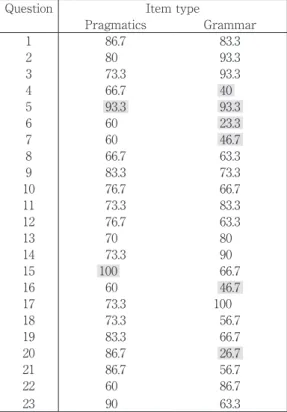
appropriately with a wider range of situations remains undetermined. The third problem is that the questionnaire was too difficult for the lower level learners - the fifth-semester Japanese language learners. They could identify neither the grammatical nor the pragmatic errors. Even for intermediate and advanced learners, some of the situations were too difficult for proper identification (see Table 8). The instrument should therefore be piloted in future research.
Question Item type
Pragmatics Grammar 1 86.7 83.3 2 80 93.3 3 73.3 93.3 4 66.7 40 5 93.3 93.3 6 60 23.3 7 60 46.7 8 66.7 63.3 9 83.3 73.3 10 76.7 66.7 11 73.3 83.3 12 76.7 63.3 13 70 80 14 73.3 90 15 100 66.7 16 60 46.7 17 73.3 100 18 73.3 56.7 19 83.3 66.7 20 86.7 26.7 21 86.7 56.7 22 60 86.7 23 90 63.3 Table 8. Accuracy Rates on Each Question ( % )
Here are some examples of situations in which the results were remarkable. (Note: G = Grammar, P = Pragmatics).
4.日本語のクラスで話しています。 G: Incorrect, P: Correct Nihongo no kurasu de hanashite imasu.
Japanese NML class at talking You are chatting in Japanese class.
友達:昨日、去年同じクラスだったシュミットさんに会いましたよ。 Tomodachi: kinoo kyonen onaji kurasu datta shumitto san ni aimashita yo.
Friend: Yesterday last year same class PST Schmitt to see-PST FP
Friend: Yesterday, I met Mr. Schmitt, who was in the same class last year.
私:あぁ、シュミットさん。その人、今、どうしてるんですか? Watashi: Aa, Shumitto san. Sono hito ima dou shite ru n desu ka. I: Oh Schmitt that person now how do NML COP Q
I: Oh, Mr. Schmitt. What is he doing now?
友達:日本の会社に勤めているんだって。日本語がとても上手に なっていて、びっくりしたよ。
Tomodachi: Nihon no kaisha ni tsutomete iru n da tte. Friend: Japan NML company at work be NML COP QT Nihongo ga totemo jyouzu ni natte ite, bikkuri shita yo. Japanese NOM very well become surprise do-PST FP
Friend: He works at a Japanese company. His Japanese was much improved and I was quite surprised.
Only 40 % of learners recognized that the underlined sentence contained a grammatical error. It is easy to notice the inaccurate usage of ano (that) and sono (the) when they are spoken, but it is harder to notice it in the written format because a single altered character can make it incorrect. If learners did not read the underlined sentence carefully, they might easily have missed this.
5.日本語のクラスで話しています。 G: Correct, P: Incorrect Nihongo no kurasu de hanashite imasu.
Japanese NML class at talking. You are in Japanese class.
先生:授業中は食べ物を食べないでくださいね。
Sensei: Jyugyouchuu wa tabemono o tabenai de kudasai ne. Teacher: Class hours TOP food ACC eat-NEG please FP Teacher: Do not eat during the class.
学生:でも、ほかのクラスでは、食べてもいいんですよ。 Gakusei: Demo, hoka no kurasu de wa tabete mo ii n desu yo.
Student: But other GEN class at TOP eat even ok NML COP FP Student: But it's allowed in other classes.
Even though only 78% of the native Japanese raters realized that the underlined sentence contained pragmatic errors, 93 % of the students recognized the errors. In Japanese society, it is inappropriate not to obey the teacher. Students are aware of this and treated this sentence as pragmatically incorrect. However, because more than 20% of the native Japanese raters treated this sentence as pragmatically
appropriate, whether this item is inappropriate or acceptable needs to be reconsidered.
6.日本語のクラスで夏休みの予定について話しています。 G: Correct, P: Incorrect
Nihongo no kurasu de natsuyasumi no yotei nit suite hanashite imasu.
Japanese GEN class at summer break GEN plan about talking You are chatting about plans for a summer vacation in Japanese class.
友達:夏休みにアメリカの西海岸に行こうかと思っているんだけど。 オレゴンはどこがおすすめ?
Tomodachi: Natsuyasumi ni amerika no nishikaigan ni ikouka to omotte iru n dake do.
Friend: summer break America NML west coast to go Q QT thinking NML COP but
Oregon wa doko ga osusume.
Oregon TOP where NOM recommend
Friend: I am thinking to go to the west coast of the U.S. during this summer. What do you recommend to see in Oregon?
私:それじゃ、ポートランドに来たらどう?夏休みは授業がないん ですから、マディソンに帰るつもりです。よかったら、私のうちに 遊びにきませんか。
Watashi: Sorejya, Pootorando ni kitara dou. I: then Portland to come-if how
tsumori desu.
Summer break TOP class NOM no NML COP because Madison to return thinking COP
Yokattara watashi no uchi ni asobini kimasen ka. Good-if my house to come Q
I: Since I am not taking classes this summer, I am going back to Madison. If you would like, come visit me.
Only 23 % of students were aware that this sentence contains pragmatic errors. The item nodakara (nominalizer + because) is grammatically correct but somewhat offensive when directed toward other people. Given that only 56% of the native Japanese raters were aware that this was a pragmatic error, I should reconsider using nodakara.
7.日本語のクラスの最後の日です。 G: Correct, P: Incorrect Nihongo no kurasu no saigo no hi desu.
Japanese GEN class GEN last GEN day COP. Last day of Japanese class.
先生:今日で日本語の勉強もおわりですね。これからもがんばって ください。
Sensei: Kyou de nihongo no jyugyoo mo owari desu ne. Teacher: today Japanese ACC class also end COP FP Korekara mo ganbatte kudasai.
From now also try hard please
わたし:先生の授業はとても上手でした。本当にありがとうござい ました。
Watashi: Sensei no jyugyoo wa totemo jyouzu deshita. I: teacher ACC class TOP very good COP PST Hontoo ni arigatou gozaimashita.
Really thank you PST
I: You did a good job. Thank you very much.
Only 46% of the students were aware that this sentence contained pragmatic errors. Complimenting one's superior is not target-like in Japanese. However, this is not implicitly taught in classroom settings. That is why students could not recognize this as a pragmatically inappropriate sentence. This item should be removed and an item explicitly taught in the classroom used instead.
15.友達と話しています。 G: Incorrect, P: Correct Tomodachi to hanashite imasu.
Friend with talking
You are talking to your friend.
友達:教科書なくしちゃったんだけど、新しいのを買ったほうがい いかな。
Tomodachi: Kyoukasho nakushi chatta n da kedo Friend: textbook lost NML COP but
Atarashii no o katta hou ga ii kana
New thing ACC buy-PST NOM good wonder Friend: I lost my textbook. Should I buy a new one?
私:図書館で借りるほうがいいと思うよ。もうあと2週間で冬休み だし。
Watashi: Toshokan de kariru hou ga ii to omou yo. I: Library at borrow NOM goo QT think FP Mou ato nishuukan de fuyuyasumi dashi.
Already last two weeks winter break COP also
I: You better borrow one from the library. We have only two more weeks before winter break.
A full 100 % of the students recognized that this sentence was grammatically inaccurate. In this sentence, karita (borrowed) is the correct form. For students, it is easy to recognize verb conjugation errors. In the future, items likely to be very obvious for students should be excluded.
16.先生のオフィスで話しています。 G: Incorrect, P: Correct Sensei no ofisu de hanashi te imasu.
Teacher GEN office at talking.
You are talking at your teacher's office.
先生:昨日のテストはあまりよくありませんでしたね。 Sensei: Kinoo no tesuto wa amari yoku arimasen deshita ne.
Teacher: yesterday NML test TOP not much good-NEG-PST FP Teacher: The result of yesterday's test was not good.
わたし:すみません、昨日は一時間だけ勉強しましたから。この次 はもっと勉強します。
kara.
I: Sorry, yesterday TOP one hour only study-PST because Kono tsugi wa motto benkyoo shimasu.
This next TOP more study do
I: Sorry. I studied only for an hour. I will study more next time. Although the usage of dake (only: indicating a positive situation) and shika (only: indicating a negative situation) is difficult, the students could recognize these errors. In this case, the grammatically accurate way of saying is: ichijikan shika benkyo shimasen deshitakara (I studied for only one hour). However, most of the students said that this sentence contains pragmatic errors because it does not use honorific forms. When I revise the questionnaire, I should carefully consider the interpersonal relationship between the two speakers. 20.友だちが自宅に遊びにきました。 G: Incorrect, P: Correct
Tomodachi ga jitaku ni asobi ni kimashita. Friend NOM home to visit to came. Your friend is visiting you at your home. 友だち:あぁ、喉がかわいた。
Tomodachi: Aa nodo ga kawai ta. Friend: Oh throat NOM thirsty-PST Friend: I am thirsty.
わたし:冷蔵庫にビールが冷やしていますよ。飲みませんか。 Watashi: Reizouko ni biiru ga hiyashite imasu yo. Nomimasen ka. I: refrigerator beer NOM make it to cool exist FP. Drink-TAG Q
I: There is a cold beer in the refrigerator. Do you want it?
Only 20% of the students realized that this sentence does not contain pragmatic errors. Perhaps they thought that it was not a good idea to offer a beer to a friend in Japanese society and treated this sentence as pragmatically inappropriate. This sentence contained grammatical errors since hiyashite imasu yo (I am cooling the beer), which includes a transitive verb to indicate action in progress, should be hiete imasu yo (The beer is chilled), in which an adjective indicates current state.
6. Pedagogical implications
Low-proficiency level JFL and JSL learners judged pragmatic and grammatical errors to be severe. They perceived both pragmatic and grammatical errors equally. As teachers, we should take this into consideration in the classroom and focus not only on grammatical elements but also on pragmatic elements not only for higher proficiency students but for lower proficiency students also in both SL and FL settings.
The results of this study suggest that Japanese instructors should be more aware of the fact that students perceive grammatical errors and pragmatic errors in different ways. In order to avoid situations whereby a student uses grammatically accurate but pragmatically inappropriate utterances, it is necessary for instructors to determine whether the student lacks L2 pragmatic competence or simply does not regard pragmatic errors as serious.
severity of pragmatic errors similarly, it is evident that pragmatic awareness can indeed be acquired in the FL environment, or more specifically, in the FL classroom. This strongly indicates that further observational and instructional research should be conducted to determine specifically how pragmatics can be taught in the JFL classroom.
7. Conclusion and issues for future research
This study investigated JFL and JSL learners' perceptions of grammar and pragmatics. The analysis of the questionnaire demonstrated that a learner's environment does not always influence the learner's awareness. On the other hand, the study found that proficiency does influence awareness.
It should be noted that this study investigated the perceptions of specific pragmatic and grammatical elements that appeared in the questionnaire administered to a limited number of subjects. Thus, the results do not represent JFL and JSL learners' perceptions of pragmatics and grammar in general. This study's findings may therefore not be directly applicable to other JSL and JFL students.
In future research, longitudinal studies should be conducted to examine how learners' pragmatic awareness develops in SL and FL settings, respectively.
References
Bardovi-Harlig, K. (1999). Exploring the interlanguage of interlanguage pragmatics: A research agenda for acquisitional pragmatics. Language Learning, 49: 677-713.
Bardovi-Harlig, K., & Dörnyei, Z. (1998). Do language learners recognize pragmatic violations? Pragmatic vs. grammatical awareness in instructed L2 learning. TESOL Quarterly, 32:233-259.
Jung, J. Y. (2002). Issues in acquisitional pragmatics. Teacher's College, Columbia University, Working Papers in TESOL & Applied Linguistics, 2.
Niezgoda, K., & Röver, C. (2001). Pragmatic and grammatical awareness: A function of learning environment? In K. R. Rose & G. Kasper (Eds.), Pragmatics in language teaching (pp. 63-79). New York: Cambridge University Press.
Rose, K. R., & Ono, R. (1995). Eliciting speech act data in Japanese: The effect of questionnaire type. Language Learning, 45: 191-223. Schauer, G.A. (2006). Pragmatic awareness in ESL and EFL contexts:
Contrast and development. Language Learning, 56: 269-318. Takahashi, T., & Beebe, L. M. (1987). The development of pragmatic
competence by Japanese learners of English. JALT Journal, 8: 131-155.
Xu, W., Case, R. E., & Wang, Y. (2009). Pragmatic and grammatical competence, length of residence, and overall L2 proficiency. System, 37: 205-216.
L2 learners often develop grammatical competence in the absence of concomitant pragmatic competence (Bardovi-Harlig & Hartford, 1990). In an exploration of the relationship between pragmatic and grammatical competence, Bardovi-Harlig and Dörnyei (1998) undertook a study to investigate the effects of environment and language proficiency on learners' metalinguistic assessment of pragmatic and grammatical errors in the target language. They found that learners in a second language (SL) setting assessed pragmatic errors as more severe than grammatical errors, whereas learners in a foreign language (FL) setting assessed grammatical errors as more severe than pragmatic errors. This study is a replication of their study in the context of learning Japanese as a second/foreign language. The research questions are as follows:
1) Does an environmental experience in the L2 culture influence awareness? Do JSL and JFL learners show the same degree of awareness?
2) Does the learners' level of proficiency influence the degree of awareness of pragmatic and grammatical errors?
3) Do learners who perceive more pragmatic and grammatical errors have more grammatically and pragmatically accurate/ appropriate production? Are there any differences in this respect between SL and FL settings?
4) Is there more pragmatic transfer in the production of higher proficiency learners than in the production of lower proficiency learners?
JSL learners and JFL learners were compared using a written questionnaire containing contextualized pragmatic and grammatical judgment tasks consisting of seven speech acts. Participants were asked to answer a Discourse-Completion Test to uncover the relationship between learners' perception and production. A total of 90 learners participated to this study.
Results showed that JSL groups considered pragmatic and grammatical errors to be identical. Although the error severity ratings of the JFL group were higher than those of the JSL group, the error identification rate of the former was much lower than that of the latter. The analysis of the questionnaire demonstrated that a learner's environment does not always influence the learner's awareness whereas proficiency does. Results for production were inconclusive.