
会話型とバッチ型処理兼用の大規模統計プログラム・パッケージSPTSS
19
0
0
全文
(2) Journal of Hokkaido University of Education (Section II A) Vol. 30, No. 1 September, 1979. *ittitft»*^»% (% 2 $|iA) ^ 30 « IS 1 -?- Bgffi 54 ^ 9 fi. Statistical Program Package SPTSS : Conversational and Batch Unified Operation, Large Scale FACOM Extensions to SPSS. Yoshihiro NAKANO Physics Laboratory, Sapporo College, Hokkaido University of Educetion,. Sapporo 064. +@NH^ : ^mb^-v^-m^mm^±M. ?§+7°o ^-'7 A • ^u.y ^->>' SPTSS. -ib^ia^t^^+Lffi^-^'fta'^isi. Abstract SPTSS is a statistical program package of Japanese FACOM extensions to SPSS. SPTSS contains 35 statistical subprograms (15 subprograms more than the original SPSS) and works in a unified manner for conversational mode as well as usual batch.. Attractive subprograms are, for examples, DATACLEAN, CLUSTER, XYPLOTTERs and HAYASIs (these are the multivariate analyses for nominal scale variables). SPTSS also has many kinds of still more extended service routines than SPSS has for data handling, e. g. multiple choice and full-columed DOCUMENTS and LIST CASES facilities. Therefore, SPTSS may also be of use as a handy IR (information retrieval) or mini Data Base system.. § 0 Introduction This paper is a case study of a program package in the field of practical computer applications.. A preliminary report was presented in a poster session at the 1st international conference of. SPSS users at Chicago in October, 1977.1) SPSS is the most famous statistical program package developed by SPSS Inc., USA.2' SPSS was originally batch oriented only. And SPSS Inc. now provides another special program package SCSS for use in conversational mode only.3' I have. heard the name SPSS/ONLINE, but merely by name, and I have no further information of it.* * This is a CDC program.. (29).
(3) Yoshihiro NAKANO. Our program package SPTSS, developed by a Japanese group, contains large scale extensions. to SPSS and works in a unified operating mode in conversational as well as batch. SPTSS works from terminal typewriter or display terminals with prompting as SCSS does. SPTSS has many more statistical subprograms by fifteen than original SPSS. They are Japanese subprorgrams : DATACLEAN,4' CLUSTER, MULTIGRAM,S> HAYASIs (multivariate analysis for nominal scale variables) etc. SPTSS has 35 subprograms in total. Among them the subprogram MULTIGRAPH is attractive, because it will convert map or diagram and/or any other documents for printing on LP to drawing in any scale on XYplottesr. Of coures, SPTSS has its own XYPLOTTER subprogram. SPTSS has also many kinds of still more extended service routines for data handling : for example, multiple choice, full-size DOCUMENTS and LIST CASES facilities. Therefore, SPTSS may be of use as a handy IR (information retrieval) or mini Data Base system too. SPTSS was realized on FACOM 230-75 at HUCC (Hokkaido University Computing Center,. JAPAN). § 1 Statistical subprograms in SPTSS Our SPTSS is provided with 35 statistical subprograms, whereas original SPSS has 20 subprograms and SCSS has only 7 ones. They are compared in the following.. SCSS (Release 3 by SPSS Inc.). 1 ) UNIVARIATE 2 ) CROSSTABULATION 4 ) CORRELATION 5 ) PARTIAL CORRELATION 7 ) FACTOR SPSS (Version 7 by SPSS Inc.). 1 ) CONDESCRIPTIVE 4 ) CROSSTABS 7 ) BREAKDOWN 10) NPAR TESTS 13) PARTIAL CORR 16) FACTOR 19) GUTTMAN SCALE. 2 ) FREQUENCIES 5 ) MULT RESPONSE 8 ) ONEWAY 11) PEARSON CORK 14) SCATTERGRAM 17) CANCORR 20) RELIABILITY. 3) BREAKDOWN 6) REGRESSION 3) AGGREGATE 6) T-TEST 9) ANOVA. 12) NONPAR CORR 15) REGRESSION 18) DISCRIMINANT. SPTSS (Version 7, FACOM Extension to SPSS) Added 15 subprograms to SPSS are in the following.. 21) DATACLEAN 22) DATAPATTERN 24) CONTOUR MAP 25) MULTIGRAM 27) XYPLOTTER 28) SURVIVAL 30) CLUSTER 31) NONLINEAR MAP 33) HAYASI 2 34) HAYASI 3 Explanations of our subprograms are given in a later section.. (30). 23) TRIANGRAM 26) MULTIGRAPH 29) QFACTOR 32) HAYASI 1 35) HAYASI 4.
(4) Statistical Program Package SPTSS. § 2 Operation and I/O Modes in SPTSS Operation and I/O modes of our SPTSS are many-sided as shown in the following. (See Fig. 1, Fig. 2) A. 1 ) Conversational demand mode (TSS mode) 2 ) Prompt real time terminal run.. 3 ) Remote and central batch job. B. 4 ) Tab set symbol @, to specify the 16th column. This may be useful even for card input of batch jobs. 5 ) Common control statements with SPSS 6 ) Common output format with SPSS 7 ) Common system file and Archive file with SPSS 8 ) System file and work file allocations are available even half-way in to a run on TSS mode.. 9 ) Input from a general file, which is constructed not only by SPSS or a Fortran job but by general file management routines, are available.. C. 10) Special use of keyword EDIT EDIT @ T starts TSS mode run.. 11) PAGESIZE NOEJECT is specified by default on TSS mode. In batch mode, the 'NOEJECT specification is available even if we have carelessly mispunched or column shifted in the specification field (in fact, any alphabetic string in place of 'NOEJECT can be effective too).. 12) PRINT BACK @ NO is specified by default in TSS mode. 13) PRINT FORMAT specification is available by default according to INPUT FORMAT FIXED ( ) statement. This is common in TSS mode as well as in batch job. 14) Space allocation information is printed out only when ALLOCATE TRANSPACE command is given (not by default). D. 15) Syntax error checking and prompt revision are available in a run in TSS mode. This is just conversational. Mispunches in control field (column 1—8) are answered by double. question marks '??'. Errors in specification fields (column 16—80) by '?? ERR NUMBER and ERR COUNTS ='. 16) Input of single question mark '?' for inquiries from terminal KB (Key Board) print back corresponding error message, promptly.. 14) LIST ERR @ n (n is the error number) command gives the same effect. This is of use at any step of a run and effective even if run has no error.. 18) LIST ERR (without error number) command returns promptly all error messages which have already occured in a run.. 19) EDIT @ 19 command additionally gives automatic saving of SPSS control statements on a disk after TSS run. 20) Further, EDIT @ 3 command initializes direct access file to allow repeatable. (3D.
(5) Yoshihiro NAKANO. run from any point of SPTSS run by the following pointer commands. See Fig. 2, * present card, * @ — n pointer back from. POINTER @ •{ n card number n here by n cards GO start from here 21) Step by step execution of a SPSS run with direct data input from terminal KB is the most popular style in TSS mode. (See Fig. 1) 22) Automatic edition or saving in a disk of SPSS card decks including data is possible. These card decks are available to be used in another real time prompt run or usual batch job. 23) Alternating order of I/O sequences is adjustable by using dummy symbol ' ; ' or '+'.. 24) These dummy symbols are of use in TSS mode in place of the READ INPUT DATA card, except at the first procedure in a run.. 25) It must be noted that the READ INPUT DATA command is necessary on TSS mode at the first procedure of a run even if we begin with a GET FILE command. This READ INPUT DATA command is requested to open the scratch data file. E. New commands. 26) VERSION gives informations of version or level in Sf>TSS. 27) MANUAL lists useful references or articles about SPSS and SPTSS. 28) HELP gives some helpful suggestions.. § 3 Data I/O Routines Our SPTSS has provided the following data I/O routines in addition to SPSS. A. Filed data prepared by general file management routines can be input. This is available in. the Archive file procedure also. Our SPTSS does not restrict input data to be prepared as Fortran oriented only.. B. New subprogram DATA CLEAN checks card image data in the following formal aspects. (See Fig. 3) 1) Format checks : format misses (columnwise or in each format width), card ID, card seqnum, case seqnum, order of cards (record) in the same case. matching of numbers among total cards, cases and records.. 2 ) Data accumulation : this is similar to ADD CASES or ADD SUBFILE facilities. 3 ) Data blocksize conversion 4 ) DATACLEAN subprogram is effective to check data prepared especially via OCR. C. INPUT FORMAT specifications. SPSS original : FIXED, FREEFIELD, BINARY SPTSS extension : FORMAT permits Fortran formats. Undefined repeating format is available. BLANKCVT gives value of -0.0 to BLANK. D. PRINT FORMAT specification is available by default according to INPUT FORMAT FIXED( ) specification.. (32).
(6) Statistical Program Package SPTSS. E. AGGREGATE FORMAT = BCD keyword produce BCD formatted AGGREGATE file.. F. LIST CASES 0 ) CASES == n (last case number) SPSS original 1) MCASE = m (starting case number) SPTSS extension 2 ) CASLIST = nl, n2,------nl0 (selected cases number). 3 ) VARIABLES = varlist (to be reordered) SPTSS extension (not reordered) SPSS original Reordered variables set is more useful to compare the results of transformations of data.. 4 ) DCM This new keyword read card image data with format (20A4) and lists out with (20A4) too. The output is formatted with neither variable names nor extra blanks. This makes SPTSS to be available as an IR or mini Data Base system too.. G. WRITE CASES Some new output specifications have been added.. 1) FORMAT ( ) specifys Fortran formats. Therefore unrestricted folding of the format is available now.. 2 ) DCM Similarly for 'LIST CASES @ DCM' but realized onto BCD out put. 3) OPTIONS 3 does not round the last digit of numerical output.. §4 DOCUMENTS Multiple choice of full-size (1—80 column) documentary information is available in our SPTSS. These facilities are very large extensions to original SPSS. It must be noted that in SPSS (original), column 1 through 15 of all cards must be left blank and only one set of DOCUMENT cards may be used on any run. No restrictions exist in our SPTSS. New cards of. FULLDCMT and END DOCUMENT are provided to input multiple sets and/or group of sets of full-sized DOCUMENTS. A. Input. 1) FULLDCMT namel for the 1st set of documents (1—80 columns available) documentary cards.. FULLDCMT name2 end of the 1st set and the start of the 2nd set documentary cards.. 2 ) END DOCUMENT specifies the end of group of documentary sets. Keyword FULLDCMT specifies the starting point or division of documentary sets to be input. The name specified may be used to pick up a .special documentary set afterwards. END. DOCUMENT indicates the group end of documentary sets. Multiple use of step (from FULLDCMT to END DOCUMENT) is available. Of course, this input must be done before the first statistical procedure.. Any SPSS card decks including data may be save filed as documetary information for reference at GET FLILE.. (33).
(7) Yoshihiro NAKANO. B. Output. 1) LIST FILE DCMDIREC This lists the directory of all documentary sets.. 2 ) LIST FILE DOCUMENT dumps out all douments.. 3 ) LIST FILE DOCUMENT name 1 [rangel [, range2]] The specified subset of documents from name 1 in the range of (range 1 through range2) may be dumped out. This is available immediately at terminal typewriters in the TSS mode of SPTSS. Therefore, SPTSS may be used be as a handy IR or mini Data Base system too. (See Fig. 5) 4 ) Writing out document cards onto BCD out put media :. RAW OUTPUT UNIT @ logical unit # LIST FILE FDCMOUT name 1 (cardl [, card2]]. § 5 Data Handling in SPTSS Miscellaneous data handling facilities are added to original SPSS. A. List values vs. LIST CASES While LIST CASES command lists values of the cited variables at the given seqnum, the inverse approach, searching for the corresponding case seqnum to the given value, this may be very useful at inital data cleanings.. New OPTIONS 20 in FREQUENCIES (general mode) gives just the reference index tables between code values and case seqnum of data for specified VARIABLES and for each SUBFILE.. RUN SUBFILES EACH. FREQUENCIES GENERAL = ALL or varlist. OPTIONS 20 5 9. (without STATISTICS card) (See Fig. 4) B. Case data updating in a system file UPDATE IF (logical expression) This is desighed by Prof. I. Miyake (Doshisha University, Kyoto) and extended by the author for multiple uses.. C. Matrix data I/O. 1) CROSSTABS. Matrix data input is now available at CROSSTABS (integer mode) by the following new options. Up to triple crosstabulation may be produced by matrix input. STATISTICS calculations are also available. This facility serves as a kind of report generator.. CROSSTABS OPTIONS OPTIONS OPTIONS. (integer mode). 10. Matrix data input. 11. Matrix data with weighting data. 20. Output of STATISTICS only. (See Fig. 6). (34).
(8) Statistical Program Package SPTSS. 2) FACTOR OPTIONS 3, 13 allows the correlation matrix input of only lower triangular part. This may simplify terminal operation.. 3) DATA PATTERN. Multiple response counting tables are produced by options. These tables may be input again. into CROSSTABS by the options mentioned above.. 4) HAYASIs Japanese subprogram HAYASIs correspond to REGRESSION, DISCRIMINANT, PCA (principal component analysis) and FACTOR for nominal scale data. Some matrix outputs from. HAYASIs are available to do cross analysis with CROSSTABS.. § 6 Additional procedures in SPTSS This section is a complement of § 1.. 21) DATACLEAN (by Y. NAKANO, Hokkaido Kyoiku University) This is a routine for formal checks of card image data and available to accumulate data similarly to ADD CASES procedure.. 22) DATA PATTERN (by I. MIYAKE, Doshisha University) This gives maximum of 18 dimensional BREAKDOWN in condensed form and also produces multiple responses tables by options.. 23) TRIANGRAM (by N. NISHIWAKI, Kyoto University) 3-component scattergram.. 24) CONTOUR MAP (by N. NISfflWAKI, Kyoto University) 3-dimensional or contour map.. 25) MULTIGRAM (by S. KAMISHIMA, Hokkaido University) Mulipurpose graphics printing routine on LP.. 26) MULTIGRAPH (by S. KAMISHIMA, Hokkaido University) General routine to prepare XYplotter run with SPTSS language. (See Fig. 7). 27) XYPLOTTER (by Y. NAKANO, Hokkaido Kyoiku University) XYplotter routine for special purposes.. 28) SURVIVAL (by Sachiko ITO.Hokkaido University) Survival analysis and administration of inpatients in hospital.. 29) QFACTOR (by K. YAMAMOTO, Kyoto University) Q-mode factor analysis. 30) CLUSTER R-mode, Q-mode and BLOCK-mode (by K. YAMAMOTO, Kyoto University) PCA-mode (by N. NISHIWAKI, Kyoto University). 31) NONLINEAR MAP (by K. YAMAMOTO, Kyoto University) From multi-dimensional to 2-dimensional conversion of map by NLMA (nonlinear mapping. algorithm). (35).
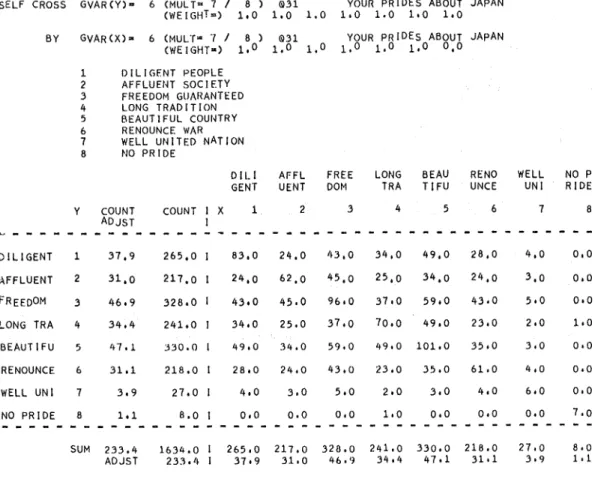
(9) Yoshihiro NAKANO. 32) HAYASI 1 (by I. MIYAKE, Doshisha University) corresponds to Regression at nominal scale data.. 33) HAYASI 2 (by I. MIYAKE, Doshisha University) corresponds to Discriminant at nominal scale data.. 34) HAYASI 3 (by I. MIYAKE, Doshisha University) corresponds to PCA (Principal component analysis) at nominal scale data.. 35) HAYASI 4 (by I. MIYAKE, Doshisha University) corresponds to Factor at nominal scale data.. These HAYASIs are the famous method derived by Dr. Chikio HAYASI (director of the Institute of Statistical Mathematics, Tokyo) and called by alias as 'Quantification analysis'. These HAYASIs programs have high popularity in Japan. 5-A) MULT ANS (by Y. NAKANO, Hokkaido Kyoiku Univ.) This is a more practical substitute for the MULT RESPONSE subprogram implemented, in the original SPSS. The differences between this and that are in the following. a . MULT ANS subprogram is allowed to use its own input format specification and hence permits arbitrary characters of input data, not restricted to numerics. b. The codes out of the specified range or not responsible to any category are picked up accompanied by the case number, group variable name and category name. c . Frequency table sorted in the descending order of counts is also printed out. (See Fig. 8) d . Self crosstabs of the responsive codes in a group variable is given to show similarities among. the items in question. (See Fig. 9). § 7 Concluding Remarks and Acknowledgements New Statistical Package SPTSS for conversational and batch unified operation has been made. SPTSS includes the service facilities corresponding to both SPSS (batch only) and SCSS (conversational only).. This SPTSS is a natural extension of the KYOTO version of SPSS6 and may be useful in the servicing levels corresponding to the original version of SPSS7. SPTSS has 35 statistical subprograms, that is 15 subprograms more than US original version. These 15 subprograms are due to a Japanese reserch group. The author must express his. sincere gratitude to them, especially Prof. I. MIYAKE (Doshisha University, coordinator of SPSS group in Japan), Drs,. K. YAMAMOTO, N. NISHIWAKI (Kyoto Univ.), S. KAMISHIMA and S. ITO (Hokkaido Univ.) for their excellent subprograms implemented in this SPTSS.. (36).
(10) Statistical Program Package SPTSS. References 1 ) Y. NAKANO ; Proceedings of the First Annual SPSS Users and Coordinators Conference : p. 98, 1977, SPSS Inc. Chicago, Illinois 2 ) Norman H. NIE, C. Hadlai HULL, Jean G. JENKINS, Karin STEINBRENNER, Dale H. BENT ; SPSS (Statistical Package for the Social Sciences) Second Edition, 1975, McGraw-Hill, N. Y. 3 ) Norman H. NIE and C. Hadlai HULL ; SCSS (Spss Conversational Statistical System), Release 1.1, September 1977 4 ) Y. NAKANO ; Center News of Hokkaido University Computing Center, Vol. 11, No. 2, 1979, p. 18 (in Japanese) 5 ) . KAMISHIMA ; Manual of Library Programs of Hokkaido University Computing Center, No. 8, 1979 (in Japanese). (37).
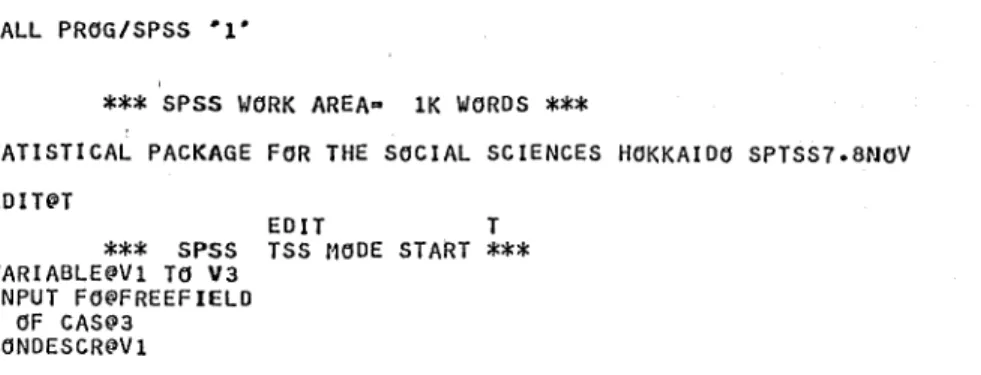
(11) Yoshibiro NAKANO. Fig. 1 SPTSS conversational run, CONDESCRIPTIVE with data input from terminal KB. Note the tabset symbol '©', EDIT @ T and the dummy symbol ' ; '.. //CALL PROQ/SPSS '•1' *** SPSS WORK AREA- 1K WORDS *** STATISTICAL PACKAGE FOR THE SOCIAL SCIENCES HOKKAIOQ SPTSS7.8NOV >EDIT@T. EDIT T. *** SPSS TSS MODE START *** >VARIABLE@V1 TO V3 >INPUT FO@FREEFIELD >N OF CAS@i3 >C9NOESCR@Vl ***** GIVEN UORKSPACE ALLOWS FOR 68 VARIABLES FOR C8NDESCRIPTIVE PROBLEH **< >STATISTICS@>1 >REAO INP >l 23456789 JAN.17. 1979 STATISTICAL PACKAGE SPTSS7 FILE NONAHE (CREATION DATE = JAN.17. 1979). VARIABLE VI MEAN 4.000 VALID OBSERVATIONS - 3 HISSING OBSERVATIONS - 0. >i. THIS TASK ENDED. THE AMOUNT OF TRANSPACE REQUIRED IS 0 WORDS. >FINISH NORMAL END OF JOB. 7 CONTROL CARDS WERE PROCESSED. 0 ERRORS WERE DETECTED. * END OF FORTRAN *. . 7*05*5& ;'<! SPSS . »>y3i) 3-h*! 000.. (38).
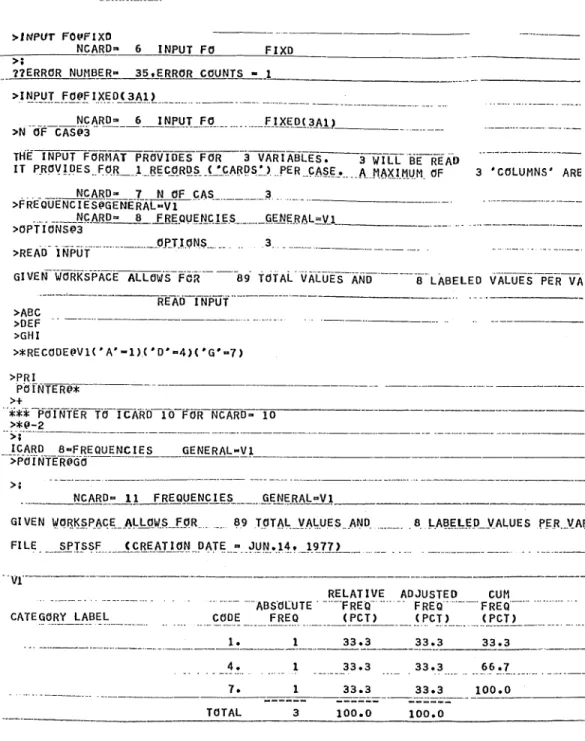
(12) Statistical Program Package SPTSS. Fig. 2 SPTSS conversational repeated run by POINTER commands. Note the dummy symbols ' ; ', '+', POINTER @ * , @ * -2 and POINTER @ GO commands.. >1NPUT FOCFIXO NCARD' >;. 6 INPUT FO. FIXD. 77ERR8R NUMBER- 35.ERROR COUNTS - .L. >INPUT FO@FIXEO(3A1) >N. -NC ARD"__6_INPUT_FO___ .„ .. .._.flXE_D( 3AJ_)_. OF. CASP3. -~. THE-TNPUT FORMAT PROVTDES FOR -3—VARIABLES. —rwTLT BE—READ —•——""•IT PROV!DES.j.pR__l_RECJ[RgS_(JCARDS^..PER_CASE._^AHA^^^ 3 'COLUMNS' ARE. J^CARD" 7 N OF CAS 3. >FREQUENCIES@GENERAL»Vl — —~- -~ ., . _._NCARD» 8 FREQUENCIES GE_NERAL=V1. >OPTIONS@3 >READ. ———. _0_PT.!.ONS.__. .. .3. ._.._._„. INPUT. ------. GIVEN W8RKSPACE ALLOWS FSR. -—..-—.—.-.. 89 TOTAL VALUES AND. ....-...-.....__. 8 LABELED VALUES PER VA. READ INPUT. >ABC. >DEF "' —-'~"— — ——~" >GHI. >*RECOOEeVK'A'-l)('D'»4)('G'-7). >PRI. P6 TNTER?* ' ~ - ~~—. >+. '***~p8TfftE^fb~TcARD'—T6-F-OFTNCARD^-I^~ >*e-2 >{. _ICARD 8-FREQUENCIES >POINTER@QO >;. GENERAL-V1. NCARD- 11 FREQUENCI_ES GENERAL-Vl. GIVEN WORKSPACE__ALLWS_FOR,._, 89 T.8TAL_VALUES_ANO „.__. . 8. LABEl,ED_ VALUES PER._VAF.. FILE SPTSSF (CREATION DATE » JUN.14, 1977) VI-. CATEGORY LABEL. RELATIVE ADJUSTED CUH. CODE. "ABSOLUTE ~~FREQ~ " " FREQ" -~ FREQ~. FREQ <PCT) (PCT) (PCT). 1.. 1. 33 .3. 33.3. 33 .3. 4.. I. 33 .3. 33.3. 66 .7. 7.. 1. 33 .3. 33.3. 100 .0. TOTAL. 3. 100 .0. 100.0. (39).
(13) Fig. 3 This is the simplest example in the service of DATACLEAN subprogram. Mispunches of alphabetic codes for numeric or unexpected strange codes are disclosed at the responsible columns. This procedure is useful for checking of data prepared especially by OCR. S1ATISTICAL PACKAGL PUK IHE SOCIAL SCItNCEb HOKKA1UO SPTSS7.8NOV. PAGE. MAR. 6, 1979. DATACLEAN *»» OATACi-EANlNG PROGRAM NEEDS DATACL MSK= 2 SMOD=0 PMOD=0. MASK CARD 1 MASK CARD 2. A. 492 WORDS SPACE.. INPM=5 OUTM=0 MINN=0 MAXN=9 MINA=A MAXA=Z NGCOD= CHECK COL (r CODE: 0= 0= 0= 0= 0= 0=. A. * * • • • 1 • • • • -itARD CASE RECORD 3. • • .* 2 • • • •* 4••••*• 1 1 1246 1 •»(78l2A222Qll4522 522222 31213 2 D 3 1 7812A2499115422 511212 31281236 92D68 7 13 1 78l2A21l3l222l6 143223411127 246893 9 17 1 D 32 12 5 6 7812A2137112111 213222 IDS 13 25 1 7812A24671222281211211 11122 23 1 45 R 7812A24261222111032232 128 6R 22236 25 50 2 lt(7812A23852111 7 9 914 2626564-6762566 710 32 I 63 1 7812A2178112315 313211 916 311H456 50 2 »(7812A222221 9 6 4 4 9135352225433444 100 53 105 1 7812A2307112214 6132338- 1268 72 826 127 64 1 7812A2208112224 413221 68- 32113. 317 159 341 171 350 175 354 177. 0. 0= 0. I I 7812A23B0113I110913I22. 3138136. ..5....*....6.........7.. 235. 1322 2 31617 3522 4. 364. 1121 4 6 910163121 3. 13456. 2223 1 21112133121 5. 4. 1111 69 1 9. 1. 1312 6 81517 1 19. 5. 4141 1111613 33131 5. 451. 1543 134 5153131 6. 13. .1111 1 3 517 3131 3. 23. 41110204051617273103. 7812A2279122228 613222 14689 11-12356 5231 4 6 817 1 2 <t(78l2A237e2116141Ql310 85234346552353 710 2 »(7812A234926 11416 2 3123534545543434. CARD CASE RECORD .........1. TOTAL CARDS 354, N OF CAS 177<. »....2....*....3. EACH 2 RECORDS. •*• • •. 1221 2 3 510113231 1. .8. Os. SMOD»0 SMOD=0. PMOD=0 )* ECHO:. p. 1. > )* ECHO:. 50. )* ECHO:. 100. 13 356. )» ECHO:. )» END:. .»....4....»....5....*....6....*....7....*....8 PMOD=0. 350 354. s > 0.
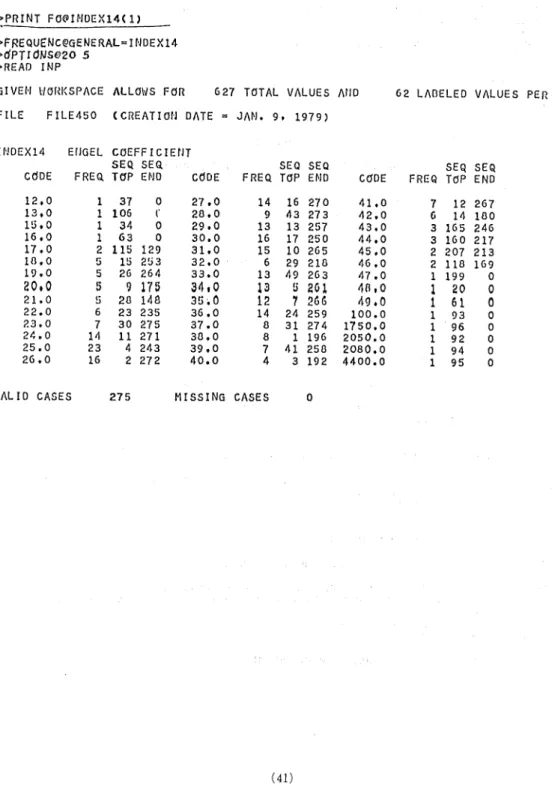
(14) Statistical Program Package SPTSS. Fig. 4 Datacleaning facilities given by OPTIONS 20 in the general mode of FREQUENCIES subprogram. Reference table between data codes and the corresponding case seqnums is listed here. The codes larger than 100 may be got in by some mistakes. Note the commands of RUN SUBFILES EACH,. PRINT FORMAT, OPTIONS 20, 5, 9 without STATISTICS card. >PRINT FOi5>IHDEX14(l) >FR£QUENC@8ENERAL=INDEX14. >tfPTIC!NS®20 5 >READ INP. 62 LAtiELEO VALUES PER VAf. QIVEI'I UOKKSPACE ALLOWS FOR 627 TOTAL VALUES AFID FILE FILE450 (CREATION DATE ° JAN. 9. 1979) IHDEX14 EIIGEL COEFFICIENT SEQ SES CdDE CODE FRES T0P END 12.0. 13.0. lii.O 16.0 17.0. 0 1 37 (• 1 106 0 1 34 0 1 63 2 115 129. 10.0 19.0. 5 5. lii 2U3 26 264. 21.0 22.0. y 6. 20 23 30 11. 20.0. ?.3.0. 24.0 25.0 26.0. VALID CASES. 5. 7 14. 23 16. 9 17S. 1-18 235. 275. 271. 4 243 2 272. 275. SEQ SEQ. FREQ TOP END. CODE. 16 270 43 273 13 257 17 250 10 265 29 210 49 263 ii 80),. 41.0 42.0 43.0 44.0. 24 259 31 274 1 196 41 250 3 192. 100.0. 27.0 20.0 29.0 30.0. 14 9. 32.0 33.0. 6 13. 31.0. 34.0. 35.0. 36.0 37.0 30.0 39.0 40.0. 13. 16 15. 13 12 14 8 8. 7 4. 7 266. MlssiNa CASES. 0. (41). 45.0. 46.0 47.0. '10,0 49.0. 1750.0. 2050.0. 2080.0 4400.0. SEQ SEQ. FREQ TOP END. 7 6. 12 267 14 100 3 165 246 3 160 217 2 207 213 2 no 169 0 1 199 0 I 20. 1. 1 I 1 1. 1. 61. 93. 96. 92 94. 95. 0. 0 0 0 0 0.
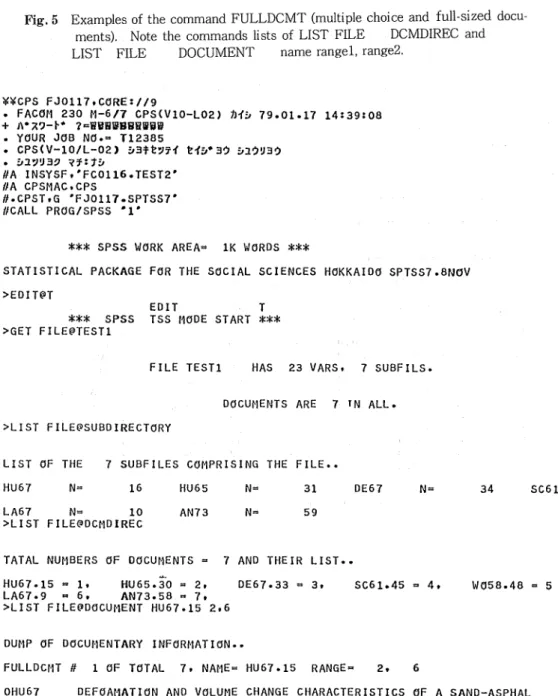
(15) Yoshihiro NAKANO. Fig. 5 Examples of the command FULLDCMT (multiple choice and full-sized documents). Note the commands lists of LIST FDJE DCMDIREC and LIST FILE DOCUMENT name rangel, rangeZ.. ¥¥CPS FJ0117.CORE://9 . FACOM 230 H-6/7 CPS(V10-L02) A<y 79.01.17 14:39:08. + t\'W-t" P-BBHBBBBBBB. . YOUR JOB N8.» T12385. . CPS(V-10/L-02> S/aft'Jr-f fe-Ty'3'5 y2'5'J3'5 . y3y'J39 ??:3-y. ffh INSYSF,'FC0116.TEST2' //A CPSMAC.CPS //•CPST.G 'FJOH7.SPTSS7' //CALL PROG/SPSS •I*. *** SPSS WORK AREA" 1K WORDS *** STATISTICAL PACKAGE FOR THE SOCIAL SCIENCES HOKKAIOO SPTSS7.8M8V >EDIT@T. EDIT T. *** SPSS TSS I18DE START *** >GET FILEOTEST1 FILE TEST1. HAS 23 VARS. 7 SUBFILS. DOCUNENTS ARE 7 TN ALL.. >LIST FILES'SUBDIRECTORY LIST OF THE 7 SUBFILES COMPRISING THE FILE. HU67 ? 16 HU65 N= 31. DE67. ?. 34. SC61. LA67 N» 10 AN73 ? 59 >LIST FILEODCHDIREC TATAL NUMBERS OF DOCUMENTS HU67.15 » 1. HU65.30 " 2, LA67.9 ° 6. AN73.58 » ?•. 7 AND THEIR LIST.. DE67.33. SC61.45 - 4.. W058.48 ° 5. >LIST FILE9D8CUHENT HU67.15 2.6 DUMP OF DGCUHENTARY INF8RNATION.• FULLDCHT it 1 OF TOTAL 7. NAME" HU67.15 RANGE- 2, 6 OHU67 DEFOAHATI8N AND VOLUHE CHANGE CHARACTERISTICS OF A SAND-ASPHAL T MIXTURE UNDER CONSTANT DIRECT AND TRIAXIAL COHPRESIVE STRESS ES; BI H R R; N8 178 PP 60 - 74 (1967); FILE BD26<HUANG); **. 5 OR (. 2-. 6) DOCUMENT WERE OUTPUT. (42).
(16) Fig. 6 Example of the matrix data input in CROSSTABS integer mode subprogram.. Note the extra dummy variables Dl TO D6 in VARIABLE LIST and OPTIONS 10.. >VARIABLEPX Y Dl TO 06. >INPUT MEPCARD >INPUT FO@FIXED(8F4.0) >;. THE INPUT FORMAT PROVIDES FOR 8 VARIABLES. 8 WILL BE READ IT PROVIDES FOR 1 RECORDS ('CARDS') PER CASE. A MAXIMUM OF 32 'COLUMNS' ARE USED B,M A RECORD. >CRGSSTABSeVARIABLES-Y(1.2)/X(l,8)/TABLES"Y BY X. >OPTIONS@3 4 5 10 >STATISTICS@ALL >READ MATRIX. en. w l-f. »*»** -CROSSTABS' PROBLEM REQUIRES 16 WORDS W8RKSPACE NOT INCLUDING VALUE LABELS ***** ||.. w. > 25 10 9 > 147 124 66. "ti. 6 14 4 14 14 & 81 136 58 113 122 §. FILE NONAME (CREATION DATE " NOV.12. 1977) . ^ u. «*******«***««**«* CRBSSTABULATIGN OF ************** g'. Y. BY. X. %. ************************************************* PAGE £^ VI. x. ". COUNT I I ROW I TOTAL I II 21 31 41 51 61 71 81. Y ——„ i ——— i —___— i ———i——— i ———i -_——i__——_i—_—_-_i. II 25 I 10 I 91 61 14 I 41 14 I 14 I 96 II. II. III. II. 10.2. II. II. III. II. 89.8. -I ———I —_——I ———I ———I ———I ———I ———I —_——I 21 147 I 124 I 66 I 81 I 136 I 58 I 113 I 122 I 847. -I———I————I———I———I———I———I———I———I COLUMN 172 134 75 87 150 62 127 136 943 TOTAL 18.2 14.2 8.0 9.2 15.9 6.6 13.5 14.4 100.0. RAW CHI SQUARE - 7.10783 WITH 7 DEGREES OF FREEDOM. SIGNIFICANCE - 0.4177 CRAMER'S V » 0.08682. CONTINGENCY COEFFICIENT - 0.08649.
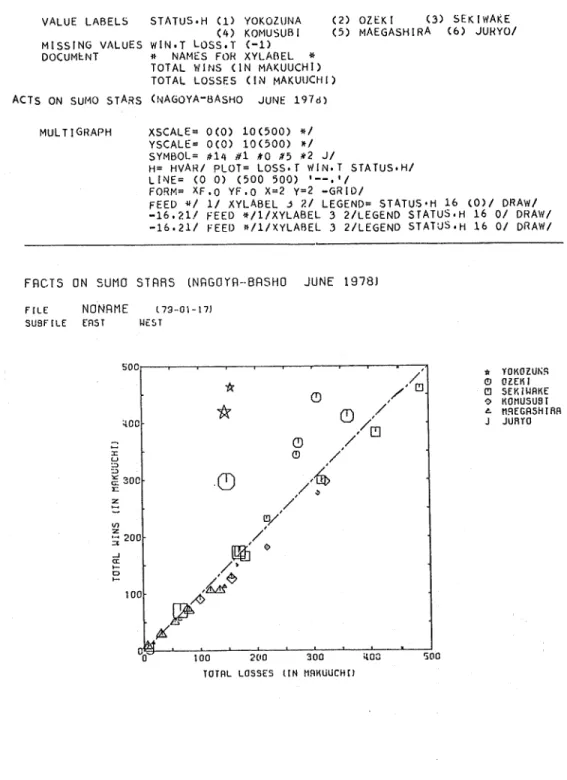
(17) Yoshihiro NAKANO. Fig. 7 Example of MULTIGRAPH, the special subrogram to prepare general XY-. plotter run by SPTSS language. Note that RUN NAME, FILE NAME, SUBFILE NAMES and VALUE LABELS are drawn on XYplotter chart.. Labels on X and Y axes are drawn out from DOCUMENT.. (2) OZtKl (3) SEKIWAKE VALUE LABELS STATUS.H (1) YOKOZUNA (5) MAEGASH1RA (6) JUKYO/ <4) KOMUSUBI MISSING VALUES WlN.T LOSS.T (-1) DOCUMfcNT tt NAMES FOK XYLAREL » TOTAL WINS (IN MAKUUCHD TOTAL LOSSES (IN MAKUUCHI) ACTS ON SUMO STARS <NAGOYA-8ASHO JUNE l97d) MULTIGRAPH XSCALE= 0(0) 10(500) */ YSCALE" 0(0) 10(500) »/ SYMBOL= *U #1 *0 ^5 »2 J/. H= HVAR/ PLOT= LOSS.T WIN.T STATUS.H/ LlNE= <0 0) (500 500) '—• ' / FORM" XF.O YF.O X=2 Y=2 -GRID/. FEED *1 I/ XYLABEL 3 7.1 LEGENO= ST^TUS-H 16 (O)/ DRAW/ -16.21, FEED </l/XYLABEL 3 2/LEGENO STATUS.H 16 O/ DRAW/ -16.21, FEED w/1/XYLABEL 3 2/LEGEND STATUS.H 16 O/ DfiAW/. FRCTS ON SUMO STRRS INRGOTfl-BRSHO JUNE 1978) FILE NONRME 173-oi-n) SU3FILE ERST UEST. soo. ft YOKOZUKfi. 0 OZEKI a SEKiURKE. o nonususi A M.REGRSHIRR j JURTO. wo. [ 30C|. •3 200. 100[-. 100 200 300 -103 TOTflL LOSSES (IN MaKUUCHI). (44). '3DO.
(18) Statistical Program Package SPTSS. Fig. 8 Example of MULT ANS subprogram (Japanese substitute for MULT RESPONSE subprogram of SPSS). Sorted frequency table of counts with code labels is listed here.. GVAR- 6 (MULT. 7./ 8 ) S31 .YOUR PRICES ABOUT JAPAN <WEISHT°> 1.0 1.0 1.0 1,0 1,0 1.0 1.0 CODE LABELS ITEMITEM= ITEM" ITEM= ITEMITEM" ITEM= ITEM". 1. 2. 3 4 5 6 7 8 ITEMFRE8" %=. DILIGENT PEOPLE AFFLUENT SOCIETY FREEDOM GUARANTEED LONG TRADITION BEAUTIFUL cOuNTRY RENOUNCE WAR WELL_UNITED NATION NO PR I DE 1. _. 2. 3. 83,0 62,0 96.0 17.1 12.8 19.8. 6. 4 70,0 14,4. 5 101,0. 20.8. bl.O 12,6. LONG TRA. AFFL UENT. 4 70.0. 2 62.0 12.1S 84.6. 7. 8 7.0. 6.0. 1.2. 1.1. RENO UNCE. NO P. WELL UN I. 6 61.0 12.6 97,3. 8 7.0. SORTED MULTI FREQUENCIES. ITEM= FRE8= » =. ACM!»=. BEAU. TIFU. FREE DOM. DILI CENT. 5 101,0 Z0.8 2°, 8. 3 96.0 19.8 4°.5. 83-0 17.1 57.6. 1. It.4. 72,0. RIDE. 1.4. 98. 8. 7. 6.0 1,2 loo.o. ACCUM FRE8 ". 486 ( 186 .0 ). VALID CODES-. 486. MISSING CODES". 753. TOTAL CODES'E=. 1239 ANSWER RATE (CODE)' 39.23. VALID CASES-. 176. MISS ING CASES'. 1. TOTAL CASES'. 177 ANSWER RATE (CASE)' 99>41. .100.Ox. (45).
(19) Yoshihiro NAKANO. Fig. 9 OPTIONS 4 in MULT ANS subprogram gives "Self Crosstabs" among categories (individual variables) in one group variable. This table shows how closely these categories are responding.. YOUR PRIDES ABOUT JAPAN. SELF CROSS GVAR(Y)" 6 <MULT° ^ I 8 ) 831. (WEIGHT") 1.0 1.0 1.0 1.0 1.0 1.0 1.0. BY GVAR<X)'. 6 (MULT- 7 / 8.) S31 (WEIGHT-) 1.° l.° 1.°. YOUR PRIDES ABOUT JAPAN. 1.° 1.0 1.0 0,0. 1 DILIGENT PEOPLE 2 AFFLUENT SOCIETY 3 FREEDOM GUARANTEED 4 LONG TRADITION 5 BEAUTIFUL COUNTRY 6 RENOUNCE WAR 7 WELL UNITED NATION 8 HO PRIDE. Y. COUNT ADJST. D II. I. GENT. AFFL UENT. FREE DOM. LONG TRA. BEAU TIFU. RE NO UNCE. WELL UN I. NO P RIDE. COUNT 1 X 1. 2. 3. 4. 5. 6. 7. 8. 1. DILIGENT. 1. 37. ,9. 265,.0 I. 83.0. 24.0. 43,0. 34.0. 49.0. 28,0. ^.0. 0.0. AFFLUENT. 2. 31-..0. 217 .0 1. 24.0. 62.0. t5.0. 25.0. 34.0. 2'».0. 3.0. 0.0. FREEDOM. 3. 46,.9. 328 .0 I. 43.0. 45.0. 96.0. 37.0. 59.0. 43.0. 5.0. 0.0. LONG TRA. 4. 34,.4. 241 .0 I. 34.0. 25.0. 37.0. 70.0. 49.0. 23.0. 2.0. 1.0. BEAUTIFU. 5. 47 .1. 330 .0 I. 49.0. 3<».0. 59.0. 19.0. 101.0. 35.0. 3.0. 0.0. 31. 218. RENOUNCE. 6. WELL UN I. 7. 3,.9. NO PRIDE. 8. 1 .1. SUM. .1. 233 ,4. .0. 1. 28.0. 24.0. 43.0. 23.0. 35.0. 61.0. t.O. 0.0. 27,.0. I. 4.0. 3.0. 5.0. 2.0. 3.0. 4.0. 6.0. 0.0. .0. 1. 0<0. 0.0. 0.0. 1.0. 0.0. 0.0. 0.0. 7.0. 1634 .0. I. 265.0. 217.0. 328.0. 211.0. 330.0. 218.0. 27.0. 8.0. 8. (46). .1. •I. 3.. 1,1..
(20)
図
+4

関連したドキュメント
The resulting nonlinear model contains a set of reaction-drift-diffusion equations for the point defects and pairs, reaction equations for the immobile dopants and clusters as well as
Lemma4.1.. This is not true if f is not positively homogeneous as the following example shows.. Let f be positively homogeneous. We shall give an example later to show that
Lomadze, On the number of representations of numbers by positive quadratic forms with six variables.. (Russian)
(v) It is worth mentioning here that the Banach contraction principle [2] and its generalizations give the existence of a unique …xed point for a self map (for instance, Baradol et
We show that a discrete fixed point theorem of Eilenberg is equivalent to the restriction of the contraction principle to the class of non-Archimedean bounded metric spaces.. We
In this work we give definitions of the notions of superior limit and inferior limit of a real distribution of n variables at a point of its domain and study some properties of
We establish different fundamental inequalities on a class of multistructures, more precisely Poincaré’s inequality for second and fourth order (scalar) opera- tors as well as
The idea of applying (implicit) Runge-Kutta methods to a reformulated form instead of DAEs of standard form was first proposed in [11, 12], and it is shown that the
