Nimstring Values for 2 × n Rectangular Arrays
II
By Toru Ishihara
Professor Emeritus, The University of Tokushima e-mail address : [email protected]
(Received September 30, 2011)
Abstract
In the present paper, succeeding the previous paper [4], we con-tinue to study Nimstring values of 2 × n rectangular arrays. 2000 Mathematics Subject Classification. Primary 05A99; Sec-ondary 05C99
Introduction
In this paper, our main purpose is to obtain the value of an array with two arrows like Figure 1. It has m boxes and two arrows, and it is described as Rma2. The arrow is denoted by a.
Figure 1 Rma2 = u u u u u u r r r r r r r r r r u u u u u u u u u -a a
1
Arrays of form R
mcA
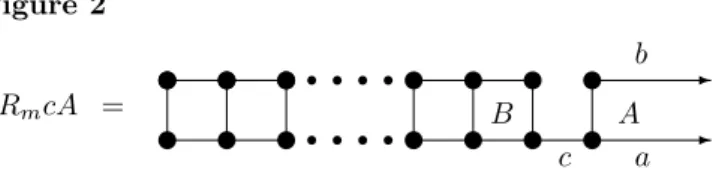
Let A be a graph composed of two arrows a, b and a v-edge connecting them. In this section, we study a graph RmcA composed of m boxes and A which is
described in Figure 2 below. Figure 2 RmcA = u u u u u u r r r r r r r r r r u u u u u u u u u u u -B c b a A
Let both the sizes of a and of b be x and that of c be y. Let B be the rightmost box with size z. Moreover, let the size of the box next ot B be w. Put G = RmcA
Proposition 1.(1) In the case x = y = 1 and z = 1 or z ≥ 4, the value |G| is 0 (resp ∗) if m is odd (resp. even).
(2) In the cases (x = 2, 3, y = 2, 3, z ≥ 1), (x = 1, 2, 3, y ≥ 4, z ≥ 1), (x = 3, y = 1, z ≥ 1), (x = 2, y = 1, z = 1, 2, 3), the value |G| is ∗ (resp. 0) if m is odd (resp. even), except the case m = 1, x = 2, y = 1, z = 1, 2, 3 in which its value is ∗2.
(3) In the cases (x = 1, y = 2, 3, z ≥ 1), (x = y = 1, z = 2, 3), (x = 2, y = 1, z ≥ 4), the value |G| is ∗2 (resp. ∗3) if m is odd (resp. even), except the case m = 1, x = 1, y = 1, z = 2, 3 in which its value is 0.
(4) In the case x ≥ 4 and y = z = 1 or y = 1, 2, 3, z ≥ 4, the value |G| is ∗ (resp. 0) if m is odd (resp, even).
(5) In the case x ≥ 4 and y = 2, 3, z = 1, 2, 3 or y = 1, z = 2, 3, the value |G| is ∗3 (resp. ∗2) if m is odd (resp. even).
Proof. Let e be the rightmost inner v-edge of Rm. By removing an inner
h-edge of Rm, we get a subgraph H = Rn1dRn2cA, where n1+ n2= m − 1 and
d is a connection of Rn1 and Rn2cA.
(1) Let m be odd. The value |c| (correctly, the value of a proper edge of c) is ∗. By Proposition 3 in [4], the values |a| and |b| are both ∗3 (resp. ∗) if z = 1 (resp. z ≥ 4). If z = 1, the value of a h-edge of B is ∗3 by induction. The value |e| is ∗3 (resp. ∗) if z = 1, w = 1, 2 (resp. z = 1, w ≥ 3 or z ≥ 4, w ≥ 1). The values of the other inner v-edges are ∗. We prove the value |d| in H is 0. If both n1and n2are odd (resp. even), The values |Rn1| and |Rn2cA| are both
0 (resp. ∗). Hence, the value |H| is not 0. Thus, the value |G| is 0, because the values of all its edges are not 0.
Let m be even. The value |c| is 0. The value |a| and |b| are both ∗2 (resp. 0) if z = 1 (resp. z ≥ 4), by Proposition 3 in [4]. If z = 1, the value of a h-edge of B is ∗2 by induction. The value |e| is ∗2 (resp. 0) if z = 1, w = 1, 2 (resp.
z = 1, w ≥ 3 or z ≥ 4). The values of the other inner v-edges are 0. We prove the value |d| in H is ∗. If n1 is odd (resp. even) and n2 is even (resp. odd),
The value |Rn1| is 0 (resp. ∗) and |Rn2cA| is ∗ (resp. 0). Hence, the value |H|
is not ∗. Thus, the value |G| is ∗, because G has some edges with value 0 and the values of all its edges are not ∗.
(2) Let m be odd. The value |c| is 0 (resp. loony) if x = 2, 3 and y = 1, 2, 3 (resp. x = 1, 2, 3 and y ≥ 4). The value |a| is 0 and |b| is ∗3 (resp. 0) if x = 2, y = 1 (resp. x = 2, 3, y = 2, 3 or x = 3, y = 1). If z = 1, 2, 3, the values of outer edges of B are 0. The value |e| is 0 (resp. ∗3) if (x = 2, 3, y = 2, 3), (x = 1, 2, 3, y ≥ 4), (x = 3, y = 1) or (x = 1, y = 2 and z = 1, w = 1, 2 or z = 2, w = 1) (resp. x = 1, y = 2 and (z = 1, w ≥ 3), (z = 2, w ≥ 2) or z = 3). The values of the other inner v-edges are 0. We prove the value |d| in H is ∗ except the case n2 = 1, x = 2, y = 1 and z = 1, 2, 3. If n1 and n2 are
odd (resp. even), The value |Rn1| is 0 (resp. ∗) and |Rn2cA| is ∗ (resp. 0).
When n2= 1, x = 2, y = 1 and z = 1, 2, 3, the value of the lower h-edge of B
in H = Rm−1dR1cA is ∗. Hence, the value |H| is not ∗. Thus, the value |G|
is ∗, because it has some edges with value 0 and the values of all its edges are not ∗.
Let m be even. The value |c| is ∗ (resp. loony) if x = 2, 3 and y = 1, 2, 3 (resp. x = 1, 2, 3 and y ≥ 4). The value |a| is ∗, and |b| is ∗2 (resp. ∗) if x = 2, y = 1 (resp. (x = 2, 3, y = 2, 3), (x = 1, 2, 3, y ≥ 4) or (x = 3, y = 1)). If z = 1, 2, 3, the values of outer edges of B are ∗. The value |e| is ∗ (resp. ∗2) if (x = 2, 3, y = 2, 3), (x = 1, 2, 3, y ≥ 4), (x = 3, y = 1) or (x = 2, y = 1 and z = 1, w = 1, 2 or z = 2, w = 1) (resp. x = 1, y = 2 and (z = 1, w ≥ 3), (z = 2, w ≥ 2) or (z = 3, w ≥ 1)). The values of the other inner v-edges are ∗. We prove the value |d| in H is 0 except the case n2= 1, x = 2, y = 1 and
z = 1, 2, 3. If n1is odd (resp. even) and n2is even (resp. odd), the values |Rn1|
and |Rn2cA| are both 0 (resp. ∗). When n2 = 1, x = 2, y = 1 and z = 1, 2, 3,
the value of the lower h-edge of B in H = Rm−1dR1cA is 0. Hence, the value
|H| is not 0. Thus, the value |G| is 0, because the values of all its edges are not 0.
(3) Let m be odd. The value |c| is ∗ (resp. 0) if x = 1 (resp. x = 2). The values |a| is 0. The value |b| is ∗, if z ≥ 4 and x = 1, y = 2 or x = 2, y = 1. This value is 0 (resp. ∗3) if x = 1, y = 3, z ≥ 1 (resp. x = 1, y = 2, z = 1, 2, 3 or x = 1, y = 1, z = 2, 3). If z = 1, 2, 3, the values of outer edges of B are 0 or ∗3. The value |e| is ∗ (resp. ∗3) if (x = 1, y = 1) and z = 2, w ≥ 2 or z = 3, w ≥ 1 (resp. (x = 1, y = 2, 3, z ≥ 1), (x = 1, y = 1, z = 2, w = 1) or (x = 1, y = 1, z ≥ 4)). The values of the other inner v-edges are ∗3. We prove the value |d| in H is ∗2 except the case n2= 1, x = y = 1, z = 2, 3. If n1 and
n2are odd (resp. even), The value |Rn1| is 0 (resp. ∗) and |Rn2cA| is ∗2 (resp.
∗3). When n2= 1, x = y = 1 and z = 2, 3, the value |d| in H = Rm1dR1A is
∗2, by Lemma 2 below. Hence, the value |H| is not ∗2. Thus, the value |G| is ∗2, because G has some edges with value 0 and ones with value ∗, and the values of its all edges are not ∗2.
Let m be even. The value |c| is 0 (resp. ∗) if x = 1 (resp. x = 2). The values |a| is ∗. The value |b| is 0, if z ≥ 4 and x = 1, y = 2 or x = 2, y = 1. This value is ∗ (resp. ∗2) if x = 1, y = 3, z ≥ 1 (resp. x = 1, y = 2, z = 1, 2, 3 or x = 1, y = 1, z = 2, 3). If z = 1, 2, 3, the values of outer edges of B are ∗(resp. ∗ or ∗2), if x = 1, y = 3, z = 1 or z = 2, 3 (resp. x = 1, y = 2, z = 1). The value |e| is ∗2 (resp. 0) if (x = 1, y = 2, 3, z ≥ 1), (x = y = 1, z = 2, w = 1) or (x = 2, y = 1, z ≥ 4) (resp. (x = y = 1, z = 2, w ≥ 2) or (x = y = 1, z = 3, w ≥ 1)). The values of the other inner v-edges are ∗2. We prove the value |d| in H is ∗3 except the case n2= 1, x = y = 1, z = 2, 3. If n1 is odd (resp. even) and n2 is
even (resp. odd), The value |Rn1| is 0 (resp. ∗) and |Rn2cA| is ∗3 (resp. ∗2).
When n2 = 1, x = y = 1 and z = 2, 3, the value |b| in H = Rm1dR1A is ∗3,
by Lemma 2 below. Hence, the value |H| is not ∗3. Thus, the value |G| is ∗3, because G has some edges with value 0, ones with value ∗ and ones with value ∗2, and the values of all its edges are not ∗3.
(4) Let m be odd. The value |c| is 0. If z = 1, the value of an outer edge of B is 0. The value |e| is 0 or ∗2. The values of the other inner v-edges of Rm
are 0. We prove the value |d| in H is ∗. If n1and n2 are odd (resp. even), the
value |Rn1| is 0 (resp. ∗) and |Rn2cA| is ∗ (resp. 0). Hence, the value |H| is
not ∗. Thus, the value |G| is ∗, because G has some edges with value 0 and the values of all its edges are not ∗.
Let m be even. The value |c| is ∗. If z = 1, the value of an outer edge of B is ∗. The value |e| is ∗ or ∗3. The values of the other inner v-edges of Rmare
∗. We prove the value |d| in H is 0. If n1 is odd (resp. even) and n2 is even
(resp. odd), The values |Rn1| and |Rn2cA| is 0 (resp. ∗). Hence, the value |H|
is not 0. Thus, the value |G| is 0, because the values of all edges of G are not 0.
(5) Let m be odd. The value |c| is 0. The value of the lower h-edge of B is ∗ and values of the other outer edges are 0, ∗ or ∗2. The value |e| is 0 or ∗2. The values of the other inner v-edges of Rm are ∗2. We prove the value |d| in H is
∗3 except the case n2= 1, y = 1, 2, 3. If n1 and n2 are odd (resp. even), The
value |Rn1| is 0 (resp. ∗) and |Rn2cA| is ∗3 (resp. ∗2). When n2= 1, y = 1, 2, 3,
the value of H = Rm−1dR1cA is ∗2, by Lemma 3 below. Hence, the value |H|
is not ∗3. Thus, the value |G| is ∗3, because G has some edges with value 0, ones withe value ∗ and ones with value ∗2 and the values of all its edges are not ∗3.
Let m be even. The value |c| is ∗. The value of the lower h-edge of B is 0 and values of the other outer edges are 0, ∗ or ∗3. The value |e| is ∗ or ∗3. The values of the other inner v-edges of Rm are ∗3. We prove the value |d| in H is
∗2 except the case n2= 1, y = 1, 2, 3. If n1 is odd (resp. even) and n2 is even
(resp. odd), The value |Rn1| is 0 (resp. ∗) and |Rn2cA| is ∗2 (resp. ∗3). When
n2 = 1, y = 1, 2, 3, the value of H = Rm−1dR1cA is ∗3, by Lemma 3 below.
Hence, the value |H| is not ∗2. Thus, the value |G| is ∗2, because G has some edges with value 0 and ones withe value ∗, and the values of all its edges are not ∗2.
Put G = RmcAa, where Aa is a box with an arrow a and c is a connection
of Rmand Aa. Let the size of A be 2 or 3, that of a be 2 or 3 and that of c be
1, 2 or 3. Let the rightmost box of Rm be B. As in Figure 3, G is described.
Figure 3 RmcAa = u u r r r r r r r r r r u u u u u u u u uB u u u -c a A
Lemma 2. The value of G = RmcAa is ∗2 (resp. ∗3) if m is odd (resp.
even).
Proof. Let the size of a be x, that of A be y, that of c be z and that of B be w. By removing an inner h-edge of Rm, we get a subgraph H = Rn1dRn2cAa,
where n1+ n2= m − 1 and d is a connection of Rn1 and Rn2cAa.
Let m be odd. The value |a| is ∗ or ∗3 by Proposition 2 in[4], |c| is ∗ and the value of the lower h-edge of A is 0. The values of h-edges of B are ∗3 (resp. 0 or ∗3), if z = 1, w = 1 (resp. z = 2, w = 1 or z = 1, w = 2). These values are 0 if z = 2, w = 2, 3 or z = 3, w = 1, 2, 3. The values of the inner v-edges of Rm are ∗3. We show the value |d| in H is ∗2 to prove |H| is not ∗2. If n1
and n2 are odd (resp. even), the value |Rn1| is 0 (resp. ∗) and |Rn2cAa| is ∗2
(resp. ∗3). Thus, the value |G| is ∗2, because G has some edges with value 0 and ones with value ∗, and the value of all its edges are not ∗2.
Let m be even. The value |a| is 0 or ∗2 by Proposition 2 in [4], |c| is 0 and the value of the lower h-edge of A is ∗. The values of h-edges of B are ∗2 (resp. 0 or ∗2), if z = 1, w = 1 (resp. z = 2, w = 1 or z = 1, w = 2). These values are ∗ if z = 2, w = 2, 3 or z = 3, w = 1, 2, 3. The values of the inner v-edges of Rm are ∗2. We show the value |d| in H is ∗3 to prove |H| is not ∗3. If n1 is
odd(resp. even) and n2 is even (resp. odd), the value |Rn1| is 0 (resp. ∗) and
|Rn2cAa| is ∗3 (resp. ∗2). Thus, the value |G| is ∗3, because G has some edges
with value 0, ones with value ∗ and ones with value ∗2, and the value of all its edges are not ∗3.
Lemma 3. Let G be a graph RmdBcA, where A is the subgraph, c is the
connection given in Proposition 1, B is a box of size z and d is a connection. Assume z is 2 or 3 and the size of d is 1, 2 or 3. Then, the value |G| is ∗2 (resp. ∗3) if m is odd (resp. even).
Proof. By removing an inner h-edge of Rm, we get a subgraph H =
Rn1eRn2dBcA, where n1+ n2 = m − 1 and e is a connection of Rn1 and
Let m be odd. The value |c| is ∗ or ∗3 by Proposition 2 in [4] and |d| is ∗. The value of the lower h-edge of B is 0. The values of the inner v-edges of Rm
are ∗3. If we can remove an outer edge of the rightmost box of Rm, its value is
∗3 or 0. We prove the value |e| in H is ∗2. If n1and n2are odd (resp. even),
the value |Rn1| is 0 (resp. ∗) and |Rn2dBcA| is ∗2 (resp. ∗3). Hence, the value
|H| is not ∗2. Thus, the value |G| is ∗2, because G has some edges with value 0 and ones withe value ∗, and the values of all its edges are not ∗2.
Let m be even. The value |c| is 0∗ or ∗2 by Proposition 2 in [4] and |d| is 0. The value of the lower h-edge of B is ∗. The values of the inner v-edges of Rm
are ∗2. If we can remove an outer edge of the rightmost box of Rm, its value
is ∗2 or ∗. We prove the value |e| in H is ∗3. If n1 is odd (resp. even) and n2
is even (resp. odd), The value |Rn1| is 0 (resp. ∗) and |Rn2dBcA| is ∗3 (resp.
∗2). Hence, the value of H is not ∗3. Thus, the value |G| is ∗3, because G has some edges with value 0, ones withe value ∗ and ones with value ∗2 and the values of all its edges are not ∗3.
2
Arrays with two arrows
Let G = Rma2be an array which has m boxes and two arrows. Let the size of
the arrow a be x. Let A be the rightmost box of Rm and B be the box next
to A. Let the sizes of A and B be y and z respectively.
Proposition 4.(1) In the cases x = y = 1, z = 1, 2, 3 or x = 1, 2, 3, y ≥ 4, z ≥ 1 except the case m = 2, x = y = 1, z = 1, 2, 3, the value |G| is ∗2 (resp. ∗3), if m is odd (resp. even). When m = 2, x = 1, y = 1 and z = 1, 2, 3, its value is ∗.
(2) In the case x = 1, y = 1, z ≥ 4, m ≥ 2, the value |G| is 0 (resp. ∗), if m is odd (resp. even).
(3) In the cases x = 1, y = 2, 3, z ≥ 1 or x = 2, 3, y = 1, 2, 3, z ≥ 1 except m = 1, the value |G| is ∗ (resp. 0) if m is odd (resp. even) except m = 1. When m = 1, its value is ∗2.
(4) In the case x ≥ 4, y ≥ 1, z ≥ 1, the value |G| is ∗ (resp. 0) if m is odd (resp. even)
Proof. When m = 1 or m = 2, we can get the results directly in any cases. By removing an inner h-edge of Rm, we get a subgraph H = Rn1cRn2a
2, where
n1+ n2 = m − 1 and c is a connection of Rn1 and Rn2a
2. Let the rightmost
v-edge of Rmbe denoted by e1, and the v-edge next to e1 be denoted by e2.
(1) Let m be odd. By Proposition 3 in [4], we have |a| = ∗. By induction, we get |e1| = 0 , and |e2| = 0 (resp. |e2| = ∗3) if x = y = 1, z = 1, 2 (resp.
are ∗3 (resp. ∗ or ∗3) if y ≥ 4 (resp. x = y = 1). The value of a h-edge of A is ∗ (resp. ∗3), if x = y = z = 1 (resp. x = y = 1, z = 2, 3), by Proposition 1. We show the value |c| in H is ∗2 except the case m2= 2, x = y = 1, z = 1, 2, 3.
If m1 and m2 are odd (resp. even), we have |Rm| = 0 (resp. |Rm| = ∗) and
|Rm2a2| = ∗2 (resp. |Rm2a2| = ∗3). When m2= 2, x = y = 1, z = 1, 2, 3, the
value of a h-edge of A in H is also ∗2. Hence, we get |H| 6= ∗2. Thus |G| = ∗2, because G has some edges with value 0 and ones with value ∗, and the values of all its edges are not ∗2.
Let m be even. By Proposition 3 in [4], we have |a| = 0. By induction, we get |e1| = ∗ , and |e2| = ∗ (resp. |e2| = ∗2) if x = y = 1, z = 1, 2 (resp.
x = y = 1, z = 3 or x = 1, 2, 3, y ≥ 4). The value of the v-edge next to e2 is ∗2
(resp. 0 or ∗2) if y ≥ 4 (resp. x = y = 1). The value of the other v-edges of Rm are ∗2. The value of a h-edge of A is 0 (resp. ∗2), if x = y = z = 1 (resp.
x = y = 1, z = 2, 3 ), by Proposition 1. We show the value |c| in H is ∗3 except the case m2 = 2, x = y = 1, z = 1, 2, 3. If m1 is odd (resp. even) and m2 is
even (resp. odd), we get |Rm| = 0 (resp. |Rm| = ∗) and |Rm2a
2| = ∗3 (resp.
|Rm2a
2| = ∗2. When m
2= 2, x = y = 1, z = 1, 2, 3, the value of a h-edge of A
in H is also ∗3. Hence, we get |H| 6= ∗3, Thus |G| = ∗3, because G has some edges with value 0, ones with value ∗ and ones with value ∗2, and the values of all its edges are not ∗3
(2) Let m be odd. By Proposition 3 in [4], we have |a| = ∗. By induction, we get |e1| = |e2| = ∗3. The values of the other v-edges of Rm are ∗. The
value of a h-edge of A is ∗, by Proposition 1. We show the value |c| in H is 0. If m1 and m2 are odd (resp. even),we have |Rm| = 0 (resp. |Rm| = ∗)
and |Rm2a2| = 0 (resp. |Rm2a2| = ∗). Hence, we get |H| 6= 0. Thus |G| = 0,
because the values of all edges of G are not 0.
Let m be even. By Proposition 3 in [4], we have |a| = 0. By induction, we get |e1| = |e2| = ∗2. The values of the other v-edges of Rm are 0. The value
of a h-edge of A is 0, by Proposition 1. We show the value |c| in H is ∗. If m1 is odd (resp. even) and m2 is even (resp. odd), we have |Rm| = 0 (resp.
|Rm| = ∗) and |Rm2a
2| = ∗ (resp. |R
m2a
2| = 0). Hence, we get |H| 6= ∗. Thus
|G| = ∗, because G has some edges with value 0, and the values of all its edges are not ∗.
(3) Let m be odd. By Proposition 3 in [4], we have |a| = ∗3. By induction, we get |e1| = 0 (resp.|e1| = ∗3), if (x = 2, 3, y = 2, 3, z ≥ 1), (x = 3, y = 1, z ≥
1), (x = 1, y = 3, z ≥ 1), (x = 1, y = 2, z = 1, 2, 3)or(x = 2, y = 1, z = 1, 2, 3) (resp. (x = 1, y = 2, z ≥ 4) or (x = 2, y = 1, z ≥ 4)). We also have |e2| = 0
(resp. |e2| = ∗3), if (x = 2, 3, y = 1, z = 1, 2), (x = 2, 3, y = 2, z = 1) or
(x = 1, y = 2, z = 1) (resp. (x = 2, 3, y = 1, 2, 3, y + z ≥ 4) or (x = 1, y = 2, 3, y + z ≥ 4)). The values of the other v-edges of Rm are 0. The value of a
h-edge of A is 0 (resp. ∗3) if (x = 2, 3, y = 2, 3, z ≥ 1), (x = 3, y = 1, z ≥ 1) or x = 2, y = 1, z = 1, 2, 3) (resp. (x = 2, y = 1, z ≥ 4) or x = 1, y = 2, 3, z ≥ 1)), by Proposition 1. We show the value |c| in H is ∗ except the case n2 = 1. If
m1 and m2 are odd (resp. even), |Rm| = 0 (resp. |Rm| = ∗) and |Rm2a
(resp. |Rm2a
2| = 0). Hence, we get |H| 6= ∗. When n
2= 1, we can show H 6= ∗
in Lemma 6 below. Thus |G| = ∗, because G has some edges with value 0, and the values of all its edges are not ∗.
Let m be even. By Proposition 3 in [4], we have |a| = ∗2. By induction, we get |e1| = ∗ (resp.|e1| = ∗2), if (x = 2, 3, y = 2, 3, z ≥ 1), (x = 3, y = 1, z ≥
1), (x = 1, y = 3, z ≥ 1), (x = 1, y = 2, z = 1, 2, 3) or (x = 2, y = 1, z = 1, 2, 3) (resp. (x = 1, y = 2, z ≥ 4) or (x = 2, y = 1, z ≥ 4)). We also have |e2| = ∗
(resp. |e2| = ∗2), if (x = 2, 3, y = 1, z = 1, 2), (x = 2, 3, y = 2, z = 1) or
(x = 1, y = 2, z = 1) (resp. (x = 2, 3, y = 1, 2, 3, y + z ≥ 4) or (x = 1, y = 2, 3, y + z ≥ 4)). The values of the other v-edges of Rm are ∗. The value of a
h-edge of A is ∗ (resp. ∗2) if (x = 2, 3, y = 2, 3, z ≥ 1), (x = 3, y = 1, z ≥ 1) or x = 2, y = 1, z = 1, 2, 3) (resp. (x = 2, y = 1, z ≥ 4) or (x = 1, y = 2, 3, z ≥ 1)), by Proposition 1. We show the value |c| in H is 0 except the case n2 = 1. If
m1 is odd (resp. even) and m2 is even (resp. odd), we get |Rm| = 0 (resp.
|Rm| = ∗) and |Rm2a
2| = 0 (resp. |R
m2a
2| = ∗). Hence, we get |H| 6= 0. When
n2 = 1, we can show H 6= 0 in Lemma 6 below. Thus |G| = 0, because the
values of all edges of G are not 0.
(4) Let m be odd. By induction, we get |e1| = |e2| = 0. The values of the
other v-edges of Rm are also 0. If z = 1, 2, 3, the value of a h-edge of A is 0
or ∗2, by Proposition 1. We show the value |c| in H is ∗. If m1 and m2 are
odd (resp. even), we have |Rm| = 0 (resp. |Rm| = ∗ and |Rm2a
2| = ∗ (resp.
|Rm2a2| = 0. Hence, we get |H| 6= ∗. Thus |G| = ∗, because G has some edges
with value 0, and the values of all its edges are not ∗.
Let m be even. By induction, we get |e1| = |e2| = ∗. The values of the
other v-edges of Rmare also ∗. If z = 1, 2, 3, the value of a h-edge of A is ∗ or
∗3, by Proposition 1. We show the value |c| in H is 0. If m1is odd (resp. even)
and m2 is even (resp. odd), we get |Rm| = 0 (resp. |Rm| = ∗ and |Rm2a
2| = 0
(resp. |Rm2a
2| = ∗). Hence, we get |H| 6= 0. Thus |G| = 0, because the values
of all edges of G are not 0.
Lemma 5 Let H = Rm−3cR2a2 be the graph given in the proof of
Propo-sition 4(1) for the case m2= 2, x = y = 1, z = 1, 2, 3, where R2 = AB. Then,
we have |H| 6= ∗2 (resp. |H| 6= ∗3) if m is odd (resp. even).
Proof. Let b1(resp. b2) be the upper (resp. lower) h-edge of A. By removing
the edge b1 (resp. b2) from H, we get a subgraph K1 = Rm−3cBb2a2 (resp.
K2 = Rm−3cBb1a2). We prove |K1| = |K2| = ∗2 (resp. |K1| = |K2| = ∗3),
if m is odd (resp. even). This shows our desired result. Let the size of the rightmost box D of Rm−3 be w. By removing an inner h-edge of Rm−3, we get
a subgraph H1= Rn1dRn2cBb2a
2, where n
1+n2= m−4 and d is a connection
of Rn1 and Rn2cBb2a
2.
Let m be odd. We get |c| = ∗, and |b| = ∗ or |b| = ∗3. The value of the lower (resp. upper) h-edge of B is 0 (resp. 0 or ∗3). If w = 1, 2, 3, then the
values of the outer edges of D are 0 or ∗3. The values of the inner v-edges of Rm−3 is ∗3. We show |d| in H1 is ∗2. If n1 is odd (resp. even) and n2 is
even (resp. odd), we have |Rn1| = 0 (resp. |Rn1| = ∗) and |Rn2cBb2a
2| = ∗2
(resp. |Rn2cBb2a
2| = ∗3). Hence, we get |H
1| 6= ∗2. We will show later that
the values of arrows in K1 are ∗3 (resp. ∗2) if m is odd (resp. even). Thus,
when m is odd, we get |K1| = ∗2, because K1 has some edges with value 0 and
ones with value ∗, and the values of all its edges are not ∗2. Similarly, we can prove |K2| = ∗2.
Let m be even. We get |c| = 0, and |b| = 0 or |b| = ∗2. The value of the lower (resp. upper) h-edge of B is ∗ (resp. 0 or ∗2). If w = 1, 2, 3, then the values of the outer edges of D are ∗ or ∗2. The values of the inner v-edges of Rm−3is ∗2. We show |d| in H1is ∗3. If n1and n2are odd (resp. even), we have
|Rn1| = 0 (resp. |Rn1| = ∗) and |Rn2cBb2a
2| = ∗3 (resp. |R
n2cBb2a
2| = ∗2).
Hence, we get |H1| 6= ∗3. We will show later that the values of arrows in K1are
∗3 (resp. ∗2) if m is odd (resp. even). Thus, when m is even, we get |K1| = ∗3,
because K1has some edges with value 0, ones with value ∗ and ones with value
∗2, and the values of all its edges are not ∗3. Similarly, we can prove |K2| = ∗3.
Now, We show that the values of arrows in K1 are ∗3 (resp. ∗2) if m is
odd (resp. even). By removing one of arrows form K1, we get a subgraph
L = Rm−3cBa0, where a0 is an arrow of size 2 or 3. We will show |L| = ∗3
(resp. |L| = ∗2), if m is odd (resp. even).
Let m be odd. We have |c| = 0 and the values of h-edges of B are ∗. We also get |a0| = 0 or |a0| = ∗2 by Lemma 2. If w = 1, 2, 3, the values of the outer
edges of D are ∗ or ∗2. The values of the inner v-edges of Rm−3 are ∗2. By
removing an inner h-edge of Rm−3, we can show the values of inner h-edges are
not ∗3. Thus, we obtain |L| = ∗3.
Let m be even. We have |c| = ∗ and the values of h-edges of B are 0. We also get |a0| = ∗ or |a0| = ∗3 by Lemma 2. If w = 1, 2, 3, the values of the outer
edges of D are 0 or ∗3. The values of the inner v-edges of Rm−3 are ∗3. By
removing an inner h-edge of Rm1, we can show the values of inner h-edges are
not ∗2. Thus, we obtain |L| = ∗2.
Lemma 6 Let H = Rm−2cAa2be the graph given in the proof of
Proposi-tion 4(3) for the case m2= 1 and x = 1, 2, 3, y = 2, 3, z = 1, 2, 3 or x = 2, 3, y =
1, z = 1, 2, 3, where the size of c is z. Then, we have |H| 6= ∗ (resp. |H| 6= 0), when m is odd (resp. even).
Proof. Let m be odd. By Proposition 1, the value of the right v-edge of A is ∗ when z = 1, 2, 3 and x = 1, y = 2 or x = 2, y = 1. The value of the lower h-edge of A is ∗ when y = 1, 2, 3 and x = 1, 2, 3, z = 2, 3 or x = 2, 3, z = 1. When x = 1, y = 3, z = 1, the value of the upper h-edge of A is ∗. Hence, in any cases, we have |H| 6= ∗.
when z = 1, 2, 3 and x − 1, y = 2 or x = 2, y = 1. The value of the lower h-edge of A is 0 when y = 1, 2, 3 and x = 1, 2, 3, z = 2, 3 or x = 2, 3, z = 1. When x = 1, y = 3, z = 1, the value of the upper h-edge of A is 0. Hence, in any cases, we have |H| 6= 0.
References
[ 1 ] E. R. Berlecamp, The Dot and Boxes Game, A K Perters Ltd, MA 2001. [ 2 ] E. R. Berlecamp, J. H. Conway and R. K. Guy, Winning Ways for Your
Mathematical Games, Second edition, A K Perters Ltd, MA 2001. [ 3 ] J. C. Holladay, A note on the game of dots, American Mathematical
Monthly, 73, (1966), 717-720.
[ 4 ] T. Ishihara, Nimstring values for 2 × n rectangular arrays I, J. of Math., The University of Tokushima, 44, (2010), 47-52.