Estimating the value of coral reefs in Kume
Island, Japan, using a contingent behavior
method: A Poisson-Inverse Gaussian approach
with on-site correction
著者
Nohara Katsuhito, Narukawa Masaki, Hibiki
Akira
journal or
publication title
DSSR Discussion Papers
number
103
page range
1-21
year
2019-10
URL
http://hdl.handle.net/10097/00126433
Data Science and Service Research
Discussion Paper
Discussion Paper No. 103
Estimating the value of coral reefs in Kume Island,
Japan, using a contingent behavior method:
A Poisson-Inverse Gaussian approach
with on-site correction
Katsuhito Nohara, Masaki Narukawa
and Akira Hibiki
October, 2019
Center for Data Science and Service Research
Graduate School of Economic and Management
Tohoku University
27-1 Kawauchi, Aobaku
Sendai 980-8576, JAPAN
1
Estimating the value of coral reefs in Kume Island, Japan, using a
contingent behavior method:
A Poisson-Inverse Gaussian approach
with on-site correction
Katsuhito Nohara
a,*, Masaki Narukawa
band Akira Hibiki
caHokusei Gakuen University, bOkayama University, and cTohoku University
Abstract
Coral reefs face a critical crisis because of rising ocean temperature, human resource use, run-off of red soil, among others. Since the recreational and tourism value of reef, in particular, have great potential, the degradation of reef quality may have a great effect on the tourism industry of Okinawa Prefecture, which largely depends on it. This study employs a contingent behavior approach to estimate the effect of reef extinction on recreational demand for Kume Island, Okinawa, Japan. Moreover, the Poisson-Inverse Gaussian model with correction for on-site sampling issues proposed in this study can potentially derive more accurate estimates of consumer surplus. The results show that the CS losses in the case of coral reef extinction become about 627.78 million yen per year.
Keywords: Contingent behavior, Coral reef; Count data model; On-site sampling; Poisson-Inverse
Gaussian model; Random-effects model
1. Introduction
Currently, coral reefs worldwide are facing serious threats. The Paris Agreement proposed to pursue efforts to limit the temperature increase to 1.5 °C above pre-industrial levels. However, even if we can achieve that target, 70 to 90 percent of coral reefs are projected to decline with high statistical confidence by the middle of this century (IPCC, 2018). The Okinawa Prefecture has 80 percent of the coral reefs of Japan. However, they now tend to decrease because of factors including coral reefs bleaching, primarily due to climate-induced ocean warming, feeding damage by acanthaster, and run-off of red soil. (Hongo and Yamano, 2013). The Ministry of the Environment started an investigation of the coral reef communities in 2017 to capture their condition by using images from an artificial satellite and results from a field study. In 1991, the area covered by more than 50 percent of coral reefs filled 5.5 percent of all the area in the surrounding waters of Ishigaki Island and Iriomote Island. However, from the recent investigation, its coverage reduced by approximately 0.1 percent. A
* Corresponding author at: School of Economics, Hokusei Gakuen University, 2-3-1 Ohyachi-Nishi, Atsubetsu-ku, Sapporo,
2
supplementary investigation in 2018 concluded that coral reefs bleaching occurred at all observation spots (https://www.env.go.jp/press/105494-print.html). However, in 2010, the World Wildlife Fund (WWF) reported that a diver and fisherman had discovered a new coral reef community in Kume Island (https://www.wwf.or.jp/activities/achievement/3434.html). Although its scholarly value is remarkably high, it might disappear due to ocean warming or other external factors. As coral reef bleaching occurs in many other remote islands of the Okinawa Prefecture, it seems to be an urgent issue to conserve coral reefs in Kume Island even if those conditions are not terrible at present.
In general, coral reefs provide many ecological goods and services, such as food provision, shoreline protection, erosion regulation, biogeochemical cycling, and tourism and recreational opportunities (Elliff and Kikuchi, 2017; Robles-Zavala and Reynoso, 2018). Additionally, many studies point out that coral reefs have multiple ecosystem functions which support tourism benefits such as the generation of fine sand beaches, the maintenance of islands, protection from storm, and the production of seafood (Perry et al., 2015; Kench, 2014; Perry et al., 2011; Ferrario et al., 2014; Cabral and Geronimo, 2018). The tourism or recreation value of coral reefs in the world have the highest potential net benefits, and the net present value includes the value of fisheries, coastal protection, and biodiversity (Cesar et al., 2003; van Beukering et al., 2011). Therefore, the degradation of coral reefs would seriously affect the tourism industry. According to the Okinawa Prefectural Government1 in 2016, a ripple effect on other industries of the tourism industry will be approximately
1.14 trillion yen. As the Okinawa Prefecture largely depends on the tertiary industry, the detriment to the tourism industry would lead to a sluggish regional economy.
A large number of studies have attempted to estimate the monetary value of coral reefs in several parts of the world by using non-market valuation methods. The travel cost method (TCM) using revealed preference (RP) data is one of the widely accepted techniques to assess the value of outdoor recreational activities. However, it is difficult to estimate the difference in consumer surplus (CS) when the quality of the environment has changed. Therefore, combining contingent behavior (CB) classified as stated preference (SP) data with TCM (TCM + CB) has recently been attempted. The CB model asks individuals to state their intended visit frequency if environmental quality changes under a hypothetical situation (Lienhoop and Ansmann, 2011; Pueyo-Ros et al., 2018). TCM+CB is often applied to quality changes to estimate benefits which includes sports fishing, recreational fishing, coastal wetland, swimming, cave diving, and winter outdoor recreation (Alberini et al., 2007; Prayaga et al., 2010; Pueyo-Ros et al., 2018; Deely et al., 2019; Lankia et al., 2019; Morgan and Huth, 2011; Filippini et al., 2018). Apart from these, some studies are adopting TCM + CB to valuate coral reefs. Bhat (2003) estimates the recreational benefits if the quality of coral reefs is improved by the so-called gamma distributed Poisson random-effects model in TCM + CB, which indicates that the number of
1Okinawa Prefectural Government, http://www.pref.okinawa.jp/site/chijiko/kohokoryu/foreign/english/index.html, Accessed date:
3
trips will increase by about 43 percent and the change in CS per person will be US$3,080 under the scenario of 100 percent improvement of coral quality. Folkersen et al. (2018) employ TCM + CB to estimate the effect of deep sea mining on future trip demand in Fiji, although they focus on the number of planned future trips with and without deep sea mining. This approach means that irrespective of whether degradation of coral reefs would occur, the recreational use-value of coral reefs is limited to diving and snorkeling. However, Kragt et al. (2009) estimate the effects of Great Barrier Reef degradations on trip demand by using only CB data in a negative binomial random-effects model. Although almost all of the previous studies estimate the effects of environmental improvements on trip demand, they assess the effects of environmental degradation on recreational demand. That is, they use the number of future trips as SP data under the hypothetical scenario of decline in reef quality. Following their approach, we use only CB data by asking respondents about their future trips under the scenario of both its current state and extinction. Note that this study focuses on not the improvement of reef quality but the extinction of coral reefs because of two reasons. First, for example, they argue that using the number of planned trips at current and degraded reef quality is more suitable in the case of Great Barrier Reef quality decline, from which they consider an 80 percent reduction of coral reefs as a hypothetical scenario. However, it seems difficult for respondents to imagine the effects of reef degradation, such as an 80 percent loss on their future trips even if they are shown pictures. Second, we pay much attention to the fact that coral reefs were imminently threatened with extinction in the past, and this situation is worsening year by year. For instance, multiple events of coral bleaching have been recorded in most regions since the mass bleaching event of 1998, which cause a 100 percent coral depletion in some regions.2 Given the state of recent coral reefs, such a scenario is not unrealistic.
Furthermore, the extinction of coral reefs does not necessarily induce zero recreation demand, although it may affect water quality and landscape. According to a public opinion poll carried out by the Cabinet Office (2014), for example, most people do not recognize the ecosystem services of coral reef such as recreation or tourism included in cultural services; only 19 percent do. Meanwhile, in Japan, the recreational value of coral reefs has been little investigated. Oh (2004) and Tamura (2006) estimate the non-use values of coral reefs in the Kerama Islands and around the Akajima sea area by using CVM, respectively. The problem seems to lie in the fact that there are no studies on estimating the effects of the decline in reef quality on future recreational demand in Japan.
It should also be emphasized that the previous studies estimating the value of coral reefs have not considered the possibility of employing a more suitable statistical approach. For example, although Prayaga et al. (2010) and Pueyo-Ros et al. (2018) have not estimated the value of coral reefs directly, they adopt a pooled TCM + CB model which cannot capture individual-specific effects in count data. Despite that, Bhat (2003) collects the data through an on-site survey; however, an estimation problem related to the sampling is not dealt with. Statistical analysis of such on-site count data should be
4
controlled for truncation and endogenous stratification, as advocated by Shaw (1988), who addresses these issues in the Poisson regression model. As stated above, Kragt et al. (2009) analyze CB data by a negative binomial random-effects model; however, their model is not adjusted for on-site sampling. As far as collecting data through an on-site survey, even if only CB data is used in the estimation, it must be corrected for its issues. In addition, as argued by Guo and Trivedi (2002), Sarker and Surry (2004), and Cameron and Trivedi (2013), the capability of negative binomial to capture overdispersion would be limited and inadequate if the data has a distribution with a so-called long (heavy) tail. Therefore, a reliable statistical inference cannot be made. However, Willmot (1987) and Dean et al. (1989) consider the Poisson-Inverse Gaussian (PIG) model to be an easier and more usable parametric model because, in an analysis of insurance data, it reflects more long-tailed count data than the negative binomial model, even with the same number of parameters. Guo and Trivedi (2002) apply the PIG model to an analysis of patent data. Since this paper uses trip number data from an on-site survey, our estimation approach is based on the PIG model and add Shaw’s (1988) correction for on-site sampling issues. Moreover, to analyze the CB data, we expand it into a random-effects model that can use pseudo panel data, as in Beaumais and Appéré (2010). Although Narukawa and Nohara (2018) have recently proposed an estimation approach to panel count data (truncated at zero), to utilize TCM + CB, they presume that the data are collected via a web-based off-site survey. Our approach is clearly different from theirs since we consider the PIG model adjusted for an on-site survey. To our knowledge, this is the first attempt to construct the PIG approach using on-site sampling data, which is another contribution of this study.
This study estimates the changes of consumer surplus in the Kume Island trip resulting from a decline in reef quality using the PIG approach while controlling for on-site sampling in CB. The remainder of this study is composed as follows. In the next section, we explain the data collection procedure. Section 3 proposes the estimation approach based on the PIG model for an on-site survey. Section 4 provides the estimation results and the welfare estimates related to loss of reef quality. Section 5 concludes and presents the topics for future research.
2. Survey design and data 2.1 Data collection
Kume Island is located about 90 km west from the main island of Okinawa (Fig.1) and blessed with a richness of natural resources that yields much potential ecosystem services. However, not so many tourists visit as compared to other isolated islands of the Okinawa Prefecture, such as Ishigaki Island or Miyako Island. However, the rich natural resources have been largely preserved and
5
Fig. 1 Location of Kume island
untouched due to the absence of large-scale development in Kume Island. Table 1 shows the top five most visited isolated islands in 1985 and the corresponding number of tourists in 1985 and 2015, which is obtained from the Okinawa Prefectural Government (2018). Although the increasing rate of tourists in the past thirty years in Kume Island is of least value among the isolated islands, many tourists will likely be attracted to Kume Island in the near future because there remain precious reefs as stated in Section 1.
Our survey was conducted for a week in September 2015 at the Kumejima airport; it included weekdays and weekend.3 The sample was randomly selected at the airport, as well as from limited
visitors who had come from other prefectures to end their trips in Kume Island. We presented photographic material to respondents, which was provided by a scientist, Dr. Hiroya Yamano, to help respondents comprehend the condition of the reef going extinct. We obtained 302 respondents, but not all were used for analysis due to missing information. Thus, 168 respondents were included in the empirical analysis of this study. The information was gathered by distributing a survey questionnaire to visitors who came on a trip to Kume Island. The questionnaire included accompanying persons and
3 The survey questions used in this study are available upon request.
Source: http://www.craftmap.box-i.net/ken.php
Japan Main island of Okinawa
Kume Island
Miyako Island
Ishigaki Island Iriomote Island
6
Table 1 The number of tourists for 30 years in isolated islands of Okinawa Prefecture
Island name 1985 2015 The rate of increase (%)
Ishigaki 250,072 11,477,964 4489.86
Miyako 122,715 511,665 316.95
Kume 81,268 102,797 26.49
Iriomote 71,405 380,573 432.98
Ie 58,000 135,739 134.03
their age, activities enjoyed during the trip, the interest for natural resources in Kume Island, the visit duration in Kume Island, travel mode, several demographic characteristics, and the number of trips planned for the next ten years at the current reef quality given the extinction of coral reef. It was expected that these variables would affect visitors’ trip frequency significantly. Moreover, we gathered data on whether visitors had stayed at Naha city to locate the main destination of the trip. Since there were no direct flights between Kume Island and other domestic regions, and all visitors had to transit at Naha airport, we can exclude the possibility of a substitute recreation site affecting the demand for Kume Island and apply the framework of a single-site demand function. Although 19 percent of respondents made a stop in Naha city and all of them had an overnight stay there, their length of stay at Kume Island was greater than that of Naha city. Concerning CB questions, Kragt et al. (2009) and Folkersen et al. (2018) ask respondents about the planned trips for the next five years under a hypothetical scenario. However, we set its period to the next ten years because it would be unrealistic for the extinction of coral reefs to occur in such a short term.
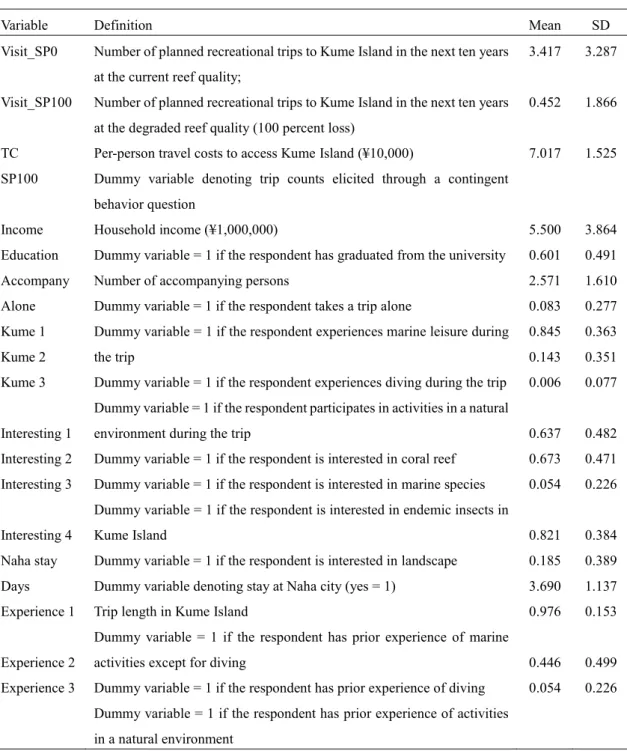
From the above survey design and the collected data, the variables used in our analysis are summarized in Table 2. In general, the recreation benefits of the quality changes are measured as CS, which is the area between the RP trip demand curves and the SP trip demand curves (Whitehead et al., 2000). In other words, respondents provide the actual number of trips (the observed behavior data) under the current reef quality and the planned reef visits (the contingent behavior data) based on a hypothetical reef quality. However, as discussed by Bockstael et al. (1989) and Kragt et al. (2009), since incorporating the actual number of trips in the recreational demand function would result in biased estimates of CS, it seems more appropriate for its estimation to employ the difference between the planned recreational demand at the current reef quality, as well as the degraded reef quality. Thus, we estimate CS by using the number of planned trips at the current reef quality and at the extinction of coral reefs as dependent variables in the subsequent empirical model.
7
Table 2 Definition of variables used in the model
2.2 Travel costs
The travel costs are computed as the round trip costs from origin to destination. Specifically, we calculated them by summing up 1) the costs from the nearest public office to the nearest airport and 2) airfares from that airport to the Kumejima airport. First, when respondents used their own car between their house and the nearest airport, the costs were defined as the petrol cost at that time (135
Variable Definition Mean SD
Visit_SP0 Visit_SP100 TC SP100 Income Education Accompany Alone Kume 1 Kume 2 Kume 3 Interesting 1 Interesting 2 Interesting 3 Interesting 4 Naha stay Days Experience 1 Experience 2 Experience 3
Number of planned recreational trips to Kume Island in the next ten years at the current reef quality;
Number of planned recreational trips to Kume Island in the next ten years at the degraded reef quality (100 percent loss)
Per-person travel costs to access Kume Island (¥10,000)
Dummy variable denoting trip counts elicited through a contingent behavior question
Household income (¥1,000,000)
Dummy variable = 1 if the respondent has graduated from the university Number of accompanying persons
Dummy variable = 1 if the respondent takes a trip alone
Dummy variable = 1 if the respondent experiences marine leisure during the trip
Dummy variable = 1 if the respondent experiences diving during the trip Dummy variable = 1 if the respondent participates in activities in a natural environment during the trip
Dummy variable = 1 if the respondent is interested in coral reef Dummy variable = 1 if the respondent is interested in marine species Dummy variable = 1 if the respondent is interested in endemic insects in Kume Island
Dummy variable = 1 if the respondent is interested in landscape Dummy variable denoting stay at Naha city (yes = 1)
Trip length in Kume Island
Dummy variable = 1 if the respondent has prior experience of marine activities except for diving
Dummy variable = 1 if the respondent has prior experience of diving Dummy variable = 1 if the respondent has prior experience of activities in a natural environment 3.417 0.452 7.017 5.500 0.601 2.571 0.083 0.845 0.143 0.006 0.637 0.673 0.054 0.821 0.185 3.690 0.976 0.446 0.054 3.287 1.866 1.525 3.864 0.491 1.610 0.277 0.363 0.351 0.077 0.482 0.471 0.226 0.384 0.389 1.137 0.153 0.499 0.226
8
yen) which corresponds to the Price Survey of Oil Products published by Agency for Natural Resources and Energy (2015).4 The average runnable distance per liter (26.1 km/l) of passenger cars
using petrol, based on the List of Vehicle Fuel Consumption published by Ministry of Land, Infrastructure, Transport and Tourism (2015a),5 was adopted for the calculation of fuel consumption.
If respondents used the highway for time savings, we assumed that they referred to Drive Plaza6 to
infer their cost. The distance from a respondent’s house to the nearest airport was calculated using Google Maps.7 When the respondents used rental cars between their house and the nearest airport, we
regarded that costs as the sum of the price of a rental car and the petrol cost. The rental car fee was calculated by using the price list of the nearest rental car shop from a respondent’s house. We assumed that the price of a rental car is the one-way car rental fee.8,9 When respondents used taxi services or
public transportation between their house and the nearest airport, the cost was calculated by summing up each fee from the appropriate internet site.10,11 Second, airfares from the nearest airport to the
Kumejima airport were calculated by using the Airplane Passenger Survey published by the Ministry of Land, Infrastructure, Transport and Tourism (2015b).12 We adopted the discount which most
passengers utilized at each air route. The opportunity cost of time between respondents’ house and Kumejima airport was considered to be one-third of the wage rate following many previous studies.
3. Model estimation
3.1 A PIG model with on-site correction
Let 𝑦𝑖 and 𝐱𝑖 = (𝑥1𝑖, ⋯ , 𝑥𝑘𝑖)′ denote the number of trips by individual 𝑖 and the 𝑘 -dimensional explanatory variable vector, which includes a constant, respectively. It, then, follows from the exponential mean specification (Cameron and Trivedi, 2013, p. 71) that the conditional mean of 𝑦𝑖 is defined as
𝜆𝑖= E(𝑦𝑖|𝐱𝑖) = exp(𝐱𝑖′𝜷) , 𝑖 = 1, ⋯ , 𝑁, (1) where 𝜷 is the parameter vector. If 𝑦𝑖 is independently Poisson distributed with the above mean
4 Agency for Natural Resources and Energy., 2015. The Price Survey of Oil Products.
http://www.enecho.meti.go.jp/statistics/petroleum_and_lpgas/pl007/results.html#headline4, Accessed date: 22 February 2018.
5 Ministry of Land, Infrastructure, Transport and Tourism., 2015a. The List of Vehicle Fuel Consumption.
http://www.mlit.go.jp/jidosha/jidosha_fr10_000031.html, Accessed date: 22 February 2018.
6 Drive Plaza. http://www.driveplaza.com/dp/SearchTop, Accessed date: 22 February 2018. 7 Google Maps. https://www.google.co.jp/maps, Accessed date: 21 February 2018. 8 Nippon Rent-a-car. https://www.nrgroup-global.com/en/, Accessed date: 21 February 2018. 9 Niconico Rent a car. https://niconicorentacar.jp/, Accessed date: 21 February 2018. 10 TaxiSite. http://www.taxisite.com/ (in Japanese), Accessed date: 22 February 2018.
11 Google Maps Transit. http://maps.google.com/landing/transit/index.html, Accessed date: 22 February 2018. 12 Ministry of Land, Infrastructure, Transport and Tourism., 2015. Airplane Passenger Survey,
9
parameter 𝜆𝑖 , Equation (1) is the well-known standard Poisson regression model. However, this specification has the so-called equidispersion property, which means that the conditional variance equals its mean. Thus, to relax this restrictive property, we introduce 𝜈𝑖 , which expresses the unobserved heterogeneity of individuals to Equation (1) as follows: 𝜇𝑖= 𝜆𝑖
𝜈
𝑖,
where 𝜈𝑖 is independent of 𝑦𝑖, and thus E(𝜇𝑖|𝜆𝑖) = 𝜆𝑖 because we can assume that E(𝜈𝑖) = 1 without loss of generality. Thus, unobserved heterogeneity is multiplicatively incorporated into the exponential conditional mean. Now, assuming that 𝑦𝑖 follows the Poisson distribution of the mean parameter 𝜇𝑖, and letting 𝑔(𝜈𝑖) denote the probability density function of 𝜈𝑖, the (marginal) probability density function of 𝑦𝑖, which is called a mixed Poisson distribution, is shown as𝑓(𝑦|𝐱) = ∫ exp(−𝜆𝜈) (𝜆𝜈) 𝑦 𝑦! 𝑔(𝜈)𝑑𝜈 ∞ 0 , (2)
where the subscript 𝑖 for an individual is omitted for notational simplicity. This expression is a generalization of the standard Poisson regression model, although specifying 𝑔(𝜈) is necessary to obtain the explicit form of the density. The most popular example is to assume that 𝜈 follows a gamma distribution; that is, the mixed Poisson distribution (2) is the Poisson-gamma mixture, which leads to the well-known negative binomial model.
This study considers the PIG model of Dean et al. (1989), in which 𝜈 follows an inverse Gaussian (IG) distribution. Since E(𝜈) = 1, the probability density function of an IG distribution is given by
𝑔(𝜈) = √ 1
2𝜋𝜏𝜈3exp (−
(𝜈 − 1)2 2𝜏𝜈 ),
where Var(
𝜈
) = 𝜏 > 0 is a shape parameter and unknown. Thus, we have a Poisson inverse Gaussian mixture as the mixed Poisson distribution (2). From the explicit expression of a PIG distribution shown by Willmot (1987), the conditional probability mass function for the PIG model can be obtained from Equations (3) and (4) below. If y > 0,ℎ(𝑦|x) = 𝑝(0)𝜆 𝑦 Γ(𝑦 + 1)∑ Γ(𝑦 + 𝑘) Γ(𝑦 − 𝑘)Γ(𝑘 + 1)( 𝜏 2) 𝑘 (1 + 2𝜏𝜆)−𝑦+𝑘2 𝑦−1 𝑘=0 , (3) whereas if 𝑦 = 0, 𝑝(0) = exp (𝜏−1(1 − √1 + 2𝜏𝜆)) . (4)
Note that as the shape parameter 𝜏 → 0, the PIG model approaches the standard Poisson regression model, and, thus, 𝜏 is the parameter describing overdispersion.
Since the count data are collected via an on-site survey, there are two problems: truncation and endogenous stratification. This problem exists because non-visitors are excluded, which means that
10
the sample is zero-truncated, and visitors who make frequent trips to the site are covered by oversampling. The endogenous stratification problem is one of the particular forms of the so-called choice-based sampling and causes biased and inconsistent estimators of parameters, which may lead to serious mistakes in the statistical inference. Following Shaw (1988), we derive a probability mass function of the PIG model that allows for on-site sampling. Shaw’s correction for the conditional probability density function to control for the effects involved in on-site sampling is given by
ℎ𝑆(𝑦|𝐱) = ℎ(𝑦|𝐱)𝑤(𝑦, 𝜆), 𝑤(𝑦, 𝜆) = 𝑦
E(𝑦|𝐱). (5)
Thus, by applying Equation (5), we can construct a log-likelihood function suitable for the on-site sampling data, as shown in Equation (6):
∑ log ℎ𝑆(𝑦 𝑖|𝐱𝑖; 𝜽) 𝑁 𝑖=1 = ∑ log (𝑦𝑖 𝜆𝑖 ℎ(𝑦𝑖|𝐱𝑖; 𝜽)) 𝑁 𝑖=1 = ∑ {log 𝜆𝑖 Γ(𝑦𝑖) + 𝜏−1(1 − √1 + 2𝜏𝜆) log (∑ Γ(𝑦 + 𝑘) Γ(𝑦 − 𝑘)Γ(𝑘 + 1)( 𝜏 2) 𝑘 (1 + 2𝜏𝜆)−𝑦+𝑘2 𝑦−1 𝑘=0 )} 𝑁 𝑖=1 . (6) Here, 𝜽 = (𝜷′, 𝜏)′ is the unknown parameter. Thus, we obtain the maximum likelihood estimators based on the PIG model under on-site sampling.
3.2 Expansion to the random effects model
Given that this study aims to measure the recreational benefits, it is necessary to analyze the TCM + CB data. Thus, it is not desirable to analyze each response from a given individual as a univariate count data because ignoring the multivariate dependence will cause an efficiency loss of the estimators and may also affect their consistency. The most natural expansion is to handle it as a multivariate count data, as in Egan and Herriges (2006). However, it is not easy to obtain the estimates because the likelihood function is usually complicated, and its computational burden may be heavy. As an alternative estimation method, their study proposes the use of the seemingly unrelated negative binomial (SUNB) model of Winkelmann (2000) because it avoids computational complexity even though the correlation structure is restrictive. However, Beaumais and Appéré (2010) view multivariate data as a pseudo-panel data. This view implies that the time index of the standard panel data model is regarded as the number of scenarios that accompanies the CB data. Thus, they propose an estimation method invoking the gamma-distributed Poisson random-effects (RE-PGM) model of Hausman et al. (1984), in which each of the random effects is independently and identically distributed as gamma. Following their pseudo-panel approach, we first introduce the inverse Gaussian distributed Poisson random effects (RE-PIG) model, which is the expansion of the univariate PIG model. Then, to analyze on-site sampling data, we correct for its sampling effects in a way similar to that given in Section 3.1.
11
Let 𝑦𝑖𝑗 be the number of trips in scenario 𝑗 for individual 𝑖 , and let 𝐱𝑖𝑗 = (𝑥1𝑖𝑗, ⋯ , 𝑥𝑘𝑖𝑗) ′ denote the 𝑘-dimensional explanatory variable vector, including a constant in scenario 𝑗. Similar to Section 3.1, we assume that the conditional mean, which is denoted by 𝜆𝑖𝑗 and satisfies E(𝜇𝑖𝑗|𝜆𝑖𝑗) = 𝜆𝑖𝑗, can be described as follows:
𝜇𝑖𝑗 = exp(𝐱𝑖𝑗′ 𝜷) 𝜈𝑖, 𝑖 = 1, ⋯ , 𝑁, 𝑗 = 1, ⋯ , 𝐽
The characteristic feature of this specification is that 𝜈𝑖𝑗 , which denotes the heterogeneity of individuals in a scenario, is considered a random effect that is not dependent on scenario 𝑗; thus, 𝜈𝑖𝑗 = 𝜈𝑖. Hence, although the random effect is denoted by a random variable that follows a common IG distribution, note that it restricts the correlation structure. The number of trips for each individual is now a multivariate count data; thus, we introduce some new notations: 𝐲𝑖= (𝑦𝑖1, ⋯ , 𝑦𝑖𝐽)
′ and 𝐱̃𝑖 = (𝐱𝑖1, ⋯ , 𝐱𝑖𝐽)
′
. Then, by expanding Equation (2) in Section 3.1 to the present context, the conditional probability density function of the RE-PIG model is given by
ℎ(𝒚|𝐱̃) = ∫ ∏exp(−𝜇𝑗) 𝜇𝑗 𝑦𝑗 𝑦𝑗! 𝐽 𝑗=1 𝑔(𝜈)𝑑𝜈 ∞ 0 = ∏𝜆𝑗 𝑦𝑗 𝑦𝑗! 𝐽 𝑗=1 ∫ exp (−𝜈 ∞ 0 𝜆𝐽∗)𝜈𝑦𝐽 ∗ 𝑔(𝜈)𝑑𝜈, where 𝑦𝐽∗= ∑ 𝑦𝑗 𝐽 𝑗=1 , 𝜆𝐽∗= ∑ 𝜆𝑗 𝐽
𝑗=1 , and the subscript 𝑖 denoting an individual is omitted for notational simplification. Since 𝑔(𝜈) is the density function of the IG distribution, it follows from the same argument in Section 3.1 that, after some calculation, we obtain the conditional probability mass function for the RE-PIG model as follows:
ℎ(𝒚|𝐱̃) = 𝑞(0) ∑ Γ(𝑦𝐽 ∗+ 𝑘) Γ(𝑦𝐽∗− 𝑘)Γ(𝑘 + 1)( 𝜏 2) 𝑘 (1 + 2𝜏𝜆𝐽∗) −𝑦𝐽 ∗+𝑘 2 𝑦𝐽∗−1 𝑘=0 ∏𝜆𝑗 𝑦𝑗 𝑦𝑗! 𝐽 𝑗=1 = 𝑞(𝑦𝐽∗) ∏ 𝜆𝑗𝑦𝑗 𝑦𝑗! 𝐽 𝑗=1 , where 𝑞(0) = exp (𝜏−1(1 − √1 + 2𝜏𝜆 𝐽∗)).
Next, it is necessary to allow for the fact that 𝐲𝑖 is assumed to be collected via an on-site survey. Since there is typically one variable with on-site sampling in 𝐲𝑖, which we set at 𝑦𝑖1
,
it is sufficient to control for the sampling effects only for variable 𝑦1.
Thus, considering this point, the conditional probability mass function with on-site correction is written asℎ𝑆(𝒚|𝐱̃) =𝑞(𝑦𝐽 ∗)𝜆 1 𝑦1−1 (𝑦1− 1)! ∏𝜆𝑗 𝑦𝑗 𝑦𝑗! 𝐽 𝑗=2 . (7)
Hence, we can construct a log-likelihood function from Equation (7) in the same way as in Equation (6) in Section 3.1 and obtain the maximum likelihood estimators of parameters, which are given by maximizing ∑𝑁𝑖=1log ℎ𝑆(𝒚𝑖|𝐱̃𝑖; 𝜽) with respect to the unknown parameters 𝜽 = (𝜷′, 𝜏)′. Note that the proposed estimation approach has a similar correlation structure to the SUNB model and the RE-PGM model; thus, the correlation structure among the multivariate count data (that is, the over scenarios) is restricted to be positive and is mainly determined by only one parameter.
12 3.3 Empirical model
This section introduces our model for empirical analysis, in which dependent variables are constructed from the CB data only; thus, the proposed estimation approach is also capable of dealing with such a case. Following the variable definition from the on-site survey as described in Table 2, the recreational demand function for Kume Island can be specified as:
𝜆𝑖𝑗 = exp(𝛽0+ 𝛽1𝑇𝐶𝑖𝑗+ 𝛽2𝐼𝑛𝑐𝑜𝑚𝑒𝑖𝑗+ 𝛽4𝐸𝑑𝑢𝑐𝑎𝑡𝑖𝑜𝑛𝑖𝑗+ 𝛽5𝐴𝑐𝑐𝑜𝑚𝑝𝑎𝑛𝑦𝑖𝑗+ 𝛽6𝐴𝑙𝑜𝑛𝑒𝑖𝑗
+𝛽7𝐾𝑢𝑚𝑒1𝑖𝑗+ 𝛽8𝐾𝑢𝑚𝑒2𝑖𝑗+ 𝛽9𝐾𝑢𝑚𝑒3𝑖𝑗+ 𝛽10𝐼𝑛𝑡𝑒𝑟𝑒𝑠𝑡𝑖𝑛𝑔1𝑖𝑗+ 𝛽11𝐼𝑛𝑡𝑒𝑟𝑒𝑠𝑡𝑖𝑛𝑔2𝑖𝑗
+𝛽12𝐼𝑛𝑡𝑒𝑟𝑒𝑠𝑡𝑖𝑛𝑔3𝑖𝑗+ 𝛽13𝐼𝑛𝑡𝑒𝑟𝑒𝑠𝑡𝑖𝑛𝑔4𝑖𝑗+ 𝛽14𝑁𝑎ℎ𝑎𝑖𝑗+ 𝛽15𝐷𝑎𝑦𝑠𝑖𝑗
+𝛽16𝐸𝑥𝑝𝑒𝑟𝑖𝑎𝑛𝑐𝑒1𝑖𝑗+ 𝛽17𝐸𝑥𝑝𝑒𝑟𝑖𝑎𝑛𝑐𝑒2𝑖𝑗+ 𝛽18𝐸𝑥𝑝𝑒𝑟𝑖𝑎𝑛𝑐𝑒3𝑖𝑗), 𝑗 = 1, 2,
which implies that 𝐱𝑖𝑗 =
(1, 𝑇𝐶𝑖𝑗, 𝐼𝑛𝑐𝑜𝑚𝑒𝑖𝑗, 𝐸𝑑𝑢𝑐𝑎𝑡𝑖𝑜𝑛𝑖𝑗, 𝐴𝑐𝑐𝑜𝑚𝑝𝑎𝑛𝑦𝑖𝑗, 𝐴𝑙𝑜𝑛𝑒𝑖𝑗, 𝐾𝑢𝑚𝑒1𝑖𝑗, 𝐾𝑢𝑚𝑒2𝑖𝑗,
𝐾𝑢𝑚𝑒3𝑖𝑗, 𝐼𝑛𝑡𝑒𝑟𝑒𝑠𝑡𝑖𝑛𝑔1𝑖𝑗, ⋯
,
𝐼𝑛𝑡𝑒𝑟𝑒𝑠𝑡𝑖𝑛𝑔4𝑖𝑗,
𝑁𝑎ℎ𝑎𝑖𝑗, 𝐷𝑎𝑦𝑠𝑖𝑗, 𝐸𝑥𝑝𝑒𝑟𝑖𝑎𝑛𝑐𝑒1𝑖𝑗, ⋯ , 𝐸𝑥𝑝𝑒𝑟𝑖𝑎𝑛𝑐𝑒3𝑖𝑗) ′ and 𝜷 = (𝛽0, 𝛽1, ⋯ , 𝛽18)′ in the framework of Section 3.2. Note that 𝐲𝑖 = (𝑉𝑖𝑠𝑖𝑡_𝑆𝑃0𝑖, 𝑉𝑖𝑠𝑡_𝑆𝑃100𝑖)′ represents the CB data under the hypothetical scenarios, the current reef condition, and reef extinction (cf. Kragt. et al., 2009). That is, 𝑦1 is subject to the on-site correction because, to collect the data, an on-site survey is employed as mentioned in Section 2.1, and it seems natural that the number of visits will not decrease under the current reef quality. The minimum number of planned trips under the current reef quality is 1 from the on-site survey data. However, 𝑦2 indicates CB data in which the hypothetical scenario of coral reef extinction may lead to a decrease in the number of planned trips.From the empirical model as specified above, per-person recreational value of a site quality change is measured as
ΔCS =𝜆2− 𝜆1 𝛽1
, (8)
where 𝜆2 is the number of planned trips associated with a change in reef quality (extinction), 𝜆1 is the number of planned trips under current reef quality, and the coefficient of travel cost is assumed to remain the same after a quality change. In the subsequent section, we compute the estimated ΔCS by replacing 𝜆1, 𝜆2, and 𝛽1 with their predicted or estimated values 𝜆̂1, 𝜆̂2, and 𝛽̂1 in Equation (8). Note that for the predicted number of the trips, 𝜆̂𝑗, the evaluation at the mean of the independent variables is adopted in the same manner as the previous studies (Whitehead et al., 2000).
4. Estimation results
We estimate the parameters in the recreational demand function constructed in the previous section by the two types of econometric approaches–the RE-PGM and RE-PIG models with on-site
13
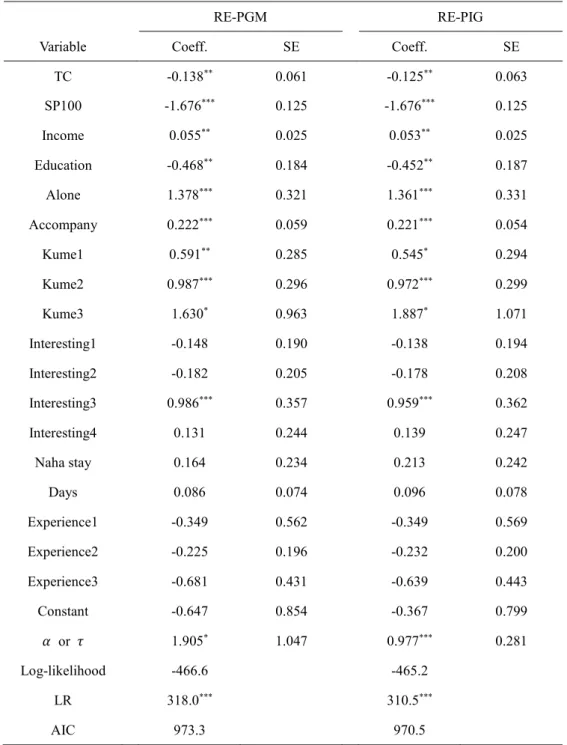
correction. All computations in this section are conducted using Ox (Doornik, 2009). Table 3 reports the estimation results of the empirical model by the two approaches. First, the travel cost coefficients (𝑇𝐶), which is our primary interest, are negative as expected and significant at the 5% level in both approaches. Moreover, both of the likelihood ratio (LR) statistics reject the null hypothesis that all of the coefficients except for the constant are zero at the 1% significance level. Although there are only
Table 3 Results of RE-PGM and RE-PIG models with on-site correction
RE-PGM RE-PIG
Variable Coeff. SE Coeff. SE
TC -0.138** 0.061 -0.125** 0.063 SP100 -1.676*** 0.125 -1.676*** 0.125 Income 0.055** 0.025 0.053** 0.025 Education -0.468** 0.184 -0.452** 0.187 Alone 1.378*** 0.321 1.361*** 0.331 Accompany 0.222*** 0.059 0.221*** 0.054 Kume1 0.591** 0.285 0.545* 0.294 Kume2 0.987*** 0.296 0.972*** 0.299 Kume3 1.630* 0.963 1.887* 1.071 Interesting1 -0.148 0.190 -0.138 0.194 Interesting2 -0.182 0.205 -0.178 0.208 Interesting3 0.986*** 0.357 0.959*** 0.362 Interesting4 0.131 0.244 0.139 0.247 Naha stay 0.164 0.234 0.213 0.242 Days 0.086 0.074 0.096 0.078 Experience1 -0.349 0.562 -0.349 0.569 Experience2 -0.225 0.196 -0.232 0.200 Experience3 -0.681 0.431 -0.639 0.443 Constant -0.647 0.854 -0.367 0.799 𝛼 or 𝜏 1.905* 1.047 0.977*** 0.281 Log-likelihood -466.6 -465.2 LR 318.0*** 310.5*** AIC 973.3 970.5
14
slight differences in the significance level between the RE-PGM and RE-PIG models, each of the coefficients for SP100, Income, Education, Alone, Accompany, Kume, and Interesting 3 is statistically significant at the 10% or lower levels. In particular, the estimates of SP100 support the anticipation that the number of planned trips at the degraded quality will be less than that at the current quality. Further, the coefficients associated with Kume show statistically positive signs, indicating that the experience of activities during the trip has increasing effects on future recreational demand. Since Days and the other dummy variables except for Interesting 3 are not statistically significant in both approaches, visitors’ interest regarding natural resources in Kume Island and past experiences about marine activities do not seem to affect their trip decision making. Focusing on the overdispersion parameters, 𝛼 and 𝜏, we find that they are statistically different from zero at the 10% and 1% levels, respectively, which implies that ignoring unobserved heterogeneity will incur efficiency loss of the estimators and may also make them inconsistent. Thus, it seems that the random-effects model approaches with on-site correction in the framework of pseudo panel data offer more reliable parameter estimates. Next, to compare the performance between the RE-PGM and RE-PIG models, the Akaike information criterion (AIC; Akaike, 1973) for each approach are reported in Table 3. Since the AIC of the RE-PIG model is slightly smaller than that of the RE-PGM model, in addition to the fact that the significance levels of 𝛼 and 𝜏 are largely different from each other, it is conjectured that the former approach is more appropriate to analyzing our on-site sampling data than the latter approach. This conjecture implies that the IG distribution would be able to capture overdispersion or unobserved heterogeneity than the gamma distribution more adequately.
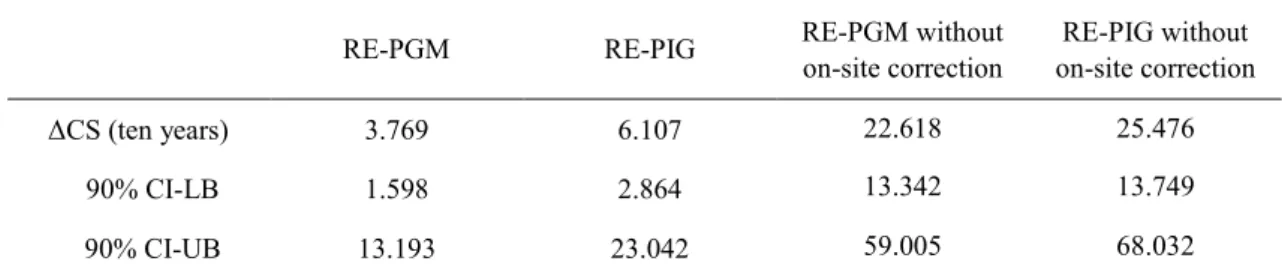
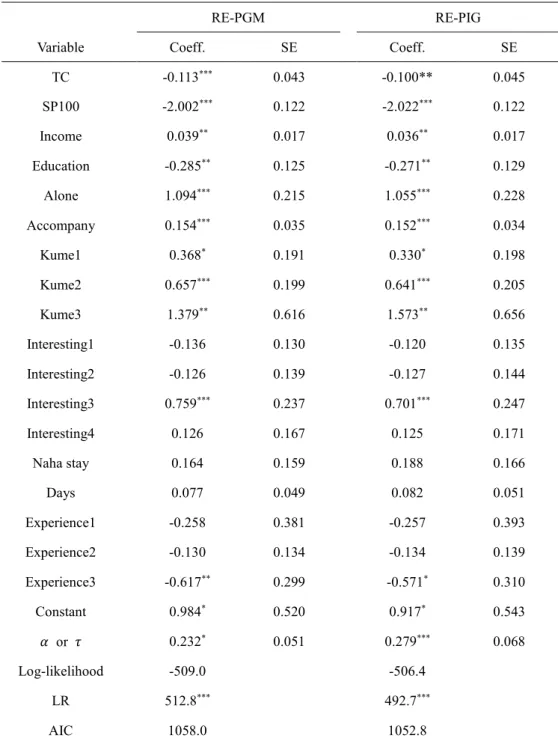
Following Equation (8) and the related discussion in Section 3.3, we can calculate the per-person CS (ΔCS) for ten years in Table 4, where the 90% confidence intervals of the estimates using the Krinsky-Robb procedure (Haab and MacCnonell, 2002; González-Sepúlveda and Loomis. 2011) are also reported. Note that Table 4 includes the estimates obtained by using the RE-PGM and RE-PIG models while ignoring the on-site sampling issues to examine the effects of on-site correction. The estimation results of the empirical model corresponding to Table 3 by these approaches are provided in the Appendix.It is easily seen from the results that the annual CS per-person trip by the RE-PGM
Table 4 Estimation results for CS loss
RE-PGM RE-PIG RE-PGM without
on-site correction RE-PIG without on-site correction ΔCS (ten years) 3.769 6.107 22.618 25.476 90% CI-LB 1.598 2.864 13.342 13.749 90% CI-UB 13.193 23.042 59.005 68.032 Unit: ¥10,000
15
model (3,796 yen) is smaller than that by the RE-PIG model (6,107 yen), and, although both of the confidence intervals are asymmetric, the latter has a wider range than the former. We find that a similar tendency also exists in both models without on-site correction. These features seem to reflect the underestimation caused by the inadequacy of the RE-PGM model specification on unobserved heterogeneity as discussed above. Thus, in terms of the model evaluation, it is preferred to adopt the result of the RE-PIG model in the following discussion. For comparison, Kragt et al. (2009) demonstrated that the annual CS per-person trip was 83.5 Australian dollars in their study, though the per-person recreational value of a site quality change using Equation (8) was not explicitly provided. Thus, converting Australian dollars into yen by using the exchange rate at that time, we find that this amount is approximately 7,097 yen, noting that the hypothetical scenarios (the degraded reef quality) are not the same. It is clear from Table 4 that the CS estimates based on the models without on-site correction are considerably larger than those of the corrected models. Given this fact, there is a possibility that Kragt et al. (2009) will overestimate the CS loss because they did not deal with the on-site sampling issues. It is, thus, crucial to measure recreational values via an on-on-site survey to control for on-site sampling and adequately specify unobserved heterogeneity or overdispersion.
As the total number of visitors to Kume Island in 2015 is 102,797, the CS loss in the case of coral reef extinction become about 627.78 million yen per year based on our RE-PIG estimate. According to the original budget from the Okinawa Prefectural Government of 2015 and 2019,13 reproduction
project for conservation of coral reefs in 2015 includes 233.52 million yen, whereas that amount decreases by 69.3 million yen in 2019. As the original budget in 2015 to protect coral reefs is not enough given our results, it might be necessary to reconsider the optimal allocation of budget and the effective use of it.
5. Concluding remarks
In Japan, coral reefs in the Okinawa Prefecture are seriously damaged, and their distributional area decreases year by year. However, there remains a coral reef community which has remarkably high scholarly value in Kume Island. Thus, this paper focuses on Kume Island and estimates the recreational demand function by using only CB data. Moreover, we propose the PIG model adjusted for an on-site survey and expand it to the random-effects model as an estimation approach. From the empirical analysis, we estimate the CS losses under the hypothetical scenario of current coral reef quality and extinction and show that the annual CS per-person trip is 6,107 yen by the RE-PIG model. To avoid the overestimation of CS, the comparative study suggests that, choosing the appropriate estimation approach and the correct for on-site sampling issues is a requirement. However, note that
16
there is still some room for improving the estimation accuracy because the sample size may be small. Furthermore, from the estimated CS loss, the coral reef extinction in Kume Island might cause serious economic damage to recreational demand in the Okinawa Prefecture. According to the report about the action plan to conserve coral reef ecosystems in Japan 2016-2020, published by the Ministry of the Environment (2015) in Japan, three priority issues are selected, and one of them is the promotion of sustainable tourism in coral reef ecosystems. This report also mentions that coral reef tourism is very popular and is an industry which produces the highest economic value in the coral reef areas. Finally, it concludes that the coral reef will become more and more important in terms of the development of the tourism industry in the region because conservation of the coral reef ecosystem enhances its value as a tourism resource. Thus, it is agreeable that the protection of the coral reef based on economic valuation leads to the desirable promotion of sustainable tourism. Additionally, in Kume Island, the reproduction project for the protection of coral reefs was organized in 2019 to promote sustainable activities which aimed at recuperation from coral reef bleaching or death. The contents of this project include cultivation, monitoring, and enlightening people on coral reefs. It seems valid to presume that our results present the necessity of cost-effective policy measures as soon as possible to support, such as a local project. It is hoped that our study would be of some benefit to the conservation of coral reefs in Kume Island.
From the methodological viewpoint, there is a potential concern that the PIG model with controlling for on-site sampling is extended to latent class or random parameter approaches, which was considered and proposed by Hynes and Greene (2013, 2016) based on the negative binomial model. They applied these approaches to the panel dataset of beach users and showed that the unobserved heterogeneity in the framework of their contingent behavior travel cost model can be adequately accounted for even if the data are collected through an on‐site survey. These directions may, thus, make it possible to more flexibly cover a wide range of specification on unobserved heterogeneity in a pseudo-panel data and would be of value to the field regarding welfare estimation of recreation, which is scope for future research.
Acknowledgments
This study was funded by the National Institute for Environmental Studies (NIES) and, also, supported by Japan Society for the Promotion of Science (JSPS), Grant-in-Aid for Young Scientists (B) (Grant Number 17K18038).
17 Appendix
Table A1 Results of RE-PGM and RE-PIG models without on-site correction
RE-PGM RE-PIG
Variable Coeff. SE Coeff. SE
TC -0.113*** 0.043 -0.100** 0.045 SP100 -2.002*** 0.122 -2.022*** 0.122 Income 0.039** 0.017 0.036** 0.017 Education -0.285** 0.125 -0.271** 0.129 Alone 1.094*** 0.215 1.055*** 0.228 Accompany 0.154*** 0.035 0.152*** 0.034 Kume1 0.368* 0.191 0.330* 0.198 Kume2 0.657*** 0.199 0.641*** 0.205 Kume3 1.379** 0.616 1.573** 0.656 Interesting1 -0.136 0.130 -0.120 0.135 Interesting2 -0.126 0.139 -0.127 0.144 Interesting3 0.759*** 0.237 0.701*** 0.247 Interesting4 0.126 0.167 0.125 0.171 Naha stay 0.164 0.159 0.188 0.166 Days 0.077 0.049 0.082 0.051 Experience1 -0.258 0.381 -0.257 0.393 Experience2 -0.130 0.134 -0.134 0.139 Experience3 -0.617** 0.299 -0.571* 0.310 Constant 0.984* 0.520 0.917* 0.543 𝛼 or 𝜏 0.232* 0.051 0.279*** 0.068 Log-likelihood -509.0 -506.4 LR 512.8*** 492.7*** AIC 1058.0 1052.8
18 References
Akaike, H., 1973. Information theory and an extension of the maximum likelihood principle. In Petrov, B.N. and Csaki, F. (eds.), Second International Symposium on Information Theory, pp. 267-281. Akademiai Kiado, Budapest.
Alberini, A., Zanatta, V., and Rosato, P., 2007. Combining actual and contingent behavior to estimate the value of sports fishing in the Lagoon of Venice. Ecol. Econ., 61, 530-541.
Beaumais, O., and G. Appéré., 2010. Recreational shellfish harvesting and health risk: a pseudo-panel approach combining revealed and stated preference data with correction for on-site sampling, Ecol. Econ., 69, 2315-2322.
Bhat, M.G., 2003. Application of non-market valuation to the Florida Keys marine reserve management. J. Environ. Manage., 67, 315-325.
Bockstael, N.E., McConnell, K.E., and Strand, I.E., 1989. Measuring the benefits of improvements in water quality: the Chesapeake Bay. Mar. Resour. Econ. 6, 1-18.
Cabral, R.B., and Geronimo, R.C., 2018. How important are coral reefs to food security in the Philippines? Diving deeper than national aggregates and averages. Mar. Policy., 91, 136-141. Cameron, A.C., and P.K. Trivedi., 2013. Regression analysis of count data, 2nd ed. Cambridge
University Press, New York.
Cesar, H., Burke, L., and Pet-Soede, L., 2003. The economics of worldwide coral reef degradation.
Cesar environmental economics consulting (CEEC).
https://www.wwf.or.jp/activities/lib/pdf_marine/coral-reef/cesardegradationreport100203.pdf, Accessed date: 4 March 2019.
Dean, C., Lawless J.F., and G.E. Willmot., 1989. A mixed Poisson-inverse-Gaussian regression model. Can. J. Stat. 17, 171-181.
Deely, J., Hynes, S., and Curtis, J., 2019. Combining actual and contingent behaviour data to estimate the value of coarse fishing in Ireland. Fish. Res., 215, 53-61.
Doornik, J.A., 2009. An Object-oriented Matrix Programming Language Ox 6. Timberlake Consultants Press, London.
Egan, K., and Herriges, J., 2006. Multivariate count data regression models with individual panel data from an on-site sample. J. Environ. Econ. Manag. 52, 567-581.
Elliff, C.I., and Kikuchi, R.K., 2017. Ecosystem services provided by coral reefs in a Southwestern Atlantic Archipelago. Ocean Coast. Manage., 136, 49-55.
Ferrario, F., Beck, M.W., Storlazzi, C.D., Micheli, F., Shepard, C.C., and Airoldi, L., 2014. The effectiveness of coral reefs for coastal hazard risk reduction and adaptation. Nat. Commun., 5, 3794.
Filippini, M., Greene, W., and Martinez-Cruz, A.L., 2018. Non-market Value of Winter Outdoor Recreation in the Swiss Alps: The Case of Val Bedretto. Environ. Resour. Econ., 71, 729-754.
19
Folkersen, M.V., Fleming, C.M., and Hasan, S., 2018. Deep sea mining's future effects on Fiji's tourism industry: A contingent behaviour study. Mar. Policy., 96, 81-89.
González-Sepúlveda, J.M., and Loomis, J.B., 2011. Are benefit transfers using a joint revealed and stated preference model more accurate than revealed and stated preference data alone? In J.C. Whitehead, T.C. Haab, and J.Huang (eds.), Preference Data for Environmental Valuation: Combining Revealed and Stated Approaches,pp.289-302. Routledge, New York.
Guo, J.E, and P.K. Trivedi., 2002. Flexible parametric models for long-tailed patent count distributions, Oxf. Bull. Econ. Stat., 64, 63-82.
Haab, T.C., and McConnell, K.E., 2002. Valuing Environmental and Natural Resources, The Economics of Non-Market Valuation. Edward Elgar, Cheltenham, UK.
Hausman, J.A., Hall, B.H., and Griliches, Z., 1984. Econometric models for count data with an application to the patents-R&D relationship. Econometrica, 52, 909-938.
Hongo, C., and Yamano, H., 2013. Species-specific responses of corals to bleaching events on anthropogenically turbid reefs on Okinawa Island, Japan, over a 15-year period (1995–2009). Plos One, 8, e60952.
Hynes, S., and Greene, W., 2013. A panel travel cost model accounting for endogenous stratification and truncation: A latent class approach. Land. Econ. 89, 177-192.
Hynes, S., and Greene, W., 2016. Preference heterogeneity in contingent behaviour travel cost models with on‐site samples: A random parameter vs. a latent class approach. J. Agr. Econ., 67, 348-367. Intergovernmental Panel on Climate Change (IPCC), 2018. Global warming of 1.5℃, summary for policymakers. https://www.ipcc.ch/sr15/chapter/summary-for-policy-makers/, Accessed date: 4 March 2019.
Kench, P.S., Owen, S.D., and Ford, M.R., 2014. Evidence for coral island formation during rising sea level in the central Pacific Ocean. Geophys. Res. Letters., 41, 820-827.
Kragt, M.E., Roebeling, P.C., and Ruijs, A., 2009. Effects of Great Barrier Reef degradation on recreational reef-trip demand: a contingent behaviour approach. Aust. J. Agr. Resour. Ec., 53, 213-229.
Lankia, T., and Pouta, E., 2019. Effects of water quality changes on recreation benefits in Finland: Combined travel cost and contingent behavior model. Water Resour. Econ., 25, 2-12.
Lienhoop, N., and Ansmann, T., 2011. Valuing water level changes in reservoirs using two stated preference approaches: An exploration of validity. Ecol. Econ., 70, 1250-1258.
Ministry of the Environment. 2015, The action plan to conserve coral reef ecosystems in Japan 2016-2020. Available at: https://www.env.go.jp/nature/biodic/coralreefs/pamph/pamph_full-en.pdf, Accessed date: 4 March 2019.
Morgan, O.A., and Huth, W.L., 2011. Using revealed and stated preference data to estimate the scope and access benefits associated with cave diving. Resour. Energy. Econ., 33, 107-118.
20
Narukawa, M., and Nohara, K., 2018. Zero-truncated panel Poisson mixture models: Estimating the impact on tourism benefits in Fukushima Prefecture. J. Environ. Manage, 211, 238-246.
Oh, S., 2004. Economic Valuation of Okinawa’s Coral Reefs –Economic Analysis of Unavailable Value by Contingent Valuable Method-, Journal of Business and Economics. Okinawa International University, 32, 35-54 (in Japanese).
Okinawa Prefectural Government, 2018. Ritou Kankei Shiryo (Statistical material about isolated islands) (in Japanese).
https://www.pref.okinawa.jp/site/kikaku/chiikirito/ritoshinko/h31ritoukannkeisiryou.html, Accessed date: 4 March 2019.
Perry, C.T., Kench, P.S., O’Leary, M.J., Morgan, K.M., and Januchowski-Hartley, F., 2015. Linking reef ecology to island building: Parrotfish identified as major producers of island-building sediment in the Maldives. Geology, 43, 503-506.
Prayaga, P., Rolfe, J., and Stoeckl, N., 2010. The value of recreational fishing in the Great Barrier Reef, Australia: a pooled revealed preference and contingent behaviour model. Mar. Policy., 34, 244-251.
Pueyo-Ros, J., Garcia, X., Ribas, A., and Fraguell, R.M., 2018. Ecological restoration of a coastal wetland at a mass tourism destination. Will the recreational value increase or decrease? Ecol. Econ., 148, 1-14.
Robles-Zavala, E., and Reynoso, A.G.C., 2018. The recreational value of coral reefs in the Mexican Pacific. Ocean Coast. Manage., 157, 1-8.
Sarker, R., and Surry, Y., 2004. The fast decay process in outdoor recreation activities and the use of alternative count data models. Am. J. Agr. Econ., 86, pp.701-715.
Shaw, D., 1988. On-site samples’ regression problems of non-negative integers, truncation, and endogenous stratification. J. Econometrics., 37, pp.211-223.
Tamura, M., 2006. Toward the Establishment of Strategies for the Sustainable Management of Coral Reefs in Akajima Island; Questioner Survey on Socio-economic Value of Coral Reefs. Midoriishi, 17, 29-33 (in Japanese).
The Cabinet Office in Japan, 2014. Kankyo Mondai ni kansuru Yoron Chosa no Gaiyo (Summary of a public opinion poll about environmental issues) (in Japanese). https://survey.gov-online.go.jp/h26/h26-kankyou/index.html, Accessed date: 22 February 2018.
van Beukering, P., Brander, L., van Zanten, B., Verbrugge, E., and Lems, K., 2011. The economic value of the coral reef ecosystems of the United States Virgin Islands: Final report. IVM Institute for Environmental Studies Report Number: R-11/06., The Netherlands: Amsterdam.
Whitehead, J.C., Haab T.C., and J. Huang., 2000. Measuring recreation benefits of quality improvements with revealed and stated behavior data. Resour. Energy. Econ. 22, 339-354. Willmot, G.E., 1987. The Poisson-Inverse Gaussian distribution as an alternative to the negative
21 binomial. Scand. Actuar. J. 1987, pp.113-127.
Winkelmann, R., 2000. Seemingly unrelated negative binomial regression. Oxford. B. Econ. Stat. 62, 553-560.