長波短波相互作用方程式のパンルベ特性と
川積分性
Painlev\’e
properties
and integrability of the
long- and short-wave interaction
equation
阪大基礎工吉永隆夫
Takao
Yoshinaga
Department of
Mechanical
Engineering
Faculty of
Engineering
Science
$\mathrm{O}_{\mathrm{S}}\mathrm{a}1\backslash \prime \mathrm{a}$
University,
Toyonaka,
Osaka
560,
Japan
Abstract
The
$i\mathrm{n}\mathrm{t}\mathrm{e}_{\mathrm{t}\supset}\sigma \mathrm{r}\mathrm{a}\mathrm{b}\mathrm{i}\mathrm{l}\mathrm{i}\mathrm{t}\mathrm{y}$in the
sense of
Painlev\’e
property
is
examined
in the
$1\mathrm{o}\mathrm{n}_{\Leftrightarrow}\sigma-$and short-
wave interaction
equation. The equation
de-scribed in
a
coupled
form of the
NLS
equation
with the K-dV equation
has only
two
parameters
in the
$\mathrm{n}\mathrm{o}\mathrm{r}\mathrm{m}x_{\mathrm{z}\mathrm{e}\mathrm{d}}$form. When the equation
is
reduced
to
the
ODE through
the
traveling wave
transformation. it
is
shown
to
pass the
Painlev\’e
test
for
three
cases
of the parameters.
On the
other hand, for these
parameters,
when
the
test
is
directly
ap-plied
to
the original PDE, it is found that
two
cases
except
for one do
not
pass the
test
without any
restrictions.
However,
the
test
is
found
not to
be
successful in the nearly integrable
$\mathrm{r}\mathrm{e}_{b}^{\sigma}\mathrm{i}\mathrm{o}\mathrm{n}$. Furthermore,
the
possibility
of
’finite time
$\mathrm{i}\mathrm{n}\mathrm{t}\mathrm{e}_{\Leftrightarrow}^{\sigma}\mathrm{r}\mathrm{a}\mathrm{b}\mathrm{i}\mathrm{l}\mathrm{i}\mathrm{t}\mathrm{y}$’
is discussed for
a
special
case
of the parameters.
1
Introduction.
In dispersive
media,
wave
interactions play an important role in
energy
ex-change
$\mathrm{a}\mathrm{m}\mathrm{o}\mathrm{n}_{\mathrm{o}}\sigma$different
two
or more wave modes,
if
resonance
conditions
with
respect to
wave
frequencies
(and
wave
numbers)
or
wave velocities
are
satisfied in these wave modes. The
$1\mathrm{o}\mathrm{n}_{\mathrm{o}}\sigma-$and
short-wave interaction is one
of
such
interactions and thought of as a special case of the three-wave
inter-action. [1] That is to say,
$\mathrm{a}\mathrm{s}\mathrm{s}\mathrm{u}\min_{\mathrm{o}}\sigma$a
$\sin_{\mathrm{O}}\sigma 1\mathrm{e}\mathrm{l}\mathrm{o}\mathrm{n}_{\circ}\sigma$wave
$(\triangle \mathrm{k}, \omega(\triangle k))$
and
two
short
waves
$(\mathrm{k}\pm\triangle \mathrm{k}/2,\omega(k\pm\triangle k/2))$
,
from the
resonance condition of the
three-wave
interaction given as
$\omega(\triangle k)=\omega(k+\triangle k/2)-\omega(k-\triangle k/2)$
,
(1)
we can
approximately obtain the following resonance condition between
long
and
short
waves:
$\Delta/\mathrm{k}\cdot(\partial\omega/\partial \mathrm{k})|_{\mathrm{k}}\simeq\omega(/\Delta k)$
,
(2)
where
$k=|\mathrm{k}|$
and
$\omega\ll 1$
is assumed for
$\triangle/k(\ll k).\cdot$
The above condition is
found
to
be
equivalent
to
$\mathrm{v}_{p}\cdot \mathrm{v}_{g}\simeq v_{p}^{2}$
or
$v_{g}\cos\psi\simeq v_{p}$
,
(.3)
where the
phase velocity
of
the
$1\mathrm{o}\mathrm{n}_{\mathrm{o}}\sigma$wave is
given
by
$\mathrm{v}_{p}=\omega(\triangle k)\triangle \mathrm{k}/\Delta/k^{2}$
and the
$\mathrm{o}\mathrm{P}\sigma \mathrm{r}\mathrm{o}\mathrm{u}$velocity
of the short
wave by
$\mathrm{v}_{g}=(\partial\omega/\partial \mathrm{k})|_{\mathrm{k}}$
. Therefore,
if the above condition is satisfied. the interaction is possible between the
two
waves
propagating in the different direction by
$\psi$
.
In particular, this
condition is
simplified
to
$v_{g}\sim v_{p}$
when
both
waves propagate in the same
direction
$(\psi=0)$
.
Such
a
resonance
condition can be satisfied in water
waves,
plasma waves
and
others in dispersive media.
$[1]-[6]$
Although several nonlinear interaction
equations have been proposed for these waves,
in this
article,
we deal
with the
following
$\mathrm{e}\mathrm{q}_{\mathfrak{U}}\mathrm{a}\mathrm{t}\mathrm{i}_{\mathrm{o}\mathrm{n}}$,
which
is
represented
in
a coupled form of the Nonlinear
$\mathrm{S}\mathrm{c}\mathrm{h}\mathrm{r}\ddot{\mathrm{o}}\mathrm{d}\mathrm{i}\mathrm{n}_{\mathrm{o}}\sigma \mathrm{e}\mathrm{r}$(NLS)
equation
with the
Korteweg-de Vries
(K-dV)
equation:
[7]
$\mathrm{i}S_{t}\pm S_{xx}=SL$
,
$L_{t}+\alpha LL_{x}+\beta L_{xxx}=|S|_{x}^{2}$
,
(4)
where
$L$
and
$S$
denote,
respectively, the real
$1\mathrm{o}\mathrm{n}_{\mathrm{o}}\sigma$wave and the complex
amplitude of
the envelope of the short
wave,
while
$x$
and
$t$
are spatial and
temporal coordinates in
a
frame of reference
$\mathrm{m}\mathrm{o}\mathrm{v}\mathrm{i}\mathrm{n}_{\circ}\sigma$with the phase
velocity
of the long wave
or
the
group velocity of
the
short wave.
In
the above equation, which
is
expressed
in
the
normalized form with
only two parameters
$\alpha$and
$\beta$,
the parameters and the alternative
of
the
$\pm$
the media concerned: [7] the gravity and capillary waves in
a
single layer fluid
$(\alpha, \beta\leq 0\mathrm{a}\mathrm{n}\mathrm{d}+\mathrm{s}\mathrm{i}\mathrm{g}\mathrm{n})$
,
the
$\circ\sigma \mathrm{r}\mathrm{a}\mathrm{v}\mathrm{i}\mathrm{t}\mathrm{y}$waves in a two-layer fluid
(
$\beta\leq 0$
and
-$\mathrm{s}\mathrm{i}\sigma \mathrm{n})\circ$
’
the ion acoustic and electron plasma waves
$(\alpha\geq 0, \beta\leq 0\mathrm{a}\mathrm{n}\mathrm{d}+\mathrm{s}\mathrm{i}_{\mathrm{o}}\sigma \mathrm{n})$
and so on. However,
since
the
case
$\mathrm{o}\mathrm{f}-\mathrm{s}\mathrm{i}_{\mathrm{o}}\sigma \mathrm{n}$can be formally obtained if
$t$
,
$L$
and
$\beta$in
$\mathrm{e}\mathrm{q}.(4)$are
replaced
$\mathrm{b}.\mathrm{v}-t,$
$-L\mathrm{a}\mathrm{n}\mathrm{d}-\grave{\beta}$
,
we will consider only the
case
$\mathrm{o}\mathrm{f}+\mathrm{s}\mathrm{i}_{\mathrm{o}}\sigma \mathrm{n}$in
the
followings.
Depending upon the
parameters
$\alpha$and
$\beta$,
physical
$\mathrm{m}\mathrm{e}\mathrm{a}\mathrm{n}\mathrm{i}\mathrm{n}_{\circ}\sigma \mathrm{S}$and
mathe-matical properties of this equation can be said as follows: When both
$\alpha$and
$\beta$are equal
to zero,
$\mathrm{e}\mathrm{q}.(4)$represents the
case when the magnitude of the
$1\mathrm{o}\mathrm{n}_{\mathrm{o}}\sigma$
wave is
much
less
than
that
of
the
short
wave
$(|L|\ll|S|)$
.
For this
case,
the equation is proved
to
be
$\mathrm{i}\mathrm{n}\mathrm{t}\mathrm{e}_{\mathrm{o}}\sigma \mathrm{r}\mathrm{a}\mathrm{b}\mathrm{l}\mathrm{e}$or to have
the
$\mathrm{n}$-soliton solution by
means of the inverse
$\mathrm{s}\mathrm{c}\mathrm{a}\mathrm{t}\mathrm{t}\mathrm{e}\mathrm{r}\mathrm{i}\mathrm{n}_{\circ}\sigma$transform
(IST)
method.
$[8, 9]$
On
the other
hand,
when both
$\alpha$and
$\beta$have
finite
values,
the equation
represents
the
case
for which the
$\mathrm{m}\mathrm{a}_{\mathrm{o}}\sigma \mathrm{n}\mathrm{i}\mathrm{t}\mathrm{u}\mathrm{d}\mathrm{e}\mathrm{S}$of
the
$1\mathrm{o}\mathrm{n}_{\mathrm{o}}\sigma$and short
waves are of
the
same order
$(|L|\sim|S|)$
. In this case, not only analytic solitary wave (one-soliton)
solu-tions, but also a variety of numerical solitary
wave solutions including ones
with oscillatory damped tails are found.
[10]
It
is expected,
however, that
the
$1\mathrm{o}\mathrm{n}_{\mathrm{o}}\sigma$
time asymptotic wave behavior may become chaotic for general initial
waves or soliton interactions, since the equation for
$\beta=1$
is shown
to
be
$\mathrm{n}\mathrm{o}\mathrm{n}- \mathrm{i}\mathrm{n}\mathrm{t}\mathrm{e}_{\circ}\sigma_{\Gamma \mathrm{a}\mathrm{b}}1\mathrm{e}\mathrm{t}\mathrm{h}\mathrm{r}\mathrm{o}\mathrm{u}_{\circ}\sigma \mathrm{h}$
IST
[11]. Additionally,
in the Hirota bilinear form
for
$a=-6\beta$
,
the
$\mathrm{n}$-soliton
solution has not been found for
$\alpha,$$\beta\neq 0$
.
$[11,12]$
Nevertheless,
for the
nearly
$\mathrm{i}\mathrm{n}\mathrm{t}\mathrm{e}_{\mathrm{o}^{\Gamma \mathrm{a}\mathrm{b}}}\sigma 1\mathrm{e}$case
in the vicinity of
$\alpha=\beta=0$
,
it is
numerically
shown
that the wave
behavior
is regular or
$\mathrm{i}\mathrm{r}\mathrm{r}\mathrm{e}_{\mathrm{o}}\sigma \mathrm{u}\mathrm{l}\mathrm{a}\Gamma \mathrm{d}\mathrm{e}\mathrm{p}\mathrm{e}\mathrm{n}\mathrm{d}\mathrm{i}\mathrm{n}_{\mathrm{o}}\sigma$upon initial conditions and values
of
the parameters. [10]
As is
seen
in
the above,
though
$\mathrm{e}\mathrm{q}.(4)$is
shown to be
non-integrable
for the
particular
$\alpha$and
$\beta$,
the
integrability
has not yet
been
analytically
surveyed
for all values of the
parameters,
in particular,
in the nearly
$\mathrm{i}\mathrm{n}\mathrm{t}\mathrm{e}_{\mathrm{o}}\sigma \mathrm{r}\mathrm{a}\mathrm{b}\mathrm{l}\mathrm{e}\mathrm{r}\mathrm{e}_{\mathrm{o}}\sigma \mathrm{i}\mathrm{o}\mathrm{n}$.
Therefore,
in this
article, the
$\mathrm{i}\mathrm{n}\mathrm{t}\mathrm{e}_{\mathrm{o}}\sigma \mathrm{r}\mathrm{a}\mathrm{b}\mathrm{i}\mathrm{l}\mathrm{i}\mathrm{t}\mathrm{y}$of
$\mathrm{e}\mathrm{q}.(4)$
is examined in the
$(\alpha, \beta)$
parameter
space
by
means of the
Painlev\’e
test,
which
is known as one
of
the
$\mathrm{u}\mathrm{S}\mathrm{e}\mathrm{f}\mathfrak{U}1$and practical techniques
to
test the
integrability despite some
drawbacks.
$[13, 14]$
$\iota$The
$\mathrm{o}\mathrm{r}_{\mathrm{o}}\sigma \mathrm{a}\mathrm{n}\mathrm{i}_{\mathrm{Z}}\mathrm{a}\mathrm{t}\mathrm{i}_{\mathrm{o}\mathrm{n}}$of this
article is
as follows: In section
‘2,
the results
of the
test
are shown for the reduced ordinary
differential
equation (ODE)
$\mathrm{t}\mathrm{h}\mathrm{r}\mathrm{o}\mathrm{u}_{\mathrm{o}}\sigma \mathrm{h}$
a
variable transformation (Painlev\’e
ODE
test).
In addition, they
are
confirmed
by
$\mathrm{e}\mathrm{x}\mathrm{a}\mathrm{n}\dot{\mathrm{u}}\mathrm{n}\mathrm{i}\mathrm{n}_{\circ}\sigma$the
surface of section for particular parameters.
In
section
3, for the
cases
which
pass the
ODE
test,
the
original partial
differential equation
(PDE)
is directly tested
(Painlev\’e
PDE
test).
And
finally,
in section
4,
we remark the
validity
of the
test
in the
nearly
integrable
region
and
the possibility of the
’finite time integrability’.
2
Painlev\’e
ODE
test.
For the
Painlev\’e
ODE
test,
we first
reduce
$\mathrm{e}\mathrm{q}.(4)$
to
the
ODE
$\mathrm{t}\mathrm{h}\mathrm{r}\mathrm{o}\mathrm{u}\mathrm{o}\sigma \mathrm{h}$the
$\mathrm{f}\mathrm{o}11\mathrm{o}\mathrm{W}\mathrm{i}\mathrm{n}_{\mathrm{o}\mathrm{O}}\sigma \mathrm{t}\mathrm{r}\mathrm{a}\mathrm{v}\mathrm{e}\mathrm{l}\mathrm{i}\mathrm{n}\sigma$wave transformation:
$S=f(\zeta)\exp[\mathrm{i}(\lambda/2)(x-Vt)]$
,
$L=g(\zeta)$
,
$(\zeta=x-\lambda t)$
(5)
where
$\lambda$and
$V$
are
constants.
Substituting
(5)
into
$\mathrm{e}\mathrm{q}.(4)$
and
$\mathrm{i}\mathrm{n}\mathrm{t}\mathrm{e}_{\mathrm{o}}\sigma \mathrm{r}\mathrm{a}\mathrm{t}\mathrm{i}\mathrm{n}_{\circ}\sigma_{\mathit{9}}$with respect to
$\zeta$,
we
can
easily
obtain the reduced
ODE
$f_{(\zeta}+(\lambda/2)(V-\lambda/2)f=fg$
,
$\beta g_{\zeta\zeta}+(\alpha/2)g^{2}-\lambda g=f2-c^{2}$
,
(6)
where
we have imposed the boundary conditions:
$farrow C$
(const.),
$f_{\zeta},$
$f_{\zeta(}$
,
$g,$
$g_{\zeta},g_{\dot{\mathrm{t}}\zeta}arrow 0$
as
$|\zeta|arrow\infty$
,
and
$\lambda=2V$
for
$C\neq 0$
.
$\mathrm{M}\mathrm{a}\mathrm{k}\mathrm{i}\mathrm{n}_{\mathrm{O}}\sigma$
use of the followin\mbox{\boldmath $\sigma$}o variable transformation into
$\mathrm{e}\mathrm{q}.(6)$
:
$garrow(2/\beta)^{1/2}g$
,
$(arrow(\beta/2)^{1/4}\zeta,$
$(7)$
we
can
show that our system has
H\’enon-Heiles
Hamiltonian
$H=(1/2)[f_{\zeta}2g_{\zeta}^{2}+]+I(f, g)$
,
(8)
where
$I=(\beta/2)^{1/2}(\lambda/4)(V-\lambda/2)f^{2}-(2/\beta)^{1/2}(\lambda/4)g^{2}-(f^{2}-c^{2})g/2+\alpha g^{3}/(6\beta)$
.
Since
the
Painlev\’e
properties
(
$\mathrm{P}$-properties)
in the above
system
have been
examined by
$\mathrm{C}\mathrm{h}\mathrm{a}\mathrm{n}_{\mathrm{o}}\sigma$et
al. [15] for
$\beta>0$
and
$C=0$
,
it
is expected that
our
ODE
has similar
$\sin_{\mathrm{o}}\sigma \mathrm{u}\mathrm{l}\mathrm{a}\mathrm{r}$structures.
In
fact,
it
is found
that
$\mathrm{e}\mathrm{q}.(6)$
has
similar
$\mathrm{P}$-properties. [10]
According
to
the
procedure of the test by
Ablowitz
et
$al,$
$[16]$
the solutions
of
$\mathrm{e}\mathfrak{c}_{1}.(6)$are
expanded
in
the
$\mathrm{f}\mathrm{o}\mathrm{l}1_{0}\mathrm{W}\mathrm{i}\mathrm{n}_{\circ}\circ$Laurent series:
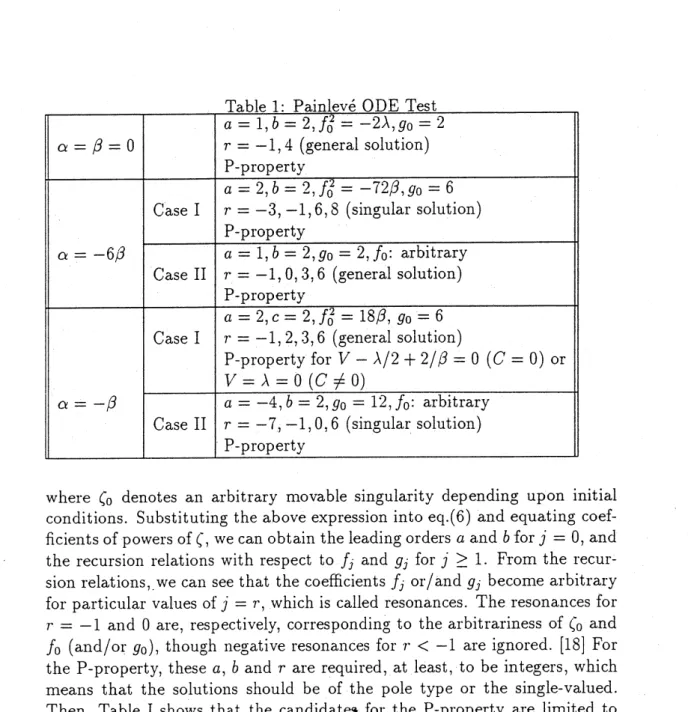
Table
1:
Painlev\’e
ODE Test
where
$\zeta_{0}$denotes an arbitrary
movable singularity depending upon
initial
conditions. Substituting the above
expression into
$\mathrm{e}\mathrm{q}.(6)$
and
equating
coef-ficients of
powers of
$\zeta$,
we
can obtain the leading
orders
$a$
and
$b$
for
$j=0$
,
and
the
recursion relations with
respect to
$f_{j}$
and
$g_{j}$
for
$j\geq 1$
.
From
the
recur-sion
relations,
we can see that the coefficients
$f_{i}\mathrm{o}\mathrm{r}/\mathrm{a}\mathrm{n}\mathrm{d}gj$become arbitrary
for particular values of
$j=r$
,
which is called
resonances.
The resonances for
$r=-1$
and
$0$
are,
respectively,
$\mathrm{c}\mathrm{o}\mathrm{r}\mathrm{r}\mathrm{e}\mathrm{s}\mathrm{p}\mathrm{o}\mathrm{n}\mathrm{d}\mathrm{i}\mathrm{n}\sigma 0$to the arbitrariness
of
$\zeta_{0}$and
$f_{0}$
(
$\mathrm{a}\mathrm{n}\mathrm{d}/\mathrm{o}\mathrm{r}$go),
though
$\mathrm{n}\mathrm{e}_{\mathrm{o}}\sigma \mathrm{a}\mathrm{t}\mathrm{i}\mathrm{V}\mathrm{e}$resonances
for
$r<-1$
are
ignored. [18] For
the
$\mathrm{P}$-property, these
$a,$
$b$
and
$r$
are required,
at least, to
be
integers, which
means that the solutions should
be
of the
pole type
or the single-valued.
Then,
Table I shows
$\mathrm{t}\mathrm{h}\mathrm{a}\mathrm{t}_{\wedge}$the
candidates
for the
$\mathrm{P}$-property are
limited
to
three
$\mathrm{s}\mathrm{i}_{\mathrm{o}}\sigma \mathrm{n}\mathrm{i}\mathrm{f}\mathrm{i}\mathrm{C}\mathrm{a}\mathrm{n}\mathrm{t}$cases
of
a
and
$\beta$.
It
is
found in
this
table
that the
case
$\alpha=\beta=0$
has only
$\circ\sigma \mathrm{e}\mathrm{n}\mathrm{e}\mathrm{r}\mathrm{a}\mathrm{l}$solution,
while the other cases have both
gen-eral and
$\sin_{\mathrm{o}}\sigma \mathrm{u}\mathrm{l}\mathrm{a}\mathrm{r}$solutions in pairs. In these
solutions,
the
$0\sigma \mathrm{e}\mathrm{n}\mathrm{e}\mathrm{r}\mathrm{a}\mathrm{l}$solution
lneans
that
the
equation
has
equal
arbitrary
parameters
to
the order of
the
equation, while
the
$\sin_{\mathrm{o}}\sigma \mathrm{u}\mathrm{l}\mathrm{a}\mathrm{r}$solution means that the solution has
less
arbi-trariness
than
the order of the equation.
However,
in order for these three
candidates
to
have the
$\mathrm{P}$-property,
the
self-consistency
of the resonance
must
be checked
in the recursion relations. Resultin
$\circ$\mbox{\boldmath$\sigma$}
from
this,
it
is
finally
found
that the
Case
I
for
$\alpha=-\beta$
has
the
$\mathrm{P}$-property
under
the
restrictions that
either
$V-\lambda/2+2/\beta=0$
for
$C=0$
or
$V=\lambda=0$
for
$C\neq 0_{\text{ノ}}$
.
while the other
cases have
$\mathrm{P}$-property
without
any restrictions.
The results of the
ODE
test
can be
confirmed
by
examining
the surfaces
of section for the
H\’enon-Heiles
system (8)
when
$\beta>0$
and
$C=0$
.
$\mathrm{A}\mathrm{l}\mathrm{t}\mathrm{h}\mathrm{o}\mathrm{u}_{\mathrm{o}}\sigma \mathrm{h}$phase
trajectories in this
system
move through the
four-dimensional
phase
space
$(f, f_{(,g,g\zeta})$
,
we can construct the two-
dimensional
surface
of
section
$(g, g_{\zeta})$
,
by
$\mathrm{s}\mathrm{l}\mathrm{i}\mathrm{C}\mathrm{i}\mathrm{n}\mathrm{o}\sigma$the phase space at
$f=0$
and
$\mathrm{t}\mathrm{a}\mathrm{k}\mathrm{i}\mathrm{n}_{\mathrm{o}}\sigma$the trajectories with
$f_{\zeta}>0$
for the fixed
total
$\mathrm{e}\mathrm{n}\mathrm{e}\mathrm{r}_{\mathrm{o}}\sigma \mathrm{y}E(=H)$.
In the
$\mathrm{f}\mathrm{o}\mathrm{l}1_{\mathrm{o}\mathrm{W}}\mathrm{i}\mathrm{n}\circ\sigma \mathrm{s}$,
typical
examples
of the surfaces of section
are
shown
for both
$\mathrm{i}\mathrm{n}\mathrm{t}\mathrm{e}_{\mathrm{o}}\sigma \mathrm{r}\mathrm{a}\mathrm{b}\mathrm{l}\mathrm{e}$and
$\mathrm{n}\mathrm{o}\mathrm{n}- \mathrm{i}\mathrm{n}\mathrm{t}\mathrm{e}\sigma \mathrm{r}\mathrm{a}\mathrm{b}\mathrm{o}\mathrm{l}\mathrm{e}$cases:
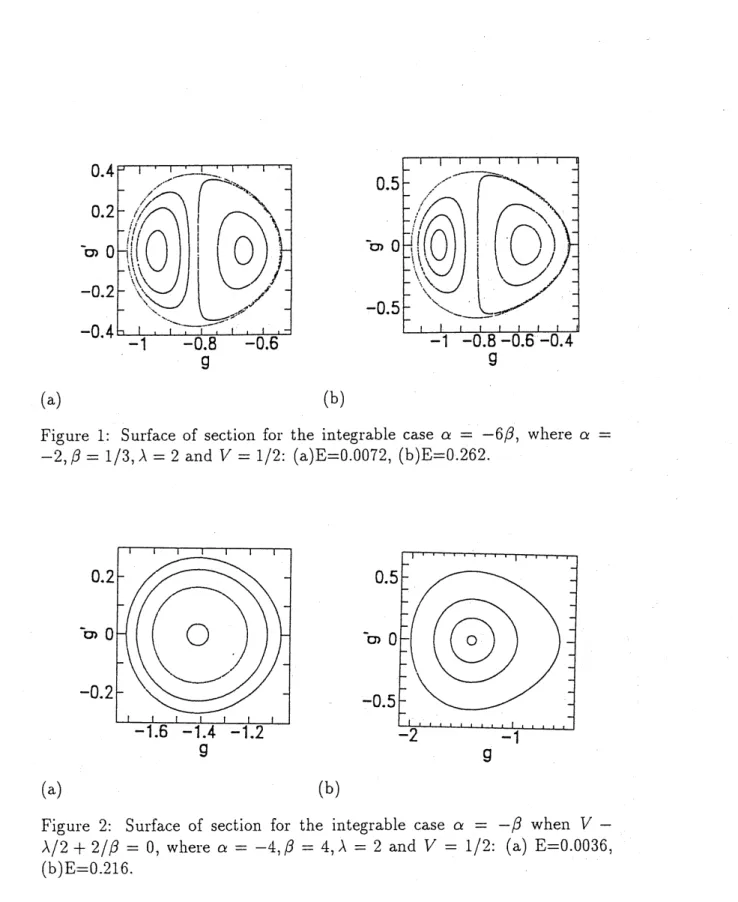
$\mathrm{F}\mathrm{i}_{\mathrm{o}}\sigma \mathrm{u}\mathrm{r}\mathrm{e}1$shows the sections for the integrable
case
$\alpha=-6\beta$
,
where
$\alpha=-2,$
$\beta=1/3,$
$\lambda=2$
and
$V=1/2$
are taken.
$\mathrm{F}\mathrm{i}_{\mathrm{o}}\sigma \mathrm{u}\mathrm{r}\mathrm{e}\mathrm{s}(\mathrm{a})$and (b),
respectively, show the surfaces when
$\mathrm{E}=0.0072$
and
0.262.
We can see that
the
closed smooth
curves are
$1.\mathrm{v}\mathrm{i}\mathrm{n}_{\mathrm{o}}\sigma$on the surface even if the
energy
increases,
which means that the trajectories move on the tori in the
$\mathrm{o}\mathrm{r}\mathrm{i}_{\mathrm{o}}\sigma \mathrm{i}\mathrm{n}\mathrm{a}1$phase
space
even
in the nonlinear
$\mathrm{r}\mathrm{e}_{\mathrm{o}}\sigma \mathrm{i}\mathrm{m}\mathrm{e}$.
The
situation on the
$\mathrm{r}\mathrm{e}_{\mathrm{o}}\sigma \mathrm{u}\mathrm{l}\mathrm{a}\mathrm{r}$motion of
the trajectories
is
similar when
$\alpha=-\beta$
,
if the
condition
$V-\lambda/2+2/\beta=0$
is satisfied. Figure 2
shows this case, where
we
take
$\alpha=-4,$
$\beta=4,$
$\lambda=2$
and
$V=1/2$
.
As is
seen in both
$\mathrm{F}\mathrm{i}_{\mathrm{o}}\sigma \mathrm{s}.(\mathrm{a})$for
$\mathrm{E}=0.0.36$
and (b)
for
$\mathrm{E}=0.216$
,
even
if the
energy
increases, the smooth
curves
are retained
on
the surface,
which
means that the motion of the trajectories is
$\mathrm{r}\mathrm{e}_{\mathrm{o}}\sigma \mathrm{u}\mathrm{l}\mathrm{a}\mathrm{r}$.
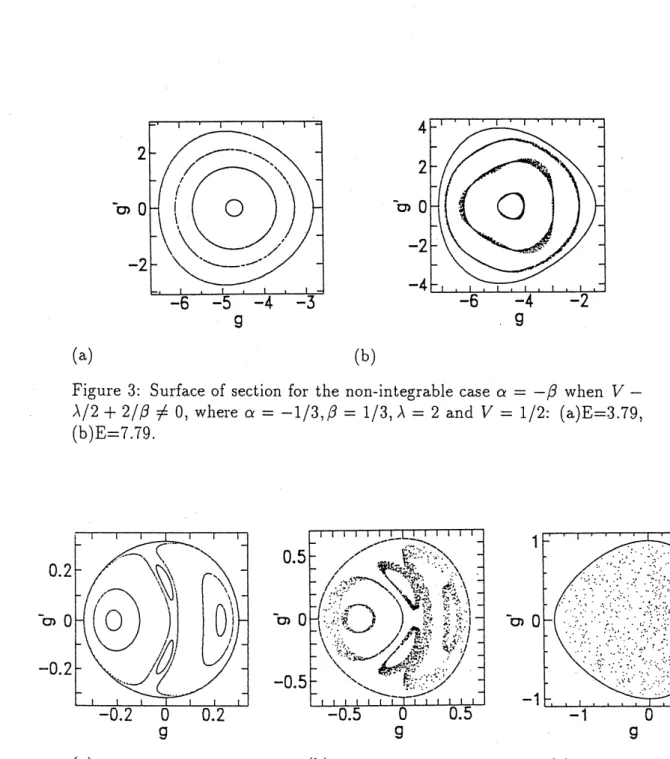
However, if this
condition is
not satisfied,
the motion of the trajectories are
$\mathrm{i}\mathrm{r}\mathrm{r}\mathrm{e}_{\mathrm{o}}\sigma \mathrm{u}\mathrm{l}\mathrm{a}\mathrm{r}$in the
nonlinear
$\mathrm{r}\mathrm{e}_{\mathrm{o}}\sigma \mathrm{i}\mathrm{m}\mathrm{e}$. This
is shown in Fig.3, where
$\alpha=-1/\cdot 3,$ $\beta=1/\cdot 3,$ $\lambda=2$
and
$V=1/‘ 2$ .
It
is found from both
Figs.(a)
for
$\mathrm{E}=3.79$
and
(b)
for
$\mathrm{E}=7.79$
that the smooth
curves are partly
replaced
by
$\mathrm{v}\mathrm{a}_{\mathrm{o}}\sigma \mathrm{u}\mathrm{e}\mathrm{l}\mathrm{y}$scattered points, when
the
$\mathrm{e}\mathrm{n}\mathrm{e}\mathrm{r}_{\mathrm{O}}\sigma \mathrm{y}$increases.
Furthermore,
in Fig.4
for
$\alpha=\beta$
,
we
can
illustrate one
of the examples which do
not
pass the test and show the large
regions
of
chaotic motion, where we take
$\alpha=\beta=1/\cdot 3,$ $\lambda=2$
and
$V=1/2$ .
$\mathrm{A}\mathrm{l}\mathrm{t}\mathrm{h}\mathrm{o}\mathrm{u}_{\mathrm{O}}\sigma \mathrm{h}$closed smooth curves are
$1\mathrm{y}\mathrm{i}\mathrm{n}_{\mathrm{o}}\sigma$on the surface for sufficiently
small
$\mathrm{e}\mathrm{n}\mathrm{e}\mathrm{r}_{\mathrm{o}}\sigma \mathrm{y}$
$\mathrm{E}=0.05(\mathrm{F}\mathrm{i}_{\mathrm{o}}\sigma.(\mathrm{a}))$
,
when the
energy
increases to
$\mathrm{E}=0.2(\mathrm{F}\mathrm{i}\mathrm{g}.(\mathrm{b}))$
,
the
curves
become
vague
due
to
scattering points
$\mathrm{a}\mathrm{l}\mathrm{o}\mathrm{n}_{\mathrm{o}}\sigma$them. Finally, when
$\mathrm{E}=0.5$
,
all
smooth curves disappear and random
spread
of points are found all over the
surface within the maximum
energy
shell
$(\mathrm{F}\mathrm{i}_{\mathrm{o}}\sigma.(\mathrm{C}))$.
(a)
(b)
$\mathrm{F}\mathrm{i}_{\mathrm{o}}^{\sigma \mathrm{u}\mathrm{r}\mathrm{e}}1$
:
Surface
of
section for
the
integrable case
$\alpha=-6\beta,$
$\mathrm{w}\mathrm{l}$)
$\mathrm{e}\mathrm{r}\mathrm{e}\alpha=$$-2,$
$\beta=1/3,$
$\lambda=2$
and
$V=1/2:(\mathrm{a})\mathrm{E}=0.0072,$
$(\mathrm{b})\mathrm{E}=0.262$
.
(a)
(b)
Figure
2:
Surface
of section for the
integrable
case
$\alpha=-\beta$
when
$V-$
$\lambda/2+2/\beta=0$
,
where
$\alpha=-4,$ $\beta=4,$
$\lambda=2$
and
$V=1/2$
:
(a)
$\mathrm{E}=0.0036$
,
(a)
(b)
Figure
3:
Surface of section for the non-integrable case
$\alpha=-\beta$
when
$V-$
$\lambda/2+2/\beta\neq 0$
,
where
$\alpha=-1/3,\beta=1/3,$
$\lambda=2$
and
$V=1/2:(\mathrm{a})\mathrm{E}=.3.79$
,
$(\mathrm{b})\mathrm{E}=7.79$
.
(a)
(b)
(c)
Figure
4:
Surface
of
section
for the
non-integrable case
$\alpha=\beta$
,
where
$\alpha=$
3
Painlev\’e
PDE
test.
It
is known
that
the test in the
reduced ODE gives
only necessary conditions
for the
$\mathrm{o}\mathrm{r}\mathrm{i}_{\mathrm{o}}\sigma \mathrm{i}\mathrm{n}\mathrm{a}1$PDE
to
be completely
$\mathrm{i}\mathrm{n}\mathrm{t}\mathrm{e}_{\mathrm{o}}\sigma \mathrm{r}\mathrm{a}\mathrm{b}\mathrm{l}\mathrm{e}$.
$[16]$
In other words, a
$0\sigma \mathrm{i}\mathrm{v}\mathrm{e}\mathrm{n}$PDE is not completel.V
$\mathrm{i}\mathrm{n}\mathrm{t}\mathrm{e}_{\mathrm{o}}\sigma \mathrm{r}\mathrm{a}\mathrm{b}\mathrm{l}\mathrm{e}$when the
ODE
reduced from the
PDE
does
not have the
$\mathrm{P}$-property.
Therefore,
in this
section,
the
$\mathrm{i}\mathrm{n}\mathrm{t}\mathrm{e}_{\mathrm{o}}\sigma \mathrm{r}\mathrm{a}\mathrm{b}\mathrm{i}\mathrm{l}\mathrm{i}\mathrm{t}\mathrm{y}$of the
original PDE is directly examined for the three cases that pass the
ODE
test
in the
$\mathrm{p}\mathrm{r}\mathrm{e}\mathrm{C}\mathrm{e}\mathrm{d}\mathrm{i}\mathrm{n}_{\circ}\sigma$section.
Let us apply the
Painlev\’e
PDE
test,
whose direct procedure was
intro-duced by Weiss et al. [17] In this
test,
a
given partial
differential
equation
is
said
to
have the P- property if the solutions are
$\sin\sigma \mathrm{l}\mathrm{e}\mathrm{o}$-valued
in the
neigh-borhood of the
arbitrary
and analytic (movable)
$\sin_{\mathrm{o}}\sigma \mathrm{u}\mathrm{l}\mathrm{a}\mathrm{r}$manifold.
Since
the
$\sin_{\mathrm{o}}\sigma \mathrm{u}\mathrm{l}\mathrm{a}\mathrm{r}$manifold for
the
ODE
reduces to the
$\sin_{\mathrm{O}}\sigma \mathrm{u}\mathrm{l}\mathrm{a}\mathrm{r}\mathrm{i}\mathrm{t}\mathrm{y}$with respect
to
a
$\sin\sigma \mathrm{l}\mathrm{e}\mathrm{o}$variable,
the
PDE
test may be
considered
as a
$\mathrm{s}\mathrm{t}\mathrm{r}\mathrm{a}\mathrm{i}_{\mathrm{o}}\sigma \mathrm{h}\mathrm{t}\mathrm{f}_{\mathrm{o}\mathrm{r}}\mathrm{w}\mathrm{a}\mathrm{r}\mathrm{d}$extention of the
ODE
test
with similar procedure. For
convenience,
$\mathrm{r}\mathrm{e}\mathrm{w}\mathrm{r}\mathrm{i}\mathrm{t}\mathrm{i}\mathrm{n}_{\mathrm{o}}\sigma$$\mathrm{e}\mathrm{q}.(4)$
in the followin\mbox{\boldmath $\sigma$}o form:
$\mathrm{i}n_{t}+u_{xx}=u\omega$
,
$-\mathrm{i}v_{t}+u_{xx}=vw$
,
$\omega_{t}+\alpha ww_{x}+\beta w_{xxx}=(uv)_{x}$
,
(10)
the solutions
are
set
as
$u= \phi^{-a}\sum_{j=0}u\infty j\varphi^{1j}$
,
$v= \phi^{-b}\sum_{j=0}v_{j}\phi^{j}\infty$
,
$w=( \delta^{-\mathrm{c}}\sum w_{j}\phi^{j}j=\infty 0^{\cdot}$
(11)
$\mathrm{M}\mathrm{a}\mathrm{k}\mathrm{i}\mathrm{n}_{\mathrm{O}}\sigma$
use of
(11)
into
$\mathrm{e}\mathrm{q}.(10)$
,
we can deterlnine the
$1\mathrm{e}\mathrm{a}\mathrm{d}\mathrm{i}\mathrm{n}_{\mathrm{o}}\sigma$order
$a,$
$b$
and
$c$
and the
resonances
$r$
like
in the
ODE
test,
whose values are integers for the
same three cases of
$\alpha$and
$\beta$as
in Table I. The results of the PDE
test
are
shown
in Table II,
where
the
case
$\alpha=\beta=0$
have only
general
solution,
while
the other
two
cases have both
$\sin_{\mathrm{o}}\sigma \mathrm{u}\mathrm{l}\mathrm{a}\mathrm{r}$and
$0\sigma \mathrm{e}\mathrm{n}\mathrm{e}\mathrm{r}\mathrm{a}\mathrm{l}_{\mathrm{S}}\mathrm{o}\mathrm{I}\mathrm{u}\mathrm{t}\mathrm{i}\mathrm{o}\mathrm{n}\mathrm{S}$.
$[19]\mathrm{C}\mathrm{h}\mathrm{e}\mathrm{c}\mathrm{k}\mathrm{i}\mathrm{n}_{\mathrm{o}}\sigma$the
recursion relations for the self-consistency of the
resonances,
it is finally
found that the case of
$\alpha=\beta=0$
and the
Case
II
for
$\alpha=-\beta$
hold
the
$\mathrm{P}$
-property
without any
restrictions. The latter
case,
however,
is
excluded in
the present context,
since
the solutions
$u$
and
$v$
are
$\mathrm{r}\mathrm{e}_{\mathrm{o}}\sigma \mathrm{u}\mathrm{l}\mathrm{a}\mathrm{r}$to
vanish closely
near
the
$\sin_{\mathrm{o}}\sigma \mathrm{u}\mathrm{l}\mathrm{a}\mathrm{r}$manifold
$\phi=0$
. Consequently, the
$\mathrm{s}\mathrm{i}_{\mathrm{o}}\sigma \mathrm{n}\mathrm{i}\mathrm{f}\mathrm{i}\mathrm{C}\mathrm{a}\mathrm{n}\mathrm{t}$solution is
only
$w$
which
is
$\mathrm{n}\mathrm{o}\mathrm{t}\mathrm{h}\mathrm{i}\mathrm{n}_{\circ}\sigma$but that
of the
K-dV equation,
where the
resonances
occur
for $r=-1,4,6$
.
On
the other
hand,
the other cases have
the
P-property
through the
$\mathrm{t}\mathrm{r}\mathrm{a}\mathrm{v}\mathrm{e}\mathrm{l}\mathrm{i}\mathrm{n}\circ\circ$wave transformation like
$\phi=x-ct$
(
$c$
:const.),
that
is
completely
$\mathrm{i}\mathrm{n}\mathrm{t}\mathrm{e}_{\mathrm{o}}\sigma \mathrm{r}\mathrm{a}\mathrm{b}\mathrm{l}\mathrm{e}$,
which
is consistent with the result of
IST
method.
$[8, 9]$
4
Concluding
remarks.
We
can see in Table
II
that
the
leading orders and some coefficients in the
expansions are coincident or
adjustable
between the completely
$\mathrm{i}\mathrm{n}\mathrm{t}\mathrm{e}_{\mathrm{o}}\circ\cdot \mathrm{r}\mathrm{a}\mathrm{b}\mathrm{l}\mathrm{e}$case
$\alpha=\beta=0$
and
the
case for
$\alpha=-6\beta$
(Case II).
Although this
$\mathrm{s}\mathrm{u}\mathrm{g}_{\mathit{0}}\sigma \mathrm{e}\mathrm{S}\mathrm{t}_{\mathrm{S}}$that these
two
cases are
closely related to
each
other,
the
test
is found
not to
be successful in the nearly
$\mathrm{i}\mathrm{n}\mathrm{t}\mathrm{e}_{\mathrm{o}}\sigma \mathrm{r}\mathrm{a}\mathrm{b}\mathrm{l}\mathrm{e}\mathrm{r}\mathrm{e}_{\mathrm{o}}\sigma \mathrm{i}\mathrm{o}\mathrm{n}\alpha,$$\beta\sim 0$
for
$\alpha=-6\beta$
,
since the
$\sin_{\mathrm{o}}\sigma \mathrm{u}\mathrm{l}\mathrm{a}\mathrm{r}$manifold
expansions become non-uniformly valid when
$\beta$tends
to
zero. This
non-unifo,rmity
may be due to the small parameter
$\beta$in
the
$\mathrm{h}\mathrm{i}_{\mathrm{o}}\sigma \mathrm{h}\mathrm{e}\mathrm{S}\mathrm{t}$order derivative term
in
$\mathrm{e}\mathrm{q}.(4)$. Additionally,
since
there
exists
one-soliton
solutions
which
are
uniformly
valid for
$\alpha=-6\beta \mathrm{i}\mathrm{n}\mathrm{C}\mathrm{l}\mathrm{u}\mathrm{d}\mathrm{i}\mathrm{n}_{\mathrm{o}}\sigma\alpha=\beta=0,$
$[10]$
the usual
$\sin_{\mathrm{o}}\sigma \mathrm{u}\mathrm{l}\mathrm{a}\mathrm{r}$manifold expansions
(9)
and
(11)
is not appropriate
to
examine the
$\mathrm{i}\mathrm{n}\mathrm{t}\mathrm{e}_{\mathrm{o}}\sigma \mathrm{r}\mathrm{a}\mathrm{b}\mathrm{i}\mathrm{l}\mathrm{i}\mathrm{t}\mathrm{y}$in this region.
On
the other
hand,
in
the
$\circ\sigma \mathrm{e}\mathrm{n}\mathrm{e}\mathrm{r}\mathrm{a}\mathrm{l}$solution for
$\alpha=-6\beta$
(Case II),
we
is
found
to
be
relaxed considerably for
a
finite time. That is
to
say,
since the
$\mathrm{s}\mathrm{i}_{\mathrm{o}}\sigma \mathrm{n}\mathrm{i}\mathrm{f}\mathrm{i}\mathrm{c}\mathrm{a}\mathrm{n}\mathrm{t}$
compatibility condition for the
$\mathrm{P}$-property
is written as
$\theta_{t}-\theta\theta_{x}=0$
,
(12)
$\mathrm{t}\mathrm{h}\mathrm{r}\mathrm{o}\mathrm{u}_{\mathrm{o}}\sigma \mathrm{h}\theta=\phi_{t}/c)\mathcal{I}_{\text{ノ}}$
.
the
$0\sigma \mathrm{e}\mathrm{n}\mathrm{e}\mathrm{r}\mathrm{a}\mathrm{l}$solution of the above wave
equ.ation
$\theta=(x \dagger t\theta)$
.
(13)
is
analytic
for a finite
time depending
upon initial conditions, where
$\ominus$de-notes
an
arbitrary function. Therefore, for a
certain
class
of
$\acute{\varphi}$which
is
given
by
(13)
$\mathrm{t}\mathrm{h}\mathrm{r}\mathrm{o}\mathrm{u}_{\mathrm{o}}\sigma \mathrm{h}\theta=\phi_{t}/\Phi_{x}’$,
the
compatibility condition
(12)
can be
satisfied
for a finite time
$\mathrm{d}\mathrm{u}\mathrm{r}\mathrm{i}\mathrm{n}_{\mathrm{o}}\sigma$which the solution
(13)
is analytic and arbitrary.
This means
that
the equation holds the
$\mathrm{P}$-property
for
the finite time and is
expected
to
have multi-soliton solutions
for the
time. As
a
special
case,
it is
easil.v
seen that the condition
(12)
is
identically
satisfied for
an
infinitely
$1\mathrm{o}\mathrm{n}_{\mathrm{o}}\sigma$time under the
$\mathrm{t}\mathrm{r}\mathrm{a}\mathrm{Y}^{-}\mathrm{e}\mathrm{l}\mathrm{i}\mathrm{n}_{\mathrm{o}}\sigma$wave
transformation
$\mathit{0}’=x-ct$
,
which
is
confirmed
by
the
existence of one-soliton solution. [10]
Thus,
for
$\alpha=-6\beta,$
$\mathrm{t}\mathrm{h}\mathrm{o}\mathrm{u}_{\mathrm{o}}\sigma \mathrm{h}$one
soliton
state
is valid for an infinitely
$1\mathrm{o}\mathrm{n}_{\mathrm{o}}\sigma$time.,
the soliton
interactions
due
to
multi-soliton state
$\mathrm{n}\dot{\mathrm{u}}_{\mathrm{o}}\sigma \mathrm{h}\mathrm{t}$be elastic
for
the
finite
time,
that
is
to say, the
possibility of
’finite time
$\mathrm{i}\mathrm{n}\mathrm{t}\mathrm{e}_{\mathrm{o}}\sigma \mathrm{r}\mathrm{a}\mathrm{b}\mathrm{i}\mathrm{l}\mathrm{i}\mathrm{t}\mathrm{y}$’
is expected.
References
[1]
D.J. Benney, Stud.
Appl.Math.55 (1976)93.
[2]
A.D.D.Craik.
PVaue interactions and
fiuid fiows
(
$\mathrm{C}\mathrm{a}\mathrm{m}\mathrm{b}\mathrm{r}\mathrm{i}\mathrm{d}_{\mathrm{o}}\sigma \mathrm{e}$University
Press,
1985).
[3]
G.D.Crapper.
Introduction to water waves
(Ellis
Horwood,
1984).
[4] V.E.Zakharov, Sov.Phys.35(1972)908,
and see also
Sov.
J. Eksp.Theor.
Phys.62(1972)1745.
[5]
$\perp l\mathrm{I}.\mathrm{V}$.
Goldman,
Rev.
Mod.Phys.56(1984)709.
[7]
$\mathrm{T}.\mathrm{Y}_{\mathrm{o}\mathrm{S}}\mathrm{h}\mathrm{i}\mathrm{n}\mathrm{a}\mathrm{o}\sigma \mathrm{a}$,
M.Wakamiya and
T.Kakutani,
Phys.Fluids
$\mathrm{A}3(1991)8.3$
,
and
see
also
$\mathrm{T}.\mathrm{Y}_{0}\mathrm{s}\mathrm{h}\mathrm{i}\mathrm{n}\mathrm{a}\sigma \mathrm{a}\mathrm{o}$and
T.Kakutani,
J.Phys.Soc..Jpn.
63 (1994)445
and the
references therein.
[8]
N.Yajima and M.Oikawa,
$\mathrm{P}\mathrm{r}\mathrm{o}^{\sigma}.\mathrm{T}\mathrm{o}\mathrm{y}\mathrm{h}\mathrm{e}\mathrm{o}\mathrm{r}.\mathrm{P}\mathrm{h}\mathrm{s}.56(1976)1719$.
[9]
Y-C.Ma,
Stud.
in
Appl.Math.59(1978)201.
[10]
$\mathrm{T}.\mathrm{Y}^{r}\mathrm{o}\mathrm{S}\mathrm{h}\mathrm{i}\mathrm{n}\mathrm{a}\sigma \mathrm{a}\circ$and T.Kakutani, J.Phys.Soc.Jpn.63(1994)445.
[11]
E.S.Benilov and
S.P.Burtsev, Phys.Lett.
$\mathrm{A}98(198.3)256$
.
[12]
$\mathrm{T}.\mathrm{Y}_{\mathrm{o}\mathrm{S}}\mathrm{h}\mathrm{i}\mathrm{n}\mathrm{a}_{\mathrm{o}}\sigma \mathrm{a}$,
Proc.Estonian Acad.Sci.Phys.Math.,44
(1995)
96.
[1.3]
M.Tabor,
Chaos
and
integrability
in
nonlinear
dynamics
(John
Wiley&
Sons,
New
York, 1989).
[14]
M.J.Ablowitz
and P.A.Clarkson,
Solitons,
Nonlinear Evolution
Equa-tions and Inverse
Scattering
(London Vl
Iathematical Society Lecture
Note
Series
$149,\mathrm{C}\mathrm{a}\mathrm{m}\mathrm{b}\mathrm{r}\mathrm{i}\mathrm{d}_{\mathrm{o}}\sigma \mathrm{e}$Univ.Press,
$\mathrm{C}^{\mathrm{t}}\mathrm{a}\mathrm{m}\mathrm{b}\mathrm{r}\mathrm{i}\mathrm{d}\mathrm{o}\sigma \mathrm{e}$,
1991).
[15]
$\mathrm{Y}.\mathrm{F}.\mathrm{C}\mathrm{h}\mathrm{a}\mathrm{n}_{\mathrm{o}}\sigma$,
M.Tabor and J.Weiss,
J.Math.Phys.23(1982)531.
[16] M.J.Ablowitz,
A.Ramani and
$\mathrm{H}.\mathrm{S}\mathrm{e}_{\mathrm{o}}\sigma \mathrm{u}\mathrm{r}$,
J.Math.Phys.21
(1980)
715.
$[17].].\mathrm{t}\mathrm{V}\mathrm{e}\mathrm{i}_{\mathrm{S}\mathrm{s}}$