JAIST Repository
https://dspace.jaist.ac.jp/Title
Shortest Reconfiguration of Sliding Tokens on a
Caterpillar
Author(s)
Yamada, Takeshi; Uehara, Ryuhei
Citation
Lecture Notes in Computer Science, 9627: 236-248
Issue Date
2016-03-29
Type
Journal Article
Text version
author
URL
http://hdl.handle.net/10119/15101
Rights
This is the author-created version of Springer,
Takeshi Yamada and Ryuhei Uehara, Lecture Notes
in Computer Science, 9627, 2016, 236-248. The
original publication is available at
www.springerlink.com,
http://dx.doi.org/10.1007/978-3-319-30139-6_19
Shortest Reconfiguration of Sliding Tokens on a
Caterpillar
Takeshi Yamada1 and Ryuhei Uehara1 School of Information Science, JAIST, Japan.
{tyama,uehara}@jaist.ac.jp
Abstract. For given two independent sets Ib and Ir of a graph, the
sliding token problem is to determine if there exists a sequence of in-dependent sets which transforms Ibinto Irso that each independent set
in the sequence results from the previous one by sliding exactly one token along an edge in the graph. The sliding token problem is one of the reconfiguration problems that attract the attention from the viewpoint of theoretical computer science. These problems tend to be PSPACE-complete in general, and some polynomial time algorithms are shown in restricted cases. Recently, the problems for finding a shortest reconfigu-ration sequence are investigated. For the 3SAT reconfigureconfigu-ration problem, a trichotomy for the complexity of finding the shortest sequence has been shown; it is in P, NP-complete, or PSPACE-complete in certain conditions. Even if it is polynomial time solvable to decide whether two instances are reconfigured with each other, it can be NP-complete to find a shortest sequence between them. We show nontrivial polynomial time algorithms for finding a shortest sequence between two independent sets for some graph classes. As far as the authors know, one of them is the first polynomial time algorithm for the shortest sliding token problem that requires detours of tokens.
1
Introduction
Recently, the reconfiguration problems attract the attention from the viewpoint of theoretical computer science. The problem arises when we wish to find a step-by-step transformation between two feasible solutions of a problem such that all intermediate results are also feasible and each step abides by a fixed reconfiguration rule. The reconfiguration problems have been studied extensively for several well-known problems, including satisfiability [7, 13], independent set [8–11, 15], set cover, clique, matching [10], and so on.
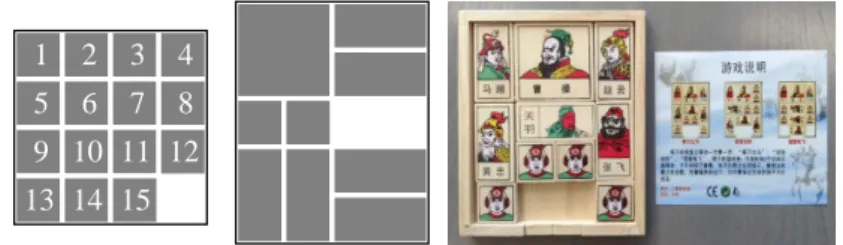
The reconfiguration problem can be seen as a natural “puzzle” from the viewpoint of recreational mathematics. The 15 puzzle is one of the most famous classic puzzles, that had the greatest impact on American and European society of any mechanical puzzle the word has ever known in 1880 (Fig. 1; see [18] for its history). It is well known that it has a parity; for any two placements, we can decide if they are reconfigurable or not by the parity. Thus, we can solve the reconfiguration problem in linear time just by checking their parities. Moreover,
1 2 3 4
5 6 7 8
9 10 11 12 13 14 15
Fig. 1. The 15 puzzle, Dad’s puzzle, and its Chinese variant.
the distance between any two reconfigurable placements is O(n3), i.e., we can
reconfigure from one to the other in O(n3) sliding pieces, where the board is
of size n× n. However, surprisingly, for these two reconfigurable placements, finding a shortest path is NP-complete in general [17]. That is, although we know that it is O(n3), finding a shortest one is NP-complete. Another interesting
property of the 15 puzzle is in another way of generalization. We have the other famous classic puzzles that can be seen as a generalization from this viewpoint. Namely, while every piece is a unit square in the 15 puzzle, when rectangles are allowed, we have the other classic puzzles, called “Dad puzzle” and its variants (Fig. 1). In 1964, Gardner said that “These puzzles are very much in want of a theory” [6], and Hearn and Demaine gave it after 40 years [8]; they proved that these puzzles are PSPACE-complete using their nondeterministic constraint logic model [9]. That is, the sliding block puzzle is PSPACE-complete in general decision problem, and it is linear time solvable for unit square pieces. However, finding a shortest reconfiguration for unit square pieces is NP-complete. In other words, we can characterize these three complexity classes using the model of the sliding block puzzle.
From the viewpoint of theoretical computer science, one of the most impor-tant problems is the 3SAT problem. Recently, for the 3SAT problem, a similar trichotomy for the complexity of finding a shortest sequence has been shown; that is, for the reconfiguration problem, finding a shortest sequence between two satisfiable assignments is in P, NP-complete, or PSPACE-complete in certain conditions [14]. In general, the reconfiguration problems tend to be PSPACE-complete, and some polynomial time algorithms are shown in restricted cases. However, finding a shortest sequence can be a new trend in theoretical computer science because it has a potential to characterize the class NP and gives us a new insight into this class.
Beside the 3SAT problem, one of the most important problems in theoretical computer science is the independent set problem. For this notion, the natural reconfiguration problem is called the sliding token problem introduced by Hearn and Demaine [8]: Suppose that we are given two independent sets Ib and
Irof a graph G = (V, E) and imagine that a token is placed on each vertex in Ib.
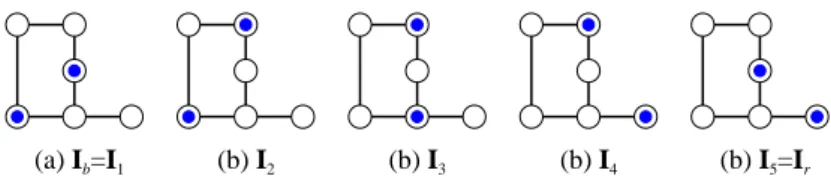
Then, the sliding token problem asks if there exists a sequence hI1, I2, . . . , I`i
(a) Ib=I1 (b) I2 (b) I3 (b) I4 (b) I5=Ir
Fig. 2. A sequence hI1, I2, . . . , I5i of independent sets of the same graph, where the vertices in independent sets are depicted by small black circles (tokens).
i with 1 ≤ i ≤ `; and (b) for each i, 2 ≤ i ≤ `, there is an edge {u, v} in E
such that Ii−1\ Ii = {u} and Ii\ Ii−1 ={v}. Figure 2 illustrates a sequence
hI1, I2, . . . , I5i of independent sets which transforms Ib= I1 into Ir= I5. Hearn
and Demaine proved that the sliding token problem is PSPACE-complete for planar graphs.
For the sliding token problem, some polynomial time algorithms are in-vestigated as follows: Linear time algorithms have been shown for cographs [11] and trees [3]. Polynomial time algorithms are shown for bipartite permutation graphs [5] and claw-free graphs [1]. On the other hand, PSPACE-completeness is also shown for graphs of bounded tree-width [16] and planar graphs [9].
In this context, we investigate for finding a shortest sequence of the sliding token problem, which is called the shortest sliding token problem defined as follows:
Input: A graph G = (V, E) and two independent sets Ib, Ir with|Ib| = |Ir|.
Output: A shortest reconfiguration sequence Ib= I1, I2, . . ., I`= Irsuch that
Ii can be obtained from Ii−1 by sliding exactly one token on a vertex
u∈ Ii−1 to its adjacent vertex v along{u, v} ∈ E for each i, 2 ≤ i ≤ `.
We note that ` is not necessarily in polynomial of |V |; this is an issue how we formalize the problem, and if we do not know that ` is in polynomial or not. If the length k is given as a part of input, we may be able to decide if ` ≤ k in polynomial time even if ` itself is not in polynomial. However, if we have to output the sequence itself, it cannot be solved in polynomial time if ` is not in polynomial.
In this paper, we will show that the shortest sliding token problem is solvable in polynomial time for the following graph classes:
Proper interval graphs: We first prove that every proper interval graph with
two independent sets Ib and Ir is a yes-instance if |Ib| = |Ir|. Furthermore, we
can find the ordering of tokens to be slid in a shortest sequence in O(n) time (implicitly), even though there exists an infinite family of independent sets on paths for which any sequence requires Ω(n2) length.
Trivially perfect graphs: We then give an O(n)-time algorithm for trivially
per-fect graphs which actually finds a shortest sequence if such a sequence exists. In contrast to proper interval graphs, any shortest sequence is of length O(n)
for trivially perfect graphs. Note that trivially perfect graphs form a subclass of cographs, and hence its decision problem can be solved in polynomial time [11].
Caterpillars: We finally give an O(n2)-time algorithm for caterpillars for the
shortest sliding token problem. To make self-contained, we first show a linear time algorithm for decision problem that asks if two independent sets can be transformed into each other. (We note that more general result for a tree has been shown [3].) For a yes-instance, we next show an algorithm that finds a shortest sequence between two independent sets.
We here remark that, since the problem is PSPACE-complete in general, an instance of the sliding token problem may require the exponential number of independent sets to transform. In such a case, tokens should make detours to avoid violating to be independent (as shown in Fig. 2). As we will see, caterpillars certainly require to make detours to transform. Therefore, it is remarkable that any yes-instance on a caterpillar requires a sequence of token-slides of polynomial length. This is still open even for a tree; in a tree, we can determine if two independent sets are reconfigurable in linear time due to [3], however, we do not know if the length of the sequence is in polynomial or not.
As far as the authors know, this is the first polynomial time algorithm for the shortest sliding token problem for a graph class that requires detours.
Due to the lack of space, some proofs are omitted, and available in a draft on arXiv [19].
2
Preliminaries
In this section, we introduce some basic terms and notations. In the sliding token problem, we may assume without loss of generality that graphs are simple and connected.
Sliding token: For two independent sets Ii and Ij in a graph G = (V, E), if
there exists exactly one edge{u, v} in G such that Ii\Ij ={u} and Ij\Ii={v},
then we say that Ij can be obtained from Ii by sliding a token on the vertex
u∈ Ii to its adjacent vertex v along the edge{u, v}, and denote it by Ii ` Ij.
A reconfiguration sequence between two independent sets I1 and I` of G
is a sequence hI1, I2, . . . , I`i of independent sets of G such that Ii−1 ` Ii for
i = 2, 3, . . . , `. We denote by I1 `∗ I` if there exists a reconfiguration sequence
between I1 and I`. We note that a reconfiguration sequence is reversible, that
is, we have I1`∗ I` iff I``∗ I1. Thus we say that two independent sets I1 and
I` are reconfigurable into each other if I1 `∗ I`. The length of a reconfiguration
sequence S is defined as the number of independent sets contained in S. For example, the length of the reconfiguration sequence in Fig. 2 is 5.
The sliding token problem is to determine if two given independent sets Ib and Ir are reconfigurable into each other. We may assume without loss of
generality that|Ib| = |Ir|; otherwise the answer is clearly “no.” In this paper, we
of a shortest reconfiguration sequence between two independent sets. Note that the length of a reconfiguration sequence may not be in polynomial of the size of the graph when the sequence may contain detours of tokens.
We always denote by Ib and Ir the initial and target independent sets of G,
respectively, as an instance of the (shortest) sliding token problem; we wish to slide tokens on the vertices in Ib to the vertices in Ir. We sometimes call the
vertices in Ib blue, and the vertices in Ir red; each vertex in Ib∩ Ir is blue and
red.
Target-assignment: We here give another notation of the sliding token
prob-lem to explain our algorithm. Let Ib={b1, b2, . . . , bk} be an initial independent
set of a graph G. For the sake of convenience, we label the tokens on the ver-tices in Ib; let ti be the token placed on bi for each i, 1 ≤ i ≤ k. Let S be a
reconfiguration sequence between Ib and an independent set I of G, and hence
Ib`∗ I. Then, for each token ti, 1≤ i ≤ k, we denote by fS(ti) the vertex in I
on which the token ti is placed via the reconfiguration sequenceS. Notice that
{fS(ti)| 1 ≤ i ≤ k} = I.
Let Ir be a target independent set of G, which is not necessarily
reconfig-urable from Ib. Then, we call a mapping g : Ib → Ira target-assignment between
Ib and Ir. The target-assignment g is said to be proper if there exists a
recon-figuration sequence S such that fS(ti) = g(bi) for all i, 1 ≤ i ≤ k. Note that
there is no proper target-assignment between Ib and Ir if Ib 6`∗ Ir. Therefore,
the sliding token problem can be seen as the problem of determining whether there exists at least one proper target-assignment between Ib and Ir.
Interval graphs and subclasses: The neighborhood of a vertex v in a graph G =
(V, E) is the set of all vertices adjacent to v, and denoted by N (v) ={u ∈ V |
{u, v} ∈ E}. Let N[v] = N(v)∪{v}. Two vertices u and v are called strong twins
if N [u] = N [v], and weak twins if N (u) = N (v). We only consider the graphs without strong twins since only one of them can be used by a token for strong twins.
A graph G = (V, E) with V ={v1, v2, . . . , vn} is an interval graph if there
exists a set I of intervals I1, I2, . . . , In such that {vi, vj} ∈ E iff Ii∩ Ij 6= ∅
for each i and j with 1 ≤ i, j ≤ n.1 We call the set I of intervals an interval
representation of the graph, and sometimes identify a vertex vi ∈ V with its
corresponding interval Ii ∈ I. We denote by L(I) and R(I) the left and right
endpoints of an interval I∈ I, respectively. That is, we always have L(I) ≤ R(I) for any interval I = [L(I), R(I)].
We suppose that an interval graph G = (V, E) is given as an input by its interval representation using O(n) space, where n = |V |. (An interval repre-sentation of G can be found in O(n + m) time [12], where m =|E|.) More pre-cisely, G is given by a string of length 2n over alphabets{L(I1), L(I2), . . . , L(In),
R(I1), R(I2), . . . , R(In)}.
1
In this paper, a bold I denotes an “independent set,” an italic I denotes an “interval,” and calligraphyI denotes “a set of intervals.”
An interval graph is proper if it has an interval representation such that no interval properly contains another. An interval graph is trivially perfect if it has an interval representation such that the relationship between any two intervals is either disjoint or inclusion.
A caterpillar G = (V, E) is a tree that consists of two subsets S and L of V as follows. The vertex set S induces a path (s1, . . . , sk) in G, each vertex v in L
has degree 1, and its unique neighbor is in S. We call the path (s1, . . . , sk) spine,
and each vertex in L leaf. In this paper, without loss of generality, we assume that k ≥ 2, deg(s1) ≥ 2, and deg(sk) ≥ 2. It is easy to see that the class of
caterpillars is a proper subset of the class of interval graphs.
3
Proper Interval Graphs
We show the main theorem in this section for proper interval graphs. Firstly, the answer of sliding token is always “yes” for connected proper interval graphs. We give a constructive proof of the claim, and it certainly finds a shortest sequence in linear time.
Theorem 1. For a connected proper interval graph G = (V, E), any two inde-pendent sets Ib and Ir with |Ib| = |Ir| are reconfigurable into each other, i.e.,
Ib `∗ Ir. Moreover, the shortest reconfiguration sequence can be found in
poly-nomial time.
We give an algorithm which actually finds a shortest reconfiguration sequence between any two independent sets Ib and Ir of a connected proper interval
graph G. A connected proper interval graph G = (V, E) has a unique interval representation (up to reversal), and we can assume that each interval is of unit length in the representation [4]. Therefore, by renumbering the vertices, we can fix an interval representation I = {I1, I2, . . . , In} of G so that L(Ii) < L(Ii+1)
(and R(Ii) < R(Ii+1)) for each i, 1 ≤ i ≤ n − 1, and each interval Ii ∈ I
corresponds to the vertex vi∈ V .
Let Ib = {b1, b2, . . . , bk} and Ir = {r1, r2, . . . , rk} be any given initial and
target independent sets of G, respectively. W.l.o.g., we assume that the blue vertices b1, b2, . . . , bk are labeled from left to right (according to the unique
interval representation I of G), that is, L(bi) < L(bj) if i < j; similarly, we
assume that the red vertices r1, r2, . . . , rk are labeled from left to right. Then,
we define a target-assignment g : Ib→ Ir, as follows: for each blue vertex bi∈ Ib
g(bi) = ri. (1)
To prove Theorem 1, it suffices to show that g is proper, and each token takes no detours.
String representation: By traversing the interval representationI of a connected
proper interval graph G from left to right, we can obtain a string S = s1s2· · · s2k
which is a superstring of both b1b2· · · bkand r1r2· · · rk, that is, each letter siin S
may assume without loss of generality that s1= b1since the reconfiguration rule
is symmetric. If a vertex is in Ib∩ Ir as bi and rj, then we define that it appears
as birj in S. Then, for each i, 1≤ i ≤ 2k, we define the height h(i) at i by the
number of blue vertices appeared in the substring s1s2· · · si minus the number
of red vertices appeared in s1s2· · · si. For the sake of notational convenience, we
define h(0) = 0. Then h(i) can be recursively computed as follows:
h(i) = 0 if i = 0; h(i− 1) + 1 if si is blue; h(i− 1) − 1 if si is red. (2)
Note that h(2k) = 0 for any string S since|Ib| = |Ir|.
Using the notion of height, we split the string S into substrings S1, S2, . . . , Sh
at every point of height 0, that is, in each substring Sj = s2p+1s2p+2· · · s2q, we
have h(2q) = 0 and h(i)6= 0 for all i, 2p + 1 ≤ i ≤ 2q − 1. Then, the substrings
S1, S2, . . . , Sh form a partition of S, and each substring Sj contains the same
number of blue and red tokens. We call such a partition the partition of S at
height 0.
Lemma 1. Let Sj = s2p+1s2p+2· · · s2q be a substring in the partition of the
string S at height 0. Then, (a) the blue vertices bp+1, bp+2, . . . , bq appear in Sj,
and their corresponding red vertices rp+1, rp+2, . . . , rq appear in Sj; (b) if Sj
starts with the blue vertex bp+1, then each blue vertex bi, p + 1≤ i ≤ q, appears
in Sj before its corresponding red vertex ri; and (c) if Sj starts with the red
vertex rp+1, then each blue vertex bi, p + 1 ≤ i ≤ q, appears in Sj after its
corresponding red vertex ri.
Algorithm: Recall that we have fixed the unique interval representation I = {I1, I2, . . . , In} of a connected proper interval graph G so that L(Ii) < L(Ii+1)
for each i, 1 ≤ i ≤ n − 1, and each interval Ii ∈ I corresponds to the vertex
vi ∈ V . Since all intervals in I have unit length, the following proposition clearly
holds.
Proposition 1. For two vertices vi and vj in G such that i < j, there is a path
P in G which passes through only intervals (vertices) contained in [L(Ii), R(Ij)].
Furthermore, if Ii0∩Ii=∅ for some index i0with i0< i, no vertex in v1, v2, . . . , vi0
is adjacent to any vertex in P . If Ij∩ Ij0 =∅ for some index j0 with j < j0, no
vertex in vj0, vj0+1, . . . , vn is adjacent to any vertex in P .
Let S be the string of length 2k obtained from two given independent sets Ib and Ir of a connected proper interval graph G, where k = |Ib| = |Ir|. Let
S1, S2, . . . , Shbe the partition of S at height 0. The following lemma shows that
the tokens in each substring Sjcan always reach their corresponding red vertices.
(Note that we sometimes denote simply by Sj the set of all vertices appeared in
the substring Sj, 1≤ j ≤ h.)
Lemma 2. Let Sj = s2p+1s2p+2· · · s2q be a substring in the partition of S at
such that tokens are slid along edges only in the subgraph of G induced by the vertices contained in [L(s2p+1), R(s2q)].
Proof of Theorem 1. We now give an algorithm for sliding all tokens on the vertices in Ib to the vertices in Ir. Recall that S1, S2, . . . , Sh are the substrings
in the partition of S at height 0. Intuitively, the algorithm repeatedly picks up one substring Sj, and slides all tokens in Ib∩Sj to Ir∩Sj. By Lemma 2 it works
locally in each substring Sj, but it should be noted that a token in Sj may be
adjacent to another token in Sj−1or Sj+1at the boundary of the substrings. To
avoid this, we define a partial order over the substrings S1, S2, . . . , Sh, as follows.
Consider any two consecutive substrings Sjand Sj+1, and let Sj= s2p+1s2p+2
· · · s2q. Then, the first letter of Sj+1 is s2q+1. We first consider the case where
both s2q and s2q+1 are the same color. Then, since s2q and s2q+1 are both in
the same independent set of G, they are not adjacent. Therefore, by Proposi-tion 1 and Lemma 2, we can deal with Sj and Sj+1independently. In this case,
we do not define the ordering between Sj and Sj+1. We next consider the case
where s2q and s2q+1 have different colors; in this case, we have to define their
ordering. Suppose that s2q is blue and s2q+1 is red; then we have s2q = bq and
s2q+1= rq+1. By Lemma 2 the token tq on s2q is slid to left, and the token tq+1
will reach rq+1 from right. Therefore, the algorithm has to deal with Sj before
Sj+1. Note that, after sliding all tokens tp+1, tp+2, . . . , tq in Sj, they are on the
red vertices rp+1, rp+2, . . . , rq, respectively, and hence the tokens in Sj+1are not
adjacent to any of them. By the symmetric argument, if s2q is red and s2q+1 is
blue, Sj+1should be dealt with before Sj.
Such an ordering is defined only for two consecutive substrings Sj and Sj+1,
1 ≤ j ≤ h − 1. Therefore, the partial order over the substrings is acyclic, and hence there exists a total order consistent with the partial order. The algorithm certainly slides all tokens from Ib to Iraccording to this total order. Therefore,
the target-assignment g defined in Eq. (1) is proper, and hence Ib`∗Ir.
We now discuss the length of reconfiguration sequences between Ib and Ir,
together with the running time of our algorithm.
Proposition 2. For two given independent sets Iband Ir of a connected proper
interval graph G with n vertices, (1) the ordering of tokens to be slid in a shortest reconfiguration sequence between them can be computed in O(n) time and O(n) space, and (2) a shortest reconfiguration sequence between them can be output in O(n2) time and O(n) space.
This proposition also completes the proof of Theorem 1. ut It is remarkable that there exists an infinite family of instances for which any reconfiguration sequence requires Ω(n2) length. Simple example is: G is a path
(v1, v2, . . . , v8k) of length n = 8k for any positive integer k, Ib={v1, v3, v5, . . . , v2k−1},
and Ir={v6k+2, v6k+4, . . . , v8k}. In this instance, each token timust be slid Θ(n)
times, and hence it requires Θ(n2) time to output them all.
4
Caterpillars
Theorem 2. The sliding token problem for a caterpillar G = (V, E) and two independent sets Ib and Ir of G can be solved in O(n) time and O(n) space,
where n =|V |. Moreover, for a yes-instance, a shortest reconfiguration sequence between them can be output in O(n2) time and O(n) space.
Let G = (S∪ L, E) be a caterpillar with spine S which induces the path (s1, . . . , sm), and leaf set L. We assume that m≥ 2, deg(s1)≥ 2, and deg(sm)≥
2. First we show that we can assume that each spine vertex has at most one leaf without loss of generality.
Lemma 3. For any given caterpillar G = (S∪ L, E) and two independent sets Iband Ir on G, there is a linear time reduction from them to another caterpillar
G0 = (S0∪ L0, E0) and two independent sets I0b and I0r such that (1) G with Ib
and Ir is a yes-instance of the sliding token problem if and only if G0 with I0b
and Iris a yes-instance of the sliding token problem, (2) the maximum degree
of G0 is at most 3, and (3) deg(s1) = deg(sm) = 2, where m =|S0|. In other
words, the sliding token problem on a caterpillar is sufficient to consider only caterpillars of maximum degree 3.
Hereafter, we only consider the caterpillars stated in Lemma 3, and we denote the unique leaf of siby `iif it exists. We here introduce a key notion of the
prob-lem on these caterpillars that is named locked path. Let G and I be a caterpillar and an independent set of G, respectively. A path P = (p1, p2, . . . , pk) on G is
locked by I iff (a) k is odd and greater than 2, (b) I∩ P = {p1, p3, p5, . . . , pk},
(c) deg(p1) = deg(pk) = 1 (in other words, they are leaves), and deg(p3) =
deg(p5) =· · · = deg(pk−2) = 2. This notion is simplified version of a locked tree
used in [3]. Using the discussion in [3], we obtain the condition for the immovable independent set on a caterpillar:
Theorem 3 ([3]). Let G and I be a caterpillar and an independent set of G, respectively. Then we cannot slide any token in I on G at all if and only if there exist a set of locked paths P1, . . . , Ph for some h such that I is a union of them.
The proof can be found in [3], and omitted here. Intuitively, for any caterpillar
G and its independent set I, if I contains a locked path P , we cannot slide
any token through the vertices in P . Therefore, P splits G into two subgraphs, and we obtain two completely separated subproblems. Therefore, we obtain the following lemma:
Lemma 4. For any given caterpillar G = (S∪ L, E) and two independent sets Iband Ir on G, there is a linear time reduction from them to another caterpillar
G0 = (S0∪ L0, E0) and two independent sets I0b and I0r such that (1) G, Ib, and
Ir are a yes-instance of the sliding token problem if and only if G0, I0b, and
Ir are a yes-instance of the sliding token problem, and (2) both of I0b and I0r
contain no locked path.
Hereafter, without loss of generality, we assume that the caterpillar G with two independent sets Ib and Irsatisfies the conditions in Lemmas 3 and 4. That
c
a
b
d
R
L
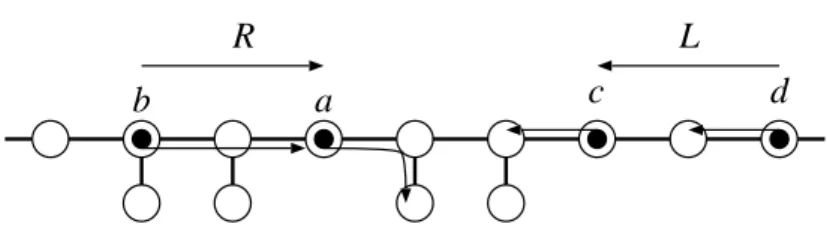
Fig. 3. The most right R token a has to precede the most left L token c.
`m, respectively, both of Ib and Ircontain no locked path, and|Ib| = |Ir|. Then,
by the result in [3], this is a yes-instance. Thus, it is sufficient to show an O(n2)
time algorithm that finds a shortest reconfiguration sequence between Iband Ir.
It is clear that each pair (si, `i) can have at most one token. Therefore,
without loss of generality, we can assume that the blue vertices b1, b2, . . . , bk in
Ib(and the red vertices r1, r2, . . . , rk) are labeled from left to right according to
the order (s1, `1), (s2, `2), . . ., (sm, `m) of G. Then, by a similar argument for
the proper interval graphs, we have g(bi) = rifor each i. To prove Theorem 2, it
suffices to show that we can move tokens with fewest detours by case analysis. Now we introduce direction of a token t denoted by dir(t) as follows: when
t moves from vi ∈ {si, `i} in Ib to vj ∈ {sj, `j} in Ir with i < j, the direction
of t is said to be R and denoted by dir(t) = R. If i > j, it is said to be L and denoted by dir(t) = L. If i = j, the direction of t is said to be C and denoted by dir(t) = C.
We first consider a simple case: all directions are either R or L. In this case, we can use the same idea appearing in the algorithm for a proper interval graph in Section 3. We can introduce a partial order over the tokens, and move them straightforwardly using the same idea in Section 3.Intuitively, a sequence of R tokens are moved from left to right, and a sequence of L tokens are moved from right to left, and we can define a partial order over the sequences of different directions. The only additional considerable case is shown in Fig. 3. That is, when the token a moves to `ifrom left and the other token c moves to si+1 from
right, a should precede c. It is not difficult to see that this (and its symmetric case) is the only exception than the algorithm in Section 3when all tokens move to right or left.
We next suppose that Ib (and hence Ir) contains some token t with dir(t) =
C. In other words, t is put on si or `i for some i in both of Ib and Ir. We have
five cases. Among them, here we consider the most complicated case that t is put on si in Ib and Ir, and `i does not exist (the other cases are simpler, and
omitted here). By assumption, 1 < s < m (since `1 and `m exist). Without
loss of generality, we suppose t is the leftmost spine with the condition. We first observe that |Ib∩ {si−1, `i−1, si+1, `i+1}| is at most 1. Clearly, we have no
token on si−1 and si+1. When we have two tokens on `i−1 and `i+1, the path
(`i−1, si−1, si, si+1, `i+1) is a locked path, which contradicts the assumption. We
Now we consider the most serious case since the other cases are simpler and easier than this case. The most serious case is that Ib contains `i−1 and
Ir contains `i+1. Since any token cannot bypass the other, Ib contains an L
token on `i−1, and Ir contains an L token on `i+1. In this case, by the L token
on `i−1, first, t should make a detour to right, and by the L token in Ir, t
next should make a detour to left twice after the first detour. It is clear that this three slides should not be avoided, and this ordering of three slides cannot be violated. Therefore, t itself should slide at least four times to return to the original position, and t can done it in four slides. During this slides, since t is the leftmost spine with this condition, the tokens on s1, `1, s2, `2, . . . , si−1, `i−1 do
not make any detours. Thus we focus on the tokens on si+1, `i+1, . . .. Let t0 be
the token that should be on `i+1 in Ir. Since t is on si, t0 is not on{si+1, `i+1}.
If t0 is on one of `i+2, si+3, `i+3, si+4, . . . in Ib, we have nothing to do; just make
a detour for only t. The problem occurs when t0 is on si+2 in Ib. If there exists
`i+2, we first slide t0 to it, and it is not difficult to see that this detour for t0
is unavoidable. If `i+2 does not exist, we have to slide t0 to si+3 before slide
of t. This can be done immediately except the similar situation that the only considerable case is that we have another L or S token t00on si+3. We can repeat
this process and confirm that each detour is unavoidable. Since G with Ib and
Ircontains no locked path, this process will halts. (More precisely, this process
will be stuck if and only if these sequence of tokens forms a locked path on G, which contradicts the assumption.) Therefore, traversing this process, we can construct the shortest reconfiguration sequence.
Proof of Theorem 2. Using the algorithm in [3], we can decide if the input is a yes-instance. For a yes-instance, a shortest sequence can be constructed from the case analysis above. For each token, the number of detours made by the token is bounded above by O(n), the number of slides of the token is also bounded above by O(n), and the computation for the token can be done in O(n) time. Therefore, the algorithm runs in O(n2) time, and the length of the shortest
sequence is O(n2). (We note that, as shown before, there is a simple instance of
the problem that requires a shortest sequence of length Θ(n2).) ut
5
Concluding Remarks
In this paper, we showed that the shortest sliding token problem can be solved in polynomial time for three subclasses of interval graphs. The computa-tional complexity of the problem for chordal graphs, interval graphs, and trees are still open. Especially, tree seems to be the next target from the viewpoint of finding a shortest sequence. We can decide if two independent sets are reconfig-urable in linear time [3], then can we find a shortest sequence for a yes-instance? As in the 15-puzzle, finding a shortest one can be NP-hard even if the decision problem is polynomial time solvable. (In fact, the exact analysis for the 15-puzzle has been done up to 4× 4 so far.) From the viewpoint of finding any sequence, the next target can be interval graphs. In general, it is an interesting open
ques-tion whether there is any instance on some graph classes whose reconfiguraques-tion sequence requires super-polynomial length.
References
1. Bonsma, P., Kami´nski, M., Wrochna M.: Reconfiguration Independent Sets in Claw-Free Graphs arXiv:1403.0359, 2014.
2. Brandst¨adg, A., Le, V.B., Spinrad, J.P.: Graph Classes: A Survey, SIAM (1999) 3. Demaine, E.D., Demaine, M.L., Fox-Epstein, E., Hoang, D.A., Ito T., Ono, H.,
Otachi, Y., Uehara, R., Yamada, T.: Linear-Time Algorithm for Sliding Tokens on Trees. Theoretical Computer Science 600, pp. 132–142 (2015)
4. Deng, X., Hell, P., Huang., J.: Linear-time representation algorithms for proper circular-arc graphs and proper interval graphs. SIAM J. Computing 25, pp. 390– 403 (1996)
5. Fox-Epstein, E., Hoang, D.A., Otachi, Y., Uehara, R.: Sliding Token on Bipar-tite Permutation Graphs. The 26th International Symposium on Algorithms and Computation (ISAAC), accepted, 2015.
6. Gardner, M.: The Hypnotic Fascination of Sliding-Block Puzzles. Scientific Amer-ican 210, pp. 122–130 (1964).
7. Gopalan, P., Kolaitis, P.G., Maneva, E.N., Papadimitriou, C.H.: The connectivity of Boolean satisfiability: computational and structural dichotomies. SIAM J. Com-puting 38, pp. 2330–2355 (2009)
8. Hearn, R.A., Demaine, E.D.: PSPACE-completeness of sliding-block puzzles and other problems through the nondeterministic constraint logic model of computa-tion. Theoretical Computer Science 343, pp. 72–96 (2005)
9. Hearn, R.A., Demaine, E.D.: Games, Puzzles, and Computation. A K Peters (2009) 10. Ito, T., Demaine, E.D., Harvey, N.J.A., Papadimitriou, C.H., Sideri, M., Uehara, R., Uno, Y.: On the complexity of reconfiguration problems. Theoretical Computer Science 412, pp. 1054–1065 (2011)
11. Kami´nski, M., Medvedev, P., Milaniˇc, M.: Complexity of independent set recon-figurability problems. Theoretical Computer Science 439, pp. 9–15 (2012) 12. Korte, N., M¨ohring, R.: An incremental linear-time algorithm for recognizing
in-terval graphs. SIAM J. Computing 18, pp. 68–81 (1989)
13. Makino, K., Tamaki, S., Yamamoto, M.: An exact algorithm for the Boolean con-nectivity problem for k-CNF. Theoretical Computer Science 412, pp. 4613–4618 (2011)
14. Mouawad, A.E., Nishimura, N., Pathak, V., Raman, V.: Shortest Reconfiguration Paths in the Solution Space of Boolean Formulas. In Proc. of ICALP 2015, LNCS 9134, pp. 985–996 (2015)
15. Mouawad, A.E., Nishimura, N., Raman, V., Simjour, N., Suzuki, A.: On the pa-rameterized complexity of reconfiguration problems. In Proc. of IPEC 2013, LNCS 8296, pp. 281–294 (2013)
16. Mouawad, A.E., Nishimura, N., Raman, V., Wrochna, M.: Reconfiguration over tree decompositions. In Proc. of IPEC 2014, LNCS 8894, pp. 246–257 (2014) 17. Ratner, R., Warmuth, M.: Finding a shortest solution for the N× N-extension of
the 15-puzzle is intractable. J. Symb. Comp., Vol. 10, pp. 111–137, 1990.
18. Slocum, J.: The 15 Puzzle Book: How it Drove the World Crazy. Slocum Puzzle Foundation, 2006.
19. Yamada, T., Uehara, R.: Shortest Reconfiguration of Sliding Tokens on a Cater-pillar. arXiv:1511.00243, November 1, 2015.