Production lot size models for perishable seasonal
products
Abdul, Ibraheem
1and Atsuo Murata
2Department of Intelligent Mechanical Systems, Division of Industrial Innovation Sciences, Graduate School of Natural
Science and Technology, Okayama University, Okayama,
3-1-1, Tsushimanaka, Okayama, 700-8530 Japan.
1[email protected]Abstract — Seasonal items like fruits, fish, winter cosmetics, fashion apparel, etc. generally exhibits different demand patterns at various times during the season. Production and inventory planning must reflect this property for cost effectiveness and optimization of resources. This paper presents two production-inventory models for perishable seasonal products that minimize total inventory costs. The models obtains optimal production run time and optimal production quantity for cases when the production rate is constant and when it is allowed to vary with demand. The products are assumed to deteriorate at an exponential rate and demand for them follows a three-phase ramp type pattern during the season. Numerical examples and sensitivity analysis are carried out. Production run time and production quantity obtained by the model were found to be independent of cost parameters. The variable production rate strategy was also found to give lower inventory costs and production quantity than the constant production rate strategy.
I. INTRODUCTION
The demand for seasonal items like fruits, fish, winter cosmetics, fashion apparel, etc. generally varies with the season. It usually begins with increasing trend, attains a peak and becomes steady at the middle of the season. Researchers have used various time dependent functions to depict this demand pattern in literature. This includes time dependent quadratic function, ramp-type function etc. A correct representation of the demand pattern is essential for production and inventory planning. Khanra and Chaudhuri [1] proposed the use of the quadratic function to represent the demand pattern of seasonal products since its coefficients can be selected to reflect the accelerated growth/decline in demand usually experienced at the beginning/end of the season. This view is supported by others like Sana and Chaudhuri [2], Ghosh and Chaudhuri [3] and others.
On the other hand, the demand of seasonal products has been found to exhibit a ramp-type pattern during their life cycle in the market [4]. The increasing-steady-decreasing demand pattern usually exhibited by most seasonal products during the season, can be represented by a three-phase ramp function. The ramp pattern allows three-phase variation in demand representing the growth, the steady and the decline phases commonly experienced by most seasonal products during their life cycle in the market. Panda et at [4] used this
pattern to generate optimal replenishment policies for perishable seasonal products over a finite time horizon. Another form of this pattern, called trapezoidal demand pattern, was used by Cheng and Wang [5] in developing an economic order quantity model for deteriorating items.
The production–inventory systems of perishable items are very common in reality and have been studied by a number of researchers. Balkhi and Benkherouf [6] developed a fixed production schedule for perishable items having constant rate of deterioration. Teng and Chang [7] developed a deterministic inventory model for perishable items with price-and stock-dependent demprice-and rate, finite production rate, price-and constant deterioration rate. Abad [8] considered the pricing and lot sizing problem for a perishable good under finite production, exponential decay and partial backordering and lost sale. Sana et al [9] developed an economic production lot size (EPLS) model for a deteriorating item over a finite planning horizon. The model adopted the critical design production rate (CDPR) for a machine as the production rate in the model. None of the models above considered demand as a ramp type function.
Since the introduction of the ramp-type demand pattern by Hill [10], efforts of researchers focus mainly on the EOQ models and only few have considered the production aspect of the problem. This may be due to the fact that studies linking ramp-type demand pattern to seasonal products are very recent. Manna and Chaudhuri [11] developed a production-inventory model for deteriorating items having ramp type demand pattern. The model assumes a finite production rate that is proportional to the demand rate and a time-proportional deterioration rate. Recently Panda et al [12] developed a single item economic production quantity (EPQ)
model with ramp type demand function. Like Manna and
Chaudhuri [11] they assumed the production rate is finite and proportional to the demand rate. The model determines the optimal production stopping time to maximize total unit profit of the system. However, both production models mentioned above considered only the growth and the steady phases of demand for the product. As mentioned earlier the demand for seasonal products is often characterized by a growth-steady-decline pattern. Hence, these models will not be suitable for seasonal products with this type of demand pattern.
Fifth International Workshop on Computational Intelligence & Applications
Two production-inventory models that consider the growth, the steady and the decline phase of demand for seasonal products are presented in this paper. In the first model, the production rate is constant and assumed to be equal to the critical design production rate (CDPR) of the machine, the product deteriorates at an exponential rate and demand follows a three-phase ramp type pattern. The second model allows production rate to vary proportionally with demand. In both models, the production run time is constrained within the steady phase of demand. This represents an aspect of an elaborate model in which production run time will be unconstrained. While the constant production rate model will be useful for production systems that still uses the traditional manufacturing techniques, the variable production rate model is applicable to industries using the flexible manufacturing systems whereby production
rate can be adjusted according to demand.
f (t)
0 μ γ t Figure 1. The Ramp type demand pattern
II. MODELASSUMPTIONSANDNOTATIONS The model is developed under the following assumptions and notations:
• A single item, single period, production inventory cycle is considered.
• Demand rate f (t) for the item is a general time dependent ramp-type function of the form:
( )
( )
( )
( )
( )
0,( )
0, 0 ,( ) ( )
. , . , , , 0 , γ μ γ μ γ γ μ μ μ h g t h t g t t h t g t t g t f = ≤ ≤ ≥ ≥ ⎪ ⎩ ⎪ ⎨ ⎧ ≥ ≤ ≤ ≤ ≤ =The function g(t) can be any continuously increasing function of time, while h(t) is any continuously decreasing function of time in the given interval. Parameters ‘ μ ’ and ‘ γ ’ represent the parameter of the ramp type demand function. The pattern f (t) is as depicted in Fig. 1.
• Production rate, K, is constant for Model A, and a known function of demand rate for Model B. • The productions run time (t1) and quantity
produced (Q) are decision variables. • Shortages are not allowed.
• A constant fraction (θ) of on-hand inventory deteriorates per unit time.
• Set up cost per cycle (AS), Deterioration cost per
unit (CD) and Inventory holding cost per unit
(Ch), are known and constant during the cycle.
• The inventory level at any time (t) during the cycle is I(t)
• The Length of the cycle is T.
• No repair, replacement of deteriorated items during the cycle.
III. MODELFORMULATION
A. Model with Constant production rate
The cycle begins with production at time t = 0 with zero stock level. As production continues, inventory begins to pile up continuously after meeting demand and deterioration. Production stops at time t1 and the accumulated inventory is gradually depleted due to demand and deterioration until it becomes zero at time T. Production commences again and the cycle repeats itself. Due to the nature of the demand pattern, production can be stopped while the demand is increasing, steady or decreasing. However, in this aspect of the model formulation, production is constrained to stop during the demand stabilization period. The variation of the inventory level with time for the cycle is shown in figure 2 below. I (t)
0 μ t1 γ T t Figure 2. Variation of Inventory level with time.
The behavior of the inventory level is described by the following differential equations:
( )
( )
( )
( )
( )
( )
( )
( )
( )
⎪⎪ ⎪ ⎭ ⎪⎪ ⎪ ⎬ ⎫ ≤ ≤ − − = ≤ ≤ − − = ≤ ≤ − − = ≤ ≤ − − = . , , , , , , 0 , 1 1 T t t I t h t t t I g t t t I g K t t I t g K dt t dI γ θ γ θ μ μ θ μ μ θ (1)The boundary conditions are:
( ) ( )
0 =IT =0;I( ) ( ) ( ) ( )
μ− =I μ+;Iγ− =Iγ+.I
The solutions to this set of equations are given in Eq. (2) below.
( )
(
( )
)
( )
(
)
(
( )
)
(
)
( )
( )
(
)
( )
⎪⎪ ⎪ ⎭ ⎪ ⎪ ⎪ ⎬ ⎫ ≤ ≤ = ≤ ≤ + = ≤ ≤ − + − = ≤ ≤ − = ∫ ∫ ∫ ∫ ∫ ∫ − − − − . , , , , , , 0 , 1 1 0 0 T t dx x h e e t t dx x h e dx g e e t t dx x g K e dx g K e e t dx x g K e e t I T t x t t T x x t t x x t t x t γ γ μ μ μ μ θ θ γ γ θ θ θ μ θ μ θ θ θ θ (2)The total number of units carried in inventory during the cycle is given in Eq. (3) below.
II =∫0TI
( )
t. (3)( )
(
)
(
)
( )
(
)
(
( )
)
(
)
(
)
( )
( )
(
)
(
)
( )
(
)
. . 1 1 0 0 0 ⎪ ⎪ ⎪ ⎭ ⎪ ⎪ ⎪ ⎬ ⎫ + + + − + − + − = ∫ ∫ ∫ ∫ ∫ ∫ ∫ ∫ ∫ ∫ − − − − T T t x t t t T x x t t t t x x t x t I dx x h e e dt dx x h e dx g e e dt dx x g K e dx g K e e dt dx x g K e e I γ θ θ γ γ γ θ θ θ μ θ μ θ μ θ μ θ θ μ μ (4)Inventory holding cost for the cycle is given by
HC = Ch ∫0TI
( )
t . =( )
(
)
(
)
( )
(
)
(
( )
)
(
)
(
)
( )
( )
(
)
(
)
( )
(
)
⎟⎟ ⎟ ⎟ ⎟ ⎟ ⎟ ⎟ ⎠ ⎞ ⎜⎜ ⎜ ⎜ ⎜ ⎜ ⎜ ⎜ ⎝ ⎛ + + + − + − + − ∫ ∫ ∫ ∫ ∫ ∫ ∫ ∫ ∫ ∫ − − − − T T t x t t t T x x t t t t x x t t h dx x h e e dt dx x h e dx g e e dt dx x g K e dx g K e e dt dx x g K e e C γ θ θ γ γ γ θ θ θ μ θ μ θ μ θ μ θ μ μ 1 1 0 0 0 . (5)Total number of items that deteriorate during the cycle is given by ID=θII.
Deterioration cost for the cycle is DC = CD ID. Set-up cost
for the cycle, AS, is constant.
Total relevant inventory cost per unit time, TRCA(t1),is
given by:
( )
1 1(
s)
1(
s(
h D)
I)
. A A C C I T DC HC A T t TRC = + + = + +θ (6)The necessary and sufficient condition for minimizing relevant inventory cost per unit time, TRCA
( )
t1 , is( )
0 1 1 = dt t dTRCA , provided( )
0 2 1 1 2 > dt t TRC d A at the minimum point.Using Eq. (6) and Eq. (4) we establish the first condition for minimum total relevant inventory cost per unit time in Eq. (8) below.
( ) (
)
1 1 1 dt dI T C C dt t dTRCA = h+θ D I . (7)( )
(
)
(
)
( )
(
)
(
( )
)
(
)
(
)
( )
( )
(
)
(
)
( )
(
)
. 0 1 1 0 0 0 1 = ⎟⎟ ⎟ ⎟ ⎟ ⎟ ⎟ ⎟ ⎠ ⎞ ⎜⎜ ⎜ ⎜ ⎜ ⎜ ⎜ ⎜ ⎝ ⎛ + + + − + − + − ∫ ∫ ∫ ∫ ∫ ∫ ∫ ∫ ∫ ∫ − − − − T T t x t t t T x x t t t t x x t t dx x h e e dt dx x h e dx g e e dt dx x g K e dx g K e e dt dx x g K e e dt d γ θ θ γ γ γ θ θ θ μ θ μ θ μ θ μ θ μ μ (8)Theorem 1: TRCA
( )
t1 is strictly convex for all t1*≥0. Proof: See Appendix A.From Theorem 1, it follows that all necessary and sufficient condition for minimum total relevant inventory cost per unit time is satisfied by Eq. (6). Hence, solving Eq. (8) gives the
optimal value of the production run time, t1*, for minimum total relevant inventory cost per unit time.
B. Model with variable production rate
The production rate, K(t), in this model is a known function of demand rate such that K
( )
t =β tf( )
;β>1.The behavior of the system is similar to that of Model A and its equation is given below.( )
( ) ( )
( )
( ) ( )
( )
( )
( )
( )
( )
⎪⎪ ⎪ ⎭ ⎪⎪ ⎪ ⎬ ⎫ ≤ ≤ − − = ≤ ≤ − − = ≤ ≤ − − = ≤ ≤ − − = . , , , , , , 0 , 1 1 T t t I t h t t t I g t t t I g g t t I t g t g dt t dI γ θ γ θ μ μ θ μ μ β μ θ β (9)The boundary conditions are: I
( ) ( )
0 = TI =0.The solutions to this set of equations are given below.
( )
(
) ( )
(
) ( )
(
) ( )
(
)
( )
( )
(
)
( )
⎪⎪ ⎪ ⎭ ⎪ ⎪ ⎪ ⎬ ⎫ ≤ ≤ = ≤ ≤ + = ≤ ≤ − + − = ≤ ≤ − = ∫ ∫ ∫ ∫ ∫ ∫ − − − − . , , , , , 1 1 , 0 , 1 1 1 0 0 T t dx x h e e t t dx x h e dx g e e t t dx x g e dx g e e t dx x g e e t I T t x t t T x x t t x x t t x t γ γ μ μ β μ β μ β θ θ γ γ θ θ θ μ θ μ θ θ θ θ (10) Number of units in inventory during the cycle is II =∫0TI( )
t.
(
) ( )
(
)
(
) ( )
(
) ( )
(
)
(
)
( )
( )
(
)
(
)
( )
(
)
. . 1 1 1 1 1 0 0 0 ⎪ ⎪ ⎪ ⎭ ⎪ ⎪ ⎪ ⎬ ⎫ + + + − + − + − = ∫ ∫ ∫ ∫ ∫ ∫ ∫ ∫ ∫ ∫ − − − − T T t x t t t T x x t t t t x x t x t I dx x h e e dt dx x h e dx g e e dt dx x g e dx g e e dt dx x g e e I γ θ θ γ γ γ θ θ θ μ θ μ θ μ θ μ θ θ μ β μ β β (11)Using same procedure as in Model A, the holding cost is:
(
) ( )
(
)
(
) ( )
(
) ( )
(
)
(
)
( )
( )
(
)
(
)
( )
(
)
⎟⎟ ⎟ ⎟ ⎟ ⎟ ⎟ ⎟ ⎠ ⎞ ⎜⎜ ⎜ ⎜ ⎜ ⎜ ⎜ ⎜ ⎝ ⎛ + + + − + − + − = ∫ ∫ ∫ ∫ ∫ ∫ ∫ ∫ ∫ ∫ − − − − T T t x t t t T x x t t t t x x t x t h dx x h e e dt dx x h e dx g e e dt dx x g e dx g e e dt dx x g e e C HC γ θ θ γ γ γ θ θ θ μ θ μ θ μ θ μ θ θ μ β μ β β 1 1 0 0 0 1 1 1 .Total relevant inventory cost per unit time (TRCB
( )
t1 ) is given by B( )
1 1(
s)
1(
As(
Ch CD)
II)
. T DC HC A T t TRC = + + = + +θ (12)A unique optimal value of production run time t1 will be obtained by setting
( )
01 1 = dt
t
dTRCB , if and only if,
( )
1 t TRCB is a convex function of t1.(
) ( )
(
)
(
) ( )
(
) ( )
(
)
(
)
( )
( )
(
)
(
)
( )
(
)
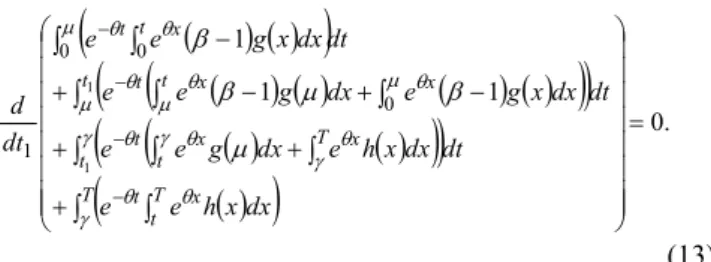
. 0 1 1 1 1 1 0 0 0 1 = ⎟⎟ ⎟ ⎟ ⎟ ⎟ ⎟ ⎟ ⎠ ⎞ ⎜⎜ ⎜ ⎜ ⎜ ⎜ ⎜ ⎜ ⎝ ⎛ + + + − + − + − ∫ ∫ ∫ ∫ ∫ ∫ ∫ ∫ ∫ ∫ − − − − T T t x t t t T x x t t t t x x t x t dx x h e e dt dx x h e dx g e e dt dx x g e dx g e e dt dx x g e e dt d γ θ θ γ γ γ θ θ θ μ θ μ θ μ θ μ θ θ μ β μ β β (13) Theorem 2: TRCB( )
t1 is strictly convex for all t1*≥0.Proof: See Appendix B.
From the two theorems above, the existence and uniqueness of an optimal value of *
1
t that minimizes total relevant inventory cost per unit time for the two models is guaranteed. The procedure for obtaining the optimal production run time, quantity to be produced and total relevant inventory cost per unit time is outlined below.
Step 1: To obtain the optimal production run time, * 1 t , solve Eq. (8) (for Model A), and Eq. (13) (for Model B).
Step 2: Obtain optimal production quantity using Eq. (14) and Eq. (15) below for Model A and Model B respectively.
1 * K t QA = ∗ . (14)
( )
( )
1( )
. 1 0 0 * Ktdt gtdt g dt QB =∫t =∫μβ +∫μtβ μ (15) Step 3: Obtain optimal total relevant inventory cost per unit time for model A, TRCA( )
t1 , using Eq. (6), while that of Model B, TRCA( )
t1 , can be obtained from Eq. (12).Two numerical examples are presented below to illustrate the application of the models and analyze its performance.
IV. NUMERICALEXAMPLESANDSENSITIVITY ANALYSIS
Example 1: For constant production rate model.
( )
⎪ ⎩ ⎪ ⎨ ⎧ ≤ ≤ − ≤ ≤ ≤ + = . 112 10 220 , , 120 , , 5 100 t t t t t t f γ γ μ μ . 12 ; 1 . 0 ; 10 ;4weeks = weeks = T= weeks
= γ θ μ . 3 . 0 $ ; 6 $ ; 75
$ perorder C perunit C perunit
AS= D= h=
; / 175units unittime K=
Example 2: For the variable production rate model.
( )
⎪ ⎩ ⎪ ⎨ ⎧ ≤ ≤ − ≤ ≤ ≤ + = . 112 10 220 , , 120 , , 5 100 t t t t t t f γ γ μ μ . 12 ; 1 . 0 ; 10 ;4weeks = weeks = T= weeks
= γ θ μ . 3 . 0 $ ; 6 $ ; 75
$ perorder C perunit C perunit
AS= D= h=
( )
t =β tf( )
; β=175/120. KFor appropriate comparison, the only difference in the two examples presented above is the rate of production. The variable production rate in Example 2 is such that it does not
exceed the constant value used in Example 1. While Example 1 is solved using Model A, the solution to Example 2 is obtained using Model B. The results obtained are presented in Table 1 below.
To further analyze the behavior of the models, sensitivity analysis is carried out to examine the effect of changes in parameters on the optimal result using Model A as case study. The result of the analysis is presented in Table 2.
Table 1. Result of numerical examples
Model A Model B * 1 t 9.279weeks 9.429weeks * Q 1623.8units 1591.7units * TRC $189.105 $165.061
Table 2. Sensitivity analysis of Model A Parameters % Change in value of parameters % Change in Cost (TRC*) % Change in Order Quantity (Q*) θ -25 -11.93 -3.17 -50 -25.58 -6.73 +25 10.33 2.80 +50 19.22 5.24 AS -25 -0.83 0 -50 -1.65 0 +25 0.83 0 +50 1.65 0 γ -25 -1.19 1.74 -50 -12.15 5.81 +25 3.19 2.43 +50 21.52 11.04 K -25 -65.43 -10.16 -50 -157.90 -24.52 +25 49.19 7.64 +50 87.69 13.61 V. DISCUSSIONOFRESULTS
It is evident from Table 1 that the production run time in Model A is lower than in Model B. This can be explained from the fact that the production rate in Model A is constant at the maximum value while the production rate in Model B varies between this maximum value and other lower values due to changes in demand rate. However, in spite of this longer production run time, Model B gave lower values of optimal inventory cost and production quantity than Model A. This shows that varying the production rate will be a better strategy to ensure optimal cost in a production-inventory system. Observations from the sensitivity analysis can be stated as follows:
1. The total relevant inventory cost obtained by the model is very sensitive to changes in production rate (K), deterioration rate (θ ), and demand parameter
(γ ). The sensitivity to changes in set-up cost and indeed all other costs is very low.
2. The optimal production quantity does not respond to changes in costs and is moderately sensitive to changes in deterioration rate ( θ ), and demand parameter (γ ). It is, however, very sensitive to changes in production rate.
3. The sensitivity of the model to changes in production rate is so high that the production run time exceeds the set limits in some cases.
The insensitivity of the production quantity obtained by the models to changes in cost parameters follows from Eq. (8) and Eq. (13). These equations shows that the production run time is independent of cost parameters, hence the resulting production quantity will be equally independent of costs. The high sensitivity of the model to production rate also follows from the system equations, as the production rate is a significant component in all the equations.
VI. CONCLUSIONS
In this paper, two production inventory models are developed for perishable seasonal products having ramp type demand. The models obtained optimal production run time and optimal production quantity for cases when the production rate is constant and when it is allowed to vary with demand. The production run time is however constrained to the steady phase of the ramp type demand in both cases.
The optimal results obtained from numerical examples presented showed that the variable production rate strategy gives lower inventory costs and production quantity than the constant production rate strategy. It is also shown that the production run time and production quantity is independent of cost parameters. Production run time was discovered to be longer in variable production rate model than when the production rate is constant.
The models can be improved by removing the constraint on production run time and allowing shortages and backlogging of demand in future works. This will allow for a more flexible production policy in which production can be stopped at any time during the season.
APPENDIX A Proof of Theorem 1
( )
1 1(
s)
1(
s(
h D)
I)
. A A C C I T DC HC A T t TRC = + + = + +θFirst we obtain the derivative of TRCA
( )
t1 with respect to t1.( ) (
)
1 1 1 dt dI T C C dt t dTRCA = h+θ D I .( )
(
)
(
)
( )
(
)
(
( )
)
(
)
(
)
( )
( )
(
)
(
)
( )
(
)
. 1 1 0 0 0 1 1 ⎟⎟ ⎟ ⎟ ⎟ ⎟ ⎟ ⎟ ⎠ ⎞ ⎜⎜ ⎜ ⎜ ⎜ ⎜ ⎜ ⎜ ⎝ ⎛ + + + − + − + − = ∫ ∫ ∫ ∫ ∫ ∫ ∫ ∫ ∫ ∫ − − − − T T t x t t t T x x t t t t x x t t I dx x h e e dt dx x h e dx g e e dt dx x g K e dx g K e e dt dx x g K e e dt d dt dI γ θ θ γ γ γ θ θ θ μ θ μ θ μ θ μ θ μ μ (A1) On simplification A1 yields:( )
(
)
(
1 ( 1))
1 1( )
(
( 1) 1)
2 1 1 − − − + − − = −t −t −t −t I K g e e F e F g e dt dI θμ θ θ θγ θ μ θ μ (A2) Where, F =∫ ex(
P−g( )
x)
dx andF =∫Texh( )
xdx γ θ μ θ , . 2 0 1Applying the first condition for minimizing TRCA
( )
t1 (i.e.( )
0 1 1 = dt t dTRCA ) leads to:( )
(
)
(
1 ( 1))
1 1( )
(
( 1) 1)
0 2 1− − − = + − −g e −t e−tF e−tF g e −t K θ μ θ θ θγ θ μ θ μ .Further simplification gives:
( )
(
)
(
1 ( 1))
1 1( )
(
( 1) 1)
2 1= + − + − −g e −t e−tF e−tF g e −t K θ μ θ θ θγ θ μ θ μ .(A3)The second derivative of TRCA
( )
t1 gives:( ) (
)
2 1 2 2 1 1 2 dt I d T C C dt t TRC d A = h+θ D I . (A4)But using (A2) above, we obtain:
( )
(
)
( 1) 1 1( )
( 1). 2 1 2 1 2 t t t t I K g e e F e F g e dt I d = − μ θμ− −θ −θ +θ −θ + μ θγ− (A5) Substituting (A3) in (A5) gives: 2 .1 2 K dt I d I = Using the above result in (A4) gives
( ) (
)
. 2 1 1 2 K T C C dt t TRC d A = h+θ D (A6)It follows from (A6) that 2
( )
01 1 2 > dt t TRC d A at the minimum
point. Hence, TRCA
( )
t1 is strictly convex for all t1*≥0. APPENDIX B Proof of Theorem 2( )
1 1(
s)
1(
s(
h D)
I)
. B A C C I T DC HC A T t TRC = + + = + +θThe first derivative of TRCB
( )
t1 with respect to t1is:( ) (
)
1 1 1 dt dI T C C dt t dTRCB = h+θ D I .(
) ( )
(
)
(
) ( )
(
) ( )
(
)
(
)
( )
( )
(
)
(
)
( )
(
)
. 1 1 1 1 1 0 0 0 1 1 ⎟⎟ ⎟ ⎟ ⎟ ⎟ ⎟ ⎟ ⎠ ⎞ ⎜⎜ ⎜ ⎜ ⎜ ⎜ ⎜ ⎜ ⎝ ⎛ + + + − + − + − = ∫ ∫ ∫ ∫ ∫ ∫ ∫ ∫ ∫ ∫ − − − − T T t x t t t T x x t t t t x x t x t I dx x h e e dt dx x h e dx g e e dt dx x g e dx g e e dt dx x g e e dt d dt dI γ θ θ γ γ γ θ θ θ μ θ μ θ μ θ μ θ θ μ β μ β β (B1) On simplification B1 yields:(
) ( )
(
( ))
(
)
( )
(
( ) 1)
. 1 1 1 1 1 1 1 2 1 1 ⎟⎟ ⎟ ⎟ ⎠ ⎞ ⎜ ⎜ ⎜ ⎜ ⎝ ⎛ − − − − + − − = − − − − t t t t I e g F e F e e g dt dI γ θ θ θ μ θ θ μ β θ μ β (B2) Where, F =∫ exg( )
xdx andF =∫Te xh( )
xdx γ θ μ θ , . 2 0 1Applying the first condition for minimizing TRCB
( )
t1 (i.e.( )
0 1 1 = dt t dTRCB ) leads to:(
) ( )
(
( ))
(
)
( )
(
( ))
⎟⎟⎟ ⎟ ⎠ ⎞ ⎜ ⎜ ⎜ ⎜ ⎝ ⎛ − − − − + − − − − − − 1 1 1 1 1 1 1 1 2 1 t t t t e g F e F e e g γ θ θ θ μ θ θ μ β θ μ β = 0. Further simplification gives:(
1) ( )
(
1 ( 1))
1 1( )
(
( 1) 1)
. 2 1⎟= + − ⎠ ⎞ ⎜ ⎝ ⎛ − + − g eθ μ−t e−θtF e−θtF g eθγ−t θ μ θ μ β . (B3) The second derivative of TRCB( )
t1 gives:( ) (
)
2 1 2 2 1 1 2 dt I d T C C dt t TRC d B = h+θ D I . (B4)Using (B2) above, we obtain:
(
) ( )
( )(
)
( )
( ) 1 . 1 1 1 1 1 2 1 2 1 2 ⎟ ⎟ ⎠ ⎞ ⎜ ⎜ ⎝ ⎛ + + − − − = − − − − t t t t I e g F e F e e g dt I d γ θ θ θ μ θ μ θ β θ μ β (B5) Substituting (B3) in (B5) gives: 2( )
. 1 2 μ βg dt I d I = Using the above result in (B4) gives( ) (
) ( )
. 2 1 1 2 μ β θ g T C C dt t TRC d B = h+ D (B6)It follows from (B6) that 2
( )
01 1 2 > dt t TRC d B at the minimum
point. Hence, TRCB
( )
t1 is strictly convex for all t1*≥0. REFERENCES[1] S. Khanra, K. S. Chaudhuri. A note on an order-level inventory model for a deteriorating item with time-dependent quadratic demand, Computers and Operations Research, Vol. 30, pp. 1901–1916, 2003. [2] S.S. Sana, K. S. Chaudhuri. A deterministic EOQ model with delays in
payments and price-discount offers, European Journal of Operational Research, Vol. 185, pp. 509-533, 2008.
[3] S.K.Ghosh, K.S.Chaudhuri. An order-level inventory model for a deteriorating item with weibull distribution deterioration, time-quadratic demand and shortages, Advanced Modeling and Optimization, Vol. 6, pp. 21-35, 2004.
[4] S. Panda, S. Senapati, M. Basu. Optimal replenishment policy for perishable seasonal products in a season with ramp-type time dependent demand, Computers and Industrial Engineering, Vol. 54, pp. 301–314, 2008.
[5] M. Cheng, G. Wang. A note on the inventory model for deteriorating items with trapezoidal type demand rate, Computers and Industrial Engineering, Vol. 56, pp. 1296-1300, 2009.
[6] Z. T. Balkhi, L. Benkherouf. On the optimal replenishment schedule for an inventory system with deteriorating items and time-varying demand and production rates, Computers and Industrial Engineering, Vol. 30, pp. 823–829, 1996.
[7] J-T. Teng, C-T. Chang. Economic production quantity models for deteriorating items with price- and stock-dependent demand, Computers and Operations Research, Vol. 32, pp. 297–308, 2005.
[8] P. L., Abad. Optimal pricing and lot-sizing under conditions of perishability, finite production and partial backordering and lost sale, European Journal of Operational Research, Vol. 144, pp. 677–685, 2003.
[9] S. Sana, S. K. Goyal, K. S. Chaudhuri. A production–inventory model for a deteriorating item with trended demand and shortages, European Journal of Operational Research, Vol. 157, pp. 357–371, 2004. [10] R. M. Hill. Inventory model for increasing demand followed by level
demand, Journal of the Operational Research Society, Vol. 46, pp. 1250–1259, 1995.
[11] S. K. Manna, K. S. Chaudhuri. An EOQ model with ramp type demand rate, time dependent deterioration rate, unit production cost and shortages, European Journal of Operational Research, Vol. 171, pp. 557–566, 2006.
[12] S. Panda, S. Saha, M. Basu. Optimal Optimal production stopping time for perishable products with ramp-type quadratic demand dependent production and setup cost, Central European Journal of Operational Research, DOI 10.1007/s10100-009-0098-y, 2008.