Establishment of transformation protocol and
production of transgenic plants expressing blue gene in
Dendrobium
September, 2015
Wasana PHLAETITA
Graduate School of Horticulture
Establishment of transformation protocol and
production of transgenic plants expressing blue gene in
Dendrobium
Dendrobium
2015
9
Contents
Page Chapter 1 General Introduction………...………...………... 1 Chapter 2 High efficiency Agrobacterium-mediated transformation of Dendrobium orchid using protocorms as a target material ………..………... 8Chapter 3 Agrobacterium-mediated transformation of protocorm-like bodies in Dendrobium Formidible ‘Ugusu’……….. 21
Chapter 4 Blue gene expression in Dendrobium nobile by introducing flavonoid 3’, 5’ -hydroxylase gene via genetic manipulation……….. ……… 38
Chapter 5 General Discussion and Conclusion……….. 59
References……….. 65
Appendix………...…. 73
Summary………...…. 79
! ! ! ! ! ! ! ! ! ! ! ! ! ! ! ! !
!
Chapter 1
General Introduction
Chapter 1: General Introduction
2
Chapter 1:
General Introduction
Introduction
Background of this study
The aim of this study was to determine the best and most useful procedure for the production of novel Dendrobium, using sufficient genetic manipulation.
The genus Dendrobium is one of the largest genera in the family Orchidaceae, comprising some 1,200 individual species, growing in a wide range of climates from hot, wet lowlands to high-altitude, colder mountainous areas. Dendrobiums are divided into several groups based on their growing conditions. They are distributed from the foothills of the Himalayas through Southeast Asia to Japan, Australia, Tasmania, and the Pacific Islands (Kamemoto et al. 1999) growing as epiphytes or lithophytes. Many species of this genus are important as popular orchids, grown as potted plants and cut flowers for commercial production. In 2005, orchids comprised 8% of the worldwide floriculture trade (Martin and Madassery 2005). Their free flowering and long vase life of two to three weeks are important characteristics that make orchids ideally suited for the cut-flower trade. Thailand is the world’s largest exporter of Dendrobium and other tropical orchids. The cut flower export business is estimated to be worth over US 70 million (Lekawatana, 2010). Recently world production of potted Dendrobium plants has increased, with production on a large scale in many countries including China, Taiwan, Thailand, The Philippines, The United States of America, Japan and
Chapter 1: General Introduction
3
Germany (Puchooa D, 2004). Potted Dendrobiums of wide color varieties, shapes, and long vase life are the fourth ranked flower and nursery crop in the USA, with sales value increased dramatically to 12% of total potted plants (Kuehnle et al. 2003). Dendrobium nobile is an
orchid used for ornamental purposes. It is one of the orchids commonly available in flower shops, stores and garden centers, easy to cultivate with reliable flowering of many big, beautiful blossoms that keep fresh for a long time. In Japan, this species has been developed into elite cultivars, with numerous colors and shapes by Yamamoto Dendrobiums, Japan. Dendrobium Formidible has a character like D. nobile but showed hair on stem. It blooms large sized white flowers in early and mid summer but flower color is limited.
Breeding of Dendrobium
Numerous characters in Dendrobium are unique, frequent flowering and long vase life
which leading to high demand in orchids market. Also, Dendrobium could be used as indoor and outdoor pot plants and cut flowers. However, diseases, new color and longevity are important strategies from the point for development to forward the high demand in the future. Viral diseases can infect Dendrobium during cultivation, including Cymbidium mosaic virus (CyMV) and Odontoglossum ring spot virus (ORSV). These are considered the most prevalent and economically deleterious, and blight numerous commercially grown important orchid genera. Infection by CyMV can cause blossom brown necrotic streaks, reducing plant vigor and flower quality, thus affecting economic value (Hu et al. 1993). The virus is most commonly spread through mechanical transmission during propagation or flower harvest; it can be carried from plant to plant by shears, knives, or direct contact of plants (Ishii, 1968). From these reasons, the vigor plant of Dendrobium needs to produce a free disease and could be controlled from the sprout through tissue culture and molecular method.
Chapter 1: General Introduction
4
Flower color displays on Dendrobium depending on accumulation of secondary compounds, including flavonoids and carotenoids. Anthocyanins are colored flavonoids and displayed predominantly purple, lavender and pink flowers due to cyanidin and peonidin accumulation (Rasika et al. 2013). Carotenoids are natural pigments that impart yellow, red, or orange colors to flowers (Park et al. 2015). Also more than one color can appear on different parts of the flower that could be developed through intraspecific and interspecific hybridizations. However, blue delphinidin is absent in Dendrobium that an impossible to produce the blue flower color by the conventional breeding method. Recently, the novel colored like the blue flower is a new target to produce the novel flower character.
The cut flower of Dendrobium is high demand and one of important species of orchids in the flower market. However, its problem showed like any cut flower, their face vase-life-related problem such as excessive water loss, decline in respiring substrate and sensitively to exogenous or endogenous ethylene that hastens senescence and wilting of the flowers (Hew 1994). This problem has more effect when exported them to far countries because most of produced countries are located in Asia such as Thailand, Singapore to Europe or America. For resolving, many studies focused on the effect and mechanism of ethylene inhibitors and sugars (Chandran et al. 2006). Chemical treatment and plant breeding were utilized widely to improve the longevity of cut flowers (Yamada et al. 2003). Therefore, molecular method such as RNAi method involving ethylene pathway (Gupta et al. 2013) is an essential target for improving long vase-life cut Dendrobium.
Above the situation, research work in many tropical and sub-tropical countries is concentrated on the continuous breeding of plants with desirable traits to produce high value export products. Maintaining the high quality of Dendrobium orchids is a new challenge, and has become most important in the flower market. Orchid breeders have tried to produce new cultivars through conventional sexual breeding. However, some traits such as the blue color
Chapter 1: General Introduction
5
are difficult to generate because of the lack of genetic variability in the germplasm. New strains also have to be strong and resistant to viruses to reduce losses from diseases. For creating new varieties with such new traits, plant biotechnology (genetic manipulation) has to utilize all available protocols to create new varieties.
Genetic transformation of Dendrobium
Three steps are important and necessary for feasible plant genetic engineering: 1) plant tissue must be able to regenerate after introducing the target gene, 2) the gene transfer method and gene expression vectors must be compatible with the plant, and 3) the selection of shoots arising from the target tissue and identification of the transformation. In orchids, seeds, protocorms, protocorm-like bodies (PLBs), and meristematic tissues such as excised shoot tips and lateral buds can be used as materials for the transformation. Mainly, two methods have been reported to introduce the foreign genes into plants, particle bombardment (Chia et al. 1994; Kuehnle and Sugii 1992; Suwanaketchanatit et al. 2007; Tee et al. 2003; Yu et al. 2001), and Agrobacterium-mediated transformation (Julkifle et al. 2012; Men et al. 2003; Pimda & Bunnag 2010; Yu et al. 2001). Particle bombardment requires the necessary equipment, while Agrobacterium-mediated transformation needs no extra equipment and is an easy and convenient method.
The establishment of an efficient transformation system of Dendrobium is necessary for genetic improvement to produce ornamental and marketable qualities, such as novel blue flower color, virus resistance, and stress tolerance.
Agrobaterium-mediated gene transfer
Over the past decade, the Agrobacterium-mediated gene transformation method has been
widely used for molecular breeding in various plant species. Agrobacterium is a gram-negative soil-borne pathogen, well-known for its ability to transfer DNA between itself and
Chapter 1: General Introduction
6
plants. It harbors large plasmids called Ti-plasmid, which induce crown galls in the host plant cells and integrate randomly into the plant genomes. Agrobacterium-mediated transformation takes advantage of this natural mechanism by incorporating the T-DNA into the plant cells at the wounded sites. However, monocotyledonous plants are rarely natural hosts for
Agrobacterium and difficult to transform. To solve the problem, various studies have been
conducted by examine several factors that affect transformation efficiency including explants,
Agrobacterium strain and plasmid, pretreatment, inoculation and cultivation conditions, and Agrobacterium density (Cheng et al. 2004; Sood et al. 2011). The optimal factors must be
determined to produce transgenic varieties that can regenerate, without using chimeric or escape plants.
Color pigmentation
Flower color is one of the most attractive characteristics in ornamental plants, contributing
major value in the floricultural market. In nature, three classes of pigments; i.e., flavonoids, carotenoids, and betalains, determine the coloration of flowers. Kuenhle et al. (1997) analyzed floral flavonoids in Dendrobium. Anthocyanidins, water-soluble flavonoid pigments were detected in 28 Dendrobium species and hybrids selected for analysis, based on color and suitability for cut flower breeding. Flowers colored pink, red, maroon, orange, bronze, and brown following the standard of The Royal Horticultural Society (RHS) contained anthocyanins based on cyanidin, with peonidin occurring as a minor pigment. The flower of D. gouldii, D. bigibbum, and D. kultana contained anthocyanins based on cyanidin. Pink flowers were classified as red or red purple, and included pelargonidin glycosides. Unfortunately, Dendrobium lacks blue flowers due to the absence of delphinidin-based anthocyanins. Delphinidin is one of the key anthocyanins, which produces the blue color in flowers; it is not available for synthesis by itself. Flavonoid-3’, 5’-hydroxylase (F3’5’H) leads to the formation of dihydromyricetin (DHM) and subsequently to the production of
Chapter 1: General Introduction
7
delphinidin-based pigments. Blue flowers have been successfully produced in several important ornamental plants including rose, chrysanthemum and carnation (Brugliera et al. 2013; Fukui et al. 2003; Katsumoto et al. 2007; Noda et al. 2013). Therefore, production of blue dendrobiums was targeted for D.nobile and D. Formidible in this experiment.
Aim of the study and outline of the thesis
Highly efficient genetic transformation systems were established by
Agrobacterium-mediated transformation for the introduction of flavonoid-3’, 5’-hydroxylase (F3’5’H) gene and related anthocyanin biosynthesis genes into D. nobile and D. Formidible using two types of plant materials. For D. nobile, protocorms were infected with Agrobacterium with different inoculation times and bacteria concentrations in Chapter 2, and PLBs for Dendrobium Formidible as target material in Chapter 3. From the optimum transformation system, F3’5’H gene isolated from Commelina communis was introduced to D. nobile, with different genetic backgrounds of seedlings (protocorms) derived from the cross between elite cultivars in Chapter 4. Finally, general conclusions, discussions and recommendations for further experiments are presented in Chapter 5, thereby showing the usefulness of molecular breeding or engineering of Dendrobium to create new cultivars with specific and novel features.
Chapter 2
High efficiency Agrobacterium-mediated transformation of
Chapter 2: Agrobacterium-mediated transformation of Dendrobium orchid using protocorms.
9 !
Chapter 2: High efficiency Agrobacterium-mediated transformation of Dendrobium orchid
using protocorms as a target material
Introduction
Dendrobium is one of the largest genera in the family Orchidaceae and includes the most
popular orchids grown for commercial production of cut flowers and pot plants. The commonly cultivated species include D. phalaenopsis, D. gouldii and D. nobile. Recently, cultivars with novel flower colors, shapes and disease resistance have been developed through intraspecific and interspecific hybridizations (Kamemoto et al. 1999). However, conventional breeding in this genus by means of sexual hybridization is restricted due to long generation time, generally 3 years from seed sowing to flowering and lack of useable genetic variability (Kuehnle and Sugii 1992). Therefore, genetic engineering remains an important tool for producing Dendrobium with desirable traits such as blue flowers, disease resistance and long flower life.
In the last 15 years, genetic transformation of orchids has been reported using
Agrobacterium-mediated method by targeting protocorm-like bodies (PLBs) as material for Phalaenopsis (Belarmino and Mii 2000; Chai et al. 2002; Sjahril and Mii 2006), Cymbidium
(Chen et al. 2002; Chin et al. 2007), Vanda (Shrestha et al. 2007), Cattleya (Zhang et al. 2010), Oncidium (Liau et al. 2003) and Dendrobium (Nan et al. 1998; Yu et al. 2001; Men et al. 2003b). It is natural to use PLBs as the target for genetic transformation because most cultivars of these commercially important orchids are vegetatively propagated by tissue culture, and hence targeting the cultivars with superior traits is usually needed. In transgenic plants, however, expression of foreign genes is sometimes affected greatly by the genetic background of the target plants (Cogan et al. 2001). Therefore, it is necessary to introduce such genes into the plants with diverse genotypes to evaluate the usefulness or effectiveness of the target genes for transformation. Based on such idea, Mishiba et al. (2005) have already
Chapter 2: Agrobacterium-mediated transformation of Dendrobium orchid using protocorms.
10 !
reported successful Agrobacterium-mediated transformation with rapid selection of transgenic plants in Phalaenopsis by targeting protocorms at an early stage after germination. In D.
nobile, however, protocorms have not been used as target material although PLBs have
successfully been transformed by using both biolistic and Agrobacterium-mediated methods (Men et al. 2003a; 2003b)
In the present study, we tried to develop a simple and efficient procedure for
Agrobacterium-mediated transformation by using the protocorms obtained from the cross
between two cultivars of D. nobile-type hybrid as target material.
Materials and Methods Plant material
Seeds of Dendrobium nobile-type hybrid obtained from a cross between D. Flower Palace ‘Cinderella’ × D. Santa Isabel ‘True Love’ were kindly provided by Mr. Nobuyuki Asai, Asai Daikeien Co. Ltd. To produce protocorms, seeds were surface-sterilized by agitating for 10 min in a sodium hypochlorite solution containing 1% (v/v) active chlorine, and then rinsed three times with sterile distilled water. Sterilized seeds were cultured in 35 ml of liquid New Dogashima (ND) medium (Tokuhara and Mii 1993) containing 10 g L-1 maltose without adding any plant growth regulators (pH 5.4) in 100 ml flask and agitated at 80 rpm. All of the seeds were incubated at 25°C under constant illumination (33 µmol m-2 s-1) with cool-white-fluorescent lamps (National FL30SN, Osaka, Japan).
Plasmid vector and bacterial strain
Agrobacterium tumefaciens strain EHA101 (Hood et al. 1986), which harboring with binary vector pIG121Hm (Ohta et al. 1990), which contains a hygromycin phosphotrasferase gene (hpt) and an intron GUS gene, both under the control of a 35S cauliflower mosaic virus promoter, and a neomycin phosphotransferase II gene (nptII) under the control of a nopaline synthase promoter in the T-DNA region was used.
Chapter 2: Agrobacterium-mediated transformation of Dendrobium orchid using protocorms.
11 !
Inoculation and co-cultivation with Agrobacterium
Agrobacterium was grown overnight at 28°C in LB liquid medium containing 50 mg L-1 hygromycin (Hygromycin B; Wako Pure Chemical Industries, Osaka, Japan), 50 mg L-1 kanamycin (Kanamycin sulfate; Wako Pure Chemical Industries, Osaka, Japan) and 25 mg L-1
chloramphenicol (Sigma-Aldrich, St. Louis, MO, USA). The bacterial suspension was diluted to final density of OD600≈1.0 in inoculation medium, which was liquid ND medium
containing 100 µM acetosyringone (AS) (3’, 5’-dimethoxy-4’-hydroxy-acetophenone; Sigma-Aldrich, St. Louis, MO, USA). For inoculation, 21 day-old protocorms (Mishiba et al. 2005), obtained as described above were inoculated 3.5 ml (1/10) or 700 µl (1/50) of Agrobacterium suspension culture for either 30 or 300 min with mild agitation at 80 rpm on rotary shaker. The protocorms were then collected with a 40 µm nylon mesh placed on a funnel and immediately transferred with the nylon mesh onto a 0.25% (w/v) gellan gum (Wako Pure Chemical Industries)-solidified ND medium supplemented with 100 µM AS and co-cultivated for 3 days.
Elimination of bacteria, selection and plant regeneration
For selection and elimination of bacteria, protocorms were washed with liquid ND medium and placed onto 40 µm nylon mesh, which was overlaid on 0.25% (w/v) gellan gum-solidified ND medium containing 30 mg L-1 hygromycin and 20 mg L-1 meropenem trihydrate (Meropen; Dainippon Sumitomo Pharma, Osaka, Japan http://www.ds-pharma.co.jp) a β-lactam antibiotic (Ogawa and Mii 2004, 2007), for primary selection of transformants. The protocorms were subcultured every 3 weeks to fresh medium of the same composition. After selection for 3 months, protocorms showing green coloration were cut transversely into two pieces and placed onto ND medium without hygromycin but with meropenem (recovery medium) (Mishiba et al. 2005) and cultured for 1 month. Then, newly proliferated PLBs from protocorms on this medium were selected and returned to selection medium containing 30 mg L-1 hygromycin and 10 mg L-1 meropenem for 1 month (secondary selection). Transformation
Chapter 2: Agrobacterium-mediated transformation of Dendrobium orchid using protocorms.
12 !
efficiency was recorded after 1 month of secondary selection as the percentage of initial protocorms yieldling survived PLBs from 3 replications experiments. Data collected were subjected to statistical analysis after arcsine transformation and were compared using one way ANOVA, followed by tukey’s multiple range test using SPSS program (IBM SPSS statistical version 22).
After secondary selection, PLBs were transferred onto ND medium containing 10 mg L-1 hygromycin and 10 mg L-1 meropenem for shoot formation and rooting. Some putative transgenic plantlets were transferred to pots and grown in growth chamber at 25°C under a 16 -/8-h (day/night) photoperiod without any acclimatization treatment.
GUS assay
After 5 months of selection, hygromycin-resistant plantlets were randomly selected and assayed for GUS gene Histochemical GUS assay (Jefferson, 1987) with 5-bromo-4-chloro-3-indolyl β-D-glucuronide (X-Gluc) as the substrate. Leaves and roots of control and transformed plantlets were incubated in sodium phosphate buffer containing X-Gluc overnight at 37°C after vacuum-infiltration with the buffer solution using desiccator for 15 min. Following the incubation, tissues were bleached with 70% ethanol until chlorophyll was removed.
DNA isolation, polymerase chain reaction (PCR) and Southern hybridization
Total DNA was extracted from leaves (1.5 g fresh weight) of the control and putative transgenic plants following CTAB method (Murray and Thompson 1980). PCR detection of
hpt and gus was performed as described by Hamill et al. (1991) and Xiao and Ha (1997),
respectively. The PCR amplifications were carried out using the following thermal cycles: 30 cycles of 94°C for 1 min (denaturation), 59°C for hpt and 62°C for gus for 1 min (annealing) and 72°C for 1.5 min (elongation). Primers used for amplifying a 0.6-kb fragment inside the
hpt gene were 5’-ACAGCGTCTCCGACCTGATGCA-3’ and
Chapter 2: Agrobacterium-mediated transformation of Dendrobium orchid using protocorms.
13 !
gene were 5’-GGTGGGAAAGCGCGTTACAAG-3’ and
5’-GTTTACGCGTTGCTTCCGCCA-3’. After amplification, 3 µl of PCR products were loaded on the gel and detected by ethidium bromide staining after electrophoresis on 1% agarose gel at 100 V for 35 min. For Southern hybridization, 10 µg of genomic DNA was digested overnight with HindΙΙΙ, electrophoresed on 0.9% agarose gel, and subsequently transferred to a nylon membrane (Immobilon-Ny+ Transfer Membrane; Millipore Co, Billerica, MA, USA). The GUS probe (1.2 kb) was generated from plasmid DNA of pIG121Hm by labeling with digoxigenin (DIG) using the PCR DIG Probe synthesis kit (Roche Diagnostics, Mannheim, Germany) and the following set of primers, GGTGGGAAAGCGCGTTACAAG-3’ and 5’-GTTTACGCGTTGCTTCCGCCA-3’ were used. Washing and detection were carried out according to the instruction manual of the DIG labeling and detection system (Roche Diagnostics, Mannheim, Germany). For detection of hybridization signals, the membrane was exposed to a detection film (Lumi-film Chemiluminescent Detection Film; Roche Diagnostics, Mannheim, Germany) for 60 min.
Results and discussion
Transformation and selection of hygromycin-resistant protocorms
Our preliminary study showed that prolonged co-cultivation period of 4 days caused rapid browning of protocorms in D. nobile-type hybrid after transfer onto selection medium, whereas no appreciable damage was observed in the co-cultivation of up to 3 days. After 3 days of co-cultivation, used in the present study, bacterial overgrowth was observed around protocorms infected for 300 min at 1:10 bacterial concentration (Figure 2-1A), whereas protocorms infected for 30 min did not show bacteria overgrowth irrespective of the bacterial concentration. In both cases, some of the infected protocorms continued to grow and retained their green color after transfer onto selection medium containing antibiotics, while all of the control protocorms without Agrobacterium infection failed to grow and turned brown within
Chapter 2: Agrobacterium-mediated transformation of Dendrobium orchid using protocorms.
14 !
4 weeks of culture on selection medium. Although bacterial overgrowth during the selection stages is usually considered as a serious problem in Agrobacterium-mediated genetic transformation (Arifin et al. 2004), it was successfully prevented by using 20 mg L-1 meropenem in the present study even if the overgrowth was observed during the co-cultivation period. Previously, Mishiba et al. (2005) succeeded to obtained transgenic plants in Phalaenopsis by infecting 21 day-old protocorms with the same Agrobacterium strain, EHA101 (pIG121Hm). Although we did not examine the optimum stage of protocorm development for Agrobacterium infection, present results clearly indicate the appropriateness of the selected developmental stage of protocorms as the target material in D. nobile-type hybrid.
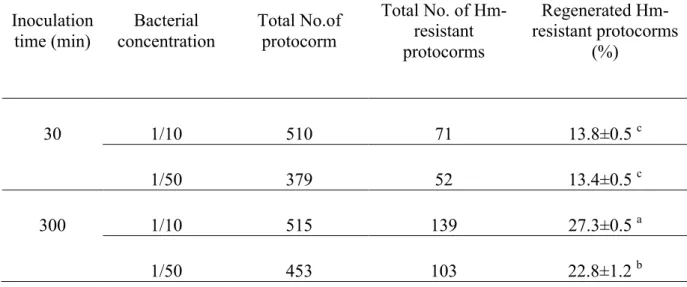
In the present study, inoculation time of Agrobacterium solution gave apparently high effect on transformation efficiency and long inoculation time of 300 min resulted in higher transformation efficiencies (23-27%) than short inoculation time of 30 min, which gave 13-14% efficiencies (Table 2-1). On the contrary, Men et al. (2003b) obtained the highest transformation efficiency by infecting PLBs of D. nobile with AGL1/pCAMBIA1301 vector with the short inoculation time (30 min) and indicated that the long period of 60 min significantly decreased transformation to 3-4%. In Phalaenopsis, bacterial inoculation period of 7 h was used for production of transgenic plants when protocorms were used as a target (Mishiba et al. 2005), whereas 2 h was found to be optimal for the transformation of PLBs (Sjahrill and Mii 2006). These results suggest that the long period of inoculation is suitable for transformation of orchids when using protocorms as target materials. Although the reason for the difference in the optimum time of infection with Agrobacterium for transformation efficiency between protocorm and PLB, it might be attributed to the differences in the strain of Agrobacterium or in the susceptibility between these two types of target materials.
Although usefulness of high bacterium concentration has been reported as an imported factor for achieving transformation of orchids (Mishiba et al. 2005; Chin et al. 2007; Shrestha et al.
Chapter 2: Agrobacterium-mediated transformation of Dendrobium orchid using protocorms.
15 !
2007; Zhang et al. 2010), it has less effect in the present study, i.e. 1:10 dilution (OD600≈0.1)
gave slightly higher transformation efficiency than 1:50 dilution only at 300 min inoculation time and no differences was found at 30 min inoculation (Table 2-1).
Confirmation of transformation
The surviving protocorms obtained from the primary selection were cut into 2 pieces and cultured on recovery medium lacking hygromycin. One month after the culture on this medium, PLBs were regenerated from the surviving tissues of protocorms. Some of PLBs survived after transfer onto the same selection medium used for the secondary selection of the transgenic tissues and regenerated into shoots (Figure 2-1B). They produced roots after transfer to medium containing reduced concentration of hygromycin to 10 mg L-1 and the same concentration (10 mg L-1) of meropenem (Figure 2-1C).
The leaf and root tissues of plantlets regenerated on the secondary selection medium showed positive results for histochemical GUS assay (Figure 2-2). About 90% of the selected plants showed GUS staining in these tissues (data not shown), whereas GUS activity was not detected in any of the tissues of untransformed plantlets. To confirm the presence of transgenes in the putative transformants, PCR analysis was carried out for the hpt and gus genes. All selected hygromycin-resistant plants showed positive amplification for both genes (Figure 2-3A), which were not detected in the untransformed plants, indicating that the T-DNA of the binary vector was successfully integrated into the genome of the transgenic plants. Southern hybridization was also performed on randomly selected plantlets using GUS probe. All the plants showed hybridization signals with the integration of one to five copies of T-DNA in the plant genome (Figure 2-3B, lanes 1-10), while no hybridization signal was observed in the untransformed plant (Figure 2-3B, Lane C).
In conclusion, we have established a highly efficient transformation system with 27.3% transformation efficiency in D. nobile–type hybrid using protocorms as target material by applying 300 min period of inoculation of Agrobacterium solution at OD600≈0.1. The value is
Chapter 2: Agrobacterium-mediated transformation of Dendrobium orchid using protocorms.
16 !
much higher than the highest transformation efficiencies of Dendrobium obtained previously by 18% with Agrobacterium-mediated (Men et al. 2003b) and 19.87% with microprojectile bombardment methods, respectively (Suwanaketchanatit et al. 2007). Therefore, the transformation procedure established in the present study could be used efficiently to introduce various desirable traits such as novel flower colors and disease resistances into D.
nobile-type hybrids with various genetic background at the same time. Although the reason
for the high transformation efficiency of protocorms in D. nobile-type hybrid is still unclear, protocorms might also be useful material to obtain comparably high transformation efficiency in other orchid species of Dendrobium and other economically important orchid genera. For producing D. nobile-type hybrids with blue flower introduction of flavonoid 3’, 5’- hydroxylase gene in now in progress.
Acknowledgement
We thank Mr. Nobuyuki Asai, Asai Daikeikan Co. Ltd. to kindly provide the seeds as plant materials in this research.
Chapter 2: Agrobacterium-mediated transformation of Dendrobium orchid using protocorms.
17 !
Table 2-1. Effect of bacterial concentration and inoculation time on transformation efficiency of protocorms in Dendrobium nobile.
Transformation efficiency was recorded after secondary selection on medium containing 30 mg L-1 hygromycin and 10 mg L-1 meropenem as the number of independent Hm resistant protocorms with respect to the initial number of protocorms infected.
Means of 3 replications with the different letters show significant difference as analyzed by Tukey's test
at p < 0.05.
Inoculation time (min) Bacterial concentration Total No.of protocorm Total No. of Hm-resistant protocorms Regenerated Hm-resistant protocorms (%) 30 1/10 510 71 13.8±0.5 c 1/50 379 52 13.4±0.5 c 300 1/10 515 139 27.3±0.5 a 1/50 453 103 22.8±1.2 bChapter 2: Agrobacterium-mediated transformation of Dendrobium orchid using protocorms.
18 !
Figure 2-1. Regeneration of putative transgenic plantlets of Dendrobium nobile-type hybrid. A: Inoculated protocorms with A. tumefaciens (EHA101/pIG121Hm) showing bacterial overgrowth after 3 days of co-cultivation. B: Multiple shoots regenerated from protocorm-derived PLBs after secondary selection with 30 mg L-1 hygromycin and 10 mg L-1 meropenem
for 4 months. C: Putative transgenic plantlet 8 months after transfer one of the multiple shoots and culture on medium containing 10 mg L-1 hygromycin and 10 mg L-1 meropenem. Bars = 1 cm.
Chapter 2: Agrobacterium-mediated transformation of Dendrobium orchid using protocorms. 19 ! ! ! ! ! ! ! ! ! !!!!!!!!!!!!!!!!!!!!!!!!!!!!!!!!!!!!!!!!!!!!!!!!! ! ! ! ! ! ! ! ! ! ! ! ! ! ! ! ! ! ! ! ! ! ! ! ! ! ! ! !
Figure 2-2. GUS histochemical assay of roots (upper) and leaves (lower) of transgenic
Dendrobium nobile-type hybrid.
! ! ! ! !
Chapter 2: Agrobacterium-mediated transformation of Dendrobium orchid using protocorms. 20 ! ! ! ! ! ! ! ! ! ! ! ! ! ! ! ! !
! ! ! ! ! ! ! ! ! ! ! ! ! ! ! ! !
Figure 2-3. Molecular analysis of transgenic Dendrobium nobile-type hybrid. (A) PCR analysis of transgenic plantlets for hygromycin phosphotransferase (hpt) and β-glucuronidase (gus) genes. Lane M: Molecular size marker (φX174/HaeIII), Lane P: Plasmid pIG121Hm (Positive control), Lane C: untransformed plant as negative control (non-transformed plant), Lanes 1-9: Transgenic plants. (B) Southern blot analysis of transgenic plants. Ten µg of genomic DNA was digested with HindΙΙΙ and hybridized with digoxigenin (DIG)-label gus gene probe. Lane M: Molecular size marker (DIG), Lane C: untransformed plant as negative control (non-transformed plant), Lanes 1-10: Transgenic plants.
!
Chapter 3
Agrobacterium-mediated transformation of protocorm-like bodies
Chapter 3: Transformation of Dendrobium Formidible !
! 22
Chapter 3: Agrobacterium-mediated transformation of protocorm-like bodies in Dendrobium
Formidible ‘Ugusu’
Introduction
Dendrobiums are commercially important orchids cultivated as potted plants and cut flowers around the world because of their beautiful flowers and good shape. Nowadays, numerous cultivars have been developed through intra- and inter-specific cross hybridizations. However, improvements are still required in various traits such as flower longevity, disease resistance and novel flower color in order to catch up with its increasing demand and extended market. For achieving these breeding goals, conventional breeding technologies are rather difficult to apply, and genetic transformation remains an useful and possible option.
In Dendrobium orchids, genetic transformation studies has been initiated by using biolistic-mediated method (Kuehnle and Sugii 1992; Chia et al. 1994; Tee et al. 2003; Suwanaketchanatit et al. 2007), followed by Agrobacterium-mediated method (Men et al. 2003). Among these studies, successful regeneration of transgenic plants has been reported by Men et al. (2003) and Suwanaketchanatit et al. (2007). Based on these studies, virus resistant plants were successfully produced by introducing viral coat proteins in the genome of
Dendrobium (Chang et al. 2005). The inhibition of ethylene production in order to delay the
senescence and increase the flower longevity in Dendrobium has also been reported recently (Zheng et al. 2012).
Dendrobium Formidible is a name given to the interspecific hybrid between D. formosum and D. infundibulum in 1967 (The International Orchid Register, Royal Horticultural Society,
Chapter 3: Transformation of Dendrobium Formidible !
! 23
have large white flowers (ca. 12 cm in diameter) with yellow eye and usually bloom during early to mid summer season. Moreover, each flower lasts long for more than one month. Due to these unique characters, it has become an important popular pot plant during the hot summer season. Since D. Formidible lacks color variations and novel cultivars with other flower colors are now expected because of difficulty in crossing with other Dendrobium species and cultivars, genetic transformation technology is now expected to apply to achieve such breeding goals. In the present study, we developed a simple and efficient system for
Agrobacterium-mediated transformation in D. Formidible ‘Ugusu’, which is a dwarf cultivar
suitable as pot plant, by using protocorm-like bodies (PLBs) as a target material.
Materials and Methods Plant materials
PLBs of Dendrobium Formidible ‘Ugusu’ were induced by culturing shoot tips (1 mm high x 2 mm diameter) excised from sprouting shoots of ca. 10 cm on New Dogashima (ND) medium (Tokuhara and Mii 1993) containing 10 g L-1 maltose, 0.1 mg L-1 1-naphthaleneacitic
acid (NAA), 1.0 mg L-1 N6-benzyldenine (BA) and 0.25% gellan gum at pH 5.4 and were subculture every 4 weeks for 2 years. For each subculture, PLBs were cut into several pieces of approximately 3-4 mm in size and transferred to the same fresh medium but added with 10 g L-1 potato granules (Basic American Foods, California, U.S.A). One month-old PLBs after each subculture were used for the transformation experiments. To investigate the effect of the age of PLBs after subculture on transformation, PLBs maintained for the different periods (0, 1, 2, 3, 4, 5 and 6 weeks) after subculture on the same medium were used for the experiment. All of the cultures were incubated at 25°C under constant illumination with cool-white-fluorescent lamps (Hitachi FLR40SW/M/36-B 25HA, Japan).
Chapter 3: Transformation of Dendrobium Formidible !
! 24
Agrobacterium tumefaciens strain EHA 101 (Hood et al. 1986) harboring the binary vector plasmid pIG121Hm (Ohta et al. 1990) was used for the transformation. The T-DNA region of pIG121Hm contains hygromycin phosphotrasferase gene (hpt) and neomycin
phosphotransferase II gene (nptII) as selectable markers and an intron-containing β-glucuronidase (gus) reporter gene.
Inoculation and cocultivation with Agrobacterium
Agrobacterium was grown overnight at 28°C in LB liquid medium containing 50 mg L-1
hygromycin (Wako Pure Chemical Industries, Osaka, Japan), 50 mg L-1 kanamycin (Wako
Pure Chemical Industries, Osaka, Japan) and 25 mg L-1 chloramphenicol (Sigma-Aldrich, St. Louis, MO, USA). The bacterial suspension was diluted to final density of OD600≈1.0 in
inoculation medium, which was liquid ND medium containing 100 µM acetosyringone (AS) (3’, 5’-dimethoxy-4’-hydroxy-acetophenone; Sigma-Aldrich, St. Louis, MO, USA). For inoculation, PLBs of 3-4 mm in size were transferred to 35 ml inoculation medium in a 100 ml flask, to which Agrobacterium suspension was added to give 1/10 or 1/50 concentration of bacteria (OD600=0.1 or 0.02), and incubated for either 30, 45 or 60 min with or without
rotation for shaking at 100 rpm. Effect of the shorter inoculation times, i.e., 10, 20, 30 and 40 min, on the transformation efficiency was also examined under optimal concentration of bacteria (OD600=0.1) with the rotary shaking. For selection of the suitable inoculation
medium, PLBs were infected with Agrobacterium, which was suspended in either distilled water (DW), 1% maltose solution without ND nutrient (only 1% Mal) or full strength ND medium with 1% maltose. AS was added to these 3 kind of inoculation media at 100 µM. The inoculated PLBs were then blotted dry, and co-cultivated on 2.5g L-1 gellan gum (Wako Pure Chemical Industries, Osaka, Japan)-solidified ND medium supplemented with 100 µM AS at 25°C in the dark for 3 days. After determining the optimum inoculation condition for the transformation, the suitable stage of PLBs for the transformation was investigated.
Chapter 3: Transformation of Dendrobium Formidible !
! 25
Agrobacterium elimination, selection and plant regeneration
After cocultivation, the inoculated PLBs were washed with liquid ND medium, blotted dry and transferred onto 2.5 g L-1 gellan gam-solidified ND medium containing 20 mg L-1 hygromycin and 20 mg L-1 meropenem (Ogawa and Mii 2004, 2007; Meropen; Dainippon
Sumitomo Pharma, Osaka, JPN) for selection and bacterium elimination (primary selection). PLBs were subcultured every 2 weeks to a fresh medium of the same composition. Secondary PLBs showing green coloration were separated from the inoculated original PLBs by forceps after 2 months of culture on the selection medium and cultured on hygromycin-free fresh medium for 1 month. Thereafter, the PLBs were returned onto the selection medium as used for the primary selection for 2 months. For plantlet regeneration, surviving PLBs were transferred onto gellan gum-solidified ND medium containing 10 mg L-1 hygromycin and 10 mg L-1 meropenem. Regenerated plantlets as putative transformants were each transferred into a culture bottle containing the same selection medium. Three months after transplanting, plantlets which developed 3-4 leaves and several roots were acclimatized in sphagnum moss of small pots and grown in a growth chamber at 25°C under a 16-/8-h (day/night) photoperiod. Transformation efficiency was recorded after 4 month of culture on the secondary selection medium as the percentage of initial PLBs yieldling survived PLBs. The experiment was replicated 3 times and the data were subjected to statistical analysis after arcsine transformation and compared using one way ANOVA, followed by Tukey’s multiple range test using SPSS program (IBM SPSS statistical version 22).
GUS assay
GUS histochemical assay was performed on hygromycin-resistant PLBs, shoots, leaves, roots and untransformed tissues as a control. These tissues were immersed in X-Gluc (5-bromo-4-chloro-3-indolyl-D-glucuronide) solution (Jefferson, 1987), vacuum-infiltrated for
Chapter 3: Transformation of Dendrobium Formidible !
! 26
15 min and incubated overnight at 37°C. The tissues were then soaked in 70% ethanol for several hours to remove chlorophyll before observation.
DNA isolation and molecular analysis
Plantlets regenerated from PLBs were selected randomly to check for the presence of transgene. Total genomic DNA was extracted from leaf tissues (2.0 g fresh weight) of the plantlets using the CTAB method (Murray and Thompson 1980). For detecting hpt, nptΙΙ and gus, the PCR amplifications were carried out using the following thermal cycles: 30 cycles with 94°C for 1 min (denaturation), 59°C for hpt, 58°C for nptΙΙ and 62°C for gus for 1 min (annealing), respectively and 72°C for 1.5 min (elongation). Primers used for amplifying a 0.6-kb fragment inside the hpt gene were 5’-ACAGCGTCTCCGACCTGATGCA-3’ and 5’AGTCAATGACCGCTGTTATGCG-3’; those amplifying a 0.7-kb fragment inside the nptΙΙ gene were 5’GAGGCTATTCGGCTATGACTG-3’ and 5’-ATCGGGAGCGGCGATACCGTA-3’, and those for amplifying a 1.2-kb fragment of the gus gene were 5’-GGTGGGAAAGCGCGTTACAAG-3’ and 5’-GTTTACGCGTTGCTTCCGCCA-3’, respectively. After amplification, 3 µl of PCR products were loaded on the gel and detected by ethidium bromide staining after electrophoresis on 1% agarose gel at 100 V for 35 min. For Southern hybridization, 10 µg of genomic DNA was digested overnight with HindΙΙΙ, electrophoresed on 0.9% agarose gel, and transferred to a nylon membrane (Immobilon-Ny+ Transfer Membrane; Millipore Co, Billerica, MA, USA). The hpt probe (0.6 kb) was generated from plasmid DNA of pIG121Hm by labeling with digoxigenin (DIG) using the PCR DIG Probe Synthesis kit (Roche Diagnostics, Mannheim, Germany). Southern blot hybridization and detection were performed using digoxigenin-labeled hpt probe following the manufacturer’s instructions (Roche Diagnostics, Mannheim, Germany).
Chapter 3: Transformation of Dendrobium Formidible !
! 27
Results and Discussion
Effect of bacterial concentration, inoculation time and inoculation condition on the
transformation efficiency
PLBs were infected with two concentrations of A. tumefaciens (OD600= 0.1 or 0.02) at
different inoculation time (30, 45, 60 min) with or without rotary shaking during inoculation. As the results, higher concentration of bacteria, shorter inoculation period and application of agitation gave beneficial effects on the transformation and the highest transformation efficiency of 12.2% was obtained when 1:10 (OD600= 0.1) bacterial concentration and 30 min
inoculation time was applied with shaking during inoculation (Table 3-1). Especially at this bacterial concentration and inoculation period, 1.8 times higher transformation efficiency was obtained with the application of agitation during the inoculation period than that without it. These results indicate that agitation treatment increased the susceptibility of explants to
Agrobacterium through giving the damage of the surface of PLBs. For confirming the
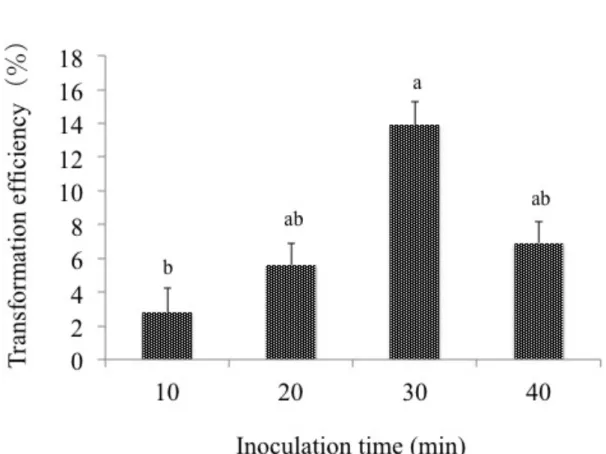
optimum period of inoculation, PLBs were further inoculated with Agrobacterium at the periods for 10 to 40 min at the bacterial concentration of OD600= 0.1 with agitation. The
results showed that 30 min of inoculation time gave the highest transformation efficiency of 13.9%, whereas shorter inoculation time as 10 and 20 min decreased to 2.8 and 5.6%, respectively and also longer inoculation time as 40 min decreased the efficiency to 6.9 % (Figure 3-1). These results indicate that 30 min was the optimum period for the infection of PLBs with Agrobacterium at OD600= 0.1 with agitation treatment during inoculation period.
In other Dendrobium orchids, inoculation of PLBs for 30 min also gave the highest transformation efficiency (Yu et al. 2001; Men et al. 2003). However, in other orchids, combinations of higher bacterial concentration and longer inoculation period have been recommended for the successful genetic transformation, such as OD 600 ≈ 0.5 for 4 h in Vanda
Chapter 3: Transformation of Dendrobium Formidible !
! 28
Therefore, Dendrobium orchids might be more susceptible to Agrobacterium infection compared to other kind of orchids.
Effect of different stage of PLBs after subculture and inoculation medium on
transformation efficiency
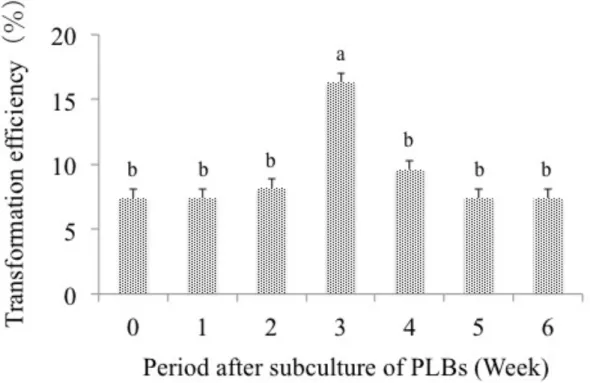
In genetic transformation of various orchids, PLB has predominantly been used as target material for inoculation of Agrobacterium because it has high potential to regenerate into plants and could be easily obtained by culturing shoot tip (Tokuhara and Mii 1993; Martin et al. 2005; Shrestha et al. 2007) and root tip (Guo et al. 2010). In the present study, we investigated the suitable stage of PLBs for transformation. Among the 7 stages examined, PLBs obtained 3 weeks after subculture produced the highest transformation efficiency of 16.3% (Figure 3-2). It has been reported that transgene integration is favored in cells at the S- and G1-phase and target tissue in transformation must be actively dividing cells, which could be obtained by sub-culturing (Suwanaketchanatit et al. 2007). Julkifle et al. (2012) have reported that the cells in PLBs are actively dividing at the third week after subculture. Therefore, 3 week-old PLBs might be suitable as a target material for Agrobacterium infection.
The composition of inoculation medium has been known to influence the efficiency of transformation. In Lilium, Azadi et al. (2010) attempted to investigate the efficiency of transformation by removing some elements in Murashige and Skoog medium (MS) used for inoculation and co-cultivation. The highest transformation efficiency (25.4%) was obtained when calli were inoculated with Agrobacterium in MS medium lacking KH2PO4, NH4NO3,
KNO3 and CaCl2. However, the inoculation medium with only distilled water (D.W.) and
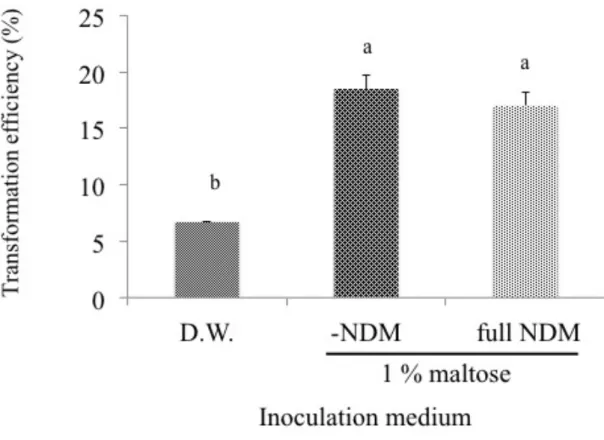
sucrose also showed high transformation efficiency of 10.7%. In the present study, medium containing only 10 g L-1 maltose gave slightly but not significantly higher transformation
Chapter 3: Transformation of Dendrobium Formidible !
! 29
removal of ND mineral and organic components did not affect the transformation efficiency. In contrast, complete removal of medium components from the inoculation medium, i.e., only D. W., gave significantly lower transformation efficiency (6.7%), suggesting the importance of maltose during infection period for the successful transformation with Agrobacterium. Previous studies demonstrated that sugars greatly increased the expression of vir genes in combination with AS (Shimoda et al. 1990, Wise et al. 2005). In the present study, difference in the presence of maltose in medium was made only at short period of inoculation but not at subsequent cocultivation period. Therefore, effectiveness of maltose for Agrobacterium infection was exerted probably through its enhanced attachment to the host cells. For achieving more efficient transformation, it might be necessary to find out more suitable sugars for Dendrobium as shown in lily transformation (Azadi et al. 2010).
Selection and regeneration of transgenic plants
When PLBs 3 weeks after subculture (Figure 3-4A) were cultivated for 2 months on the selection medium containing 20 mg L-1 hygromycin after co-cultivation (primary selection),
some parts of them remained green (Figure 3-4B), whereas others turned brown and died. The survived PLB tissues were separated and cultured for one month on hygromycin-free ND medium on which they initiated to induce secondary PLBs. These PLBs with new proliferation were reselected by transferring and subculturing on the primary selection medium i.e. ND medium containing 20 mg L-1 hygromycin at one month intervals. One
month after the transfer, all of the secondary PLBs survived (Figure 3-4C) and produced multiple shoots after 4 months of culture on medium (Figure 3-4D). When these multiple shoots were transferred onto medium containing reduced concentration of hygromycin to 10 mg L-1, they produced roots and developed into plantlets with 3-4 leaves 6 months after the transfer (Figure 3-4E). These plantlets were successfully acclimatized in sphagnum moss of
Chapter 3: Transformation of Dendrobium Formidible !
! 30
small pots in a growth chamber at 25°C under a 16-/8-h (day/night) photoperiod (Figure 3-4F).
GUS histochemical assay and confirmation of transgenic plants
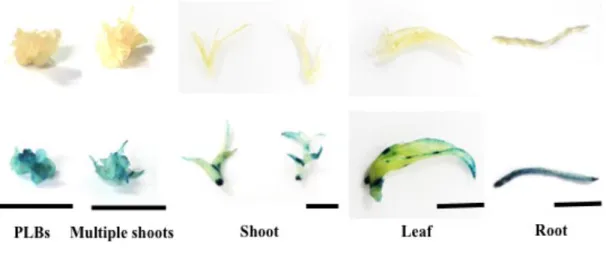
Hygromycin resistant PLBs and multiple shoots showed histochemical GUS staining, which was not observed in untransformed control PLBs (Figure 3-5). GUS staining could also be detected in shoots, leaves and roots of the regenerated plantlets. The presence of the gus,
nptII and hpt genes in these putatively transformed plantlets was confirmed by PCR
amplification, which showed the expected 1.2-, 0.7- and 0.6-kb amplification products, respectively (Figure 3-6A). Furthermore, Southern blot analysis using the hpt gene probe showed that all of the plantlets confirmed the presence of the hpt gene sequence in the genomes of all the 6 plantlets randomly selected. Of these six transgenic plantlets, 3 exhibited single insertion sites (Lanes 2, 3 and 5), whereas another 3 showed 2 (Lane 4) or more (Lanes 1 and 6) T-DNA insertion sites in their genomes (Lane 1) (Figure 3-6B).
In conclusion, we have succeeded in establishing an efficient transformation system for D. Formidible ‘Ugusu’ via Agrobacterium-mediated transformation. The factors optimized here, use of 3 week-old PLBs after regular subculture, appropriate inoculation medium (1% maltose+100 µM AS), and optimum bacterial concentration (OD600= 0.1) and inoculation
time (30 min) could be applied for the transformation of various cultivars of Dendrobium and their hybrids. Introduction of the genes that regulate economically important traits such as flower color and disease resistance into D. Formidible ‘Ugusu’ are now in progress.
Ch ap te r 3 : T ra ns form ati on of D endr obi um F orm idi bl e ! ! 31 ! T abl e 3 -1. E ffe ct of ba cte ri al c onc ent ra tion a nd i noc ul ati on t im e on t ra ns form ati on of D endr obi um F orm idi bl e ‘U gus u’ . ! Condi tions f or tra ns form ati on s ys te m T ot al N o. of P L Bs inoc ul ate d N o. of Hm -re sis ta nt P L Bs 1) T ra ns form ati on e ffi cie nc y 2) Inoc ul ati on c ondi tion Ba cte ri al conc ent ra tion Inoc ul ati on time (m in) S ha ki ng 1: 10 30 90 13 12. 2 ± 0.5 a 45 90 7 6.7 ± 0. 5 b 60 90 6 4.4 ± 1.1 bc 1: 50 30 90 6 5. 5 ± 1.0 bc 45 90 6 3. 4 ± 0.2 c 60 90 4 3.3 ± 0. 1 c N on -s ha ki ng 1: 10 30 90 4 6.7 ± 0. 4 b 45 90 4 5. 6 ± 1.1 bc 60 90 4 4.4 ± 1.0 bc 1: 50 30 90 3 3. 4 ± 0.2 c 45 90 5 4. 4 ± 0.9 bc 60 90 4 4. 7 ± 1.5 bc T ra ns form ati on e ffi cie nc y w as re corde d a s t he pe rc ent age of P L Bs tha t produc ed s hoot pri m ordi a a fte r 4 m ont hs of s ec onda ry s ele cti on on m edi um c ont aini ng 20 m g L -1 hygrom yc in a nd 20 m g L -1 m erope ne m . 1) Re corde d 4 m ont hs a fte r t ra ns fe r ont o s ec onda ry s ele cti on m edi um . 2) M ea ns of 3 re pl ic ati ons w ith t he s am e l ett ers s how s igni fic ant di ffe re nc e a s a na lyz ed by T uke y's te st at p < 0.05 a fte r a rc sine tra ns form ati on of the da ta .
Chapter 3: Transformation of Dendrobium Formidible !
! 32!
Figure 3-1. Effect of the inoculation time of PLBs with Agrobacterium on transformation efficiency of Dendrobium Formidible ‘Ugusu’.
!
Means of 3 replications with the different letters show significant differences as analyzed by Tukey's testat p < 0.05 after arcsine transformation of the data
! ! ! ! ! ! ! ! ! ! ! ! !
Chapter 3: Transformation of Dendrobium Formidible ! ! 33 ! ! ! ! ! ! ! ! ! ! ! ! ! !
Figure 3-2. Effect of the age of PLBs on transformation efficiency of Dendrobium Formidible ‘Ugusu’.
! !
Means of 3 replications with the same letters show significant difference as analyzed by Tukey's testat p < 0.05 after arcsine transformation of the data.
! ! ! ! ! ! ! !
Chapter 3: Transformation of Dendrobium Formidible ! ! 34 ! ! ! ! ! ! ! ! ! ! ! ! ! ! ! !
Figure 3-3. Effect of inoculation medium on transformation of Dendrobium Formidible ‘Ugusu’. For each medium, 100µM acetosyringone was added.
! !
Means of 3 replications with the different letters show significant difference as analyzed by Tukey's test
at
p < 0.05 after arcsine transformation of the data.! ! ! ! !
Chapter 3: Transformation of Dendrobium Formidible ! ! 35 ! ! ! ! !
Figure 3-4. Plantlet regeneration of Dendrobium Formidible ‘Ugusu’ after infection of PLBs with A.tumefaciens (EHA101/pIG121Hm) and selection with hygromycin.
!
A: PLBs after subculture for 3 weeks on ND medium containing 0.1 mg L-1 1-naphthaleneacitic acid (NAA), 1.0 mg L-1 N6-benzyladenine (BA), 1% maltose and 0.25% gellan gum at pH 5.4. B: Inoculated PLBs with A.tumefaciens (EHA101/pIG121Hm) after 6 weeks of culture on selection medium containing 20 mg L-1 hygromycin and 20 mg L-1 meropenem. C: Surviving PLBs after transfer to secondary selection medium containing 20 mg L-1 hygromycin and 20 mg L-1 meropenem for 1 month. D: Multiple shoots regenerated from secondary PLBs after secondary selection with 20 mg L-1 hygromycin for 4 months. E: Rooting plantlets regenerated from multiple shoots on selection medium with 20 mg L-1 hygromycin and 20 mg L-1 meropenem for 6 months. F: Successfully acclimatized transgenic plants grown for 3 months in a growth chamber at 25°C under a16-/8-h photoperiod. Bar = 1 cm ! ! ! ! ! !
Chapter 3: Transformation of Dendrobium Formidible ! ! 36 ! ! ! ! ! ! ! ! ! ! ! ! ! !
Figure 3-5. GUS histochemical assay of Dendrobium Formidible ‘Ugusu’ at different growth stages
PLBs: after selection on medium containing 20 mg L-1 hygromycin and 20 mg L-1 meropenem
for 2 months. Multiple shoots: shoots regenerating from PLBs after secondary selection on medium 20 mg L-1 hygromycin and 20 mg L-1 meropenem for 3 months. Shoot: 5 months after regenerated from PLBs. Leaf and Root: 6 months after regeneration from PLBs. Un-transformed plant (upper) and transgenic plant (lower) Bar = 1 cm
Chapter 3: Transformation of Dendrobium Formidible !
! 37
Figure 3-6. Molecular analysis of transgenic Dendrobium Formidible ‘Ugusu’.
(A) PCR analysis of transgenic plantlets for hygromycin phosphotransferase (hpt), neomycin phosphotransferase II (nptII) and β-glucuronidase (gus) genes. Lane M: Molecular size marker (φX174/HaeIII), Lane PC: Plasmid pIG121Hm (positive control), Lane NC: untransformed plant as negative control (non-transformed plant), Lanes 1-6: Transgenic plants of D. Formidible ‘Ugusu’. (B) Southern blot analysis of transgenic plants. Ten µg of genomic DNA was digested with HindΙΙΙ and hybridized with digoxigenin (DIG)-labelled HPT gene probe. Lane M: Molecular size marker (DIG), Lane C: untransformed plant as negative control (non-transformed plant), Lanes 1-6: Transgenic plants.
! ! ! ! ! ! ! ! ! ! ! ! ! ! ! ! ! ! ! !
!
Chapter 4
Blue gene expression in Dendrobium nobile by introducing
flavonoid 3’, 5’ –hydroxylase gene via Agrobacterium-mediated
Chapter 4 blue gene expression in D. nobile
!
! 39
Chapter 4: Blue gene expression in Dendrobium nobile by introducing flavonoid 3’, 5’ –
hydroxylase gene via Agrobacterium-mediated transformation
Introduction
Dendrobium nobile is one of the most popular cultivated orchids for house decoration,
blooming in winter and spring. This genus is an epiphyte of Asian origin, found throughout tropical and subtropical Asia, as Far East as the Fiji Islands and Southern Australia. It is a widespread species, which occurs in many forms and varieties including waxy and fragrant, with colors ranging from white to pink and purple. Recently, the high demand for D. nobile has attracted the attention of biotechnology companies for large scale clonal propagation of elite genotypes of this genus (Faria and Illg 1995). One trait that is prime importance in breeding is the blue color, which lacks germplasm by sexual hybridization. Violet to blue color is produced by the delphinine-based anthocyanin. Flavonoid 3’, 5’-hydroxylase (F3’5’H) is one of the key enzymes with potential for delphinidin biosynthesis, however
Dendrobium lacks the F3’5’H gene. Unfortunately, this gene cannot be manufactured.
Genetic engineering is a powerful method that may be able to resolve this problem. Recently, around 20 different ornamental species have been successfully produced with the blue flower and they are now marketed as commercial cultivars in the USA, Europe, Japan, and Australia.
Rosa hybrida lacks the blue flower variety as it does not contain a delphinidin-based
anthocyanin (F3’5’H). In a previous study, delphinidin-accumulating rose was successful in producing by down-regulation, the endogenous dihydroflavonol 4-reductase (DFR) gene. Then, overexpressing of the Irish × Hollandica DFR gene was done by the introduction of the viola F3’5’H gene (Katsumoto et al. 2007).
Chapter 4 blue gene expression in D. nobile
!
! 40
To introduce the target F3’5’H gene into Dendrobium, the F3’5’H needs to be sufficient to engineer the altered flower color. Commelina communis, commonly known as the Asiatic Dayflower, is a herbaceous annual plant. Hayashi et al. (1958) reported the blue pigment in
Commelina communis as commelinin, a metal-complex anthocyanin from the blue petal.
However, the existence of a blue-color magnesium complex was denied by Bayer et al. (1996). Moreover, the metal complexation of anthocyanin and intermolecular hydrophobic association explained the blue flower-color development and the stability of the color (Kondo et al. 1992). It is well-known that delphinidin is an important factor for producing blue flower color; the commelinin molecule involves the chelate formation of two Mg2+ ions with the 4’-keto-quinoidal base of anthocyanin and coordination with the other two Mg2+ ions to produce flavone plays a crucial role in giving stability to the complex molecule (Shiono et al. 2008). Here, we attempt to introduce the F3’5’H gene isolated from Commelina cummunis into D.
nobile. The expressing of the F3’5’H gene into the different morphology was performed
based on the divergent genetic backgrounds as the target material.
Materials and Methods
Plant materials
Seeds of Dendrobium nobile, an elite clone obtained from a cross between D. Flower Palace ‘Cinderella’ × D. Santa Isabel ‘True Love’ representative non-anthocyanin source and ‘Watarun’ × ‘868’ representative as anthocyanin source gene background were kindly provided by Mr. Nobuyuki Asai, Asai Daikeien Co. Ltd (Figure 4-1). To produce protocorms, used system that described in chapter 2. The young protocorm after germinated at 21 days was used as material in this experiment.
Chapter 4 blue gene expression in D. nobile
!
! 41
Agrobacterium tumefaciens strain EHA 101 (Hood et al. 1986), which harboring with four
different binary vectors, which contains a hygromycin phosphotransferase gene (hpt) and
Commelina communis F3’5’H gene both under the control of a 35S cauliflower mosaic virus
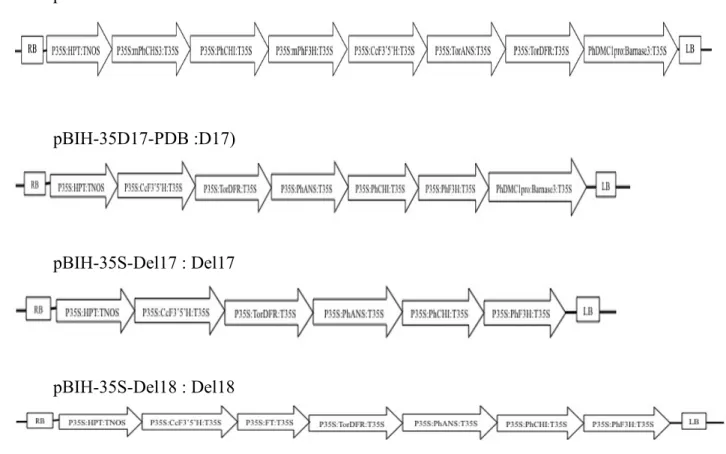
promoter as a basical gene in vector. Four vectors such as 35D9-PDB (D 9), pBIH-35D17-PDB (D 17), pBIH-35S-Del17 (Del 17), pBIH-35S-Del18 (Del 18) contain different gene in vectors as described in figure 4-2 were used in this transformation experiment.
Inoculation and co-cultivation with Agrobacterium
Four vectors of Agrobacterium were grown overnight and cultured in liquid LB medium containing 50 mg L-1 hygromycin at 28°C. The protocorms after germinated for 21 days were used as material in transformation following procedure that described in chapter 2.
Elimination of bacteria, selection and plant regeneration
After co-cultivation, inoculated protocorms were subjected to eliminate and select in the same time. From this step until acclimatize was used procedure as described in chapter 2.
DNA isolation, polymerase chain reaction (PCR) and southern hybridization
Genomic DNA was extracted from leaves of the wild type as a negative control and putative transgenic plants using CTAB method (Murray and Thompson 1980). PCR detection of hpt and F3’5’H gene was performed to detected the presence gene in the putative transgenic plants. The PCR amplifications were carried out using the following thermal cycles: 30 cycles of 94 °C for 1 min (denaturation), 59 °C for hpt or 54 °C for F3’5’H for 1 min (annealing) and 72 °C for 1.5 min (elongation). Primers used for amplifying a 0.6-kb fragment inside the
hpt gene were 5’-ACAGCGTCTCCGACCTGATGCA-3’ and
5’AGTCAATGACCGCTGTTATGCG-3’ and those amplifying a 1.5 kb fragment of the
5’-Chapter 4 blue gene expression in D. nobile
!
! 42
TTATGTTGTTTTTATATTCTTATAAACG-3’. After amplification, 3 µl of PCR products was loaded on the gel and detected by ethidium bromide staining after electrophoresis on 1% agarose gel at 100 V for 35 min.
For southern hybridization, 10 µg of genomic DNA was digested overnight with HindΙΙΙ, electrophoresed on 0.9% agarose gel, and subsequently transferred to a nylon membrane (Immobilon-Ny+ Transfer Membrane; Millipore Co, Billerica, MA, USA). The hpt probe (0.6 kb) was generated from plasmid DNA of pIG121Hm by labeling with digoxigenin (DIG) using the PCR DIG Probe synthesis kit (Roche Diagnostics, Mannheim, Germany) and the following set of primers, 5’-ACAGCGTCTCCGACCTGATGCA-3’ and 5’AGTCAATGACCGCTGTTATGCG-3’. Washing and detection were carried out according to the instruction manual of the DIG labeling and detection system (Roche Diagnostics, Mannheim, Germany). For the detection of hybridization signals, membrane was exposed to a detection film (Lumi-film Chemiluminescent Detection Film; Roche Diagnostics, Mannheim, (Germany) for 60 min.
For a transcription of the transgene, RT-PCR analysis was carried out for the gene expression. Total RNA was extracted from the 1.5 g leaves of the wild type as a negative control and transgenic plants by using extraction buffer method. For the management contaminated DNA, RNA (3µg) was treated with RNase-free DNase (Promega) at 37°C for 30 min before the first-strand synthesis. DNase-treated RNA samples were reverse-transcribed using Superscript III RNase H reverse transcriptase (RT) kit (Invitrogen) with minor modification. Briefly, 2 µg DNase-treated total RNA was mixed with 100 ng random primers, 1 µl 10 mM dNTP mixes and 7 µl diethyldicabornate (DEPC) treated water. The reaction was performed at 65°C for 5 min and incubated on ice for 1 min. Then, 4 µl of 59 First strand buffer, 1 µl of 0.1 M DTT and 1 µl Superscript III RT was added. Finally, the reaction was incubated for 1 h at 50°C and for 15 min at 70°C. These templates after performed this step were used for amplification of the F3’5’H gene with the primer and PCR
Chapter 4 blue gene expression in D. nobile
!
! 43
cycle as described above in PCR analysis. The control of quality in the sample was used rice actin gene (RAc1; X16280). The PCR amplification was carried out using the primer pair: 5’-GAAAATGGTGAAGGCTGGTTTTG-3’ and 5’-AGGATTGATCCTCCGATCCAGA-3’. The PCR products were then separated then divided by 1% agarose gel electrophoresis for 30 min at 100 volts.
Results and discussion
Selection of Hm-resistant PLBs, regeneration and acclimatization of the transgenic plant
After three days of co-cultivation, bacterial overgrowth was observed around two genotype protocorms infected with all vectors similar to Agrobacterium infection, as described in Chapter 2. In all vectors between two kinds of materials, some of the infected protocorms continued to grow and retained their green color after transfer onto the selection medium, which contained the antibiotics. All the control protocorms without Agrobacterium infection failed to grow, turning brown within four weeks of culture. After remaining on the selection medium, containing 30 mg L-1 hygromycin and 20 mg L-1 meropenem for 6 months, the surviving protocorms that regenerated from the secondary PLBs were recorded for transformation efficiency. In this study a transformation procedure was used that combined the effects of bacterial concentration and inoculation time. Transformation efficiency of ‘Cinderella’ × ‘Truelove’ resulted in 4.2, 7.0, 8.6, and 8.8% efficiency for D17, D9, Del17, and Del18, respectively (Table 4-1). Infection of ‘Watarun’ × ‘868’ showed a slightly lower transformation efficiency of 3.0, 3.1, 3.5, and 3.7 for Del 18, Del 17, D 9, and D 17, respectively. These results were significantly less than the transformation efficiency previously investigated in Chapter 2. However, this experiment showed no significance in the same genotype (Table 4-1), indicating that the transformation efficiency may be affected by the target-introducing gene that introduced the desirable traits. Patterns for selection and regeneration showed no changed in the color of the PLBs or shape within selection over 12