天文・天体物理若手 夏の学校 @ 宮城蔵王ロイヤルホテル (2013/7/30)
渦巻銀河ダイナミクス理論の進展と
天の川銀河
馬場淳一
東京工業大学 地球生命研究所
Earth-Life Science Institute (ELSI)
渦状腕の正体,発生・維持メカニズムは?
-どのように回転しているか?
-持続時間はどのくらいか?
-渦状腕の本数は何で決まるのか?(多様性の起源)
...etc.
M74
M83
M63
棒状構造
Grand-Design型渦状腕
Flocculent型渦状腕
M101
Multi-Arm型渦状腕
21964ApJ...140..646L
1964ApJ...140..646L
1964ApJ...140..646L
3
Lin & Shu, ApJ, 140, 640, (1964)
F. H. Shu
C.C. Lin
A. Toomre
4
Spiral Instability and Transient Spiral
A. Toomre D. Lynden-Bell P. Goldreich
Julian & Toomre (1966)
渦状腕=自己重力により形成された
密度超過領域が差動回転で引き延ば
された構造.
J. Oort (1962)
渦状腕を実体と考えると現実の渦
巻銀河のゆるい巻き込みを説明で
きない.
巻き込みの困難 (winding dilemma)
-星の軌道の渋滞パターン(恒星系円盤を伝わる
粗密波
)
-渦状腕を「
中立安定
(neutrally stable)な波
」と考える.
-self-consistentな
分散関係
(振動数と波長の関係式)の導出
-銀河回転周期で変化しない
準定常
パターン(
剛体回転
)
-線形解析,局所解析(Tight-Winding近似)
高速道路の渋滞(アナロジー)
渋滞個所(=密度波)は構成す る車(=星)が入れ替わりなが らゆっくりと伝播する.密度波仮説
F. H. Shu
C.C. Lin
5渦状腕=恒星系円盤を伝わる定常波 (定常密度波)
渦状腕領域の星の密度増加とそれにともなう重力ポテ ンシャルの変化をself-consistentに考慮した分散関係 注) 密度波理論では恒星系円盤を連続体と みなして波の分散関係を導出している.そ のため,渦状腕領域における星の軌道運動 に関して定量的理論予言はできない.密度波の伝播と吸収・増幅
SL
LL
LT
ST
SL
LL
LT
ST
OLR半径
CR半径
ILR半径
ランダウ減衰
ランダウ減衰
ランダウ減衰
ランダウ減衰
反射
反射
SWA
SL→ST+ST
WASER
LT→ST+ST
•短波(SL, ST): ILR,OLRでランダウ減衰(Mark 1974) •長波(LL, LT):反射(Goldreich & Tremaine 1978,1979) •trailing波(LT→ST): CRでWASERによる増幅 (Mark 1974)
銀河中心距離
増幅
P. Goldreich S. TremaineA. Toomre
6A.Toomreの反論
Lin-Shuの密度波は銀河円盤内を動径方向に伝播
し∼1Gyrで吸収され消える (定常仮定の破綻)
大局振動モード理論 (定常波)
7Y.Y. Lau
C.C. Lin
G. Bertin
Feedback:
Qバリアによる反射 (Mark 1976; Lau et al. 1976)
→ILRにおける吸収減衰を回避
Overreflection:
CRにおけるWASER増幅 (Mark 1974)
→ 最終的にR
ILR-R
CRの領域に「定常波」が生じる
Lau, Lin, & Mark (1976)
Bertin et al. (1977)
Bertin (1983)
Bertin et al. (1984)
Bertin et al. (1989a,b)
Bertin & Lin (1996)
J.W.-K. Mark
Two-turning point problem
(Schredinger-type equation)
Bertin et al. (1989a,b)
大局不安定モード
8
3.5. 銀河円盤の大局不安定モード 47
銀河円盤の回転曲線が与えられた場合,大局的な不安定モードは,J とQの2つのパラメータで決まる.
パラメーターJ がモードの形状を決める.具体的には,J が小さい場合には渦状腕モードとなり,J が大
きい場合には棒状モードとなる.パラメーターQは自己制御過程に影響する(Bertin et al. 1989a).
モード理論は自己完結な理論である.渦状腕モードの維持は,ある分散関係を満たす反対方向に伝播する 波列(wave train)によって視覚化される.モードの励起機構はCR半径付近での過剰反射(overreflection)
によって起こる(WASER機構).過剰反射は波作用(wave action)の保存から生じる現象である.ほかの反
射過程は銀河中心付近で起こり,波列はフィードバックループを形成する.
図3.16を見る.短波と長波の間の過剰反射はQ ≈ 1では適度(moderate)である.open wave間の過剰反
射(J が大きい)はQ ≈ 1では高く,Qが大きくなるほどmoderateになる.従って,(J , Q) = (1, 1)から始
めると,激しい不安定性によりQは急激に上昇する.そして,自己制御機構によりmoderate overreflection
が起こる状態に落ち着く.このような過剰反射はスウィング増幅機構と対立するものではない.遷移線よ
り上にあるopen waveの過剰反射はスウィング増幅機構と同一であることが示されている(Bertin 1983a).
Hunter(1965)による圧力のない冷たいガス円盤の大局モードの線形解析は初め.
(Bardeen 1975; Aoki et al. 1979; Bertin+1989)
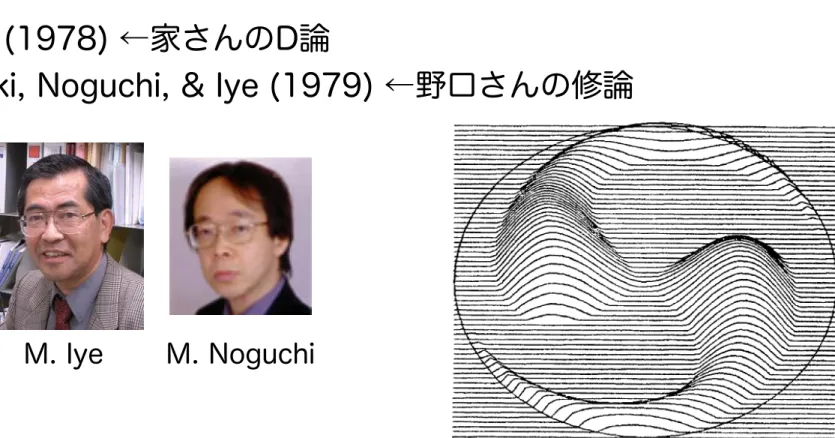
銀河円盤の重力不安定固有振動モードは必然的に渦巻状になる(Iye 1978).
大局モード解析の固有値がすべて実数の場合,面密度の空間分布はRとφで独立で渦状腕構造とはならな
い.つまり,銀河円盤の基準振動モード(normal mode)は渦状腕構造をもたない(反渦定理 Lynden-Bell
& Ostriker 1967).この結果,渦状腕構造をもつようなモードは振動ではなく(固有値が虚数),時間と共 に発展するようなものであることが示唆される.大局モード解析の結果,m=2 のモードの成長率がもっ とも高く,密度の濃淡が銀河円盤上を特定のパターン速度で伝播していく可能性が示されている(ref. C. Hunter/Bertin+1989).Lin-Shuの局所理論では渦状腕構造を決定するパターン速度や腕の本数が理論の枠 内では決まらなかったが,一方,大局モード解析では,最も成長率の高いモードが実際に観測される渦状 腕構造であるという仮定を設ければ,平衡銀河円盤から一意に渦状腕構造を予測できるのである. 差動回転するガス円盤では不安定モードは渦巻パターンとなることは示されているが,恒星系円盤でも 正しいのか?渦巻振動パターンは巻き込まれないのか? 図 3.14: 自己重力不安定性により成長する渦巻振動モード.Iye (1978)より引用.
3.5.2
シアを考慮した局所分散関係 局所密度波理論では,きつく巻いた渦状腕を考えているため,差動回転に由来するシアーの効果が考慮していない.Lau & Bertin (1978)は方位角方向の力を考慮した一様ガス円盤の解析を行い,シアーの効果
M. Iye
M. Noguchi
渦状腕=銀河円盤の大局的『不安定』振動モード
Iye (1978) ←家さんのD論
Aoki, Noguchi, & Iye (1979) ←野口さんの修論
※家さんは銀河円盤の振動解析から能動光学や補償光学の研究へ
9
ここまでの論争は線形理論 (解析的理論)
しかし,実際の渦巻銀河は非線形構造
定常密度波は実在するのだろうか?
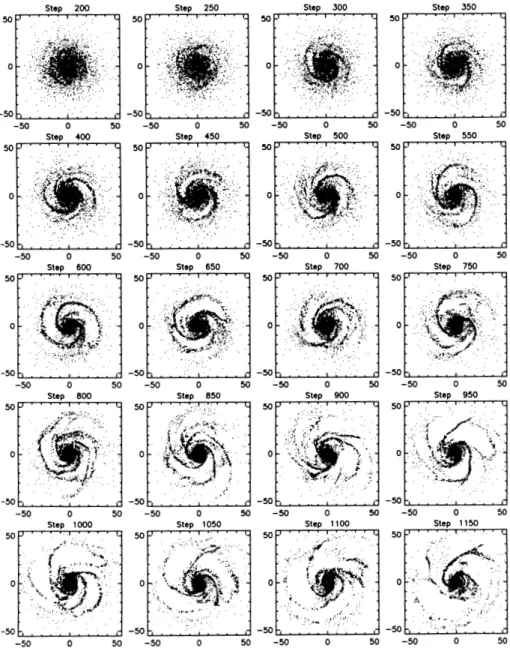
→ 数値シミュレーションによる検証
Self-Excited
Grand-Design?
Thomasson et al. (1990);
Elmegreen & Thomasson (1993)
数銀河回転の間維持される準定常的な
grand-design spiral が再現できた!?
(=Lin-Shu-Bertinの密度波理論がシミ
ュレーションで検証された!?)
1990ApJ...356L...9T 101642
J. A. Sellwood
makes it inevitable that every one of their galaxy models with a low-mass disc will be subject to stronger activity due to disturbance forces with m > 2, which will quickly heat the outer disc and destroy the conditions they require, as just demonstrated. Thus the ‘basic state’ invoked by BLLT for the modes they favour to account for bisymmetric spiral patterns could not survive in real discs that permit disturbances of all sectoral harmonics.
As this conclusion depends largely on the results from simula-tions, one must worry whether they can be trusted. The principal source of concern is that the origin of the multi-arm patterns that heat the disc remains obscure. Simulations of this kind over many years (e.g. Sellwood & Carlberg 1984; Fujii et al. 2010) have mani-fested recurrent multi-arm spiral patterns, and the behaviour has not changed as numerical quality has risen and the codes have passed many tests. However, the possibility that the behaviour could result from some artefact in the simulations cannot be excluded altogether until a satisfactory explanation is provided. Note that to doubt the result on these grounds calls into question all simulations of isolated discs over the past 40 yr, as well as those that model the formation of disc galaxies.
Other possible criticisms, such as the simulations could be unre-liable because of gravity softening, particle noise, or the restriction to two dimensions, are more readily rebutted. First, the very same code has been shown to reproduce modes predicted from linear stability analyses of other models, as cited above. Also, Plummer softening in simulations with particles confined to a plane provides a reasonable allowance for finite disc thickness and anyway the same behaviour persists in simulations of discs with finite thickness (Ro˘skar et al. 2008b; Fujii et al. 2010). Further, since the only vari-ation in the behaviour as N is increased 100-fold is an increasing delay due to a decreasing seed amplitude, with no other qualitative differences, an argument that simulations cannot be trusted because
N is too small is somewhat threadbare.
One might also worry that the stellar dynamical realization I have created differs from the model that BLLT analysed in the hydrodynamic approximation – essentially I have replaced pressure in their hydrodynamic calculations with velocity spreads; a more direct test would require a prediction of a slowly growing spiral in a stellar dynamical model. However, it is hard to see why this minor difference should matter, especially in this case where the dispersion is a small fraction of the orbit speed almost everywhere; the exception is at the centre where Q is so large that the disc is (by design) dynamically inert.
The simulations here have not, of course, made any allowance for the influence of the gas component, which can offset the heat-ing effects from transient spiral patterns to some extent. However, Sellwood & Carlberg (1984) found that simulations that included a very crude form of cooling still settled to 1.5 ! Q ! 2.
5 S I M U L AT I O N S
Short-lived recurrent spiral patterns have developed spontaneously in simulations of isolated galaxies, from the first studies by Miller, Prendergast & Quirk (1970) and Hockney & Brownrigg (1974), right through to modern simulations that include more sophisticated physical processes (e.g. Ro˘skar et al. 2008b; Agertz, Teyssier & Moore 2010).
Claims of long-lived spiral waves (e.g. Thomasson et al. 1990) have mostly been based on simulations of short duration. For ex-ample, Elmegreen & Thomasson (1993) presented a simulation that displayed spiral patterns for ∼10 rotations, but the existence of some underlying long-lived wave is unclear because the pattern changed
Figure 6. The rotation curve of the initial model adopted by DT94 and Z96
in units given in the text. The solid line is the full circular speed, the dotted line is the speed due to the modified exponential disc and the dashed and dot–dashed lines show the speed due the bulge and halo, respectively.
from snapshot to snapshot. Other claims are equally doubtful, as I show next.
5.1 Direct tests
As Donner & Thomasson (1994, hereafter DT94) and Zhang (1996, hereafter Z96) have presented evidence for long-lived spirals in the same model, I have chosen to try to reproduce their results here. I first summarize the model they employed and then report my own analysis of the similar results I obtain when I reproduce their simulations.
DT94 adopted the disc surface density distribution (Rohlfs & Kreitschmann 1980)
!(R) = 2Md 3πR2
d
[e−R/Rd − e−2R/Rd]. (4)
Here Rd is the scalelength of the outer exponential disc and Md
is the disc mass. DT94 and Z96 chose Md = 0.5Mt, where Mt
is the total mass of the model, and employed two additional mass components to represent a central bulge and a halo, both of which exert the central attraction in the mid-plane of a razor-thin simple exponential disc. The masses and scalelengths were, respectively, 0.1Mt, 0.1Rd for the bulge and 0.4Mt, 0.5Rd for the halo. The
rotation curve of this model is shown in Fig. 6, which compares well with that shown in fig. 1 of DT94. These authors set the initial velocities in the disc such that Q = 1 at all radii.
Here I recreate this model, and compute its evolution using es-sentially the same 2D polar grid code, but with a larger number of particles. The disc has N = 2M particles that move over a grid having 100 × 128 mesh points. As DT94 and Z96, I use a Plum-mer softening law with a length-scale 0.15Rd to compute forces
between particles. However, I adopt a more physically motivated set of units for which G = Mt = Rd = 1. For comparison with
the previous results, it should be noted that Rd = 10 in their units,
and one rotation period at R = 2Rd, which takes 2πR/Vc = 18.5 of my time units (925 time-steps), is 314 time-steps in DT94 and 628 time-steps in Z96.
Fig. 7 shows the evolution computed here, which should be com-pared with that shown in fig. 2 of Z96. Since the 10 times larger number of particles used here lowers the seed amplitude, a little more evolution is needed for the spiral to grow. To make the closest possible comparison, I therefore show snapshots that are spaced at the same time interval, but are shifted later by a little over one
C
$ 2010 The Author. Journal compilation$C 2010 RAS, MNRAS 410, 1637–1646
1642
J. A. Sellwood
makes it inevitable that every one of their galaxy models with a low-mass disc will be subject to stronger activity due to disturbance forces with m > 2, which will quickly heat the outer disc and destroy the conditions they require, as just demonstrated. Thus the ‘basic state’ invoked by BLLT for the modes they favour to account for bisymmetric spiral patterns could not survive in real discs that permit disturbances of all sectoral harmonics.
As this conclusion depends largely on the results from simula-tions, one must worry whether they can be trusted. The principal source of concern is that the origin of the multi-arm patterns that heat the disc remains obscure. Simulations of this kind over many years (e.g. Sellwood & Carlberg 1984; Fujii et al. 2010) have mani-fested recurrent multi-arm spiral patterns, and the behaviour has not changed as numerical quality has risen and the codes have passed many tests. However, the possibility that the behaviour could result from some artefact in the simulations cannot be excluded altogether until a satisfactory explanation is provided. Note that to doubt the result on these grounds calls into question all simulations of isolated discs over the past 40 yr, as well as those that model the formation of disc galaxies.
Other possible criticisms, such as the simulations could be unre-liable because of gravity softening, particle noise, or the restriction to two dimensions, are more readily rebutted. First, the very same code has been shown to reproduce modes predicted from linear stability analyses of other models, as cited above. Also, Plummer softening in simulations with particles confined to a plane provides a reasonable allowance for finite disc thickness and anyway the same behaviour persists in simulations of discs with finite thickness (Ro˘skar et al. 2008b; Fujii et al. 2010). Further, since the only vari-ation in the behaviour as N is increased 100-fold is an increasing delay due to a decreasing seed amplitude, with no other qualitative differences, an argument that simulations cannot be trusted because
N is too small is somewhat threadbare.
One might also worry that the stellar dynamical realization I have created differs from the model that BLLT analysed in the hydrodynamic approximation – essentially I have replaced pressure in their hydrodynamic calculations with velocity spreads; a more direct test would require a prediction of a slowly growing spiral in a stellar dynamical model. However, it is hard to see why this minor difference should matter, especially in this case where the dispersion is a small fraction of the orbit speed almost everywhere; the exception is at the centre where Q is so large that the disc is (by design) dynamically inert.
The simulations here have not, of course, made any allowance for the influence of the gas component, which can offset the heat-ing effects from transient spiral patterns to some extent. However, Sellwood & Carlberg (1984) found that simulations that included a very crude form of cooling still settled to 1.5 ! Q ! 2.
5 S I M U L AT I O N S
Short-lived recurrent spiral patterns have developed spontaneously in simulations of isolated galaxies, from the first studies by Miller, Prendergast & Quirk (1970) and Hockney & Brownrigg (1974), right through to modern simulations that include more sophisticated physical processes (e.g. Ro˘skar et al. 2008b; Agertz, Teyssier & Moore 2010).
Claims of long-lived spiral waves (e.g. Thomasson et al. 1990) have mostly been based on simulations of short duration. For ex-ample, Elmegreen & Thomasson (1993) presented a simulation that displayed spiral patterns for ∼10 rotations, but the existence of some underlying long-lived wave is unclear because the pattern changed
Figure 6. The rotation curve of the initial model adopted by DT94 and Z96
in units given in the text. The solid line is the full circular speed, the dotted line is the speed due to the modified exponential disc and the dashed and dot–dashed lines show the speed due the bulge and halo, respectively.
from snapshot to snapshot. Other claims are equally doubtful, as I show next.
5.1 Direct tests
As Donner & Thomasson (1994, hereafter DT94) and Zhang (1996, hereafter Z96) have presented evidence for long-lived spirals in the same model, I have chosen to try to reproduce their results here. I first summarize the model they employed and then report my own analysis of the similar results I obtain when I reproduce their simulations.
DT94 adopted the disc surface density distribution (Rohlfs & Kreitschmann 1980)
!(R) = 2Md 3πR2
d
[e−R/Rd − e−2R/Rd]. (4)
Here Rd is the scalelength of the outer exponential disc and Md
is the disc mass. DT94 and Z96 chose Md = 0.5Mt, where Mt
is the total mass of the model, and employed two additional mass components to represent a central bulge and a halo, both of which exert the central attraction in the mid-plane of a razor-thin simple exponential disc. The masses and scalelengths were, respectively, 0.1Mt, 0.1Rd for the bulge and 0.4Mt, 0.5Rd for the halo. The
rotation curve of this model is shown in Fig. 6, which compares well with that shown in fig. 1 of DT94. These authors set the initial velocities in the disc such that Q = 1 at all radii.
Here I recreate this model, and compute its evolution using es-sentially the same 2D polar grid code, but with a larger number of particles. The disc has N = 2M particles that move over a grid having 100 × 128 mesh points. As DT94 and Z96, I use a Plum-mer softening law with a length-scale 0.15Rd to compute forces
between particles. However, I adopt a more physically motivated set of units for which G = Mt = Rd = 1. For comparison with
the previous results, it should be noted that Rd = 10 in their units,
and one rotation period at R = 2Rd, which takes 2πR/Vc = 18.5 of my time units (925 time-steps), is 314 time-steps in DT94 and 628 time-steps in Z96.
Fig. 7 shows the evolution computed here, which should be com-pared with that shown in fig. 2 of Z96. Since the 10 times larger number of particles used here lowers the seed amplitude, a little more evolution is needed for the spiral to grow. To make the closest possible comparison, I therefore show snapshots that are spaced at the same time interval, but are shifted later by a little over one
C
$2010 The Author. Journal compilation$C 2010 RAS, MNRAS 410, 1637–1646
MNRAS. 410, 1637‒1646 (2011)
-2D N-body, N=3k
-Pure Stellar Disk.
-multiple armは恒星系円盤の重力不
安定に関連して自然に現れる構造.
-spiralは形成・破壊を繰り返す.
-しかし,その変動性は∼10回転程度
で終わる.
→ 渦状腕維持には恒星系円盤を力学的
に冷やす 散逸成分 (ISM) が必須.
J. Sellwood
Transient Recurrent Spiral
11
恒星系渦状腕の
変動性
-自己重力により自発的に渦状腕が発生.
-個々のスパイラルは
銀河回転周期(∼数100Myr)で合体-分裂
を繰り返す.
-しかし,
変動性は10Gyr以上維持される (←3D・大粒子数が必須)
.
Fujii, Baba, et al., ApJ, (2011)
12
銀河中心距離 R [kpc]
方位角 Φ [ ]
3D恒星系円盤 300万体
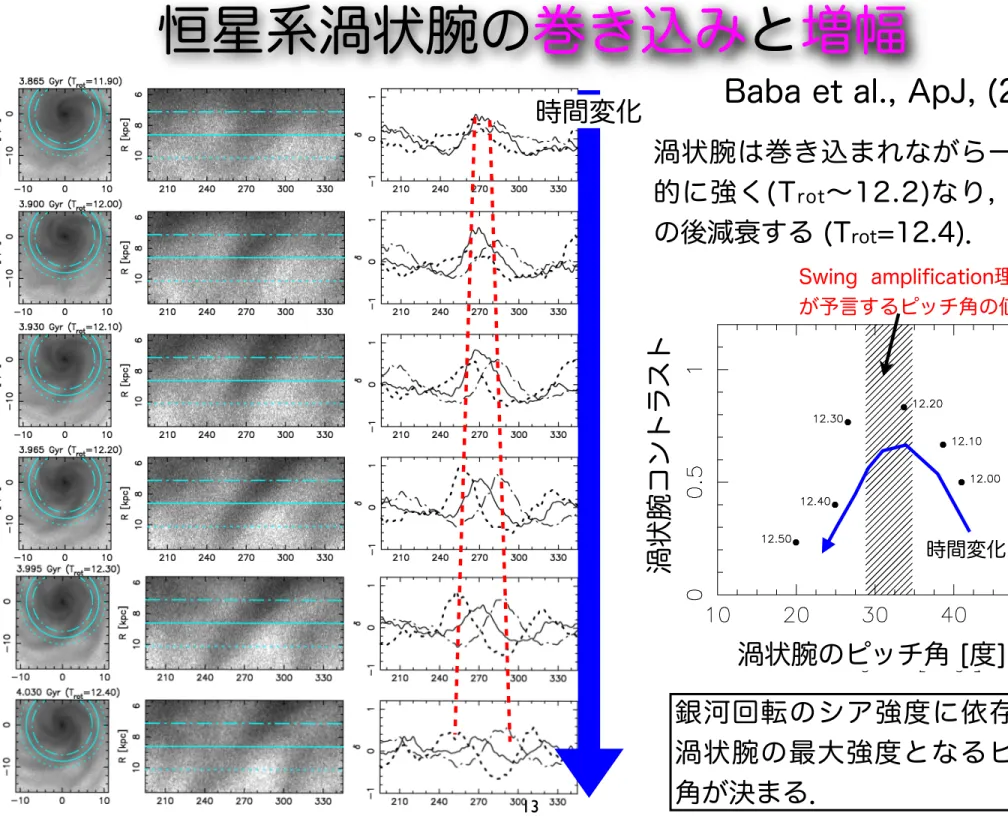
Stellar Dynamics of Non-Steady Spiral Arms 5
Fig. 4.—: Evolution of a spiral arm in growing phase. Left columns: face-on views of the disk. The surface density
is shown in logarithmic scale. The time referring to each row is indicated upper each panel. Rotating frame at R = 2Rsd = 8.6 kpc (solid circle). Middle columns: the corresponding density distribution in φ − R plane. Right
columns: the corresponding azimuthal density contrast (δ) profiles at R = 2Rsd− 1.5 kpc (dashed), 2Rsd (solid),
2Rsd+ 1.5 kpc (dotted). See a supplimentary movie.
恒星系渦状腕の
巻き込み
と
増幅
6 J. Baba et al.
Fig. 5.—: Same as Figure 4, but in damping (Trot= 12.2 − 12.5) and reconnecting (Trot= 12.5 − 12.7) phases. See a
supplimentary movie.
渦状腕は巻き込まれながら一時
的に強く(T
rot∼12.2)なり,そ
の後減衰する (T
rot=12.4).
Stellar Dynamics of Non-Steady Spiral Arms 7
Fig. 6.—: Evolution of the spiral arm on i − ¯δ plane
during Trot = 12.0 − 12.5. The hatched region is
corre-spond to a predicted maximum pitch angle around the analyzed region (Q " 1.4 and Γ " 0.75 − 0.85) by the swing amplification (see equation (7)).
During the stars are captured by the density enhance-ment, they move along with the spiral arm in changing their angular momenta. This behavior can be clearly seen on φ − L planes (middle columns). If any non-axistmmetric structures are developed, the stellar par-ticles oscillate in the horizontal direction (φ-direction) on the φ − L plane (Trot " 11.7). These motions show
epicyclic motions which are orbits associated with circu-lar motions. After the spiral arms are developed from the weak density enhancement (Trot " 11.8), the stars
cap-tured by the density enhancement radially migrate along the spiral arms seen in the φ−L plane (Trot " 12.0−12.4).
The stars approaching behind the spiral arm (i.e., inner radius) tend to get angular momenta via accelerating by the spiral arm, and move to outer radius. In contrast, the stars approaching front of the spiral arm (i.e., outer radius) tend to loss angular momenta via decelerating by the spiral arm, and move to inner radius. Migrated par-ticles begin to do epicyclic motions around new guiding center, again.
The evolution of distribution of the stellar particles on the E − L planes (Lindblad diagram) are shown in a right column of Figure 8. The stellar particles tend to move along the curve of circular motion, similar to other works (e.g. Sellwood & Binney 2002; ?; Bird et al. 2011). This can be naturally explained by scattering of the stars around co-rotating spirals, because stars around co-rotation change their angular momenta without in-creasing their random energie (Lynden-Bell & Kalnajs 1972). Furthermore, we see E − L changes occur over a large range of radii. This is entirely difference from those in stationary density waves, where these changes are limited to resonances (Lynden-Bell & Kalnajs 1972).
5.2. Orbital Characteristics
what determines oscillation amplitudes of stellar or-bits?
The orbital eccentricity is given by e ∼!(u2+ 2v2)/2
Fig. 7.—: Top row: time evolution of relative velocities
respect to the stellar spiral arm (∼ 270◦), ∆v
η (left),
∆vξ (right), at Trot = 12.1 (solid), 12.3 (dashed), and
12.5 (dot-dashed). Middle row: same as the top row, but for non-axisymmetric gravitational forces (i.e., spi-ral perturbation) ∆Fgrav. Here Fcir is the axisymmetric
gravitational force. Bottom row: same as the middle row, but for “net” non-axisymmetric forces ∆Fgrav+cori.
for a flat rotation curve (?), where u and v are the ra-dial and tangential velocities with the LSR velocity sub-tracted.
6. DYNAMICAL EFFECTS OF THE GAS ON CO-ROTATING STELLAR SPIRALS
In previous sections, although we neglected the gas component in disk galaxies, it was suggested that dynam-ical interactions between the gas and the stellar spiral arm are essential for both stationary density waves (e.g., Roberts & Shu 1972; Kalnajs 1972; Lin & Bertin 1985) and swing-amplified spirals (e.g., Sellwood & Carlberg 1984; Jog 1992; Elmegreen 2011). It needs to investigate the effects of the gas on dynamics of non-steady stellar spirals.
The gas trapped into stellar spiral arms gets cool due to the dissipation and its gravity amplifies the stellar spirals (left panel in Figure 9). This enlarges derivation from the circular motions, resulting that heating is larger than the pure stellar disk case (right panel in Figure 9). On the other hand, as proposed by Sellwood & Carlberg (1984), new stars formed form the ISM have as small velocity dispersion as that of the gas, leading dynamical cooling the galactic disk. Therefore, the gas in galactic disks can work as both dynamical cooling and heating sources.
渦状腕のピッチ角 [度]
渦状腕コント
ラ
スト
時間変化時間変化
Baba et al., ApJ, (2013)
Swing amplification理論 が予言するピッチ角の値
銀河回転のシア強度に依存して
渦状腕の最大強度となるピッチ
角が決まる.
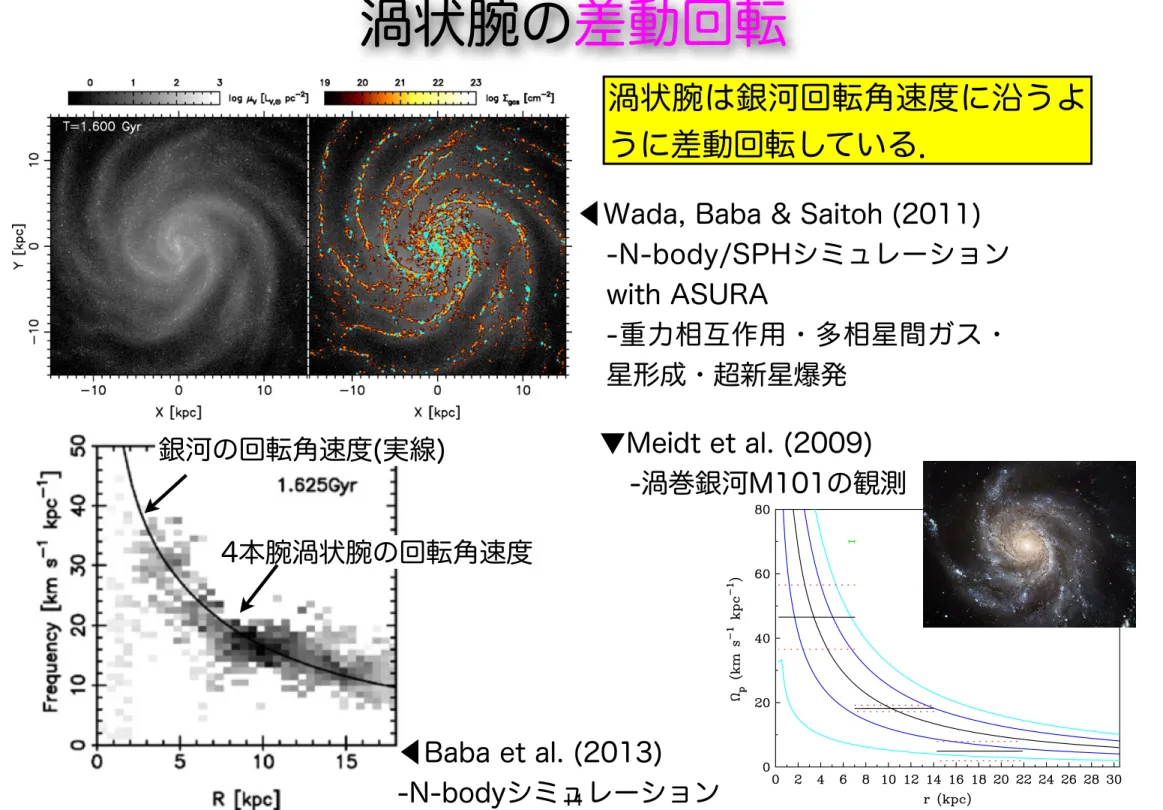
13◀Wada, Baba & Saitoh (2011)
-N-body/SPHシミュレーション
with ASURA
-重力相互作用・多相星間ガス・
星形成・超新星爆発
The Astrophysical Journal, 735:1 (9pp), 2011 July 1 Wada, Baba, & Saitoh
Figure 7. Same as the middle and right panels of Figure6, but the velocities are defined on the local galactic rotation.
(An animation and a color version of this figure are available in the online journal.)
Figure 8. Same as Figure5, but a close-up of a collision of gas clouds near the stellar arm every 20 Myr.
(An animation of this figure is available in the online journal.)
Figure 9. Left: V-band surface luminosity calculated from stellar density with a population synthesis model. Right: cold gas (T < 100 K) density and star particles,
whose ages are < 30 Myr and are represented by light blue color, formed from cold, dense gas are overlaid on the left panel. (An animation of this figure is available in the online journal.)
2006; Wada & Koda2004; Shetty & Ostriker 2006; Dobbs & Bonnell2006). This implies that the difference of rotational ve-locities between spiral potentials and the ISM is essential for forming the downstream spurs/feathers. In the present model, there are no strong shears or ordered motions of the gas in the live spiral model, because both the stellar spirals and the ISM
follow the galactic rotation, i.e., Ωp ∼ Ω(R). If Ωp < Ω(R),
as suggested by recent numerical simulations of tidally excited spirals (Dobbs et al. 2010; Struck et al. 2011), spurs could be formed. This is consistent with the fact that spurs tend to be clearly observed in well-defined two-arm spirals, such as M51 (Scoville et al.2001).
7
282 MEIDT, RAND, & MERRIFIELD Vol. 702
Figure 4. Best-fit regularized solution for M101 with rc= 21.9 ± 0.43 kpc for
P.A. = 42◦± 3◦. For this solution, bins exterior to rc(not shown) have been
calculated without regularization. Dashed red lines represent the dispersion in solutions derived with a three-pattern speed model at P.A. = 39◦and 45◦.
Horizontal error bars represent the dispersion in rt,1, rt,2,and rcfrom P.A. to P.A.
The innermost speed corresponds toΩp,1= 47 ± 10 km s−1kpc−1out to rt,1=
6.7 ± 0.25 kpc, followed by Ωp,2∼ 18 ± 1 km s−1kpc−1out to rt,2= 13.8 ±
0.58 kpc andΩp,3= 5 ± 3 km s−1kpc−1out to rc. Curves forΩ, Ω ± κ/2 and
Ω ± κ/4 (see the text) are shown in black, cyan, and blue. (A color version of this figure is available in the online journal.)
observed in the gas) with aB ∼ 0.7 kpc (Verdes-Montenegro
et al.2000), has not been otherwise conclusively related to the
spiral. In search, as well, of spiral winding and multiple spiral
modes, here we analyze 20$$resolution archival WSRT H i data
where the dominant two-armed spiral and the outer ring are clear, in addition to the outer lopsided region exhibiting a twist
in the isovels (van der Kruit & Shostak 1982). The zone of
the bar and the inner ring, which falls within the central 26$$
where there is little 21 cm emission, corresponds to less than two resolution elements. So although the ring is resolved in CO
(Regan et al.2002), and the peak H2column density (Helfer et al.
2003) there exceeds the H i, we do not consider the contribution
of the molecular gas here.
3. RESULTS
3.1. Applying the TWR Method
We apply the regularized TWR method as in Paper I. For each galaxy, we consider several smoothed, testable models
for Ωp(r). These models vary as polynomials (order n ! 2)
designated into at most three distinct radial zones. Where a priori evidence suggests that there is little information from a strong pattern beyond a certain radius, or that the TW assumptions are otherwise violated by the presence of a warp, for example, our models also include the parameterization of a cut radius,
rc, beyond which all bins are calculated without regularization
(i.e., the functional form is unconstrained). These models,
with rc marking the end of the dominant structure, have been
demonstrated to sufficiently separate the compromised zones in the disk from regions where information about patterns can be reliably extracted in the TWR calculation (Papers I and II).
All transitions rtbetween distinct zones and all cut radii, where
present, are treated as free parameters.
For each model, the two numerical solutions forΩp(r) from
either side of the galaxy (y > 0 and y < 0; Merrifield et al.
2006) are averaged to construct a single, global model solution.
Each model solution is then judged based on a simple reduced
χ2statistic, with the best-fit solution corresponding to the χν2
-minimum in the full parameter space.
As in Paper II, the random, measurement errors used in the regularized calculation, and with which we judge the best-fit solution, reflect uncertainty arising with the chosen flux cutoff in the first-moment maps. The systematic errors on each measurement represent uncertainty in the P.A., which is the dominant source of error in TW and TWR estimates (Debattista
2003; Paper I), roughly 20% for δP.A.= 3◦. But, here we report
these as a dispersion on each measured value, rather than present individual solutions for each P.A; this is possible here since, unlike in M51 (Paper II), we find no meaningful evidence that the form of the model associated with the best-fit solution for any of the galaxies in the current sample varies from P.A. to P.A. Also, unless otherwise noted, errors due to uncertainty in, e.g., the inclination angle are generally smaller and are not reported; these prove to be of little consequence to the accurate placement of radial bins defined in the quadrature (as suggested in Paper I). The additional change introduced in the measurements
Ωp through a change in sin i is furthermore shared by Ω and
κ, and so our resonance identifications, in particular, should not be effected by error in the inclination to first order. A thorough account of our methodology can be found in Paper I (and references therein).
3.2. M101
We apply the TWR calculation with radial bin width∆r =
7$$= 0.27 kpc (D = 7.4 Mpc), the resolution of the combined
cube. Together with the position of the outermost slice on each side, |y| = 30.4 cos i kpc, this establishes the extent of integration along each slice, equipping solutions with 113 bins in
total. The best-fit solution given a P.A. uncertainty ±3◦is plotted
in Figure4. There shown, also, are the rotation and resonance
curves derived as described in Section2.1. It should be noted
that a ∼75 km s−1asymmetry in the rotational velocities from
the approaching and receding sides exists at radii r " 20 kpc
(e.g., Kamphuis1993; Jog2002).
The outermost portion of the disk is effectively removed from
the solution with the parameterization of a cut radius rc =
21.9 ± 0.43 kpc. This radius, identified at the minimum of the
χ2, is comparable to the location where the disk becomes visibly
distorted. We find that the outer distortion/lopsidedness clear in the surface density is well characterized by the predominance of an m = 1 asymmetry beyond r ∼ 20 kpc in the Fourier
decomposition (Figure 5) and also matched by a warp in
the outer velocity field; in addition to the rotation curve asymmetry, with our ROTCUR analysis we find that the P.A. and inclination of fitted rings beyond this radius vary significantly from the nominal values established in rings interior. (We note that this strong variation in the P.A. is found to start at
a much larger radius than identified by Rownd et al. 1994.)
Inclination variation, in particular, is a violation of the TW/ TWR assumptions and so we argue that, by excluding the bins
covering the outer disk from models forΩp(r), the remaining,
inner regularized bins are better equipped to reproduce the true pattern speed. (Note that with this cut radius a possible m = 1 mode describing the outer, lopsided portion of the disk is ignored.)
In this case, the most conspicuous aspect of the solution
is the pair of transitions at rt,1 = 6.7 ± 0.25 kpc and rt,2 =
13.8 ± 0.58 kpc (marked in Figure6) between three distinct
▼Meidt et al. (2009)
-渦巻銀河M101の観測
銀河の回転角速度(実線)
4本腕渦状腕の回転角速度
渦状腕の
差動回転
◀Baba et al. (2013)
-N-bodyシミュレーション
渦状腕は銀河回転角速度に沿うよ
うに差動回転している.
14円軌道
拡大図
初期にR
gc=7kpcの星
渦状腕はΩ
sp∼Ω
rotなので,広い半径範囲で星の散乱はCR共鳴
→
散乱後にランダムエネルギー(Q)をあまり増さない.
E:粒子のエネルギー
L:粒子の角運動量
CR散乱
OLR散乱
ILR散乱
Lynden-Bell & Kalnajs (1972)
Sellwood & Binney (2002)
ヤコビ積分J=E-Ω
pL
なぜ差動回転渦状腕が維持されるのか?
共鳴散乱は
Jacobi integral = 一定
の直線に沿って動く
Baba et al. (2013)
N-body simulation
15Baba et al. (2013)
銀河中心からの距離 R [kpc]星が集団で収束・拡散することで渦状腕は形成・破壊を
繰り返す (非線形物理・協同現象) →
動的平衡構造
16銀河円盤の極座標表示 (R-Φ)
E-J面
(Lindlbadダイアグラム)
銀河円盤のL-Φ表示
渦状腕を構成する星の集団運動
(協同現象)
17
動的平衡渦状腕の場合,
星間ガスはどのように振る舞うのか?
銀河衝撃波は実在するのか?
密度波
と
銀河衝撃波
密度波(恒星系渦状腕)
の重力ポテシャル
ガス密度
星間ガスの流れ:
スパイラルを横切る
銀河衝撃波
渦状腕の重力ポテンシ
ャルにより運動が乱れ
る(
銀河衝撃波
)
高密度ガス(分子雲)
銀河衝撃波の下流で
星
間ガスが圧縮(分子雲)
星形成
渦状腕に沿った
星形成
藤本光昭 (1968); Roberts (1969)
渦状腕を横切る方向に星間ガスの速度場や熱相,
星年齢が変化
18銀河回転
と恒星系渦状腕
Rota%onal velocity
radius
Rota%onal velocity
spiral
gas
radius
spiral
gas
伝統的描像(密度波)
新たな描像
ガスは渦状腕に対し
超音速
ガスは渦状腕に対し
亜音速
剛体回転
(密度波)
差動回転
V
rot=Ω
pR
19Wada, Baba, & Saitoh (2011)
Baba, Saitoh, & Wada (2013)
co-rotation
定常密度波
動的平衡渦状腕
星円盤密度
ガス密度
アームの両方からガスが流入し衝突
星円盤重力ポテンシャ
ル
ガス密度
非定常渦状腕におけるガスの運動:二次元
20u
supersonic subsonicdensity
shockc
su
supersonic subsonicGas density
poten1al Gas flows Gas flows伝統的描像(銀河衝撃波)
新たな描像
一方向
から流れ込む
上流側に衝撃波
両側
から流れ込む
渦状腕底に溜まる
Φ(x,t)
V
gas∼V
spiral∼V
rotV
gas!= V
spiral非定常渦状腕におけるガスの運動:一次元
21
Wada, Baba, & Saitoh (2011)
星間ガスが超音
速で流れ込む
定常密度波のつく
るポテンシャル
銀河衝撃波
渦状腕の起源によって周辺ガスの運動が異なる
はず
♦渦状腕構造論:半世紀の論争
密度波理論 (定常渦状腕)
vs.
transient recurrent spiral
Lin, Shu, Bertin, Lau Toomre, Lynden-Bell, Sellwood