Privatizing and Liberalizing Electricity,
The Case of Hungary
Gabor BAKOS
Hungary, a forerunner in Eastern reforms, has boldly privatized its energy sector with for-eign capital. While in the West liberalization resulted in electricity abundance and dramati-cal tariff-cuts, in Hungary it brought excess capacities, but lower tariffs are still a long way to go.
Key Word: energy, electricity, privatization, Hungary
The energy liberalization brought a most surprising result. This time, again, economics produced something which physically would be impossible, it created energy from nothing! Because, just with changing market rules, crushing century old monopolies suddenly a sur-plus in energy has arisen. Consumers will be able to enjoy low energy prices, costs of produc-tion will come down and existing or planned nuclear power plants will become unnecessary.
Traditionally, certain regions of a country are supplied electricity by one or few power plants or supplier companies which are state owned or "state guided". Hence, electricity was a segmented monopolistic market where companies enjoyed regional monopolies. During the late 1990s however, dramatical changes have begun on Western European markets and elec-tricity is becoming a tradeable like other commodities. According to the European Elecelec-tricity Directive of the EU, 25% of electricity market should be freed by February 1999, 28% by February 2000, 33% by February 2003 and 100% by February 2006. In fact, however, coun-tries overfulfilled the target, by 1999 they have liberalized already 66%.
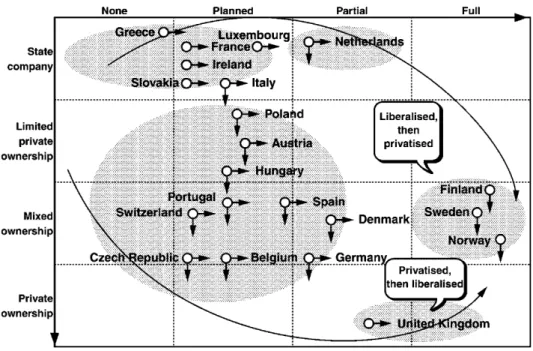
In order to come to a free market, two kinds of measures are necessary, privatization and market liberalization. The speed of the progress in each is different across countries in Eu-rope, some of them move faster ahead in liberalization, while others progress faster in privatization as figure 1 shows. Finally, all of them would arrive at the right bottom section where fully liberalized market with privately owned electricity companies would benefit con-sumers.
Figure 1 The pace of liberalization and privatization
In this study the case of Hungary will be taken up. Hungary is the pioneer in Central Eu-rope in privatizing energy and it has privatized the energy sector with foreign capital, which is rarely the case even in western countries. It is now facing the challenge of liberalizing the energy market, together with all its problems.
The study may be of interest also for readers in Japan, because Japan embarked the same way to liberalization in 2000. The two countries are rather similar not only in the deficit of natural resources but also in facing similar problems of stranded costs, sudden excess capaci-ties, or the reluctance of monopolists (providers, transmission companies) to open the market.
Preparations for privatization
When in 1993 discussions about privatizing the energy sector began, the energy supply in Hungary was relatively stable, generating capacities exceeded energy needs. This was due mainly to two circumstances. First, that because of the systemic change economic growth turned into negative and the protracting recession needed less energy. Second, that the im-ports of energy generating fuels from Russia were still undisturbed despite that the neighbouring country already experienced economic difficulties.
At that time the electricity system was run by 16 generator and distributor companies, transformed meanwhile into shareholding companies where the owner was the Hungarian state. In more concrete terms, the power plants were owned by the MVM (Magyar Villamos
Figure 2 The system of electricity companies before privatization (1994) 1st level Power plants
2nd level Distributor
3rd level Suppliers
Bakony Power Plant, Budapest Power Plant Dunamenti Power Plant, Ma.tra Power Plant Paks Nuclear Power Plant, Pees Power Plant Tisza Power Plant, V ertes Power Plant
Hungarian Power Companies Ltd (MVM Rt)
Budapest Electricity Supply Company (ELMU)
South-West Hungarian Electricity Supply Company (DEDASZ) South Hungarian Electricity Supply Company (DEMASZ) North-West Hungarian Electricity Supply Company (EDASZ) North Hungarian Electricity Supply Company (EMASZ) East Hungarian Electricity Supply Company (TITASZ)
Muvek, Hungarian Power Companies Ltd), a state run shareholding company, and the distri-butor companies were in the ownership of the APV Rt (Allami Privatizaci6s es Vagyonkezelo Rt, Hungarian Privatization and State Holding Company).
Economically the problem with the system was, that electricity prices were not much differ-ent from those prevailing in the socialist era, that is they were still distorted and a cross-financing between prices and companies balanced revenues with costs. Under such conditions it was impossible to assess efficiency. Another task was to keep up with energy-system changes in the EU since Hungary wanted to join the European integration.
Therefore, the new energy policy accepted by the Hungarian Parliament in 1993, stressed the need of energy import diversification (in order to diminish the one-sided dependence on Russian supplies) and of improving efficiency with introducing market competition and the respective ownership forms (privatization).
According to the new energy policy, in 1994 electricity companies were arranged into a three-level system (Figure 2) where the 8 electricity generating companies were grouped together (first level), the 6 supplier companies belonged to another group (third level) and probably the most important company managing the whole system, the MVM Rt (Hungarian Power Companies Ltd) was placed into the central place, that is the second level. In addition, the Hungarian Energy Office (Magyar Energia Hivatal, MEH) was set up in the same year to supervise the energy market, in particular to license the forming of companies in the energy sector, to guard consumers and to prepare the necessary price adjustments for electricity
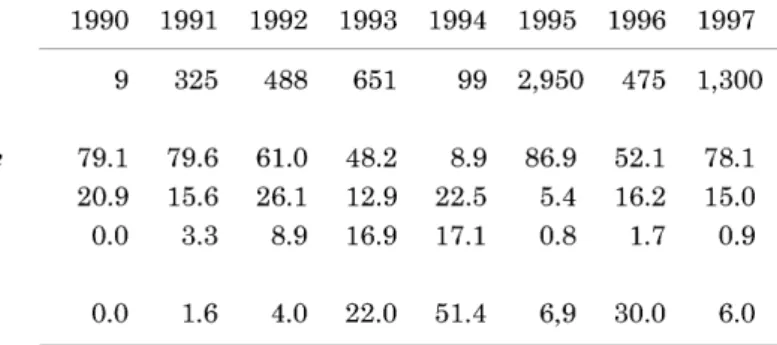
Table 1 Privatization revenues
1990 1991 1992 1993 1994 1995 1996 1997
Revenues, million USD 9 325 488 651 99 2,950 475 1,300
Share of(%)
Sale for foreign exchange 79.1 79.6 61.0 48.2 8.9 86.9 52.1 78.1
Sale for HUF 20.9 15.6 26.1 12.9 22.5 5.4 16.2 15.0
Sale for loans 0.0 3.3 8.9 16.9 17.1 0.8 1.7 0.9
Sale for compensation
vouchers 0.0 1.6 4.0 22.0 51.4 6,9 30.0 6.0
Source: Mihalyi
(and gas).
In December 1994 the government decided the first steps toward privatization, that is - the majority of shares of supply companies should be sold to investors, 15% of the shares
should be exchanged for compensation vouchers and the remaining 33% should be sold on the stock exchange
- the power plants should be offered for sale, however maintaining 50+ 1% in voting for the MVM, that is for the Hungarian state
- the new cost-based electricity prices should be introduced by 1 January 1996
The year 1995 gave then a powerful push to privatization. The new social-liberal coalition government enacted in 1994 not only wanted to speed up privatization, but there were some other developments, too. First, the boom of the privatization beginning from 1990 was declin-ing, the main industrial companies were sold out already and to ensure a continued inflow of privatization revenues of USD 1-1.5 bn yearly, new fields had to be opened up. Second, the repayment of foreign debts cumulated in 1995 and this circumstance also necessitated revenues in convertible currency. Third, the government's budget showed a chronic deficit, where especially the burden of servicing government bonds amounted almost to 30% of the deficit.
In Hungary, unlike other Central European countries, privatization was carried out mainly with foreign capital, foreign investors bought up 75-85% of state assets. Table 1 indicates also the shrinking revenues in 1995 which then in 1996 show a remarkable upswing due to privatization of the energy companies.
Privatization
In the need of financial resources, energy privatization became urgent and thus the largest privatization project in Hungary's history has started. In June 1995 a government decision took concrete measures. These were:
- electricity suppliers
The 46.14-49.23% share of each of the 6 supplying companies will be opened for privatiza-tion. After 2 years the new owner will be allowed to acquire majority.
- power plants
The 34.0-49.71% share of each of the 7 power plants will be opened for privatization. In the case of some power plants investors will be obliged to expand the plants' capacity and through this additional investment they can acquire majority.
-MVM
A 24% share of the MVM will be opened_!)
-one investor can acquire shares maximum in 2 supplying companies or in 2 power plants (a consortium in 3 each)
Thus, the decision modified the earlier guideline in one main point, that is foreign investors may not acquire majority neither in supplying companies, nor in power plants, nor in the MVM itself.
The privatization tenders were then shortly published on 29 July 1995 in domestic and Western dailies, after which the tender documents were issued and sold from 15 October. Tenders were bought by 28 firms, of which 8 were English, 6 German and 6 American (USA). Investors had 45 days to submit their bids, deadline expired on 30 November.
There was a quite strong interest from Western investors. For that, the main reasons were - In Western Europe preparations have already begun to liberalize electricity market which
would bring down prices. In the competitive market, companies would loose their stable, monopolistic position. Because of oversupply in electricity, new investments would be irra-tional. These unstable expectations drove Western electricity companies to expand to new markets in Central Europe.
-In contrast to Western volatility, the Hungarian government guaranteed a stable 8% profit margin in electricity prices, and
- promised to purchase from the new owners electricity with long term (20-25 years) con-tracts, at fixed prices (whereas Western prices were prognosed to quickly dwindle). Even if
there would be some risk because of regulation uncertainties, the government's guarantee seemed to be attractive for a strategic expansion.
In this first round (1995) 6 supplying companies and 2 power plants (out of the total 7) were sold (Table 2). Privatization continued from 1996 in the second round with power plants.
The second round had two specific features. The first was that American and Finnish, Japanese investors being newcomers on the Hungarian market, were licensed. This was in line with the aim to diversify investors in order to counterbalance the expansion of German firms. The second was that from 1996 foreign majority was allowed in acquiring Hungarian electricity firms, while in the first round it was not.
In the list of privatized companies, however, we cannot find probably the most important ones. That is, the MVM Rt, this concern-like firm to which all power plants belonged and which played the central role in managing the electricity system. Although in the privatiza-tion concept the MVM was also foreseen to be sold, it was even in 1999 in state ownership. Another one is the Paks Nuclear Power Plant, the only nuclear plant in Hungary, but it is generating 40% of total electricity. First it was separated from the MVM with the purpose of an eventual privatization, but later the MVM managed to get it back so that it could reaffirm its central position. Paks, too, is still state owned. The third one is the OVIT (Orszagos Vil-lamostavvezetek Rt, National Power Line Company) operating the high-voltage transmission grid. First it also was separated from the MVM, but now the MVM again possesses it. The OVIT, of course, is essential in controlling electricity distribution and supply.
How can the privatization revenue be assessed in comparison with the asset value? Were the assets sold at a good price or sold just for bargain price? Looking at the data (Table 3) as-sets were sold higher than their registered value, figures show effective prices being 105-178% of the registered assets value. Energy specialists, however, maintained that assets were sold at only one-third of their real value. Professor E.Petz, member of the presidium of the Hungarian Energy Association says: "The assets' value was corrected in 1991. Those cor-rected asset values are being registered also today in the books. But, in the meantime there was a high inflation which caused that by 1995, by the time of privatization, the real value in HUF was much higher than the corrected value of 1991. It is then not fair to state that energy firms were sold 'over price'."2) P. Mihalyi estimated that privatization contract prices
could have been 50-60% higher, if the time would have been long enough to prepare an auc-tion and continue negotiaauc-tions. True enough, investors submitted their bids on 30 November 1995 and on 6 December the decision was made by privatization authorities. Also,
Table 2 Company MVM Rt TITASZ Rt
:EMAsz
Rt ELMU Rt:EnAsz
Rtn:EMAsz
Rtn:EnAsz
RtV ertes Power Plant Pees Power Plant Tisza Power Plant
Matra Power Plant
Dunamenti Power
Budapest Power Plant Bakony Power Plant
Pees Power Plant
Tisza Power Plant
Budapest Power Plant
Bakony Power Plant
bold bid accepted Source: Mihalyi
~~~~~::k$~ ttt±~$1I]f~
Privatization Bids in 1995 and 1996-1998
Bidder
1995
Bayernwerk/EDF/Atel consortium (German, French, Swiss)
RWE Energie/EV Schwaben consortium (German) ISAR Amperwerke (German)
ISAR Amperwerke (German) RWE Energie/EV Schwaben
consortium (German) Bayernwerk (German)
RWE Energie/EV Schwaben consortium (German) EDF International (French)
EDF International (French)
Bayernwerk (German)
Energie Versorgung Niederosterreich (Austrian)
AES Electric (British) Powergen (British) STEAG (German) AES Electric (British) NRG Energy Int. (USA) RWE Energie/EV Schwaben
consortium (German)
Powerfin/Tractebel consortium (Belgian) Plant
Powergen (British) IVO (Finnish)
AES Electric (British) 1996-1998 Bayernwerk (German) Mecsek Energy Ltd STEAG
AES Summit Generation (USA)
Imatran Voima (IVO)/Toma consortium (Finnish-Japanese) Transelektro-Euroinvest consortium (Hungarian) Bid million HUF (million USD) 43,429 12,741 17,810 (132) 20,399 22,468 (164) 42,744 49,046 (358) 26,989 (197) 21,235 (155) 14,796 (100) 11,200 5,617 14,399 3,562 1,370 6,165 10,138 (74) 19,331 (141) 24,674 3,474 822 (2) 10,363 (110) 8,000 (47) 4,000 35
Table 3 New Owners in Electricity Companies Share owned by investor (%) Selling price
Company at privati- in 1999 to registered Investor
zation capital in %*
ELMU 46.16 76.07 178 RWE-EVS
DEDAsz 47.25 75.30 107 Bayernwerk
DEMAsz 47.98 54.11 122 EDF
EDAsz 47.55 27.38 EDF 123 EDF
27.38 Bayernwerk Bayernwerk
EMAsz 48.81 80.77 134 RWE-EVS
TITAsz 49.23 74.99 Isar- 109 Isar-Amperwerke
Amperwerke 3.14 other investors
Ma.tra Power 38.09 71 100 RWE-EVS
Plant
Dunamenti Power 48.76 50.31 Tractebel 120 Powerfin-Tractebel
Plant 24.45 Tractebel Ltd
Eroterv 89.60 105 IVO International
Budapest Power 73.70 24.99 IVO Holding 74 IVO/Toma
Plant 18.44 Fortum Power
24.99 Tomen Power 18.84 Tomen Corp.
Tisza Power Plant 80.80 60 AES
Bakony Power
Transelektro-Plant 65.00 51.10 38 Euroinvest
Pees Power Plant 68.45 Mecsek Energy Ltd
*At privatization
Source: Mihalyi, A magyar energiapolitika 1999-ben
tion revenues could have been much higher, if the Hungarian side would have agreed to grant majority for investors in privatized companies.
Foreign majority and profits
For foreign investors, of course, it was a key question to acquire majority in the Hungarian company. Even if formally they could not get the majority of capital share because of the privatization restrictions (during the 1995 first round), in fact they enjoyed a majority in the management. P. Mihalyi is quite right in saying that "privatized companies were from the first moment under the leadership of foreign investors". The French EDF, for example, se-cured for himself 3 seats out of the total of 5 management seats although their capital share was only 4 7.55%.3) Foreign investors smartly "invented" methods to ensure the majority
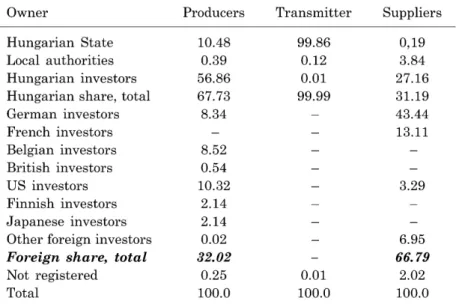
Table 4 Breakdown of Registered Capital According to Owners, as of 31 December 1999 (%)
Owner Producers Transmitter Suppliers
Hungarian State 10.48 99.86 0,19
Local authorities 0.39 0.12 3.84
Hungarian investors 56.86 0.01 27.16
Hungarian share, total 67.73 99.99 31.19
German investors 8.34 43.44 French investors 13.11 Belgian investors 8.52 British investors 0.54 US investors 10.32 3.29 Finnish investors 2.14 Japanese investors 2.14
Other foreign investors 0.02 6.95
Foreign share, total 32.02 66.79
Not registered 0.25 0.01 2.02
Total 100.0 100.0 100.0
Source: Report on the activity of the Hungarian Energy Office, 1999
tal share for themselves. One of them was to buy out the so-called employee-shares from the workers, as it was done by Tractabel in Dunamenti Power Plant. Another method was to in-crease capital (for example RWE in Matra Power Plant). Table 3 indicates clearly that for-eign owners in 1999 possessed a majority share.
The foreign share in registered capital was 32% in electricity generation and 67% in sup-plying. (Table 4) As to the market shares (supplied electricity, 1999), 43% belongs to the RWE, 35% to Bayernwerk and 22% to EDF. Thus, there is an overwhelming German dominance on the electricity market.
Privatization restrictions also stipulated that employment in privatized companies should not be decreased for some years, or that shares of the acquired company should not be sold within 5 years. Yet, these were circumvented, too. For example, instead of guaranteed em-ployment the American AES in the Tisza Power Plant offered a generous retirement al-lowance to its workers and half of the employees asked themselves for retirement. The French EDF asked for exemption from resale restriction, and when it was granted, the com-pany sold 50% of its share to the German Bayernwerk in 1997. As a result of slimming meas-ures by foreign managers, in the whole electricity industry employment decreased by 22% from 44,746 employees in 1994 to 34,988 in 1999.
Concerning dismissed employees, the APV, the privatization authority, envisaged relief measures. The APV separated HUF 8.6 bn to compensate 15 thousand employees. However, about 25% of the sum will be "economized" because the government limited compensation to HUF 600 per employee and compensation payments should be effected until 2004.4)
Table 5 Yearly Average Number of Employees in Electricity Companies Year Capita 1994 44,746 1995 43,693 1996 41,990 1997 40,203 1998 39,636 1999 34,988
Source: Report on the activity of the Hungarian Energy Office, 1999
Electricity pnces were another key issue for investors. The Hungarian government promised to introduce cost-based prices from October 1996 and from 1 January 1997 prices which would contain a minimum of 8% profit to assets and that this profit margin would be maintained during the following 5 years that is until 31 December 2001.5) How big should be
the price increase? It was the competence of the MEH (Hungarian Energy Office) to solve the problem. Its specialists suggested to raise generators' (producers') prices by 30-31% and con-sumer prices by 34-35%. At the same time foreign investors demanded a price increase of 40%. Since preparatory works were moving slowly, it was impossible to keep the deadline of October 1996 for cost-based prices, so they were to be introduced with the 8% profit margin prices in January 1997. This again caused a problem, because a large price increase instead of the planned 2 steps would be shocking for citizens. Therefore, the government considering the general inflation trends, decided a price increase not much different from that and set it at 24.9%. Foreign investors were disappointed and citizens were still shocked.
Even if the expectations of investors formally did not come true, the way of realizing the price corrections was much in their favour and their profitability was rather preferred to Hungarian owned electricity companies. The 8% profit margin was a general stipulation of price correction, but in fact prices increased more for privatized companies, while state owned companies got a much less profit margin. In detail, it happened as follows.
Power plants are selling their electricity at producers' price to the MVM (wholesaler) which adds its margin (wholesale margin) to the producers' price and distributes the electricity to supplying companies. The suppliers add their margin and this is the consumer price which is then paid by consumers. Now, in the price corrections producers' prices of the power plants increased only by 15%, the wholesale price of the MVM increased by only 18%, while con-sumer prices increased by 24.9%. The gap between the MVM price increase and the concon-sumer price increase yielded a 41% increase in the margin of the foreign owned supplying
compa-4) Feltoltik ...
Table 6 Economic Data of Electricity Companies Million HUF 1994 1995 1996 1997 1998 1999 Subscribed capital 804,955 799,366 806,154 816,654 802,587 733,201 Own capital 867,078 795,411 768,724 790,183 803,824 849,423 Net revenue 351,323 445,340 587,925 788,500 945,749 1,059,235 Profit before taxes -14,737 -73,758 -42,401 18,427 54,812 75,048 of which*
Generators -5,518 -6,768 -18,836 12,702 23,400 31,210
Suppliers -6,547 -10,927 -10,700 11,668 28,232 32,809
* The data of generators and suppliers do not add up to total (the row "profit before taxes"), the rest is due to the MVM
Source: Report ... , and courtesy of Hungarian Energy Office
nies! Calculating the volume of price increase, its distribution is more striking. The price in-crease totaled at HUF 57 bn of which foreign owned suppliers got 46%, while their share in the costs of electricity supply is a mere 25%. In the final result, 85% of the revenues from price increases went to foreigners and only 15% to state owned companies, while these latter ones own half of total assets. 6)
The situation was similarly much favourable in the case of foreign owned energy plants, for which producers' prices were increased by 27%, prices of the Budapest Power Plant alone went up by 60%. At the same time, prices of state owned power plants were increased by only 3%, and prices of the biggest power plant, the Paks Nuclear Plant were even decreased by 3%!
The year of 1997 was a turning point both for generators and suppliers, because pretax profits for both turned into positive (Table 6). In this year only the Bakony Power Plant (Transelektro), the state owned Vertes Power Plant, and the RWE-led EMASZ displayed a loss. Since then pretax profits for all companies in both branches are continuously accruing until present (2000).
In the final result, foreign owned companies got out from the red already in 1997 and they were planning to invest their profit into capacity developments. The German Bayernwerk, for example, planned to construct the Debrecen power plant with an investment of HUF 17 bn, out of the total investments of HUF 25 bn. (Peredi 15 May 1998)7) The RWE-led Matra Power Plant continuously improved profitability so that dividents were 17.52% after the 1999
busi-6) Calculations of Dr. M. Jarosi, vice president of MVM. (See: Jarosi)
7) In rare cases prices did not cover costs, for example EDF asked the Ministry of Economic Affairs to recon-sider prices, because they did not cover even the costs for assets maintenance in 1998. As the Hungarian side declined it, the problem was submitted to the court. (Peredi 5 Nov. 1998)
(average %, to 1990)
700 ... 679,4,,:0
Index of electricity consumer price CPI
600 500 400 300 200 100 1990 1991 1992 1993 1994 1995 1996 1997
Figure 3 Index of Electricity Price
ness results.8)
Consumers, on the other hand, were dissatisfied because their electricity bills went up con-siderably, especially for pensioners. To calm down citizens, compensation was promised for those having low incomes. Compensation amounted to HUF 1 bn which was 1.8% of the price increase. Even so, many adversely effected citizens were unable to pay the high bills for months and electricity supply for them was cut off. Although price corrections were planned not to exceed inflation, real price hikes of electricity were well over inflation (Figure 3)
Capacity tender
When preparing privatization, the Hungarian side was considering the needs of further capacity development. Earlier, state owned power plants were provided investment allot-ments from the government's budget and now state authorities wanting to ensure a safe supply of electricity, boundled privatization with capacity development engagements from in-vestors. The underlying presumption was, that foreign investors would eventually come only to acquire a market share but would not care about assets maintenance and development, whereas equipments would need a considerable renewal or exchange for new ones beginning from 2000 as energy specialists calculated. After privatization started, however, it soon became clear that these fears were groundless, because many investors declared their
tion to boost capacities. 9) Such an outcome, of course, was not surprising if we remember that Hungary promised foreign investors to purchase electricity from them at fixed prices for the long run10) while in Western Europe electricity market just became competitive and hard for
them.
The capacity development was also urged through opening a tender for investors. The MVM announced the tender in 1997 which was based on electricity needs calculated earlier in 1995. After reassessing it, necessary capacity was revised downward, a new tender was is-sued in 1998 and winners were selected in early 1999.
The 1995 energy policy guideline predicted a total of 3000 MW new capacities becoming necessary between 1995 and 2010 in order to replace polluting old units and to meet growing demand. At that time a yearly 1.5-1. 7% growth in energy demand was assumed, which could go up to 2% after 200011), however in the meantime real growth became slower, even less
than 1%. Also, Western Europe has recently considerable surplus capacities being 60% higher than peak demand. In Hungary surplus capacity is just 24-25% which is the standard re-quirement for a UCTPE member country_l2) The 1997 MVM tender aimed at a capacity of 2000 MW, but because of recalculated needs it accepted in 1999 only two bids totaling to a mere 300 MW.
In 1997 the MVM issued the initial tender in two categories. The first was for less than 200 MW units, with a total capacity of 800 (±200) MW, operation starting between 2001-2003. The second was for more than 200 MW units, with a total capacity of 1100 (±300) MW, operation starting between 2004-2005. As a result, 25 bidders submitted 63 offers with a total capacity of 5245 MW for the first category and 9 bidders submitted 26 offers with over 8000 MW total capacity for the second category. That is, investment bids surpassed invited capacity by 6 times! Then, in 1998 the MVM corrected the tender capacities downward, in the first category total capacity was fixed at 500 MW starting between 2002-2004, and in the se-cond category at 600 MW starting between 2003-2006. That is, invited capacity was cut by almost 50% from the initial 1900 MW to 1100 MW. This time 24 bids were submitted with a total capacity of 3524 MW in the first category and 9 bids were submitted with a total capaci-ty of 4017 MW in the second category. Again, offered capacities surpassed more than 6 times the tender invitation! Interesting is the pattern of the bids in the first category. 60.3% of
9) For example, the Belgian Tractebel wanted to install a 200-250 MW gas turbine and to construct a coal fired power plant of 400 MW. The British Powergen planned to add 390 MW, the American AES an-nounced a coal fired power plant. (Peredi 16 April 1997)
10) On contracted capacities see Fig. 4 "Estimated demand, contracts" 11) Interview with I. Bakacs, president of the MVM, in Peredi 24 Febr. 1999
12) In order to increase safety, Hungary started negotiations about joining the electricity system of Western Europe in 1990 and became member of the UCTPE in 1999.
them was gas fired projects and 34% was coal fired projects. All gas fired projects were of combined cycle gas-turbine cogeneration type.
Finally, two bidders were accepted, both in the first category. First the 191 MW cogenera-tion combined cycle combuscogenera-tion turbine project of Tisza Power Plant, submitted by AES and second, the same type 110 MW power plant (Kispest Power Plant) project by Budapest Power Plant. The average production cost will be HUF 6.43/kWh in the AES project, while HUF 6.87/kWh in the Budapest Power Plant project_l3) This is how the initially projected 2000 MW
capacity got down to a mere 300 MW of accepted bids.
Probably it will be interesting to have a look at the case of the hopeful but finally aborted project of the RWE. The German firm offered before the effective privatization of the Matra Power Plant to the Hungarian side to boost generating capacities with a new project of 2x500 MW. The "secret agreement" contained that the RWE would pay an additional USD 26 mil-lion over the selling price of the Matra Power Plant, would build the new capacities and the MVM would buy from them electricity without competition for 5 years.l4) The RWE offer
seemed rather promising, because in the Matra-region coal reserves would be sufficient for 120 years and generation cost would be HUF 7-8/kWh which is almost the same as gas fired power plant costs. 15) Also, the job creating effect would be advantageous because the new plant would create jobs for 6000 people between 2000-2005 and for an additional 1500 there-after.16) Even when the MVM cut the tender values, the RWE was ready to install smaller u-nits. However, later the Hungarian side pulled back as energy prognosis was corrected down-ward. There also was an economic consideration, namely that the MVM would have to pay USD 18 bn in the form of guaranteed electricity price to RWE for 5 years while real market prices (as a result of liberalization or import) would probably be lower. Finally, in 2000 the Hungarian side declined the RWE, and rather payed him back the USD 26 million with in-terests (USD 30 million) in compensation for unfulfillment. This was still less than the loss from guaranteed electricity prices.
Discussion and criticism
In general, a measure if well prepared is preceded by a discussion about the idea itself and then the ways and methods are adjusted for an optimal realization. The Hungarian case,
13) Power Plant Capacity Tender, MVM 14) Mihalyi
15) Peredi 10 April 1999 16) Romhanyi
however, was just on the contrary. Because of the urgent need of getting additional revenue, the government suddenly decided to privatize the energy sector. This decision was made without the consensus from the parliament, which would be impossible in western democra-cies, as T. Pongracz then head of the presidium of the
A
vU
(State Privatization Agency) pointed out in an interview_l7) Thus, the discussion and critical remarks came after
privatiza-tion has already been started.
Criticism focused mainly on foreign majority saying that the total privatization of the energy sector being the base of the whole national economy would be unimaginable in the world, it would endanger the country's souvereignty_l8) The original privatization concept
en-visaged a mixed ownership, first with state majority, but this plan was interrupted by the sudden decision to speed up privatization from 1994.19) Professor Petz means that the foreign share should have been in the range of 25-30% in order to protect the country's interest.20)
Because of the primary goal of revenues, privatization prices and the timing of sales could not be arranged in an optimal way. Also, due to the hasty decision the study of the Hungari-an Academy of Sciences was given no attention Hungari-and the privatization of energy sector was given in the hand of non-professionals.21)
Concerning the electricity price rise, J arosi contends that it was realized unequally in the favor of foreign managed companies, and further that power generating companies were dis-favored although they are producing a larger added value and need more for replacement and development of assets. Foreign managers and domestic "marketizers" were stressing the need of raising Hungarian energy prices up to the western level. Professor Petz, however, warned that the term "international level" would be not correct since the domestic real costs should be covered in prices. Here the costs of replacement and development should be considered and also the costs of storing nuclear waste and of a later demolition of the Paks Nuclear Pow-er Plant should be included.22)
Liberalization
Liberalization of the electricity market means, that any company can construct a power plant, generator companies can sell their electricity freely to other user (supplier) companies,
1 7) Pongra.cz 18) Pongracz 19) Jarosi 20) In: Molnar 1996 21) Molnar 1997 22) In: Molnar 1996
consumers will be free to buy electricity from the cheapest source and import-export will be free. As a result prices will come down, services of public utilities will improve.
In Hungary liberalization was planned to start in January 2001 by opening up 10% of elec-tricity market. 23) Following the EU policy guidelines, the market will be opened first for the
large users consuming over 100 GWh in a year. There are 12-14 large companies in this cate-gory, their market share is about 10-15%, these companies will be entitled to choose freely their suppliers. In a later second stage from 2005, liberalization will extend to the household consumers.
The liberalized market will be based on a special market institution which, similarly to the commodity exchange, is called energy-exchange or pool, where generators and users can trade electricity. The Hungarian model will be formed using the experiences of pools on western markets.24)
The most serious barrier of liberalization are the so-called stranded costs, originating from long term contracts. Next the problem of stranded costs will be examined and considerations will be provided on expectations whether prices would decrease after liberalization.
Stranded costs
In energy liberalizing countries with the liberalization a part of the surplus energy supply or capacities cannot be sold. If there are earlier engagements (contracts) on the side of public utilities or suppliers to purchase such energy, generators must be compensated. This is usually meant by the term "stranded costs". In Hungary, too, the problem of stranded costs will become relevant when opening the electricity market, however it is due not to surplus capacities in absolute terms but is caused by foregone electricity purchase contracts.
The MVM, the organization playing the central role in electricity trade and supply, signed two kinds of contracts. First, it has contracts with generator companies to purchase electrici-ty from them, and second, it has contracts with suppliers on selling them electricielectrici-ty. Buying contracts are for 20-25 years, while selling contracts have a validity for 15 years.25) Now, the
problematic ones are those concluded with the generators.
With the generator companies the MVM concluded contracts in 1995. These contracts were 23) A magyar ... , July 1999
24) The first study was elaborated by mid 2000. (See: Azonos ... )
25) Contracts with suppliers were concluded in 1997 for 15 years (Mihalyi, Peredi 10 Sept. 1997). Here prices are guaranteed, too. These contracts are so-called gliding contracts, extending automatically unless the buyer declares his unwillingness to cancel during 3 consecutive years. In this case the contract will ex-pire after 12 years, after which the supplier may freely purchase electricity from any generator (or from imports).
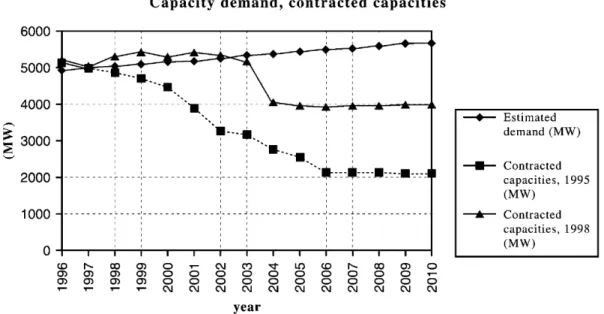
Capacity demand, contracted capacities
sooo~~~~~~~~~~~.-~~~t-_.~~T
4000~
3000 2000 1000-~---.
___ : ______···-··.:--,
·-
...
:,·-
..•
----~---
_:_-- --- _;_-- _j--- ------~~:~-~-:~·-·:~---·~~---•·-·--~
I I I I I I I I I I I I I I I I I I I I I I ---'---~---'----.J---~----.l.---1 I I I I ' ' ' I I I ' ' ' ' ' ' o~~~~--r~--~~--~~~--~--r-~'--~~--~~ ~ ~ oo m o ~ ~ ~ ~ ~ ~ ~ m m m m o o o o o o o o m m m m o o o o o o o o ~ C\1 ~ C\1 ~ C\1 C\1 C\1 year oo m o 0 0 .-0 0 0 C\1 C\1 C\1--+--
Estimated demand (MW) __.,_ Contracted capacities, 1995 (MW) ___....,._ Contracted capacities, 1998 (MW)Figure 4 Capacity Demand, Contracted Capacities
for the long run, for 20-25 years and included 85-90% of total generating capacities of 7500 MW.26) Dr. K. Gerse, commercial director of the MVM provides a somewhat lower figure (a
little over 5000 MW) in his graph (Figure 4), however the difference is not essential. Later the MVM signed contracts for new capacities, the total contracted capacity stock is marked with the 1998-curve. This curve is slightly over the estimated demand until 2002 and con-siderably lower thereafter, which means that stranded costs would arise not because of ex-cess capacities in absolute terms. These contracts contain that the MVM will purchase elec-tricity from the generators at guaranteed prices, that is generators will enjoy guaranteed prices even after 2001 from when the electricity market would be liberalized and market prices would decrease. Since the MVM would have to sell electricity at lower market prices, while it would have to pay the earlier promised higher prices to generators, it would suffer a considerable loss in the form of "stranded costs".
How much would be the stranded costs and how to solve the problem?
There are several estimations on the magnitude of stranded costs. In 1999, I. Bakacs, then president of the MVM wrote about the long term contracts: "The long term contracts were necessary mainly because of privatization, and further because of the need of financing new power plants. In 1995 electricity purchase contracts amounted to HUF 2000 bn and there-after to an additional HUF 1500 bn. The system of long term contracts ... with the generator companies on the one hand, and with the supplier companies on the other, is not consistent."
12 (ij 10 Q) 8 >.
-LL 6 :J I c: 4 ..0 2 0 0 0 0 C\10
0 C\1 C\1 0 0 C\1 C') 0 0 C\1 '<t 0 0 C\1 year 1.0 0 0 C\1 CD 0 0 C\1 1'--0 0 C\1121
From contracts extended • From rise of average price[ill From guarantted purehase and sale
Source: courtesy of Gerse
Figure 5 Stranded Costs
00 0 0
C\1
(Bakacs). It means then, that long term electricity purchases are in total HUF 3500 bn. Of course, not this total volume but only a part of it would become stranded costs after opening the market. Energy specialists were giving figures with broad limits, estimating stranded costs from a few billion to 40 billion HUF (USD 200 million) yearly27), or from HUF 5 bn to
100 bn (USD 500 million). 28)
Probably the most competent estimation is from Gerse, commercial director of the MVM. He distinguishes three kinds of stranded costs:
- costs of maintaining coal fired excess capacities for heating purposes, about HUF 22 bn ("From contracts extended" in Fig. 5)
-diminishing the operation of the contracted power plant portfolio, which will result in a rise of average price, HUF 60-75 bn
- guaranteed purchase of electricity from contracted capacities, where the "take or pay" con-dition will yield a loss of HUF 10-45 bn depending on real market prices (guaranteed pur-chase and sale)29)
Adding the three items, stranded costs would come to over HUF 140 bn in total. Figure 5 rev-eals their pattern in each year. However, this calculation includes the period up to 2008 only which is about half of the 20-25 years run time of the long term contracts. Even if this run time is an average calculated for the whole power plants portfolio, it may well be assumed
27) Mink 28) Krivan
29) More exactly, the loss results from the difference between the purchase prices guaranteed by the MVM and the lower, actual market prices at which the MVM will sell electricity to suppliers. (Gerse)
that stranded costs would continue to arise after 2008 too, so that in total they would double to HUF 300 bn or more. Which, compared to the total contract value of HUF 3500 bn, would be a 10% loss.
A connecting issue is the problem of coal mines (also referred by Gerse in his first item). During 1993-1994 coal mines were integrated to power plants, while the not integrated un-competitive mines were to be closed down gradually until 1998, however this was realized only partially. 30) In 1999 the government decided to close these loss making mines during 2000. 31) The integrated coal mines may continue in the framework of capacity and electricity purchase contracts with the MVM, until the operation license of the respective power plant expires, but even in this case loss making mines should not be subsidized as policy guidelines state.
Who will pay the stranded costs? When answering this question, one seems to be sure: in the final result it will be the consumer or citizen who will pay in the form of higher electrici-ty prices or taxes for subsidies.
If opening the market, final consumers would have to pay immediately HUF 5.5 bn more, 66% of which would be billed to households and the rest to large volume consumers. Large consumers could probably economize this cost through purchasing directly from producers. Still, an additional loss of HUF 9 bn would arise from excess capacities, the financing of which is unsolved, as P. Honig, deputy state secretary of the Ministry of Economic Affairs in-dicated.32) On the other hand, consumer prices for the households cannot be raised limitless since the government has set a 6% ceiling for the whole year of 2001.
To escape from the trap of stranded costs, the problem of the long term purchase contracts must be reconsidered. Therefore, the report of the Ministry of Economic Mfairs from Decem-ber 1999 already called on the MVM to review these long term contracts, to renegotiate them again with the partners in order to shorten the contracts' run time and to find methods for handling the stranded costs of investments in power plants becoming uncompetitive. 33) For-eign owners also are aware of the eventual new negotiations about long term contracts. 34) Still, as of the state at the end of 2000, the MVM did not start yet renegotiations.
30) A magyar ... Dec. 1999
31) They are: Putnok, Feketevolgy and Lencsehegy. These mines were maintained with a subsidy of HUF 2.6 bn in 1998. The mines employed 2500 people who are to be compensated with HUF 4 million per em-ployee if mines will be closed.
32) In: Krivan
33) A magyar ... Dec. 1999
34) K. Kreuzer, president of Bayernwerk Hungaria Rt maintains that "these contracts must be renegotiated and shifted to market base. If the MVM could bargain down the guaranteed contract prices, the problem of stranded costs would be solved automatically" (in: Krivan, 27 Sept. 2000)
Outlook: prices and competition
The most important expectation toward electricity liberalization is that prices would go down. The question is, however, more complicated than just to wait the spectacular price cuts in western market to expand automatically to the Hungarian market. First we will review the supply side and then other elements.
The supply of electricity will be determined by domestic and import sources. Since after liberalization anybody can construct and sell electricity, the supply may increase. However, at the moment of liberalization new market entries would be negligible, because only power plants of big industrial companies could offer electricity and there are less than 10 such generators, with a low 50 MW capacity. The construction of new power plants will take a few years and would cost more than existing ones, because of greater risk and the need of a higher share of self-financing of new projects.35) Also, new costs of environment protection will be added. And thus a paradox will arise, that the construction and entry of new capaci-ties would not result in lower but rather in higher electricity prices.
As for imports, cheap electricity could be imported from Slovakia and Ukraine. Here, however, crossborder transmission line capacities are a bottleneck and further, imported elec-tricity should be adjusted to the Hungarian- UCPTE safety standards which would induce ad-ditional costs. The estimates for imported capacities are 450 MW from Ukraine and 400-600 MW from Austria and Slovakia. 36) Still, it will take some time until imported electricity
would add to domestic supply, because the 1999 policy guidelines clearly stipulate that im-ports will be free only when Hungary becomes a member of the EU, until then the export-im-port monopoly of the MVM will be maintained.37) The year 2002 was first scheduled for Hun-gary's membership but recently it has been postponed, and so are electricity imports, too. But imports may be opened even later because domestic power plants should be given a protec-tion against cheap import electricity, as Katona, new president of the MVM stresses.38)
Another limit to imports is set in the draft of the new act on electricity stipulating that the market players, that is the eligible large consumers should buy 50% of their annual electrici-ty from domestic production39), which would mean that the 10-15% market share envisaged to
be free would shrink to 5-7%. And this would be too small a share to exert any influence on
35) According to preliminary calculations the usual 25% own share would increase to over 50% of the project and banks would charge higher interest and tighten other conditions, too. Thus, the costs of new power plants will be higher than those of the power plants with which the MVM has long term contracts. (Gerse)
36) Gerse
37) A magyar ... July 1999 38) Az MVM .. .
PJ~ PJ(o P}- •v ~· ~· ~·
,OJ ,OJ ,OJ p_,Cb· ~· p_,OJ p_,•
,OJ "O)Oj ,OJ "O)Oj
E:J
Q
Source: courtesy of the Ministry of Economic affairs Figure 6 Electricity Prices for Paper Mills
market prices whatsoever.
Germany Austria Hungary
The central monopolistic-controlling position of the MVM seems to remain unshattered. Although the original privatization envisaged also the privatization of the MVM, however the energy policy guidelines from 1999 state that it should not be privatized before market open-ing.40) Even if its future is deemed as a holding, the two powerful key control elements of the Paks Nuclear Plant and the national power line grid would belong to it also after liberaliza-tion.41)
Pressure from industrial consumers is increasing on central authorities to open the market, including free imports. Thus, for example, the paper mills of Mosonmagyar6var located on the western border of Hungary found in 1999 that electricity would be cheaper from neighboring Austria than from Hungarian suppliers (Figure 6) and they asked authorities to agree. The request was declined. The MVM has a monopoly of import and export, and also it is bound by the long term agreements with generators on the one hand, and with suppliers, on the other.
The structure of the Hungarian electricity pnces 1s another factor why pnces would not decrease as much as on western markets. Namely, while in German tariffs and producers
39) "Eligible consumers shall procure at least half of their annual consumption from domestic production." (Act on Electric Energy, Sect.29 (4)
40) "The organizational structure of MVM Co. Ltd. has to be transformed. Paks Nuclear Power Plant and Vertes Power Plant, as well as the new National Transmission Line Company (which will be created from the merger of MVM's high voltage base grid and OVIT Co. Ltd.) will continue to belong to the hold-ing. The period of reorganization and preparation for the market opening is not a suitable time for privatization of MVM Co. Ltd." (A magyar ... , July 1999)
prices there was a considerable margin-reserve to grant spectacular price cuts for consumers, in Hungarian wholesale prices and supplier tariffs there is no built-in margin for market risks. Rather, this risk-margin must be included in future Hungarian prices.42)
Gas fired power plants can also generate costs against price cuts. The latest power plants are running on natural gas, their share is increasing, because this cheap fuel was anticipated for the longer run and also environment protection costs would not be severe. However, the higher oil prices in 2000 pulled up gas prices and from November 2000 gas price was sudden-ly increased by 43% for industrial users. In gas fired plants fuel costs amount usualsudden-ly to 60-70% of total costs, so the higher gas price would cause a 30% rise in total costs. Its effect on electricity consumer prices will be a 12% hike.43) According to calculations of specialists, a
total gas price increase of 70-80% (another 40% to the 43% in November 2000) would again make reasonable to continue coal fired power plants.44) With the gas price hike the gap
be-tween gas fired and coal fired production costs came close, HUF 6-7/kWh for gas and HUF 8-10/kWh for coal.45) And thus dreams about cheap fuel run plants begin to evaporate, gas
prices are not independent from oil prices as was supposed earlier. Hence, electricity prices may in fact rise instead of decreasing.
Foreign investors are confident, mainly because they are expecting prices to increase. With levelling up to the western price level in general, this seems inevitable also for energy, for ex-ample Hungarian electricity prices are still about half of the German prices. Investors are preparing for the liberalization and even if they are not allowed to construct new plants at present, they are investing in environment measures and other projects enabling them to "jump" when the market opens. The German RWE, for example, is ready with the plans for the 1000 MW project which was earlier declined by the Hungarian side, and will eventually construct it after 2010. As it is a coal fired project, the RWE does not think about closing mines.46) The RWE completed in 2000 the HUF 16 bn desulphuring-project and thus it will
have an edge on other generators, because an EU environment agreement obliges all coal fired generators to apply desulphuring equipment by 2004. With this project the RWE became the first among all coal fired plants in Hungary. Even if strongly investing47), the
RWE has attained a solid profit, dividends were 17% in 2000.48) The power plant (Matra
Pow-42) Gerse 43) Tovabb ...
44) Peredi 18 Aug. 1999 45) Krivan-Kubik 1 Nov. 2000 46) Krivan-Kubik 1 Nov. 2000
4 7) In addition, RWE started the so-called retrofit project to extend the life of generating units and to in-crease their output.
京都女子大学現代社会学研究51
er Plant) is running on full capacity, the MVM is paying HUF 8/kWh for the contracted elec-tricity, and also purchases the surplus electricity, however at a lower price of HUF 3.60/kWh.
For the short run after market opening, P. Honig, deputy state secretary of the Ministry of Economic Affairs is probably right when he warns that it is a wrong dream to expect electric-ity prices to come down from liberalization, only the rate of price increase would be slower. (in: Krivan 30 June 2000)
Originally, the market opening was planned for January 2001, however because of the un-resolved problems of stranded costs and also because of the reluctance of the MVM it was postponed to 2002, when 25% of the market would be opened. Quite interestingly, soon after the postponement the industrial large users published a joint communique urging the im-mediate liberalization. Today nothing can justify the old, monopolistic system, they reason, because it leads to high costs and a real competitive electricity market is desirable. In the first step, 10-20% the market should be opened for large users in 2001, and in the second step the whole market should be free by 2005. "The international competitiveness of our com-panies and the national economy is at risk", they warn49).
References
Act on Electric Energy (draft), Ministry of Economic Affairs, at:
www.gm.hu/english/economy/energy/act- elect-2 .htm
A magyar energiapolitika 1999-ben (A Gazdasagi Miniszterium orszaggyillesi beszamoloja), Hungarian
energy policy (Report of the Ministry of Economic Affairs to the Parliament), Gazdasagi Miniszterium,
De-cember 1999,
also at: www.gm.hu/economy/indust/epol/energpol.htm
A magyar energiapolitika alapjai, az energia iizleti modellje (Hungarian Energy Policy Principles and the
Business Modell of the Energy Sector), Gazdas6gi Miniszterium, July 1999;
in English: www.gm.hu/english/economy/energy/energy.pdf
Az ipari energiafogyasztok allasfoglalasa a villamosenergia-piacnyitas kerdeseiral (The opinion of industrial
energy users about electricity market opening), Magyar Hirlap, 10 October 2000, p. 12
Az MVM keszill a versenyre (MVM prepares for competition), Magyar Hirlap, 27 September 2000
Azonos felteteleket teremt az energiatozsde (Energy exchange provides equal conditions), Magyar Nemzet, 22
August 2000
Bakács, István: A villamosenergia-ipar két átalakulás között (Electric energy industry between two
restruc-turings), A Magyar Villamos Mûvek Közleményei (Bulletin of the MVM), 1999. 6., also at: www.mvm.hu
Feltöltik a villamoskasszát (Electricity fund will be filled up), Magyar Hirlap, 1 September 1999
Gerse, Károly: Piacnyitás, verseny, befagyott költségek, fogyasztói árak (Market opening, competition,
stranded costs, consumer prices), A Magyar Villamos Mûvek Közleményei, 2000. 1., also at: www.mvm.hu
Járosi, Márton: Az energiaprivatizáció öosszefüggései (Contexts of privatizing energy), Magyar Nemzet, 16
January 1997
Kriván, Bence: Tízfilléres nyitás az árampiacon (Opening the electricity market by 10 fillér), Magyar Hirlap,
30 June 2000
Kriván, Bence — Kubik, Pál: Szenesnek áll a világ (Chances open for coal), Magyar Hirlap, 1 November 2000
Mihályi, Péter: A magyar privatizáció krónikája 1989-1997 (Chronicle of the Hungarian privatization,
1989-1997), Budapest, Közgazdasági és Jogi Könyvkiadó, 1999
Mink, Mária: Kisfeszültség (Low voltage), HVG, 14 August 1999
Molnár, Pál: Példátlan az energiaipar külföldi kézbe adása (It is unprecedented to give energy industry into
foreign hands), Magyar Nemzet, 27 April 1996
Molnár, Pál: Vagyontalanitás szemellenzõvel (Narrowminded unpropertizing), Magyar Nemzet, 16 January
1997
Peredi, Ágnes: Hiány helyett erõmûbõség? (Abundance of power plants instead of shortage?), Népszabadság, 16 April 1997
Peredi, Ágnes: Tizenöt évig biztos áramellátás (Stable electricity supply for 15 years), Népszabadság, 10
Sep-tember 1997
Peredi, Ágnes: Kijutottak a veszteségzónából (Got out from the red), Népszabadság, 15 May 1998
Peredi, Ágnes: Per árán is emelnék az áram árát a szolgáltatók (Suppliers would raise prices even through
lawsuit), Népszabadság, 5 Nov. 1998
Peredi, Ágnes: A legkisebb rosszat próbálták választani (Try to choose the least worse), Népszabadság, 24
Febr. 1999
Peredi, Ágnes: Mégis bõvülhet a Mátrai Erõmû? (Mátra Power Plant can still expand?), Népszabadság, 10
April 1999
Peredi, Ágnes: Gázárfüggõ erõmûfejlesztések (Gasprice-depending power plant developments), Népszabadság,
18 August 1999
Pénzügyi befektetõ az ÉDÁSZ-nál (Financial investor at the ÉDÁSZ), Magyar Nemzet, 22 January 1997
Pongrácz Tibor a magánositás tanulságairól (T. Pongrácz on the lessons of privatization) in: D. Megyeri: A
szuverenitásunkat veszélyezteti az energiaszektor teljes privatizációja (Total privatization of the energy
sector is a danger for our souvereignty), Magyar Nemzet, 15 May 1997
Power Plant Capacity Tender, press release, MVM homepage: www.hu/angol/angolkapac.html
Report on the activity of the Hungarian Energy Office, 1999, also at:
www.eh.gov.hu/angol/indexf a.htm
Romhányi Tamás: Bükkábrányi erõmûábránd (The power plant illusion of Bükkábrány), Népszabadság, 28
Aug. 1999