*1 Interdisciplinary Graduate School of Medical and Engineering (Primary Midwifery Care), University of Yamanashi *2 Interdisciplinary Graduate School of Medical and Engineering (Maternity Nursing and Midwifery), University of Yamanashi
Received 12 January 2012; accepted 7 August 2012
Data
An intervention to build maternal confidence
in new mothers one month after childbirth
Yoko KUBOTA
*1, Yasue KOBAYASHI
*2Abstract Purpose
To verify the outcomes of care provided by midwives for the purpose of building maternal confidence in new mothers.
Methods
This research was designed as a sequential, quasi-experimental study targeting an intervention group of 27 new mothers and a comparison group of 35 new mothers. Confidence-building care was given to the intervention group at 2-weeks postpartum (by phone) and 3-weeks postpartum (by interview). This care consisted of a midwife listening to a mother talk about the kinds of experiences that made her feel capable of taking care of her baby, and the kinds of experiences that made her feel as if she was doing her best, or has done her best, to care for her baby. The midwife then recognized the mother’s efforts, and communicated assurances and a positive assessment. The Japanese version of the Maternal Confidence Questionnaire (hereafter, J-MCQ) was administered 4-5 days post-partum (pre-test) and 1-month postpost-partum (post-test). A t-test was conducted to validate the intervention outcomes. Results
The average J-MCQ score for the pretest was 34.2 points (SD=8.3) for the intervention group and 34.5 points (SD=7.9) for the comparison group. No significant difference was seen between the groups (t=0.191, p=.849). The average J-MCQ score for the posttest was 46.3 points (SD=9.1) for the intervention group and 42.8 points (SD=7.5) for the comparison group. No significant difference was seen between the groups (t=1.663, p=.101). Both groups scored significantly higher in the post-test than the pre-test (intervention group: t=9.446, p=.000; comparison group: t=6.28, p=.000).
Conclusion
The confidence-building care for first-time mothers conducted by midwives was not demonstrated to be ef-fective, but whether or not the intervention was implemented, this study clearly showed that mothers at 1-month postpartum possessed more confidence that at 4-5 days postpartum.
Keywords: mother, confidence, midwife, quasi-experiment, Maternal Confidence Questionnaire
I. Introduction
In modern society where there are fewer opportuni-ties to observe mothers caring for their children, many mothers have not been around small children or lived with children before becoming mothers themselves, and contend with uncertainty about parenting while raising their own child. In addition, the mother lacks confidence
in parenting skills, confronts a reality that differs from the image she has drawn of herself and her child, and distresses over taking care of a child alone (Ohinata, 2002). Understanding the situation that new mothers face after giving birth and providing maternal support is becoming an issue that nurses must tackle.
Specifically, a woman must identify with herself as a mother to possess maternal confidence. In other
An intervention to build maternal confidence in new mothers one month after childbirth
words, it is imperative to motherhood (Zahr, 1991). A mother who acquires maternal identity is believed ca-pable of caring for her child and able to express joy and gratitude in her own role as a mother (Mercer, 1986, 2004, 2006). A mother acquires confidence by reading her child’s signals as she establishes her own style of parenting through trial and error, and successfully meet-ing her child’s needs (Maehara, 2005). In addition, re-ceiving validation from others regarding one’s own style of childcare leads to confidence (Suzuki & Kobayashi, 2009). Care provided by nurses for the first month after giving birth is an integral part of a mother’s external validation. In particular, a mother’s confidence level is greatly impacted when a nurse listens to her talk about the first month of motherhood and affirms her parent-ing skills (Kobayashi, 2012). When a nurse listens to a mother, she can sort through her thoughts and actions, which leads to self-affirmation. This prompts the real-ization that she has grown as a mother and turns into confidence (Kobayashi, 2007; Suzuki & Kobayashi, 2009). Furthermore, clear feedback is provided by a nurse who ascertains the mother’s parenting style and praises it, which has been indicated to play a significant role in boosting maternal confidence (Kobayashi, 2012; Mercer, 2006).
For the above reasons, it can be concluded that the acquisition of confidence is aided by the act of listening to a mother talk and validating her parenting style. How-ever, no research has been found that confirms these re-sults. This study verifies the outcomes of this type of nursing care for mothers, which is thought to facilitate the acquisition of maternal identity by building maternal confidence.
II. Purpose
The purpose of this study is to verify the outcomes of care provided by midwives to instill confidence in new mothers.
III. Operational Definition of Terms
Maternal confidence is a mother’s self-recognition of the fact that she possesses the skills to care for andunderstand her own child, and is indicated by a score for the Japanese version of the Maternal Confidence Ques-tionnaire.
IV. Method
1. Design
This study was designed as a time-dimensional, quasi-experiment.
2. Participants
Study participants were first-time Japanese moth-ers who gave birth between June 21, 2010 and Novem-ber 4, 2010, and were in agreement with the study aims. The new mothers gave birth at full term to a single child at a regional perinatal center for maternal and child health. Women were excluded from the study if they did not reside with their infant either due to the mother’s or child’s hospitalization, or if the need existed for con-tinued hospitalization or local follow-up. The Japanese-language version of the Maternal Confidence Ques-tionnaire (Kobayashi, 2010, 2012), which measures intervention outcomes, was used to estimate differences in standard deviation and the average score between the intervention group and the comparison group at 1 month postpartum. Calculations established a significance lev-el of 0.05 and statistical power of 80%. Therefore, par-ticipants were divided into groups of 24. Missing value was then estimated at 20% and the drop out rate at 20%, resulting in assigning 40 participants to each group. The participating facility was a regional perinatal center for maternal and child health that carries out 1-month infant health examinations 3 weeks after birth and 1-month maternal health examinations at 4-weeks postpartum. 1) Recruitment
The researcher used a written document to explain the aims and study method to women who fulfilled the participation requirements. When the women consented to participate, they were asked to sign a consent form, and at that time the “notice of withdrawal of consent” was also explained.
2) Allocation
It was thought that if the mothers discerned which group they had been placed in from their conversations
her experiences. Asking concrete questions also enabled the midwife to become familiar with the mother’s feel-ings and experiences.
Recognition
This refers to the nonjudgmental acceptance and validation of a mother’s feelings and experiences. The midwife accepted the mother’s struggles, experiences, and emotions of anxiety, happiness, and enjoyment without passing judgment, and affirmed them with ex-pressions of “That’s good” and “You’re trying really hard.”
Assurance
This refers to giving a mother positive assurance about her parenting style and her feelings. The mother’s parenting and emotions are validated from the perspec-tive of a specialist by declaring that, “What you’re doing is fine,” and “That’s the perfect way to care for your child if both you and your baby feel comfortable with it.”
Communicating positive assessment
This refers to communicating to a mother what she is doing well and praising her. While listening to a mother speak, the midwife verbally communicates what the mother is doing well and what she has learned to do well. The mother is also praised with words such as, “It’s important that you think that way,” and “It’s won-derful that you feel that way.” Communicating what a mother is capable of accomplishing and praising her for it leads to the recognition that what she is achieving is natural for a mother, and the mother becomes capable of realizing for herself that she is indeed capable.
2) Caregivers
The intervention was administered by 3 midwives with a wealth of experience listening to patients dur-ing clinical and educational work who were capable of eliciting from the mothers what they truly wanted to express. In addition, those midwives who had limited experience attended a study session on communication techniques held by the La Leche League Japan to train them to intently listen to the mothers’ expressions in a natural way.
to track them in accordance with their group division. Therefore, the women in the pre-intervention group were assigned to the comparison group, and the women in the post-intervention group were assigned to the in-tervention group.
3. Intervention
1) Confidence-building care
The intervention consisted of confidence-building care where the midwife intently listened to mothers talk, recognized the mothers’ efforts, and communicated as-surances and a positive assessment. The care was carried out twice. On the first occasion, the midwife phoned the mothers during the 2-week postpartum period when they were most likely to feel anxious about caring for their child. In addition to giving confidence-building care during the phone call, screening was also con-ducted to determine the need for a medical consultation. On the second occasion, the mothers were interviewed at 3-weeks postpartum when they visited the hospital for a health examination to follow up on the 1-month postpartum period. The purpose of the interview was for the midwife to meet face-to-face with the mother and child to recognize heightened validation, and provide assurances and positive feedback. If the researcher de-termined there was a need for a medical consultation during either the phone call or interview, the mother was advised to receive one.
The mothers were encouraged to speak through questions such as, “What is life like with your baby?” and “Is it different from what you had imagined?” The midwife also asked the following core confidence-building questions. (1) Up to this point, what kind of things make you feel that you have learned to take care of your child? (2) What kind of things make you feel as if you are doing your best, or have done your best, to care for your baby?
Attentive Listening
This refers to listening to a mother talk from a perspective very close to that of the mother. Asking a mother specific questions such as, “Why do you feel that way?” and “At what times do you think that way?”
An intervention to build maternal confidence in new mothers one month after childbirth
4. Measurements
1) Maternal Confidence Questionnaire
The Maternal Confidence Questionnaire (hereaf-ter, MCQ) was utilized. Parker & Zahr created the MCQ based on a similar scale and their clinical experience for the purpose of measuring maternal confidence related to maternal skills and the ability of a mother to under-stand what her child requires (Badr, 2005; Zahr, 1991). The scale consists of 14 items. Answers are given on a 5-point Likert scale ranging from “1. Never” to “5. Al-ways.” A total score is derived after reverse scoring two items, producing a score range from 14-70. The higher the score is, the greater the indication of maternal con-fidence. Face validity and content validity are validated by the creator. The Japanese-language version of the Maternal Confidence Questionnaire (hereafter, J-MCQ) was translated by Kobayashi (2010, 2012). Cronbach’s α is .84 and internal consistency has been preserved (Kobayashi, 2012). In this study, Cronbach’s α was α=.82 pretest, and α=.85 posttest.
2) Demographics
Participant attributes were ascertained regarding the mother’s age, family composition, delivery method, birth weight, the child’s sex, living arrangements after hospital discharge, whether there was a home visit or telephone inquiry, living arrangements at the 1-month checkup, mother’s physical condition, feeding method, child’s weight at the 1-month checkup, and whether there was anyone to help with housework and childcare. 3) Period of measurement
The pretest was administered 4-5 days after giving birth, and the posttest 1 month after giving birth. The pretest was conducted before the mothers went home in light of Rubin’s developmental process for maternal behavior (Rubin, 1967a, 1967b), and due to the fact that there was little impact from other care since the moth-ers were being treated at the same facility. The posttest was conducted at 1 month postpartum to avoid an im-mediate intervention when the mothers would be easily susceptible to an intervention. Rather, the posttest was conducted when the mothers had returned to their life-styles and looked back on their experience. The ques-tionnaires were left with the participants and picked up at a later time.
5. Analysis
The statistical software, SPSS Ver. 19.0 was used to calculate the descriptive statistics for each question. The difference in basic attributes between the 2 groups was calculated with the χ2 test and the unpaired t test. The normality of the pretest and posttest J-MCQ scores was determined for each group based on the p-value of the Shapiro-Wilk test. Comparisons within groups were made using the paired t test, and the unpaired t test was used to make comparisons between the 2 groups. The significance level was set at 5%.
6. Ethical considerations
To prevent the perception of compulsory partici-pation imposed by the hospital, the researcher met in person with participants and explained the study using a written request for participation in order to gain consent. In addition, the researcher strove to place phone calls at a time convenient to the mothers, and shorten the wait time for the interview and questionnaires. Furthermore, to maintain equality in care, confidence-building care was given to those in the comparison group wishing to receive it after the study came to an end. In accordance with the International Code of Ethics for Midwives, the midwives provided care in instances requiring resolu-tion of issues such as maternal concerns. This study was approved by the university ethics committee (No. 694).
V. Results
1. Number of study participants and follow-up rate
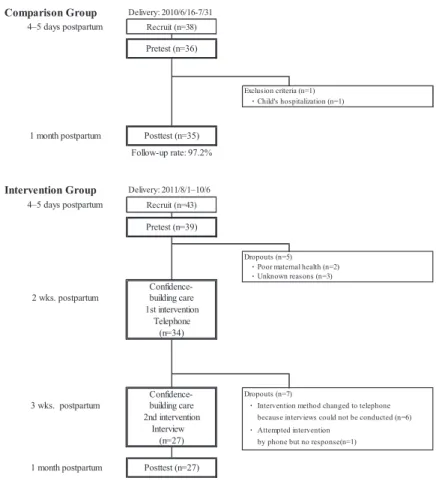
(Figure 1)
The comparison group consisted of 36 mothers who agreed to cooperate in the study (out of 38 who were asked to participate). One mother met the exclu-sion criteria, and the follow-up rate for the remaining 35 mothers was 97.2%. The intervention group consisted of 39 mothers who agreed to cooperate in the study (out of 43 who were asked to participate). There were 12 drop-outs, and 27 mothers tracked with a 69.3% follow-up rate.
Of the 12 dropouts, 5 withdrew prior to the first intervention, while 7 mothers forgot about the interview
(the second intervention) and returned home after the 1-month infant health examination. The intervention method was changed to interview by phone for these 7 mothers. Table 1 shows the length of the intervention and the number of postpartum days at implementation.
2. Comparison of study participant backgrounds
(Table 2)
The average maternal age for the intervention group was 28.6 (SD=4.6), and 30.3 (SD=5.1) for the comparison group. No significant differences were seen between the two groups. At the suggestion of the re-searcher, 2 mothers received outpatient care for breast-feeding. Exclusion criteria (n=1) ・Child's hospitalization (n=1) Intervention Group 4–5 days postpartum Dropouts (n=5) ・Poor maternal health (n=2) ・Unknown reasons (n=3)
2 wks. postpartum
Dropouts (n=7)
3 wks. postpartum ・Intervention method changed to telephone
because interviews could not be conducted (n=6) ・Attempted intervention
by phone but no response(n=1)
building care 1st intervention Confidence-Telephone Confidence-(n=34) Pretest (n=36)
1 month postpartum Posttest (n=35) Follow-up rate: 97.2% Delivery: 2011/8/1–10/6 Recruit (n=43) Pretest (n=39) 2nd intervention Interview 1 month postpartum Posttest (n=27)
Follow-up rate 69.3% (n=27) building care
Figure 1. Number of study participants & follow-up rate
Table 1. Circumstances during implementation of confidence-building care
Range
mean±SD min-max median
1st Intervention Telephone (n=27)
Implementation length (min.)
No. of postpartum days at implementation(days) 22.9±9.615.3±2.5 9-5412-25 20.015.0
2nd Intervention Interview (n=27)
Implementation length (min.)
No. of postpartum days at implementation(days) 29.5±9.823.5±2.1 15-5020-26 25.024.0
Persons present 7 husbands, 3 mothers,
An intervention to build maternal confidence in new mothers one month after childbirth
3. J-MCQ scores (Figure 2)
1) Comparison of J-MCQ scores between groups The average pretest J-MCQ score for the interven-tion group was 34.2 points (SD=8.3), and 34.5 points (SD=7.9) for the comparison group. No significant dif-ference was seen in pretest scores between the groups (t=0.191, p=.849).
The average posttest J-MCQ score for the inter-vention group was 46.3 points (SD=9.1) and 42.8 points
(SD=7.5) for the comparison group. No significant dif-ference was seen in posttest scores between the groups (t=1.663, p=.101).
2) Comparison of pre-test/posttest J-MCQ scores within groups
The average pretest J-MCQ score for the interven-tion group was 34.2 points (SD=8.3), and 46.3 points (SD=9.1) for the posttest, showing a significantly higher posttest score (t=9.446, p=.000). The average pretest
J-Table 2. Comparison of study participant backgrounds Items
Intervention group Comparison group
Pearson’s χ2 test Fisher’s exact test
(n=27) (n=35)
n (%) n (%) χ2 Degree of
freedom p p
Age (M±SD) 28.6±4.6 30.3±5.1 1.305 (t value) .197 (unpaired t test) Family composition Nuclear family Step family 23 ( 85.2) 4 ( 14.8) 27 ( 77.1) 8 ( 22.9) 0.632 1 .427 — Delivery method Vaginal delivery Planned caesarean section Emergency caesarean section
23 ( 85.2) 1 ( 3.7) 3 ( 11.1) 25 ( 71.4) 3 ( 8.6) 7 ( 20.0) 1.679 2 .432 .576
Child’s birth weight 3049.2±356.7 2997.3±328.8 0.594 (t value) .555 (unpaired t test) Child’s sex
Male
Female 12 ( 44.4)15 ( 55.6) 21 ( 60.0)14 ( 40.0)
1.481 1 .224 — Living arrangements after discharge
Parents’ home
Husband’s parents’ home Own home 18 ( 66.7) 1 ( 3.7) 8 ( 29.6) 23 ( 65.7) 12 ( 34.3) 1.401 2 .496 .668 Home visit Yes
Will receive in future No 4 ( 14.8) 16 ( 59.3) 7 ( 25.9) 5 ( 14.3) 24 ( 68.6) 6 ( 17.1) 0.769 2 .681 — Telephone inquiry Yes
Will receive in future No 8 ( 29.6) 6 ( 22.2) 13 ( 48.1) 11 ( 31.4) 7 ( 20.0) 17 ( 48.6) 0.053 2 .974 —
Living arrangements at 1-month checkup Own home
Parents’ home
Husband’s parents’ home
12 ( 44.4) 14 ( 51.9) 1 ( 3.7) 17 ( 48.6) 17 ( 48.6) 1 ( 2.9) 0.122 2 .941 .900
Mother’s physical condition after hospital discharge Good
Poor 26 ( 96.3) 1 ( 3.7) 35 (100.0)
1.318 1 .251 .435 Feeding method at 1-month checkup
Only breastfeeding
Primarily breastfeeding, supplemented with formula Primarily formula, supplemented with breastfeeding Only formula 10 ( 37.0) 15 ( 55.6) 2 ( 7.4) 8 ( 22.9) 16 ( 45.7) 10 ( 28.6) 1 ( 2.9) 5.650 3 .130 .105
Child’s weight at 1-month checkup (M±SD) 3799.4±462.6 3731.0±521.5 .538 (t value) .593 (unpaired t test) Help with housework and childcare
Yes
No 27 (100.0) 35 (100.0)
— — — —
MCQ score for the comparison group was 34.5 points (SD=7.9), and 42.8 points (SD=7.5) for the posttest, showing a significantly higher posttest score (t=6.275, p=.000).
VI. Discussion
1. Outcomes in maternal confidence resulting from confidence-building care
This study verified the outcomes of care provided by midwives to instill confidence in new mothers. Re-sults did not indicate the intervention was effective.
There are 3 possible reasons the intervention was not shown to be effective. First, the follow-up rate for this study’s intervention group did not fulfill the 80% needed to guarantee research reliability (Heneghan & Badenoch, 2006 / 2007). Although dropouts can occur in intervention studies and were anticipated in this study as well, the fact that 7 mothers dropped out during the second intervention indicates a need to rethink the meth-od used in the second intervention.
The second reason could be an insufficient sample size. This study planned for a sample size sought with the expectation of a point spread based on the J-MCQ scores from previous studies (Kobayashi, 2010, 2012). However, calculations from the disparity in average values for J-MCQ scores at 1-month postpartum in this study yielded 106 for each group, pointing to the signifi-cant likelihood that an insufficient sample size accounts
issue. Confidence-building care was implemented by intently listening to mothers talk about childcare and their emotions, giving recognition, and communicating assurances and a positive assessment. Receiving assur-ances from midwives through care became an oppor-tunity for mothers to validate their style of childcare, and the receipt of praise changed the mothers’ percep-tion of their acpercep-tions from that of being only natural for a mother, to something special that only they could ac-complish. It is surmised that after intervention this led to maternal confidence. However, for mothers this is a period of daily trial and error when it comes to childcare (Maehara, 2005), and even if an issue is resolved new ones emerge. Therefore, even if a mother feels confident following the intervention, that confidence might wane during their daily childcare struggles, and the effects of the intervention might not last.
2. Changes in maternal confidence 1 month after giv-ing birth
Regardless of the presence or absence of interven-tion, a significant increase in scores was seen in both the intervention group and the comparison group from the pretest to the posttest. The fact that maternal confidence is gained during the postpartum process supports previ-ous research (Kobayashi, 2012; Kuo, Chen, Lin, et al., 2009). During the postpartum period in the hospital, a mother learns the basics of caring for her child. After hospital discharge, she learns parenting skills through trial and error with help from her husband and family. As she cares for her baby and learns to read her child’s needs, she experiences either a match or mismatch be-tween her anticipation of needs and her parenting style (Maehara, 2005). As a mother experiences a match be-tween these and effective mother-child interaction, she begins to gain maternal confidence (Maehara, 2005; Su-zuki & Kobayashi, 2009). Therefore, it is believed that maternal confidence is acquired through the repeated experiences of success and failure experienced in the course of mother and child living together.
**
Note **:p<.01 ns: not significant
Intervention Group Comparison Group ◆
■
An intervention to build maternal confidence in new mothers one month after childbirth
3. Suggestions for nursing care
The outcomes of this study did not show that confidence-building care implemented by midwives to first-time mothers was effective. However, conducting confidence-building care did not lower J-MCQ scores, nor have a negative effect on the mothers caring for their babies.
Mothers at 1-month postpartum seek approval of their thoughts and feelings, and their childcare choic-es and stylchoic-es (Uyama & Kume, 2005). In other words, although the impact of confidence building was not validated, the content of the confidence-building care— listening to mothers talk about childcare and their emo-tions, giving recognition, and communicating assur-ances and a positive assessment—can be considered support that meets the needs of the postpartum mother.
The dropout rate for this study indicates a need to examine the implementation method. The following methods are suggested. For first-time mothers, a follow-up by telephone should be implemented at 2-weeks post-partum when they are prone to feeling insecure. Rather than conduct an interview at health examinations, mid-wives should carefully listen to what mothers say during history taking and confirm the growth/development of the baby when taking physical measurements to assure mothers about mothering styles. Mothers assessed as needing a face-to-face interview should receive a sepa-rate interview.
4. Limits of this study and further issues
The approximate 30% dropout rate impacted this study’s outcomes. The confidence-building care out-comes must be validated by increasing the number of study participants and examining the intervention meth-od, taking into account the fact that participants are first-time mothers and that the care is conducted during the 1-month postpartum period.
VII. Conclusion
The confidence-building care for first-time moth-ers conducted by midwives was not demonstrated to be effective, but whether or not the intervention was implemented, this study clearly showed that mothers at
1-month postpartum possessed more confidence that at 4-5 days postpartum.
Acknowledgements
The researcher would like to express her deepest gratitude to the mothers and facility staff who so gra-ciously cooperated in this study. This study is a FY2010 master’s thesis submitted to the University of Yamanashi Graduate School that has been expanded upon and re-vised. It also represents a portion of research conducted through a FY2009-FY2011 Grant in Aid for Scientific Research (C). A part of the study outcomes were pre-sented at the 52nd Annual Meeting of Japan Society of Maternal Health.
References
Badr, L.K. (2005). Further psychometric testing and use of the maternal confidence questionnaire. Comprehensive
Pediatric Nursing, 28, 163-174.
Heneghan, C. & Badenoch, D. (2006) / Saio, T. (2007). Evi-dence-based medicine toolkit second edition. 59, Tokyo : Nakayama-shoten. (In Japanese.)
Kobayashi, Y. (2007). Toujisha no jishin wo sasaeru kango sango 1~2 kagetsu no hahaoya ga ‘dekiru’ to omoe-rukoto wo sasaeru kango [Confidence-boosting nurs-ing—care that helps mothers 1‒2 months postpartum believe they are capable]. Family Nursing, 5(1), 65-70. (In Japanese.)
Kobayashi, Y. (2010). Assessing the reliability and validity of Japanese version of the maternal confidence ques-tionnaire. Journal of Yamanashi Maternal Health, 9, 34‒40. (In Japanese.)
Kobayashi, Y. (2012). Hahaoyatoshiteno jishin wo hakaru [Measuring maternal confidence]. Yanai, H., Ibe, T. (Ed.), Kango wo hakaru [Measuring nursing]. Tokyo : Asakura-shoten. (In Japanese.)
Kuo, S.C., Chen, Y.S., Lin, K.C., Lee, T.Y., & Hsu, C.H. (2009). Evaluating the effect of an Internet education program on newborn care in Taiwan, Journal of
Clini-cal Nursing, 18, 1592-1601.
Maehara, K. (2005). Maternal role attainment during the postpartum period: The process of gaining maternal confidence through experiencing interactions with their infant. Journal of Japan Maternity Nursing, 5(1),
teens to forties. 2-6, New York: Springer.
Mercer, R.T. (2004). Becoming a mother versus maternal role attainment, Journal of Nursing Scholarship, 36(3), 226-232.
Mercer, R.T. (2006). Nursing support of the process of be-coming a mother. Journal of Obstetric, Gynecologic &
Neonatal Nursing, 35(5), 649-651.
Ohinata, M. (2002). Ikujifuan toha nanika—Sono teigi to haikei hattatsushinrigaku no tachiba kara [What is childcare anxiety? The definition and context from the perspective of developmental psychology]. Human
Mind, 103, 10-15. (In Japanese.)
Rubin, R. (1967a). Attainment of the maternal role part I.
Models and referrants, Nursing Research, 16(4), 342-346.
Suzuki, Y. & Kobayashi, Y. (2009). Process of achieving maternal confidence during the first four months of motherhood. Japan Academy of Midwifery, 23(2), 251-260. (In Japanese.)
Uyama, A. & Kume, M. (2005). Investigation of social sup-port required by mothers in the first month postpartum.
Women’s Health Society Journal of Japan, 4, 19-31. (In
Japanese.)
Zahr, L.K. (1991). The relationship between maternal con-fidence and mother—Infant behaviors premature in-fants. Research in Nursing & Health, 14, 279-286.
An intervention to build maternal confidence in new mothers one month after childbirth