Model architectures to extrapolate emotional expressions in DNN-based text-to-speech
Katsuki Inouea, Sunao Haraa, Masanobu Abea, Nobukatsu Hojob, Yusuke Ijimab aGraduate school of Interdisciplinary Science and Engineering in Health Systems, Okayama University, Japan
bNTT Corporation, Japan
Abstract
This paper proposes architectures that facilitate the extrapolation of emotional expressions in deep neural network (DNN)-based text-to-speech (TTS). In this study, the meaning of “extrapolate emotional expressions” is to borrow emotional expressions from others, and the collection of emotional speech uttered by target speakers is unnecessary. Although a DNN has potential power to construct DNN-based TTS with emotional expressions and some DNN-based TTS systems have demonstrated satisfactory performances in the expression of the diversity of human speech, it is necessary and troublesome to collect emotional speech uttered by target speakers. To solve this issue, we propose architectures to separately train the speaker feature and the emotional feature and to synthesize speech with any combined quality of speakers and emotions. The architectures are parallel model (PM), serial model (SM), auxiliary input model (AIM), and hybrid models (PM&AIM and SM&AIM). These models are trained through emotional speech uttered by few speakers and neutral speech uttered by many speakers. Objective evaluations demonstrate that the performances in the open-emotion test provide insufficient information. They make a comparison with those in the closed-emotion test, but each speaker has their own manner of expressing emotion. However, subjective evaluation results indicate that the proposed models could convey emotional information to some extent. Notably, the PM can correctly convey sad and joyful emotions at a rate of >60%.
Keywords: Emotional speech synthesis, Extrapolation, DNN-based TTS, Text-to-speech, Acoustic model, Phoneme duration model
1. Introduction
This paper proposes architectures that facilitate the extrapo-lation of emotional expressions in deep neural network (DNN)-based text-to-speech (TTS). Text-to-speech (TTS), is a tech-nology that generates speech from text. A variety of TTS methods have been proposed to generate natural, intelligi-ble, and human-like speech. Recently, deep neural network (DNN)-based TTS has been intensively investigated, and the results demonstrated that DNN-based TTS can outperform hid-den Markov model (HMM)-based TTS in the quality and nat-uralness of synthesized speech [1, 2, 3, 4]. First, a feed-forward neural network (FFNN) was proposed as a replacement for decision-tree approaches in HMM-based TTS [1]. Subse-quently, long short-term memory (LSTM)-based recurrent neu-ral network (RNN) has been adopted and provided better nat-uralness and prosody because of their capability to model the long-term dependencies of speech [5].
In addition to the quality and naturalness, DNN-based TTS has advantages in capabilities for controlling voice aspects. For example, to control speaker identity, several multi-speaker models have been proposed [6, 7, 8]. To control speaker changes, a method using auxiliary vectors of the voice’s gen-der, age, and identity was proposed [9]. Additionally, a multi-language and multi-speaker model was built by sharing data across languages and speakers [10].
In terms of voice aspects, emotional expression is one of the more important features. Notably, DNN-based TTS was
ad-ditionally proposed to synthesize speech with emotions. For example, in the simplest approach, usage of the emotional one-hot vector was proposed by [11]. To control emotional strength, a method that used an auxiliary vector based on listener per-ception was proposed by [12]. By using a speaker adapta-tion method, Yang et. al [13] proposed a method that gen-erated emotional speech from a small amount of emotional speech training data. In all aforementioned methods, the target speaker’s emotional speech is necessary for training. However, in general, it is difficult for individuals to utter speech with a specific emotion and to continue speaking with the emotion for a few hours. In conclusion, recording the target speaker’s emo-tional speech is a bottleneck in constructing DNN-based TTS that can synthesize emotional speech with a particular speaker’s voice quality.
To overcome the problem, one possible approach is extrap-olation. Emotional expression models are trained using speech uttered by a particular person, and the models are applied to another person to generate emotional speech with the person’s voice quality. In other words, a collection of emotional speech uttered by a target speaker is not required, and emotional ex-pression is generated using models trained by the emotional speech of another person. In summary, the meaning of extrap-olation is to borrow emotional models from another individual. Based on this approach, several methods have been proposed, for example, in HMM-based TTS, methods that can generate emotional speech in extrapolation conditions. Kanagawa et al.
suggested generating speaker-independent transformation ma-trices using pairs of neutral and target-style speech, and apply-ing these matrices to a neutral-style model of a new speaker [14]. Similarly, Trueba et al. [15] proposed to extrapolate the expressiveness of proven speaking-style models from speakers who utter speech in a neutral speaking style. The proposal in-cluded using a constrained structural maximum a posteriori lin-ear regression (CSMAPLR) algorithm [16]. Ohtani et al. pro-posed an emotion additive model to extrapolate emotional ex-pression for a neutral voice [17]. All the aforementioned meth-ods above suggest that the extrapolation of emotional sions is possible by separately modeling the emotional expres-sions and the speaker identities.
Based on the extrapolation approach, we propose a novel DNN-based TTS that can synthesize emotional speech. The biggest advantage of the proposed algorithm is that we can synthesize several types of emotional speech with the voice qualities of the multiple speakers. This works even if the tar-get speaker’s emotional speech is not included in training data. A key idea is to explicitly control the speaker factor and the emotional factor, motivated by the success in the multi-speaker model [6, 7, 8, 9, 10] and multi-emotional model [11, 12, 13]. Once the factors are trained, by independently controlling the factors, we can synthesize speech with any combination of a speaker and an emotion. As training data, we have emotional speech uttered by few speakers, including a neutral speaking style, and have only neutral speech uttered by many speakers. The speaker factor must be trained using the neutral speech ut-tered by each speaker, and the emotional factor must be trained using the speech uttered by few speakers. To achieve the pur-pose, we examine five types of DNN architectures: parallel model (PM), serial model (SM), auxiliary input model (AIM), and the hybrid models (PM&AIM and SM&AIM). The PM deals with emotional factors and speaker factors in parallel on the output layer. Also, the SM deals with two factors in serial order on the last hidden layer and output layer. The AIM deals with the two factors by using auxiliary one-hot vectors. Dif-fering from those simple models, the hybrid models are com-posed two potential pairs: PM and AIM, or SM and AIM. In [18], we reported the extrapolation of emotional expressions in acoustic feature modeling, and evaluated the performance of synthesized speech uttered by only female speakers. Addition-ally, in this paper, we investigate the extrapolation of emotional expressions in phoneme duration modeling, and evaluate the performance of synthesized speech uttered by both males and females.
This paper is organized as follows. In Section 2, we provide an overview of DNN-based TTS and introduce expansions to control multiple voice aspects. In Section 3, we describe the proposed DNN architectures. In Section 4, we explain objec-tive and subjecobjec-tive evaluation. In Section 5, we present our conclusions and suggestions for further research.
2. DNN-based TTS
DNN-based TTS is a method of speech synthesis that uses the DNN to map linguistic features to acoustic features. A
DNN-based TTS system comprises of text analysis, a phoneme duration model, an acoustic model, and waveform synthesis.
The simplest DNN that generates output vector y from input vector x is expressed by following a recursive formula.
h(`) = f(`)(W(`)h(`−1)+ b(`))
where 1 ≤ ` ≤ L, h(0) = x, h(L)= y. (1) h(`−1)∈ Rd`−1×1is the d
`−1dimensional output vector of (` − 1)-th layer, and h(`)∈ Rd`×1is the d
`dimensional output vector of `-th layer. Additionally, W(`)∈ Rd`×d`−1and b(`) ∈ Rd`×1are the
weight matrix, with bias from the (` − 1)-th hidden layer to the `-th hidden layer, f(`)(·) is the activation function on the `-th
hidden layer, and L-th layer is the output layer.
To control the voice aspects, for example, the speaker iden-tity, speaking style, and emotional expression, the DNN archi-tecture was expanded in two ways: input and output. Expan-sion of input is a common way to control the voice aspects and is known as feature-embedding. Also, expansion of output is a newly proposed way in our research [18] and inspired by mul-titask learning DNN [3].
2.1. Expansion of input
The input of the `-th layer in eq.1 h(`−1)can be expanded as follows, h(`) = f(`)(W(`)a h (`−1) a + b (`) ) (2) h(`−1)a = " h(`−1) v(`−1)a # (3) W(`)a =hW(`) Wa i (4) The input vector h(`−1)a ∈ R(d`−1+da)×1comprises the input to the
`-th layer h(`−1)
and the auxiliary vector v(`−1)a ∈ Rda×1. W(`)a ∈
Rd`×(d`−1+da) is the weight matrix in the `-th layer. The effects
caused by the auxiliary vector are spread throughout the entire model, which results in controlling the factors as a black box.
As the auxiliary vector, An et al. [11] applied a one-hot vec-tor that indicated emotions to all layers (1 ≤ ` ≤ L) for multi-emotional modeling. Additionally, Wu et al. [7] applied an i-vector [19] to the first hidden layer (`= 1) for multi-speaker modeling, and Hojo et al. [8] applied a one-hot vector to all layers (1 ≤ ` ≤ L) for multi-speaker modeling.
2.2. Expansion of output
The outputs of `-th layer in eq.1 h(`)can be expanded as fol-lows,
h(`) =hh(`)(1)h(2)(`). . . h(`)(I)iv(`)a (5) h(`)(i) = f(i)(`)(W(`)(i)h(`−1)+ b(`)(i)) (6) The output h(`)(i) ∈ Rd`×1 that corresponds to the i-th factor of
auxiliary vector v(`)a(i) ∈ R is calculated from the shared input h(`−1). The output of the `-th layer h(`)is a weighted sum of h(`)(i)
Speaker ID Emotion ID
Speaker NEU JOY SAD A 〇 〇 〇 B 〇 〇 〇 C 〇 〇 〇 D 〇 〇 〇 (a) Training step (b) Generating step Emotion Table of synthesized speech DNN duration model DNN acoustic model Text Emotional expression Speaker identity Phoneme duration Duration analysis Phoneme duration Loss (MSE) Linguistic features Acoustic features Acoustic features STRAIGHT analysis Text analysis One-hot encoding Loss (MSE) DNN duration model DNN acoustic model Phoneme duration Acoustic features Speaker ID Emotion ID Linguistic features STRAIGHT synthesis Text Emotional expression Speaker identity Text analysis One-hot encoding Corpus Input data
Speaker NEU JOY SAD A 〇 〇 〇 B 〇 C 〇 〇 〇 D 〇 Emotion Table of training speech (c) Speech configuration Feature transformation (phoneme-basis to frame-basis) Feature transformation (phoneme-basis to frame-basis)
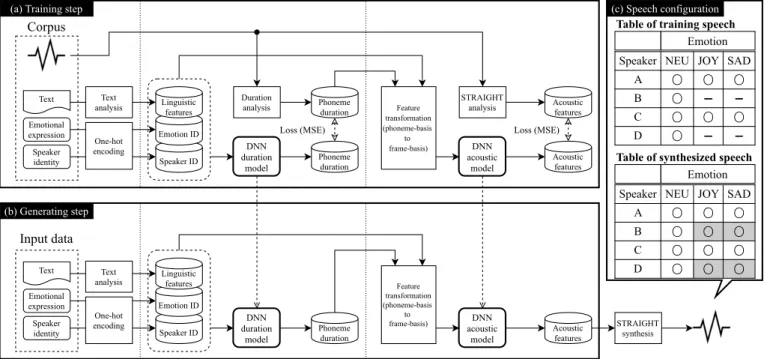
Figure 1: The proposed method of emotional speech synthesis in DNN-based TTS. In the table of training data, indicates data used for training, — indicates data not used for training. In the table of synthesized speech, indicates data that the system can synthesize, hatching boxes indicate the extrapolation conditions, normal boxes indicate the interpolation conditions.
that uses the i-th factor of an auxiliary vector v(`)a(i)as the weight. When the auxiliary vector v(`)a is a one-hot vector, the formula
is related to DNN by using multitask learning [20], which is a technique wherein a primary learning task is solved jointly with additional related tasks. In multitask learning DNN [3], the model has a shared hidden layer h(`−1) that can be considered the task-independent transformation. Additionally, the model has multiple output layers corresponding to each task.
In multi-speaker DNN [6] and emotional speech synthesis by speaker adaptation [13], the model of each speaker has its own output layer, that is, the first task is speaker A, the second task is speaker B.
3. Proposed method
3.1. Overview of the proposed method
Figure 1 presents the proposed DNN-based TTS that gener-ates emotional speech by combining the emotional factor and the speaker factor. In the training step presented in Fig. 1 (a), multi-speaker and multi-emotional speech data are used, where speakers and types of emotions are unbalanced. That is, many speakers utter only neutral speech and few speakers utter both neutral and emotional speech. To synthesize emotional speech with the voice quality of the speakers who only utter neutral speech, DNNs must have an architecture to separately train the emotional factor and the speaker factor by introducing the aux-iliary vectors. Details of the architecture are explained in 3.3. In Fig. 1 (a), a phoneme duration model and acoustic model are trained. Both models have the same DNN architecture but dif-ferent model parameters. In the speech synthesis step presented
in Fig. 1 (b), DNNs generate the target phoneme duration and the target acoustic features by setting speaker ID and emotion ID by using the auxiliary vectors. In Fig. 1 (c), because any combination of speaker ID and emotion ID is possible, we syn-thesize emotional speech with the voice quality of the speakers who only utter neutral speech.
3.2. Vector representation for controlling emotional expression and speaker identity
Two types of a vector called emotion ID and speaker ID are used as features to control the emotional expression and speaker identity. Several methods have been proposed to control speak-ers or emotions, for example, one-hot vector [8, 11], i-vector [7], d-vector [21], x-vector [22]. Because the one-hot vector is simple and intuitive, we adopt its features to control emotions and speakers.
The emotion ID E(i)for the i-th emotion is defined as E(i) =
h
e(i)1, e(i)2 , ..., e(i)Mi>, where each value e(i)m is expressed as follows:
e(i)m = 1m=i (7)
where M is the dimension of E(i)and equal to the number of emotions in the training data. Additionally, 1m=iis 1 if m = i
is true, and 0 otherwise. To represent the neutral emotion, the emotion ID is a zero vector.
In the same manner, the speaker ID S( j) for the j-th speaker
is defined as S( j) =hs( j)1 , s2( j), ..., s( j)Ni>, where each value s( j)n is
expressed as follows:
s( j)n = 1n= j (8)
where N is the dimension of S( j) and equal to the number of
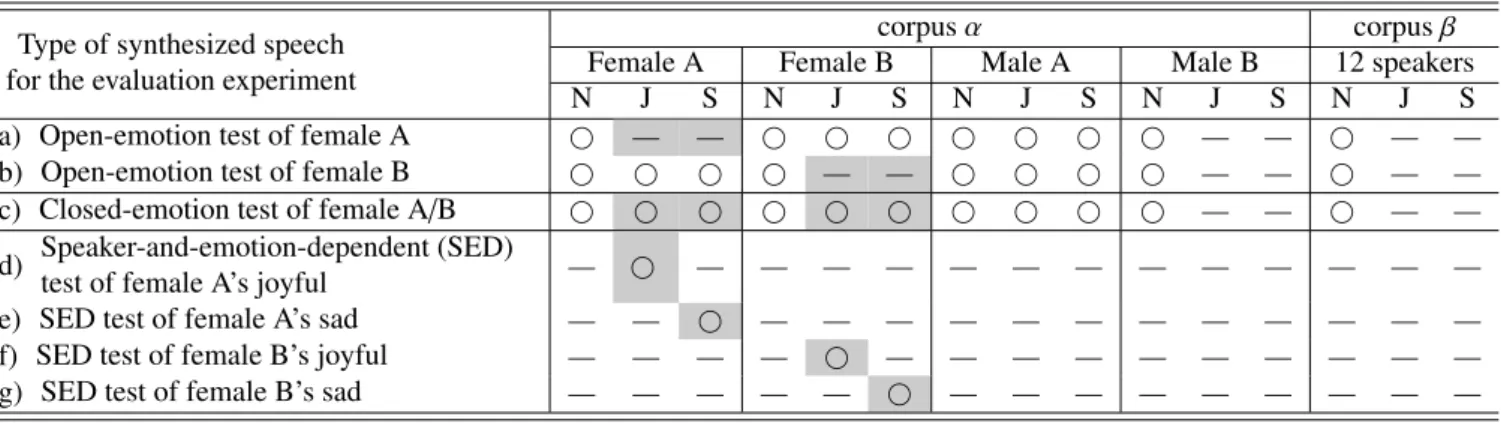
Table 1: Data configuration for training and evaluation. (In the model training, indicates that data was included, and — indicates that data was not included. In the evaluation, the hatching box indicates the synthesized speech used for the evaluation. N indicates neutral, J indicates joyful, and S indicates sad.)
Type of synthesized speech for the evaluation experiment
corpus α corpus β
Female A Female B Male A Male B 12 speakers
N J S N J S N J S N J S N J S
(a) Open-emotion test of female A — — — — — —
(b) Open-emotion test of female B — — — — — —
(c) Closed-emotion test of female A/B — — — —
(d) Speaker-and-emotion-dependent (SED)
test of female A’s joyful — — — — — — — — — — — — — —
(e) SED test of female A’s sad — — — — — — — — — — — — — —
(f) SED test of female B’s joyful — — — — — — — — — — — — — —
(g) SED test of female B’s sad — — — — — — — — — — — — — —
Acoustic features Linguistic features Weighted sum Emotional parts ( e1, …, eM) Speaker parts ( s1, …, sN) Shared part Emotion ID Speaker ID
Figure 2: The parallel model (PM)
3.3. Proposed model architecture
We propose five types of DNNs that can separately control the speaker factor and emotional factor.
3.3.1. Parallel model
In Fig. 2, a PM has an output layer comprised of emotion-dependent parts (Emotion 1, Emotion 2, ..., Emotion M), speaker-dependent parts (Speaker 1, Speaker 2, ..., Speaker N), and a shared part. The PM useshE(i)>S( j)>1i> as the auxil-iary vector v(`)a in the output layer ` = L at eq.5. The outputs
of the emotion-dependent part and speaker-dependent part are summed linearly, because the linear activation function is used at the output layer. The PM is newly proposed and is moti-vated by a multi-speaker DNN [6] and the emotion additive model [17], where hidden layers are regarded as a linguistic feature transformation shared by all speakers [23]. Because the acoustic feature is represented as the addition of the emotional-dependent part, and the speaker-emotional-dependent part, the emotional factor and speaker factor are separately controlled.
3.3.2. Serial model
In a SM, the speaker factor and emotional factor are sequen-tially modeled in different layers. The two types of architec-tures are: that the SMse, which models the speaker factor in the
former layer, and then models the emotional factor in the later layer: the other type of architecture is the SMes, which
mod-els the two factors in reverse order. The SMseuses
h
S( j)>1i> as the auxiliary vector v(`)a in the last hidden layer ` = L − 1
at eq.5, andhE(i)>1i> as the auxiliary vector v(`)a in the output
layer ` = L at eq.5. Opposite to SMse, SMesuses
h
E(i)>1i> in the last hidden layer, andhS( j)>1i>in the output layer. As with the PM, in the output layer, the output of the speaker-dependent part or emotion-dependent part is summed linearly. However, in the hidden layer, the output of the emotion-dependent part or speaker-dependent part is summed nonlinearly because the sigmoid activation function is used.
3.3.3. Auxiliary input model
An AIM implicitly models the speaker factor and emotional factor by forwarding the value of the auxiliary input vector. The AIM useshE(i)>S( j)>i>
in the auxiliary vector v(`)a of the input
layer `= 0 in eq.3. 3.3.4. Hybrid models
As hybrid models, two types of model are used, namely the combination of PM and AIM (PM&AIM), and the combination of SM and AIM (SM&AIM). The PM&AIM uses the auxiliary vector if the input layer `= 0 and the output layer ` = L. Also, the SM&AIM uses the auxiliary vector if the input layer `= 0, the last hidden layer `= L − 1 and the output layer ` = L.
4. Evaluation experiments
To evaluate the extrapolation performance of the proposed architectures, open-emotion tests and closed-emotion tests are conducted objectively and subjectively. Here, open-emotion and closed-emotion mean that, in the training step, the emo-tional speech of a target speaker is not included and is included, respectively.
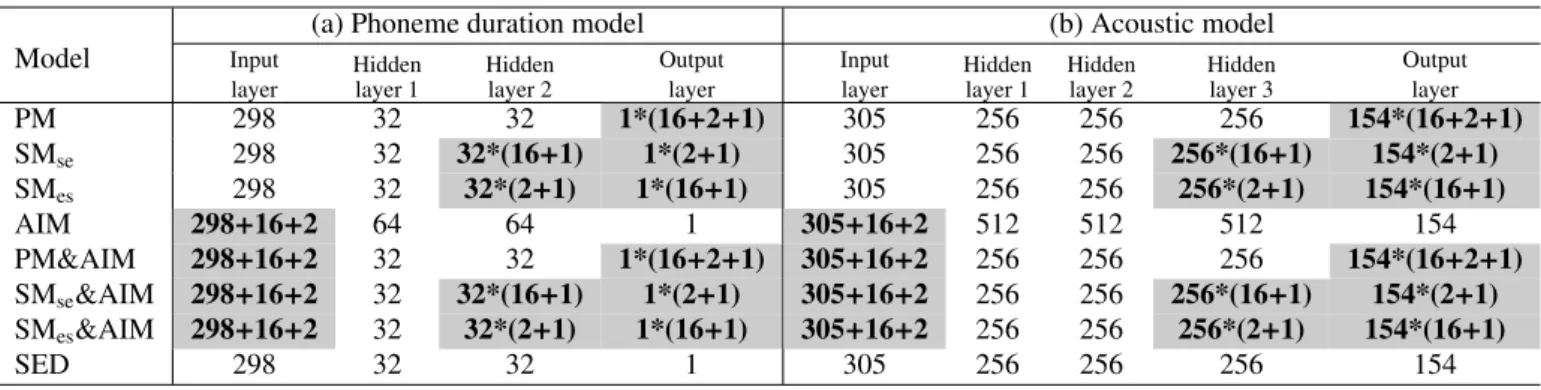
Table 2: The DNN architectures for the phoneme duration model and the acoustic model. (The hatching box indicates the expanded part of the simplest DNN.)
(a) Phoneme duration model (b) Acoustic model
Model Input layer Hidden layer 1 Hidden layer 2 Output layer Input layer Hidden layer 1 Hidden layer 2 Hidden layer 3 Output layer PM 298 32 32 1*(16+2+1) 305 256 256 256 154*(16+2+1) SMse 298 32 32*(16+1) 1*(2+1) 305 256 256 256*(16+1) 154*(2+1) SMes 298 32 32*(2+1) 1*(16+1) 305 256 256 256*(2+1) 154*(16+1) AIM 298+16+2 64 64 1 305+16+2 512 512 512 154 PM&AIM 298+16+2 32 32 1*(16+2+1) 305+16+2 256 256 256 154*(16+2+1) SMse&AIM 298+16+2 32 32*(16+1) 1*(2+1) 305+16+2 256 256 256*(16+1) 154*(2+1) SMes&AIM 298+16+2 32 32*(2+1) 1*(16+1) 305+16+2 256 256 256*(2+1) 154*(16+1) SED 298 32 32 1 305 256 256 256 154
4.1. Emotional speech database 4.1.1. Overview of speech database
In the experiments, two types of Japanese speech corpus, cor-pus α and β, were used. In corcor-pus α, the same 500 sentences were uttered in several ways. Two female speakers and a male speaker uttered the sentences with neutral, joyful, and sad tions; and a male speaker uttered them with only neutral emo-tion. Each dataset’s duration of each dataset was approximately 35 minutes, and the duration of the entire “corpus α” is approx-imately 350 minutes. In corpus β, the same 130 sentences that differed from corpus α, were uttered with only neutral emo-tion by six female and six male speakers. The duraemo-tion of each dataset was approximately 40 minutes, and the duration of the entire corpus β is approximately 480 minutes. The speech sig-nals were sampled at 22.05 kHz and quantized at 16 bits. The phoneme duration was manually annotated and labeled with the same format as the hidden Markov model toolkit (HTK) [24].
Speech data were divided into a training-set, validation-set, and test-set with a rate of 90%:5%:5%, that is, corpus α was divided into 450:25:25, and corpus β was divided into 120:5:5. 4.1.2. Training data combination and test data
Table 1 presents a summary of training and test data. A circle in the table indicates that 95% of the data (the training-set) is used for training, and a dash in the table indicates that speech is not included in the training. Hatching in the table indicates data used for the evaluation. A circle in the hatching box in-dicates that 5% of the data (the test-set) is used for evalua-tion. For the open-emotion test, DNN was trained using data (a) and (b) in Table 1. The synthesized speech is compared with the real emotional speech uttered by female speakers A and B. For the closed-emotion test, DNN is trained using data (c) in Table 1. The synthesized speech is compared with the real emotional speech uttered by female speakers A and B. As ref-erences, speaker-and-emotion-dependent models (SEDs) were trained using the training-set of (d), (e), (f), and (g), and evalu-ated using their test-sets.
4.2. Model training
The proposed models and SEDs are trained using the database described in 4.1. The STRAIGHT [25] analy-sis is used to extract the spectral envelop, aperiodicity, F0,
and voiced/unvoiced flag in a 5-ms frame shift. Next, 40-dimensional Mel-cepstral coefficients, 10-band-aperiodicities, and F0 in log-scale are calculated. Notably, 80% of the silent frames are removed from the training data to avoid increasing the proportion of silence in the training data and reduce the computational cost.
4.2.1. Phoneme duration model
For the PM, SM, and SED, the input feature vectors are 289-dimensional binary features of categorical linguistic con-texts (e.g., quinphone, the interrogative sentence flag), and 9-dimensional numerical linguistic contexts (e.g., the number of mora in the current word, the relative position toward the ac-cent nucleus in the current mora). For the AIM, PM&AIM, and SM&AIM, as auxiliary features, speaker and emotion IDs are added to the input feature vectors. Because the speaker ID is 16 dimensions and the emotion ID is 2 dimensions, the dimension of the input vector becomes 316.
The output feature is the integer scalar value that indicates the number of frames (i.e., phoneme duration). The output fea-tures of the training data are normalized to zero mean and unit variance.
As DNN model architectures, the FFNNs presented in Table 2 (a) are used. A sigmoid function is used in the hidden layers followed by a linear activation at the output layer. For the train-ing process, the weights of all DNN (PM, SM, AIM, PM&AIM, SM&AIM and SED) are randomly initialized. The weights are trained using a backpropagation procedure with a minibatch-based MomentumSGD to minimize the mean squared error be-tween the output features of the training data and the predicted values. The initial learning rate of MomentumSGD is 0.16 (PM, SM, PM&AIM, SM&AIM, and SED) or 0.08 (AIM), and the momentum is 0.9. The training data for the minibatch is ran-domly selected, and the minibatch size is 64 (PM, SM, AIM, PM&AIM, and SM&AIM) or 16 (SED). The schedule of the training is a similar method, to randomly select the data as con-ventional DNN. The hyper-parameters of each model were se-lected by a grid search that has a higher performance based on a smaller number of parameters.
4.2.2. Acoustic model
For the PM, SM, and SED, 7-dimensional time features (e.g., the total frame number of current mora, the current state in
5-JOY
SAD
Root mean squared error of phoneme duration [ms]
0 10 20 30 PM SMse SMes AIM PM&AIM SMse&AIM SMes&AIM PM SMse SMes AIM PM&AIM SMse&AIM SMes&AIM
Open-emotion test Closed-emotion test SED
Figure 3: Objective evaluation results of the RMSE of phoneme duration
state) are added to the feature vector used in the phoneme du-ration model. Thus, the dimension of the input feature vector is 305. The dimension of the input feature vectors for the AIM, PM&AIM, and SM&AIM, is 323 because both the speaker and emotion IDs are added as auxiliary features in the same manner as in the phoneme duration model.
The output feature vector contains log F0, 40 Mel-cepstral coefficients, 10-band-aperiodicities, their delta and delta-delta counterparts, and a voiced/unvoiced flag, which results in 154 dimensions. The voiced/unvoiced flag is a binary feature that indicates the voicing of the current frame. The output features of the training data are normalized to zero mean and unit vari-ance. In these experiments, phoneme durations extracted from natural speech are used.
As DNN model architectures, the FFNNs presented in Ta-ble 2 (b) were used. Activation function, loss function, op-timizer, and training schedules are the same condition as in Section 4.2.1. The initial learning rate of MomentumSGD is 1.28 (PM, SM, AIM, PM&AIM, SM&AIM, and SED), and the momentum is 0.9. The training data for the minibatch is ran-domly selected, and the minibatch size is 128 (PM, SM, AIM, PM&AIM, SM&AIM and SED). The hyper-parameters of each model are selected by using the same rule we used with the phoneme duration model.
4.3. Objective evaluation experiments
To make sure the advantages of the proposed architectures, objective evaluations were performed by comparing the esti-mated values using the models with extracted values from real emotional speech. Another aim of the experiments is to know the upper limit of interpolation by comparing the estimated val-ues of the open-emotion test with those of the closed-emotion test.
4.3.1. Objective evaluation of the phoneme duration model The phoneme duration models are evaluated by the root mean squared error (RMSE) of phoneme duration that is calculated between the phoneme duration extracted from real emotional speech and the phoneme duration generated by the phoneme duration model. 0 100 200 300 400 500 0 0.5 1 1.5 2 2.5 3
Target Mean of target
PM(closed) Mean of PM(closed)
SED Mean of SED
Time [s]
F0 [
Hz]
Model Corr. of logF0 RMSE of logF0
PM(closed) 0.81 287.96
SED 0.63 465.65
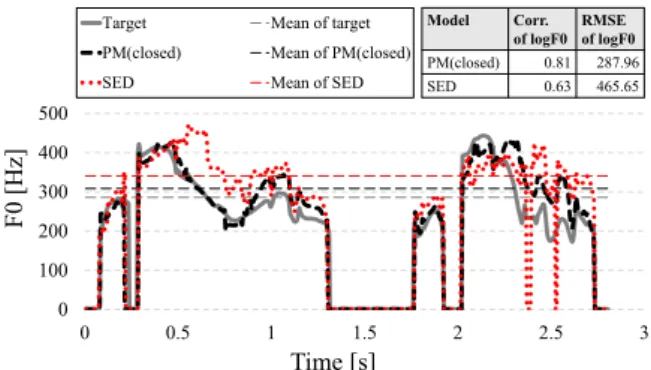
Figure 4: The comparison of F0 of female B’s joyful speech. The upper right table shows the values that are calculated using the shown F0 patterns.
Figure 3 presents the experimental results. Compared with the open-emotion test and the closed-emotion test, the di ffer-ence is less than 5 ms except for the joyful speech of SMseand
SMse&AIM. The differences are small and might not be
per-ceivable by hearing. Based on the results, for phoneme dura-tion modeling, the proposed model works well, and we do not collect emotional speech uttered by each speaker.
4.3.2. Objective evaluation of the acoustic model
The acoustic models are evaluated by the correlation coef-ficient of log F0, the RMSE of log F0, and the Mel-cepstral distortion (MCD). The objective measure is calculated between the parameters extracted from the real emotional speech and the parameters generated by the acoustic model. Figure 4 shows the F0 contours and the average F0 of joyful speech that is gen-erated by the SED and PM in the closed-emotion test as well as those extracted from the target speaker’s joyful speech. The upper right table indicates the correlation coefficient of log F0 and the RMSE of log F0 calculated from this single utterance. It is observed that the correlation coefficient of log F0 and the RMSE of log F0 are useful for evaluating whether the F0 con-tour and average F0 are similar to the target speech.
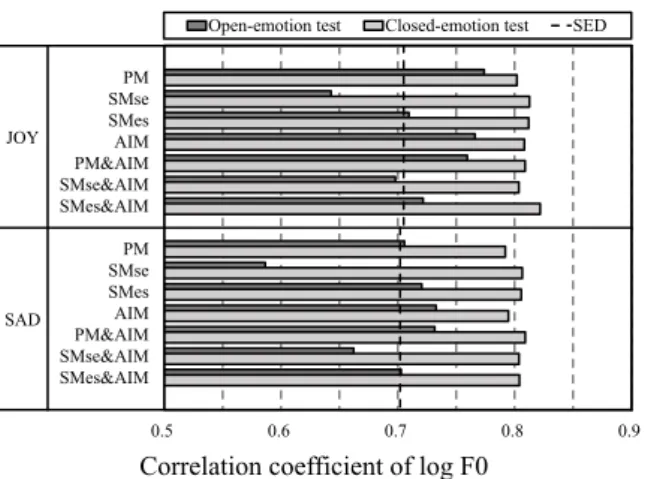
Figure 5 presents the results for the correlation coefficient of log F0. In closed-emotion test, the SED has poorer perfor-mance than the proposed models. The main reason for the re-sults is that the SED takes approximately 35 minutes of training data, while the proposed model takes approximately 760 min-utes. Moreover, corpus β contains different texts from corpus α, which results in increasing variations in phoneme contexts. This is another advantage of the proposed approach; i.e., we can effectively use speech data from many speakers. Interestingly, even in the open-emotion test, all the proposed models except the SMseand SMse&AIM have the same or better performance
compared with the SED. This is because the all speakers ut-tered the same text with several emotions. Because Japanese is a tonal language, F0 patterns are important to convey meanings. So speakers cannot drastically change the shape of F0 patterns, but can change only the height or length of F0 patterns to ex-press emotions. Therefore, the correlation coefficient of log F0 showed fairly good in open-emotion tests. The degradation of the coefficient is only 0.1 from the closed-emotion test.
JOY SAD 0.5 0.6 0.7 0.8 0.9 PM SMse SMes AIM PM&AIM SMse&AIM SMes&AIM PM SMse SMes AIM PM&AIM SMse&AIM SMes&AIM
Open-emotion test Closed-emotion test SED
Correlation coefficient of log F0
Figure 5: Objective evaluation results of the correlation coefficient of log F0
JOY SAD 0 100 200 300 400 500 600 PM SMse SMes AIM PM&AIM SMse&AIM SMes&AIM PM SMse SMes AIM PM&AIM SMse&AIM SMes&AIM
Open-emotion test Closed-emotion test SED
Root mean squared error of log F0 [cent] Figure 6: Objective evaluation results of the RMSE of log F0
contrast to the correlation coefficient of log F0, in the open-emotion test, all the proposed models have poorer performances than the SED. This mainly occurs because each speaker has their own means to control F0 contours to express emotion.
Figure 7 presents the results for the MCD. In the open-emotion test, all the proposed models again have poorer per-formances than the SED. This indicates that each speaker also changes their articulation in their own fashion to express emo-tion and the F0 contour.
In terms of the overall performance of the models, we can say that SMse and SMesare not promising, because their
per-formance showed different tendencies and is not predictable. This was shown in the correlation coefficient of log F0 and in the RMSE of log F0. As well as these simple SMs, hybrid SMs, namely SMse&AIM and SMes&AIM, are not promising
in overall performance. 4.4. Subjective evaluation test
According to the results of objective evaluations, emotional expressions highly depend on each speaker. However, emo-tional expression is useful even though the means of expression is not the same as thier own means. Therefore, subjective tests are conducted to examine to what extent emotional expressions are reproduced in the open-emotion test. Firstly, to confirm the
JOY SAD 4 5 6 7 PM SMse SMes AIM PM&AIM SMse&AIM SMes&AIM PM SMse SMes AIM PM&AIM SMse&AIM SMes&AIM
Open-emotion test Closed-emotion test SED
Mel-cepstral distortion [dB] Figure 7: Objective evaluation results of the MCD
basic performance, naturalness and speaker similarity are eval-uated by the mean opinion score (MOS). Then, emotion identi-fication tests are performed in the open-emotion test.
4.4.1. Experimental procedure of naturalness and speaker sim-ilarity
To evaluate the naturalness of synthesized speech, the MOS test was carried out. For the open-emotion test, stimuli are syn-thesized by the PM, SMse, SMes, AIM, PM&AIM, SMse&AIM,
and SMes&AIM. However, for the closed-emotion test, stimuli
are only synthesized by the PM and AIM, because the simple and hybrid SMs showed bad performance in the correlation co-efficient of log F0. As reference speech, the SED and a resyn-thesized speech by STRAIGHT (resyns) are employed. Forty-eight sentences (twelve sentences covering two emotions from two female speakers in corpus α of Table 1) were synthesized using each model. A five-point scale (1, very unnatural, to 5, very natural) was used for the MOS.
To evaluate speaker similarity, the MOS test was performed, where the quality of synthesized emotional speech was com-pared to target neutral speech (resyns). The models used in the experiment were the same as the naturalness test. Twenty-four sentences (six sentences covering two emotions from two fe-male speakers in corpus α of Table 1) were synthesized for each pair. A five-point scale (1, very dissimilar, to 5, very similar) was used for the MOS.
For both MOS tests, fifteen Japanese listeners participated. The order of presenting the stimuli was randomly selected, but the order was the same for all participants. In the speech synthe-sis, phoneme durations extracted from the neutral speech were used, and acoustic features were smoothed by maximum likeli-hood parameter generation (MLPG) [26]. The variance of these features was expanded to the global variance (GV) [27], ex-tracted from the target neutral speech, by using variance scaling [28].
4.4.2. Experimental results of naturalness and speaker similar-ity
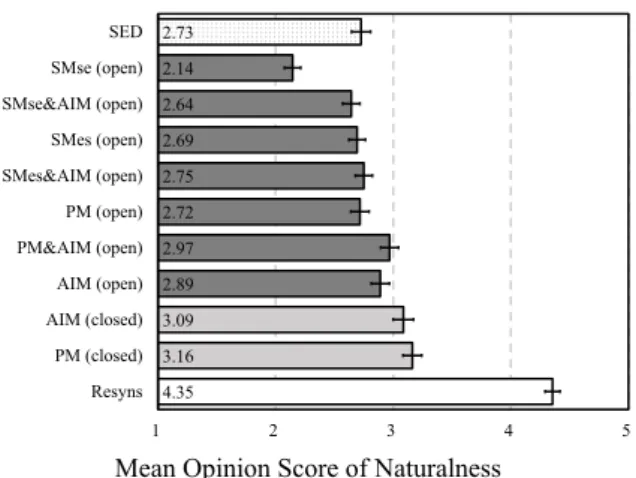
Figure 8 presents the results of the MOS test for naturalness. In the closed-emotion test, the PM and AIM show better natu-ralness than in the open-emotion test. However, the difference
2.73 2.14 2.64 2.69 2.75 2.72 2.97 2.89 3.09 3.16 4.35 1 2 3 4 5 SED SMse (open) SMse&AIM (open) SMes (open) SMes&AIM (open) PM (open) PM&AIM (open) AIM (open) AIM (closed) PM (closed) Resyns
Mean Opinion Score of Naturalness
Figure 8: MOS test of naturalness results with their 95% confidence interval.
2.48 2.18 2.53 2.99 3.09 2.59 2.62 2.84 2.56 2.62 3.06 1 2 3 4 5 SED SMse (open) SMse&AIM (open) SMes (open) SMes&AIM (open) PM (open) PM&AIM (open) AIM (open) AIM (closed) PM (closed) Resyns
Mean Opinion Score of Speaker Similarity
Figure 9: MOS test of speaker similarity results with their 95% confidence interval.
between closed- and open-emotion tests is smaller than the dif-ference between Resyns and closed-emotion tests. In the open-emotion test, the SMse&AIM indicates significantly better
per-formance than SMse. This result shows the AIM mechanism
helps to improve the performance of SMse. But this is not true
for the PM and SMes.
Figure 9 presents the results of the MOS test for speaker sim-ilarity. As shown in the figure, even the resynthesized voice achieves approximately 3 in opinion score. This indicates that even though emotional speech is uttered by the same speaker, the speaker identity of emotional speech is a little different from that of neutral speech. Because of this, in terms of speaker identity, there are small differences between closed- and open-emotion tests.
4.4.3. Experimental procedure of emotional expressions To evaluate the performance in extrapolating emotional ex-pressions, emotion identification tests were carried out in the open-emotion test. Fifteen Japanese listeners participated in the subjective test. For the presented synthesized speech, they were asked to select an emotion from four choices: neutral, sad, joy-ful, and others. As stimuli from the open-emotion test, the PM, SMes, AIM, PM&AIM, and SMes&AIM synthesized 120
sen-tences (five sensen-tences covering three emotions from four male
and four female speakers in corpus β of Table 1), the total num-ber of sentences was 600. As a reference stimuli from the closed-emotion test, the PM is selected. From informal listen-ing tests, the SM was worse, but there are no significant di ffer-ences between the AIM and PM. Besides, the PM has averaged performance for objective evaluations. The PM synthesized 30 sentences (five sentences covering three emotion from two fe-male speakers in corpus α of Table 1). The order of present-ing the stimuli was randomly selected, but the order was the same for all participants. The speech synthesis procedures are the same as 4.4.1. A chi-square test was used for evaluating whether the open-emotion test has a significant difference with the closed-emotion test in each correct emotion.
4.4.4. Experimental results of emotional expressions
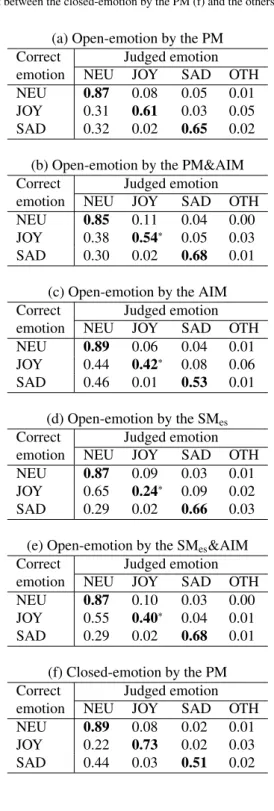
Table 3 presents the confusion matrices of participants’ choices and correct answers. A symbol (*) indicates p< 0.001 in a chi-square test between the closed-emotion by the PM (f) and the others (a, b, c, d, and e). For neutral, all models have a high correct rate (> 0.85). This finding is reasonable because neutral is the closed-emotion test in all models. For sad, lit-tle difference is observed between the closed-emotion test (Ta-ble 3 (f)) and open-emotion test (Ta(Ta-ble 3 (a), (b), (c), (d), and (e)). This mainly occurs because the differences in F0 and the cepstrum for sad are relatively small in Fig. 6 and Fig. 7, and easily trained from other speakers’ speech. Based on the results, we propose that sadness can be expressed by the pro-posed models (PM, SMes, AIM, PM&AIM, and SMes&AIM).
For joyful, however, only the PM demonstrates little difference in the closed-emotion test and open-emotion test. In Fig. 6 and Fig. 7, differences in F0 and the cepstrum for joyful are larger than those for sad. The results indicate that the PM can inde-pendently model the speaker factor and emotional factors even if large differences are observed in the acoustic parameters to express emotion. According to the results, we should select the PM from the proposed five models to synthesize emotional speech based on the extrapolation approach.
5. Conclusion and future work
In this paper, to generate emotional expressions using DNN-based TTS, we proposed the following five models: PM, SM, AIM, PM&AIM, and SM&AIM. These models are based on the following extrapolation approach: emotional expression mod-els are trained using speech uttered by a particular person, and the models are applied to another person for generating emo-tional speech with the person’s voice quality. In other words, the collection of emotional speech uttered by a target speaker is unnecessary, and emotional expression is generated using models trained by the emotional speech of another person. To evaluate the extrapolation performance of the proposed models, an open-emotion test and closed-emotion test were conducted objectively and subjectively. The objective evaluation results demonstrate that the performances in the open-emotion test are insufficient on the basis of a comparison to those in the closed-emotion test, because each speaker has their own manners of
expressing emotion. However, the subjective evaluation results indicate that the proposed models can convey emotional infor-mation to some extent, especially, the PM, which can correctly convey sad and joyful emotions at a rate of >60%. In con-clusion, the PM architecture works well to separately train the speaker and emotion factors for DNN-based TTS.
The proposed methods synthesize emotional speech possible without collecting emotional speech uttered by a target speaker. However, in evaluation experiments, each speaker has their own manners of expressing emotion. The solution to this problem is a topic for further research. First, the needs should be ex-amined, that is, in which situation speaker-specific emotional expressions are necessary and how precisely the emotional ex-pression should be reproduced. The other consideration is a trade-off between collecting emotional speech uttered by target speakers and the performance of the extrapolation approach. As mentioned in Section 1 (Introduction), it is difficult for individ-uals to utter speech with a specific emotion, and to continue speaking with that emotion for an extended time. Thus, no guar-antee can be given that models trained by collecting emotional speech uttered by target speakers always outperform the perfor-mance of the extrapolation approaches. The perforperfor-mance of the DNN-based extrapolation method will be clarified by compar-ing it with conventional extrapolation methods.
References
[1] Heiga Zen, Andrew Senior, and Mike Schuster, “Statistical parametric speech synthesis using deep neural networks,” in Proceedings of ICASSP, 2013, pp. 7962–7966.
[2] Yao Qian, Yuchen Fan, Wenping Hu, and Frank K Soong, “On the train-ing aspects of deep neural network (DNN) for parametric TTS synthesis,” in Proceedings of ICASSP, 2014, pp. 3829–3833.
[3] Zhizheng Wu, Cassia Valentini-Botinhao, Oliver Watts, and Simon King, “Deep neural networks employing multi-task learning and stacked bottle-neck features for speech synthesis,” in Proceedings of ICASSP, 2015, pp. 4460–4464.
[4] Oliver Watts, Gustav Eje Henter, Thomas Merritt, Zhizheng Wu, and Si-mon King, “From HMMs to DNNs: where do the improvements come from?,” in Proceedings of ICASSP, 2016, pp. 5505–5509.
[5] Yuchen Fan, Yao Qian, Feng-Long Xie, and Frank K Soong, “TTS syn-thesis with bidirectional LSTM based recurrent neural networks,” in Pro-ceedings of INTERSPEECH, 2014, pp. 1964–1968.
[6] Yuchen Fan, Yao Qian, Frank K Soong, and Lei He, “Multi-speaker mod-eling and speaker adaptation for DNN-based TTS synthesis,” in Proceed-ings of ICASSP, 2015, pp. 4475–4479.
[7] Zhizheng Wu, Pawel Swietojanski, Christophe Veaux, Steve Renals, and Simon King, “A study of speaker adaptation for DNN-based speech syn-thesis,” in Proceedings of INTERSPEECH, 2015, pp. 879–883. [8] Nobukatsu Hojo, Yusuke Ijima, and Hideyuki Mizuno, “DNN-based
speech synthesis using speaker codes,” IEICE TRANSACTIONS on In-formation and Systems, vol. 101, no. 2, pp. 462–472, 2018.
[9] Hieu-Thi Luong, Shinji Takaki, Gustav Eje Henter, and Junichi Yamag-ishi, “Adapting and controlling DNN-based speech synthesis using input codes,” in Proceedings of ICASSP, 2017, pp. 4905–4909.
[10] Bo Li and Heiga Zen, “Multi-language multi-speaker acoustic modeling for LSTM-RNN based statistical parametric speech synthesis,” in Pro-ceedings of INTERSPEECH, 2016, pp. 2468–2472.
[11] Shumin An, Zhenhua Ling, and Lirong Dai, “Emotional statistical para-metric speech synthesis using LSTM-RNNs,” in Proceedings of APSIPA ASC, 2017, pp. 1613–1616.
[12] Jaime Lorenzo-Trueba, Gustav Eje Henter, Shinji Takaki, Junichi Yam-agishi, Yosuke Morino, and Yuta Ochiai, “Investigating different repre-sentations for modeling and controlling multiple emotions in DNN-based speech synthesis,” Speech Communication, vol. 99, pp. 135–143, 2018.
[13] Hongwu Yang, Weizhao Zhang, and Pengpeng Zhi, “A DNN-based emo-tional speech synthesis by speaker adaptation,” in Proceedings of APSIPA ASC, 2018, pp. 633–637.
[14] Hiroki Kanagawa, Takashi Nose, and Takao Kobayashi, “Speaker-independent style conversion for HMM-based expressive speech synthe-sis,” in Proceedings of ICASSP, 2013, pp. 7864–7868.
[15] Jaime Lorenzo-Trueba, Roberto Barra-Chicote, Oliver Watts, and Juan Manuel Montero, “Towards speaking style transplantation in speech synthesis,” in 8th ISCA Speech Synthesis Workshop, 2013, pp. 159–163. [16] Junichi Yamagishi, Takao Kobayashi, Yuji Nakano, Katsumi Ogata, and
Juri Isogai, “Analysis of speaker adaptation algorithms for HMM-based speech synthesis and a constrained SMAPLR adaptation algorithm,” IEEE Transactions on Audio, Speech, and Language Processing, vol. 17, no. 1, pp. 66–83, 2009.
[17] Yamato Ohtani, Yu Nasu, Masahiro Morita, and Masami Akamine, “Emotional transplant in statistical speech synthesis based on emotion additive model,” in Proceedings of INTERSPEECH, 2015, pp. 274–278. [18] Katsuki Inoue, Sunao Hara, Masanobu Abe, Nobukatsu Hojo, and Yusuke
Ijima, “An investigation to transplant emotional expressions in DNN-based TTS synthesis,” in Proceedings of APSIPA ASC. IEEE, 2017, pp. 1253–1258.
[19] Najim Dehak, Patrick J. Kenny, R´eda Dehak, Pierre Dumouchel, and Pierre Ouellet, “Front-end factor analysis for speaker verification,” IEEE Transactions on Audio, Speech, and Language Processing, vol. 19, no. 4, pp. 788–798, 2010.
[20] Rich Caruana, “Multitask learning,” Machine learning, vol. 28, no. 1, pp. 41–75, 1997.
[21] Ehsan Variani, Xin Lei, Erik McDermott, Ignacio Lopez Moreno, and Javier Gonzalez-Dominguez, “Deep neural networks for small footprint text-dependent speaker verification,” in Proceedings of ICASSP, 2014, pp. 4052–4056.
[22] David Snyder, Daniel Garcia-Romero, Gregory Sell, Daniel Povey, and Sanjeev Khudanpur, “X-vectors: Robust DNN embeddings for speaker recognition,” in Proceedings of ICASSP, 2018, pp. 5329–5333. [23] Junichi Yamagishi, Masatsune Tamura, Takashi Masuko, Keiichi Tokuda,
and Takao Kobayashi, “A training method of average voice model for HMM-based speech synthesis,” IEICE TRANSACTIONS on Fundamen-tals of Electronics, Communications and Computer Sciences, vol. 86, no. 8, pp. 1956–1963, 2003.
[24] Steve Young, Gunnar Evermann, Mark Gales, Thomas Hain, Dan Ker-shaw, Xunying Liu, Gareth Moore, Julian Odell, Dave Ollason, Dan Povey, et al., “The htk book,” Cambridge university engineering de-partment, vol. 3, pp. 75, 2006.
[25] Hideki Kawahara, Ikuyo Masuda-Katsuse, and Alain De Cheveigne, “Re-structuring speech representations using a pitch-adaptive time-frequency smoothing and an instantaneous-frequency-based F0 extraction: Possible role of repetitive structure in sounds,” Speech Communication, vol. 27, no. 3, pp. 187–207, 1999.
[26] Keiichi Tokuda, Takayoshi Yoshimura, Takashi Masuko, Takao Kobayashi, and Tadashi Kitamura, “Speech parameter generation algo-rithms for HMM-based speech synthesis,” in Proceedings of ICASSP, 2000, pp. 1315–1318.
[27] Tomoki Toda and Keiichi Tokuda, “A speech parameter generation al-gorithm considering global variance for HMM-based speech synthesis,” IEICE TRANSACTIONS on Information and Systems, vol. 90, no. 5, pp. 816–824, 2007.
[28] Hanna Sil´en, Elina Helander, Jani Nurminen, and MoncefSil´en Gabbouj, “Ways to implement global variance in statistical speech synthesis,” in Proceedings of INTERSPEECH, 2012, pp. 1436–1439.
Table 3: Confusion matrices for subjective emotional classification results (Value indicates the accuracy of classification. * indicates p< 0.001 in a chi-square test between the closed-emotion by the PM (f) and the others (a, b, c, d, and e).)
(a) Open-emotion by the PM
Correct Judged emotion
emotion NEU JOY SAD OTH
NEU 0.87 0.08 0.05 0.01
JOY 0.31 0.61 0.03 0.05
SAD 0.32 0.02 0.65 0.02
(b) Open-emotion by the PM&AIM
Correct Judged emotion
emotion NEU JOY SAD OTH
NEU 0.85 0.11 0.04 0.00
JOY 0.38 0.54∗ 0.05 0.03
SAD 0.30 0.02 0.68 0.01
(c) Open-emotion by the AIM
Correct Judged emotion
emotion NEU JOY SAD OTH
NEU 0.89 0.06 0.04 0.01
JOY 0.44 0.42∗ 0.08 0.06
SAD 0.46 0.01 0.53 0.01
(d) Open-emotion by the SMes
Correct Judged emotion
emotion NEU JOY SAD OTH
NEU 0.87 0.09 0.03 0.01
JOY 0.65 0.24∗ 0.09 0.02
SAD 0.29 0.02 0.66 0.03
(e) Open-emotion by the SMes&AIM
Correct Judged emotion
emotion NEU JOY SAD OTH
NEU 0.87 0.10 0.03 0.00
JOY 0.55 0.40∗ 0.04 0.01
SAD 0.29 0.02 0.68 0.01
(f) Closed-emotion by the PM
Correct Judged emotion
emotion NEU JOY SAD OTH
NEU 0.89 0.08 0.02 0.01
JOY 0.22 0.73 0.02 0.03